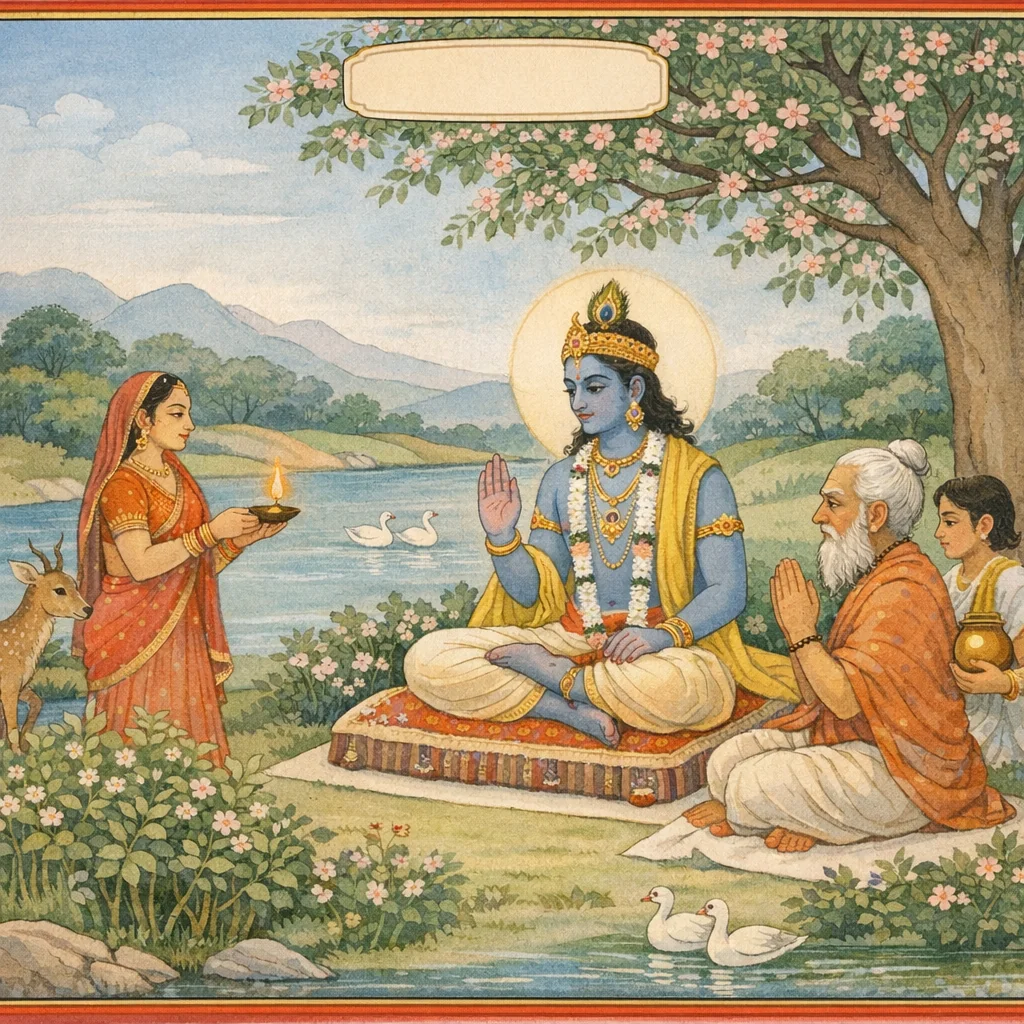
Adhyaya 119
The Kāmodā Episode: Ocean-Churning Maiden, Tulasī Identity, and the Merit of Proper Flower-Offerings
The chapter begins by praising a wondrous source of divine flowers born from Kāmodā’s joy and laughter, teaching that Śaṅkara (Śiva) is swiftly pleased when worship is offered with gladness and fragrant offerings. Asked about the flower’s special power and Kāmodā’s true identity, Kuṁjala recounts the churning of the ocean, from which four maiden-treasures arise—Sulakṣmī, Vāruṇī, Jyeṣṭhā, and Kāmodā. Linked with vāruṇī/foam and the waves of amṛta, Kāmodā is foretold to become Tulasī, eternally dear to Viṣṇu; even a single tulasī leaf offered to Kṛṣṇa is extolled. The narrative then warns that worship with scentless or improper flowers brings sorrow. A new episode follows: Kṛṣṇa sends Nārada to delude the sinful Vihuṇḍa, who seeks Kāmodā’s flowers to win a woman. Nārada redirects him to flowers borne by the Gaṅgā, and then proceeds toward Kāmodā, pondering how to still her tears.
Shlokas
Verse 1
एकोनविंशत्यधिकशततमोऽध्यायः । कपिंजल उवाच । यस्याः प्रहसनात्तात सुहृद्यानि भवंति वै । पुष्पाणि दिव्यगंधीनि दुर्लभानि सुरासुरैः
Kapiñjala said: “Dear one, by whose laughter there come into being delightful flowers of divine fragrance—flowers that are hard to obtain even for gods and demons.”
Verse 2
कस्मात्तु देवताः सर्वाः प्रवांछंति महामते । शंकरः सुखमायाति हास्यपुष्पैः सुपूजितः
O great-minded one, why indeed do all the gods long for this? Properly worshipped with flowers offered in joy and laughter, Śaṅkara comes readily and graciously.
Verse 3
को गुणस्तस्य पुष्पस्य तन्मे कथय विस्तरात् । कामोदा सा भवेत्का तु कस्य पुत्री वरांगना
“What is the virtue, the special quality, of that flower? Tell me of it in full detail. And who is the beautiful woman called Kāmodā—whose daughter is she?”
Verse 4
हास्यात्तस्या महाभाग सुपुष्पाणि भवंति च । को गुणस्तत्कथां ब्रूहि सकलां विस्तरेण च
O noble one, from her smile even the finest flowers come into being. What virtue lies behind this? Tell me her whole story, in full detail.
Verse 5
कुंजल उवाच । पुरा देवैर्महादैत्यैः कृत्वा सौहार्दमुत्तमम् । ममंथुः सागरं क्षीरममृतार्थं समुद्यताः
Kuṁjala said: Long ago, the Devas and the mighty Dānavas, having forged an excellent pact of friendship, set about churning the Milk-Ocean to obtain amṛta, the nectar of immortality.
Verse 6
मथनाद्देवदैत्यानां कन्यारत्नचतुष्टयम् । वरुणेन दर्शितं पूर्वं सोमेनैव तथा पुनः
From the churning performed by the Devas and Daityas arose a fourfold treasure of maiden-gems; it was first revealed by Varuṇa, and again likewise by Soma.
Verse 7
पश्चात्संदर्शितं पुण्यममृतं कलशे स्थितम् । कन्या चतुष्टयं पूर्वं देवानां हितमिच्छति
Afterwards, the holy amṛta—set within a pitcher—was shown; and earlier, the company of four maidens desired the welfare of the Devas.
Verse 8
सुलक्ष्मीर्नाम सा चैका द्वितीया वारुणी तथा । ज्येष्ठा नाम तथा ख्याता कामोदान्या प्रचक्षते
One among them is named Sulakṣmī; the second is likewise called Vāruṇī. Another is famed as Jyeṣṭhā, and yet another is spoken of as Kāmodā.
Verse 9
तासां मध्ये वरा श्रेष्ठा पूर्वं जाता महामते । तस्माज्ज्येष्ठेति विख्याता लोके पूज्या सदैव हि
Among them, O great-minded one, the best and most excellent was born first; therefore she is renowned as “Jyeṣṭhā” and is ever worthy of worship in the world.
Verse 10
वारुणीपानरूपा च पयःफेनसमुद्भवा । अमृतस्य तरंगाच्च कामोदाख्या बभूव ह
Taking the form of Vāruṇī, the intoxicating drink, born from the foam of milk, and from the waves of amṛta, she indeed came to be known as Kāmodā.
Verse 11
सोमो राजा तथा लक्ष्मीर्जज्ञाते अमृतादपि । त्रैलोक्यभूषणः सोमः संजातः शंकरप्रियः
King Soma and Lakṣmī, too, were born from the nectar. Soma—an ornament of the three worlds—came into being, beloved of Śaṅkara.
Verse 12
मृत्युरोगहरा जाता सुराणां वारुणी तथा । ज्येष्ठासु पुण्यदा जाता लोकानां हितमिच्छताम्
Vāruṇī came into being for the devas as a remover of death and disease; and among the eldest, Jyeṣṭhā arose as a bestower of merit for those people who seek the welfare of the world.
Verse 13
अमृतादुत्थिता देवी कामोदा नाम पुण्यदा । विष्णोः प्रीत्यै भविष्ये तु वृक्षरूपं प्रयास्यति
From the nectar arose the goddess named Kāmodā, bestower of merit; and in time to come, for the delight of Viṣṇu, she will assume the form of a tree.
Verse 14
विष्णुप्रीतिकरी सा तु भविष्यति सदैव हि । तुलसी नाम सा पुण्या भविष्यति न संशयः
Indeed, she will ever be one who pleases Viṣṇu. She will become the holy one named Tulasī—of this there is no doubt.
Verse 15
तया सह जगन्नाथो रमिष्यति न संशयः । तुलस्याः पत्रमेकं यो नीत्वा कृष्णाय दास्यति
With her, Jagannātha will surely delight—there is no doubt. Whoever brings even a single leaf of Tulasī and offers it to Kṛṣṇa attains His favor.
Verse 16
मेने तस्योपकाराणां किमस्मै च ददाम्यहम् । इत्येवं चिंतयेन्नित्यं तस्य प्रीतिकरो भवेत्
One should keep thinking: “I have considered his helpful deeds—what, then, can I give him in return?” Thinking in this way each day, one becomes a cause of his joy.
Verse 17
एवं कामोद नामासौ पूर्वं जाता समुद्रजा । यदा सा हसते देवी हर्षगद्गदभाषिणी
Thus, she—named Kāmodā—was formerly born from the ocean. Whenever that goddess laughs, her speech falters, choked with joy.
Verse 18
सौहृद्यानि सुगंधीनि मुखात्तस्याः पतंति वै । अम्लानानि सुपुष्पाणि यो गृह्णाति समुद्यतः
From her mouth indeed fall forth fragrant tokens of goodwill—unwithered, beautiful flowers—which an eager devotee receives.
Verse 19
पूजयेच्छंकरं देवं ब्रह्माणं माधवं तथा । तस्य देवाः प्रतुष्यंति यदिच्छति ददंति तत्
One should worship Lord Śaṅkara, Brahmā, and Mādhava as well; when they are pleased, the gods grant whatever one desires.
Verse 20
रोदित्येषा यदा सा च केन दुःखेन दुःखिता । नेत्राश्रुभ्यो हि तस्यास्तु प्रभवंति पतंति च
Whenever she weeps, afflicted by some sorrow, tears indeed arise from her eyes and fall down.
Verse 21
तानि चैव महाभाग हृद्यानि सुमहांति च । सौरभेण विना तैस्तु यः पूजयति शंकरम्
And those offerings, O greatly fortunate one, are indeed pleasing and very excellent. But whoever worships Śaṅkara with them devoid of fragrance (proper scent) …
Verse 22
तस्य दुःखं च संतापो जायते नात्र संशयः । पुष्पैस्तु तादृशैर्देवान्सकृदर्चति पापधीः
For him, sorrow and burning anguish arise—of this there is no doubt. A sinful-minded person worships the gods even once with such (improper) flowers.
Verse 23
तस्य दुःखं प्रकुर्वंति देवास्तत्र न संशयः । एतत्ते सर्वमाख्यातं कामोदाख्यानमुत्तमम्
Indeed, the gods bring about his suffering—of this there is no doubt. Thus I have told you everything: the excellent narrative known as the Kāmoda episode.
Verse 24
अथ कृष्णो विचिंत्यैव दृष्ट्वा विक्रमसाहसम् । विहुंडस्यापि पापस्य उद्यमं साहसं तदा
Then Kṛṣṇa, reflecting for a moment, beheld the bold valor and daring enterprise that the sinful Vihuṇḍa had undertaken at that time.
Verse 25
नारदं प्रेषयामास मोहयैनं दुरासदम् । नारदस्त्वथ संश्रुत्य वाक्यं विष्णोर्महात्मनः
He dispatched Nārada to delude that formidable, hard-to-approach one. Then Nārada, having heard the words of great-souled Viṣṇu, set out accordingly.
Verse 26
गच्छमानं दुरात्मानं कामोदां प्रति दानवम् । गत्वा तमाह दैत्येंद्रं नारदः प्रहसन्निव
As that wicked-souled Dānava was setting out toward Kāmodā, Nārada went up to him and addressed that lord of the Daityas, as if smiling.
Verse 27
क्व यासि त्वं च दैत्येंद्र सत्वरं च समातुरः । सांप्रतं केन कार्येण कस्यार्थं केन नोदितः
Where are you going, O lord of the Daityas, in such haste and seeming agitation? Right now, for what task are you going—on whose behalf, and urged by whom?
Verse 28
ब्रह्मात्मजं नमस्कृत्य प्रत्युवाच कृतांजलि । कामोदपुष्पार्थमहं प्रस्थितो द्विजसत्तम
Having bowed to Brahmā’s son, he replied with folded hands: “O best of the twice-born, I have set out in search of the flowers of Kāmoda.”
Verse 29
तमुवाच स धर्मात्मा पुष्पैः किं ते प्रयोजनम् । विप्रवर्यं पुनः प्राह कार्यकारणमात्मनः
That righteous-souled one said to him, “What purpose do you have with flowers?” Then, addressing the best of brāhmaṇas again, he explained his own reason and intention for the act.
Verse 30
नंदनस्य वनोद्देशे काचिन्नारी वरानना । तस्या दर्शनमात्रेण गतोऽहं कामवश्यताम्
In a part of Nandana’s forest, there was a certain woman with a beautiful face. By merely seeing her, I fell under the sway of desire.
Verse 31
तया प्रोक्तोऽस्मि विप्रेंद्र पुष्पैः कामोदसंभवैः । पूजयस्व महादेवं पुष्पैस्तु सप्तकोटिभिः
O best of Brahmins, I was instructed by her: “Worship Mahādeva with flowers born of Kāmoda—indeed, with seven crores of flowers.”
Verse 32
ततस्ते सुप्रिया भार्या भविष्यामि न संशयः । तदर्थे प्रस्थितोऽस्म्यद्य कामोदाख्यं पुरं प्रति
Then I shall become your most beloved wife—of this there is no doubt. For that purpose, I am setting out today toward the city called Kāmoda.
Verse 33
तामहं कामयिष्यामि सिंधुजां शुणु सांप्रतम् । मनोल्लासैर्महाहासैर्हासयिष्याम्यहं पुनः
Listen now: I desire the maiden born of the Sindhu. Again, with the delights of the mind and with great laughter, I shall make her laugh once more.
Verse 34
प्रीता सती महाभागा हसिष्यति पुनः पुनः । तद्धास्यं गद्गदं विप्र मम कार्यप्रवर्द्धनम्
That virtuous and greatly fortunate lady, pleased at heart, will laugh again and again. O brāhmaṇa, her laughter—trembling and choked with emotion—will advance my purpose.
Verse 35
तस्माद्धास्यात्पतिष्यंति दिव्यानि कुसुमानि च । तैस्तु देवमुमाकांतं पूजयिष्यामि सांप्रतम्
Therefore, from that laughter, divine flowers will fall; and with those I shall now worship the Lord, Umā’s beloved.
Verse 36
तेन पूजाप्रदानेन तुष्टो दास्यति मे फलम् । ईश्वरः सर्वभूतेशः शंकरो लोकभावनः
Pleased by that offering of worship, the Lord will grant me its fruit. He is Śaṅkara, sovereign of all beings and benefactor of the worlds.
Verse 37
नारद उवाच । तत्र दैत्य न गंतव्यं कामोदाख्ये पुरोत्तमे । विष्णुरस्ति सुमेधावी सर्वदैत्यक्षयावहः
Nārada said: “O Daitya, you should not go there—to that excellent city called Kāmodā—for Viṣṇu, the supremely wise, dwells there, bringing about the destruction of all daityas.”
Verse 38
येनोपायेन पुष्पाणि कामोदाख्यानि दानव । तव हस्ते प्रयास्यंति तमुपायं वदाम्यहम्
O Dānava, I shall tell you the means by which the flowers called ‘Kāmoda’ will come into your hand.
Verse 39
गंगातोयेषु दिव्यानि पतिष्यंति न संशयः । वाहितानि जलैर्दिव्यैरागमिष्यंति सांप्रतम्
There is no doubt that the divine offerings will fall into the waters of the Gaṅgā; borne along by those sacred waters, they will now arrive here.
Verse 40
तानि त्वं तु प्रतिगृहाण सुहृद्यानि महांति च । गृहीत्वा तानि पुष्पाणि साधयस्व मनीप्सितम्
Therefore accept those great gifts, pleasing to the heart. Having taken those flowers, accomplish what you desire.
Verse 41
नारदो दानवश्रेष्ठं मोहयित्वा ततः पुनः । ततश्च स तु धर्मात्मा चिंतयामास वै पुनः
After deluding the foremost of the Dānavas, Nārada withdrew again; and then that righteous-souled one reflected once more.
Verse 42
कथमश्रूणि सा मुंचेत्केनोपायेन दुःखिता । चिंतयानस्य तस्यैवं क्षणं वै नारदस्य च
“How may that sorrow-stricken woman cease her tears—by what means?” Thus thinking, Nārada remained silent for a moment.
Verse 43
ततो बुद्धिः समुत्पन्ना कामोदाख्यं पुरं गतः
Then understanding arose within him, and he went to the city called Kāmoda.
Verse 119
इति श्रीपद्मपुराणे भूमिखंडे वेनोपाख्याने गुरुतीर्थमाहात्म्ये च्यवनचरित्रे कामोदाख्याने एकोनविंशत्यधिकशततमोऽध्यायः
Thus ends the one-hundred-and-nineteenth chapter of the Śrī Padma Purāṇa, in the Bhūmi-khaṇḍa—within the narrative of Vena, in the glorification of Guru-tīrtha, in the account of Cyavana, and in the episode called “Kāmodā.”