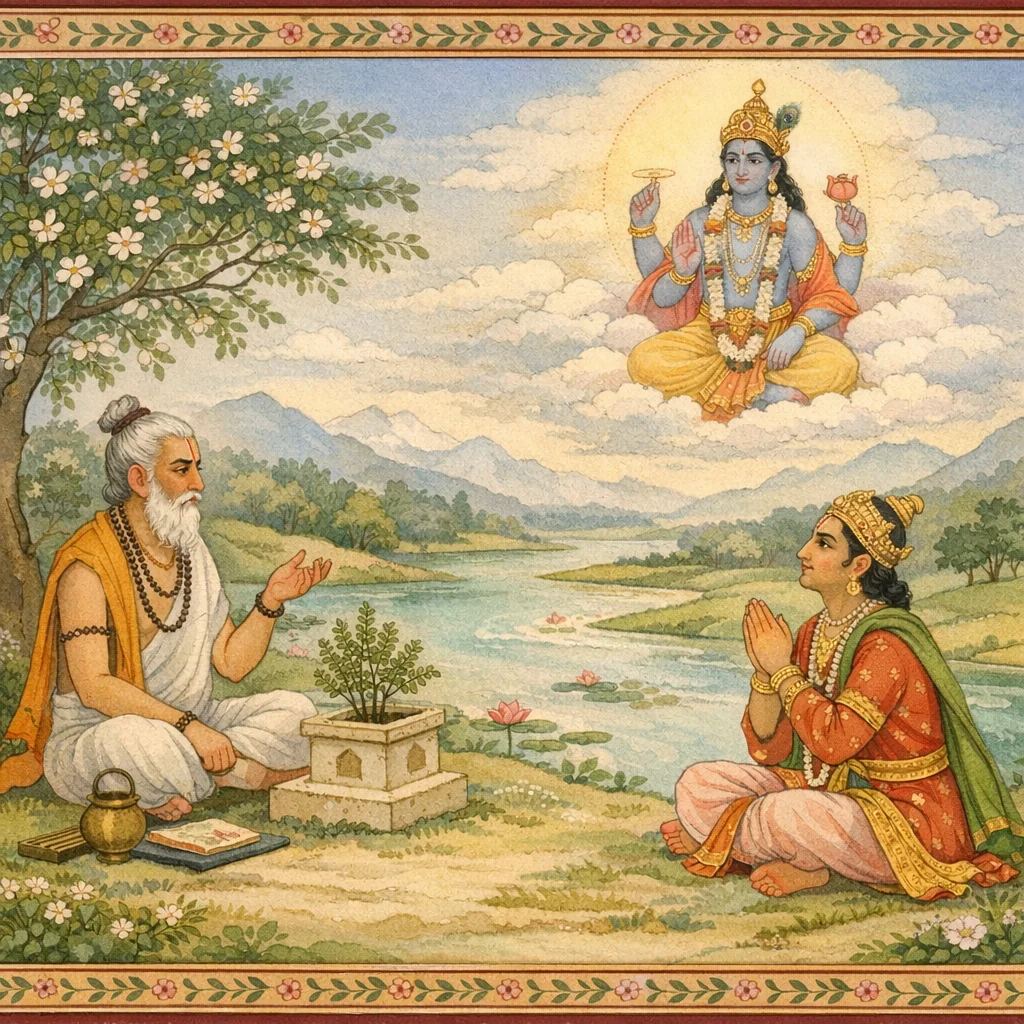
Adhyaya 46
The Vena Episode and the Sukalā Narrative: The Speaking Sow, Pulastya’s Curse, and Indra’s Appeal
The chapter opens with compassion for a fallen sow devoted to her young. Astonishingly, she speaks refined Sanskrit, and the king with his beloved Sudevā asks who she is and what karmic history has brought her to such a state. Śūkarī unfolds a layered account: the master-singer Vidyādhara (Raṅgavidyādhara) meets the sage Pulastya on Mount Meru, and a dispute arises over the power of song versus ascetic concentration, tapas, and restraint of the senses. When the singer, taking boar-form, harasses the meditating brāhmaṇa, Pulastya curses him to enter a sow’s womb. The cursed one appeals to Indra, and Śakra approaches Pulastya as mediator seeking release. Pulastya grants conditional forgiveness in accord with Indra’s plea, foretelling a Manu-line king, Ikṣvāku, as part of the karmic resolution. The chapter then turns toward Śūkarī’s own confession of former wrongdoing, extending the teaching of moral causality across rebirth.
Shlokas
Verse 1
षट्चत्वारिंशोऽध्यायः । सुकलोवाच । श्वसंतीं शूकरीं दृष्ट्वा पतितां पुत्रवत्सलाम् । सुदेवावकृपयाविष्टा गत्वा तां दुःखितां प्रति
Sukala said: Seeing the sow Śvasaṃtī fallen down—she who was devoted to her young—Sudevā, overcome with compassion, went toward that grieving one.
Verse 2
अभिषिच्य मुखं तस्याः शीतलेनोदकेन च । पुनः सर्वांगमेवापि दुःखितां रणशालिनीम्
Having sprinkled her face with cool water, he again sprinkled her whole body as well—she, battle-hardened, was now afflicted with pain.
Verse 3
पुण्येन शीततोयेन सा उवाचाभिषिंचतीम् । उवाच मानुषीं वाचं सुस्वरं नृपतिप्रियाम्
As she sprinkled him with blessed, cool water, she spoke—uttering human words in a sweet voice, pleasing to the king.
Verse 4
सुखं भवतु ते देवि अभिषिक्ता त्वया यदि । संपर्काद्दर्शनात्तेद्य गतो मे पापसंचयः
May happiness be yours, O Goddess. If I have been consecrated and purified by you, then by your touch and by seeing you today, my accumulated store of sins has departed.
Verse 5
तदाकर्ण्य महद्वाक्यमद्भुताकारसंयुतम् । चित्रमेतन्मया दृष्टं कृतं तेऽनामयं वचः
Having heard that great statement, endowed with wondrous import, he said: “This is astonishing—I have witnessed it. I have spoken to you words free from harm, conducive to well-being.”
Verse 6
पशुजातिमतीचेयं सौष्ठवं भाषते स्फुटम् । स्वरव्यंजनसंपन्नं संस्कृतमुत्तमं मम
This creature—though of an animal kind—speaks clearly and with refinement, uttering my excellent Sanskrit, complete with vowels and consonants.
Verse 7
हर्षेण विस्मयेनापि कृत्वा साहसमुत्तमम् । तत्रस्था सा महाभागा तं पतिं वाक्यमब्रवीत्
Filled with joy and wonder, having performed a most extraordinary daring act, that noble lady, standing there, spoke these words to her husband.
Verse 8
पश्य राजन्नपूर्वेयं संस्कृतं भाषते महत् । पशुयोनिगता चेयं यथा वै मानुषो वदेत्
Behold, O King—this is unprecedented: though born in an animal womb, she speaks refined Sanskrit clearly, just as a human would speak.
Verse 9
तदाकर्ण्य ततो राजा सर्वज्ञानवतां वरः । अद्भुतमद्भुताकारं यन्न दृष्टं श्रुतं मया
Hearing that, the king—foremost among the wise—said: “This is wondrous, of an astonishing form, such as I have never seen or even heard of.”
Verse 10
तामुवाच ततो राजा सुदेवां सुप्रियां तदा । पृच्छ चैनां शुभां कांते का चेयं तु भविष्यति
Then the king spoke to Sudevā, his beloved: “O fair one, my dear, ask this auspicious lady—who is she, and what is to become of her?”
Verse 11
श्रुत्वा तु नृपतेर्वाक्यं सा पप्रच्छ च सूकरीम् । का भविष्यसि त्वं भद्रे चित्रं ते दृश्यते बहु
Hearing the king’s words, she then questioned the sow: “O good lady, what will you become? Much that is strange is seen in you.”
Verse 12
पशुयोनिगता त्वं वै भाषसे मानुषं वचः । सौष्ठवं ज्ञानसंपन्नं वद मे पूर्वचेष्टितम्
Though you have entered an animal womb, you speak human speech—well-formed and filled with understanding. Tell me of your former deeds.
Verse 13
भर्तुश्चापि महाराज भटस्यास्य महात्मनः । कोयं धर्मो महावीर्यो गतः स्वर्गं पराक्रमैः
And also, O great king, regarding the husband of this noble warrior—what was the dharma by which that mighty hero, through his valor, attained heaven?
Verse 14
आत्मनश्च स्वभर्तुश्च सर्वं पूर्वानुगं वद । एवमुक्त्वा महाभागा विरराम नृपप्रिया
“Tell in full everything that happened earlier—both about yourself and about your own husband.” Having spoken thus, that noble lady, dear to the king, fell silent.
Verse 15
शूकर्युवाच । यदि पृच्छसि मां भद्रे ममास्य च महात्मनः । तत्सर्वं ते प्रवक्ष्यामि चरितं पूर्वचेष्टितम्
Śūkarī said: If you ask me, O auspicious lady, about me and about this great-souled one, then I shall tell you all of it—his story and his former deeds.
Verse 16
अयमेष महाप्राज्ञो गंधर्वो गीतपंडितः । रंगविद्याधरो नाम सर्वशास्त्रार्थकोविदः
This very one is a greatly wise Gandharva, a master of song—named Raṅgavidyādhara—skilled in the meanings and purport of all the śāstras.
Verse 17
मेरुं गिरिवरश्रेष्ठं चारुकंदरनिर्झरम् । तमाश्रित्य महातेजाः पुलस्त्यो मुनिसत्तमः
Taking refuge on Meru—the finest of mountains, adorned with lovely caves and cascading streams—the supremely radiant sage Pulastya, best among seers, abode there.
Verse 18
तपश्चचार तेजस्वी निर्व्यलीकेन चेतसा । विद्याधरस्तत्र गतः स्वेच्छया स महाप्रभो
O mighty lord, the radiant one performed austerities with a mind free from deceit; and a Vidyādhara came there of his own accord.
Verse 19
तमाश्रित्य गिरिश्रेष्ठं गीतमभ्यसते तदा । स्वरतालसमोपेतं सुस्वरं चारुहासिनि
Then, taking refuge with that foremost of mountains, she practiced singing—endowed with proper notes and rhythm, sweet-voiced, O beautifully smiling one.
Verse 20
गीतं श्रुत्वा मुनिस्तस्य ध्यानाच्चलितमानसः । गायंतं तमुवाचेदं गीतविद्याधरं प्रति
Hearing his song, the sage—his mind drawn away from meditation—addressed that Vidyādhara, skilled in the art of music, as he continued singing.
Verse 21
भवद्गीतेन दिव्येन देवा मुह्यंति नान्यथा । सुस्वरेण सुपुण्येन तालमानेन पंडित
By your divine singing, even the gods are enchanted—never otherwise. O learned one, you sing with a beautiful voice, rich in merit, and in perfect rhythm and measure.
Verse 22
लययुक्तेन भावेन मूर्च्छना सहितेन च । मे मनश्चलितं ध्यानाद्गीतेनानेन सुव्रत
With rhythm-filled feeling and accompanied by melodic modes, this song has stirred my mind and drawn it away from meditation, O you of excellent vows.
Verse 23
इदं स्थानं परित्यज्य अन्यस्थानं व्रजस्व तत् । गीतविद्याधर उवाच । आत्मज्ञानसमं गीतमन्यस्थानं व्रजामि किम्
“Leave this place and go elsewhere.” Gīta-vidyādhara replied: “If this song is equal to self-knowledge, why should I go to any other place?”
Verse 24
दुःखं ददे न कस्यापि सुखदो नृषु सर्वदा । गीतेनानेन दिव्येन सर्वास्तुष्यंति देवताः
Let him cause sorrow to none; among people let him always be a giver of happiness. By this divine hymn, all the deities are pleased.
Verse 25
शंभुश्चापि समानीतो गीतध्वनिरतो द्विज । गीतं सर्वरसं प्रोक्तं गीतमानंददायकम्
O brāhmaṇa, Śambhu too was summoned, absorbed in the sound of song. Song is declared to embody every rasa, and music bestows joy (ānanda).
Verse 26
शृंगाराद्यारसाः सर्वे गीतेनापि प्रतिष्ठिताः । शोभामायांति गीतेन वेदाश्चत्वार उत्तमाः
All rasas—beginning with śṛṅgāra—are established through song as well. Through song, even the four excellent Vedas attain splendor.
Verse 27
गीतेन देवताः सर्वास्तोषमायांति नान्यथा । तदेवं निन्दसे गीतं मामेवं परिचालयेः
By sacred singing, all the deities are pleased—by no other means. Yet you disparage song in this way; do not treat me like this.
Verse 28
अन्यायोऽयं महाभाग तवैव इह दृश्यते । पुलस्त्य उवाच । सत्यमुक्तं त्वयाद्यैव गीतार्थं बहुपुण्यदम्
“This is unjust, O noble one; it is seen here as belonging to you alone.” Pulastya said: “What you have said just now is indeed true; the meaning you have expressed about song is greatly meritorious.”
Verse 29
शृणु त्वं मामकं वाक्यं मानं त्यज महामते । नाहं गीतं प्रकुत्सामि गीतं वंदामि नान्यथा
Listen to my words, O great-minded one; abandon pride. I do not disparage song; rather, I honor song—never otherwise.
Verse 30
विद्याश्चतुर्दशैवैता एकीभावेन भावदाः । प्राणिनां सिद्धिमायांति मनसा निश्चलेन च
These fourteen branches of knowledge, when integrated into a single, unified vision, become bestowers of true realization; and with a steady, unwavering mind, beings attain spiritual accomplishment.
Verse 31
तपश्च तद्वन्मंत्राश्च सुसिद्ध्यंत्येकचिंतया । हृषीकाणां महावर्गश्चपलो मम संमतः
Austerity—and likewise mantras—become perfectly accomplished through one-pointed contemplation. But the great multitude of the senses, in my view, is restless and fickle.
Verse 32
विषयेष्वेव सर्वेषु नयत्यात्मानमुच्चकैः । चालयित्वा मनस्तस्माद्ध्यानादेव न संशयः
It forcefully drives the self toward every object of the senses. Therefore, having steadied the mind and turned it away from that, one should engage in meditation alone—of this there is no doubt.
Verse 33
यत्र शब्दं न रूपं च युवती नैव तिष्ठति । मुनयस्तत्र गच्छंति तपःसिद्ध्यर्थमेव हि
Where neither distracting sound nor alluring form is present, and where no young woman resides—there the sages go, indeed, solely for the attainment of success in austerity (tapas).
Verse 34
अयं गीतः पवित्रस्ते बहुसौख्यप्रदायकः । न पश्येम वयं वीर तिष्ठामो वनसंस्थिताः
This song of yours is sacred and bestows great happiness. Yet, O hero, we cannot see you—since we remain dwelling within the forest.
Verse 35
अन्यत्स्थानं प्रयाहि त्वं नोवा वयं व्रजामहे । गीतविधाधर उवाच । इंद्रियाणां बलं वर्गं जितं येन महात्मना
“Go to another place; otherwise, we shall depart.” Gītavidhādhara said: “By that great-souled one, the powerful host of the senses has been conquered.”
Verse 36
स जयी कथ्यते योगी स च वीरः ससाधकः । शब्दं श्रुत्वाथ वा दृष्ट्वा रूपमेवं महामते
That yogin is called a conqueror; he is indeed a hero, a true sādhaka. O great-minded one, whether he hears a sound or sees a form, he remains steady in this manner.
Verse 37
चलते नैव यो ध्यानात्स धीरस्तपसाधकः । भवांस्तु तेजसा हीन इंद्रियैर्विजितो यतः
He who does not waver from meditation is steadfast and truly accomplishes tapas. But you, lacking inner radiance, are therefore overcome by the senses.
Verse 38
स्वर्गेपि नास्ति सामर्थ्यं मम गीतस्य धर्षणे । वर्जयंति वनं सर्वे हीनवीर्या न संशयः
Even in heaven there is no power to withstand the force of my song. All who lack valor avoid the forest—of that there is no doubt.
Verse 39
अयं साधारणो विप्र वनदेशो न संशयः । देवानां सर्वजीवानां यथा मम तथा तव
O brāhmaṇa, this forest-region is common to all—there is no doubt. For the gods and for all living beings, it is as much mine as it is yours.
Verse 40
कथं गच्छाम्यहं त्यक्त्वा वनमेवमनुत्तमम् । यूयं गच्छंतु तिष्ठंतु यद्भव्यं तत्तु नान्यथा
How can I go, abandoning this forest—so excellent and unsurpassed? You may go, or you may stay; whatever is destined will happen, and it cannot be otherwise.
Verse 41
एवमाभाष्य तं विप्रं गीतविद्याधरस्तदा । समाकर्ण्य ततस्तेन मुनिना तस्य उत्तरम्
Having thus addressed that brāhmaṇa, the Vidyādhara skilled in song then listened attentively to the reply given by that sage.
Verse 42
चिंतयामास मेधावी किं कृत्वा सुकृतं भवेत् । क्षमां कृत्वा जगामाथ अन्यत्स्थानं द्विजोत्तमः
The wise brāhmaṇa reflected: “By doing what may merit arise?” Then, having granted forgiveness, that best of the twice-born went to another place.
Verse 43
तपश्चचार धर्मात्मा योगासनगतः सदा । कामं क्रोधं परित्यज्य मोहं लोभं तथैव च
That righteous-souled one practiced austerities, ever established in a yogic posture, having renounced desire and anger, and likewise delusion and greed.
Verse 44
सर्वेन्द्रियाणि संयम्य मनसा सममेव च । एवं स्थितस्तदा योगी पुलस्त्यो मुनिसत्तमः
Having restrained all the senses and steadied the mind in perfect equipoise, the yogin Pulastya—best among sages—then remained established in that state.
Verse 45
सुकलोवाच । गते तस्मिन्महाभागे पुलस्त्ये मुनिपुंगवे । कालादिष्टेन तेनापि गीतविद्याधरेण च
Sukala said: When that highly fortunate Pulastya—the foremost among sages—had departed, he too, the Vidyādhara skilled in song, set out as directed by Time (destiny).
Verse 46
इति श्रीपद्मपुराणे भूमिखंडे वेनोपाख्याने सुकलाचरित्रे । षट्चत्वारिंशोऽध्यायः
Thus ends the forty-sixth chapter—the account of Vena and the story of Sukalā—in the Bhūmi-khaṇḍa of the Śrī Padma Purāṇa.
Verse 47
ज्ञात्वा पद्मात्मजसुतमेकांतवनशालिनम् । गतो वराहरूपेण तस्याश्रममनुत्तमम्
Having learned of the son of the Lotus-born’s son, who dwelt in a solitary forest, he went—assuming the form of a boar—to that unsurpassed hermitage.
Verse 48
आसनस्थं महात्मानं तेजोज्वालासमाविलम् । दृष्ट्वा चकार वै क्षोभं तस्य विप्रस्य भामिनि
O passionate lady, seeing that great-souled brāhmaṇa seated upon his seat, enveloped in a blaze of radiant splendor, she indeed became agitated.
Verse 49
धर्षयेन्नियतं विप्रं तुंडाग्रेण कुचेष्टया । पशुं ज्ञात्वा महाराज क्षमते तस्य दुष्कृतम्
If a restrained brāhmaṇa is molested—by the tip of a beak and by a lustful gesture—then, O great king, knowing the offender to be a mere beast, he forgives that wrongdoing.
Verse 50
मूत्रयेत्पुरतः कृत्वा विष्ठां च कुरुते ततः । नृत्यते क्रीडते तत्र पतति प्रोच्चलेत्पुनः
He urinates in front; then he also passes stool. There he dances and plays about; he falls down and then rises up again.
Verse 51
पशुं ज्ञात्वा परित्यक्तो मुनिना तेन भूपते । एकदा तु तथायाते तेन रूपेण वै पुनः
O king, recognizing him to be an animal, that sage abandoned him. Yet once again, when he came there in the same manner, he returned in that very form.
Verse 52
अट्टाट्टहासेन पुनर्हास्यमेवं कृतं तदा । रोदनं च कृतं तत्र गीतं गायति सुस्वरम्
Then, with loud peals of laughter, he again behaved in a comical way; there he also wept, and then sang a song in a sweet voice.
Verse 53
तथा तमागतं विप्रो गीतविद्याधरं नृप । चेष्टितं तस्य वै दृष्ट्वा घोणिरेष भवेन्नहि
O King, the brāhmaṇa likewise saw that Gandharva-like master of song arrive; and on observing his behavior, he realized: “This cannot be Ghoṇi.”
Verse 54
ज्ञात्वा तस्य तु वृत्तांतं मामेवं परिचालयेत् । पशुं ज्ञात्वा मया त्यक्तो दुष्ट एष सुनिर्घृणः
“Having learned of his conduct, let him not treat me in this way. Knowing him to be a brute, I have abandoned him—he is wicked and utterly merciless.”
Verse 55
एवं ज्ञात्वा महात्मानं गंधर्वाधममेव हि । चुकोप मुनिशार्दूलस्तं शशाप महामतिः
Thus, having understood that the so-called “great soul” was in fact a most base Gandharva, the tiger among sages became enraged; that great-minded one then cursed him.
Verse 56
यस्माच्छूकररूपेण मामेवं परिचालयेः । तस्माद्व्रज महापाप पापयोनिं तु शौकरीम्
“Since, in the form of a boar, you have thus harassed me, therefore go, great sinner—enter the sinful womb, indeed a sow’s (birth).”
Verse 57
शप्तस्तेनापि विप्रेण गतो देवं पुरंदरम् । तमुवाच महात्मानं कंपमानो वरानने
Cursed by that brāhmaṇa, he went to the god Purandara (Indra). Trembling, O fair-faced one, he addressed that great-souled lord.
Verse 58
शृणु वाक्यं सहस्राक्ष तव कार्यं कृतं मया । तप एव हि कुर्वन्सन्दारुणं मुनिपुंगवः
Hear my words, O Thousand-eyed one: I have accomplished your task. For that best of sages is indeed performing severe and arduous austerities.
Verse 59
तस्मात्तपःप्रभावात्तु चालितः क्षोभितो मया । शप्तस्तेनास्मि विप्रेण देवरूपं प्रणाशितम्
Therefore, by the power of his austerities, I was shaken and disturbed by him. That brāhmaṇa cursed me, and my divine form was destroyed.
Verse 60
पशुयोनिं गतं शक्र मामेवं परिरक्षय । ज्ञात्वा तस्य स वृत्तांतं गीतविद्याधरस्य च
“O Śakra (Indra), I have fallen into an animal birth—protect me in this way.” Having understood his account, and also the story of that singer among the Vidyādharas, he then acted accordingly.
Verse 61
तेन सार्धंगतश्चेंद्रस्तं मुनिं पर्यभाषत । दीयतामनुग्रहो नाथ सिद्धिज्ञोसि द्विजोत्तम
Accompanying him, Indra approached that sage and addressed him: “O Lord, please grant your favor. O best of the twice-born, you are a knower of siddhis, the supernatural attainments.”
Verse 62
क्षम्यतां मुनिवर्यास्मिन्क्रियतां शापमोक्षणम् । इति संप्रार्थितो विप्रो महेंद्रेणाह हृष्टधीः
“O best of sages, forgive me, and grant release from the curse.” Thus entreated by Mahendra, the brāhmaṇa replied with a joyful mind.
Verse 63
पुलस्त्य उवाच । वचनात्तव देवेश क्षंतव्यं च मयापि हि । भविष्यति महाराज मनुपुत्रो महाबलः
Pulastya said: “O Lord of the gods, in accordance with your word, I too must indeed forgive. O great king, there will be born a mighty son of Manu.”
Verse 64
इक्ष्वाकुर्नाम धर्मात्मा सर्वधर्मानुपालकः । तस्य हस्ताद्यदा मृत्युरस्यैव च भविष्यति
There was a righteous-souled king named Ikṣvāku, an upholder of all dharmas. When death comes to him, it will come from his own hand.
Verse 65
तदैष वै स्वकं देहं प्राप्स्यते नात्र संशयः । एतत्ते सर्ववृत्तांतं शूकरस्य निवेदितम्
Then indeed he will regain his own proper body—of this there is no doubt. Thus has the entire account of the boar been related to you.
Verse 66
आत्मनश्च प्रवक्ष्यामि पत्या सार्धं शृणुष्व हि । मया च पातकं घोरं कृतं यत्पापया पुरा
I shall tell you about myself as well—listen, together with my husband. Formerly, sinful as I was, I committed a dreadful offense.