Adhyaya 19
Sumanā and Somaśarmā: Tapas at the Kapilā–Revā Confluence and the Theophany of Hari
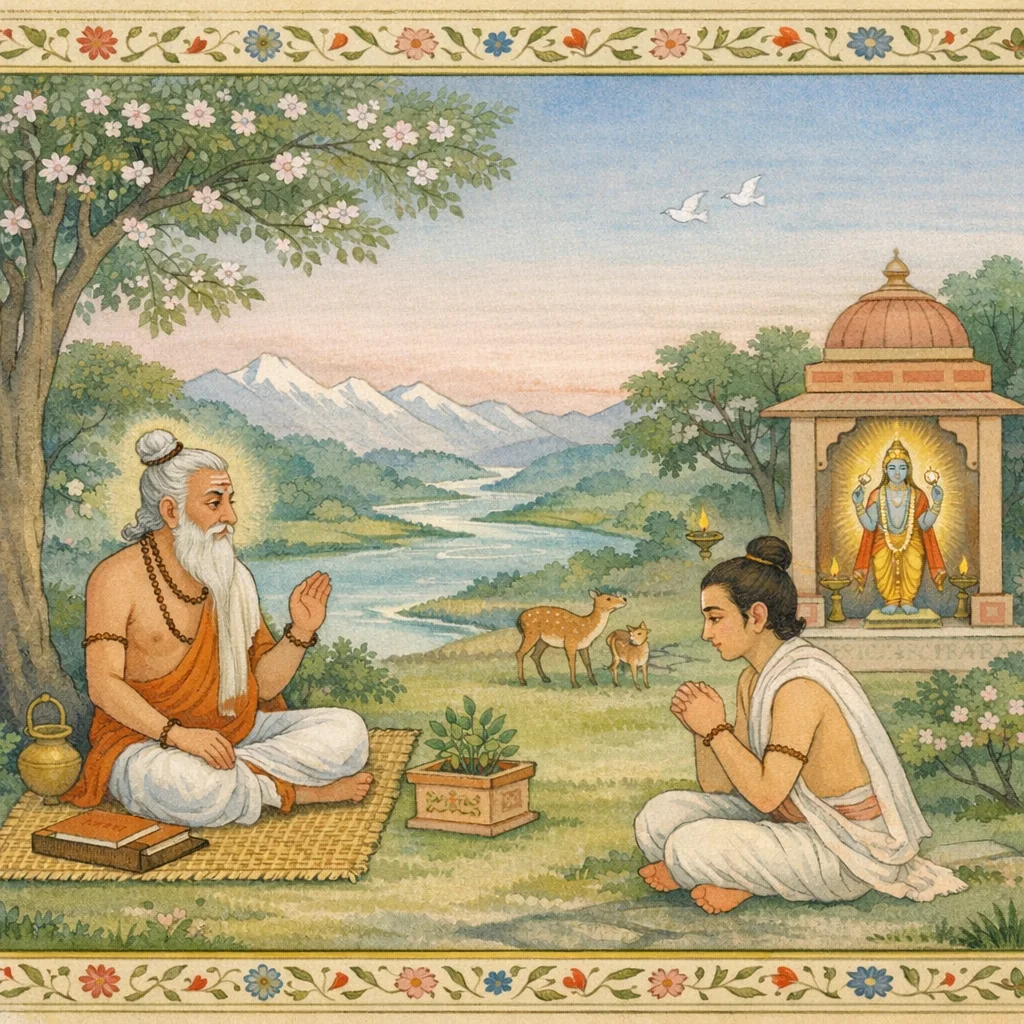
Somaśarmā and his wife Sumanā arrive at the sacred confluence of the Kapilā and Revā (Narmadā). They bathe, make offerings to the devas and the pitṛs, and begin austere tapas, sustained by mantra-japa to Nārāyaṇa and Śiva. As Somaśarmā deepens his meditation on Vāsudeva through the twelve-syllabled mantra, fearsome obstacles arise in succession—serpents, wild beasts, spirits, storms, and threatening apparitions. Unshaken, he repeatedly takes refuge in Hari, invoking divine forms—especially Nṛhari/Narasiṃha—through stotra-like declarations of śaraṇāgati. Pleased by such unwavering devotion, Hṛṣīkeśa manifests and offers a boon. A long विजय/namaskāra hymn follows, praising the Lord’s attributes and avatāras (from Matsya through Buddha and beyond), and ends with a plea for compassion across all births.
Shlokas
Verse 1
सूत उवाच । सोमशर्मा महाप्राज्ञः सुमनया सह सत्तमः । कपिलासंगमे पुण्ये रेवातीरे सुपुण्यदे
Sūta said: Somaśarmā, most excellent and of great wisdom, together with Sumanā, went to the holy confluence of the Kapilā river, upon the supremely sacred bank of the Revā (Narmadā).
Verse 2
स्नात्वा तत्र स मेधावी तर्पयित्वा सुरान्पितॄन् । तपस्तेपे सुशांतात्मा जपन्नारायणं शिवम्
Having bathed there, the wise man satisfied the devas and the ancestors with offerings; then, with a tranquil mind, he practiced tapas, repeatedly chanting the sacred names of Nārāyaṇa and Śiva.
Verse 3
द्वादशाक्षरमंत्रेण ध्यानयुक्तो महामनाः । तस्यैव देवदेवस्य वासुदेवस्य सुव्रतः
With the twelve-syllabled mantra, absorbed in meditation, the great-minded man—steadfast in sacred vows—becomes wholly intent upon that very Vāsudeva, the God of gods.
Verse 4
आसने शयने याने स्वप्ने पश्यति केशवम् । सदैव निश्चलो भूत्वा कामक्रोधविवर्जितः
Whether seated, lying down, traveling, or even in dreams, he beholds Keśava; ever steady and unmoving, he remains free from desire and anger.
Verse 5
सा च साध्वी महाभागा पतिव्रतपरायणा । सुमना कांतमेवापि शुश्रूषति तपोन्वितम्
And she—virtuous and greatly blessed, wholly devoted to the vow of pativratā, fidelity to her husband—served her beloved, endowed with tapas, with a serene and steady mind.
Verse 6
ध्यायमानस्य तस्यापि विघ्नैः संदर्शितं भयम् । सर्पा विषोल्बणाः कृष्णास्तत्र यांति महात्मनः
Even as he was absorbed in meditation, obstructing forces revealed fear to him; there, O great sage, black serpents laden with virulent poison came forth.
Verse 7
पार्श्वे ते तप्यमानस्य तस्य ते सोमशर्मणः । सिंहव्याघ्रगजा दृष्टा भयमेवं प्रचक्रिरे
While Somaśarman was performing austerities, lions, tigers, and elephants were seen nearby; thus they stirred up fear.
Verse 8
वेताला राक्षसा भूताः कूष्मांडाः प्रेतभैरवाः । भयं विदर्शयंत्येते दारुणं प्राणनाशनम्
Vetālas, rākṣasas, bhūtas, kūṣmāṇḍas, and the dread pretabhairavas—these beings display a terrible fear that destroys the life-breath.
Verse 9
नानाविधा महाभीमाः सिंहास्तत्र समागताः । दंष्ट्राकरालवक्त्राश्च जगर्जुश्चातिभैरवम्
There, lions of many kinds—terribly fearsome—gathered together; with mouths made dreadful by their fangs, they roared with an exceedingly terrifying sound.
Verse 10
विष्णोर्ध्यानात्स धर्मात्मा न चचाल महामतिः । महाविघ्नैः सुसंरूढैश्चालितो मुनिपुंगवः
Absorbed in meditation on Viṣṇu, that righteous, great-minded sage did not waver; even when assailed by formidable, fully intensified obstacles, the foremost of ascetics could not be shaken.
Verse 11
एवं न चलते ध्यानात्सोमशर्मा द्विजोत्तमः । झंझावातैश्च शीतेन महावृष्ट्या सुपीडितः
Even so, Somaśarmā—the best of brāhmaṇas—did not waver from his meditation, though sorely afflicted by raging gusts, cold, and torrential rain.
Verse 12
भंभारावमहाभीमः सिंहस्तत्र समागतः । तं दृष्ट्वा भयवित्रस्तः सस्मार नृहरिं द्विजः
Then a lion—terrifying, roaring like thunder—came there. Seeing it, the brāhmaṇa, shaken with fear, remembered Nṛhari (Viṣṇu as the Man-Lion).
Verse 13
इंद्रनीलप्रतीकाशं पीतवस्त्रं महौजसम् । शंखचक्रधरं देवं गदापंकजधारिणम्
He beheld the Lord—shining like a sapphire, clad in yellow garments, of great splendor—bearing the conch and discus, and holding the mace and lotus.
Verse 14
महामौक्तिकहारेण इंदुवर्णानुकारिणा । कौस्तुभेनापि रत्नेन द्योतमानं जनार्दनम्
Janārdana (Viṣṇu) was resplendent—adorned with a great pearl necklace resembling the hue of the moon, and also shining with the Kaustubha jewel.
Verse 15
श्रीवत्सांकेन दिव्येन हृदयं यस्य राजते । सर्वाभरणशोभांगं शतपत्रनिभेक्षणम्
On his chest the divine Śrīvatsa mark shines; his body is radiant with the beauty of every ornament; and his eyes resemble a hundred-petalled lotus.
Verse 16
सुस्मितास्यं सुप्रसन्नं रत्नदामाभिशोभितम् । भ्राजमानं हृषीकेशं ध्यानं तेन कृतं ध्रुवम्
With a gently smiling face, supremely serene, adorned with a garland of jewels and radiant, he fixed his meditation upon Hṛṣīkeśa (Viṣṇu), making it steady and unwavering.
Verse 17
त्वमेव शरणं कृष्ण शरणागतवत्सल । नमोस्तु देवदेवाय किं मे भयं करिष्यति
You alone are my refuge, O Kṛṣṇa, tender to those who seek Your protection. Salutations to the God of gods—what could fear ever do to me?
Verse 18
यस्योदरे त्रयो लोकाः सप्त चान्ये महात्मनः । शरणं तस्य प्रविष्टोस्मि क्वास्ते भयं ममैव हि
O great soul—He within whose belly abide the three worlds and seven others—I have entered into His refuge. Where could fear remain for me?
Verse 19
यस्माद्भयाः प्रवर्तंते कृत्यादिक महाबलाः । सर्वभयप्रहर्तारं तमस्मि शरणं गतः
From whom even mighty terrors—such as sorcery and the like—arise, to Him who destroys every fear, I have gone for refuge.
Verse 20
पातकानां तु सर्वेषां दानवानां महाभयम् । रक्षको विष्णुभक्तानां तमस्मि शरणं गतः
I have taken refuge in Him who is the great terror of all sins and of the Dānavas, and who is the protector of the devotees of Viṣṇu.
Verse 21
वृंदारकाणां सर्वेषां दानवानां महात्मनाम् । यो गतिः कृष्णभक्तानां तमस्मि शरणं गतः
I have taken refuge in Him who is the supreme destination of all the gods and the great-souled Dānavas, and who is the sure refuge and goal of Kṛṣṇa’s devotees.
Verse 22
अभयो भयनाशाय पापनाशाय ज्ञानवान् । एकश्चेंद्रस्वरूपेण तमस्मि शरणं गतः
I have taken refuge in that One—fearless and wise—who destroys fear and sin, and who manifests in the form of Indra.
Verse 23
व्याधीनां नाशकायैव य औषधस्वरूपवान् । निरामयो निरानंदस्तमस्मि शरणंगतः
I take refuge in Him who, being the very form of medicine, destroys diseases; who is free from illness and untouched by worldly pleasure—unto Him I have surrendered.
Verse 24
अचलश्चालयेल्लोकानपापो ज्ञानमेव च । तमस्मि शरणं प्राप्तो भयं किं मे करिष्यति
Even if the immovable were to shake the worlds, even if sinlessness and even knowledge itself were to fail—having taken refuge in Him, what fear could ever do to me?
Verse 25
साधूनां चापि सर्वेषां पालको यो ह्यनामयः । पाति विश्वं च विश्वात्मा तमस्मि शरणंगतः
I have taken refuge in Him who, ever free from affliction, is the protector of all the righteous; who safeguards the universe, and who is the very Self of the universe.
Verse 26
यो मे मृगेंद्ररूपेण भयं दर्शयतेग्रतः । तमहं शरणं प्राप्तो नरसिंहं नमाम्यहम्
I take refuge in and bow to Narasiṃha—He who, appearing as the lord of beasts, displays fear before me.
Verse 27
मदमत्तो महाकायो वनहस्ती समागतः । गजलीलागतिं देवं शरणागतवत्सलम्
A huge wild elephant, intoxicated with rut, came charging in; yet that Lord—whose gait is like the graceful play of an elephant—remains compassionate to those who seek refuge.
Verse 28
गजास्यं ज्ञानसंपन्नं सपाशांकुशधारिणम् । कालास्यं गजतुंडं च शरणं सुगतोस्म्यहम्
I take refuge in the elephant-faced One, endowed with wisdom, bearing the noose and the goad—dark-faced, with an elephant trunk; to that auspicious Lord I have come for shelter.
Verse 29
हिरण्याक्षप्रहर्तारं वाराहं शरणंगतः । वामनं तं प्रपन्नोस्मि शरणागतवत्सलम्
Having sought refuge in Varāha, the slayer of Hiraṇyākṣa, I surrender to that Vāmana—ever affectionate to those who take refuge.
Verse 30
ह्रस्वास्तु वामनाः कुब्जाः प्रेताः कूष्मांडकादयः । मृत्युरूपधराः सर्वे दर्शयंति भयं मम
Short dwarfs, hunchbacks, ghosts, and beings such as the Kūṣmāṇḍas—all assuming forms of death—appear and display fear to me.
Verse 31
अमृतं तं प्रपन्नोस्मि किं भयं मे करिष्यति । ब्रह्मण्यो ब्रह्मदो ब्रह्मा ब्रह्मज्ञानमयो हरिः
I have taken refuge in that Immortal One—what can fear do to me? Hari is devoted to the Brāhmaṇas, the giver of Brahman (spiritual power), Brahmā himself, and of the very nature of Brahma-knowledge.
Verse 32
शरणं तं प्रपन्नोस्मि भयं किं मे करिष्यति । अभयो यो हि जगतो भीतिघ्नो भीतिदायकः
I have taken refuge in Him; what can fear do to me? For He is the fearless One for the world—destroyer of fear and (to the wicked) the giver of fear.
Verse 33
भयरूपं प्रपन्नोस्मि भयं किं मे करिष्यति । तारकः सर्वलोकानां नाशकः सर्वपापिनाम्
I have taken refuge in the One who is the very form and master of fear—what can fear do to me now? He is the savior of all worlds and the destroyer of sinners’ sins.
Verse 34
तमहं शरणं प्राप्तो धर्मरूपं जनार्दनम् । सुरारणं यो हि रणे वपुर्द्धारयतेऽद्भुतम्
I have taken refuge in that Janārdana who is the very embodiment of Dharma—he who, in battle, assumes a wondrous form to become the enemy of the foes of the gods.
Verse 35
शरणं तस्य गंतास्मि सदागतिरयं मम । झंझावातो महाचंडो वपुर्दूयति मे भृशम्
To Him I shall go for refuge—He alone is ever my true resort. A violent, raging storm-wind blows, and my body is sorely tormented.
Verse 36
शरणं तं प्रपन्नोस्मि सदागतिरयं मम । अतिशीतं चातिवर्षा आतपस्तापदायकः
I have taken refuge in Him; He alone is ever my refuge. Excessive cold, torrential rain, and scorching heat are all causes of suffering.
Verse 37
एषां रूपेण यो देवस्तस्याहं शरणं गतः । कालरूपा अमी प्राप्ता भयदा मम चालकाः
I have taken refuge in that Divine One who appears in these forms. These, having come in the form of Time, are fear-giving and drive me onward.
Verse 38
एषां शरणं प्रपन्नोस्मि हरेः स्वरूपिणां सदा
I have always taken refuge in them—those who are ever of the very nature of Hari.
Verse 39
यं सर्वदेवं परमेश्वरं हि निष्केवलं ज्ञानमयं प्रदीपम् । वदंति नारायणमादिसिद्धं सिद्धेश्वरं तं शरणं प्रपद्ये
I take refuge in that Nārāyaṇa—whom they call the Supreme Lord of all the gods, the pure and absolute, a lamp made of knowledge itself; the Primordial Perfect One, the Lord of the perfected beings.
Verse 40
इति ध्यायन्स्तुवन्नित्यं केशवं क्लेशनाशनम् । भक्त्या तेन समानीतस्तदात्महृदये हरिः
Thus, constantly meditating upon and praising Keśava, the destroyer of afflictions, by his devotion he drew Hari into the very heart of his own being.
Verse 41
उद्यमं विक्रमं तस्य स दृष्ट्वा सोमशर्मणः । आविर्भूय हृषीकेशस्तमुवाच प्रहृष्टवान्
Seeing the effort and valor of Somaśarman, Hṛṣīkeśa (Viṣṇu) manifested before him and, delighted, spoke to him.
Verse 42
सोमशर्मन्महाप्राज्ञ श्रूयतां भार्यया सह । वासुदेवोस्मि विप्रेंद्र वरं याचय सुव्रत
“O Somaśarman, greatly wise—listen, together with your wife. O foremost of brāhmaṇas, I am Vāsudeva; ask for a boon, O man of noble vows.”
Verse 43
तेनोक्तो हि स विप्रेन्द्र उन्मील्य नयनद्वयम् । दृष्ट्वा विश्वेश्वरं देवं घनश्यामं महोदयम्
Thus addressed, O best of brāhmaṇas, he opened both his eyes and beheld Viśveśvara, the divine Lord—dark as a rain-cloud and radiant in majestic splendor.
Verse 44
सर्वाभरणशोभांगं सर्वायुधसमन्वितम् । दिव्यलक्षणसंपन्नं पुंडरीकनिभेक्षणम्
His body shone with every ornament, he was equipped with every weapon, endowed with divine auspicious marks, and lotus-like in his gaze.
Verse 45
पीतेन वाससा युक्तं राजमानं सुरेश्वरम् । वैनतेयसमारूढं शंखचक्रगदाधरम्
Clad in yellow garments, resplendent, the Lord of the gods—mounted upon Vainateya (Garuḍa)—bearing the conch, discus, and mace.
Verse 46
ब्रह्मादीनां सुधातारं जगतोस्य महायशाः । विश्वस्यास्य सदातीतं रूपातीतं जगद्गुरुम्
He is the excellent sustainer of Brahmā and the other gods; the greatly renowned support of this world—ever beyond time, beyond all form, the spiritual preceptor of the universe.
Verse 47
हर्षेण महताविष्टो दंडवत्प्रणिपत्य तम् । श्रियायुक्तं भासमानं सूर्यकोटिसमप्रभम्
Overwhelmed with great joy, he bowed to him in full prostration—to that One endowed with splendor, radiant, possessing a brilliance equal to ten million suns.
Verse 48
बद्धांजलिपुटोभूत्वा तया सुमनया सह । जयजयेत्युवाचैनं जयमाधवमानद
Forming a reverent gesture with folded hands, and together with the noble-minded lady Sumanā, he said to him, “Victory, victory! O Mādhava, bestower of honor!”
Verse 49
जय योगीश योगीन्द्र जय नागांगशायन । यज्ञांग जय यज्ञेश जय शाश्वतसर्वग
Victory to you, Lord of yogins, best among yogis! Victory to you who recline upon the serpent-bed! Victory to you whose limbs are the sacrifice, Lord of sacrifice! Victory to you, the eternal One, all-pervading everywhere!
Verse 50
जय सर्वेश्वरानंत यज्ञरूप नमोऽस्तु ते । जय ज्ञानवतां श्रेष्ठ जय त्वं ज्ञाननायक
Victory to you, the Infinite Lord of all, whose very form is sacrifice—salutations to you. Victory to you, the best among the wise; victory to you, the guide and leader of spiritual knowledge.
Verse 51
जय सर्वदसर्वज्ञ जय त्वं सर्वभावन । जय जीवस्वरूपेश महाजीव नमोस्तुते
Victory to You, O all-giving, all-knowing One; victory to You, the source and sustainer of all existence. Victory to You, Lord of the very nature of the living being—O Supreme Living Reality, salutations to You.
Verse 52
जय प्रज्ञादप्रज्ञांग जय प्राणप्रदायक । जय पापघ्न पुण्येश जय पुण्यपते हरे
Victory to You—whose very body is wisdom and the source of wisdom; victory to You, the giver of life. Victory to You, the destroyer of sin, the Lord of merit; victory to You, O Hari, the master of all holiness.
Verse 53
जय ज्ञानस्वरूपेश ज्ञानगम्याय ते नमः । जय पद्मपलाशाक्ष पद्मनाभाय ते नमः
Victory to You, O Lord whose very nature is knowledge—salutations to You who are attained through true knowledge. Victory to You, O lotus-petal-eyed One—salutations to You, O Padmanābha, whose navel bears the lotus.
Verse 54
जय गोविंदगोपाल जय शंखधरामल । जय चक्रधराव्यक्त व्यक्तरूपाय ते नमः
Victory to Govinda, to Gopāla; victory to the stainless bearer of the conch. Victory to the bearer of the discus—O unmanifest One; to You who assume manifest form, my salutations.
Verse 55
जय विक्रमशोभांग जय विक्रमनायक । जय लक्ष्मीविलासांग नमो वेदमयाय ते
Victory to You whose body is radiant with valor; victory to You, the lord and leader of heroism. Victory to You whose form is the playful delight of Lakṣmī—salutations to You who are the very essence of the Vedas.
Verse 56
जय विक्रमशोभांग जय उद्यमदायक । जय उद्यमकालाय उद्यमाय नमोनमः
Victory to You, whose prowess is radiant and splendid; victory to You, the giver of holy enterprise. Victory to the very Time for undertaking effort; to Effort itself, salutations again and again.
Verse 57
जय उद्यमशक्ताय उद्यमत्रयधारक । युद्धोद्यमप्रवृत्ताय तस्मै धर्माय ते नमः
Victory to that Dharma who is the power of right effort, who upholds the threefold endeavor, and who is engaged in the endeavor of battle—unto that Dharma, to You I bow.
Verse 58
नमो हिरण्यरेताय तस्मै ते जायते नमः । अतितेजःस्वरूपाय सर्वतेजोमयाय च
Salutations to You, the Golden-seeded One; salutations to That One from whom You are born. Salutations to Him whose very nature is transcendent splendor, and who is composed of all brilliance.
Verse 59
दैत्यतेजोविनाशाय पापतेजोहराय च । गोब्राह्मणहितार्थाय नमोस्तु परमात्मने
Salutations to the Supreme Self (Paramātman), who destroys the might of the Daityas, removes the force of sin, and acts for the welfare of cows and brāhmaṇas.
Verse 60
नमोस्तु हुतभोक्त्रे च नमो हव्यवहाय ते । नमः कव्यवहायैव स्वधारूपाय ते नमः
Salutations to You, the eater of oblations; salutations to You, the bearer of offerings. Salutations indeed to You, the bearer of ancestral offerings; salutations to You whose form is Svadhā.
Verse 61
स्वाहारूपाय यज्ञाय पावनाय नमोनमः । नमस्ते शार्ङ्गहस्ताय हरये पापहारिणे
Repeated salutations to Him who is the very form of Svāhā, who is the sacrifice itself, the Purifier. Salutations to You, O Hari, who hold the Śārṅga bow in Your hand, the remover of sins.
Verse 62
सदसच्चोदनायैव नमो विज्ञानशालिने । नमो वेदस्वरूपाय पावनाय नमोनमः
Salutations to the One who impels all beings toward what is true and restrains them from what is untrue; salutations to the Abode of wisdom. Salutations to Him whose very form is the Veda—to the Purifier, again and again my salutations.
Verse 63
नमोस्तु हरिकेशाय सर्वक्लेशहराय ते । केशवाय परायैव नमस्ते विश्वधारिणे
Salutations to You, O Harikeśa, remover of all afflictions. Salutations to You, O Keśava, the Supreme—O supporter of the universe.
Verse 64
नमः कृपाकरायैव नमो हर्षमयाय ते । अनंताय नमो नित्यं शुद्धाय क्लेशनाशिने
Salutations to You alone, the bestower of compassion; salutations to You, who are filled with bliss. Ever I bow to You, the Infinite—pure, and the destroyer of afflictions.
Verse 65
आनंदाय नमो नित्यं शुद्धाय केवलाय ते । रुद्रैर्नमितपादाय विरंचिनमिताय ते
Eternal obeisance to You, who are Bliss itself—pure and absolute. Obeisance to You whose feet are bowed to by the Rudras, and who are revered with salutations by Virañci (Brahmā).
Verse 66
सुरासुरेंद्रनमित पादपद्माय ते नमः । नमोनमः परेशाय अजितायामृतात्मने
Salutations to You whose lotus-feet are bowed to by the lord of the gods and by the lords among the asuras. Again and again, salutations to the Supreme Lord—unconquered, whose very nature is immortality.
Verse 67
क्षीरसागरवासाय नमः पद्माप्रियाय ते । ओंकाराय च शुद्धाय अचलाय नमोनमः
Salutations to You who dwell in the Ocean of Milk, dear to Padmā (Lakṣmī). Salutations again and again to You who are the sacred Oṃ, the Pure One, the Immovable.
Verse 68
व्यापिने व्यापकायैव सर्वव्यसनहारिणे । नमोनमो वराहाय महाकूर्माय ते नमः
Salutations again and again to You—the all-pervading, the all-encompassing—who remove every calamity. O Varāha, O Great Kūrma, to You be reverent homage.
Verse 69
नमो वामनरूपाय नृसिंहाय महात्मने । नमो रामाय दिव्याय सर्वक्षत्रवधाय च
Salutations to the One whose form is Vāmana; salutations to the great-souled Narasiṃha. Salutations to the divine Rāma as well—the slayer of all the Kṣatriyas.
Verse 70
सर्वज्ञानाय मत्स्याय नमो रामाय ते नमः । नमः कृष्णाय बुद्धाय नमो म्लेच्छप्रणाशिने
Homage to the all-knowing Matsya; homage to You, O Rāma. Homage to Kṛṣṇa; homage to Buddha; homage to the destroyer of the mlecchas (impious and barbarous forces).
Verse 71
नमः कपिलविप्राय हयग्रीवाय ते नमः । नमो व्यासस्वरूपाय नमः सर्वमयाय ते
Salutations to You as the brāhmaṇa Kapila; salutations to You as Hayagrīva. Salutations to You whose form is Vyāsa; salutations to You, all-pervading, made of all.
Verse 72
एवं स्तुत्वा हृषीकेशं तमुवाच जनार्दनम् । गुणानां तु परं पारं ब्रह्मा वेत्ति न पावन
Thus, having praised Hṛṣīkeśa, he addressed Janārdana: “O Pure One, even Brahmā does not know the farthest shore beyond the guṇas.”
Verse 73
न चैव स्तोतुं सर्वज्ञस्तथा रुद्र सःहस्रदृक् । वक्तुं को हि समर्थस्तु कीदृशी मे मतिर्विभो
Even the all-knowing—Rudra himself, the thousand-eyed—cannot fully praise You. Who, then, can speak Your greatness? What understanding do I possess, O all-pervading Lord?
Verse 74
निर्गुणं सगुणं स्तोत्रं मयैव तव केशव । क्षमशब्दापशब्दं मे तव दासोस्मि सुव्रत
O Keśava, I alone have uttered this hymn to You—both as Nirguṇa and as Saguṇa. Forgive the faults and improper words in my speech; I am Your servant, O You of excellent vows.
Verse 75
जन्मजन्मनि लोकेश दयां मे कुरु पावन
O Lord of the worlds, O Purifier—show me compassion, birth after birth.