Adhyaya 94
Karmic Causality, Fate, and the Supremacy of Food-Charity (within Guru-tīrtha Glorification)
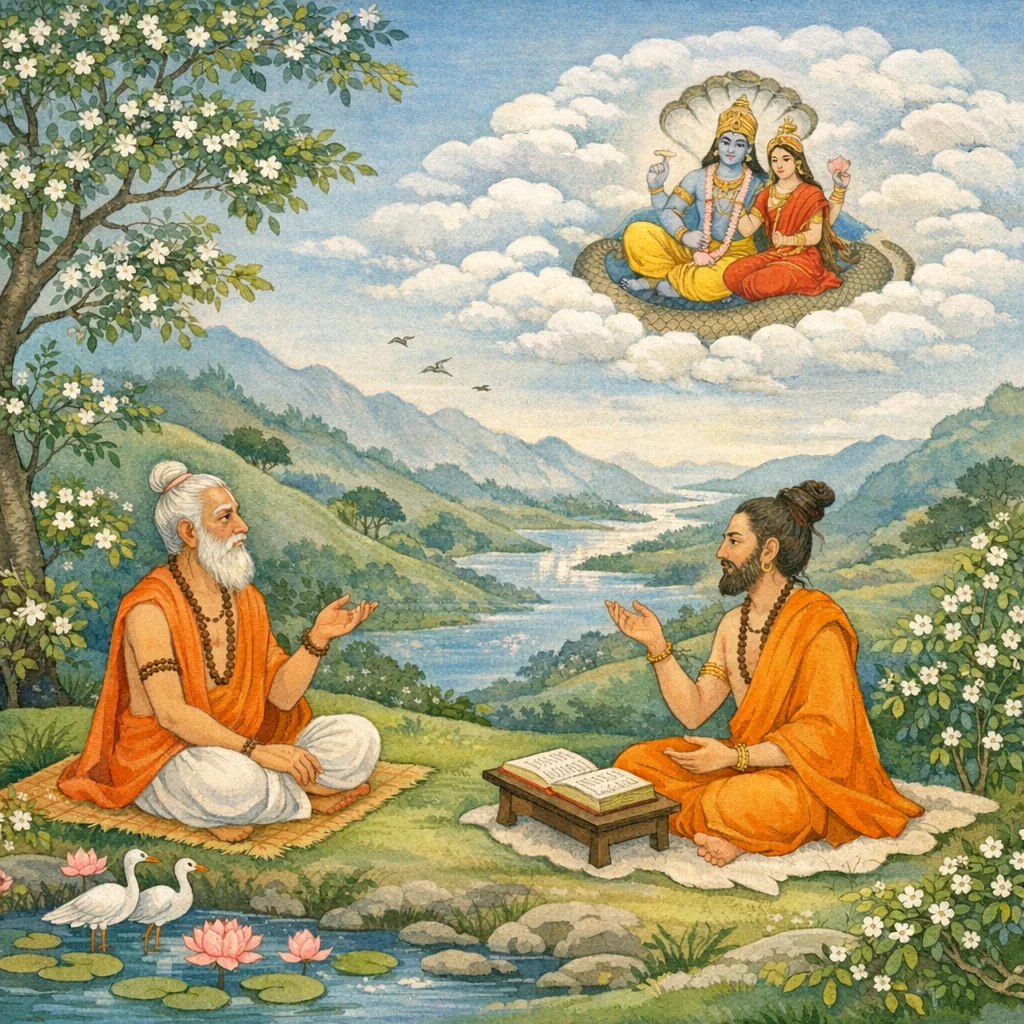
Chapter 94 teaches that karma alone governs embodied life: as deeds are done, their fruits inevitably ripen, shaping one’s birth, lifespan, wealth, learning, and the experience of pleasure and pain. Through craft metaphors—metal in fire, gold in molds, a potter’s clay—and images of inevitability—like a shadow that follows or a calf finding its mother—it declares that past action cannot be undone by strength or intellect. It then turns to lived dharma in a narrative set in the Cōḻa country: King Subāhu, a devoted Vaiṣṇava, is instructed by his priest Jaimini on the difficulty and greatness of dāna. The teaching culminates in the exaltation of anna-dāna, the gift of food, as the foremost charity for welfare in this world and the next, within the wider glorification of Guru-tīrtha and the Vena–Cyavana narrative cycle.
Shlokas
Verse 1
कुंजल उवाच । श्रूयतामभिधास्यामि तत्सर्वं कारणं सुत । यस्मात्तौ तादृशौ जातौ स्वमांसपरिभक्षकौ
Kuṃjala said: “Listen, my son—I shall declare the whole cause by which those two were born in such a state, as eaters of their own flesh.”
Verse 2
सर्वत्र कारणं कर्म शुभाशुभं न संशयः । पुण्येन कर्मणा पुत्र नरः सौख्यं प्रभुंजति
In every case, karma—auspicious or inauspicious—is the cause; of this there is no doubt. By meritorious action, my son, a person enjoys happiness.
Verse 3
दुष्कृतं भुंजते चात्र पापयुक्तेन कर्मणा । सूक्ष्मवर्त्मविचार्यैवं शास्त्रज्ञानेन चक्षुषा
Here, beings reap the fruit of their misdeeds through actions tainted by sin; therefore one should examine the subtle course of karma with the eye of scriptural knowledge.
Verse 4
स्थूलधर्मं प्रदृष्ट्वैव सुविचार्य पुनः पुनः । समारभेन्नरः कर्म मनसा निपुणेन च
Having first observed the plain, outward duties, and having reflected again and again, a person should then undertake action with a discerning and skillful mind.
Verse 5
समूर्तिकारकः शिल्पी रसमावर्त्तयेद्यथा । अग्नेश्च तेजसा पुत्र ज्वालाभिश्च समंततः
Just as a sculptor who fashions forms stirs and works the molten metal, so too, my son, by the fire’s radiance and by its flames on every side, it is heated and shaped.
Verse 6
द्रवीभूतो भवेद्धातुर्वह्निना तापितः शनैः । यादृशं वत्स भक्ष्यंतु रसपक्वं निषेच्यते
When a metal is slowly heated by fire, it melts and becomes fluid. Likewise, dear child, food that is properly cooked into its essence is fit to be eaten and assimilated.
Verse 7
तादृशं जायते वत्स रूपं चैव न संशयः । यादृशं क्रियते कर्म तादृशं परिभुज्यते
Thus, dear child, such a form indeed arises—of this there is no doubt. As the deed is done, so its fruit is experienced.
Verse 8
कर्म एव प्रधानं यद्वर्षारूपेण वर्त्तते । क्षेत्रेषु यादृशं बीजं वपते कृषिकारकः
Karma alone is paramount, working in the form of results (like the rains). In the fields, whatever seed the farmer sows, accordingly it comes to be.
Verse 9
तादृशं भुंजते तात फलमेव न संशयः । यादृशं क्रियते कर्म तादृशं परिभुज्यते
Surely, dear one, one experiences exactly such a result—there is no doubt. As the action is performed, so its consequence is inevitably enjoyed or endured.
Verse 10
विनाशहेतुः कर्मास्य सर्वे कर्मवशा वयम् । कर्म दायादका लोके कर्म संबंधिबांधवाः
Karma is the cause of one’s ruin; we all are under the sway of karma. In this world, karma is our inheritance, and karma itself is the kinship and binding bond of relatives.
Verse 11
कर्माणि चोदयंतीह पुरुषं सुखदुःखयोः । सुवर्णं रजतं वापि यथारूपं निषिच्यते
Here, one’s deeds impel a person toward pleasure and pain, just as gold or silver, poured into a mold, takes on the corresponding form.
Verse 12
तथा निषिच्यते जंतुः पूर्वकर्मवशानुगः । पंचैतानीह दृश्यंते गर्भस्थस्यैव देहिनः
Thus the embodied being is conceived, compelled by and following the force of its former actions. Here, five such conditions are seen in the case of the soul dwelling in the womb.
Verse 13
आयुः कर्म च वित्तं च विद्यानि धनमेव च । यथा मृत्पिंडकं कर्त्ता कुरुते यद्यदिच्छति
Life-span, one’s deeds, wealth, learning, and material resources—just as a potter shapes a lump of clay into whatever he wishes, so are these fashioned by the Maker as He wills.
Verse 14
तथा कर्मकृतं चैव कर्त्तारं प्रतिपद्यते । देवत्वमथ मानुष्यं पशुत्वं पक्षितां तथा
So too, the deed that has been done inevitably returns to its doer—bringing about godhood, or human birth, or animality, and likewise the state of a bird.
Verse 15
तिर्यक्त्वं स्थावरत्वं वा याति जंतुः स्वकर्मभिः । स एव तु तथा भुंक्ते नित्यं विहितमात्मनः
By its own actions a living being may fall into an animal birth or even into the state of an immobile creature; and that very same being then inevitably experiences, in due manner, what has been ordained for itself.
Verse 16
आत्मना विहितं दुःखमात्मना विहितं सुखम् । गर्भशय्यामुपादाय भुंजते पूर्वदेहिकम्
Sorrow is fashioned by oneself, and happiness is fashioned by oneself. Taking the womb as their bed, beings experience the fruit carried over from the former body (past life).
Verse 17
पूर्वदेहकृतं कर्म न कश्चित्पुरुषोत्तमः । बलेन प्रज्ञया वापि समर्थः कर्तुमन्यथा
O Puruṣottama, no one is able to make the karma performed in a former body turn out otherwise—whether by strength or even by intelligence.
Verse 18
स्वकृतान्येव भुंजंति दुःखानि च सुखानि च । हेतुतः कारणैर्वापि सोहं कारेण बाध्यते
Beings experience only what they themselves have done—both suffering and happiness. Whether from motives or from other causal factors, I too am constrained by the force of action (karma).
Verse 19
यथा धेनुसहस्रेषु वत्सो विंदति मातरम् । तद्वच्छुभाशुभं कर्म कर्तारमनुगच्छति
Just as a calf finds its own mother among thousands of cows, so too one’s good or evil deed unfailingly follows and reaches its doer.
Verse 20
उपभोगादृते यस्य नाश एव न विद्यते । प्राक्तनं बंधनं कर्म कोन्यथाकर्तुमर्हति
That (karmic result) whose destruction does not occur without being experienced—who can possibly make the binding karma of the past turn out otherwise?
Verse 21
सुशीघ्रमनुधावंतं विधानमनुधावति । शोभते संनिपातेन यथाकर्म पुराकृतम्
The ordinance of fate swiftly follows the one who runs on; and when they meet, it manifests exactly in accordance with the deeds done formerly.
Verse 22
उपतिष्ठति तिष्ठंतं गच्छं तमनुगच्छति । करोति कुर्वतः कर्मच्छायेवानु विधीयते
It attends one who stands, follows one who goes, and acts in accordance with one who acts—like a shadow, it is inevitably drawn along after a person’s deeds.
Verse 23
यथा छायातपौ नित्यं सुसंबद्धौ परस्परम् । उपसर्गा हि विषया उपसर्गा जरादयः
Just as shade and sunlight are always closely linked to each other, so too worldly objects are inseparable from afflictions—afflictions such as old age and the rest.
Verse 24
पीडयंति नरं पश्चात्पीडितं पूर्वकर्मणा । येन यत्रोपभोक्तव्यं दुःखं वा सुखमेव च
Later, they afflict a man—already burdened by his former deeds—so that, in whatever manner and in whatever place, he must experience what is to be undergone: either suffering or indeed happiness.
Verse 25
स तत्र बद्ध्वा रज्ज्वेव बलाद्दैवेन नीयते । दैवं प्राहुश्च भूतानां सुखदुःखोपपादनम्
Bound there, he is dragged along by fate—like one tied with a rope, carried off by force. For ‘fate’ is said to be that which brings about pleasure and pain for living beings.
Verse 26
अन्यथा कर्मतच्चिंत्यं जाग्रतः स्वपतोपि वा । अन्यथा ह्युद्यते दैवं बध्यते च जिघांसति
If one contemplates that action in a perverted way—whether awake or even in sleep—then daiva (fate) rises in another manner: it binds the person and seeks their destruction.
Verse 27
शस्त्राग्निविषदुर्गेभ्यो रक्षितव्यं सुरक्षति । यथा पृथिव्यां बीजानि वृक्षगुल्मतृणान्यपि
One should be well guarded against weapons, fire, poison, and perilous places; vigilant caution truly protects. Just as within the earth seeds are preserved, becoming trees, shrubs, and grasses.
Verse 28
तथैवात्मनि कर्माणि तिष्ठंति प्रभवंति च । तैलक्षयाद्यथा दीपो निर्वाणमधिगच्छति
So too, within the Self, karmic actions abide and also arise; just as a lamp, when its oil is exhausted, reaches extinction and goes out.
Verse 29
कर्मक्षयात्तथा जंतोः शरीरं नाशमृच्छति । कर्मक्षयात्तथा मृत्युस्तत्त्वविद्भिरुदाहृतम्
When a being’s karma is exhausted, the body meets destruction. In the same way, the knowers of truth declare that death too arises from the exhaustion of karma.
Verse 30
विविधाः प्राणिनां रोगाः स्मृतास्तेषां च हेतवः । तस्मात्तत्त्वप्रधानस्तु कर्म एव हि प्राणिनाम्
Many kinds of diseases befall living beings, and their causes are also taught. Therefore, for all creatures, karma alone is truly the governing principle—the primary determinant.
Verse 31
यत्पुरा क्रियते कर्म तदिहैव प्रभुज्यते । यत्त्वया दृष्टमेवापि पृच्छितं तात सांप्रतम्
Whatever action was done before is indeed experienced right here, in this very life. And what you yourself have seen—you are now asking about it, dear child.
Verse 32
तस्यार्थं तु मया प्रोक्तं भुंजाते तौ हि सांप्रतम् । आनंदे कानने दृष्टं तयोः कर्मसुदारुणम्
Its meaning has indeed been explained by me. Those two are now experiencing its result. In the Ānanda forest, their exceedingly dreadful deed has been revealed.
Verse 33
तयोश्चेष्टां प्रवक्ष्यामि शृणु वत्स प्रभाषतः । कर्मभूमिरियं तात अन्या भोगार्थभूमयः
I shall explain their respective ways of life—listen, dear child, as I speak. This world is the field of action (karma-bhūmi), while other realms are grounds meant for enjoyment (bhoga).
Verse 34
सर्गादीनां महाप्राज्ञ तासु गत्वा सुभुंजति । सूत उवाच । चौलदेशे महाप्राज्ञः सुबाहुर्नाम भूमिपः
O greatly wise one, having gone to those conditions—beginning with creation and the like—one enjoys well there. Sūta said: In the Cōḻa country there was a very wise king named Subāhu.
Verse 35
रूपवान्गुणवान्धीरः पृथिव्यां नास्ति तादृशः । विष्णुभक्तो महाप्राज्ञो वैष्णवानां च सुप्रियः
Handsome, virtuous, and steadfast—there is none like him on earth. A devotee of Viṣṇu, greatly wise, and dearly loved by the Vaiṣṇavas.
Verse 36
कर्मणा त्रिविधेनापि प्रध्यायन्मधुसूदनम् । अश्वमेधादिकान्यज्ञान्यजेत सकलान्नृप
O king, by contemplating Madhusūdana (Viṣṇu) through the threefold path of action, one attains in full the merit of all sacrifices, beginning with the Aśvamedha.
Verse 37
पुरोधास्तस्य चैवास्ति जैमिनिर्नाम ब्राह्मणः । स चाहूय सुबाहुं तमिदं वचनमब्रवीत्
He also had a family priest, a brāhmaṇa named Jaimini. Summoning Subāhu, he spoke these words.
Verse 38
राजन्देहि सुदानानि यैः सुखं तु प्रभुंज्यत । दानैस्तु तरते लोकान्दुर्गान्प्रेत्य गतो नरः
O King, give excellent gifts, by which happiness is truly enjoyed; for by acts of charity a man, having departed this life, crosses over the difficult worlds of the hereafter.
Verse 39
दानेन सुखमाप्नोति यशः प्राप्नोति शाश्वतम् । दानेन चातुला कीर्तिर्जायते मृत्युमंडले
By giving, one attains happiness and gains enduring renown; and through giving, immeasurable fame arises in this mortal world.
Verse 40
यावत्कीर्तिः स्थिता चात्र तावत्कर्ता दिवं वसेत् । तद्दानं दुष्करं प्राहुर्दातुं नैव प्रशक्यते
So long as one’s fame endures here, so long does the giver dwell in heaven. Such a gift, they say, is difficult—indeed, it cannot truly be given in full measure.
Verse 41
तस्मात्सर्वप्रयत्नेन दातव्यं मानवैः सदा । सुबाहुरुवाच । दानाच्च तपसो वापि द्वयोर्मध्ये सुदुष्करम्
Therefore, with every effort, human beings should always practice charity. Subāhu said: between giving and austerity, true giving is the more difficult.
Verse 42
किं वा महत्फलं प्रेत्य तन्मे ब्रूहि द्विजोत्तम । जैमिनिरुवाच । दानान्न दुष्करतरं पृथिव्यामस्ति किंचन
“O best of the twice-born, tell me what yields the greatest fruit after death.” Jaimini said: “On earth there is nothing more difficult than giving in charity.”
Verse 43
राजन्प्रत्यक्षमेवैकं दृश्यते लोकसाक्षिकम् । परित्यज्य प्रियान्प्राणान्धनार्थं लोभमोहिताः
O king, one thing alone is seen directly, with the whole world as witness: deluded by greed, people abandon even their beloved lives for the sake of wealth.
Verse 44
प्रविशंति नरा लोके समुद्रमटवीं तथा । सेवामन्ये प्रपद्यंतेऽश्ववृत्तिरिति या स्थिता
In the world, some men venture into the sea and the forest; others take refuge in service—this is the established livelihood known as aśva-vṛtti.
Verse 45
हिंसाप्रायां बहुक्लेशां कृषिं चैव तथा पुरा । तस्य दुःखार्जितस्यापि प्राणेभ्योपि गरीयसः
Agriculture, as practiced in former times, was largely bound up with harm and many hardships; yet even what is earned through such suffering is deemed more precious than one’s very life.
Verse 46
अर्थस्य पुरुषव्याघ्र परित्यागः सुदुष्करः । विशेषतो महाराज तस्य न्यायार्जितस्य च
O tiger among men, renouncing wealth is exceedingly difficult—especially, O great king, when that wealth has been acquired by rightful means.
Verse 47
श्रद्धया विधिवत्पात्रे दत्तस्यांतो न विद्यते । श्रद्धा धर्मसुता देवी पावनी विश्वतारिणी
A gift given with faith, in the proper manner, to a worthy recipient has no end to its merit. Faith is the goddess—Dharma’s daughter—purifying and a savior of the whole world.
Verse 48
सावित्री प्रसवित्री च संसारार्णवतारिणी । श्रद्धया साध्यते धर्मो महद्भिर्न्नार्थराशिभिः
She is Sāvitrī, and also Prasavitṛ—she who ferries one across the ocean of worldly existence. Dharma is accomplished through faith, not by great heaps of wealth.
Verse 49
निष्किंचनास्तु मुनयः श्रद्धाधर्मा दिवं गताः । संति दानान्यनेकानि नानाभेदैर्नृपोत्तम
The sages, free from possessions and devoted to faith and righteous conduct, have attained heaven. O best of kings, there are many kinds of charitable gifts, distinguished into various types.
Verse 50
अन्नदानात्परं नास्ति प्राणिनां गतिदाकयम् । तस्मादन्नंप्रदातव्यंपयसाचसमन्वितम्
For living beings, there is no gift superior to the giving of food, for it bestows the right course and welfare. Therefore, one should give food, accompanied also by milk.
Verse 51
मधुरेणापि पुण्येन वचसा च समन्वितम् । नास्त्यन्नात्तु परं दानमिहलोके परत्र च
Even when accompanied by sweet and virtuous words, there is no gift greater than the gift of food—neither in this world nor in the next.
Verse 52
तारणाय हितायैव सुखसंपत्तिहेतवे । श्रद्धया विधिवत्पात्रे निर्मलेनापि चेतसा
For the sake of deliverance, for true welfare, and as a cause of happiness and prosperity, one should—with faith, in the proper manner—give to a worthy recipient, even with a mind that is pure.
Verse 53
अन्नैकस्य प्रदानस्य फलं भुंक्ते भवेन्नरः । ग्रासाद्ग्रासं प्रदातव्यं मुष्टिप्रस्थं न संशयः
A man attains the fruit of giving even a single portion of food. Therefore, one should give food morsel by morsel—by the handful and by the measure—without doubt.
Verse 54
अक्षयं जायते तस्य दानस्यापि महाफलम् । न च प्रस्थं न वा मुष्टिं नरस्य हि न संभवेत्
From that gift arises an imperishable reward and a very great fruit. For in a man it is not possible that there be neither a prastha-measure nor even a handful to give.
Verse 55
अनास्तिक्यप्रभावेण पर्वणि प्राप्य मानवः । श्रद्धया ब्राह्मणं चैकं भक्त्या चैव प्रभोजयेत्
When, due to the influence of disbelief, a person reaches a sacred observance-day (parvan), they should still—endowed with faith—feed even a single brāhmaṇa with devotion.
Verse 56
एकस्यापिप्रधानस्यअन्नस्यापिप्रजेश्वर । जन्मांतरं सुसंप्राप्य नित्यं चान्नं प्रभुंजति
O Lord of creatures, even by the merit of a single foremost offering of food, one attains another fortunate birth and continually enjoys abundant nourishment.
Verse 57
पूर्वजन्मनि यद्दत्तं भक्त्या पात्रे सकृन्नरैः । जन्मांतरं सुसंप्राप्य नित्यमेव भुनक्ति च
Whatever a person gave even once, with devotion, to a worthy recipient in a former birth—having attained another birth, they continually enjoy its fruit.
Verse 58
अन्नदानं प्रयच्छंति ब्राह्मणेभ्यो हि नित्यशः । मिष्टान्नपानं भुंजंति ते नरा अन्नदायिनः
Those who regularly bestow the gift of food upon Brāhmaṇas indeed partake of sweet foods and drinks; such are the people who are givers of food.
Verse 59
अन्नमेव वदंत्येत ऋषयो वेदपारगाः । प्राणभूतं न संदेहममृताद्धि समुद्भवम्
The sages who have mastered the Vedas declare that food alone is life itself—there is no doubt of it—for it arises from amṛta, the immortal essence.
Verse 60
प्राणास्तेन प्रदत्ता हि येन चान्नं समर्पितम् । अन्नदानं महाराज देहि त्वं तु प्रयत्नतः
For life-breath itself is truly bestowed by the one who offers food. Therefore, O great king, give the gift of food with earnest effort.
Verse 61
एवमाकर्ण्य वै राजा जैमिनेस्तु महात्मनः । पुनः पप्रच्छ तं विप्रं जैमिनिं ज्ञानपंडितम्
Thus having listened to the great-souled Jaimini, the king once again questioned that brāhmaṇa—Jaimini, the learned master of wisdom.
Verse 94
इति श्रीपद्मपुराणे भूमिखंडे वेनोपाख्याने गुरुतीर्थमाहात्म्ये च्यवनचरित्रे चतुर्नवतितमोऽध्यायः
Thus ends the ninety-fourth chapter of the Bhūmi-khaṇḍa of the Śrī Padma Purāṇa, in the episode of Vena, in the glorification of Guru-tīrtha, and in the narrative of Cyavana.