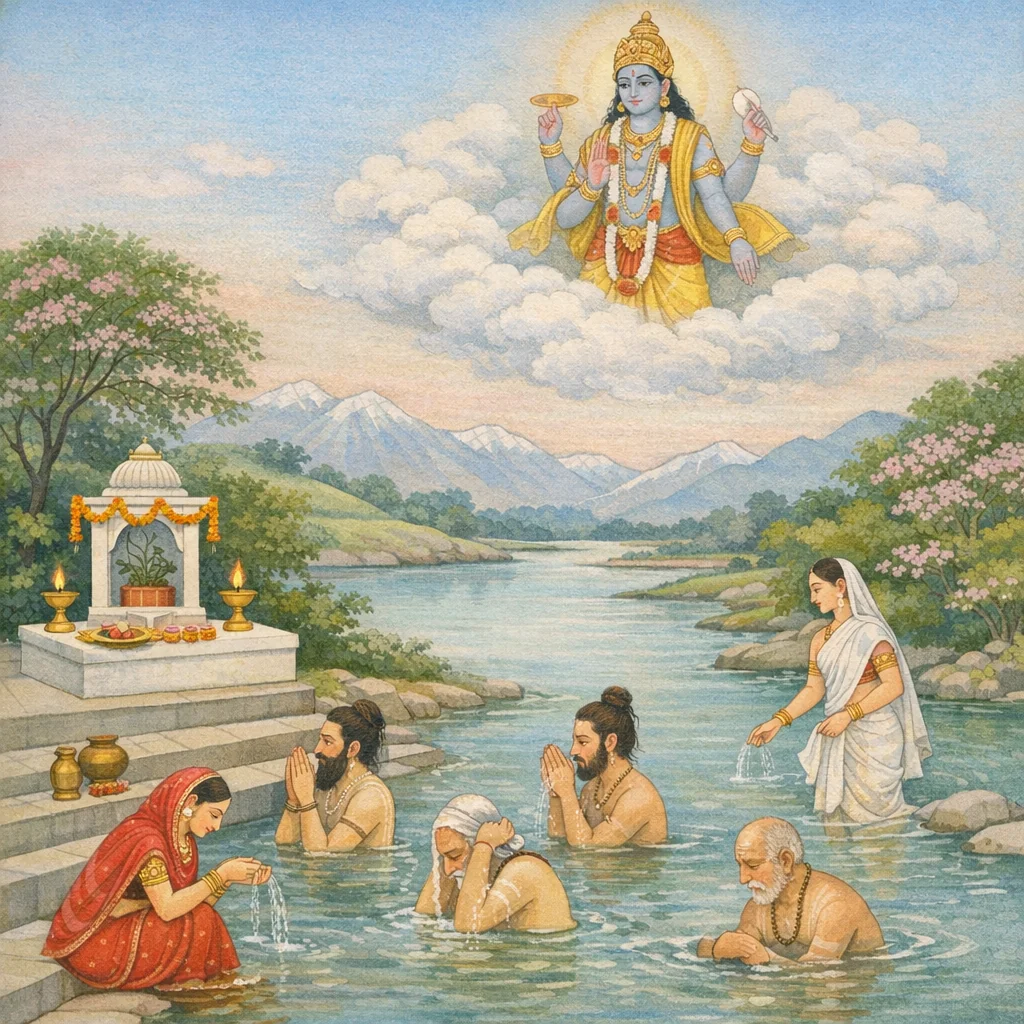
Adhyaya 53
The Tale of Sukalā: Testing Pativratā Fidelity and the Body-as-House Teaching
Chapter PP.2.53 opens with Sukalā’s existential doubt about the worth of worldly enjoyment without her husband. Viṣṇu affirms that pativratā-dharma—sacred fidelity and devoted service to one’s husband—is the highest duty and refuge for women. Indra (Śakra), wishing to test or unsettle her steadfastness, summons Kāma (Manmatha), who boasts of his power and explains how desire takes residence in the body. Indra assumes an attractive human form and sends a female messenger (dūtī) to persuade Sukalā; she declares herself Kṛkala’s wife and recounts his pilgrimage and her sorrow in separation. The chapter then turns into an extended teaching that refutes sensuality: youth passes like a house’s brief “youth,” and the body is impermanent and impure. Aging, disease, and decay dismantle the illusion of beauty, culminating in metaphysical reflection on the one Self (Ātman) abiding within many bodies and the call to transcend desire through discernment and dharma.
Shlokas
Verse 1
सुकलोवाच । एवं धर्मं श्रुतं पूर्वं पुराणेषु तदा मया । पतिहीना कथं भोगं करिष्ये पापनिश्चया
Sukalā said: “Thus have I formerly heard of dharma in the Purāṇas. But being without a husband, how can I enjoy worldly pleasures—when I am resolved upon sin?”
Verse 2
कांतेन तु विना तेन जीवं काये न धारये । विष्णुरुवाच । एवमुक्त्वा परं धर्मं पतिव्रतमनुत्तमम्
“Without that beloved husband, she would not sustain life in her body.” Viṣṇu said: Having thus declared, she set forth the supreme dharma—the unsurpassed vow of pativratā, sacred fidelity to one’s husband.
Verse 3
तास्तु सख्यो वरा नार्यो हर्षेण महतान्विताः । श्रुत्वा धर्मं परं पुण्यं नारीणां गतिदायकम्
Those noble women—her companions—were filled with great joy, having heard the supreme and holy dharma, the one that grants women their true destined path.
Verse 4
स्तुवंति तां महाभागां सुकलां धर्मवत्सलाम् । ब्राह्मणाश्च सुराः सर्वे पुण्यस्त्रियो नरोत्तम
O best of men, brāhmaṇas and all the gods, along with virtuous women, praise that most fortunate Sukalā, who is devoted to dharma and affectionate toward righteousness.
Verse 5
तस्या ध्यानं प्रकुर्वंति पतिकामप्रभावतः । अत्यर्थं दृढतामिंद्र सुःविचिंत्य सुरेश्वरः
By the power of her longing for her husband, they undertook meditation upon her; and you, O Indra, Lord of the gods, having reflected well, granted her an exceedingly firm resolve.
Verse 6
सुकलायाः परं भावं सुविचार्यामरेश्वरः । चालये धैर्यमस्याश्च पतिस्नेहं न संशयः
Having carefully considered Sukalā’s deepest disposition, the Lord of the gods (Indra) thought: “I shall unsettle her steadfastness as well—there is no doubt about her love for her husband.”
Verse 7
सस्मार मन्मथं देवं त्वरमाणः सुराधिपः । पुष्पचापं स संगृह्य मीनकेतुः समागतः
Hurrying, the lord of the gods remembered (invoked) the god Manmatha. Taking up his flower-bow, Mīnaketu (Manmatha) arrived there.
Verse 8
प्रियया च तया युक्तो रत्या दृष्टमहाबलः । बद्धांजलिपुटो भूत्वा सहस्राक्षमुवाच सः
Seeing the mighty one, who was accompanied by his beloved Rati, he folded his hands in reverence and addressed Sahasrākṣa (Indra).
Verse 9
कस्मादहं त्वया नाथ अधुना संस्मृतो विभो । आदेशो दीयतां मेद्य सर्वभावेन मानद
O Lord, why have I been remembered by you just now, O all-pervading one? Please give me your command today, O bestower of honor, with your whole intent.
Verse 10
इंद्र उवाच । सुकलेयं महाभागा पतिव्रतपरायणा । शृणुष्व कामदेव त्वं कुरु साहाय्यमुत्तमम्
Indra said: “Sukaleyā is most blessed, wholly devoted to the vow of wifely fidelity. Hear me, O Kāmadeva—grant your finest aid.”
Verse 11
निष्कर्षय महाभागां सुकलां पुण्यमंगलाम् । तच्छ्रुत्वा वचनं तस्य शक्रस्य तमथाब्रवीत्
“Bring forth that most fortunate Sukalā, sacred and auspicious.” Hearing these words of Śakra (Indra), he then replied to him.
Verse 12
एवमस्तु सहस्राक्ष करिष्यामि न संशयः । साहाय्यं देवदेवेश तव कौतुककारणात्
“So be it, O Thousand-eyed one. I shall do it—without doubt. O Lord of the gods, I will lend my aid, stirred by your wish to behold this marvel.”
Verse 13
एवमुक्त्वा महातेजाः कंदर्पो मुनिदुर्जयः । देवाञ्जेतुं समर्थोऽहं समुनीनृषिसत्तमान्
Having spoken thus, the radiant Kandarpa—invincible even to sages—declared: “I am able to conquer the gods, together with the seers, O best of ṛṣis.”
Verse 14
किं पुनः कामिनीं देव यस्या अंगे न वै बलम् । कामिनीनामहं देव अंगेषु निवसाम्यहम्
“How much more a woman seized by desire, O Lord, in whose limbs there is truly no strength. O Lord, I dwell within the limbs of amorous women.”
Verse 15
भाले कुचेषु नेत्रेषु कचाग्रेषु च सर्वदा । नाभौ कट्यां पृष्ठदेशे जघने योनिमंडले
Always—on the forehead, on the breasts, in the eyes, and at the tips of the hair; at the navel, on the waist, on the region of the back, on the buttocks, and in the circle of the yoni (genital region).
Verse 16
अधरे दंतभागेषु कक्षायां हि न संशयः । अंगेष्वेवं प्रत्यंगेषु सर्वत्र निवसाम्यहम्
In the lower lip, in the regions of the teeth, and in the armpit—indeed, without any doubt—thus, in the limbs and sub-limbs, I dwell everywhere.
Verse 17
नारी मम गृहं देव सदा तत्र वसाम्यहम् । तत्रस्थः पुरुषान्सर्वान्मारयामि न संशयः
“O Lord, a woman is my dwelling; I always reside there. Stationed there, I slay all the men—of this there is no doubt.”
Verse 18
स्वभावेनाबलादेव संतप्ता मम मार्गणैः । पितरं मातरं दृष्ट्वा अन्यं स्वजनबांधवम्
By nature she was helpless; indeed, tormented by my arrows, on seeing her father, her mother, and her other kinsmen and relatives...
Verse 19
सुरूपं सगुणं देव मम बाणा हता सती । चलते नात्र संदेहो विपाकं नैव चिंतयेत्
O Lord, my arrow has struck that virtuous woman—beautiful in form and rich in qualities. She is indeed moving; there is no doubt of it. One should not worry about the final consequence of this act.
Verse 20
योनिः स्पंदेत नारीणां स्तनाग्रौ च सुरेश्वर । नास्ति धैर्यं सुरेशान सुकलां नाशयाम्यहम्
“O Lord of the gods, the womb of women throbs, and their nipples as well; there is no steadiness, O ruler of the devas—I shall destroy Sukalā.”
Verse 21
इंद्र उवाच । पुरुषोहं भविष्यामि रूपवान्गुणवान्धनी । कौतुकार्थमिमां नारीं चालयामि मनोभव
Indra said: “I shall become a man—handsome, virtuous, and wealthy. For mere amusement I will try to unsettle this woman, O Manobhava (Kāma).”
Verse 22
नैव कामान्न संत्रासान्न वा लोभान्न कारणात् । न वै मोहान्न वै क्रोधात्सत्यं सत्यं रतिप्रिय
Not from desire, not from fear, not from greed, nor for any hidden motive; not from delusion, nor from anger—this is the truth, the truth, O beloved of delight.
Verse 23
कथं मे दृश्यते तस्या महत्सत्यं पतिव्रतम् । निष्कर्षिष्य इतो गत्वा भवन्मोहोत्र कारणम्
How shall I come to witness her great truthfulness and her wifely fidelity? Departing from here, I will draw out the very cause of your delusion in this matter.
Verse 24
एवं कामं च संदिश्य जगाम सुरराट्स्वयम् । आत्मविकृतिसंभूतो रूपवान्गुणवान्स्वयम्
Thus, having instructed Kāma, the lord of the gods departed of his own accord. Born from the transformation of his own being, he himself was handsome and endowed with virtues.
Verse 25
सर्वाभरणशोभांगः सर्वभोगसमन्वितः । भोगलीलासमाकीर्णः सर्वदौदार्यसंयुतः
His limbs shine with every kind of ornament; he is endowed with every enjoyment. Immersed in playful delights, he is possessed of unfailing generosity.
Verse 26
यत्र सा तिष्ठते देवी कृकलस्य प्रिया नृप । आत्मलीलां स्वरूपं च गुणं भावं प्रदर्शयेत्
O king, wherever that Goddess—beloved of Kṛkala—abides, she reveals her own divine play (līlā), her true form, her qualities, and her inner disposition.
Verse 27
नैव पश्यति सा तं तु पुरुषं रूपसंपदम् । यत्रयत्र व्रजेत्सा हि तत्र तां पश्यते नृप
She does not at all see that handsome man; rather, wherever she goes, it is he who sees her there, O king.
Verse 28
साभिलाषेण मनसा तामेवं परिपश्यति । कामचेष्टां सहस्राक्षोऽदर्शयत्सर्वभावकैः
As he gazed upon her with a mind full of desire, the thousand-eyed one (Indra) displayed amorous gestures, expressing every variety of emotion.
Verse 29
चतुष्पथे पथे तीर्थे यत्र देवी प्रयाति सा । तत्रतत्र सहस्राक्षस्तामेव परिपश्यति
At the four-way crossroads, on the road, and at sacred fords—wherever the Goddess goes—there, there indeed Sahasrākṣa (Indra) keeps looking upon her alone.
Verse 30
इंद्रेण प्रेषिता दूती सुकलां प्रति सा गता । सुकलां सुमहाभागां प्रत्युवाच प्रहस्य वै
Sent by Indra, the female messenger went to Sukalā; and, smiling, she addressed the greatly fortunate Sukalā.
Verse 31
अहो सत्यमहोधैर्यमहो कांतिरहो क्षमा । अस्या रूपेण संसारे नास्ति नारी वरानना
Ah! What truthfulness, what steadfast courage, what radiance, what forbearance! In all the world, there is no woman with a form like hers, O fair-faced one.
Verse 32
का त्वं भवसि कल्याणि कस्य भार्या भविष्यसि । यस्य त्वं सगुणा भार्या स धन्यः पुण्यभाग्भुवि
“Who are you, auspicious lady? Whose wife will you become? He whose wife you are—endowed with virtues—truly is blessed and possesses great merit upon the earth.”
Verse 33
तस्यास्तु वचनं श्रुत्वा तामुवाच मनस्विनी । वैश्यजात्यां समुत्पन्नो धर्मात्मा सत्यवत्सलः
Having heard her words, the resolute lady spoke to her: “He was born in the vaiśya caste—righteous in nature and devoted to truth.”
Verse 34
तस्याहं हि प्रिया भार्या सत्यसंधस्य धीमतः । कृकलस्यापि वैश्यस्य सत्यमेव वदामि ते
I am indeed the beloved wife of that wise man, true to his vow—of Kṛkala, the Vaiśya. I tell you nothing but the truth.
Verse 35
मम भर्ता स धर्मात्मा तीर्थयात्रां गतः सुधीः । तस्मिन्गते महाभागे मम भर्तरि संप्रति
My husband—righteous-souled and wise—has set out on pilgrimage to the sacred tīrthas. Now that my fortunate husband has gone, at present…
Verse 36
अतिक्रांताः शृणुष्व त्वं त्रयश्चैवापि वत्सराः । ततोहं दुःखिता जाता विना तेन महात्मना
Listen: three full years passed. After that, bereft of that great-souled one, I was overwhelmed with sorrow.
Verse 37
एतत्ते सर्वमाख्यातमात्मवृत्तांतमेव ते । भवती पृच्छते मां का भविष्यति वदस्व मे
All this—my own life-account—has been fully related to you. Now you ask me: ‘Who will she become in the future?’ Tell me.
Verse 38
सुकलाया वचः श्रुत्वा दूत्या आभाषितं पुनः । मामेवं पृच्छसे भद्रे तत्ते सर्वं वदाम्यहम्
Having heard Sukalā’s words, the messenger-woman spoke again: “O dear one, since you ask me in this way, I shall tell you everything.”
Verse 39
अहं तवांतिकं प्राप्ता कार्यार्थं वरवर्णिनि । श्रूयतामभिधास्यामि श्रुत्वा चैवाव धार्यताम्
O fair-complexioned lady of excellent beauty, I have come into your presence for a purpose. Please listen: I shall tell you; and having heard it, keep it well in mind.
Verse 40
गतस्ते निर्घृणो भर्ता त्वां त्यक्त्वा तु वरानने । किं करिष्यसि तेनापि प्रियाघातकरेण च
Your pitiless husband has gone, abandoning you, O fair-faced one. What will you do with him—one who harms what is dear?
Verse 41
यस्त्वां त्यक्त्वा गतः पापी साध्व्याचारसमन्विताम् । किं वा स ते गतो बाले तत्र जीवति वै मृतः
That sinful man who abandoned you—though you are endowed with the conduct of a virtuous woman—where has he gone, O young girl? Is he living there, or has he indeed died?
Verse 42
किं करिष्यति तेनैवं भवती खिद्यते वृथा । कस्मान्नाशयते चांगं दिव्यं हेमसमप्रभम्
What will be accomplished by that? In this way you grieve in vain. Why does he not destroy that divine body, radiant like gold?
Verse 43
बाल्ये वयसि संप्राप्ते मानवो न च विंदति । एकं सुखं महाभागे बालक्रीडां विना शुभे
When the stage of childhood has arrived, a person finds no other happiness; O fortunate one, O auspicious lady—there is only one joy: childlike play.
Verse 44
वार्द्धके दुःखसंप्राप्तिर्जरा कायं प्रहिंसयेत् । तारुण्ये भुज्यते भोगः सुखात्सर्वो वरानने
In old age, one meets with suffering; senility afflicts and harms the body. In youth, pleasures are enjoyed; thus, O fair-faced one, everyone seeks happiness.
Verse 45
यावत्तिष्ठति तारुण्यं तावद्भुंजंति मानवाः । सुखभोगादिकं सर्वं स्वेच्छया रमते नरः
So long as youth endures, people keep indulging; a man, following his own will, takes delight in every kind of pleasure and enjoyment.
Verse 46
यावत्तिष्ठति तारुण्यं तावद्भोगान्प्रभुंजते । वयस्यपि गते भद्रे तारुण्ये किं करिष्यति
So long as youth remains, one enjoys pleasures. But when age has come, dear one—what can youth then accomplish?
Verse 47
संप्राप्ते वार्द्धके देवि किंचित्कार्यं न सिध्यति । स्थविरश्चिंतयेन्नित्यं सुखकार्यं न गच्छति
O Goddess, when old age has arrived, hardly any undertaking succeeds. The aged one remains constantly worried and does not proceed toward pleasant or easeful pursuits.
Verse 48
वयस्यपि गते बाले क्रियते सेतुबंधनम् । तादृशोयं भवेत्कायस्तारुण्ये तु गते शुभे
Even after childhood has passed, one can still build a bridge; likewise, when auspicious youth has passed, the body becomes of that same kind—no longer as fit and strong as before.
Verse 49
तस्माद्भुंक्ष्व सुखेनापि पिबस्व मधुमाधवीम् । कामाबाणा दहंत्यंगं तवेमे चारुलोचने
Therefore, eat at ease, and drink this honeyed Mādhavī wine. O fair‑eyed one, these arrows of desire are burning your body.
Verse 50
अयमेकः समायातः पुरुषो रूपवान्गुणी । अयं हि पुरुषव्याघ्रः सर्वज्ञो गुणवान्धनी
This man alone has come here—handsome and virtuous. Indeed, he is a tiger among men: all-knowing, endowed with noble qualities, and wealthy.
Verse 51
तवार्थे नित्यसंयुक्तः स्नेहेन वरवर्णिनि । सुकलोवाच । बाल्यं नास्त्यपि जीवस्य तारुण्यं नास्ति जीविते
For your sake, O fair-complexioned one, I am ever devoted through affection. Sukala said: In a being’s life, childhood is scarcely present at all; and youth, too, is hardly found within this living.
Verse 52
वृद्धत्वं नास्ति चैवास्य स्वयंसिद्धः सुसिद्धिदः । अमरो निर्जरो व्यापी सुसिद्धः सर्ववित्तमः
For Him there is no old age at all. He is self-accomplished and the bestower of perfect attainment. Immortal, free from decay, all-pervading—He is perfectly accomplished and the supreme knower of all.
Verse 53
इति श्रीपद्मपुराणे भूमिखंडे वेनोपाख्याने सुकलाचरित्रे । त्रिपंचाशत्तमोऽध्यायः
Thus, in the revered Padma Purāṇa, in the Bhūmi-khaṇḍa, within the episode of Vena, in the narrative of Sukalā—here ends the fifty-third chapter.
Verse 54
यथा वार्द्धकिना कायस्तथा सूत्रेण मंदिरम् । अनेककाष्ठसंघातैर्नाना दारुसमुच्चयैः
Just as a carpenter fashions a form from material, so too a temple is fashioned according to the measuring cord, from many assemblies of timber—collections of various kinds of wood.
Verse 55
मृत्तिकयोदकेनापि समंतात्परिणामयेत् । लिपितं लेपकैः काष्ठं चित्रं भवति चित्रकैः
Even with mere clay and water one may shape forms all around; wood, when coated by plasterers, becomes a painting through the hands of painters.
Verse 56
प्रथमं रूपमायाति गृहं सूत्रेण सूत्रितम् । पुष्णंति च स्वयं तत्तु लेपनाद्वै दिने दिने
First the house takes shape, laid out by the measuring-thread’s lines; then they themselves sustain it—indeed—by plastering it day after day.
Verse 57
वायुनांदोलितं नित्यं गृहं च मलिनायते । मध्यमो वर्तुतः कालो गृहस्य परिकथ्यते
A house that is continually shaken by winds becomes soiled as well; therefore such a span is spoken of as a middling time for a house.
Verse 58
रूपहानिर्भवेत्तस्य गृहस्वामी विलेपयेत् । स्वेच्छया च गृहस्वामी रूपवत्त्वं नयेद्गृहम्
If its beauty should decline, the master of the house ought to plaster and restore it; and, according to his own wish, the householder should bring the home again to a state of beauty.
Verse 59
तारुण्यं तस्य गेहस्य दूतिके परिकथ्यते । काष्ठसंघैश्च जीर्णत्वं बहुकालैः प्रयाति सः
The ‘youth’ of that house is spoken of, O messenger-woman; yet, by the very assemblage of its timbers, with the long passage of time it inevitably reaches decay.
Verse 60
स्थानभ्रष्टाः प्रजायंते मूलाग्रे प्रचलंति ते । न सहेल्लेपनाभारमाधारेण प्रतिष्ठति
Those who have fallen from their proper place are born in a degraded state; they tremble at the very tip of the root. They cannot bear the weight of plaster, for they are not firmly established upon a supporting base.
Verse 61
एतद्गृहस्य वार्द्धक्यं कथितं शृणु दूतिके । पतमानं गृहं दृष्ट्वा गृहस्वामी परित्यजेत्
Thus has the ‘aging’—the decline—of this house been described; listen, O messenger-woman. Seeing a house that is collapsing, the master of the house should abandon it.
Verse 62
गृहमन्यं प्रवेशाय प्रयात्येव हि सत्वरम् । तथा बाल्यं च तारुण्यं नृणां वृद्धत्वमेव च
Just as one hastens quickly to enter another house, so too do childhood and youth swiftly pass for human beings, ending only in old age.
Verse 63
स बाल्ये बालरूपश्च ज्ञानहीनं प्रकारयेत् । चित्रयेत्कायमेवापि वस्त्रालंकारभूषणैः
In childhood, he should be portrayed in the form of a child and shown as lacking knowledge; and his very body should be adorned—decorated with garments, ornaments, and jewels.
Verse 64
लेपनैश्चंदनैश्चान्यैस्तांबूलप्रभवादिभिः । कायस्तरुणतां याति अतिरूपो विजायते
By cosmetic unguents, sandal-paste, and other substances such as betel and the like, the body attains youthfulness, and one becomes exceedingly handsome.
Verse 65
बाह्याभ्यंतरमेवापि रसैः सर्वैः प्रपोषयेत् । तेन पोषणभावेन परिपुष्टः प्रजायते
One should nourish both the outer and inner being with all the vital essences; by that very act and disposition of nourishment, one becomes fully strengthened and well-developed.
Verse 66
जायते मांसवृद्धिस्तु रसैश्चापि नवोत्तमा । यांति विस्तरतां राजन्नंगान्याप्यायितान्यपि
From nourishing essences, an excellent new growth of flesh arises; and, O king, the limbs too—once well-nourished—expand in fullness.
Verse 67
प्रत्यंगानि रसैश्चैव स्वंस्वं रूपं प्रयांति वै । दंताधरौ स्तनौ बाहू कटिपृष्ठमुरू उभे
And indeed, through their respective essences (rasas), the subsidiary limbs attain their own proper forms—namely the teeth and lips, the breasts, the arms, the waist and back, and both thighs.
Verse 68
हस्तपादतलौ तद्वद्वृद्धित्वं प्रतिपेदिरे । उभाभ्यामपि तान्येव वृद्धिमायांति तानि वै
Likewise, the soles of the hands and feet attained growth; and indeed, by both of them those very things come to increase.
Verse 69
अंगानि रसमांसाभ्यां सुरूपाणि भवंति ते । तैः स्वरूपैर्भवेन्मर्त्यो रसबद्धश्च दूतिके
By the admixture of bodily fluid and flesh, those limbs come to have a pleasing form; and with that very form the mortal being comes into existence—bound by sensual taste, O messenger-maid.
Verse 70
सुरूपः कथ्यते मर्त्यो लोके केन प्रियो भवेत् । विष्ठामूत्रस्य वै कोशः काय एष च दूतिके
A man may be called handsome in this world, but by what true measure could he become beloved? For this body, O messenger-maiden, is merely a bag of feces and urine.
Verse 71
अपवित्रशरीरोयं सदा स्रवति निर्घृणः । तस्य किं वर्ण्यते रूपं जलबुद्बुदवच्छुभे
O auspicious one, this body is inwardly impure and ever oozing, devoid of compassion. What lasting ‘form’ can be praised in it, when it is like a water-bubble—momentary and unstable?
Verse 72
यावत्पंचाशद्वर्षाणि तावत्तिष्ठति वै दृढः । पश्चाच्च जायते हानिस्तस्यैवापि दिनेदिने
For as long as fifty years, he indeed remains firm; but afterwards, decline arises for him as well, day by day.
Verse 73
दंताः शिथिलतां यांति तथा लालायते मुखम् । चक्षुर्भ्यामपि पश्येन्न कर्णाभ्यां न शृणोति च
The teeth become loose, and the mouth dribbles saliva; even with the eyes one cannot see, and with the ears one cannot hear.
Verse 74
गतिं कर्तुं न शक्नोति हस्तपादैश्च दूतिके । अक्षमो जायते कायो जराकालेन पीडितः
O messenger, when the time of old age afflicts him, the body becomes powerless; even with hands and feet he is unable to move about.
Verse 75
तद्रसः शोषमायाति जराग्नितापशोषितः । अक्षमो जायते दूति केन रूपत्वमिष्यते
Its vital essence dries up, scorched by the heat of the fire of old age. One becomes powerless, O messenger—how then can beauty be expected to endure?
Verse 76
यथा जीर्णं गृहं याति क्षयमेवं न संशयः । तथा संक्षयमायाति वार्द्धके तु कलेवरम्
Just as an old, worn-out house surely falls into ruin without any doubt, so too the body in old age inevitably declines and wastes away.
Verse 77
ममरूपं समायातं वर्णस्येवं दिने दिने । केनाहं रूपसंयुक्ता केन रूपत्वमिष्यते
“Day after day, my complexion has come to take on that very hue. By whom was I endowed with beauty, and through whom will this state of beauty be sustained?”
Verse 78
यथा जीर्णं गृहं याति केनासौ पुरुषो बली । यस्यार्थमागता दूति भवती केन शंसति
How has that mighty man gone away, as though to a dilapidated house? For whose purpose have you come here as a messenger, and whom do you name as the cause?
Verse 79
किमु चैव त्वया दृष्टं ममांगे वद सांप्रतम् । तस्यांगादिह हीनं च दूति नास्त्यधिकं तथा
Tell me at once—what indeed did you notice on my body? O messenger, here no limb lacks anything, nor is there anything beyond that.
Verse 80
यथा त्वं च तथासौवै तथाहं नात्र संशयः । कस्य रूपं न विद्येत रूपवान्नास्ति भूतले
Just as you are, so indeed is he; and so am I—there is no doubt of this. Whose form would not be found? On the earth there is none who is without form.
Verse 81
उच्छ्रायाः पतनांताश्च नगास्तु गिरयः शुभे । कालेन पीडिता यांति तद्वद्भूताश्च नान्यथा
O auspicious one, mountains and lofty peaks, though they rise high, end in downfall; pressed by Time, they pass away. In the same way, living beings too—there is no other outcome.
Verse 82
अरूपो रूपवान्दिव्य आत्मा सर्वगतः शुचिः । स्थावरेष्वेव सर्वेषु जंगमेषु च दूतिके
Though formless, He is also possessed of form—divine, the Self, all-pervading, and pure; present in all immovables and likewise in all movables, O messenger.
Verse 83
एको निवसते शुद्धो घटेष्वेकं यथोदकम् । घटनाशात्प्रयात्येकमेकत्वं त्वं न बुध्यसे
The one pure Reality dwells as a single presence within the many bodies, just as one and the same water abides in different pots. When a pot is destroyed, that (seemingly contained) water ‘goes’ as one—yet you do not understand this oneness.
Verse 84
पिंडनाशादयं चात्मा एकरूपो विजायते । एकं रूपं मया दृष्टं संसारे वसता सदा
When the bodily aggregate is destroyed, this Self comes to be of a single, undivided nature. While dwelling in saṃsāra, I have always perceived only that one true form.
Verse 85
एवं वद स्वतं ज्ञात्वा यस्यार्थमिह चागता । दर्शयस्व अपूर्वं मे यदि भोक्तुमिहेच्छसि
Knowing for yourself the purpose for which you have come here, speak accordingly. Show me something unprecedented, if you truly wish to partake and enjoy here.
Verse 86
व्याधिना पीड्यमानस्य कफेनापि वृतस्य च । अंगाद्विचलते शोणः स्थानभ्रष्टोभिजायते
When a person is afflicted by disease and also obstructed by phlegm, the blood is displaced from its proper seat and begins to move out from the body.
Verse 87
अंगसंधिषु सर्वासु पलत्वं चांतरं गतः । एकतो नाशमायाति स्वं हि रूपं परित्यजेत्
When pallor and inner weakness spread through all the joints of the body, one comes to ruin all at once, as if abandoning one’s own form.
Verse 88
विष्ठात्वं जायते शीघ्रं कृमिभिश्च भवेत्किल । तद्वद्दुःखकरं वापि निजरूपं परित्यजेत्
It quickly turns into excrement and, it is said, becomes filled with worms. Likewise, if one’s own condition becomes a cause of suffering, one should abandon it.
Verse 89
श्रूयतां जायते पश्चात्कृमिदुर्गंधसंकुलम् । जायंते तत्र वै यूकाः कृमयो वा न संशयः
Listen: afterwards it becomes filled with worms and foul stench; there indeed lice and worms are born—of this there is no doubt.
Verse 90
सकृमिः कुरुते स्फोटं कंडूं च परिदारुणाम् । व्यथामुत्पादयेद्यूका सर्वांगं परिचालयेत्
A skin-worm brings forth eruptions and a most severe itching; lice give rise to pain and make the whole body restless, ever fidgeting.
Verse 91
नखाग्रैर्घृष्यमाणा सा कंडूः शांता प्रजायते । तद्वत्तैश्च शृणुष्वैव सुरतस्य न संशयः
When an itch is rubbed with the tips of the nails, it is soothed and subsides. In the same way—listen—there is no doubt that the pleasure of sexual union arises from such rubbing.
Verse 92
भुंजत्येव रसान्मर्त्यः सुभिक्षान्पिबते पुनः । वायुना तेन प्राणेन पाकस्थानं प्रणीयते
A mortal indeed partakes of tastes and again drinks nourishing liquids; by that vital breath (prāṇa), borne along by the wind, the food is conveyed to the place of digestion.
Verse 93
यद्भक्तं प्राणिभिर्दूति पाकस्थानं गतं पुनः । सर्वं तत्पिहितं तत्र वायुर्वै पातयेन्मलम्
Whatever food living beings have eaten and then again reaches the place of ‘cooking’ (digestion), there everything becomes covered over; and indeed the wind causes the filth to be cast down.
Verse 94
सारभूतो रसस्तत्र तद्रक्तश्च प्रजायते । निर्मलः शुद्धवीर्यस्तु ब्रह्मस्थानं प्रयाति च
There, the essence becomes rasa, the nutritive fluid, and from that blood is produced. One who is pure, whose vital potency is purified, attains as well the abode of Brahman.
Verse 95
आकृष्टः स समानेन नीतस्तेनापि वायुना । स्थानं न लभते वीर्यं चंचलत्वेन वर्तते
Dragged by the inward-moving breath and borne along by that very wind, one finds no steady footing; one’s vital power keeps wandering in restless motion.
Verse 96
प्राणिनां हि कपालेषु कृमयः संति पंच वै । द्वावेतौ कर्णमूले तु नेत्रस्थाने ततः पुनः
Indeed, in the skulls of living beings there are said to be five kinds of worms: two are at the roots of the ears, and again (others) are located in the region of the eyes.
Verse 97
कनिष्ठांगुलिमानेन रक्तपुच्छाश्च दूतिके । नवनीतस्य वर्णेन कृष्णपुच्छा न संशयः
O messenger, by the measure of the little finger her tail is reddish; and by the color of fresh butter her tail is black—of this there is no doubt.
Verse 98
तेषां नामापि भद्रे त्वं मत्तो निगदितं शृणु । पिंगली शृंखली नाम द्वौ कृमी कर्णमूलयोः
O auspicious one, listen as I tell you their names as spoken by me: at the roots of the ears there are two worms named Piṅgalī and Śṛṅkhalī.
Verse 99
चपलः पिप्पलश्चैव द्वावेतौ नासिकाग्रयोः । शृंगली जंगली चान्यौ नेत्रयोरंतरस्थितौ
Capala and Pippala—these two are situated at the tip of the nose; and Śṛṅgalī and Jaṅgalī—two others—are positioned within (the region of) the two eyes.
Verse 100
कृमीणां शतपंचाशत्तादृग्भूता न संशयः । भालांतेवस्थिताः सर्वे राजिकायाः प्रमाणतः
Of worms there are one hundred and fifty of that kind—there is no doubt. All of them abide at the end of the forehead, each measured as a mustard seed.
Verse 101
कपालरोगिणः सर्वे विकुर्वंति न संशयः । केशद्वयं मुखे तस्य विद्यते शृणु दूतिके
All who suffer from the skull-disease act in strange and distorted ways—there is no doubt. Listen, O messenger: upon his face there is a pair of hairs.
Verse 102
प्राणिनां संक्षयं विद्धि तत्क्षणे हि न संशयः । स्वस्थाने संस्थितस्यापि प्राजापत्यस्य वै मुखे
Know that the destruction of living beings may occur that very instant—there is no doubt. Even for one firmly established in his proper station, (death arises) at the very mouth of Prajāpati.
Verse 103
तद्वीर्यं रसरूपेण पतते नात्र संशयः । मुखेन पिबते वीर्यं तेन मत्तः प्रजायते
That semen falls as a liquid essence—of this there is no doubt. By drinking the semen with the mouth, one becomes intoxicated (deluded), and thereby offspring is produced.
Verse 104
तालुमध्यप्रदेशे च चंचलत्वेन वर्तते । इडा च पिंगला नाडी सुषुम्णाख्या च संस्थिता
In the middle region of the palate it moves with restless motion; there are the nāḍīs named Iḍā and Piṅgalā, and the one called Suṣumṇā is also established there.
Verse 105
सुबलेनापि तस्यैव नाडिका जालपंजरे । कामकंडूर्भवेद्दूति सर्वेषां प्राणिनां किल
Even with little strength, that very small opening in the lattice-like cage becomes, O messenger, an itch of desire for all living beings indeed.
Verse 106
पुंसश्च स्फुरते लिंगं नार्या योनिश्च दूतिके । स्त्रीपुंसौ संप्रमत्तौ तु व्रजतः संगमं ततः
O procuress, the man’s sexual organ becomes aroused, and the woman’s yoni as well; then the woman and the man, overcome by passion, proceed to sexual union.
Verse 107
कायेन कायसंघृष्टिर्मैथुनेन हि जायते । क्षणमात्रं सुखं काये पुनः कंडूश्च तादृशी
Through sexual intercourse there arises the friction of one body against another. In the body the pleasure lasts only for a moment, and then an itching of the same kind returns again.
Verse 108
सर्वत्र दृश्यते दूति भाव एवंविधः किल । व्रज त्वमात्मनः स्थानं नैवास्त्यत्र अपूर्वता
Everywhere, indeed, this sort of go-between’s attitude is seen. Go back to your own place; there is nothing novel here.
Verse 109
अपूर्वं नास्ति मे किंचित्करोम्येव न संशयः
There is nothing unprecedented for me; I certainly carry it out—there is no doubt.