Adhyaya 4
The Episode of Śivaśarmā: Testing Somaśarmā through Service and Truth
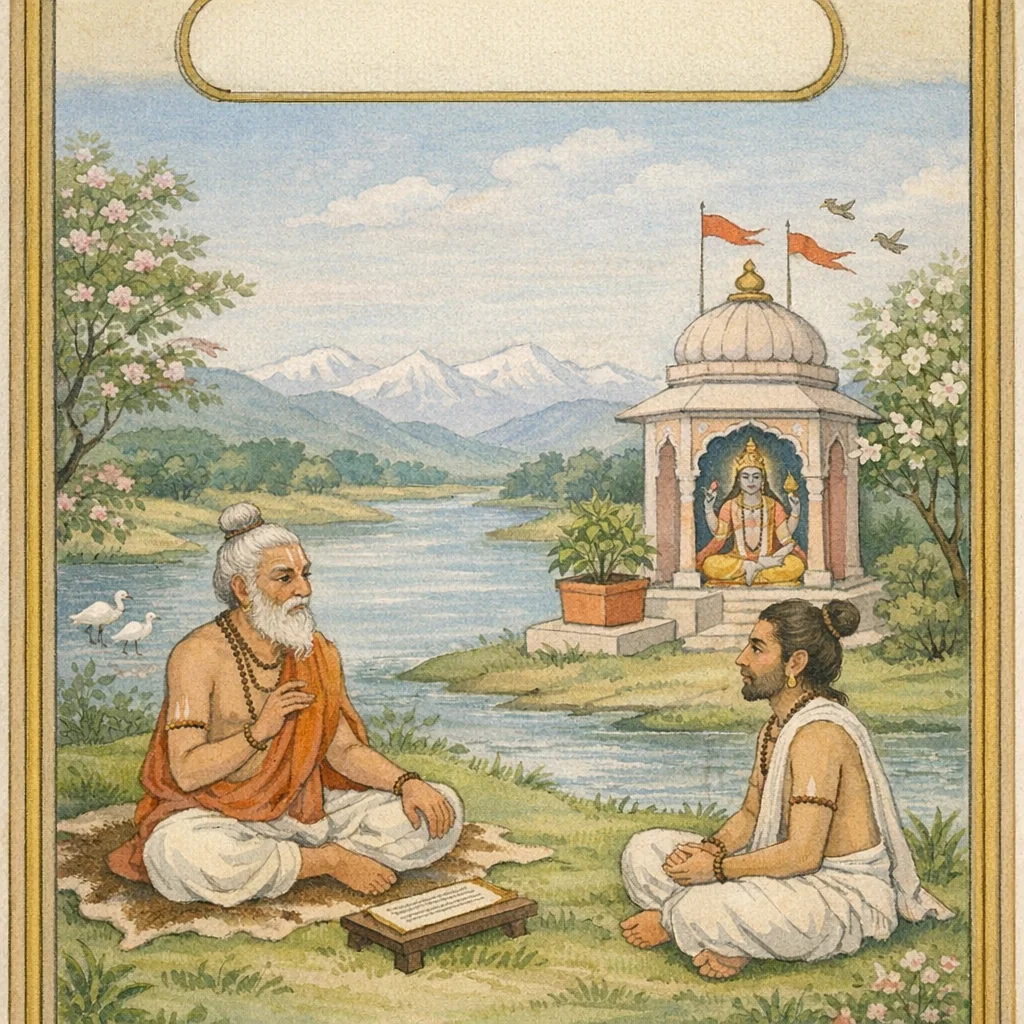
Śivaśarmā entrusts Somaśarmā with a pot of “amṛta” (nectar) and departs for pilgrimage and austerity. In time he returns to test his son through māyā, appearing as a leper in misery and displaying distressing forms meant to shake his resolve. Somaśarmā answers with compassion and unwavering guru-sevā: he cleans impurities, carries and removes filth, arranges tīrtha-bathing, offerings, and daily honors. Even when harshly rebuked and struck by his father, he remains free of anger and continues his service. When the pot seems emptied by illusion, Somaśarmā invokes satya and the truth of his devoted conduct. By the power of truth and dharma, the vessel fills again, revealing that inner integrity and faithful service—under Viṣṇu’s grace—overcome affliction and restore auspiciousness.
Shlokas
Verse 1
सूत उवाच । गतेषु तेषु गोलोकं वैष्णवं तमसः परम् । शिवशर्मा महाप्राज्ञः कनिष्ठं वाक्यमब्रवीत्
Sūta said: When they had departed to Goloka—the Vaiṣṇava realm beyond darkness—Śivaśarmā, the greatly wise, spoke words to the younger one.
Verse 2
ब्राह्मण उवाच । सोमशर्मन्महाप्राज्ञ त्वं पितुर्भक्तितत्परः । अमृतस्य महाकुंभं रक्ष दत्तं मयाधुना
The brāhmaṇa said: “O Somaśarman, greatly wise—since you are devoted to serving your father, protect this great pot of amṛta (nectar), which I now entrust to you.”
Verse 3
तीर्थयात्रां प्रयास्यामि अनया भार्यया सह । एवमस्तु महाभाग करिष्ये रक्षणं शुभम्
“I shall set out on pilgrimage to the sacred tīrthas together with this wife of mine.” — “So be it, O fortunate one; I shall provide auspicious protection.”
Verse 4
इति श्रीपद्मपुराणे भूमिखंडे शिवशर्मोपाख्याने चतुर्थोऽध्यायः
Thus ends the Fourth Chapter, the episode of Śivaśarmā, in the Bhūmi-khaṇḍa of the revered Padma Purāṇa.
Verse 5
कुंभं रक्षति धर्मात्मा दिवारात्रमतंद्रितः । पुनः स हि समायातः शिवशर्मा महायशाः
The righteous man guarded the pot, unwearied, day and night. Then Śivaśarmā, of great renown, returned once again.
Verse 6
मायां कृत्वा महाप्राज्ञो भार्यया सह तं सुतम् । कुष्ठरोगातुरो भूत्वा तस्य भार्या च तादृशी
Employing māyā, the greatly wise one, together with his wife, brought forth that son; and when he became afflicted with leprosy, his wife too became similarly stricken.
Verse 7
मांसपिंडोपमौ जातौ द्वावेतौ मायया कृतौ । संनिधिं तस्य घोरस्य विप्रस्य सोमशर्मणः
Two beings were produced, both resembling lumps of flesh; these two were fashioned by māyā, and they came into the presence of that dreadful brāhmaṇa, Somaśarman.
Verse 8
समागतौ हि तौ दृष्ट्वा सर्वतो हि सुदुःखितौ । कृपया परयाविष्टः सोमशर्मा महायशाः
Seeing those two arrive, grief-stricken on every side, the illustrious Somaśarmā was overwhelmed with profound compassion.
Verse 9
तयोः पादं नमस्कृत्य भक्त्या नमितकंधरः । भवादृशौ न पश्यामि तपसाभिसमन्वितम्
Having bowed in devotion and saluted their feet, his neck bent in reverence, he said: “I see none like you—so fully endowed with tapas, sacred austerity.”
Verse 10
गुणव्रातैः सुपुण्यैश्च किमिदं वर्तितं त्वयि । दासवद्देवताः सर्वा वर्तंते सर्वदा तव
By what multitude of virtues and meritorious deeds have you attained this—that all the gods continually attend upon you like servants?
Verse 11
आदेशं प्राप्य विप्रेंद्र आकृष्टास्तेजसा तव । तवांगे केन पापेन गदोयं वेदनान्वितः
O best of Brahmins, having received the command, we were drawn here by the radiance of your splendor. By what sin has this painful affliction arisen in your body, bringing such suffering?
Verse 12
संजातो ब्राह्मणश्रेष्ठ तन्मे कथय कारणम् । इयं पुण्यवती माता महापुण्या पतिव्रता
O best of brāhmaṇas, tell me the cause of this birth. This mother is virtuous—great in merit, a pativratā devoted to her husband.
Verse 13
या हि भर्तृप्रसादेन त्रैलोक्यं कर्तुमिच्छति । सा कथं दुःखमाप्नोति किं नास्ति तपसः फलम्
She who, by her husband’s grace, seeks to accomplish mastery over the three worlds—how could she ever fall into sorrow? Is there not, indeed, a fruit of austerity (tapas)?
Verse 14
रागद्वेषौ परित्यज्य विविधेनापि कर्मणा । या च शुश्रूषते कांतं देववद्गुरुवत्सला
Abandoning attachment and aversion, and serving through manifold deeds, she who diligently attends upon her beloved—loving him as a god and revering him as a guru—is praised.
Verse 15
सा कथं दुःखमाप्नोति कुष्ठरोगं सुदुःखदम् । शिवशर्मोवाच । मा शुचस्त्वं महाभाग भुज्यते कर्मजं फलम्
“How does she come to suffer—afflicted by leprosy, a disease of intense pain?” Śivaśarmā said: “Do not grieve, O noble one; the fruit born of one’s karma must be experienced.”
Verse 16
नरेण कर्मयुक्तेन पापपुण्यमयेन हि । शोधनं च कुरुष्व त्वमुभयो रोगयुक्तयोः
Indeed, through a man engaged in action—whose deeds are mixed with sin and merit—do you also bring about purification for both who are afflicted by disease.
Verse 17
शुश्रूषणं महाभाग यदि पुण्यमिहेच्छसि । एवमुक्ते शुभे वाक्ये सोमशर्मा महायशाः
“O noble one, if you desire merit in this world, practice attentive service.” When these auspicious words were spoken, the illustrious Somaśarmā…
Verse 18
शुश्रूषां वा करिष्यामि युवयोः पुण्ययुक्तयोः । मया पापेन दुष्टेन कृपणेन द्विजोत्तम
Or I shall render service to you both, who are endowed with merit. O best of brāhmaṇas, I—sinful, wicked, and wretched—speak thus.
Verse 19
किं कर्तव्यमिहाद्यैव यो गुरुं न हि पूजयेत् । एवमाभाष्य दुःखाद्वा तयोर्दुःखेन दुःखितः
“What should be done here—indeed, this very day—about one who does not honor the guru?” Having spoken thus, he became distressed, either from his own sorrow or from being pained by the sorrow of those two.
Verse 20
श्लेष्ममूत्रपुरीषं च उभयोः पर्यशोधयत् । पादप्रक्षालनं चक्रे अंगसंवाहनं तथा
He thoroughly cleansed away the phlegm, urine, and feces of them both; he then washed their feet and likewise massaged their limbs.
Verse 21
स्नानस्थानादिकं सोपि तयोर्भक्त्यान्वितः स्वयम् । द्वावेतौ हि गुरू विप्रः सोमशर्मा महायशाः
He himself too, filled with devotion to those two, pointed out the sacred bathing place and the other arrangements. Truly, these two are the gurus—so declares the illustrious brāhmaṇa Somaśarmā, of great renown.
Verse 22
तीर्थं नयति धर्मात्मा स्कंधमारोप्य सत्तमः । द्वावेतौ हि स्वहस्तेन स्नापयित्वा तु मंगलैः
That righteous and noble man, best among the good, bears them upon his shoulder and leads them to the sacred tīrtha; then, with his own hands, he bathes those two with auspicious rites and offerings.
Verse 23
सुमंत्रैर्वेदविच्चैव स्नानस्य विधिपूर्वकम् । तर्पणं च पितॄणां तु देवतानां तु पूजनम्
With auspicious mantras, and together with a knower of the Veda, one should perform the bathing in due and proper order; and one should also offer tarpaṇa to the ancestors and worship the deities.
Verse 24
द्वाभ्यामपि स धर्मात्मा स कारयति नित्यशः । स्वयं होमं ददात्यग्नौ पचत्यन्नमनुत्तमम्
That righteous-souled man has both of them perform their duties each day; and he himself offers the homa oblations into the fire and cooks food of unsurpassed excellence.
Verse 25
संज्ञापयति सुप्रीतौ द्वावेतौ च महागुरू । शय्यासने च तौ विप्रः प्रस्वापयति नित्यशः
That brāhmaṇa respectfully attends upon those two greatly revered gurus, who are well pleased; and every day he makes them rest, upon a bed and a seat.
Verse 26
वस्त्रपुष्पादिकं सर्वं ताभ्यां नित्यं प्रयच्छति । तांबूलं बहुगंधाढ्यमुभयोरर्पयेत्स तु
Each day he should offer to both of them everything—such as garments and flowers; and he should present to the two of them tāmbūla (betel) richly scented with many fragrances.
Verse 27
सोमशर्मा महाभागस्ताभ्यामपि च पूरयेत् । मूलं पयः सुभक्ष्याद्यं नित्यमेव ददात्यसौ
The greatly fortunate Somaśarmā satisfied even those two; every day he regularly gave them roots, milk, and other fine foods.
Verse 28
तयोस्तु वांछितं नित्यं सोमशर्मा महायशाः । अनेन क्रमयोगेन नित्यमेव प्रसादयेत्
Thus the illustrious Somaśarmā unfailingly obtained from those two whatever he desired; and by following this orderly method he continually kept them pleased.
Verse 29
सोमशर्मा सुधर्मात्मा पितरौ परिपूजयेत् । सोमशर्माणमाहूय पिता कुत्सति निष्ठुरः
Somaśarmā, righteous at heart, duly honored his parents. Yet when he called Somaśarmā to him, his father harshly reviled him.
Verse 30
निंदितैर्निष्ठुरैर्वाक्यैस्ताडयेन्मुनिसन्निधौ । कृतकार्ये कृते पुण्ये नित्यमेव सुते पुनः
In the presence of a sage, one should chastise with censuring and harsh words; and again, when a task has been accomplished and merit has been earned, one should continually do so to one’s son.
Verse 31
न कृतं शोभनं मह्यं त्वयैव कुलपांसन । एवं नानाविधैर्वाक्यैर्निष्ठुरैर्दुःखदायकैः
You—O disgrace to the family—have done nothing good for me. Thus you have spoken with many kinds of harsh, pain-causing words.
Verse 32
अताडयद्दंडघातैः शिवशर्मा सदातुरः । एवं कृतेपि धर्मात्मा नैव कुप्यति कर्हिचित्
Śivaśarmā, ever agitated, struck him with blows of a staff; yet even when treated so, that righteous-souled one never became angry at any time.
Verse 33
मनसा वचसा चैव कर्मणा त्रिविधेन च । संतुष्टः सर्वदा सोपि पितरं परिपूजयेत्
With mind, speech, and action—by this threefold means—being ever content, one should always duly honor and worship one’s father.
Verse 34
तद्वत्स सोमशर्मा वै मातरं च दिनेदिने । यज्ज्ञात्वा शिवशर्मा च चरितं स्वीयमीक्षते
“In the same way, Somaśarmā too attended upon his mother day after day; and having come to know this, Śivaśarmā reflected upon his own conduct.”
Verse 35
अमृतं मत्कृते चापि आनीतं विष्णुशर्मणा । पुण्ययुक्तः स धर्मात्मा पितृभक्तिपरः सदा
And for my sake, Viṣṇuśarman brought amṛta as well—the sacred nectar. He was endowed with merit, righteous in soul, and ever devoted to serving and honoring his forefathers.
Verse 36
एवं बहुतिथे काले शतसंख्ये गते सति । शिवशर्मा पितस्यैव भक्तिं दृष्ट्वा विचिंत्य वै
Thus, after a long time had passed—indeed, after hundreds had gone by—Śivaśarmā, seeing his father’s very devotion, reflected upon it.
Verse 37
मया वै पूर्वमित्युक्तं सुपुत्रं यज्ञसंज्ञकम् । मातृखंडानिमान्पुत्र यत्र तत्र क्षिपस्व हि
Indeed, as I told you earlier, my good son—(you who are) named Yajña—cast these pieces of the Mother (mātṛ-khaṇḍas) wherever you may.
Verse 38
मद्वाक्यं पालितं तेन कृता न मातरि कृपा । एतत्स्वल्पतरं दुःखं निर्जीवे घातमिच्छतः
He obeyed my words, yet he showed no compassion toward his mother. This is a lesser sorrow compared to the grief of one who wishes to strike down a living being.
Verse 39
साहसं तु कृतं तेन पुत्रेण वेदशर्मणा । अस्याधिकमहं मन्ये यतोऽयं चलते न च
But that son, Vedaśarman, committed a rash act. Yet I consider this to be even more remarkable—because this one does not move at all.
Verse 40
निमेषमात्रमेवापि साहसं कारयेत्पुनः । अपरं सत्यसंपन्नं प्रभावं तपसः पुनः
Even in the space of a single blink, austerity (tapas) can again bring about a bold, extraordinary feat. Yet another, higher power of austerity is this: it is fulfilled through truth.
Verse 41
नित्यं समाराधनेपि अधिकं चास्य दृश्यते । तस्मादस्य परीक्षा च समये तपसः कृता
Even in his constant worship, something exceptional is seen in him; therefore, at the proper time, he was tested through ascetic discipline (tapas).
Verse 42
भक्तिभावात्तथा सत्यान्नैव पुत्रः प्रणश्यति । मायया च निजांगेऽपि कुष्ठरोगो निदर्शितः
Through the power of devotion and through truthfulness, the son does not perish; and by divine māyā, even upon one’s own body, the affliction of leprosy was displayed.
Verse 43
श्लेष्ममूत्रमलानां च घृणां नैव करोति च । व्रणान्विशोधयेन्नित्यं स्वहस्तेन महायशाः
He feels no disgust for phlegm, urine, or excrement, and the illustrious one regularly cleanses wounds with his own hand.
Verse 44
पादसंवाहनं दद्याच्छौचं चैव महामतिः । दुःसहं वचनं मह्यं दारुणं सहते सदा
The wise person should offer foot-massage and maintain cleanliness; for she, for my sake, always endures harsh and unbearable words, cruelly spoken.
Verse 45
भर्त्सने ताडने चैव सदाभीष्टप्रवाचकः । एवं दुःखसमाचारो मम पुत्रो महामतिः
He is ever ready with words that please—yet he also rebukes and even strikes. Such is the bearer of sorrowful tidings: my son, though of great intellect.
Verse 46
दुःखानां सागरं मन्ये बहुक्लेशैस्तु क्लेशितः । अपनेष्याम्यहं दुःखं विष्णोश्चैव प्रसादतः
I deem myself an ocean of sorrows, afflicted by many hardships; yet by the grace of Viṣṇu I shall cast off this suffering.
Verse 47
विचार्य मनसा विप्रः शिवशर्मा महामतिः । पुनर्मायां चकाराथ कुंभादपहृतं पयः
Having reflected in his mind, the great-minded brāhmaṇa Śivaśarmā again employed his māyā, and thus took away the milk from the pot.
Verse 48
पश्चात्तं च समाहूय सोमशर्माणमब्रवीत् । तव हस्ते मया दत्तममृतं व्याधिनाशनम्
Then, summoning him, he said to Somaśarmā: “In your hand I have placed the amṛta, the nectar that destroys disease.”
Verse 49
तन्मे शीघ्रं प्रयच्छस्व यथा पानं करोम्यहम् । येन नीरुग्भवाम्यद्य प्रसादाद्विष्णुशर्मणः
So give it to me quickly, that I may drink it; by the grace of Viṣṇuśarman may I become free from illness today.
Verse 50
एवमुक्ते तदा वाक्ये ऋषिणा शिवशर्मणा । समुत्थाय त्वरायुक्तः सोमशर्मा कमंडलुम्
When the sage Śivaśarman had spoken those words, Somaśarman at once rose swiftly and took up his kamaṇḍalu, the water-pot.
Verse 51
तं च रिक्तं ततो दृष्ट्वा ह्यमृतेन विना कृतम् । कस्य पापस्य वै कर्म केन मे विप्रियं कृतम्
Then, seeing it empty—deprived of the amṛta—he said: “What deed born of sin is this? By whom has this wrong been done to me?”
Verse 52
इति चिंतापरो भूत्वा सोमशर्मा सुदुःखितः । पितुरग्रे च वृत्तांतं कथयिष्याम्यहं यदा
Thus, absorbed in worry and deeply distressed, Somaśarmā thought: “When I stand before my father, I shall relate to him the entire account.”
Verse 53
ततः कोपं प्रयास्येत गुरुर्मे व्याधिपीडितः । सुचिरं चिंतयित्वा तु सोमशर्मा महामतिः
Then he thought: “My teacher, afflicted by illness, may become angry.” Having reflected for a long time, the great-minded Somaśarmā considered what should be done.
Verse 54
यदि मे सत्यमस्तीति गुरुशुश्रूषणं यदि । तपस्तप्तं मयापूर्वं निर्व्यलीकेन चेतसा
If it is true that I possess truthfulness; if I have indeed served my teacher; if formerly I performed tapas with a mind free from deceit—
Verse 55
दमशौचादिभिः सत्यं धर्ममेव प्रपालितम् । तदा घटोऽमृतयुतो भवत्वेष न संशयः
If, through self-control, purity, and kindred virtues, I have upheld truth and dharma, then this pot shall indeed be filled with amṛta—of this there is no doubt.
Verse 56
यावदेव महाभागश्चिंतयित्वा विलोकयेत् । तावच्चामृतपूर्णस्तु पुनरेवाभवद्घटः
As soon as the fortunate one reflected and looked, in that very moment the pot once again became filled with amṛta, the sacred nectar.
Verse 57
तं दृष्ट्वा हर्षसंयुक्तः सोमशर्मा महायशाः । गत्वा गुरुं नमस्कृत्य कुंभमादाय सत्वरम्
Seeing it, the illustrious Somaśarmā—filled with joy—went to his teacher, bowed in reverence, and quickly took up the water-pot.
Verse 58
गृहाण त्वं पितश्चेमं पयः कुंभं समागतम् । पानं कुरु महाभाग गदान्मुक्तो भवाचिरम्
Father, please accept this pot of milk that has been brought here. Drink it, O fortunate one, and you will soon be freed from your illness.
Verse 59
एतद्वाक्यं महापुण्यं सत्यधर्मार्थकं पुनः । शिवशर्मा सुतस्यापि श्रुत्वा च मधुराक्षरम्
Hearing these words—most meritorious, again expressive of truth, dharma, and right purpose, and sweet in syllables—Śivaśarmā listened, even though they came from his son.
Verse 60
हर्षेण महताविष्ट इदं वचनमब्रवीत्
Overwhelmed with great joy, he spoke these words.