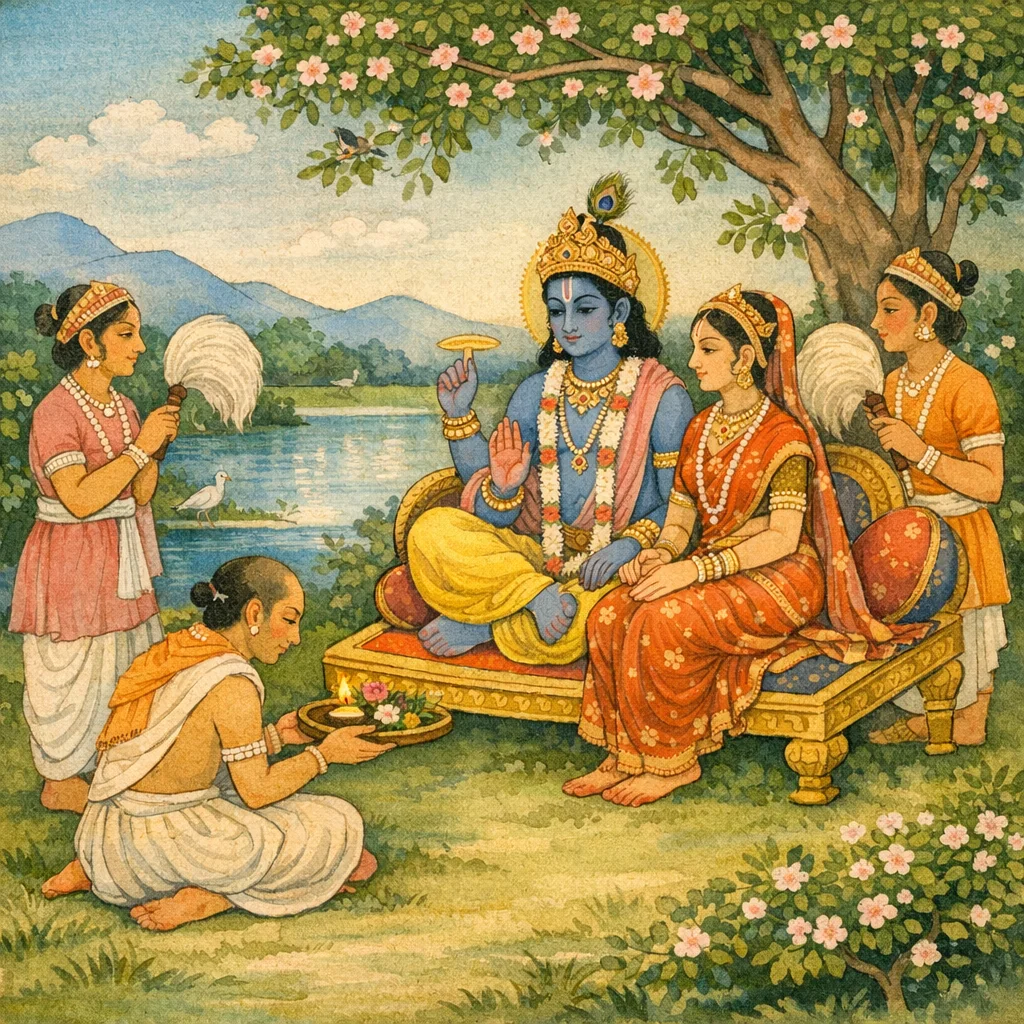
Adhyaya 17
Narrative of Sumanā: The Quest for a Worthy Son and the Karmic Roots of Poverty
Somaśarmā asks how to obtain a son who is omniscient and virtuous. On Sumanā’s advice he goes to the Gaṅgā’s bank, offers reverent prostrations to Vasiṣṭha, and is welcomed by the sages and invited to state his doubt. He inquires into the cause of poverty and why happiness through children does not arise. Vasiṣṭha defines a “worthy son” as one who is truthful, learned in scripture, charitable, self-controlled, devoted to meditation on Viṣṇu, and obedient and loving toward his parents. Vasiṣṭha then explains the karmic root: in a former birth the questioner, overcome by greed, neglected giving, worship, and śrāddha, and hoarded wealth—therefore poverty has come in this life. The chapter concludes that prosperity, a spouse, and the continuance of lineage arise only by the grace of Viṣṇu.
Shlokas
Verse 1
सोमशर्मोवाच । सर्वं देवि समाख्यातं धर्मसंस्थानमुत्तमम् । कथं पुत्रमहं विंद्यां सर्वज्ञं गुणसंयुतम्
Somaśarmā said: “O Goddess, you have fully explained the supreme establishment of Dharma. How may I obtain a son—omniscient and endowed with virtues?”
Verse 2
वद त्वं मे महाभागे यदि जानासि सुव्रते । दानधर्मादिकं भद्रे परत्रेह न संशयः
Tell me, O greatly fortunate lady of noble vows, if you know: O auspicious one, regarding charity, duty, and the like—there is no doubt about their fruits both here and hereafter.
Verse 3
सुमनोवाच । वसिष्ठं गच्छ धर्मज्ञं तं प्रार्थय महामुनिम् । तस्मात्प्राप्स्यसि वै पुत्रं धर्मज्ञं धर्मवत्सलम्
Sumana said: “Go to Vasiṣṭha, the knower of Dharma, and entreat that great sage. From him you will surely obtain a son—one who knows Dharma and is devoted to righteousness.”
Verse 4
सूत उवाच । एवमुक्ते तया वाक्ये सोमशर्मा द्विजोत्तमः । एवं करिष्ये कल्याणि तव वाक्यं न संशयः
Sūta said: When she had spoken these words, Somaśarmā, the best of brāhmaṇas, replied, “So shall I do, O auspicious lady; there is no doubt that I will follow your words.”
Verse 5
एवमुक्त्वा जगामाशु सोमशर्मा द्विजोत्तमः । वसिष्ठं सर्ववेत्तारं दिव्यं तं तपतां वरम्
Having spoken thus, Somaśarmā—the best of brāhmaṇas—quickly went to Vasiṣṭha, the all-knowing, divine sage, the foremost among ascetics.
Verse 6
गंगातीरे स्थितं पुण्यमाश्रमस्थं द्विजोत्तमम् । तेजोज्वालासमाकीर्णं द्वितीयमिव भास्करम्
On the bank of the Gaṅgā stood a sacred āśrama, where the foremost of the twice-born dwelt—encircled by blazing radiance, like a second sun.
Verse 7
राजमानं महात्मानं ब्रह्मण्यं च द्विजोत्तमम् । भक्त्या प्रणम्य विप्रेशं दंडवच्च पुनः पुनः
With devotion he bowed again and again—prostrating like a staff—before that illustrious great-souled one, the foremost of Brahmins, devoted to Brahmanical righteousness.
Verse 8
तमुवाच महातेजा ब्रह्मसूनुरकल्मषः । उपाविशासने पुण्ये सुखेन सुमहामते
Then the radiant, sinless son of Brahmā said to him: “O most wise one, sit at ease upon this sacred seat.”
Verse 9
एवमुक्त्वा स योगींद्रः पुनः प्राह तपोधनम् । गृहे पुत्रेषु ते वत्स दारभृत्येषु सर्वदा
Having spoken thus, that lord among yogins again addressed the ascetic rich in austerity: “Dear child, at all times—concerning your home, your sons, your wife, and your servants…”
Verse 10
क्षेममस्ति महाभाग पुण्यकर्मसु चाग्निषु । निरामयोसि चांगेषु धर्मं पालयसे सदा
“O fortunate one, may all be well with you—in your meritorious rites and in the sacred fires. May you be free from illness in every limb, and may you always uphold dharma.”
Verse 11
एवमुक्त्वा महाप्राज्ञः पुनः प्राह सुशर्मणम् । किं करोमि प्रियं कार्यं सुप्रियं ते द्विजोत्तम
Having spoken thus, the greatly wise one again addressed Suśarman: “What pleasing deed shall I do—what act is most dear to you, O best of the twice-born?”
Verse 12
एवं संभाषितं विप्रं विरराम स कुंभजः । तस्मिन्नुक्ते महाभागे वसिष्ठे मुनिपुंगवे
Having thus addressed the Brahmin, the sage born of the pot (Agastya) fell silent. When this had been spoken to the highly fortunate Vasiṣṭha, foremost among sages, he then continued.
Verse 13
स होवाच महात्मानं वसिष्ठं तपतां वरम् । भगवञ्छ्रूयतां वाक्यं सुप्रसन्नेन चेतसा
He then addressed the great-souled Vasiṣṭha, foremost among ascetics: “O Blessed One, please hear my words with a mind wholly serene and gracious.”
Verse 14
यदि मे सुप्रियं कार्यं त्वयैव मुनिपुंगव । मम प्रश्नार्थसंदेहं विच्छेदय द्विजोत्तम
“If you wish to do what is most dear to me, O foremost of sages, then dispel the doubt bound up with the meaning of my question, O best of the twice-born.”
Verse 15
दारिद्र्यं केन पापेन पुत्रसौख्यं कथं नहि । एतन्मे संशयं तात कस्मात्पापाद्वदस्व मे
“By what sin does poverty arise, and why does one not attain happiness through children? This is my doubt, revered sir—tell me from which sin this comes.”
Verse 16
महामोहेन संमुग्धः प्रियया बोधितो द्विज । तयाहं प्रेषितस्तात तव पार्श्वं समातुरः
Blinded by great delusion, I was awakened by my beloved. O brāhmaṇa, she has sent me, revered sir, and thus I have come to your side in deep distress.
Verse 17
इति श्रीपद्मपुराणेभूमिखंडेएंद्रे सुमनोपाख्यानेसप्तदशोऽध्यायः
Thus ends the seventeenth chapter, the “Narrative of Sumanā,” in the Bhūmi-khaṇḍa of the revered Padma Purāṇa, in the section concerning Indra.
Verse 18
वसिष्ठ उवाच । पुत्रा मित्राण्यथ भ्राता अन्ये स्वजनबांधवाः । पंचभेदास्तु संभेदात्पुरुषस्य भवंति ते
Vasiṣṭha said: Sons, friends, brothers, and other relatives and kinsmen—these become the five divisions of a person, arising from their respective distinctions.
Verse 19
ते ते सुमनया प्रोक्ताः पूर्वमेव तवाग्रतः । ऋणसंबंधिनः सर्वे ते कुपुत्रा द्विजोत्तम
Those very ones were already spoken of to you earlier by Sumanā, in your presence. All of them are bound by debt-relationships—those unworthy sons, O best of the twice-born.
Verse 20
पुत्रस्य लक्षणं पुण्यं तवाग्रे प्रवदाम्यहम् । पुण्यप्रसक्तो यस्यात्मा सत्यधर्मरतः सदा
I shall now declare before you the sacred marks of a worthy son: one whose very soul is devoted to merit, and who is always devoted to truth and righteousness.
Verse 21
शुद्धिविज्ञानसंपन्नस्तपस्वी वाग्विदां वरः । सर्वकर्मसुसंधीरो वेदाध्ययनतत्परः
Endowed with purity and true discernment, an ascetic, the foremost among those learned in sacred speech; steady and wise in every duty, and devoted to the study of the Vedas.
Verse 22
स सर्वशास्त्रवेत्ता च देवब्राह्मणपूजकः । याजकः सर्वयज्ञानां दाता त्यागी प्रियंवदः
He is a knower of all Śāstras, a worshipper of the Devas and a reverent servant of the Brāhmaṇas; he officiates at every Yajña, gives generously, is self-sacrificing, and speaks with pleasing grace.
Verse 23
विष्णुध्यानपरो नित्यं शांतो दांतः सुहृत्सदा । पितृमातृपरोनित्यं सर्वस्वजनवत्सलः
Ever devoted to meditation on Viṣṇu, peaceful, self-controlled, and always a well-wisher; ever devoted to father and mother, and affectionate toward all his own as though they were his very self.
Verse 24
कुलस्य तारको विद्वान्कुलस्य परिपोषकः । एवं गुणैश्च संयुक्तः सपुत्रः सुखदायकः
A learned son is the savior and guiding light of the family, the nourisher and sustainer of the lineage. Endowed with such virtues, that son becomes a giver of happiness.
Verse 25
अन्ये संबंधसंयुक्ताः शोकसंतापदायकाः । एतादृशेन किं कार्यं फलहीनेन तेन च
Other associations, though called “relationships,” bring only grief and burning distress. What use is such a bond—one that bears no true fruit?
Verse 26
आयांति यांति ते सर्वे तापं दत्वा सुदारुणम् । पुत्ररूपेण ते सर्वे संसारे द्विजसत्तम
They all come and go, inflicting exceedingly dreadful suffering; and all of them, O best of the twice-born, appear in worldly life in the form of sons.
Verse 27
पूर्वजन्मकृतं पुण्यं यत्त्वया परिपालितम् । तत्सर्वं हि प्रवक्ष्यामि श्रूयतामद्भुतं पुनः
That merit which you earned in a former birth—and which you have safeguarded—I shall now indeed recount in full. Listen again to this wondrous account.
Verse 28
वसिष्ठ उवाच । भवाञ्छूद्रो महाप्राज्ञ पूर्वजन्मनि नान्यथा । कृषिकर्त्ता ज्ञानहीनो महालोभेन संयुतः
Vasiṣṭha said: “O highly intelligent one, in your former birth you were indeed a Śūdra—no otherwise—an agricultural worker, lacking in true knowledge, and driven by great greed.”
Verse 29
एकभार्या सदा द्वेषी बहुपुत्रो ह्यदत्तवान् । धर्मं नैव विजानासि सत्यं नैव परिश्रुतम्
Though you have but one wife, you are ever hostile; though you have many sons, you are not charitable. You do not truly understand dharma, nor have you properly learned the truth.
Verse 30
दानं नैव त्वया दत्तं शास्त्रं नैव प्रतिश्रुतम् । कृता नैव त्वया तीर्थे यात्रा चैव महामते
You have not given charity at all; you have not even pledged yourself to the teachings of the śāstras. Nor have you undertaken a pilgrimage to a sacred tīrtha, O great-minded one.
Verse 31
एवं कृतं त्वया विप्र कृषिमार्गं पुनः पुनः । पशूनां पालनं सर्व गवां चैव द्विजोत्तम
Thus, O brāhmaṇa, you have again and again followed the path of agriculture; and you have cared for all creatures—especially the cows, O best of the twice-born.
Verse 32
महिषीणां तथाऽश्वानां पालनं च पुनः पुनः । एवं पू र्वंकृतं कर्म त्वयैव द्विजसत्तम
Again and again you have tended and cared for the buffaloes and the horses. Thus, O best among the twice-born sages, this very deed was performed by you in the past as well.
Verse 33
विपुलं च धनं तद्वल्लोभेन परिसंचितम् । तस्य व्ययं सुपुण्येन न कृतं तु त्वया कदा
And that abundant wealth was amassed by you through sheer greed; yet never, at any time, did you expend it in deeds of true merit (puṇya).
Verse 34
पात्रे दानं न दत्तं तु दृष्ट्वा दुर्बलमेव च । कृपां कृत्वा न दत्तं तु भवता धनमेव च
Even after seeing a worthy recipient—and also seeing one who was weak—you did not offer dāna (charity). Even after compassion arose, you still did not give of your wealth.
Verse 35
गोमहिष्यादिकं सर्वं पशूनां संचितं त्वया । विक्रीय च धनं विप्र संचितं विपुलं त्वया
You have amassed every kind of livestock—cows, buffaloes, and the rest. And, O brāhmaṇa, by selling them you have also accumulated abundant wealth.
Verse 36
तक्रं घृतं तथा क्षीरं विक्रयित्वा ततो दधि । दुष्कालं चिंतितं विप्र मोहितो विष्णुमायया
Having sold buttermilk, ghee, and milk, and then even curd, he—O brāhmaṇa—grew anxious about a time of famine, deluded by Viṣṇu’s māyā.
Verse 37
कृतं महार्घमेवात्र अन्नं ब्राह्मणसत्तम । निर्दयेन त्वया दानं न दत्तं तु कदाचन
Here, costly food was indeed prepared, O best of brāhmaṇas; yet you, being pitiless, never gave charity (dāna) at any time.
Verse 38
देवानां पूजनं विप्र भवता न कृतं कदा । प्राप्य पर्वाणि विप्रेभ्यो द्रव्यं न च समर्पितम्
O brāhmaṇa, you have never performed worship of the devas; and when festival days and sacred observances arrived, you offered no gifts or wealth to the brāhmaṇas.
Verse 39
श्राद्धंकालंतुसंप्राप्यश्रद्धयानकृतंत्वया । भार्या वदति ते साध्वी दिनमेनं समागतम्
When the time for the śrāddha had arrived, you did not perform it with faith. Your virtuous wife says to you, “This very day has come.”
Verse 40
श्वशुरस्य श्राद्धकालः श्वश्र्वाश्चैव महामते । त्वं श्रुत्वा तद्वचस्तस्या गृहं त्यक्त्वा पलायसे
“O wise one, it is the time for your father-in-law’s śrāddha, and for your mother-in-law’s as well. Yet, having heard her words, you abandon the house and run away.”
Verse 41
धर्ममार्गं न दृष्टं ते श्रुतं नैव कदा त्वया । लोभो मातापिता भ्राता लोभः स्वजनबांधवाः
You have neither seen the path of dharma nor ever heard of it. For you, greed is your mother and father; greed your brother; greed alone is your own kin and companions.
Verse 42
पालितं लोभमेवैकं त्यक्त्वा धर्मं सदैव हि । तस्माद्दुःखी भवाञ्जातो दरिद्रेणातिपीडितः
You have nurtured only greed, always abandoning dharma; therefore you have become sorrowful, grievously afflicted by poverty.
Verse 43
दिनेदिने महातृष्णा हृदये ते प्रवर्द्धते । यदायदा गृहे द्रव्यं वृद्धिमायाति ते तदा
Day by day, a great craving grows in your heart; and whenever the wealth in your house increases, that craving grows all the more.
Verse 44
तृष्णया दह्यमानस्तु तया त्वं वह्निरूपया । रात्रौ वा सुप्रसुप्तस्तु निश्चितो हि प्रचिंतसि
Burned by craving—by that very thirst which takes the form of fire—you, even when deeply asleep at night, still surely keep brooding over it.
Verse 45
दिनं प्राप्य महामोहैर्व्यापितोसि सदैव हि । सहस्रं लक्षं मे कोटिः कदा अर्बुदमेव च
Day after day you are always enveloped by great delusion: “A thousand, a lakh, a crore—when will I obtain even an arbuda?”
Verse 46
भविष्यति कदा खर्वो निखर्वश्चाथ मे गृहे । एवं सहस्रं लक्षं च कोटिरर्बुदमेव च
When, in my house, will there be wealth in measures such as a kharva and a nikharva—likewise a thousand, a lakh, a crore, and indeed an arbuda as well?
Verse 47
खर्वो निखर्वः संजातस्तृष्णा नैव प्रगच्छति । तव कायं परित्यज्य वृद्धिमायाति सर्वदा
Though diminished, one becomes further diminished; craving never truly departs. Casting aside the body, it always returns again, growing ever stronger.
Verse 48
नैव दत्तं हुतं विप्र भुक्तं नैव कदा त्वया । खनितं भूमिमध्ये तु क्षिप्तं पुत्रानजानते
O brāhmaṇa, you have never given in charity, never offered oblations, nor even enjoyed what you had at any time. Instead, you dug it into the middle of the earth and buried it—without your sons even knowing.
Verse 49
अन्यमेवमुपायं तु द्रव्यागमनकारणात् । कुरुषे सर्वदा विप्र लोकान्पृच्छसि बुद्धिमान्
But for the sake of acquiring wealth you always adopt such other means, O brāhmaṇa; being intelligent, you keep questioning people.
Verse 50
खनित्रमंजनं वादं धातुवादमतः परम् । पृच्छमानो भ्रमस्येकस्तृष्णया परिमोहितः
He inquired about mining, about añjana (collyrium of antimony), about disputation, and then about the doctrine concerning minerals and metals—alone, wandering in delusion, thoroughly bewildered by craving.
Verse 51
स्पर्शंचिंतयसेनित्यंकल्पान्सिद्धिप्रदायकान् । प्रवेशं विवराणां तु चिंतमानः सु पृच्छसि
You continually contemplate the kalpas, the rites that bestow attainment through sacred touch (sparśa). And as you ponder entry into the crevices and openings, you ask rightly.
Verse 52
तृष्णानलेन दग्धेन सुखं नैव प्रगच्छसि । तृष्णानलेन संदीप्तो हाहाभूतो विचेतनः
Burned by the fire of craving, you do not attain happiness at all. Inflamed by that very fire of desire, you become senseless, crying out, “Alas! Alas!”
Verse 53
एवं मुग्धोसि विप्रेंद्र गतस्त्वं कालवश्यताम् । दारापुत्रेषु तद्द्रव्यं पृच्छमानेषु वै त्वया
Thus you are deluded, O best of brāhmaṇas; you have fallen under the dominion of Time. And when your wife and sons questioned you about that wealth, you indeed had no answer.
Verse 54
कथितं नैव वृत्तांतं प्राणांस्त्यक्त्वा गतो यमम् । एवं सर्वं मया ख्यातं वृत्तांतं तव पूर्वकम्
He did not relate the account at all; abandoning his life-breath, he went to Yama. Thus, I have explained to you in full the earlier account concerning you.
Verse 55
अनेन कर्मणा विप्र निर्धनोसि दरिद्रवान् । संसारे यस्य सत्पुत्रा भक्तिमंतः सदैव हि
By this deed, O brāhmaṇa, you have become penniless and impoverished; yet in the world, your virtuous sons are always devoted, ever full of bhakti.
Verse 56
सुशीला ज्ञानसंपन्नाः सत्यधर्मरताः सदा । संभवंति गृहे तस्य यस्य विष्णुः प्रसीदति
In the home of one with whom Viṣṇu is pleased, there continually arise and dwell people of good conduct, endowed with knowledge, and ever devoted to truth and dharma.
Verse 57
धनं धान्यं कलत्रं तु पुत्रपौत्रमनंतकम् । स भुंक्ते मर्त्यलोके वै यस्य विष्णुः प्रसन्नवान्
Wealth, grain, a spouse, and an unending line of sons and grandsons—one truly enjoys these in the human world when Lord Viṣṇu is pleased with him.
Verse 58
विना विष्णोः प्रसादेन दारापुत्रान्न चाप्नुयात् । सुजन्म च कुलं विप्र तद्विष्णोः परमं पदम्
Without the grace of Viṣṇu, one does not obtain a wife and sons; nor a good birth and noble lineage, O brāhmaṇa—this is the supreme station of Viṣṇu.