Adhyaya 49
The Account of Sukalā (Vena-Episode Continuation): Padmāvatī, Gobhila’s Deception, and the Threat of a Curse
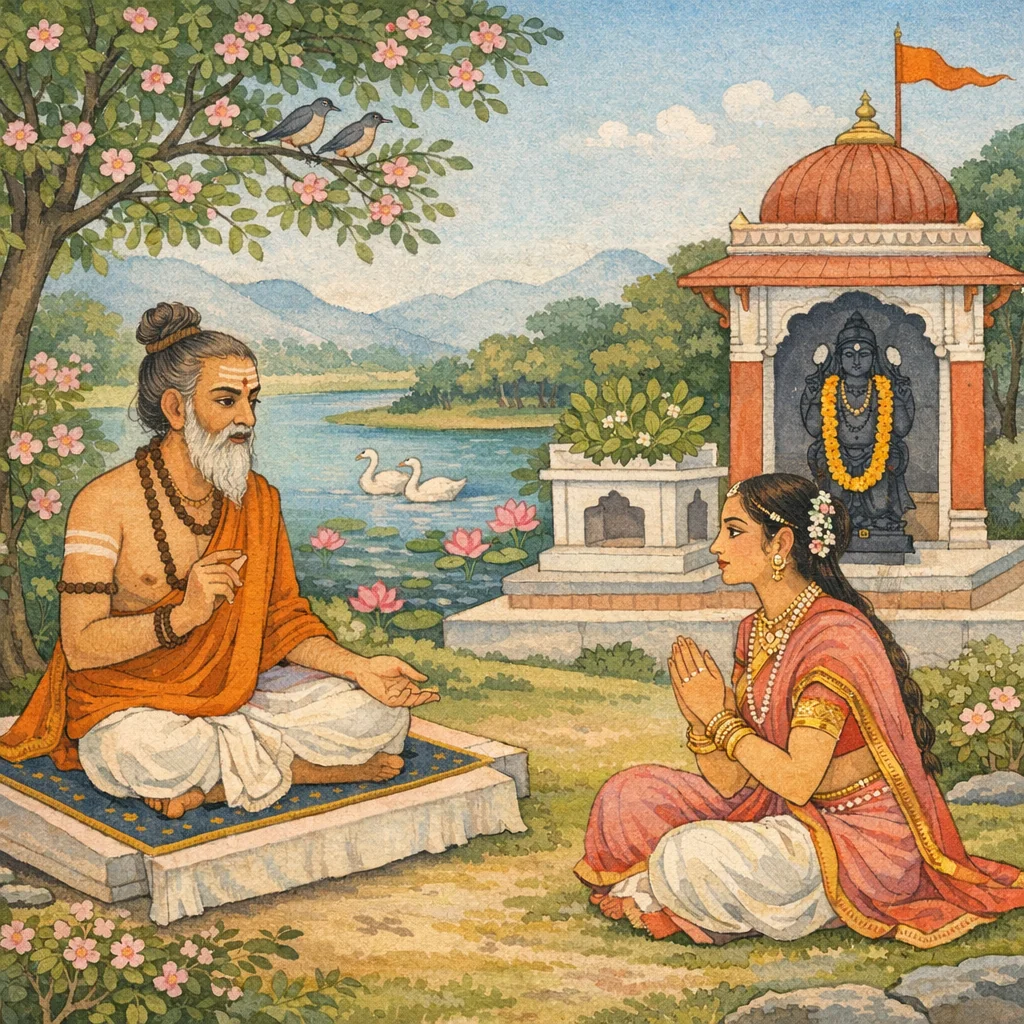
Chapter 49 opens with an extended sacred-landscape tableau: a mountain forest thick with śāla, tāla, tamāla, coconut, areca, citrus, champaka, pāṭala, aśoka, and bakula, and a lotus pond alive with birds, bees, and sweet sounds. Into this tīrtha-like serenity comes Padmāvatī, the princess of Vidarbha, sporting with her companions. Within the tale—framed with quoted words of Viṣṇu—Gobhila is introduced, a daitya connected with Vaiśravaṇa. Seeing Padmāvatī, he is seized by desire and resolves to obtain her through māyā: he assumes Ugrasena’s form and stages alluring music. Though Padmāvatī is praised as pātivratā, she becomes vulnerable to deception; she is led into seclusion and violated. The chapter closes in moral outrage: Sukalā/Padmāvatī’s grief hardens into a resolve to curse Gobhila. The episode stands as a warning against lust, disguise, and the precariousness of social and religious vows when assailed by deceit.
Shlokas
Verse 1
ब्राह्मण्युवाच । एकदा तु महाभाग गता सा पर्वतोत्तमे । रमणीयं वनं दृष्ट्वा कदलीखंडमंडितम्
The Brahmin woman said: “Once, O greatly fortunate one, she went to the best of mountains. There she saw a delightful forest, adorned with groves of banana trees.”
Verse 2
शालैस्तालैस्तमालैश्च नालिकेरैस्तथोत्कटैः । पूगीफलैर्मातुलिगैर्नारंगैश्चारुजंबुकैः
It was filled with śāla and tāla trees, and tamāla as well; with coconut palms and other luxuriant growths; with areca-nuts, citrons, oranges, and lovely jambu fruits.
Verse 3
चंपकैः पाटलैः पुण्यैः पुष्पितैः कुटकैर्वटैः । अशोकबकुलोपेतं नानावृक्षैरलंकृतम्
It was adorned with champaka and pāṭala trees—holy and in full bloom—with clusters of trees and banyans; graced with aśoka and bakula, and beautified by many kinds of trees.
Verse 4
पर्वतं पुण्यवंतं तं पुष्पितैश्च नगोत्तमैः । सर्वत्र दृश्यते रम्यो नानाधातुसमाकुलः
That sacred mountain—adorned with the finest, flower-laden trees—appears everywhere as a delightful sight, richly variegated with many kinds of minerals.
Verse 5
तडागं सर्वतोभद्रं पुण्यतोयेन पूरितम् । कमलैः पुष्पितैश्चान्यैः सुगंधैः कनकोत्पलैः
A most auspicious pond, blessed on every side, was filled with holy water—adorned with blooming lotuses and other fragrant flowers, including golden water-lilies.
Verse 6
श्वेतोत्पलैर्विभासंतं रक्तोत्पलसुपुष्पितैः । नीलोत्पलैश्च कह्लारैर्हंसैश्च जलकुक्कुटैः
It shone with white lotuses, blossomed richly with red lotuses, and was filled with blue lotuses and water-lilies, along with swans and waterfowl.
Verse 7
पक्षिभिर्जलजैश्चान्यैर्नानाधातुसमाकुलः । तडागं सर्वतः शुभ्रं नानापक्षिगणैर्युतम्
The pond was thronged with birds, aquatic creatures, and other beings, and was suffused with various minerals; it shone white on all sides and was accompanied by many flocks of birds.
Verse 8
कोकिलानां रुतैः पुण्यैः सुस्वरैः परिशोभितः । मधुराणां तथा शब्दैः सर्वत्र मधुरायते
Adorned by the pure, melodious calls of cuckoos, and by other sweet sounds as well, the place becomes delightful everywhere—sweet in every direction.
Verse 9
षट्पदानां सुनादेन सर्वत्र परिशोभते । एवंविधं गिरिं रम्यं तदेव वनमुत्तमम्
With the sweet humming of the bees, it shines beautifully everywhere. Such a delightful mountain—such indeed is the finest forest.
Verse 10
तडागं सर्वतोभद्रं ददृशे नृपनंदिनी । वैदर्भी क्रीडमाना सा सखीभिः सहिता तदा
Then the king’s daughter—the princess of Vidarbha—while sporting together with her friends, beheld an auspicious pond, beautiful on every side.
Verse 11
समालोक्य वनं पुण्यं सर्वत्र कुसुमाकुलम् । चापल्येन प्रभावेण स्त्रीभावेन च लीलया
Having looked upon that holy forest—everywhere filled and crowded with blossoms—she moved about as if in sport, with playful restlessness, radiant influence, and a womanly mood.
Verse 12
पद्मावती सरस्तीरे सखीभिः सहिता तदा । जलक्रीडा समालीना हसते गायते पुनः
Then Padmāvatī, accompanied by her friends on the bank of the lake, immersed in water-sport, laughed and sang again and again.
Verse 13
रममाणा च सा तस्मिंस्तस्मिन्सरसि भामिनी । एवं विप्र तदा सा तु सुखेन परिवर्तयेत्
Delighting herself again and again in that lake, that radiant woman—thus, O brāhmaṇa—passed her time in comfort.
Verse 14
विष्णुरुवाच । गोभिलो नाम वै दैत्यो भृत्यो वैश्रवणस्य च । दिव्येनापि विमानेन सर्वभोगपरिप्लुतः
Viṣṇu said: There was indeed a Daitya named Gobhila, a servant of Vaiśravaṇa; and even in a divine aerial chariot he was immersed in every kind of enjoyment.
Verse 15
याति चाकाशमार्गेण गोभिलो दैत्यसत्तमः । तेन दृष्टा विशालाक्षी वैदर्भी निर्भया तदा
And Gobhila, the foremost among the Daityas, went by the path of the sky. Then he saw the wide-eyed princess of Vidarbha, fearless at that time.
Verse 16
सर्वयोषिद्वरा सा हि उग्रसेनस्य वै प्रिया । रूपेणाप्रतिमा लोके सर्वांगेषु विराजते
She was indeed the foremost among all women, and truly the beloved of Ugrasena. In beauty she was incomparable in the world, radiant in every limb.
Verse 17
रतिर्वै मन्मथस्यापि किं वापीयं हरिप्रिया । किं वापि पार्वती देवी शची किं वा भविष्यति
Will she become Rati, beloved of Manmatha? Or will she be Hari’s beloved? Or will she become the goddess Pārvatī—or Śacī? What indeed will she become?
Verse 18
यादृशी दृश्यते चेयं नारीणां प्रवरोत्तमा । अन्यापि ईदृशी नास्ति द्वितीया क्षितिमंडले
As she appears—foremost among women—no other woman like her exists; upon the circle of the earth there is not a second.
Verse 19
नक्षत्रेषु यथा चंद्रः संपूर्णो भाति शोभनः । गुणरूपकलाभिस्तु तथा भाति वरानना
Just as the full moon shines beautifully among the stars, so does the fair-faced lady shine, adorned with virtues, beauty, and graceful arts.
Verse 20
पुष्करेषु यथा हंसस्तथेयं चारुहासिनी । अहो रूपमहोभाव अस्यास्तु परिदृश्यते
As a swan shines among the lotus-lakes of Puṣkara, so is this lovely, smiling woman. Ah—what beauty, what splendor is seen in her!
Verse 21
का कस्य शोभना बाला चारुवृत्तपयोधरा । व्यमृशद्गोभिलो दैत्यः पद्मावतीं वराननाम्
“Who is this lovely young maiden, and whose is she—so beautiful, with shapely, rounded breasts?” Thus spoke Gobhila the Daitya, and he touched Padmāvatī, the fair-faced lady.
Verse 22
चिंतयित्वा क्षणं विप्र का कस्यापि भविष्यति । ज्ञानेन महता ज्ञात्वा वैदर्भीति न संशयः
After reflecting for a moment, O brāhmaṇa, (he concluded): “Who could she be, belonging to anyone else?” By profound knowledge he ascertained, without doubt, that she was indeed the princess of Vidarbha.
Verse 23
दयिता उग्रसेनस्य पतिव्रतपरायणा । आत्मबलेन तिष्ठंती दुष्प्राप्या पुरुषैरपि
She is Ugrasena’s beloved, wholly devoted to the vow of wifely fidelity; standing firm by the strength of her own spirit, she is unattainable even to men.
Verse 24
उग्रसेनो महामूर्खः प्रेषिता येन वै वरा । पितुर्गेहमियं बाला स तु भाग्येन वर्जितः
Ugrasena is a great fool—the one by whom this noble young woman was sent away. This girl belongs to her father’s household; but that man is bereft of good fortune.
Verse 25
अनया विना स जीवेच्च कथं कूटमतिः सदा । किं वा नपुंसको राजा एनां यो हि परित्यजेत्
How could he live without her—he whose mind is ever crooked? Or else, is the king an impotent man, if indeed he would abandon her?
Verse 26
तां दृष्ट्वा स तु कामात्मा संजातस्तत्क्षणादपि । इयं पतिव्रता बाला दुष्प्राप्या पुरुषैरपि
Seeing her, he became lust-driven that very instant. “This young woman is pativratā, devoted to her husband; she is difficult to obtain—even for men.”
Verse 27
कथं भोक्ष्याम्यहं गत्वा कामो मामति पीडयेत् । अभुक्त्वैनां यदा यास्ये तत्स्यान्मृत्युर्ममैव हि
How could I go and enjoy her, when desire torments me so intensely? If I were to depart without enjoying her, that would truly be death for me.
Verse 28
अद्यैव हि न संदेहो यतः कामो महाबलः । इति चिंतापरो भूत्वा गोभिलो मनसैक्षत
“Even today, indeed, there is no doubt—since desire is exceedingly powerful.” Thinking thus, Gobhila, absorbed in anxious reflection, weighed it within his mind.
Verse 29
कृत्वा मायामयं रूपमुग्रसेनस्य भूपतेः । यादृशस्तूग्रसेनश्च सांगोपांगो महानृपः
O king, having assumed by māyā the illusory form of Ugrasena, lord of the earth—exactly as Ugrasena himself was, complete in every limb and feature, the great monarch—
Verse 30
गोभिलस्तादृशो भूत्वा गत्या च स्वरभाषया । यथावस्त्रो यथावेशो वयसा च तथा पुनः
Becoming just like Gobhila—matching his gait and even his voice and manner of speech—he again appeared the same in dress, in outward bearing, and also in age.
Verse 31
दिव्यमाल्यांबरधरो दिव्यगंधानुलेपनः । सर्वाभरणशोभांगो यादृशो माथुरेश्वरः
Wearing divine garlands and garments, anointed with celestial fragrances, and resplendent with every ornament—such, in appearance, is Māthureśvara, the Lord of Mathurā.
Verse 32
भूत्वाथ तादृशो दैत्य उग्रसेनमयस्तदा । मायया परया युक्तो रूपलावण्यसंपदा
Then that daitya became just like Ugrasena; endowed with supreme māyā, he was possessed of a wealth of beauty and charm.
Verse 33
पर्वताग्रे अशोकस्यच्छायामाश्रित्य संस्थितः । शिलातलस्थो दुष्टात्मा वीणादंडेन वीरकः
On the mountain peak he stood, taking refuge in the shade of an aśoka tree; upon a stone slab sat Vīraka of wicked soul, holding the neck of a vīṇā.
Verse 34
सुस्वरं गायमानस्तु गीतं विश्वप्रमोहनम् । तालमानक्रियोपेतं सप्तस्वरविभूषितम्
In a sweet, well-modulated voice he sang a song that enchanted the whole world—endowed with rhythm, measure, and proper musical execution, and adorned with the seven notes.
Verse 35
गीतं गायति दुष्टात्मा तस्या रूपेण मोहितः । पर्वताग्रे स्थितो विप्र हर्षेण महतान्वितः
That wicked-souled man sang his song, deluded by her beauty. Standing on the mountain peak, O brāhmaṇa, he was filled with great exhilaration.
Verse 36
सखीमध्यगता सा तु पद्मावती वरानना । शुश्रुवे सुस्वरं गीतं तालमानलयान्वितम्
Then Padmāvatī, the fair-faced one, seated among her companions, heard a sweet-toned song, accompanied by rhythm, measure, and tempo.
Verse 37
कोऽयं गायति धर्मात्मा महत्सौख्यप्रदायकम् । गीतं हि सत्क्रियोपेतं सर्वभावसमन्वितम्
“Who is this righteous-souled one who sings, bestowing great happiness? For this song is joined with noble conduct and is filled with every pure sentiment.”
Verse 38
सखीभिः सहिता गत्वा औत्सुक्येन नृपात्मजा । अशोकच्छायामाश्रित्य विमले सुशिलातले
Accompanied by her friends, the king’s daughter went forth in eager longing and, taking refuge in the shade of an aśoka tree, remained upon a spotless and lovely stone-slab platform.
Verse 39
ददर्श भूपवेषेण गोभिलं दानवाधमम् । पुष्पमालांबरधरं दिव्यगंधानुलेपनम्
He beheld Gobhila—the vilest of the Dānavas—disguised in royal attire, wearing garlands and fine garments, and anointed with divine fragrance.
Verse 40
सर्वाभरणशोभांगं पद्मावती पतिव्रता । मथुरेशः समायातः कदा धर्मपरायणः
Padmāvatī—faithful to her husband—her limbs adorned with every ornament, wondered: “When will the Lord of Mathurā, devoted to dharma, come here?”
Verse 41
मम नाथो महात्मा वै राज्यं त्यक्त्वा प्रदूरतः । यावद्धि चिंतयेत्सा च तावत्पापेन तेन सा
“My lord, that great-souled one has abandoned the kingdom and gone far away. So long as she broods upon it, so long is she afflicted by that very sin.”
Verse 42
समाहूता तुरीभूय एहि त्वं हि प्रिये मम । चकिताशंकितासाचकथंभर्त्तासमागतः
Summoned, she fell silent. Then he said, “Come indeed, my beloved.” But she, startled and anxious, thought, “How has my husband come here?”
Verse 43
लज्जिता दुःखिता जाता अधःकृत्वा ततो मुखम् । अहं पापा दुराचारा निःशंका परिवर्तिता
Ashamed and distressed, she lowered her face and said: “I am sinful, of wicked conduct; I have become utterly shameless and have strayed from the righteous path.”
Verse 44
कोपमेवं महाभागः करिष्यति न संशयः । यावद्धि चिंतयेत्सा च तावत्तेनापि पापिना
That wicked man will surely act in anger in this way—there is no doubt. For as long as she continues to think of him, for just that long he too, the sinner, will remain bound to her through that thought.
Verse 45
समाहूता तुरीभूय एह्येहि त्वं मम प्रिये । त्वया विना कृतो देवि प्राणान्धर्तुं वरानने
Having summoned her, he said: “Come at once—come, my beloved. O goddess, O fair-faced one, without you I have resolved to give up my life.”
Verse 46
न हि शक्नोम्यहं कांते जीवितं प्रियमेव च । तव स्नेहेन लुब्धोस्मि त्वां त्यक्त्वा नोत्सहे भृशम्
O beloved, I truly cannot go on living—life itself is dear; yet, ensnared by your affection, I cannot bear, even for a moment, to abandon you.
Verse 47
ब्राह्मण्युवाच । एवमुक्ता गतापश्यत्सुमुखं लज्जयान्विता । समालिंग्य ततो दैत्यः सतीं पद्मावतीं तदा
The brāhmaṇī said: Having spoken thus, the fair-faced lady, filled with modesty, went away. Then, at that time, the daitya embraced the virtuous Padmāvatī.
Verse 48
एकांतं तु समानीता सुभुक्ता इच्छया ततः । दैत्येन गोभिलेनापि सत्यकेतोः सुता तदा
Then Satyaketu’s daughter was taken to a secluded place and, against her will, violated by the asura Gobhila.
Verse 49
इति श्रीपद्मपुराणे भूमिखंडे वेनोपाख्याने सुकलाचरित्रे । एकोनपंचाशत्तमोऽध्यायः
Thus ends the forty-ninth chapter, “The Account of Sukalā,” in the Vena episode of the Bhūmi-khaṇḍa of the revered Padma Purāṇa.
Verse 50
सा सक्रोधा वचः प्राह गोभिलं दानवाधमम् । कस्त्वं पापसमाचारो निर्घृणो दानवाकृतिः
She, inflamed with anger, spoke these words to Gobhila, the vilest of the Dānavas: “Who are you—sinful in conduct, pitiless, and bearing a demon’s form?”
Verse 51
शप्तुकामा समुद्युक्ता दुःखेनाकुलितेक्षणा । वेपमाना तदा राजन्दुःखभारेण पीडिता
Burning with a desire to curse, she rose up, her eyes clouded with sorrow; trembling then, O king, she was crushed beneath the weight of grief.
Verse 52
मम कांतच्छलेनैव त्वयागत्य दुरात्मवन् । नाशितं धर्ममेवाग्र्यं पातिव्रत्यमनुत्तमम्
O wicked-minded one, you came here only by the pretext of being my beloved—and in doing so you have destroyed the foremost dharma: the unsurpassed vow of a wife’s fidelity (pātivratya).
Verse 53
सुस्वरं रुदितं कृत्वा मम जन्म त्वया हृतम् । पश्य मे बलमत्रैव शापं दास्ये सुदारुणम्
Having made me cry out with a loud wail, you have stolen away my very birth—my right to live. Behold my power here itself: I shall utter a most dreadful curse.
Verse 54
एवं संभाषमाणा तं शप्तुकामा तु गोभिलम्
Thus, as she spoke to him, she—intent on cursing—addressed Gobhila.