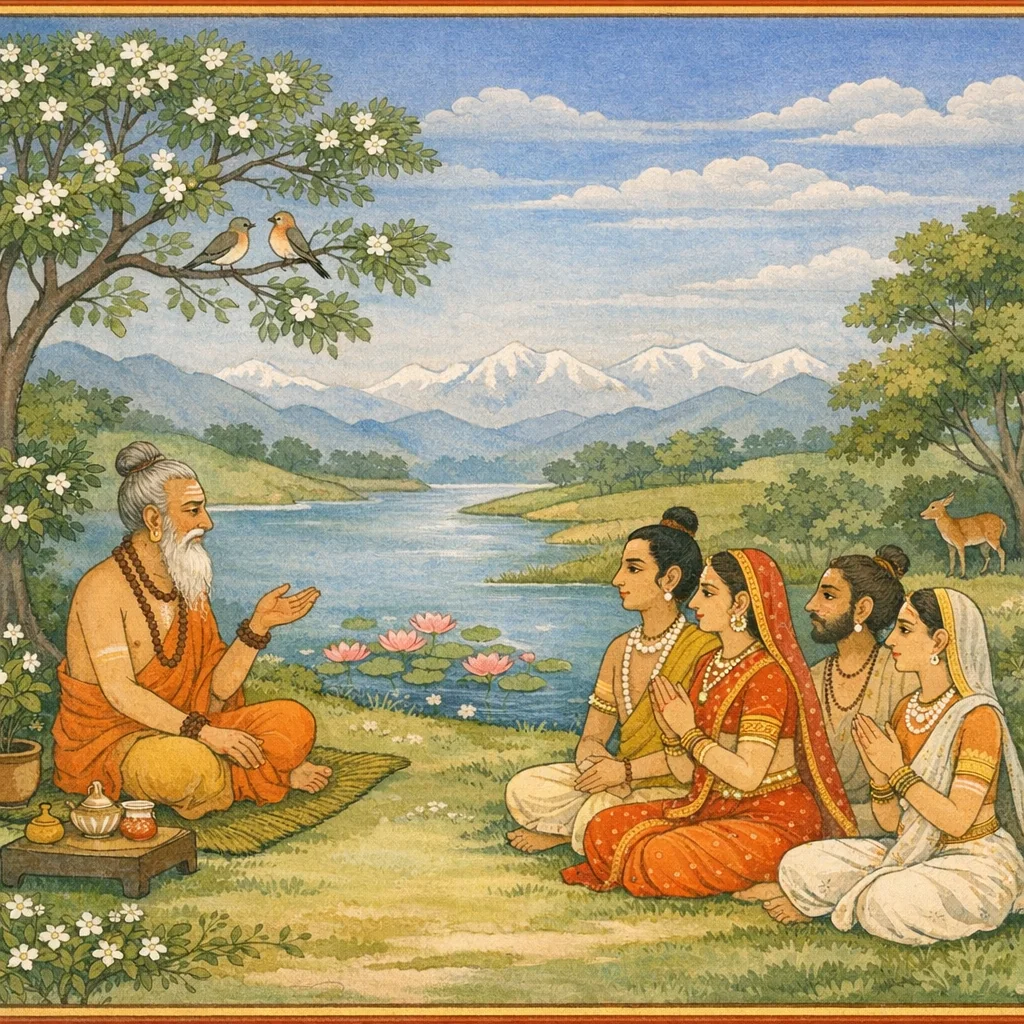
Adhyaya 34
The Vena Episode (Sunīthā’s Lament, Counsel on Fault, and the Turn toward Māyā-vidyā)
Within Sūta’s recitation, Sunīthā recounts her sorrow: a sage’s curse has thrown her marriage prospects into crisis. Though virtuous, devas and sages warn that she will bear a future sinful son who would corrupt the lineage, using “one-drop” analogies—liquor in Gaṅgā-water, sour gruel in milk—to show how moral taint spreads. When a proposed alliance is refused, Sunīthā resolves to go to the forest for austerities (tapas), accepting the rejection as karmic consequence. Her friends (sakhyaḥ), including Rambhā and other apsarās, answer with exempla that even gods carry faults—Brahmā’s crooked speech, Indra’s transgressions, Śiva’s skull-bearing, Kṛṣṇa’s curse, and Yudhiṣṭhira’s untruth—therefore hope and remedy remain. They enumerate ideal feminine virtues and promise aid. Then Rambhā and the apsarās bestow a deluding vidyā (māyā-vidyā), and Sunīthā meets an ascetic brāhmaṇa of Atri’s line, setting the stage for the next turn of the narrative.
Shlokas
Verse 1
सूत उवाच । यथा शप्ता वने पूर्वं सुशंखेन महात्मना । तासु सर्वं समाख्यातं सखीष्वेव विचेष्टितम्
Sūta said: “How they were formerly cursed in the forest by the great-souled Suśaṅkha—everything about them has been fully related, including how they behaved among their female companions.”
Verse 2
आत्मनश्च महाभागा दुःखेनातिप्रपीडिता । सुनीथोवाच । अन्यच्चैव प्रवक्ष्यामि सख्यः शृण्वंतु सांप्रतम्
“And that noble lady, within herself, was sorely afflicted by sorrow.” Sunītha said, “I shall also tell something else—friends, listen now.”
Verse 3
मदीयरूपसंपत्ति वयः सगुणसंपदः । विलोक्य तातश्चिंतात्मा संजातो मम कारणात्
Seeing my beauty, my youth, and the wealth of my virtues, my father became filled with anxious thoughts—because of me.
Verse 4
देवेभ्यो दातुकामोऽसौ मुनिभ्यस्तु महायशाः । मां च हस्ते विगृह्यैव सर्वान्वाक्यमुदाहरत्
Eager to make offerings to the gods and to the sages, that highly renowned one took hold of my hand and then addressed everyone with these words.
Verse 5
गुणयुक्ता सुता बाला ममेयं चारुलोचना । दातुकामोस्मि भद्रं वो गुणिने सुमहात्मने
This young maiden—my daughter—is endowed with virtues and has lovely eyes. With your welfare in mind, I wish to give her in marriage to a virtuous, great-souled man.
Verse 6
मृत्योर्वाक्यं ततो देवा ऋषयः शुश्रुवुस्तदा । तमूचुर्भाषमाणं ते देवा इंद्र पुरोगमाः
Then the gods and the sages heard the words of Mṛtyu (Death). As he was speaking, those gods—led by Indra—addressed him.
Verse 7
तव कन्या गुणाढ्येयं शीलानां परमो निधिः । दोषेणैकेन संदुष्टा ऋषिशापेन तेन वै
Your daughter is rich in virtues—indeed, a supreme treasure of good conduct; yet she has been tainted by a single fault, and that truly because of a sage’s curse.
Verse 8
अस्यामुत्पत्स्यते पुत्रो यस्य वीर्यात्पुमान्किल । भविता स महापापी पुण्यवंशविनाशकः
From her, it is said, a son will be born—begotten by that man’s seed. He will become a great sinner, a destroyer of a virtuous lineage.
Verse 9
गंगातोयेन संपूर्णः कुंभ एव प्रदृश्यते । सुरायाबिन्दुनालिप्तो मद्यकुम्भः प्रजायते
A pot filled with the water of the Gaṅgā is seen as a sacred vessel; but when it is smeared with even a single drop of liquor, it becomes a pot of wine.
Verse 10
पापस्य पापसंसर्गात्कुलं पापि प्रजायते । आरनालस्य वै बिंदुः क्षीरमध्ये प्रयाति चेत्
Through association with sin, even a family becomes tainted and gives rise to sinful progeny—just as a single drop of sour gruel, if it falls into milk, can spoil it.
Verse 11
पश्चान्नाशयते क्षीरमात्मरूपं प्रकाशयेत् । तद्वद्विनाशयेद्वंशं पापः पुत्रो न संशयः
Just as something in time spoils milk and reveals its own nature, so too a sinful son destroys the family line—of this there is no doubt.
Verse 12
अनेनापि हि दोषेण तवेयं पापभागिनी । अन्यस्मै दीयतां गच्छ देवैरुक्तः पिता मम
“Indeed, even by this fault, you have become a sharer in sin. Go—be given to someone else; my father has been so instructed by the gods.”
Verse 13
देवैश्चापि सगंधर्वैरृषिभिश्च महात्मभिः । तैश्चापि संपरित्यक्तः पिता मे दुःखपीडितः
Even the gods—together with the Gandharvas and the great-souled sages—abandoned him. Forsaken by them as well, my father is afflicted and tormented by sorrow.
Verse 14
ममान्ये चापि स्वीकारं न कुर्वंति हि सज्जनाः । एवं पापमयं कर्म मया चैव पुरा कृतम्
I think that even the virtuous do not accept me; for long ago I indeed committed a deed laden with sin.
Verse 15
संतप्ता दुःखशोकेन वनमेव समाश्रिता । तप एव चरिष्यामि करिष्ये कायशोषणम्
Burning with grief and sorrow, I have taken refuge in the forest alone. Alone I shall practice austerity; through penance I will make my body waste away.
Verse 16
भवतीभिः सुपृष्टाहं कार्यकारणमेव हि । मम चिंतानुगं कर्म मया तद्वः प्रकाशितम्
You have questioned me well about the very cause behind the action. The deed that followed my intention—I have now made it known to you.
Verse 17
एवमुक्त्वा सुनीथा सा मृत्योः कन्या यशस्विनी । विरराम च दुःखार्ता किंचिन्नोवाच वै पुनः
Having spoken thus, Sunīthā—the famed daughter of Death—overwhelmed with sorrow, fell silent and spoke nothing further.
Verse 18
सख्य ऊचुः । दुःखमेव महाभागे त्यज कायविनाशनम् । नास्ति कस्य कुले दोषो देवैः पापं समाश्रितम्
The friends said: “O noble lady, abandon this self-destroying course that yields only sorrow. In whose lineage is there no fault? Even the devas have been touched by sin.”
Verse 19
जिह्ममुक्तं पुरा तेन ब्रह्मणा हरसंनिधौ । देवैश्चापि स हि त्यक्तो ब्रह्माऽपूज्यतमोऽभवत्
Formerly, in the presence of Hara (Śiva), Brahmā uttered a crooked, dishonest word. Therefore even the devas forsook him, and Brahmā became the least worshipped.
Verse 20
ब्रह्महत्या प्रयुक्तोऽसौ देवराजोपि पश्य भोः । देवैः सार्धं महाभागस्त्रैलोक्यं परिभुंजति
Behold, O sir—though he was afflicted by the sin of slaying a brāhmaṇa, that lord of the devas, the illustrious one, still enjoys dominion over the three worlds together with the devas.
Verse 21
गौतमस्य प्रियां भार्यामहल्यां गतवान्पुरा । परदाराभिगामी स देवत्वे परिवर्त्तते
Formerly he approached Ahalyā, the beloved wife of Gautama; though he pursued another man’s wife, he is nevertheless restored to divine status.
Verse 22
ब्रह्महत्योपमं कर्म दारुणं कृतवान्हरः । ब्रह्मणस्तु कपालेन चाद्यापि परिवर्तते
Hara (Śiva) committed a dreadful deed, akin to the sin of slaying a brāhmaṇa; and even now he still roams, bearing Brahmā’s skull.
Verse 23
देवानमंतितं देवमृषयो वेदपारगाः । आदित्यः कुष्ठसंयुक्तस्त्रैलोक्यं च प्रकाशयेत्
The sages, perfected in the Vedas, praised that divine Lord. And Āditya, though stricken with leprosy, still illumined the three worlds.
Verse 24
लोकानमंतितं देवं देवाद्याः सचराचराः । कृष्णो भुंक्ते महाशापं भार्गवेण कृतं पुरा
Even the gods and all beings—moving and unmoving—revere that Lord as the refuge of the worlds; yet Kṛṣṇa endures a great curse once pronounced by Bhārgava.
Verse 25
गुरुभार्यांगतश्चंद्रः क्षयी तेन प्रजायते । भविष्यति महातेजा राजराजः प्रतापवान्
Because the Moon went to his teacher’s wife, he became subject to waning. From that cause will be born a mighty, radiant, and valiant king, famed as a “king of kings”.
Verse 26
पांडुपुत्रो महाप्राज्ञो धर्मात्मा स युधिष्ठिरः । गुरोश्चैव वधार्थाय अनृतं स वदिष्यति
That son of Pāṇḍu—Yudhiṣṭhira, greatly wise and righteous—will, to bring about the death of his teacher, speak an untruth.
Verse 27
एतेष्वेव महत्पापं वर्तते च महत्सु च । वैगुण्यं कस्य वै नास्ति कस्य नास्ति च लांछनम्
Even among these, great sin is found—yes, even among the great. For who indeed is without some fault, and who is without some blemish?
Verse 28
भवती स्वल्पदोषेण विलिप्तासि वरानने । उपकारं करिष्यामस्तवैव वरवर्णिनि
O fair-faced lady, you have been tainted by a slight fault. O beautiful-complexioned one, we shall indeed render you help.
Verse 29
तवांगे ये गुणाः संति सत्यस्त्रीणां यथा शुभे । अन्यत्रापि न पश्यामस्तान्गुणांश्चारुलोचने
O auspicious one, the virtues that dwell in you are like those of truthful and faithful women; we do not see such virtues anywhere else either, O fair-eyed one.
Verse 30
रूपमेव गुणः स्त्रीणां प्रथमं भूषणं शुभे । शीलमेव द्वितीयं च तृतीयं सत्यमेव च
O auspicious one, for women beauty itself is the first adornment; good conduct is the second, and truthfulness indeed is the third.
Verse 31
आर्जवत्वं चतुर्थं च पंचमं धर्ममेव हि । मधुरत्वं ततः प्रोक्तं षष्ठमेव वरानने
Straightforwardness is the fourth (virtue), and indeed righteousness itself is the fifth. Thereafter, sweetness of speech is declared as the sixth, O fair-faced one.
Verse 32
शुद्धत्वं सप्तमं बाले अंतर्बाह्येषु योषितम् । अष्टमं हि पितुर्भावः शुश्रूषा नवमं किल
O child, the seventh (virtue) is purity—of women, both inwardly and outwardly. The eighth is a fatherly disposition, and the ninth, it is said, is attentive service.
Verse 33
सहिष्णुर्दशमं प्रोक्तं रतिश्चैकादशं तथा । पातिव्रत्यं ततः प्रोक्तं द्वादशं वरवर्णिनि
Forbearance is declared the tenth virtue, and conjugal affection the eleventh. Thereafter is proclaimed the twelfth: wifely fidelity—devotion to one’s husband—O fair-complexioned lady.
Verse 34
इति श्रीपद्मपुराणे भूमिखंडे वेनोपाख्याने चतुस्त्रिंशोऽध्यायः
Thus ends the thirty-fourth chapter—the episode of Vena—in the Bhūmi-khaṇḍa of the venerable Padma Purāṇa.
Verse 35
तमुपायं प्रपश्यामस्तवार्थं वयमेव हि । तामूचुस्ता वराः सख्यो मा त्वं वै साहसं कुरु
“We ourselves shall find a means for your sake.” Thus those noble friends said to her: “Do not, indeed, commit any rash act.”
Verse 36
सूत उवाच । एवमुक्ता सुनीथा सा पुनरूचे सखीस्तु ताः । कथयध्वं ममोपायं येन भर्ता भविष्यति
Sūta said: Thus addressed, Sunīthā again spoke to those friends: “Tell me the means by which I may obtain a husband.”
Verse 37
तामूचुस्ता वरा नार्यो रंभाद्याश्चारुलोचनाः । रूपमाधुर्यसंयुक्ता भवती भूतिवर्द्धनी
Those noble women—Rambhā and the others, with beautiful eyes—said to her: “You are endowed with the sweetness of beauty; you are one who increases prosperity and well-being.”
Verse 38
ब्रह्मशापेन संभीता वयमत्र समागताः । तां प्रोचुश्च विशालाक्षीं मृत्योः कन्यां सुलोचनाम्
Frightened by Brahmā’s curse, we have gathered here. And they spoke to that wide-eyed, fair-eyed maiden—the daughter of Death.
Verse 39
विद्यामेकां प्रदास्यामः पुरुषाणां प्रमोहिनीम् । सर्वमायाविदां भद्रे सर्वभद्रप्रदायिनीम्
“We shall bestow a single vidyā, a spell of knowledge that utterly deludes men, O auspicious lady; it is known to all who wield māyā, and it grants every kind of worldly ‘good fortune’.”
Verse 40
विद्याबलं ततो दद्युस्तस्यैताः सुखदायकम् । यं यं मोहयितुं भद्रे इच्छस्येवं सुरादिकम्
Then they bestowed upon her the power of vidyā—these means being a source of pleasure—so that, O auspicious lady, she could delude whomever she wished, even the gods and the like.
Verse 41
तं तं सद्यो मोहय वा इत्युक्ता सा तथाऽकरोत् । विद्यायां हि सुसिद्धायां सा सुनीथा सुनंदिता
Told, “Delude him at once—yes, him,” she did exactly so. For in that well-mastered and perfectly accomplished vidyā, Sunīthā was highly proficient and delighted.
Verse 42
भ्रमत्येवं सखीभिस्तु पुरुषान्सा विपश्यति । अटमानागता पुण्यं नंदनं वनमुत्तमम्
Thus roaming about with her companions, she noticed men. While wandering, she arrived at the supremely excellent and sacred Nandana grove.
Verse 43
गंगातीरे ततो दृष्ट्वा ब्राह्मणं रूपसंयुतम् । सर्वलक्षणसंपन्नं सूर्यतेजः समप्रभम्
Then, on the bank of the Gaṅgā, he beheld a brāhmaṇa endowed with beauty—complete in every auspicious mark, radiant with a splendor equal to the sun’s brilliance.
Verse 44
रूपेणाप्रतिमं लोके द्वितीयमिव मन्मथम् । देवरूपं महाभागं भाग्यवंतं सुभाग्यदम्
In beauty unmatched in the world—like a second Kāma—divine in appearance, greatly blessed, endowed with good fortune, and bestowing auspicious fortune upon others.
Verse 45
अनौपम्यं महात्मानं विष्णुतेजः समप्रभम् । वैष्णवं सर्वपापघ्नं विष्णुतुल्यपराक्रमम्
He is incomparable—a great soul, radiant with the very splendor of Viṣṇu; a Vaiṣṇava who destroys all sins, and whose valor is equal to Viṣṇu’s.
Verse 46
कामक्रोधविहीनं तमत्रिवंशविभूषणम्
Him—free from lust and anger—they praised as the ornament of the lineage of Atri.
Verse 47
दृष्ट्वा सुरूपं तपसां स्वरूपं दिव्यप्रभावं परितप्यमानम् । पप्रच्छ रंभां सुसखीं सरागा कोयं दिविष्ठः प्रवरो महात्मा
Seeing that handsome one—an embodiment of austerity—radiant with divine splendor and engaged in intense penance, she, filled with eager curiosity, asked her close friend Rambhā: “Who is this exalted, foremost mahātmā dwelling in heaven?”