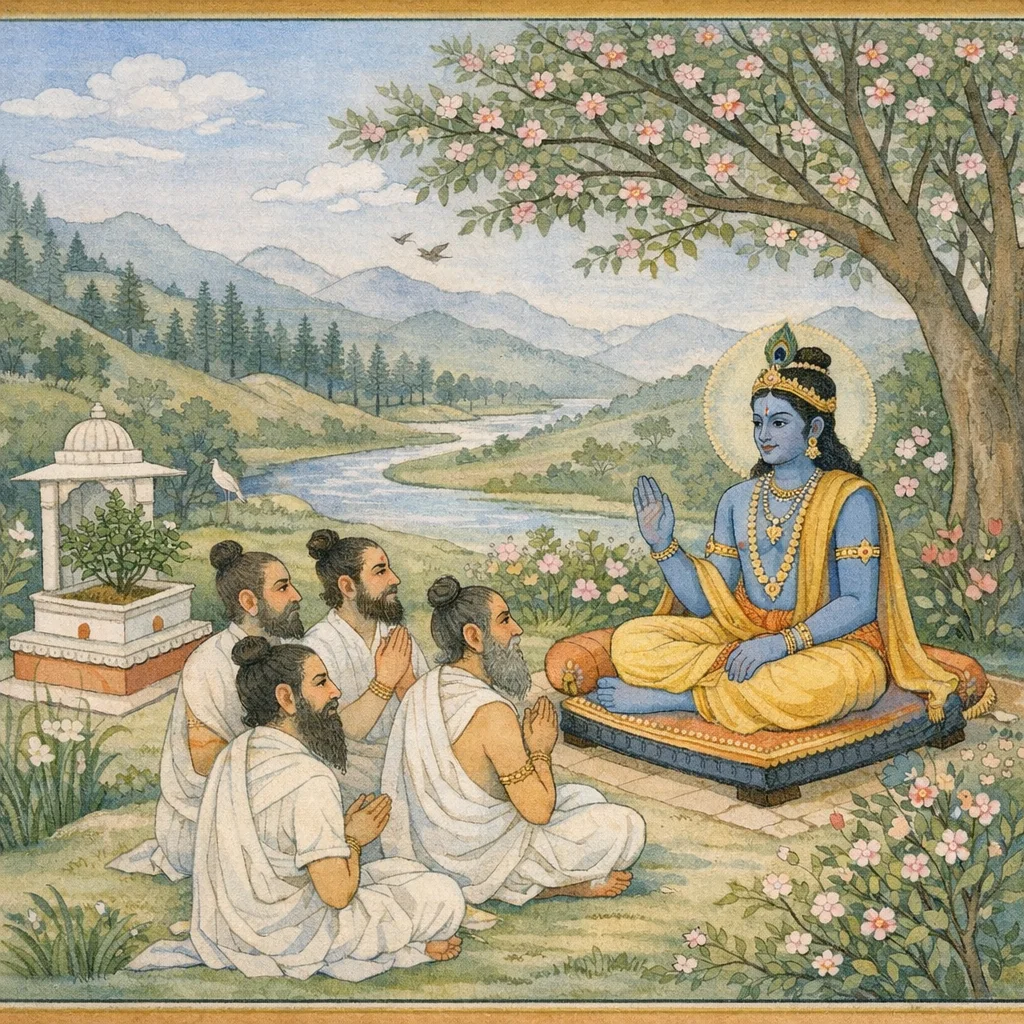
Adhyaya 87
Vows of Hari and the Hundred Names of Suputra (Viṣṇu/Kṛṣṇa): Ritual Metadata and Fruits of Japa
Chapter 87 lists several Vaiṣṇava vows (vratas)—including Ekādaśī observances, Aśūnyaśayana, and Janmāṣṭamī—declaring their power to destroy sin and bestow purity. It then presents the “Hundred Names of Suputra” as an excellent Viṣṇu/Kṛṣṇa śatanāma, supplying the ritual preliminaries (ṛṣi, chandas, devatā, and viniyoga). A sequence of salutations follows, worshiping Hari through many sacred epithets such as Keśava, Nārāyaṇa, Narasiṃha, Rāma, Govinda, and others. In the phalaśruti, steadfast japa at the three sandhyās—especially before Tulasī and Śālagrāma, and during Kārtika and Māgha—is said to grant purification and merits equal to great sacrifices, bring benefit to one’s ancestors, and lead the devotee to Viṣṇu’s abode.
Shlokas
Verse 1
कुंजल उवाच । व्रतभेदान्प्रवक्ष्यामि यैर्यैश्चाराधितो हरिः । जया च विजया चैव जयंती पापनाशिनी
Kuñjala said: “I shall describe the various kinds of vows by which Hari is worshipped—(the vows named) Jayā, Vijayā, and also Jayantī, the destroyer of sins.”
Verse 2
त्रिस्पृशा वंजुली चान्या तिलदग्धा तथापरा । अखंडाचारकन्या च मनोरथा सुपुत्रक
Trispṛśā, and another named Vaṃjulī; likewise another called Tiladagdhā; also Akhaṇḍācārakanyā; and Manorathā—(all these were) blessed with good sons.
Verse 3
एकादश्यास्तु भेदाश्च संति पुत्र अनेकधा । अशून्यशयनं चान्यज्जन्माष्टमी महाव्रतम्
O son, the observances of Ekādaśī are of many kinds. Another is the vow called Aśūnyaśayana, and (also) Janmāṣṭamī, the great vow.
Verse 4
एतैर्व्रतैर्महापुण्यैः पापं दूरं प्रयाति च । प्राणिनां नात्र संदेहः सत्यं सत्यं वदाम्यहम्
By these highly meritorious vows, sin goes far away; for living beings there is no doubt about it. This is truth—truth indeed—I declare.
Verse 5
कुंजल उवाच । स्तोत्रं तस्य प्रवक्ष्यामि पापराशिविनाशनम् । सुपुत्रशतनामाख्यं नराणां गतिदायकम्
Kuṃjala said: “Now I shall proclaim that hymn which destroys heaps of sins—the ‘Hundred Names of Suputra’—bestowing upon human beings the true path and destined goal.”
Verse 6
तस्य देवस्य कृष्णस्य शतनामाख्यमुत्तमम् । संप्रत्येव प्रवक्ष्यामि तच्छृणुष्व सुतोत्तम
Now indeed I shall proclaim the excellent ‘Hundred Names’ of that divine Kṛṣṇa; listen to it, O best of sons.
Verse 7
विष्णोर्नामशतस्यापि ऋषिं छंदो वदाम्यहम् । देवं चैव महाभाग सर्वपापविशोधनम्
I shall declare the seer (ṛṣi) and the metre of Viṣṇu’s hundred names, and also the presiding deity, O greatly fortunate one, by which all sins are purified.
Verse 8
विष्णोर्नामशतस्यापि ऋषिर्ब्रह्मा प्रकीर्तितः । ओंकारो देवता प्रोक्तश्छंदोनुष्टुप्तथैव च
For the hundred names of Viṣṇu, the seer (ṛṣi) is declared to be Brahmā; the deity is said to be Oṃkāra, and the metre is likewise Anuṣṭubh.
Verse 9
सर्वकामिकसंसिद्ध्यै मोक्षे च विनियोगकः । अस्य विष्णोः शतनामस्तोत्रस्य । ब्रह्मा ऋषिः विष्णुर्देवता अनुष्टुप्छंदः । सर्वकामसमृद्ध्यर्थं सर्वपापक्षयार्थे विनियोगः
This hymn is to be employed for the complete attainment of all desired aims and also for liberation (mokṣa). For this Viṣṇu Śatanāma-stotra: Brahmā is the seer (ṛṣi), Viṣṇu is the presiding deity, and the metre is Anuṣṭubh. Its application is for the prosperity of all desires and for the destruction of all sins.
Verse 10
नमाम्यहं हृषीकेशं केशवं मधुसूदनम् । सूदनं सर्वदैत्यानां नारायणमनामयम्
I bow to Hṛṣīkeśa, to Keśava, to Madhusūdana—the slayer of all the Daityas—to Nārāyaṇa, the stainless One, free from every affliction.
Verse 11
जयंतं विजयं कृष्णमनंतं वामनं ततः । विष्णुं विश्वेश्वरं पुण्यं विश्वाधारं सुरार्चितम्
Then one should remember Jayanta, Vijaya, Kṛṣṇa, Ananta, and Vāmana; and Viṣṇu—the Lord of the universe, the Holy One, the support of all the world, worshipped by the gods.
Verse 12
अनघं त्वघहंतारं नरसिंहं श्रियः प्रियम् । श्रीपतिं श्रीधरं श्रीदं श्रीनिवासं महोदयम्
You are sinless, the destroyer of sin—Narasimha, beloved of Śrī (Lakṣmī); Lord of Śrī, bearer of Śrī, giver of prosperity, abode of Śrī—O greatly glorious One.
Verse 13
श्रीरामं माधवं मोक्षं क्षमारूपं जनार्दनम् । सर्वज्ञं सर्ववेत्तारं सर्वदं सर्वनायकम्
I bow to Śrī Rāma, to Mādhava, to the very embodiment of liberation; to Janārdana whose nature is forgiveness—who is all-knowing, the knower of all, the giver of all, and the leader of all.
Verse 14
हरिं मुरारिं गोविंदं पद्मनाभं प्रजापतिम् । आनंदं ज्ञानसंपन्नं ज्ञानदं ज्ञाननायकम्
I worship Hari—Murāri, Govinda, Padmanābha, the Lord of creatures—who is bliss itself, endowed with true knowledge, the giver of knowledge, and the guide of knowledge.
Verse 15
अच्युतं सबलं चंद्रं चक्रपाणिं परावरम् । युगाधारं जगद्योनिं ब्रह्मरूपं महेश्वरम्
I bow to Acyuta, the Imperishable—mighty, moon-like, the wielder of the discus; the Supreme who transcends both higher and lower; the support of the ages, the womb and source of the universe; whose form is Brahman, the Great Lord.
Verse 16
मुकुंदं तं सुवैकुंठमेकरूपं जगत्पतिम् । वासुदेवं महात्मानं ब्रह्मण्यं ब्राह्मणप्रियम्
That Mukunda—supreme Vaikuṇṭha, of one unchanging nature, Lord of the universe—Vāsudeva, the great-souled one, devoted to Brahman and dharma, beloved of the brāhmaṇas.
Verse 17
गोप्रियं गोहितं यज्ञंयज्ञांगं यज्ञवर्द्धनम् । यज्ञस्यापि सुभोक्तारं वेदवेदांगपारगम्
He is dear to cows and devoted to their welfare; He is the yajña itself, an essential limb of yajña, and the increaser of yajña. He is also the auspicious enjoyer of the offering, and one who has reached the far shore of the Vedas and the Vedāṅgas.
Verse 18
वेदज्ञं वेदरूपं तं विद्यावासं सुरेश्वरम् । अव्यक्तं तं महाहंसं शंखपाणिं पुरातनम्
I bow to Him who knows the Vedas and is the very form of the Vedas; the abode of all knowledge, the Lord of the gods—unmanifest, the Mahāhaṃsa, the ancient One who bears the conch in His hand.
Verse 19
पुरुषं पुष्कराक्षं तु वाराहं धरणीधरम् । प्रद्युम्नं कामपालं च व्यासं व्यालं महेश्वरम्
Remember and praise the Supreme Puruṣa, the lotus-eyed One; Varāha, bearer of the earth; Pradyumna, protector of love; Vyāsa; Vyāla; and Maheśvara.
Verse 20
सर्वसौख्यं महासौख्यं मोक्षं च परमेश्वरम् । योगरूपं महाज्ञानं योगिनां गतिदं प्रियम्
He is all happiness and the supreme happiness; He is liberation (mokṣa) and the Supreme Lord—of the very nature of Yoga, the great Knowledge—beloved, and the giver of the yogins’ destined goal.
Verse 21
मुरारिं लोकपालं तं पद्महस्तं गदाधरम् । गुहावासं सर्ववासं पुण्यवासं महाभुजम्
I worship that Murāri—guardian of the worlds—who holds a lotus in his hand and bears the mace; who dwells in the cave of the heart, who is the abode of all, the supremely sacred abode, and the mighty-armed Lord.
Verse 22
वृंदानाथं बृहत्कायं पावनं पापनाशनम् । गोपीनाथं गोपसखं गोपालं गोगणाश्रयम्
I bow to the Lord of Vṛndā (Vṛndāvana)—vast in form, purifying, the destroyer of sin; to the Lord of the Gopīs, the friend of the cowherds, the protector of cows, the refuge of the herds of cattle.
Verse 23
परात्मानं पराधीशं कपिलं कार्यमानुषम् । नमामि निश्चलं नित्यं मनोवाक्कायकर्मभिः
I bow always—steadfastly—to Kapila: the Supreme Self, the highest Lord, who assumes human form for the sake of divine purpose, with my mind, speech, body, and actions.
Verse 24
नाम्नां शतेनापि सुपुण्यकर्ता यः स्तौति कृष्णं मनसा स्थिरेण । स याति लोकं मधुसूदनस्य विहाय लोकानिह पुण्यपूतः
Even if he praises Kṛṣṇa with only a hundred names, the doer of great merit who lauds Him with a steady mind goes to the world of Madhusūdana, leaving behind the worlds here, purified by virtue.
Verse 25
नाम्नां शतं महापुण्यं सर्वपातकशोधनम् । जपेदनन्यमनसा ध्यायेद्ध्यानसमन्वितम्
The hundredfold recitation of the Names is supremely meritorious and purges all sins. One should repeat them with an undistracted mind, and meditate—endowed with concentration.
Verse 26
नित्यमेव नरः पुण्यैर्गंगास्नानफलं लभेत् । तस्मात्तु सुस्थिरो भूत्वा समाहितमना जपेत्
Through meritorious deeds a person may continually obtain the reward of bathing in the Gaṅgā. Therefore, becoming steady and firm, one should practice japa with a concentrated mind.
Verse 27
त्रिकालं च जपेन्मर्त्यो नियतो नियमे स्थितः । अश्वमेधफलं तस्य जायते नात्र संशयः
A mortal who is disciplined and established in observances, and who repeats it at the three times of day, obtains the fruit of the Aśvamedha sacrifice—of this there is no doubt.
Verse 28
एकादश्यामुपोष्यैव पुरतो माधवस्य यः । जागरे प्रजपेन्मर्त्यस्तस्य पुण्यं वदाम्यहम्
I shall declare the merit of that mortal who, having fasted on Ekādaśī, keeps vigil before Mādhava and recites japa.
Verse 29
पुंडरीकस्य यज्ञस्य फलमाप्नोति मानवः । तुलसीसंनिधौ स्थित्वा मनसा यो जपेन्नरः
A person attains the fruit of Puṇḍarīka’s sacrifice if, standing in the presence of Tulasī, he performs japa mentally.
Verse 30
राजसूयफलं भुंक्ते वर्षेणापि च मानवः । शालग्रामशिला यत्र यत्र द्वारावती शिला
Even within a single year, a person partakes of the merit of the Rājasūya sacrifice—wherever the sacred Śālagrāma stone is, and wherever the Dvāravatī stone is.
Verse 31
उभयोः संनिधौ जाप्यं कर्तव्यं सुखमिच्छता । बहुसौख्यं प्रभुक्त्वैव कुलानां शतमेव च
One who longs for happiness should perform japa in the presence of both. Having enjoyed abundant bliss, he brings benefit even to a hundred generations of his family.
Verse 32
एकेन चाधिकं मर्त्य आत्मना सह तारयेत् । कार्तिके स्नानकर्ता यः पूजयेन्मधुसूदनम्
A mortal who, in the month of Kārtika, performs the sacred bath and worships Madhusūdana (Viṣṇu), delivers himself—and even one more person besides.
Verse 33
यः पठेत्प्रयतः स्तोत्रं प्रयाति परमां गतिम् । माघस्नायी हरिं पूज्य भक्त्या च मधुसूदनम्
Whoever, disciplined and pure, recites this hymn attains the supreme state. Bathing in the month of Māgha, one should worship Hari—Madhusūdana—with devotion.
Verse 34
ध्यायेच्चैव हृषीकेशं जपेद्वाथ शृणोति वा । सुरापानादिकं पापं विहाय परमं पदम्
One should meditate on Hṛṣīkeśa, or recite His Name, or even listen to it; casting off sins such as drinking liquor, one attains the supreme abode.
Verse 35
विना विघ्नं नरः पुत्र संप्रयाति जनार्दनम् । श्राद्धकाले हि यो मर्त्यो विप्राणां भुंजतां पुरः
O son, a man reaches Janārdana (Viṣṇu) without obstacles—indeed, the mortal who, at the time of śrāddha, remains present before the brāhmaṇas while they are eating.
Verse 36
यो जपेच्च शतं नाम्नां स्तोत्रं पातकनाशनम् । पितरस्तुष्टिमायांति तृप्ता यांति परां गतिं
Whoever recites this hymn of the hundred names, which destroys sins—his ancestors become pleased; satisfied, they attain the supreme state.
Verse 37
ब्राह्मणो वेदविद्वान्स्यात्क्षत्रियो विंदते महीम् । धनऋद्धिं प्रभुंजीत वैश्यो जपति यः सदा
A brāhmaṇa should become learned in the Vedas; a kṣatriya gains the earth (sovereignty); one should enjoy prosperity and wealth; and that vaiśya who constantly practices japa attains its fruit.
Verse 38
शूद्रः सुःखं प्रभुंक्ते च ब्राह्मणत्वं च गच्छति । प्राप्य जन्मांतरं वत्स वेदविद्यां प्रविंदति
A Śūdra enjoys happiness and even attains the state of a Brāhmaṇa. Having obtained another birth, dear one, he comes to acquire the knowledge of the Veda.
Verse 39
सुखदं मोक्षदं स्तोत्रं जप्तव्यं च न संशयः । केशवस्य प्रसादेन सर्वसिद्धो भवेन्नरः
This hymn, which bestows happiness and liberation, should indeed be recited—without any doubt. By the grace of Keśava, a man attains complete success, all spiritual attainments.
Verse 87
इति श्रीपद्मपुराणे भूमिखंडे वेनोपाख्याने गुरुतीर्थवर्णने च्यवनचरित्रे सप्ताशीतितमोऽध्यायः
Thus, in the Śrī Padma Purāṇa, in the Bhūmi-khaṇḍa—within the narrative of Vena, in the description of the sacred Guru-tīrtha, and in the account of Cyavana—ends the eighty-seventh chapter.