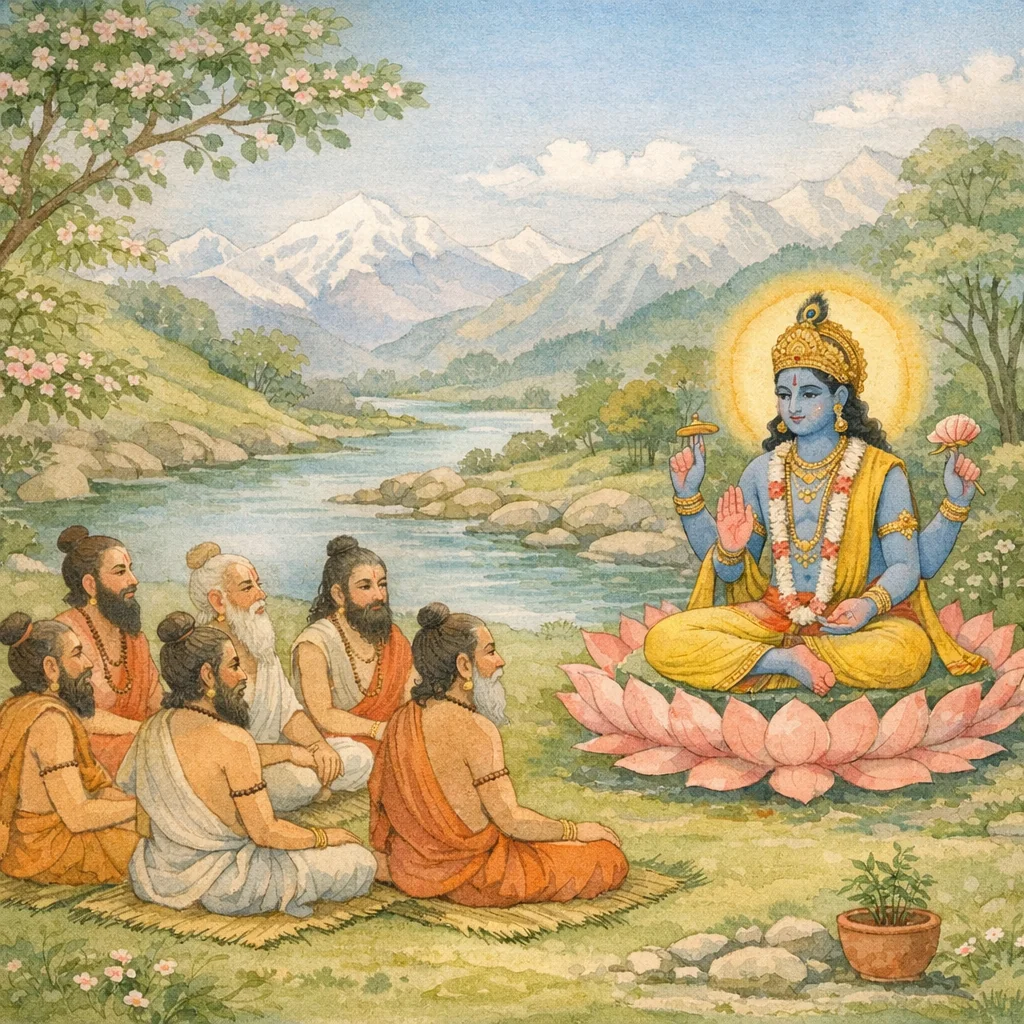
Adhyaya 85
The Glory of Guru-Tīrtha: The Guru as Supreme Pilgrimage (Prelude: Cyavana and the Parable Cycle)
Chapter 85 turns from earlier teachings on bhāryā-tīrtha, pitṛ-tīrtha, and mātṛ-tīrtha to the doctrine of Guru-tīrtha: for the disciple, the guru is the supreme pilgrimage-place and the most immediate source of visible spiritual fruit. Through images of the sun, moon, and lamp, the guru is praised as the one who continually dispels the darkness of ignorance. An exemplum then unfolds: the sage Cyavana, seeking true knowledge, undertakes wide pilgrimages to great rivers and liṅga-sites, especially Narmadā/Amarakaṇṭaka and Oṁkāra. Resting beneath a banyan, he meets a parrot family whose filial devotion frames a further tale (Plakṣadvīpa), marked by repeated widowhood and a destructive svayaṃvara. Thus the chapter binds outward tīrtha-yātrā to the inward, decisive “crossing” made possible by the guru.
Shlokas
Verse 1
वेन उवाच । भगवन्देवदेवेश प्रसादाच्च मम त्वया । भार्यातीर्थं समाख्यातं पितृतीर्थमनुत्तमम्
Vena said: O Blessed One, O Lord of the gods, by your favor you have explained to me the Bhāryā-tīrtha and the unsurpassed Pitṛ-tīrtha.
Verse 2
मातृतीर्थं हृषीकेश बहुपुण्यप्रदायकम् । प्रसादसुमुखो भूत्वा गुरुतीर्थं वदस्व मे
O Hṛṣīkeśa, the Mother’s sacred ford (mātṛ-tīrtha) bestows abundant merit. Be gracious and kindly disposed, and tell me of the Guru’s sacred ford (guru-tīrtha).
Verse 3
श्रीभगवानुवाच । कथयिष्याम्यहं राजन्गुरुतीर्थमनुत्तमम् । सर्वपापहरं प्रोक्तं शिष्याणां गतिदायकम्
The Blessed Lord said: O King, I shall describe the unsurpassed Guru-tīrtha, declared to remove all sins and to grant the disciples their destined spiritual goal.
Verse 4
शिष्याणां परमं पुण्यं धर्मरूपं सनातनम् । परं तीर्थं परं ज्ञानं प्रत्यक्षफलदायकम्
For disciples, this is the highest merit—an eternal form of Dharma; it is the supreme sacred ford, the supreme knowledge, and it grants visible, immediate results.
Verse 5
यस्यप्रसादाद्राजेंद्र इहैव फलमश्नुते । परलोके सुखं भुंक्ते यशः कीर्तिमवाप्नुयात्
O king, by whose grace one enjoys reward here itself; in the next world one partakes of happiness and attains fame and renown.
Verse 6
प्रसादाद्यस्य राजेंद्र गुरोश्चैव महात्मनः । प्रत्यक्षं दृश्यते शिष्यैस्त्रैलोक्यं सचराचरम्
O king, by the grace of that great-souled Guru, the disciples behold directly the three worlds—together with all that moves and all that is unmoving.
Verse 7
व्यवहारं च लोकानामाचारं नृपनंदन । विज्ञानं विंदते शिष्यो मोक्षं चैव प्रयाति च
He learns the ways of worldly dealings and the proper conduct of people, O prince; the disciple attains true knowledge and also goes onward to liberation.
Verse 8
सर्वेषामेव लोकानां यथा सूर्यः प्रकाशकः । गुरुः प्रकाशकस्तद्वच्छिष्याणां गतिरुत्तमा
Just as the sun illumines all the worlds, so does the Guru illumine; for disciples, he is the highest refuge and the supreme path.
Verse 9
रात्रावेव प्रकाशेच्च सोमो राजा नृपोत्तम । तेजसा साधयेत्सर्वमधिकारं चराचरम्
The Moon-king, O best of kings, shines most especially at night; by his radiance he establishes authority and influence over all, both moving and unmoving.
Verse 10
गृहेप्रकाशयेद्दीपः समूहं नृपसत्तम । तेजसा नाशयेत्सर्वमंधकारघनाविलम्
O best of kings, a lamp should illumine the whole house; by its radiance it should destroy all darkness, thick and murky.
Verse 11
अज्ञानतमसा व्याप्तं शिष्यं द्योतयते गुरुः । शिष्यप्रकाशौद्द्योतैरुपदेशैर्महामते
The guru illumines the disciple who is enveloped in the darkness of ignorance, O great-minded one, through teachings that kindle the disciple’s inner light.
Verse 12
दिवाप्रकाशकः सूर्यः शशीरात्रौ प्रकाशकः । गृहप्रकाशको दीपस्तमोनाशकरः सदा
The Sun illumines the day; the Moon illumines the night. The lamp lights the home and ever destroys darkness.
Verse 13
रात्रौ दिवा गृहस्यांते गुरुः शिष्यं सदैव हि । अज्ञानाख्यं तमस्तस्य गुरुः सर्वं प्रणाशयेत्
By night and by day, in the very heart of his dwelling, the guru should ever attend to the disciple; and wholly destroy that disciple’s darkness called ignorance.
Verse 14
तस्माद्गुरुः परं तीर्थं शिष्याणामवनीपते । एवं ज्ञात्वा ततः शिष्यः सर्वदा तं प्रपूजयेत्
Therefore, O king, the guru is the highest sacred pilgrimage-place for disciples. Knowing this, a disciple should always worship and honor that guru.
Verse 15
गुरुं पुण्यमयं ज्ञात्वा त्रिविधेनापि कर्मणा । इत्यर्थे श्रूयते विप्र इतिहासः पुरातनः
Knowing the Guru to be wholly sanctifying, one should honor him through action in all three ways—by mind, speech, and body. In this regard, O brāhmaṇa, an ancient tradition is heard.
Verse 16
सर्वपापहरः प्रोक्तश्च्यवनस्य महात्मनः । भार्गवस्य कुले जातश्च्यवनो मुनिसत्तमः
Chyavana, the great-souled sage, is declared to be the remover of all sins. That foremost of sages, Chyavana, was born in the lineage of Bhṛgu, the Bhārgavas.
Verse 17
तस्य चिंता समुत्पन्ना एकदा तु नृपोत्तम । कदाहं ज्ञानसंपन्नो भविष्यामि महीतले
Once, O best of kings, a worry arose in him: “When, upon this earth, shall I become endowed with true knowledge?”
Verse 18
दिवारात्रौप्रचिंतेत्स ज्ञानार्थी मुनिसत्तमः । एवं तु चिंतमानस्य मतिरासीन्महात्मनः
That best of sages, seeking true knowledge, reflected deeply day and night. And as that great-souled one continued contemplating in this way, a clear resolve arose in his mind.
Verse 19
तीर्थयात्रां प्रयास्यामि अभीष्टफलदायिनीम् । गृहक्षेत्रादिसंत्यज्य भार्यां पुत्रं धनं ततः
“I shall set out on a pilgrimage to sacred fords—one that grants the desired fruits—having abandoned home, lands and the like, and then (even) wife, son, and wealth.”
Verse 20
तीर्थयात्राप्रसंगेन अटते मेदिनीं तदा । लोमानुलोमयात्रां स गंगायाः कृतवान्नृप
Then, under the pretext of a pilgrimage to sacred fords, he wandered over the earth; and, O king, he performed the pilgrimage along the Gaṅgā, going with and against the current.
Verse 21
स तद्वन्नर्मदायाश्च सरस्वत्या मुनीश्वरः । गोदावर्यादिसर्वासां नदीनां सागरस्य च
In the same way, O best of sages, (he spoke) also of the Narmadā and the Sarasvatī, and of all rivers beginning with the Godāvarī, and even of the ocean.
Verse 22
अन्येषां सर्वतीर्थानां क्षेत्राणां च नृपोत्तम । देवानां पुण्यलिगानां यात्राव्याजेन सोऽभ्रमत्
O best of kings, under the pretext of pilgrimage he wandered through all the other tīrthas and holy regions, visiting the auspicious emblems of the devas.
Verse 23
भ्रममाणस्य तस्यापि तीर्थेषु परमेषु च । भ्रममाणः समायातः क्षेत्राणामुत्तमं तदा । कायश्च निर्मलो जातः सूर्यतेजः समप्रभः
Even as he wandered among the most exalted tīrthas, he kept roaming until at last he reached the best of holy regions. Then his body was purified, shining with a radiance equal to the sun’s splendor.
Verse 24
च्यवनः काशते दीप्त्या पूतात्मानेन कर्मणा
Cyavana shines with radiance, his inner self purified by his righteous deeds.
Verse 25
नर्मदा दक्षिणे कूले नाम्ना अमरकंटकम् । ददर्श सुमहालिगं सर्वेषां गतिदायकम्
On the southern bank of the Narmadā, at the place called Amarakaṇṭaka, he beheld a very great Liṅga, bestowing the highest goal upon all.
Verse 26
नत्वा स्तुत्वा तु संपूज्य सिद्धनाथं महेश्वरम् । ज्वालेश्वरं ततो दृष्ट्वा दृष्ट्वा चाप्यमरेश्वरम्
Having bowed, praised, and duly worshipped Maheshvara as Siddhanātha, he then beheld Jvāleśvara, and also beheld Amareśvara.
Verse 27
ब्रह्मेशं कपिलेशं च मार्कंडेश्वरमुत्तमम् । एवं यात्रां ततः कृत्वा ओंकारं समुपागतः
Thus, having visited Brahmeśa, Kapileśa, and the most excellent Mārkaṇḍeśvara, he completed the pilgrimage and arrived at Oṁkāra.
Verse 28
वटच्छायां समाश्रित्य शीतलां श्रमनाशिनीम् । सुखेन संस्थितो विप्रश्च्यवनो भृगुनंदनः
Taking refuge in the cool shade of a banyan tree—dispeller of fatigue—the brāhmaṇa Cyavana, son of Bhṛgu, rested there in comfort.
Verse 29
तत्र स्वनं स शुश्राव समुक्तं पक्षिणा तदा । दिव्यभाषा समायुक्तं ज्ञानविज्ञानसंयुतम्
There he heard a sound, then spoken by a bird—endowed with a divine mode of speech, and joined with both knowledge and realized discernment.
Verse 30
शुकश्च एकस्तत्रास्ते बहुकालप्रजीवकः । कुंजलोनाम धर्मात्मा चतुःपुत्रः सभार्यकः
There lived a single parrot, long-lived and sustained for many years; he was named Kuṃjala—righteous by nature—having four sons and dwelling together with his wife.
Verse 31
आसंस्तस्य हि पुत्राश्च चत्वारः पितृनंदनाः । तेषां नामानि राजेंद्र कथयिष्ये तवाग्रतः
Indeed, he had four sons—delighters of their father. O king, I shall now tell you their names in your presence.
Verse 32
ज्येष्ठस्तु उज्ज्वलो नाम द्वितीयस्तु समुज्ज्वलः । तृतीयो विज्वलोनाम चतुर्थश्च कपिंजलः
The eldest was named Ujjvala; the second, Samujjvala; the third, Vijvala; and the fourth, Kapiṃjala.
Verse 33
एवं पुत्रास्तु चत्वारः कुंजलस्य महामते । शुकस्य तस्य पुण्यस्य पितृमातृपरायणाः
Thus, O great-minded one, there were four sons of Kuñjala—sons of that virtuous Śuka—devoted to their father and mother.
Verse 34
भ्रमंति गिरिकुंजेषु द्वीपेषु च समाहिताः । भोजनार्थं तु संक्षुब्धाः क्षुधया परिपीडिताः
They wander through mountain-groves and across the islands, intent on their search; agitated in their quest for food, they are tormented by hunger.
Verse 35
स्वोदरस्थां क्षुधां सौम्य फलैरमृतसन्निभैः । अमृतस्वादुतोयेन शमयंति नृपोत्तम
O gentle one, the best of kings would soothe the hunger in their own bellies with fruits resembling nectar, and with water sweet as ambrosia.
Verse 36
फलं पक्वं रसालं तु आहारार्थं सुपुत्रकाः । दत्वा फलानि दंपत्योर्निक्षिपंति प्रयत्नतः
“Dear sons, having given ripe, juicy fruits for food, they carefully place the fruits as an offering for the couple.”
Verse 37
मातुरर्थे महाभागा भक्तिभावसमन्विताः । तुष्टा आहारमुत्पाद्य भक्षयंति पठंति च
For their mother’s sake, those noble ones—filled with the spirit of devotion—gladly procure food; they eat, and they also recite the sacred texts.
Verse 38
तत्र क्रीडारताः सर्वे विलसंति रमंति च । संध्याकालं समाज्ञाय पितुरंतिकमुत्तमम्
There, all of them, absorbed in play, sported and delighted; but on realizing that it was the time of twilight, they went to their excellent father’s presence.
Verse 39
आयांति भक्ष्यमादाय गुर्वर्थं तु प्रयत्नतः । पश्यतस्तस्य विप्रस्य च्यवनस्य महात्मनः
They come, bringing food with great effort for the sake of their teacher, while that great-souled brāhmaṇa Cyavana looks on.
Verse 40
आगतास्त्वंडजाः सर्वे पितुर्नीडं सुशोभनम् । पितरं मातरं चोभौ प्रणेमुस्ते महामते
All the egg-born young returned to their father’s splendid nest; and, O great-minded one, they bowed down to both their father and their mother.
Verse 41
ताभ्यां भक्ष्यं समासाद्य उपतस्थुस्तयोः पुरः । सर्वे संभाषिताः पित्रा मानितास्ते सुतोत्तमाः
Having obtained food from those two, they came and stood before them. Their father spoke to all those excellent sons and honored them.
Verse 42
मात्रा च कृपया राजन्वचनैः प्रीतिसंमितैः । पक्षवातेन शीतेन मातापित्रोश्च ते तदा
And your mother too, O king, out of compassion—speaking words measured and filled with affection—then fanned you with her hand like a cool breeze; and so did your father and mother at that time.
Verse 43
तेषामाप्यायनं तौ द्वौ चक्राते पक्षिणौ नृप । आशीर्भिरभिनंद्यैव द्वाभ्यामपि सुपुत्रकान्
O king, those two birds nourished and sustained them; and, blessing them with benedictions, they rejoiced as well over the two virtuous sons.
Verse 44
तैश्च दत्तं सुसंपुष्टमाहारममृतोपमम् । तावेव हि सुसंप्रीतिं चक्राते द्विजसत्तम
And the food they offered—well nourishing and strengthening, like nectar (amṛta)—indeed brought great delight to those two, O best of Brahmins.
Verse 45
पिबतो निर्मलं तोयं तीर्थकोटिसमुद्भवम् । स्वस्थानं तु समाश्रित्य सुखसंतुष्टमानसौ
Drinking the spotless water that arises from crores of sacred fords (tīrthas), they returned to their own abode, their minds peacefully happy and content.
Verse 46
चक्राते च कथां दिव्यां सुपुण्यां पापनाशिनीम् । विष्णुरुवाच । पित्रा तु कुंजलेनापि पृष्ट उज्ज्वल आत्मजः
They then related a divine narrative—most meritorious and destructive of sin. Viṣṇu said: Even when his father Kuñjala questioned him, the radiant son Ujjvala replied.
Verse 47
क्वगतोऽस्यद्य पुत्र त्वं किमपूर्वं त्वया पुनः । तत्र दृष्टं श्रुतं पुण्यं तन्मे कथय नंदन
“Where have you gone today, my son? And what new thing have you encountered again? Tell me, dear child, the meritorious things you saw and heard there.”
Verse 48
कुंजलस्य पितुर्वाक्यं समाकर्ण्य स उज्ज्वलः । पितरं प्रत्युवाचाथ भक्त्या नमितकंधरः
Hearing the words of Kuñjala’s father, he—radiant—then replied to his own father, his neck bowed down in devotion.
Verse 49
प्रणाममकरोन्मूर्ध्ना कथां चक्रे मनोहराम् । उज्ज्वल उवाच । प्लक्षद्वीपं महाभाग नित्यमेव व्रजाम्यहम्
Having bowed his head in reverence, he began a delightful narration. Ujjvala said: “O fortunate one, I go to Plakṣadvīpa every day.”
Verse 50
महता उद्यमेनापि आहारार्थं महामते । प्लक्षेद्वीपे महाराज संति देशा अनेकशः
O wise one, even with great effort undertaken for the sake of sustenance—O great king—in Plakṣadvīpa there are many regions in abundance.
Verse 51
पर्वताः सरिदुद्यान वनानि च सरांसि च । ग्रामाश्च पत्तनाश्चान्ये सुप्रजाभिः प्रमोदिताः
Mountains, rivers, gardens, forests, and lakes—as well as villages and other towns—were gladdened by virtuous and flourishing people.
Verse 52
सदा सुखेन संतुष्टा लोका हृष्टा वसंति ते । दानपुण्यजपोपेताः श्रद्धाभावसमन्विताः
Ever content with ease and happiness, those people dwell in joy—endowed with charity, meritorious virtue, and the recitation of sacred mantras, filled with faith and devotional feeling.
Verse 53
प्लक्षद्वीपे महाराज आसीत्पुण्यमतिः सदा । दिवोदासस्तु धर्मात्मा तत्सुतासीदनूपमा
O great king, on Plakṣadvīpa there always lived a man named Puṇyamati. And Divodāsa, righteous in soul and steadfast in dharma, had a daughter who was incomparable.
Verse 54
गुणरूपसमायुक्ता सुशीला चारुमंगला । दिव्यादेवीति विख्याता रूपेणाप्रतिमा भुवि
Endowed with virtues and beauty, noble in character and radiant with auspicious charm, she was famed as the “Divine Goddess,” unequalled in loveliness upon the earth.
Verse 55
पित्रा विलोकिता सा तु रूपतारुण्यमंगला । प्रथमे वयसि सा च वर्त्तते चारुमंगला
Her father gazed upon her; she was auspicious, graced with beauty and youthful charm. In the first bloom of her age, she indeed remained radiant and lovely in her blessed splendor.
Verse 56
स तां दृष्ट्वा दिवोदासो दिव्यां देवीं सुतां तदा । कस्मै प्रदीयते कन्या सुवराय महात्मने
Seeing then his daughter, the radiant and divine maiden, Divodāsa asked: “To whom is this girl being given—perhaps to Suvara, the great-souled one?”
Verse 57
इति चिंतापरो भूत्वा समालोक्य नरोत्तमः । रूपदेशस्य राजानं समालोक्य महीपतिः
Thus absorbed in thought, the best of men looked about; and the king, having beheld the ruler of Rūpadeśa, gazed upon him.
Verse 58
चित्रसेनं महात्मानं समाहूय नरोत्तमः । कन्यां ददौ महात्मासौ चित्रसेनाय धीमते
Summoning the great-souled Citrasena, that best of men—himself noble—gave his daughter in marriage to the wise Citrasena.
Verse 59
तस्या विवाहकाले तु संप्राप्ते समये नृप । मृतोसौ चित्रसेनस्तु कालधर्मेण वै किल
O king, when the appointed time for her wedding arrived, that Citrasena indeed had died, in accord with the inevitable law of Kāla, Time.
Verse 60
दिवोदासस्तु धर्मात्मा चिंतयामास भूपतिः । सुब्राह्मणान्समाहूय पप्रच्छ नृपनंदनः
Divodāsa, the righteous king, began to reflect; and summoning learned and virtuous brāhmaṇas, the prince questioned them.
Verse 61
अस्या विवाहकाले तु चित्रसेनो दिवं गतः । अस्यास्तु कीदृशं कर्म भविष्यति वदंतु मे
At the time of her marriage, Citrasena departed for heaven. Tell me, then: what kind of karma and destiny will befall her?
Verse 62
ब्राह्मणा ऊचुः । विवाहो दृश्यते राजन्कन्यायास्तु विधानतः । पतिर्मृत्युं प्रयात्यस्या नोचेत्संगं करोति च
The brāhmaṇas said: “O King, for a maiden a proper marriage is enjoined according to the prescribed rule. Otherwise, her husband meets with death if he does not consummate the union with her.”
Verse 63
महाधिव्याधिना ग्रस्तस्त्यागं कृत्वा प्रयाति च । प्रव्राजितो भवेद्राजन्धर्मशास्त्रेषु दृश्यते
If one is afflicted by a severe and intractable illness, then—having renounced worldly life—he may depart as a wandering ascetic. O King, this is seen and approved in the Dharmaśāstras.
Verse 64
अनुद्वाहितायाः कन्याया उद्वाहः क्रियते बुधैः । न स्याद्रजस्वला यावदन्यः पतिर्विधीयते
The wise arrange the marriage of an unmarried maiden; she should not be allowed to reach menstruation before another husband is duly appointed for her.
Verse 65
विवाहं तु विधानेन पिता कुर्यान्न संशयः । एवं राजन्समादिष्टं धर्मशास्त्रं बुधैर्जनैः
A father should arrange the marriage according to the prescribed rites—there is no doubt. Thus, O King, this dharmaśāstra has been laid down and enjoined by the wise.
Verse 66
विवाहः क्रियतामस्या इत्यूचुस्ते द्विजोत्तमाः । दिवोदासस्तु धर्मात्मा द्विजवाक्यप्रणोदितः
“Let her marriage be performed,” said those foremost of the twice-born. And Divodāsa, righteous-souled, urged on by the words of the brāhmaṇas, agreed.
Verse 67
विवाहार्थं महाराज उद्यमं कृतवान्नृप । पुनर्दत्ता तु दानेन दिव्यादेवी द्विजोत्तम
O great king, the ruler strove for the sake of marriage; and that divine lady was once more bestowed as dāna, a sacred gift, O best of brāhmaṇas.
Verse 68
रूपसेनाय पुण्याय तस्मै राज्ञे महात्मने । मृत्युधर्मं गतो राजा विवाहे तु महीपतिः
To that virtuous king Rūpasena, that great-souled ruler—yet at the time of the wedding the king, lord of the earth, came under the law of death.
Verse 69
यदा यदा महाभाग दिव्यादेव्याश्च भूपतिः । भर्ता च म्रियते काले प्राप्ते लग्नस्य सर्वदा
O greatly fortunate one, whenever the king—the husband of the divine lady—dies, it unfailingly occurs at the very time when the lagna, the destined moment, has arrived.
Verse 70
एकविंशतिभर्तारः काले काले मृताः पितः । ततो राजा महादुःखी संजातः ख्यातविक्रमः
In due course, one after another, her twenty-one husbands died. Thereupon the king, renowned for his valor, was overwhelmed by profound sorrow.
Verse 71
समालोच्य समाहूय समामंत्र्य स मंत्रिभिः । स्वयंवरे महाबुद्धिं चकार पृथिवीपतिः
After deliberating, summoning, and consulting with his ministers, the king formed a great resolve concerning the svayaṃvara, the rite of self-choice in marriage.
Verse 72
प्लक्षद्वीपस्य राजानः समाहूता महात्मना । स्वयंवरार्थमाहूतास्तथा ते धर्मतत्पराः
The kings of Plakṣadvīpa were summoned by that great-souled one; they were invited for the purpose of a svayaṃvara, and they too were devoted to dharma.
Verse 73
तस्यास्तु रूपसंमुग्धा राजानो मृत्युनोदिताः । संग्रामं चक्रिरे मूढास्ते मृताः समरांगणे
Bewildered by her beauty, the kings—impelled by Death—foolishly waged war, and they were slain on the battlefield.
Verse 74
एवं तात क्षयो जातः क्षत्रियाणां महात्मनाम् । दिव्यादेवी सुदुःखार्ता गता सा वनकंदरम्
Thus, dear one, there arose a destruction of those great-souled Kṣatriyas. The divine lady, overwhelmed with intense sorrow, went into a forest cave.
Verse 75
रुरोद करुणं बाला दिव्यादेवी मनस्विनी । एवं तात मया दृष्टमपूर्वं तत्र वै तदा
The young, resolute, divine goddess wept piteously. “Thus, dear one, I then beheld there something unprecedented.”
Verse 76
तन्मे सुविस्तरं तात तस्याः कथय कारणम्
O dear father, please explain to me in full detail the reason, the cause, of that matter concerning her.