Adhyaya 21
The Sumanā Episode: Suvrata’s Childhood Devotion and All-Activity Remembrance of Hari
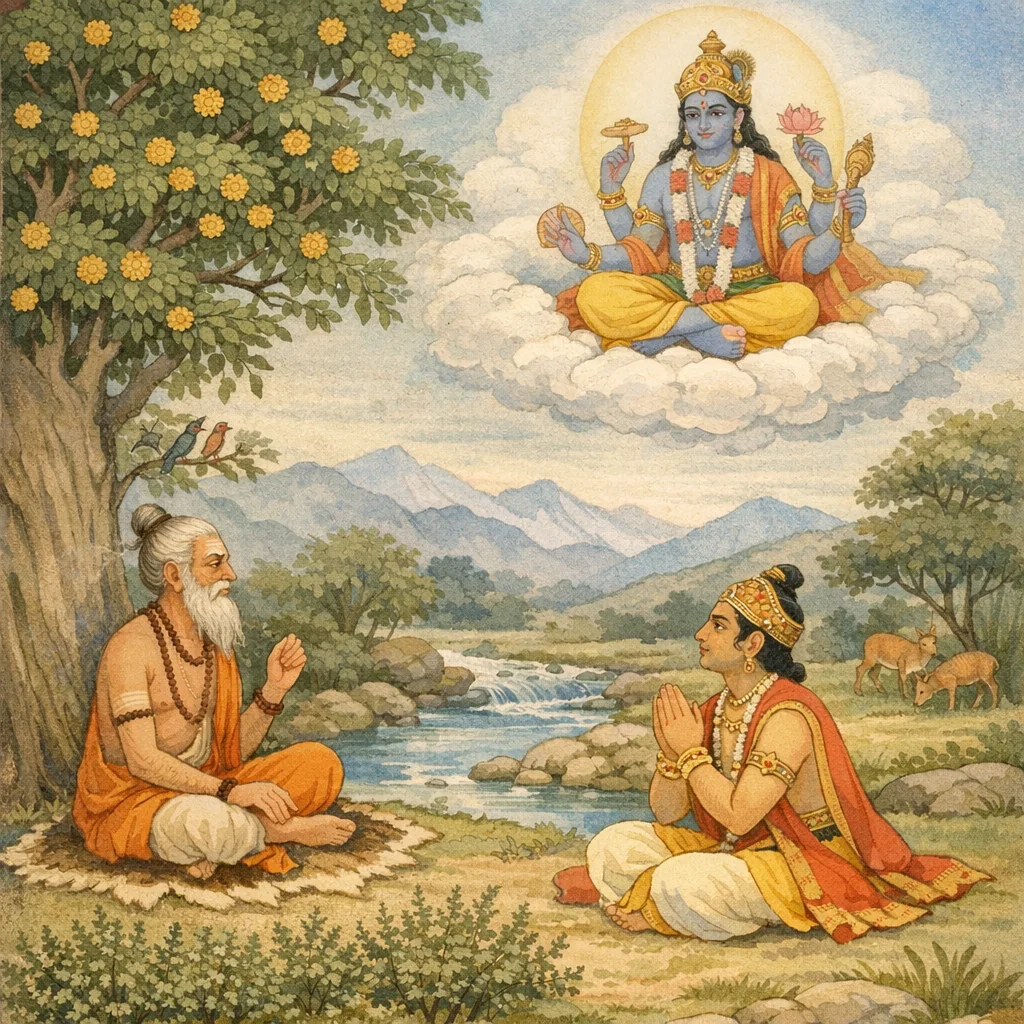
Vyāsa asks Brahmā for the full account of Suvrata. Brahmā narrates a sacred life in which Suvrata, even from the womb, beholds Nārāyaṇa and grows into a child whose very play is unbroken Hari-smaraṇa. He calls his companions by divine names—Keśava, Mādhava, Madhusūdana—sings Kṛṣṇa with rhythm and melody, and utters refuge-formulas like stotra. The chapter universalizes remembrance: in study, laughter, sleep, travel, mantra, knowledge, and good deeds, one should keep Hari present. Household acts become worship—food is regarded as Viṣṇu, offerings are made, and rest is taken with Kṛṣṇa in mind. The narrative then turns to tīrthas: Suvrata dwells on Vaiḍūrya mountain near the Siddheśvara-liṅga and practices austerity on the southern bank of the Narmadā, joining Vaiṣṇava devotion with a Śaiva sacred space.
Shlokas
Verse 1
सूत उवाच । एकदा व्यास देवोऽसौ ब्रह्माणं जगतः पतिम् । सुव्रताख्यानकं सर्वं पप्रच्छातीव विस्मितः
Sūta said: Once, the divine Vyāsa—greatly astonished—questioned Brahmā, the Lord of the world, about the entire narrative known as the account of Suvrata.
Verse 2
व्यास उवाच । लोकात्मंल्लोकविन्यास देवदेव महाप्रभो । सुव्रतस्याथ चरितं श्रोतुमिच्छामि सांप्रतम्
Vyāsa said: O Soul of the world, O Ordainer of the world, O God of gods, great Lord—now I wish to hear the account of Suvrata’s life and deeds.
Verse 3
ब्रह्मोवाच । पाराशर्यमहाभाग श्रूयतां पुण्यमुत्तमम् । सुव्रतस्य सुविप्रस्य तपश्चर्यासमन्वितम्
Brahmā said: “O illustrious Pārāśarya, listen to this supreme and sacred account—concerning Suvrata, the excellent brāhmaṇa, who was endowed with austerity and disciplined religious practice.”
Verse 4
सुव्रतो नाम मेधावी बाल्यादपि स चिंतयन् । गर्भे नारायणं देवं दृष्टवान्पुरुषोत्तमम्
There was a wise man named Suvrata; from childhood he continually contemplated the Lord. While still in the womb, he beheld Nārāyaṇa—the Supreme Lord, Puruṣottama.
Verse 5
स पूर्वकर्माभ्यासेन हरेर्ध्यानं गतस्तदा । शंखचक्रधरं देवं पद्मनाभं सुपुण्यदम्
Then, by the force of his practice rooted in former deeds, he entered into meditation on Hari—on the divine Lord Padmanābha, bearer of conch and discus, the giver of great merit.
Verse 6
ध्यायते चिंतयेत्सो हि गीते ज्ञाने प्रपाठने । एवं देवं हरिं ध्यायन्सदैव द्विजसत्तमः
Indeed, he should meditate and contemplate the Lord while reciting sacred chants, while studying spiritual knowledge, and while reading aloud. Thus, by always meditating on the God Hari, the best of the twice-born remains ever absorbed in Him.
Verse 7
क्रीडत्येवं सदा डिंभैः सार्द्धं च बालकोत्तमः । बालकानां स्वकं नाम हरेश्चैव महात्मनः
Thus the best of boys would always play together with the little children; and among the boys, his own name was spoken as “Hari”—indeed, of that great-souled one.
Verse 8
चकार स हि मेधावी पुण्यात्मा पुण्यवत्सलः । समाह्वयति वै मित्रं हरेर्नाम्ना महामतिः
Indeed, that wise and noble-minded man—devoted to righteousness and fond of virtuous deeds—then called his friend, invoking him by the name of Hari.
Verse 9
भोभोः केशव एह्येहि एहि माधवचक्रधृक् । क्रीडस्व च मया सार्धं त्वमेव पुरुषोत्तम
“O Keśava! Come here—come! O Mādhava, bearer of the discus, come! Play together with me; you alone are the Supreme Person.”
Verse 10
सममेवं प्रगंतव्यमावाभ्यां मधुसूदन । एवमेव समाह्वानं नामभिश्च हरेर्द्विजः
“O Madhusūdana, we two should proceed in this very manner. Likewise, the twice-born should invoke Hari in the same way—by calling upon Him through His names.”
Verse 11
क्रीडने पठने हास्ये शयने गीतप्रेक्षणे । याने च ह्यासने ध्याने मंत्रे ज्ञाने सुकर्मसु
In play, in study, in laughter, in sleep, in hearing or beholding song; in travel, in sitting, in meditation; in mantra, in knowledge, and in the doing of righteous deeds—let one remain mindful of the Sacred.
Verse 12
पश्यत्येवं वदत्येवं जगन्नाथं जनार्दनम् । स ध्यायते तमेकं हि विश्वनाथं महेश्वरम्
Thus, seeing thus and speaking thus of Jagannātha, Janārdana, he meditates on that One alone—Viśvanātha, the Great Lord, Maheśvara.
Verse 13
तृणे काष्ठे च पाषाणे शुष्के सार्द्रे हि केशवम् । पश्यत्येवं स धर्मात्मा गोविंदं कमलेक्षणम्
In grass, in wood, and in stone—whether dry or moist—thus he beholds Keśava; that righteous-souled one sees Govinda, the lotus-eyed Lord.
Verse 14
आकाशे भूमिमध्ये तु पर्वतेषु वनेषु च । जले स्थले च पाषाणे जीवेष्वेव महामतिः
In the sky and within the earth; in mountains and forests; in water and on land; in stones—and indeed in living beings—the Great Intelligence, the supreme principle, is present.
Verse 15
नृसिंहं पश्यते विप्रः सुव्रतः सुमनासुतः । बालक्रीडां समासाद्य रमत्येवं दिनेदिने
The brāhmaṇa Suvrata, son of Sumanā, beholds Narasiṁha; and, taking up the play of a child, he delights in this way day after day.
Verse 16
गीतैश्च गायते कृष्णं सुरागैर्मधुराक्षरैः । तालैर्लयसमायुक्तैः सुस्वरैर्मूर्च्छनान्वितैः
And with songs they sing of Kṛṣṇa—set to noble melodies with sweet syllables—accompanied by rhythm and tempo, with beautiful notes and enriched by musical modes.
Verse 17
सुव्रत उवाच । ध्यायंति वेदविदुषः सततं सुरारिं यस्यांगमध्ये सकलं हि विश्वम् । योगेश्वरं सकलपापविनाशनं च व्रजामि शरणं मधुसूदनस्य
Suvrata said: I take refuge in Madhusūdana—ever contemplated by the knowers of the Vedas, the foe of the gods’ enemies, within whose body the entire universe indeed abides, the Lord of Yoga, and the destroyer of all sins.
Verse 18
लोकेषु यो हि सकलेष्वनुवर्तते यो लोकाश्च यस्मिन्निवसंति सर्वे । दोषैर्विहीनमखिलैः परमेश्वरं तं तस्यैव पादयुगलं सततं नमामि
I continually bow to the pair of feet of that Supreme Lord—He who pervades all the worlds, in whom all worlds abide, and who is entirely free from every fault.
Verse 19
नारायणं गुणनिधानमनंतवीर्यं वेदांतशुद्धमतयः प्रपठंति नित्यम् । संसारसागरमनंतमगाधदुर्गमुत्तारणार्थमखिलं शरणं प्रपद्ये
I take refuge in Nārāyaṇa—treasury of virtues, of infinite power—whom those whose intellect is purified by Vedānta continually recite. For the sake of crossing the endless ocean of worldly existence, deep and difficult to traverse, I wholly surrender to Him as my refuge.
Verse 20
योगींद्र मानससरोवरराजहंसं शुद्धं प्रभावमखिलं सततं हि यस्य । तस्यैव पादयुगलं विमलं विशालं दीनस्य मेऽसुररिपो कुरु तस्य रक्षाम्
O Indra among yogins—like a royal swan on the Mānasarovara—whose entire, ever-present radiance is pure: O enemy of the asuras, protect me, the helpless one, by safeguarding those very two feet—spotless and vast.
Verse 21
इति श्रीपद्मपुराणे पंचपंचाशत्सहस्रसंहितायां भूमिखंडे ऐंद्रे सुमनोपाख्याने एकविंशोऽध्यायः
Thus, in the sacred Padma Purāṇa—within the compilation of fifty-five thousand verses—in the Bhūmi-khaṇḍa, in the Aindra section, in the episode called “Sumanopākhyāna,” ends the twenty-first chapter.
Verse 22
गायाम्यहं सुरसगीतकतालमानैः श्रीरंगमेकमनिशं भुवनस्य देवम् । अज्ञाननाशकमलं च दिनेशतुल्यमानंदकंदमखिलं महिमा समेतम्
With the rhythms, beats, and measures of celestial song, I continually sing of Śrī Raṅga—the one Lord of the worlds—whose radiance is like the sun, who destroys the impurity of ignorance, who is the very root of bliss, and who is endowed with all glory.
Verse 23
संपूर्णमेवममृतस्यकलानिधानं तं गीतकौशलमनन्यरसैः प्रगाये । युक्तं स्वयोगकरणैः परमार्थदृष्टिं विश्वं स पश्यति चराचरमेव नित्यम्
Thus, with single-minded relish, one should sing of Him—the complete treasury of the nectar of immortal essence, the very mastery of sacred song. United with the disciplines of one’s own yoga, and endowed with the vision of highest truth, that person ever beholds the entire universe—moving and unmoving—as it truly is.
Verse 24
पश्यंति नैव यमिहाथ सुपापलोकास्तं केशवं शरणमेवमुपैति नित्यम्
Here, even the most sinful people do not behold Yama; for one who thus continually takes refuge in Keśava.
Verse 25
कराभ्यां वाद्यमानस्तु तालं तालसमन्वितम् । गीतेनगायते कृष्णं बालकैः सह मोदते
Keeping time with both hands and marking the rhythm with claps, he sings of Kṛṣṇa in song and rejoices together with the children.
Verse 26
एवं क्रीडारतो नित्यं बालभावेन वै तदा । सुव्रतः सुमनापुत्रो विष्णुध्यानपरायणः
Thus, at that time, Suvrata, the son of Sumanā, was ever absorbed in play with a childlike spirit, yet wholly devoted to meditation upon Viṣṇu.
Verse 27
क्रीडमानं प्राह माता सुव्रतं चारुलक्षणम् । भोजनं कुरु मे वत्स क्षुधा त्वां परिपीडयेत्
Seeing him at play, the mother said to Suvrata, her well-disciplined, fair-featured child: “Eat, my dear son, lest hunger trouble you.”
Verse 28
तामुवाच पुनः प्राज्ञः सुमना मातरं पुनः । महामृतेन तृप्तोस्मि हरिध्यानरसेन वै
Then the wise Suvrata again spoke to his mother Sumanā: “Truly, I am satisfied—sated by the great nectar, the blissful essence of meditation on Hari.”
Verse 29
भोजनासनमारूढो मिष्टमन्नं प्रपश्यति । इदमन्नं स्वयं विष्णुरात्मा ह्यन्नं समाश्रितः
Seated upon the dining seat, he beholds the sweet food. For this food is truly Viṣṇu Himself; the Self indeed abides supported by food.
Verse 30
आत्मरूपेण यो विष्णुरनेनान्नेन तृप्यतु । क्षीरसागरसंवासो यस्यैव परिसंस्थितः
May that Viṣṇu—present here in the form of the Self—be satisfied by this offering of food; He whose abode is firmly established in the Ocean of Milk.
Verse 31
जलेनानेन पुण्येन तृप्तिमायातु केशवः । तांबूलचंदनैर्गंधैरेभिः पुष्पैर्मनोहरैः
May Keśava be satisfied by this meritorious offering of water, and by these pleasing flowers, together with the fragrances of betel and sandalwood.
Verse 32
आत्मस्वरूपेण तृप्तस्तृप्तिमायातु केशवः । शयने याति धर्मात्मा तदा कृष्णं प्रचिंतयेत्
May Keśava, ever content in His own true nature, bestow contentment. When the righteous person lies down to rest, then he should contemplate Kṛṣṇa.
Verse 33
योगनिद्रान्वितं कृष्णं तमहं शरणं गतः । भोजनाच्छादनेष्वेवमासने शयने द्विजः
I have taken refuge in Kṛṣṇa, who is absorbed in yogic sleep. Thus, O brāhmaṇa, in matters of food and clothing, and likewise regarding one’s seat and bed, one should act in this spirit of refuge.
Verse 34
चिंतयेद्वासुदेवं तं तस्मै सर्वं प्रकल्पयेत् । तारुण्यं प्राप्य धर्मात्मा कामभोगान्विहाय वै
Let him meditate on that Vāsudeva and dedicate everything to Him. Having attained youth, the righteous-minded one should indeed abandon indulgence in sensual pleasures.
Verse 35
स युक्तः केशवध्याने वैडूर्यपर्वतोत्तमे । यत्र सिद्धेश्वरं लिंगं वैष्णवं पापनाशनम्
Absorbed in meditation on Keśava, he remained on the excellent Vaiḍūrya mountain, where there is the Siddheśvara Liṅga—devoted to Viṣṇu and a destroyer of sins.
Verse 36
रुद्रमोंकारसंज्ञं च ध्यात्वा चैव महेश्वरम् । ब्रह्मणा वर्द्धितं देवं नर्मदादक्षिणे तटे
Meditating on Maheśvara, known as the Rudra-Om̐kāra, one should worship that Deity exalted by Brahmā on the southern bank of the Narmadā.
Verse 37
सिद्धेश्वरं समाश्रित्य तपोभावं व्यचिंतयत्
Taking refuge in Siddheśvara, he contemplated the discipline and inward intent of austerity (tapas).