Adhyaya 64
Yayāti’s Summons to Heaven and the Teaching on Old Age, the Five-Element Body, and Self–Body Discernment
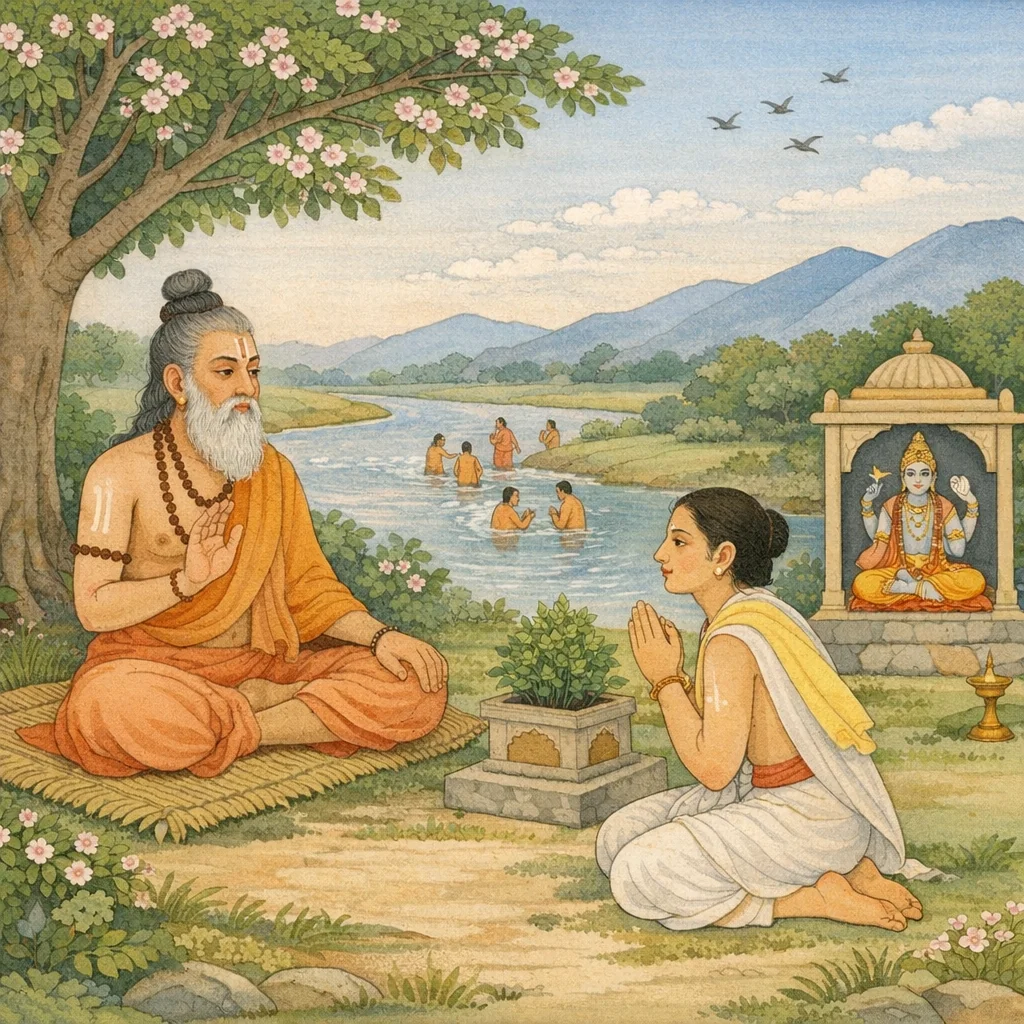
The chapter begins with a question about Yadu’s supreme happiness and Ruru’s sinful consequence, leading Sukarmā to recount the purifying history of Nahuṣa and King Yayāti. Yayāti’s exceptionally dharmic rule, sacrificial rites, and lavish charity are praised, stirring Indra’s anxiety that the king might surpass him. Nārada affirms Yayāti’s virtues, and Indra sends Mātali to summon the king to heaven. Yayāti asks how one can abandon the five-element body and still reach the realm earned by merit. Mātali explains the subtle divine body and then teaches on the body’s elemental makeup, the inevitability of old age, the inner “fire,” hunger and disease, and the destructive cycle of lust that drains vitality. The section culminates in discernment between Self and body: the Ātman departs while the body decays, and even merit cannot halt senescence.
Shlokas
Verse 1
पिप्पलौवाच । पितुःप्रसादभावाद्वै यदुना सुखमुत्तमम् । कथं प्राप्तं सुभुक्तं च तन्मे विस्तरतो वद
Pippala said: “By the gracious favor of your father, the supreme happiness that Yadu attained—how was it obtained, and how was it rightly enjoyed? Tell me that in detail.”
Verse 2
कस्मात्पापप्रभावं च रुरुर्भुंक्ते द्विजोत्तम । सकलं विस्तरेणापि वद मे कुंडलात्मज
O best of brāhmaṇas, for what reason does the creature named Ruru undergo the consequence born of sin? Tell me the whole matter in detail as well, O son of Kuṇḍala.
Verse 3
सुकर्मोवाच । श्रूयतामभिधास्यामि चरित्रं पापनाशनम् । नहुषस्य सुपुण्यस्य ययातेश्च महात्मनः
Sukarma said: “Listen; I shall relate a sin-destroying account—the story of the greatly meritorious Nahuṣa and of the great-souled Yayāti.”
Verse 4
सोमवंशात्प्रभूतो हि नहुषो मेदिनीपतिः । दानधर्माननेकांश्च चका रह्यतुलानपि
From the Lunar dynasty indeed arose Nahusha, lord of the earth; and he performed many acts of charity and dharma—unsurpassed in measure as well.
Verse 5
मखानामश्वमेधानामियाज शतमुत्तमम् । वाजपेयशतं चापि अन्यान्यज्ञाननेकधा
He performed a hundred excellent Aśvamedha sacrifices; and likewise a hundred Vājapeya rites, along with many other sacrifices of various kinds.
Verse 6
आत्मनः पुण्यभावेन इंद्रलोकमवाप सः । पुत्रं धर्मगुणोपेतं प्रजापालं चकार सः
By the merit of his own virtuous disposition, he attained Indra’s world; and he appointed his son—endowed with righteous qualities—as the protector and ruler of the people.
Verse 7
ययातिं सत्यसंपन्नं धर्मवीर्यं महामतिम् । एंद्रं पदं गतो राजा तस्य पुत्रः पदे स्वके
King Yayāti—endowed with truth, possessed of righteous valor, and great-minded—attained the Indra-like heavenly station; and his son remained established in his own rightful position.
Verse 8
ययातिः सत्यसंपन्नः प्रजा धर्मेण पालयेत् । स्वयमेव प्रपश्येत्स प्रजाकर्माणि तान्यपि
Endowed with truthfulness, King Yayāti should govern his subjects through dharma; and he himself should directly observe the deeds of the people as well.
Verse 9
याजयामास धर्मज्ञः श्रुत्वा धर्ममनुत्तमम् । यज्ञतीर्थादिकं सर्वं दानपुण्यं चकार सः
Having heard the unsurpassed teaching of dharma, that knower of righteousness caused sacrifices to be performed; and he carried out all that pertains to the sacred places of yajña, and the meritorious duty of giving in charity.
Verse 10
राज्यं चकार मेधावी सत्यधर्मेण वै तदा । यावदशीतिसहस्राणि वर्षाणां नृपनंदनः
Then that wise prince ruled the kingdom in accordance with the dharma of truth, for as long as eighty thousand years.
Verse 11
तावत्कालं गतं तस्य ययातेस्तु महात्मनः । तस्य पुत्राश्च चत्वारस्तद्वीर्यबलविक्रमाः
By that time, the span of life of the great-souled Yayāti had passed. He had four sons, renowned for their valor, strength, and prowess.
Verse 12
तेषां नामानि वक्ष्यामि शृणुष्वैकाग्रमानसः । तस्यासीज्ज्येष्ठपुत्रस्तु रुरुर्नाम महाबलः
I shall tell you their names—listen with a mind fully concentrated. His eldest son was named Ruru, a man of great strength.
Verse 13
पुरुर्नाम द्वितीयोऽभूत्कुरुश्चान्यस्तृतीयकः । यदुर्नाम स धर्मात्मा चतुर्थो नृपतेः सुतः
The second son was named Puru; the third was Kuru. The fourth, righteous-souled, was named Yadu—all were sons of the king.
Verse 14
एवं चत्वारः पुत्राश्च ययातेस्तु महात्मनः । तेजसा पौरुषेणापि पितृतुल्यपराक्रमाः
Thus the great-souled Yayāti had four sons—equal to their father in valor, in splendor, and in manly prowess.
Verse 15
एवं राज्यं कृतं तेन धर्मेणापि ययातिना । तस्य कीर्तिर्यशो भावस्त्रैलोक्ये प्रचुरोभवत्
Thus Yayāti governed the kingdom in righteousness (dharma), and his fame—his renown and noble repute—became abundant throughout the three worlds.
Verse 16
विष्णुरुवाच । एकदा तु द्विजश्रेष्ठो नारदो ब्रह्मनंदनः । एंद्रं लोकं गतो राजन्द्रष्टुं चैव पुरंदरम्
Viṣṇu said: Once, O King, the best of the twice-born—Nārada, the beloved son of Brahmā—went to Indra’s world to behold Purandara (Indra) himself.
Verse 17
सहस्राक्षस्ततोपश्यद्धुताशनसमप्रभम् । देवो विप्रं समायांतं सर्वज्ञं ज्ञानपंडितम्
Then Sahasrākṣa (Indra) saw a brāhmaṇa approaching, radiant like blazing fire—truly omniscient and a learned master of sacred knowledge.
Verse 18
पूजितं मधुपर्काद्यैर्भक्त्या नमितकंधरः । निवेश्य चासने पुण्ये पप्रच्छ मुनिपुंगवम्
Having honored him with devotion through offerings such as madhuparka, and bowing his neck in reverence, he seated the sage upon a sacred seat and questioned that foremost of ascetics.
Verse 19
इंद्र उवाच । कस्मादागमनं तेद्य किमर्थमिह चागतः । किं ते हि सुप्रियं विप्र करोम्यद्य महामुने
Indra said: “For what reason have you come today, and why have you arrived here? O brāhmaṇa, O great sage—what most pleasing thing may I do for you today?”
Verse 20
नारद उवाच । देवराज कृतं सर्वं भक्त्या यच्च प्रभाषितम् । संतुष्टोस्मि महाप्राज्ञ प्रश्नोत्तरं वदाम्यहम्
Nārada said: “O king of the gods, I am pleased with everything you have done and with what you have spoken in devotion. O greatly wise one, I shall now speak the answers to your questions.”
Verse 21
महीलोकात्सुसंप्राप्तः सांप्रतं तव मंदिरम् । त्वामन्वेष्टुं समायातो दृष्ट्वा नाहुषमेव च
Having come safely from the earthly world, I have now arrived at your temple. I have come to seek you, and I have also seen Nahuṣa himself.
Verse 22
इंद्र उवाच । सत्यधर्मेण को राजा प्रजाः पालयते सदा । सर्वधर्मसमायुक्तः श्रुतवाञ्ज्ञानवान्गुणी
Indra said: “Which king, by the dharma of truth, always protects his subjects—endowed with every virtue of dharma, learned, wise, and possessed of good qualities?”
Verse 23
पृथिव्यामस्ति को राजा वेदज्ञो ब्राह्मणप्रियः । ब्रह्मण्यो वेदविच्छूरो यज्वा दाता सुभक्तिमान्
Who on earth is that king—skilled in the Vedas, devoted to Brahmins; a protector of sacred law, radiant with Vedic wisdom; a performer of sacrifices, a generous giver, and endowed with excellent devotion?
Verse 24
नारद उवाच । एभिर्गुणैस्तु संयुक्तो नहुषस्यात्मजो बली । यस्य सत्येन वीर्येण सर्वे लोकाः प्रतिष्ठिताः
Nārada said: Endowed with these virtues was the mighty son of Nahuṣa—by whose truth and heroic power all the worlds stand firmly established.
Verse 25
भवादृशो हि भूर्लोके ययातिर्नहुषात्मजः । भवान्स्वर्गे स चैवास्ति भूतले भूतिवर्धनः
On earth there is indeed one like you—Yayāti, the son of Nahuṣa. You are in heaven, and he is likewise on the earth, an increaser of prosperity.
Verse 26
पितुः श्रेष्ठो महाराज ह्यश्वमेधशतं तथा । वाजपेयशतं चक्रे ययातिः पृथिवीपतिः
O great king, Yayāti—the lord of the earth—surpassed his father, for he performed a hundred Aśvamedha sacrifices, and likewise a hundred Vājapeya sacrifices.
Verse 27
दत्तान्यनेकरूपाणि दानानि तेन भक्तितः । गवां लक्षसहस्राणि गवां कोटिशतानि च
With devotion, he gave many kinds of gifts—tens of thousands of cows, and even hundreds of crores of cows as well.
Verse 28
कोटिहोमांश्चकाराथ लक्षहोमांस्तथैव च । भूमिदानादि दानानि ब्राह्मणेभ्योददाच्च यः
He performed homa offerings numbering in crores, and likewise offerings numbering in lakhs; and he also gave gifts—beginning with the donation of land—to the Brahmins.
Verse 29
सर्वं येन स्वरूपं हि धर्मस्य परिपालितम् । एवं गुणैः समायुक्तो ययातिर्नहुषात्मजः
He by whom the very essence of dharma was upheld in every way—thus, endowed with such virtues, was Yayāti, the son of Nahuṣa.
Verse 30
वर्षाणां तु सहस्राणि अशीतिर्नृपसत्तमः । राज्यं चकार सत्येन यथा दिवि भवानिह
O best of kings, for eighty thousand years he ruled his kingdom through truthfulness—just as you do here on earth, as if in heaven.
Verse 31
सुकर्मोवाच । एवमाकर्ण्य देवेंद्रो नारदात्स मुनीश्वरात् । समालोच्य स मेधावी संभीतो धर्मपालनात्
Sukarmā said: Having thus heard these words from Nārada, lord among sages, Indra—the king of the gods—reflected upon them; that wise one became fearful concerning the safeguarding of dharma.
Verse 32
शतयज्ञप्रभावेण नहुषो हि पुरा मम । एंद्रं पदं गतो वीरो देवराजोभवत्पुरा
By the power of performing a hundred sacrifices, the hero Nahusha—of my lineage—once attained Indra’s station and formerly became the king of the gods.
Verse 33
शची बुद्धिप्रभावेण पदभ्रष्टो व्यजायत । तादृशोयं महाराजः पितुस्तुल्यपराक्रमः
By the power of Śacī’s discerning counsel, he was raised from his fallen state and restored to his rightful station. Such is this great king—equal in valor to his father.
Verse 34
प्राप्स्यते नात्र संदेहः पदमैंद्रं न संशयः । येन केनाप्युपायेन तं भूपं दिवमानये
He will attain it—there is no doubt; he will surely reach the rank of Padma-Indra, without question. By whatever means, bring that king to heaven.
Verse 35
इत्येवं चिंतयामास तस्माद्भीतः सुरेश्वरः । भूपालस्य नृपश्रेष्ठ ययातेः सुमहद्भयात्
Thinking thus, the lord of the gods became afraid—O best of kings—because of the great terror caused by King Yayāti.
Verse 36
तमानेतुं ततो दूतं प्रेषयामास देवराट् । नहुषस्य विमानं तु सर्वकामसमन्वितम्
Then the king of the gods dispatched a messenger to bring him. And Nahusha’s aerial chariot was furnished with every desired luxury.
Verse 37
सारथिं मातलिं नाम विमानेन समन्वितम् । गतो हि मातलिस्तत्र यत्रास्ते नहुषात्मजः
Mātali, the charioteer—equipped with a celestial aerial car—indeed went there, to the place where Nahusha’s son was staying.
Verse 38
प्रहितः सुरराजेन समानेतुं महामतिम् । सभायां वर्त्तमानस्तु यथा इंद्र प्रःशोभते
Dispatched by the king of the gods to bring that great-minded one, he stood in the assembly—shining splendidly, like Indra himself.
Verse 39
तथा ययातिर्धर्मात्मा स्वसभायां विराजते । तमुवाच महात्मानं राजानं सत्यभूषणम्
Thus Yayāti, righteous in soul, shone within his own royal assembly. Then he spoke to that great king, whose ornament was truth.
Verse 40
सारथिर्देवराजस्य शृणु राजन्वचो मम । प्रहितो देवराजेन सकाशं तव सांप्रतम्
I am the charioteer of the King of the gods. Hear, O king, my words: even now the Lord of the gods has dispatched me into your presence.
Verse 41
यद्ब्रूते देवराजस्तु तत्सर्वं सुमनाः कुरु । आगंतव्यं त्वया देव एंद्रं लोकं हि नान्यथा
Whatever the King of the gods commands, do all of it with a glad mind. You must indeed come, O divine one, to Indra’s world; there is no other way.
Verse 42
पुत्रे राज्यं विसृज्यैव कृत्वा चांतेष्टिमुत्तमाम् । इलो राजा महातेजा वसते नहुषात्मज
Having entrusted the kingdom to his son and performed the most excellent funeral rites, King Ila—of great splendor, the son of Nahusha—came to dwell there.
Verse 43
पुरूरवा महावीर्यो विप्रचित्तिर्महामनाः । शिबिर्वसति तत्रैव मनुरिक्ष्वाकु भूपतिः
There dwell Purūravas of great valor, Vipracitti of noble mind, and Śibi; and there too reside Manu and Ikṣvāku, the king.
Verse 44
सगरो नाम मेधावी नहुषश्च पिता तव । ऋतवीर्यः कृतज्ञश्च शंतनुश्च महामनाः
Sagara was a wise king; Nahusha was your father. Ṛtavīrya was grateful, and Śaṃtanu too was great-minded.
Verse 45
भरतो युवनाश्वश्च कार्तवीर्यो नरेश्वरः । यज्ञानाहृत्य बहुधा मोदंते दिवि भूभृतः
Bharata, Yuvanāśva, and Kārtavīrya—the lord of men—having brought the rewards of many sacrifices, rejoice in heaven in manifold ways, O king.
Verse 46
अन्ये चैव तु राजानो यज्ञकर्मसु तत्पराः । सर्वे ते दिवि चेंद्रेण मोदंते स्वेन कर्मणा
And other kings too, devoted to the performance of sacrificial rites—each of them rejoices in heaven together with Indra, through the merit of his own deeds.
Verse 47
त्वं पुनः सर्वधर्मज्ञः सर्वधर्मेषु संस्थितः । शक्रेण सह मोदस्व स्वर्गलोके महीपते
And you, O king—knower of all dharma and steadfast in every righteous duty—rejoice in the heavenly realm together with Śakra (Indra).
Verse 48
ययातिरुवाच । किं मया तत्कृतं कर्म येन मय्यर्थिता तव । इंद्रस्य देवराजस्य तत्सर्वं मे वदस्व च
Yayāti said: “What deed have I done, that you have come to me with a request? Tell me everything—the matter concerning Indra, the king of the gods.”
Verse 49
मातलिरुवाचमातलि उपरि टिप्पणी । यदशीतिसहस्राणि वर्षाणां हि त्वया नृप । दानपुण्यादिकं कर्म यज्ञैस्तु परिसाधितम्
Mātali said: “O King, for eighty thousand years you have indeed duly accomplished meritorious acts—such as charity and other pious deeds—by means of sacrifices (yajñas).”
Verse 50
दिवं गच्छ महाराज कर्मणा स्वेन भूपते । सखित्वं देवराजेन कुरु गच्छ सुरालयम्
O great king, ruler of the earth—by your own deeds (karma) go to heaven. Become a friend of the king of the devas; go to the abode of the suras.
Verse 51
पंचात्मकं शरीरं च भूमौ त्यज महामते । दिव्यरूपं समास्थाय भुंक्ष्व भोगान्मनोनुगान्
O great-minded one, cast off upon the earth this body made of the five elements. Assuming a divine form, enjoy the pleasures that accord with your mind’s desire.
Verse 52
यथायथा कृता भूमौ यज्ञा दानं तपश्च ते । तथातथा स्वर्गभोगाः प्रार्थयंते नरेश्वर
O lord of men, in whatever measure sacrifices (yajñas), gifts (dāna), and austerities (tapas) are performed on earth, in that same measure are the enjoyments of heaven sought and attained.
Verse 53
ययातिरुवाच । येन कायेन सिध्येत सुकृतं दुष्कृतं भुवि । मातले तत्कथं त्यक्त्वा गच्छेल्लोकमुपार्जितम्
Yayāti said: “With whatever body one’s merit and demerit are accomplished upon the earth—O Mātali—how can one abandon that very body and yet go to the world one has earned?”
Verse 54
मातलिरुवाच । यत्रैवोपार्जितं कायं पंचात्मकमिदं नृप । तत्तत्रैव परित्यज्य दिव्येनैव व्रजंति तम्
Mātali said: O king, wherever this five-element body is obtained, there itself it is cast off; and then, by a divine and subtle body alone, they proceed to that realm.
Verse 55
इतरे मानवाः सर्वे पापपुण्यप्रसाधकाः । तेऽपि कायं परित्यज्य अधऊर्ध्वं व्रजंति वै
All other human beings, shaped by sin and merit, they too—after abandoning the body—indeed go either downward or upward.
Verse 56
ययातिरुवाच । पंचात्मकेन कायेन सुकृतं दुष्कृतं नराः । उत्पाद्यैव प्रयांत्येव अधऊर्ध्वं तु मातले
Yayāti said: With the body made of the five elements, people produce both merit and sin; and having produced them, they depart—going either downward or upward, O Mātali.
Verse 57
को विशेषो हि धर्मज्ञ भूमौ कायं परित्यजेत् । पापपुण्यप्रभावाद्वै कायस्य पतनं भवेत्
O knower of dharma, what special distinction is there in casting off the body upon the earth? Indeed, through the influence of sin and merit, the body’s fall—death—comes to pass.
Verse 58
दृष्टांतो दृश्यते सूत प्रत्यक्षं मर्त्यमंडले । विशेषं नैव पश्यामि पापपुण्यस्य चाधिकम्
O Sūta, an example is seen directly here in the mortal world; yet I do not perceive any special, greater distinction between sin and merit.
Verse 59
सत्यधर्मादिकं कर्म येन कायेन मानवः । समर्जयति वै मर्त्यस्तं कस्माद्विप्रसर्जयेत्
Why should a mortal cast away that very body by which a human performs deeds of truthfulness and dharma, and thereby gathers merit?
Verse 60
आत्मा कायश्च द्वावेतौ मित्ररूपावुभावपि । कायं मित्रं परित्यज्य आत्मा याति सुनिश्चितः
The Self (Ātman) and the body—these two are indeed like friends; yet the Self surely departs, leaving behind the bodily friend.
Verse 61
मातलिरुवाच । सत्यमुक्तं त्वया राजन्कायं त्यक्त्वा प्रयाति सः । संबंधो नास्ति तेनापि समं कायेन चात्मनः
Mātali said: “What you have spoken is true, O King. Having abandoned the body, he departs; therefore there is no real bond between that departing self and the body, nor is the body the same as the Ātman.”
Verse 62
यस्मात्पंचत्वरूपोऽयं संधिजर्जरितः सदा । जरया पीड्यमानस्तु व्याधिभिर्दूषितः सदा
Because this body is of fivefold nature, its joints are ever worn down; it is continually oppressed by old age and always tainted by disease.
Verse 63
जरादोषैः प्रभग्नोऽसौ अत्र स्थातुं स नेच्छति । आकुलव्याकुलो भूत्वा जीवस्त्यक्त्वा प्रयाति सः
Crushed by the afflictions of old age, he no longer wishes to remain here. Utterly agitated and confused, the jīva departs, abandoning the body.
Verse 64
सत्येन धर्मपुण्यैश्च दानैर्नियमसंयमैः । अश्वमेधादिभिर्यज्ञैस्तीर्थैः संयमनैस्तथा
By truthfulness; by righteous and meritorious deeds; by charity; by vows and self-restraint; by sacrifices such as the Aśvamedha; by sacred tīrthas, the pilgrimage-places; and likewise by disciplines of restraint—(one attains the intended spiritual merit).
Verse 65
सुपुण्यैः सुकृतैश्चान्यैर्जरा नैव प्रधार्यते । पातकैश्च महाराज द्रवते कायमेव सा
Even with abundant merit and other good deeds, old age cannot truly be held back; but through sins, O great king, it melts away the body itself.
Verse 66
ययातिरुवाच । कस्माज्जरा समुत्पन्ना कस्मात्कायं प्रपीडयेत् । मम विस्तरतस्त्वं च वक्तुमर्हसि सत्तम
Yayāti said: “From what does old age arise, and why does it afflict the body? Please explain this to me in detail, O best of the virtuous.”
Verse 67
मातलिरुवाच । हंत ते वर्णयिष्यामि जरायाः परिकारणम् । यस्माच्चेयं समुद्भूता कायमध्ये नृपोत्तम
Mātali said: “Come, I shall describe to you the underlying cause of old age—how it arises within the body, O best of kings.”
Verse 68
पंचभूतात्मकः कायो विषयैः पंचभिः श्रितः । यदात्मा त्यजते राजन्स कायः परिधक्ष्यते
The body is constituted of the five great elements and is supported by the five sense-objects. When the Self departs, O king, that body is then consigned to burning.
Verse 69
वह्निना दीप्यमानस्तु सरसो ज्वलते नृप । तस्माद्विजायते धूमो धूमान्मेघाश्च जज्ञिरे
O king, when the fire blazes, the lake itself seems to burn; from that arises smoke, and from the smoke clouds are born.
Verse 70
मेघादापः प्रवर्तंते अद्भ्यः पृथ्वी प्रकल्पते । जलमायाति साध्वी सा यथा नारी रजस्वला
From the clouds the waters set forth; from the waters the earth is formed. That virtuous earth becomes filled with water—like a woman in her menstrual season.
Verse 71
तस्मात्प्रजायते गंधो गंधाद्रसो नृपोत्तम । रसात्प्रभवते चान्नमन्नाच्छुक्रं न संशयः
Therefore fragrance arises; from fragrance arises taste, O best of kings. From taste, food is produced; and from food, semen arises—of this there is no doubt.
Verse 72
शुक्राद्धि जायते कायः कुरूपः काय एव च । यथा पृथ्वी सृजेद्गंधान्रसैश्चरति भूतले
Indeed, the body is born from semen—whether it be ugly or beautiful, it is still only a body; just as the earth produces fragrances and moves upon the surface with its tastes.
Verse 73
तथा कायश्चरेन्नित्यं रसाधारो हि सर्वशः । गंधश्च जायते तस्माद्गंधाद्रसो भवेत्पुनः
Likewise, one should constantly maintain bodily movement; for the body is, in every way, the support of taste. From it aroma arises, and from aroma, taste again comes forth.
Verse 74
तस्माज्जज्ञे महावह्निर्दृष्टांतं पश्य भूपते । यथा काष्ठाद्भवेद्वह्निः पुनः काष्ठं प्रकाशयेत्
From that the great fire was born. Behold this illustration, O king: just as fire arises from wood, and then again illuminates and reveals the wood.
Verse 75
कायमध्ये रसादग्निस्तद्वदेव प्रजायते । तत्र संचरते नित्यं कायं पुष्णाति भूपते
Within the body, from rasa—the vital essence—fire arises. It continually moves there and nourishes the body, O king.
Verse 76
यावद्रसस्य चाधिक्यं तावज्जीवः प्रशांतिमान् । चरित्वा तादृशं वह्निः क्षुधारूपेण वर्तते
So long as there is an excess of rasa, the living being remains calm; but when that state is passed, the inner fire functions in the form of hunger.
Verse 77
अन्नमिच्छत्यसौ तीव्रः पयसा च समन्वितम् । प्रदानं लभते चान्नमुदकं चापि भूपते
He intensely desires food accompanied by milk; and, O king, he receives offerings—food and also water.
Verse 78
शोणितं चरते वह्निस्तद्वद्वीर्यं न संशयः । यक्ष्मरोगो भवेत्तस्मात्सर्वकायप्रणाशकः
Fire courses through the blood; likewise vīrya—the vital potency—does so as well, without doubt. From that arises yakṣmā, a wasting disease that destroys the entire body.
Verse 79
रसाधिक्यं भवेद्राजन्नथ वह्निः प्रशाम्यति । रसेन पीड्यमानस्तु ज्वररूपोभिजायते
O King, when rasa—the bodily fluid and essence—becomes excessive, the digestive fire is subdued; and when one is oppressed by that rasa, fever arises as a disease.
Verse 80
ग्रीवा पृष्ठं कटिं पायुं सर्वास्वेव तु संधिषु । आरुध्य तिष्ठते वह्निः काये वह्निः प्रवर्तते
Having mounted the neck, the back, the waist, the anus, and indeed all the joints, the fire remains established there; thus the bodily fire becomes active throughout the body.
Verse 81
तस्याऽधिक्यं चरेन्नित्यं कायं पुष्णाति सर्वतः । रसस्तु बंधमायाति बलरूपो भवेत्तदा
By regularly maintaining an abundance of that nourishing factor, one nourishes the body in every way. Then rasa becomes well-bound and firm, taking the form of strength.
Verse 82
अतिरिक्तो बलेनैव वीर्यान्मर्माणि चालयेत् । तेनैव जायते कामः शल्यरूपो भवेन्नृप
Excessive potency, driven by sheer force, agitates the vital points of the body. From that very agitation desire arises, and, O king, it becomes like a thorn—an afflicting pain.
Verse 83
सकामाग्निः समाख्यातो बलनाशकरो नृप । मैथुनस्य प्रसंगेन विनाशत्वं कलेवरे
O king, this is called the fire of lust; it destroys one’s strength. Through indulgence in sexual union, the body comes to ruin.
Verse 84
नारीं च संश्रयेत्प्राणी पीडितः कामवह्निना । मैथुनस्य प्रसंगेन मूर्छितः कामकर्शितः
A being, tormented by the fire of desire, takes refuge in a woman; drawn into the occasion of sexual union, he grows faint—worn down by passion.
Verse 85
तेजोहीनो भवेत्कायो बलहानिश्च जायते । बलहीनो यदा स्याद्वै दुर्बलो वह्निनेरितः
When the body is bereft of vital radiance, loss of strength arises; and when one truly becomes strengthless, one is rendered weak, as though driven by fire.
Verse 86
स वह्निः प्रचरेत्काये शोणितं शुक्रमेव च । शुक्रशोणितयोर्नाशाच्छून्यदेहोभिजायते
That inner fire moves through the body, consuming both blood and semen; when blood and semen are destroyed, the body becomes empty and lifeless.
Verse 87
अतीव जायते वायुः प्रचंडो दारुणाकृतिः । विवर्णो दुःखसंतप्तः शून्यबुद्धिस्ततो भवेत्
Then an exceedingly violent wind arises, fierce and dreadful in form; one becomes pale, scorched by suffering, and thereafter the mind turns vacant and confused.
Verse 88
दृष्टा श्रुता तु या नारी तच्चित्तो भ्रमते सदा । तृप्तिर्न जायते काये लोलुपे चित्तवर्त्मनि
When a man’s mind becomes fixed on a woman—whether merely seen or only heard of—he wanders constantly; in a body driven by greed, along the mind’s restless course, contentment never arises.
Verse 89
विरूपश्च सुरूपश्च ध्यानान्मध्ये प्रजायते । बलहीनो यदा कामी मांसशोणितसंक्षयात्
From the very act of conception, a child may be born either misshapen or well-formed. And when a man, driven by lust, is weakened by the wasting of flesh and blood, such outcomes arise.
Verse 90
पलितं जायते काये नाशिते कामवह्निना । तस्मात्संजायते कामी वृद्धो भूत्वा दिनेदिने
When the body is scorched by the fire of desire, grey hair appears upon it. Therefore, day by day, even as one grows old, the lust-driven person becomes ever more impelled by desire.
Verse 91
सुरते चिंतते नारीं यथा वार्द्धुषिको नरः । तथातथा भवेद्धानिस्तेजसोऽस्य नरेश्वर
O king, just as a man, even in the midst of lovemaking, keeps thinking of another woman, so, in that very measure, there arises a corresponding loss of his vigor and spiritual radiance.
Verse 92
तस्मात्प्रजायते कायो नाशरूपं समृच्छति । अग्निः प्रजायते भूयो जरारूपो न संशयः
Therefore the body is born and inevitably comes to the form of destruction. Again fire is produced, taking on the form of decay and old age—of this there is no doubt.
Verse 93
प्राणिनां क्षयरूपेण ज्वरो भवति दारुणः । स्थावरा जंगमाः सर्वे ज्वरेण परिपीडिताः
For living beings, fever becomes dreadful in the form of wasting away. All—both the immobile and the mobile—are afflicted and tormented by fever.
Verse 94
नाशमायांति ते सर्वे बहुपीडा प्रपीडिताः । एतत्ते सर्वमाख्यातमन्यत्किं ते वदाम्यहम्
All of them, crushed by many afflictions, come to ruin. I have told you all this—what more can I say to you?
Verse 95
एवमुक्तो महाराजो मातलिं वाक्यमब्रवीत्
Thus addressed, the great king spoke these words to Mātali.