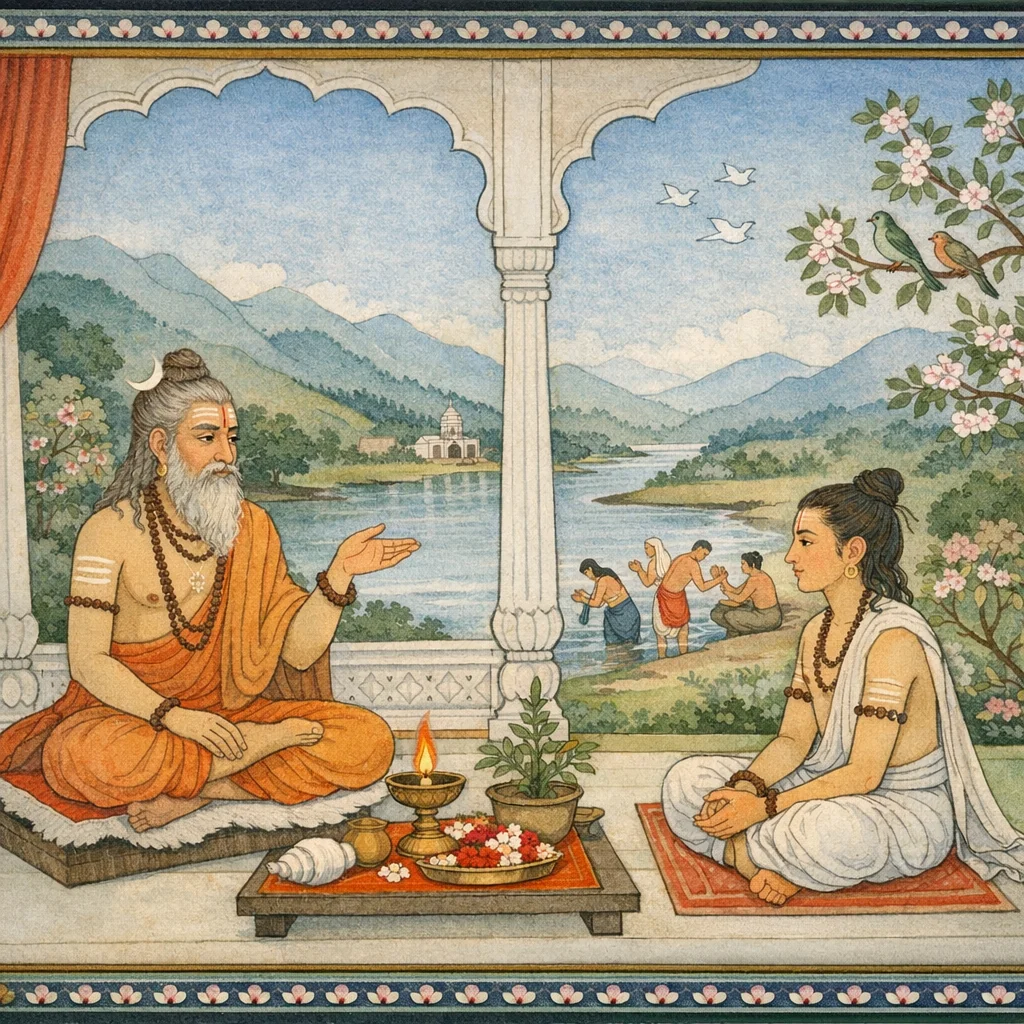
Adhyaya 62
The Glory of the Mother-and-Father Tīrtha (Within the Vena Episode)
Viṣṇu recounts a visit to Kuṇḍala’s hermitage, where Sukarmā is seen seated at his mother’s and father’s feet, exemplary in devoted service to parents. Pippala arrives and is honored with the traditional rites of hospitality—āsana, pādya, and arghya—leading to a dialogue on the source of Sukarmā’s knowledge and power. The devas are invoked; they appear and offer boons, yet Sukarmā turns all requests toward bhakti and toward his parents’ attainment of the Vaiṣṇava realm. The teaching then widens into praise of the Supreme’s ineffability and an embedded cosmic theophany: Janārdana upon Śeṣa, Mārkaṇḍeya’s wandering, and Devī revealed as Mahāmāyā/Kālarātri. The chapter concludes that daily, hands-on service to mother and father is itself the supreme tīrtha and the very essence of dharma, surpassing austerities, sacrifices, and pilgrimages.
Shlokas
Verse 1
विष्णुरुवाच । कुंडलस्याश्रमं गत्वा सत्यधर्म समाकुलम् । सुकर्माणं ततो दृष्ट्वा पितृमातृपरायणम्
Viṣṇu said: Having gone to Kuṇḍala’s hermitage, abounding in truth and dharma, he then beheld Sukarmā, devoted to serving his father and mother.
Verse 2
शुश्रूषंतं महात्मानं गुरूसत्यपराक्रमम् । महारूपं महातेजं महाज्ञानसमाकुलम्
He attended with devotion upon that great-souled one—whose valor was founded on truth and who was a venerable guru—majestic in form, vast in splendor, and filled with exalted knowledge.
Verse 3
मातापित्रोः पदांते तमुपविष्टं ददर्श सः । महाभक्त्यान्वितं शांतं सर्वज्ञानमहानिधिम्
He saw him seated at the feet of his parents—endowed with great devotion, serene, and a vast treasury of all knowledge.
Verse 4
कुंडलस्यापि पुत्रेण सुकर्मणा महात्मना । आगतं पिप्पलं दृष्ट्वा द्वारदेशे महामतिम्
Then Sukarman, the noble son of Kuṇḍala, seeing the great-souled sage Pippala arrived at the gateway,
Verse 5
आसनात्तूर्णमुत्थाय अभ्युत्थानं कृतं पुनः । आगच्छ त्वं महाभाग विद्याधर महामते
Rising quickly from his seat, he again stood up in respectful welcome and said: “Come, O fortunate one—O Vidyādhara, O great-minded sage.”
Verse 6
आसनं पाद्यमर्घं च ददौ तस्मै महामतिः । निर्विघ्नोऽसि महाप्राज्ञ कुशलेन प्रवर्त्तसे
The wise one offered him a seat, water for washing the feet, and the reverent arghya offering. Then he said: “O greatly learned one, be free from obstacles; proceed in well-being.”
Verse 7
निरामयं च पप्रच्छ पिप्पलं तं समागतम् । यस्मादागमनं तेद्य तत्सर्वं प्रवदाम्यहम्
He also asked the newly arrived Pippala about his well-being: “From where have you come today? Tell me everything—I shall relate it all.”
Verse 8
वर्षाणां च सहस्राणि त्रीणि यावत्त्वया तपः । तप्तमेव महाभाग सुरेभ्यः प्राप्तवान्वरम्
For three thousand years, you indeed performed austerity. O noble one, by that very penance you obtained a boon from the gods.
Verse 9
वश्यत्वं च त्वया प्राप्तं कामचारस्तथैव च । तेन मत्तो न जानासि गर्वमुद्वहसे वृथा
You have attained the power to subdue and the freedom to act as you wish; therefore you do not recognize me, and you carry pride in vain.
Verse 10
दृष्ट्वा ते चेष्टितं सर्वं सारसेन महात्मना । ममाभिधानं कथितं मम ज्ञानमनुत्तमम्
Having seen all your deeds performed by the great-souled Sārasa, my very name has been spoken, and my unsurpassed knowledge has been disclosed.
Verse 11
पिप्पल उवाच । योसौ मां सारसो विप्र सरित्तीरे प्रयुक्तवान् । सर्वं ज्ञानं वदेन्मां हि स तु कः प्रभुरीश्वरः
Pippala said: “O brāhmaṇa, who indeed is that Lord, the Supreme Ruler, who commissioned me on the riverbank in the form of a crane, bidding me proclaim all knowledge?”
Verse 12
सुकर्मोवाच । भवंतमुक्तवान्यो वै सरित्तीरे तु सारसः । ब्रह्माणं त्वं महाज्ञानं तं विद्धि परमेश्वरम्
Sukarmā said: “That swan who spoke to you on the riverbank—know him, O greatly wise one, to be Brahmā himself, the Supreme Lord.”
Verse 13
अन्यत्किं पृच्छसे ब्रूहि तमेवं प्रवदाम्यहम् । विष्णुरुवाच । एवमुक्तः स धर्मात्मा सुकर्मा नृपनंदन
“What else do you ask? Speak; I shall explain it to you in this manner.” Thus spoke Viṣṇu. So addressed, that righteous-souled Sukarmā, O prince, …
Verse 14
पिप्पल उवाच । त्वयि वश्यं जगत्सर्वमिति शुश्रुम भूतले । तन्मे त्वं कौतुकं विप्र दर्शयस्व प्रयत्नतः
Pippala said: “On earth we have heard that the entire world is under your control. Therefore, O brāhmaṇa, please show me that wondrous power—carefully and with full effort.”
Verse 15
पश्य कौतुकमेवाद्य त्वं वश्यावश्यकारणम् । तमुवाच स धर्मात्मा सुकर्मा पिप्पलं प्रति
“Behold this wonder today—you are the very cause by which others become controllable or uncontrollable.” Thus spoke that righteous one, Sukarmā, to Pippala.
Verse 16
अथ सस्मार वै देवान्सुकर्मा प्रत्ययाय वै । इंद्राद्या लोकपालाश्च देवाश्चाग्निपुरोगमाः
Then Sukarmā, seeking assurance and support, truly called to mind the gods—Indra and the other guardians of the worlds, and the deities with Agni at their head.
Verse 17
समागताः समाहूता नाना विद्याधरास्तथा । सुकर्माणं ततः प्रोचुर्देवाश्चाग्निपुरोगमाः
Thus many Vidyādharas, having been summoned, assembled; and then the gods as well—led by Agni—addressed Sukarmāṇa.
Verse 18
कस्मात्स्मृतास्त्वया विप्र ततोर्थकारणं वद । सुकर्मोवाच । अयमेष सुसंप्राप्तो विद्याधरो हि पिप्पलः
“O brāhmaṇa, why have you remembered him? Tell the reason for that.” Sukarma said: “This very one—Pippala, the Vidyādhara—has now arrived here safely and successfully.”
Verse 19
मामेवं भाषते विप्र वश्यावश्यत्वकारणम् । प्रत्ययार्थं समाहूता अस्यैव च महात्मनः
O brāhmaṇa, as I was speaking in this manner about the cause of being amenable or unamenable to influence, I was summoned by that very great-souled one, in order to confirm the matter.
Verse 20
स्वंस्वं स्थानं प्रगच्छध्वमित्युवाच सुरान्प्रति । तमूचुस्ते ततो देवाः सुकर्माणं महामतिम्
He said to the gods, “Let each of you return to your own proper place.” Then those gods addressed Sukarmā, the great-minded one.
Verse 21
अस्माकं दर्शनं व्रिप्र न मोघं जायते वरम् । वरं वरय भद्रं ते मनसा यद्धिरोचते
O brāhmaṇa, our appearing before you shall not be fruitless. Therefore choose a boon—may auspiciousness be yours—whatever your heart truly desires.
Verse 22
तत्ते दद्मो न संदेहस्त्वेवमूचुः सुरोत्तमाः । भक्त्या प्रणम्य तान्देवान्ययाचे स द्विजोत्तमः
“We shall grant that to you—doubt it not,” thus spoke the foremost of the gods. Then the best of brāhmaṇas, bowing to those deities in devotion, made his request.
Verse 23
अचलां दत्त देवेंद्रा सुःभक्तिं भावसंयुताम् । मातापित्रोश्च मे नित्यं तद्वै वरमनुत्तमम्
O Lord of the gods, grant me unwavering bhakti, endowed with true feeling; and may there be constant service to my mother and father—this indeed is the unsurpassed boon.
Verse 24
पिता मे वैष्णवं लोकं प्रयात्वेतद्वरोत्तमम् । तद्वन्माता च देवेशा वरमन्यं न याचये
May my father attain the Vaiṣṇava realm—this is the supreme boon. And may my mother likewise attain it, O Lord of the gods; I ask for no other boon.
Verse 25
देवा ऊचुः । पितृभक्तोसि विप्रेंद्र भक्त्या तव वयं द्विज । सुकर्मञ्छ्रूयतां वाक्यं प्रीत्या युक्ता सदैव ते
The gods said: “O best of brāhmaṇas, you are devoted to the Pitṛs, the ancestral spirits. Because of your devotion, O twice-born, we are ever favorably disposed toward you. Therefore hear our words with goodwill—words always joined with affection for you.”
Verse 26
एवमुक्त्वा गता देवाः स्वर्लोकं नृपनंदन । सर्वमैश्वर्यमेतेन तस्याग्रे परिदर्शितम्
Having spoken thus, the gods departed to Svarga, O prince. Before him was displayed every kind of sovereign splendor and majesty.
Verse 27
दृष्टं तु पिप्पलेनापि कौतुकं च महाद्भुतम् । तमुवाच स धर्मात्मा पिप्पलं कुंडलात्मजम्
Pippala too beheld a wondrous marvel, astonishing to witness. Then that righteous-souled one addressed Pippala, the son of Kuṇḍala.
Verse 28
अर्वाचीनं त्विदं रूपं पराचीनं च कीदृशम् । प्रभावमुभयोश्चैव वदस्व वदतां वर
This form is the later one—what, then, is the earlier form like? And tell me as well the power of both; O best of speakers, please explain.
Verse 29
सुकर्मोवाच । पराचीनस्य रूपस्य लिंगमेव वदामि ते । येनलोकाः प्रमोदंते इंद्राद्याः सचराचराः
Sukarma said: I shall tell you the emblem (liṅga) of the transcendent form—by which all worlds rejoice, including Indra and the rest, along with all beings, moving and unmoving.
Verse 30
अयमेव जगन्नाथः सर्वगो व्यापकः प्रभुः । अस्य रूपं न दृष्टं हि केनाप्येव हि योगिना
He alone is Jagannātha, the Lord of the universe—present everywhere, all-pervading, the sovereign. Indeed, no yogin has ever truly beheld His form in its fullness.
Verse 31
श्रुतिरेव वदत्येवं तं वक्तुं शंकितेव सा । अपाणिपादनासश्च अकर्णो मुखवर्जितः
Thus the Śruti itself speaks—yet she seems hesitant to describe Him: without hands, feet, or nose; without ears; and devoid of a mouth.
Verse 32
सर्वं पश्यति वै कर्म कृतं त्रैलोक्यवासिनाम् । तेषामुक्तमकर्णश्च स शृणोति सुसाक्ष्यदः
Indeed, He sees every action performed by the inhabitants of the three worlds; and though without ears, He hears what they speak—He, the perfect Witness who grants true testimony.
Verse 33
गतिहीनो व्रजेत्सोपि स हि सर्वत्र दृश्यते । पाणिहीनोपि गृह्णाति पादहीनः प्रधावति
Though devoid of movement, He still goes—indeed He is seen everywhere. Though without hands, He grasps; though without feet, He runs swiftly.
Verse 34
सर्वत्र दृश्यते विप्र व्यापकः पादवर्जितः । यं न पश्यंति देवेंद्रा मुनयस्तत्त्वदर्शिनः
O brāhmaṇa, He is seen everywhere—all-pervading, yet without feet; and yet the lords of the gods and the truth-seeing sages do not perceive Him.
Verse 35
स च पश्यति तान्सर्वान्सत्यासत्यपदे स्थितान् । व्यापकं विमलं सिद्धं सिद्धिदं सर्वनायकम्
And He beholds them all, standing in the states of truth and untruth; He is the all-pervading, stainless, ever-accomplished One—the giver of success and the leader of all.
Verse 36
यं जानाति महायोगी व्यासो धर्मार्थकोविदः । तेजोमूर्तिः स चाकाशमेकवर्णमनंतकम्
He whom the great yogin Vyāsa—skilled in Dharma and Artha—knows: He is a form of pure radiance; He is the sky itself, of one uniform hue, endless.
Verse 37
तदेतन्निर्मलं रूपं श्रुतिराख्याति निश्चितम् । व्यासश्चैव हि जानाति मार्कंडेयश्च तत्पदम्
The Śruti declares with certainty this very form to be stainless and pure. Vyāsa indeed knows it—and so does Mārkaṇḍeya, that supreme state.
Verse 38
अर्वाचीनं प्रवक्ष्यामि शृणुष्वैकाग्रमानसः । यदा संहृत्य भूतात्मा स्वयमेकः प्रगच्छति
I shall now explain what comes next—listen with a one-pointed mind. When the embodied self withdraws all into itself, it proceeds onward as the One alone.
Verse 39
अप्सु शय्यां समास्थाय शेषभोगासनस्थितः । तमाश्रित्य स्वपित्येको बहुकालं जनार्दनः
Resting upon a couch in the waters, seated on the serpent Śeṣa as His throne, Janārdana—alone—slept for a very long time, relying upon Him.
Verse 40
जलांधकारसंतप्तो मार्कंडेयो महामुनिः । स्थानमिच्छन्स योगात्मा निर्विण्णो भ्रमणेन सः
Tormented by the watery darkness, the great sage Mārkaṇḍeya—steadfast in yoga—longed for a resting-place, having grown weary from wandering.
Verse 41
भ्रममाणः स ददृशे शेषपर्यंकशायिनम् । सूर्यकोटिप्रतीकाशं दिव्याभरणभूषितम्
As he wandered, he beheld the Lord reclining upon the couch of Śeṣa—radiant like ten million suns, adorned with divine ornaments.
Verse 42
दिव्यमाल्यांबरधरं सर्वव्यापिनमीश्वरम् । योगनिद्रा गतं कांतं शंखचक्रगदाधरम्
Wearing divine garlands and garments, the all-pervading Lord—beloved and reposing in yogic sleep—bore the conch, discus, and mace.
Verse 43
एका नारी महाभागा कृष्णांजनचयोपमा । दंष्ट्राकरालवदना भीमरूपा द्विजोत्तम
O best of Brahmins, there was a single woman—most extraordinary—dark as a heap of black collyrium, with a terrifying mouth made dreadful by her fangs, and of a fearsome appearance.
Verse 44
तयोक्तोसौ मुनिश्रेष्ठो मा भैरिति महामुनिः । पद्मपत्रं सुविस्तीर्णं पंचयोजनमायतम्
Thus addressed by them, that foremost of sages—the great muni—said, “Do not fear,” and revealed a lotus-leaf spread wide, extending five yojanas in length.
Verse 45
तस्मिन्पत्रे महादेव्या मार्कण्डेयो निवेशितः । केशवे सति सुप्तेपि नास्त्यत्र च भयं तव
Upon that leaf, Mārkaṇḍeya was placed by the Great Goddess. Even if Keśava (Viṣṇu) is asleep, there is no fear for you here.
Verse 46
तामुवाच स योगींद्र का त्वं भवसि भामिनि । अस्मिन्विनिर्जिते चैका भवती परिबृंहिता
That lord among yogins said to her: “Who are you, O fair lady? In this place, now conquered, you alone appear enlarged and flourishing.”
Verse 47
पृष्टैवं मुनिना देवी सादरं प्राह भूसुर । नागभोगांकपर्यंके स यः स्वपिति केशवः
Thus questioned by the sage, the Goddess respectfully replied: “O brāhmaṇa, He—Keśava—who sleeps upon the couch formed by the coils of the serpent.”
Verse 48
अस्याहं वैष्णवी शक्तिः कालरात्रिरिहोच्यते । मामेवं विद्धि विप्रेंद्र सर्वमायासमन्विताम्
I am his Vaiṣṇavī power, here called Kālarātri. Know me thus, O best of brāhmaṇas, as the one endowed with every form of māyā (illusory potency).
Verse 49
महामाया पुराणेषु जगन्मोहाय कथ्यते । इत्युक्त्वा सा गता देवी अंतर्धानं हि पिप्पलः
“In the Purāṇas, she is spoken of as Mahāmāyā, the great power of illusion that deludes the world.” Having said this, the Goddess departed and vanished; indeed, she disappeared at the pippala (aśvattha) tree.
Verse 50
देव्यामनुगतायां तु मार्कंडेयस्य पश्यतः । तस्य नाभ्यां समुत्पन्नं पंकजं हाटकप्रभम्
As the Goddess proceeded onward, while Mārkaṇḍeya was watching, a lotus of golden splendor arose from his navel.
Verse 51
तस्माज्जज्ञे महातेजा ब्रह्मा लोकपितामहः । तस्माद्विजज्ञिरे लोकाः सर्वे स्थावरजंगमाः
From Him was born the great, radiant Brahmā, the grandsire of the worlds; and from him, in turn, all the worlds came forth—everything, both the immovable and the moving.
Verse 52
इंद्राद्या लोकपालाश्च देवाश्चाग्निपुरोगमाः । अर्वाचीनं स्वरूपं तु दर्शितं हि मया नृप
O king, Indra and the other guardians of the worlds, and the gods led by Agni—I have indeed shown you their present, manifest form.
Verse 53
अर्वाचीनस्वरूपोयं पराचीनो निराश्रयः । यदा स दर्शयेत्कायं कायरूपा भवंति ते
This Being appears in a later, manifest form, yet is earlier—primordial and without support. When He reveals a body, then they too become embodied in form.
Verse 54
ब्रह्माद्याः सर्वलोकाश्च अर्वाचीना हि पिप्पल । अर्वाचीना अमी लोका ये भवंति जगत्त्रये
O Pippala, Brahmā and all the worlds are indeed below; these worlds that exist within the threefold universe are all below.
Verse 55
पराचीनः स भूतात्मा यं सुपश्यंति योगिनः । मोक्षरूपं परं स्थानं परब्रह्मस्वरूपकम्
That inner Self, turned away from outwardness, is beheld clearly by the yogins—the supreme abode whose very nature is liberation, the highest state that is the form of the Supreme Brahman.
Verse 56
अव्यक्तमक्षरं हंसं शुद्धं सिद्धिसमन्वितम् । पराचीनस्य यद्रूपं विद्याधर तवाग्रतः
Unmanifest, imperishable, the Haṃsa—pure and endowed with siddhis—such is the form of Parācīna that stands before you, O Vidyādhara.
Verse 57
सर्वमेव मया ख्यातमन्यत्किं ते वदाम्यहम् । पिप्पल उवाच । कस्मादेतन्महाज्ञानमुद्भूतं तव सुव्रत
“I have explained everything. What more can I say to you?” Pippala said: “From where has this great knowledge arisen in you, O you of excellent vows?”
Verse 58
अर्वाचीनगतिं विद्वान्पराचीनगतिं तथा । त्रैलोक्यस्य परं ज्ञानं त्वय्येवं परिवर्तते
O wise one, knowing both the forward course and the backward course, the supreme knowledge of the three worlds thus revolves and abides within you.
Verse 59
तपसो नैव पश्यामि परां निष्ठां हि सुव्रत । यजनंयाजनंतीर्थंतपोवाकृतवानसि
O man of excellent vows, I do not see any higher culmination of tapas than this: you have performed yajñas, officiated sacrifices for others, visited sacred tīrthas, and undertaken penance.
Verse 60
तत्प्रभावं वदस्वैवं केन ज्ञानं तवाखिलम् । सुकर्मोवाच । तप एव न जानामि न कृतं कायशोषणम्
“Tell me the power behind this—by what means have you gained all this knowledge?” Sukarma replied: “I do not know tapas at all; nor have I performed any mortification that dries up the body.”
Verse 61
यजनं याजनं वापि न जाने तीर्थसाधनम् । न मया साधितं ध्यानं पुण्यकालं सुकर्मजम्
I do not know how to perform yajña, nor how to officiate sacrifices for others, nor the disciplines of pilgrimage to the tīrthas. Nor have I practiced dhyāna, nor observed auspicious times born of righteous deeds.
Verse 62
इति श्रीपद्मपुराणे भूमिखंडे वेनोपाख्याने मातृपितृतीर्थ । माहात्म्ये द्विषष्टितमोऽध्यायः
Thus ends the sixty-second chapter, “The Glory of the Mother-and-Father Tīrtha,” within the Vena episode, in the Bhūmi-khaṇḍa of the revered Padma Purāṇa.
Verse 63
पादप्रक्षालनं पुण्यं स्वयमेव करोम्यहम् । अंगसंवाहनं स्नानं भोजनादिकमेव च
“Washing (your) feet is meritorious—I myself shall do it. I will also massage your limbs, arrange your bath, and provide food and all such services.”
Verse 64
त्रिकालेध्यानसंलीनः साधयामि दिनेदिने । पादोदकं तयोश्चैव मातापित्रोर्दिनेदिने
Absorbed in dhyāna at the three junctions of the day, I pursue my discipline day after day; and day after day I also offer the water that has washed the feet of my mother and father.
Verse 65
भक्तिभावेन विंदामि पूजयामि सुभावतः । गुरू मे जीवमानौ तु यावत्कालं हि पिप्पल
With a feeling of bhakti I seek them out and worship them with sincere intent. So long as my revered teachers remain alive—indeed, for as long as time endures, O pippala—
Verse 66
तावत्कालं हि मे लाभो ह्यतुलश्च प्रजायते । त्रिकालं पूजयाम्येतौ शुद्धभावेन चेतसा
Indeed, for just that span, an incomparable spiritual gain arises for me. With a purified heart and sincere intent, I worship these two at the three times of the day.
Verse 67
स्वच्छंदलीलासंचारी वर्ताम्येव हि पिप्पल । किं मे चान्येन तपसा किं मे कायस्य शोषणैः
O Pippala, I live roaming freely, moving about in playful independence. What need have I of any other austerity? What need have I to emaciate the body?
Verse 68
किं मे सुतीर्थयात्राभिरन्यैः पुण्यैश्च सांप्रतम् । मखानामेव सर्वेषां यत्फलं प्राप्यते द्विज
What need have I now of journeys to excellent sacred fords (tīrthas) or of other meritorious acts, O brāhmaṇa—when the very fruit that comes from all sacrifices is being attained here?
Verse 69
तत्फलं तु मया दृष्टं पितुः शुश्रूषणादपि । मातुः शुश्रूषणं तद्वत्पुत्राणां गतिदायकम्
But I have indeed seen that fruit arise even from serving one’s father; likewise, service to one’s mother is a giver of the highest destiny for sons.
Verse 70
सर्वकर्मसुसर्वस्वं सारभूतं जगत्रये । पुत्रस्य जायते लोको मातुः शुश्रूषणादपि
In all duties, the very essence—indeed the sum total—across the three worlds is this: a son attains blessed realms even through devoted service to his mother.
Verse 71
पितुः शुश्रूषणे तद्वन्महत्पुण्यं प्रजायते । तत्र गंगा गयातीर्थं तत्र पुष्करमेव च
Likewise, by devoted service to one’s father, great merit is born. In that very act are present the Gaṅgā, the sacred tīrtha of Gayā, and Pushkara as well.
Verse 72
यत्र मातापिता तिष्ठेत्पुत्रस्यापि न संशयः । अन्यानि तत्र तीर्थानि पुण्यानि विविधानि च
Where one’s mother and father dwell—without doubt—that place is, for the son as well, a sacred tīrtha; indeed, many other holy and merit-bestowing tīrthas of various kinds are there.
Verse 73
भवंत्येतानि पुत्रस्य पितुः शुश्रूषणादपि । पितुः शुश्रूषणात्तस्य दानस्य तपसः फलम्
All these merits arise for a son even from serving his father; by serving his father, he attains the fruits of charity (dāna) and austerity (tapas).
Verse 74
सत्पुत्रस्य भवेद्विप्र अन्य धर्मः श्रमायते । पितुः शुश्रूषणात्पुण्यं पुत्रः प्राप्नोत्यनुत्तमम्
O brāhmaṇa, for a virtuous son, other duties of dharma become mere toil; by devoted service to his father, a son attains unsurpassed merit.
Verse 75
स्वकर्मणस्तु सर्वस्वमिहैव च परत्र च । जीवमानौ गुरूत्वेतौ स्वमातापितरौ तथा
Truly, one’s own actions (karma) are one’s entire wealth, both in this world and in the next. And while they live, one’s own mother and father are also to be regarded as gurus (teachers).
Verse 76
शुश्रूषते सुतो भूत्वा तस्य पुण्यफलं शृणु । देवास्तस्यापि तुष्यंति ऋषयः पुण्यवत्सलाः
Having become an obedient, service-minded son—hear the meritorious fruit of that: even the gods are pleased with him, and so too the sages, lovers of righteousness.
Verse 77
त्रयोलोकास्तु तुष्यंति पितुः शुश्रूषणादिह । मातापित्रोस्तु यः पादौ नित्यमेव हि क्षालयेत्
The three worlds are pleased here in this very life by devoted service to one’s father. Indeed, one who regularly washes the feet of one’s mother and father greatly pleases them.
Verse 78
तस्य भागीरथीस्नानमहन्यहनि जायते । पुण्यैर्मिष्टान्नपानैर्यः पितरं मातरं तथा
For such a person, bathing in the Bhāgīrathī (Gaṅgā) is as though it occurs day after day—namely, for one who duly honors father and mother with meritorious offerings of sweet foods and drinks.
Verse 79
भक्त्या भोजयते नित्यं तस्य पुण्यं वदाम्यहम् । अश्वमेधस्य यज्ञस्य फलं पुत्रस्य जायते
Whoever regularly feeds others with devotion—of that person I shall declare the merit: the fruit of an Aśvamedha sacrifice is born, that is, accrues, to his son.
Verse 80
तांबूलैश्छादनैश्चैव पानैश्चाशनकैस्तथा । भक्त्या चान्नेन पुण्येन गुरू येनाभिपूजितौ
With offerings of tāmbūla, with garments, with drinks and foods—and with devotion and sanctified, meritorious nourishment—thus were the two gurus duly worshipped.
Verse 81
सर्वज्ञानी भवेत्सोपि यशःकीर्तिमवाप्नुयात् । मातरं पितरं दृष्ट्वा हर्षात्संभाषयेत्सुतः
He too becomes all-knowing and attains fame and renown. Seeing his mother and father, a son should joyfully greet them and converse with them.
Verse 82
निधयस्तस्य संतुष्टास्तस्य गेहे वसंति ते । गावः सौहृद्यमायांति पुत्रस्य सुखदाः सदा
Contented, the treasures abide in his house. The cows come to him with affection, always bestowing happiness upon his son.