Adhyaya 99
The Glory of the Vāsudeva Hymn: Boons, Japa across the Yugas, and Ascent to Vaikuṇṭha
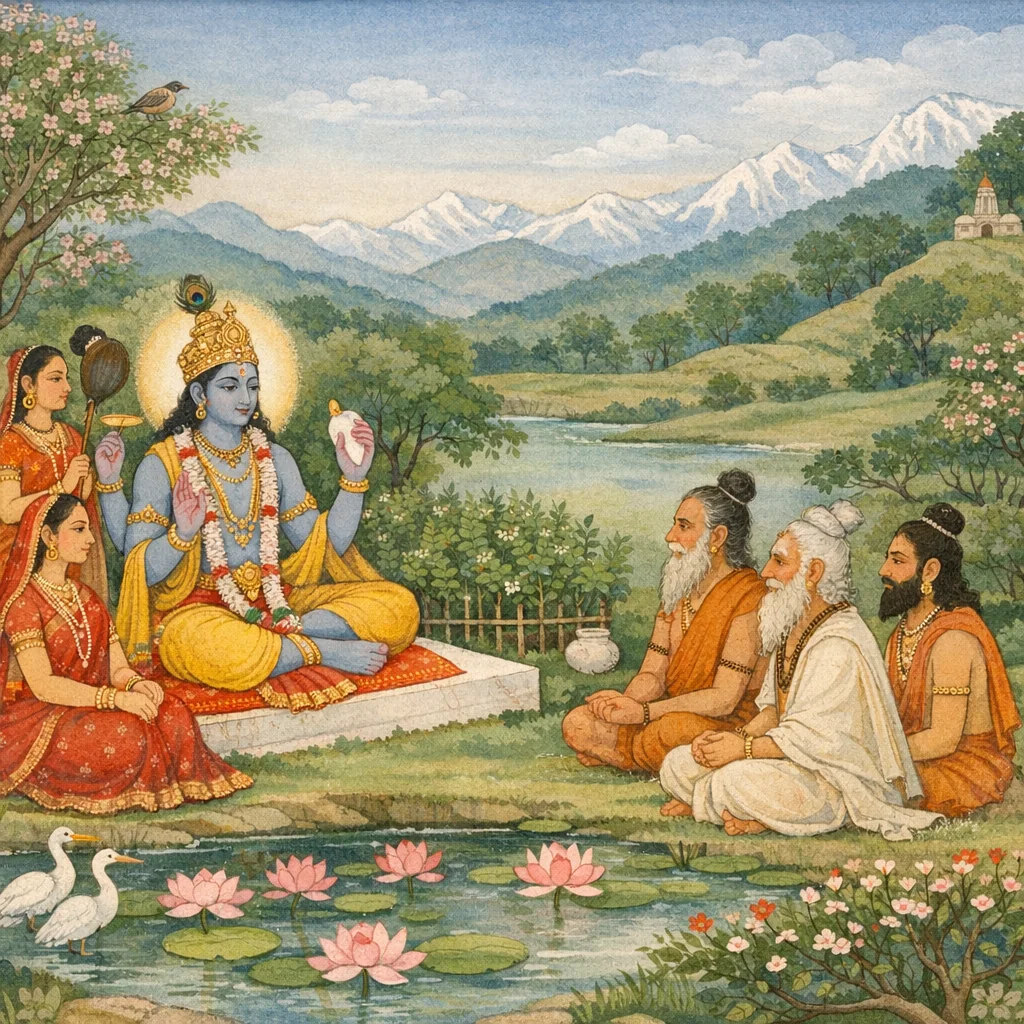
After hearing an ancient hymn that destroys sin, the king becomes purified and radiant despite his hardships. Hari—Viṣṇu as Vāsudeva, Keśava, Murāri—appears with His divine retinue; sages and gods gather and sing Vedic praises. Offered a boon, the king replies with humility, taking refuge in the Lord, and first asks benefit for his wife Vijvalā. Hari proclaims the decisive power of the Name “Vāsudeva” to annihilate even great sins and grants enjoyment in His own realm. The chapter then sets out the hymn’s discipline: the time required for japa in each yuga (instant in Kṛta, a month in Tretā, six months in Dvāpara, a year in Kali), rules for daily repetition, and its use in śrāddha, tarpaṇa, homa, sacrifice, and protection in danger. Examples—Indra’s release from brahmahatyā and nāgas and other beings attaining siddhi—confirm its efficacy; at last the king and queen ascend to Hari amid celestial celebration, and the colophon places the chapter within the Vena narrative, Guru-tīrtha, and the account of Cyavana.
Shlokas
Verse 1
विष्णुरुवाच । स्तोत्रं पवित्रं परमं पुराणं पापापहं पुण्यमयं शिवं च । धन्यं सुसूक्तं परमं सुजाप्यं निशम्य राजा स सुखी बभूव
Viṣṇu said: Having heard that hymn—supremely purifying, most excellent, purāṇic in authority, removing sins, filled with merit and auspiciousness—the king became joyful. It was blessed, well-spoken, and foremost among chants fit for repeated recitation.
Verse 2
गतासु तृष्णा क्षुधया समेता देवोपमो भूमिपतिर्बभूव । भार्या च तस्यापि विभाति रूपैर्युक्तावुभौ पापविबंधमाप्तौ
Though afflicted by thirst and hunger, the lord of the earth shone radiant like a god; and his wife too gleamed with beauty. United together, the two had fallen into the bondage wrought by sin.
Verse 3
देवः सुदेवैः परिवारितोसौ विप्रैः सुसिद्धैर्हरिभक्तियुक्तैः । आगत्य भूपं गतकल्मषं तं श्रीशंखचक्राब्जगदासिधर्ता
That Lord—bearing the auspicious conch, discus, lotus, mace, and sword—came surrounded by noble gods and accomplished brāhmaṇas endowed with devotion to Hari, and approached that king who had become free from sin.
Verse 4
श्रीनारदो भार्गव व्यास पुण्या समागतस्तत्र मृकंडसूनुः । वाल्मीकि नामा मुनिर्विष्णुभक्तः समागतो ब्रह्मसुतो वसिष्ठः
There arrived the venerable Nārada, along with Bhārgava and Vyāsa, and also the virtuous son of Mṛkaṇḍa. Vālmīki too—the sage devoted to Viṣṇu—came, as did Vasiṣṭha, the mind-born son of Brahmā.
Verse 5
गर्गो महात्मा हरिभक्तियुक्तो जाबालिरैभ्यावथ कश्यपश्च । आजग्मुरेते हरिणा समेता विष्णुप्रिया भागवतां वरिष्ठाः
Garga, the great-souled sage devoted to Hari, and also Jābāli, Raibhya, and Kaśyapa—those foremost Bhāgavatas, beloved of Viṣṇu—arrived there together, accompanied by Hari.
Verse 6
पुण्याः सुधन्या गतकल्मषास्ते हरेः सुपादांबुजभक्तियुक्ताः । श्रीवासुदेवं परिवार्य तस्थुः स्तुवंति भूपं विविधप्रकारैः
Those meritorious and truly fortunate ones—freed from sin and endowed with devotion to Hari’s excellent lotus-feet—stood surrounding Śrī Vāsudeva and praised the king in many different ways.
Verse 7
देवाश्च सर्वे हुतभुङ्मुखाश्च ब्रह्मा हरिश्चापि सुदिव्यदेव्यः । गायंति दिव्यं मधुरं मनोहरं गंधर्वराजादिसुगायनाश्च
All the gods, along with the fire-faced Agni, and also Brahmā and Hari (Viṣṇu), together with the supremely divine goddesses—along with the foremost Gandharvas and other skilled singers—sing celestial songs that are sweet and captivating.
Verse 8
सुवेद युक्तैः परमार्थसंमितैः स्तवैः सुपुण्यैर्मुनयः स्तुवंति । दृष्ट्वा पतिं भूपतिमेव देवो हरिर्बभाषे वचनं मनोहरम्
The sages praised him with very pure hymns—rooted in the Vedas and consistent with the highest truth. Seeing that lord, the king of the earth, the god Hari spoke charming words.
Verse 9
वरं यथेष्टं वरयस्व भूपते ददाम्यहं ते परितोषितो यतः । हरेस्तु वाक्यं स निशम्य राजा दृष्ट्वा मुरारिं वदमानमग्रे
“Choose a boon according to your desire, O king; I shall grant it to you, for I am pleased.” Hearing these words of Hari, the king—beholding Murāri speaking before him—listened with reverent attention.
Verse 10
नीलोत्पलाभं मुरघातिनं प्रभुं तं शंखचक्रासिगदाप्रधारिणम् । श्रियासमेतं परमेश्वरं तं रत्नोज्ज्वलं कंकणहारभूषितम्
I behold that Lord—dark-hued like a blue lotus, the slayer of Mura—bearing the conch, discus, sword, and mace; the Supreme God, accompanied by Śrī (Lakṣmī), radiant with jewels and adorned with bracelets and necklaces.
Verse 11
रविप्रभं देवगणैः सुसेवितं महार्घहाराभरणैः सुभूषितम् । सुदिव्यगंधैर्वरलेपनैर्हरिं सुभक्तिभावैरवनीं गतो नृपः
Radiant like the sun, attended by hosts of gods, adorned with priceless garlands and ornaments, and anointed with exquisite divine fragrances and unguents, the king—through his pure devotional disposition to Hari—departed from the earth.
Verse 12
दंडप्रणामैः सततं नमाम जयेति वाचाथ महानृपस्तदा । दासोस्मि भृत्योस्मि पुरः स ते सदा भक्तिं न जाने न च भावमुत्तमम्
Then the great king spoke: “I bow to You constantly with full prostrations, crying ‘Victory!’ I am Your servant, Your attendant—ever standing before You. I do not know true devotion, nor do I possess the highest inner feeling of reverence.”
Verse 13
जायान्वितं मामिह चागतं हरे प्रपाहि वै त्वां शरणं प्रपन्नम् । धन्यास्तु ते माधव मानवा द्विजाः सदैव ते ध्यानमनोविलीनाः
O Hari, I have come here together with my wife. Protect me—indeed, I have taken refuge in You. Blessed, O Mādhava, are those humans—especially the twice-born—whose minds are always absorbed in meditation upon You.
Verse 14
समुच्चरंतो भव माधवेति प्रयांति वैकुंठमितः सुनिर्मलाः । तवैव पादांबुजनिर्गतं पयः पुण्यं तथा ये शिरसा वहंति
Uttering aloud, “O Mādhava, be my refuge!”, the purified souls depart from here and attain Vaikuṇṭha. Likewise, those who bear upon their heads the holy water that has flowed from Your lotus-feet become blessed.
Verse 15
समस्ततीर्थोद्भव तोय आप्लुतास्ते मानवा यांति हरेः सुधाम
Those who bathe in waters arising from all sacred tīrthas attain the supreme abode of Hari.
Verse 16
नास्ति योगो न मे भक्तिर्ज्ञानं नास्ति न मे क्रिया । कस्य पुण्यस्य संगेन वरं मह्यं प्रयच्छसि
I have no yoga, no bhakti; I have no knowledge, nor any ritual act. By association with what merit do you grant me this boon?
Verse 17
हरिरुवाच । वासुदेवाभिधानं यन्महापातकनाशनम् । भवता विज्वलात्पुण्याच्छ्रुतं राजन्विकल्मषः
Hari said: “O King, you have heard—pure in intent—from a radiant and meritorious source, that the very name ‘Vāsudeva’ destroys great sins.”
Verse 18
तेन त्वं मुक्तिभागी च संजातो नात्र संशयः । मम लोके प्रभुंक्ष्व त्वं दिव्यान्भोगान्मनोनुगान्
Therefore you have indeed become a sharer in liberation—of this there is no doubt. In my realm, enjoy divine delights that accord with your mind’s desires.
Verse 19
राजोवाच । यदिदेववरोदेयोममदीनस्यवैत्वया । विज्वलायप्रयच्छत्वंप्रथमंवरमुत्तमम्
The king said: “If indeed you are to grant a boon to me, the helpless one, then first bestow upon Vijvalā the foremost and excellent boon.”
Verse 20
हरिरुवाच । विज्वलस्य पिता पुण्यः कुंजलो ज्ञानमंडितः । वासुदेवमहास्तोत्रं नित्यं पठति भूपते
Hari said: “O king, Vijvala’s father—virtuous Kuñjala, adorned with knowledge—recites each day the Great Hymn to Vāsudeva.”
Verse 21
पुत्रैः प्रियासमेतोऽसौ मम गेहं प्रयास्यति । एतत्तु जपते स्तोत्रं सदा दास्याम्यहं फलम्
Accompanied by his sons and beloved wife, he will come to My abode. And to the one who constantly recites this hymn, I shall ever grant its fruit.
Verse 22
एवमुक्ते शुभे वाक्ये राजा केशवमब्रवीत् । इदं स्तोत्रं महापुण्यं सफलं कुरु केशव
When those auspicious words had been spoken, the king said to Keśava: “O Keśava, make this hymn of great merit bear fruit.”
Verse 23
हरिरुवाच । कृते युगे महाराज यदा स्तोष्यंति मानवाः । तदा मोक्षं प्रयास्यंति तत्क्षणान्नात्र संशयः
Hari said: “O great king, in the Kṛta Yuga, when people become fully content, at that very moment they attain liberation—of this there is no doubt.”
Verse 24
त्रेतायां मासमात्रेण षड्भिर्मासैस्तु द्वापरे । वर्षेणैकेन च कलौ ये जपंति च मानवाः
In the Tretā-yuga, people accomplish it by japa within merely one month; in the Dvāpara-yuga, within six months; and in the Kali-yuga, within a single year—such are the humans who practice japa.
Verse 25
स्वर्गं प्रयांति राजेंद्र वैष्णवं गतिदायकम् । त्रिकालमेककालं वा स्नातो जपति ब्राह्मणः
O king of kings, they attain heaven—the Vaiṣṇava state that grants the highest destination—when a brāhmaṇa, having bathed, performs japa three times a day, or even once a day.
Verse 26
यं यं तु वांछते कामं स स तस्य भविष्यति । क्षत्रियो जयमाप्नोति धनधान्यैरलंकृतः
Whatever desire a person longs for—each such wish will be fulfilled for him. A kṣatriya attains victory and becomes adorned with wealth and abundant grain.
Verse 27
वैश्यो भविष्यति श्रीमान्सुखी शूद्रो भविष्यति । अंत्यजं श्रावयेद्योयं पापान्मुक्तो भविष्यति
A Vaiśya will become prosperous; a Śūdra will become happy. And whoever causes an outcaste to hear this (teaching/recitation) will be freed from sins.
Verse 28
श्रावको नरकं घोरं कदाचिन्नैव पश्यति । मम स्तोत्रप्रसादाच्च सर्वसिद्धो भविष्यति
A devotee will never at any time behold the dreadful hell; by the grace born of my hymn, he will attain complete success.
Verse 29
ब्राह्मणैर्भोज्यमानैश्च श्राद्धकाले पठिष्यति । पितरो वैष्णवं लोकं तृप्ता यास्यंति भूपते
O king, if this is recited at the time of śrāddha while the Brāhmaṇas are being fed, the forefathers—satisfied—will attain the Vaiṣṇava world.
Verse 30
तर्पणांते जपं कुर्याद्ब्राह्मणो वाथ क्षत्रियः । पिबंति चामृतं तस्य पितरो हृष्टमानसाः
At the close of the tarpaṇa rite, a brāhmaṇa—or likewise a kṣatriya—should perform japa; and his forefathers, gladdened in heart, drink as it were nectar (amṛta) from that act.
Verse 31
होमेषु यज्ञमध्ये च भावाज्जपति मानवः । तत्र विघ्ना न जायंते सर्वसिद्धिर्भविष्यति
When a person, with sincere devotion (bhāva), performs japa during fire-offerings (homa) and in the midst of a sacrifice (yajña), no obstacles arise there, and complete success will surely follow.
Verse 32
विषमे दुर्गसंस्थाने हिंस्रव्याघ्रस्य संकटे । चौराणां संकटे प्राप्ते तत्र स्तोत्रमुदीरयेत्
In rugged places, in an inaccessible stronghold or spot, in the peril of a ferocious tiger, or when danger from thieves arises—at such times one should recite that hymn.
Verse 33
तत्र शांतिर्महाराज भविष्यति न संशयः । अन्येष्वेव सुभव्येषु राजद्वारे गते नरे
There, O great king, peace will surely prevail—of this there is no doubt—when the man has gone to the king’s gate, and likewise in other auspicious circumstances.
Verse 34
वासुदेवाभिधानस्य अयुतं जपते नरः । ब्रह्मचर्येण संस्नातः क्रोधलोभविवर्जितः
A man who repeats the sacred name “Vāsudeva” ten thousand times—cleansed by the discipline of brahmacarya and free from anger and greed—attains great spiritual merit.
Verse 35
तिलतंडुलकैर्होमं दशांशमाज्यमिश्रितम् । वासुदेवं प्रपूज्यैव दद्यात्प्रयतमानसः
With sesame and rice-grains one should perform the fire-offering (homa), mixing in ghee amounting to one-tenth; and, having duly worshipped Vāsudeva, one should give the prescribed offering or charity with a disciplined, focused mind.
Verse 36
श्लोकं प्रति ततो देयं होमं ध्यानेन मानवैः । तेषां सुभृत्यवन्नित्यं पार्श्वं नैव त्यजाम्यहम्
Therefore, for each verse, people should offer a homa while meditating. I never abandon their side, remaining constantly with them like a faithful attendant.
Verse 37
कलौ युगे सुसंप्राप्ते स्तोत्रे दास्यं प्रयास्यति । वेदभंगप्रसंगेन यस्य कस्य न दीयते
When the Kali age has fully arrived, the true hymn of praise will fall into servitude; and, on the pretext of ‘breaking the Veda,’ it will not be given to just anyone.
Verse 38
सर्वकामसमृद्धार्थः स चैव हि भविष्यति । एवं हि सफलं स्तोत्रं मया भूप कृतं शृणु
He will indeed become one whose aims prosper and whose every desire is fulfilled. O King, listen: thus is this hymn I have composed—truly fruitful in its results.
Verse 39
ब्रह्मणा निर्मितं तेन जप्तं रुद्रेण वै पुरा । ब्रह्महत्याविनिर्मुक्त इंद्रो मुक्तश्च किल्बिषात्
Fashioned by Brahmā and formerly recited by Rudra—by that mantra Indra was indeed freed from the sin of brahmin-slaying and released from his guilt.
Verse 40
देवाश्च ऋषयो गुह्याः सिद्धविद्याधरामराः । नागैस्तु पूजितं स्तोत्रमापुः सिद्धिं मनीप्सिताम्
The gods and sages, the Guhyakas, the Siddhas, the Vidyādharas, and the immortals—by venerating this hymn as the Nāgas did—attained the desired spiritual siddhi.
Verse 41
पुण्यो धन्यः स वै दाता पुत्रवान्हि भविष्यति । जपिष्यति मम स्तोत्रं नात्र कार्या विचारणा
That giver is truly meritorious and blessed; indeed, he will obtain sons. He will recite my hymn—of this there is no need for doubt or deliberation.
Verse 42
आगच्छ त्वं स्त्रिया सार्धं मम स्थानं नृपोत्तम । हस्तावलंबनं दत्तं हरिणा तस्य भूपतेः
“Come, O best of kings, together with your wife, to my abode. Hari granted that king the support of His hand—divine aid and protection.”
Verse 43
नेदुर्दुंदुभयस्तत्र गंधर्वा ललितं जगुः । ननृतुश्चाप्सरः श्रेष्ठाः पुष्पवृष्टिं प्रचक्रिरे
There the dundubhi kettledrums resounded; the Gandharvas sang sweetly; and the finest Apsarases danced, sending down a rain of flowers.
Verse 44
देवाश्च ऋषयः सर्वे वेदस्तोत्रैः स्तुवंति ते । ततो दयितया सार्द्धं जगाम नृपतिर्हरिम्
All the gods and sages praised him with hymns from the Vedas; then the king, together with his beloved, went to Hari (Viṣṇu).
Verse 45
तं स्तूयमानं सुरसिद्धसंघैः स विज्वलः पश्यति हृष्टमानसः । समागतस्तिष्ठति यत्र वै पिता माता च वेगेन महाप्रभावः
Blazing with radiance, he beheld the one being praised by hosts of gods and Siddhas, his heart brimming with joy. Then his father and mother—of great power—came swiftly and stood there where he was.
Verse 99
इति श्रीपद्मपुराणे भूमिखंडे वेनोपाख्याने गुरुतीर्थे च्यवनचरित्रे नवनवतितमोऽध्यायः
Thus ends the ninety-ninth chapter in the Bhūmi-khaṇḍa of the Śrī Padma Purāṇa, in the section on the narrative of Vena, the sacred ford called Guru-tīrtha, and the account of Cyavana.