Adhyaya 52
Sudevā’s Ascent to Heaven (Merit, Hospitality, and Release from Hell)
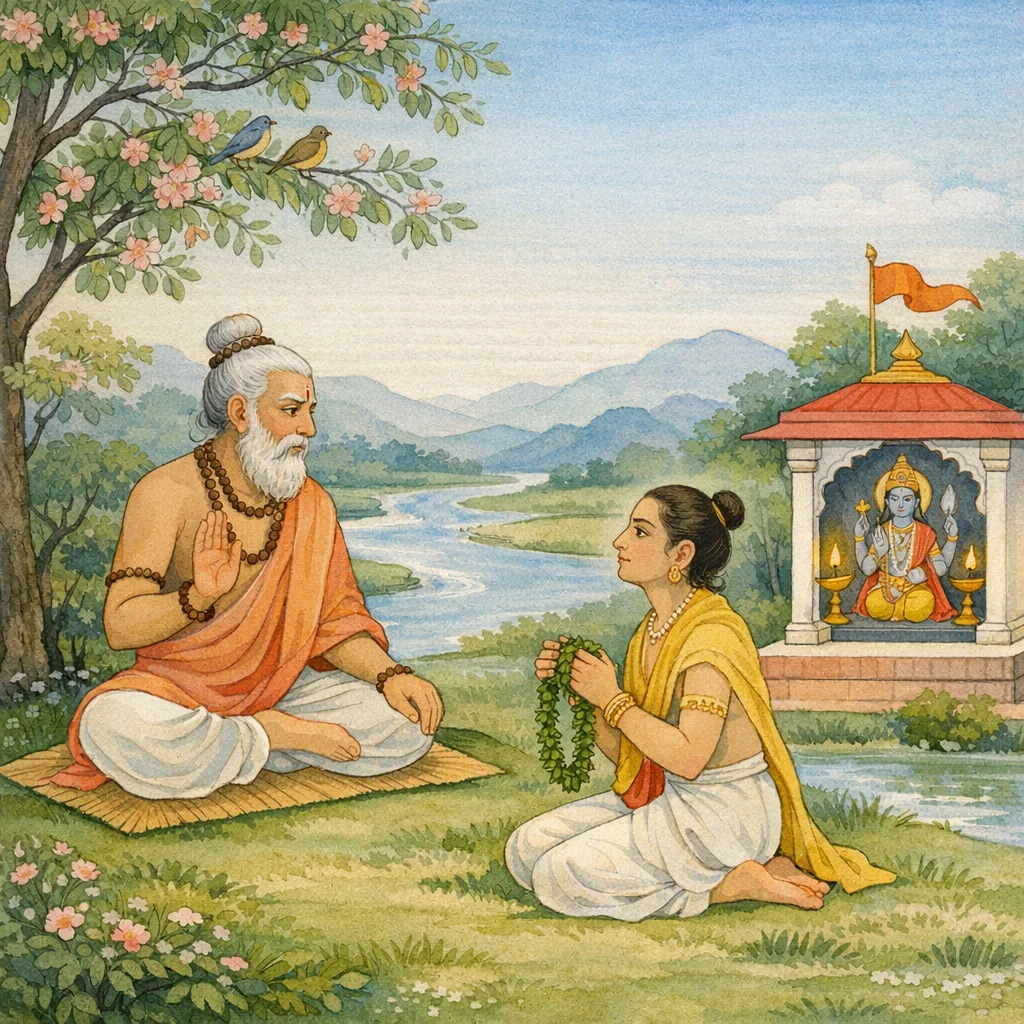
PP.2.52 presents a dharma-parable on hospitality and the peril of neglecting one who is worthy. A woman arrives disguised as a mendicant and is honored with bathing, clothing, food, and ornaments—hospitality praised as the most pleasing act. The tale then turns to confession and karmic dread: the suffering speaker recalls failing in reverence—no washing of the feet, no service—dying in grief, being seized by Yama’s messengers, enduring hell-torments, and falling into degrading rebirths in animal wombs. Seeking deliverance, the afflicted one appeals to Queen Sudevā and to Devī. King Ikṣvāku is revealed as Viṣṇu and Sudevā as Śrī; her satī-dharma becomes a cosmic tīrtha. Devī grants the merit of a year, the petitioner is transfigured into a radiant divine form, and ascends to heaven, praising Sudevā’s grace.
Shlokas
Verse 1
शिवशर्मोवाच । मंगले श्रूयतां वाक्यं यदि पृच्छसि सांप्रतम् । यदर्थं हि त्वया पृष्टं तन्निबोध वरानने
Śivaśarman said: “O Maṅgalā, listen to my words, since you are now asking. What you have asked for—understand that, O fair-faced one.”
Verse 2
इयं हि सांप्रतं प्राप्ता वराकी भिक्षुरूपिणी । वसुदत्तस्य विप्रस्य सुतेयं चारुलोचने
For this poor woman has now arrived, disguised in the form of a mendicant. O fair-eyed one, she is the daughter of the brāhmaṇa Vasudatta.
Verse 3
सुदेवा नाम भद्रेयं मम जाया प्रिया सदा । केनापि कारणेनैव देशं त्यक्त्वा समागता
O blessed one, my beloved wife is named Sudevā; she is ever dear to me. Yet for some reason she has left her homeland and come here.
Verse 4
ममदुःखेन दग्धेयं वियोगेन वरानने । मां ज्ञात्वा तु समायाता भिक्षुरूपेण ते गृहम्
“O fair-faced one, I am scorched by sorrow and by separation. Yet, recognizing me, you came to your home in the guise of a mendicant.”
Verse 5
एवं ज्ञात्वा त्वया भद्रे आतिथ्यं परिशोभितम् । कर्त्तव्यं न च संदेह इच्छंत्या मम सुप्रियम्
Knowing this, O noble lady, you should duly honor and adorn the sacred duty of hospitality—there is no doubt of it—if you wish to do what is most pleasing to me.
Verse 6
भर्तुर्वाक्यं निशम्यैव मंगला पतिदेवता । हर्षेण महताविष्टा स्वयमेव सुमंगला
Hearing her husband’s words, Maṅgalā—who revered her husband as her very deity—was overcome with great joy, becoming auspicious in her own right.
Verse 7
स्नानाच्छादन भोज्यं च मम चक्रे वरानने । रत्नकांचनयुक्तैश्चाभरणैश्च पतिव्रता
That devoted wife, O fair-faced one, provided for me bathing, clothing, and food, and also ornaments set with jewels and gold.
Verse 8
अहं हि भूषिता भद्रे तयैव पतिकाम्यया । तयाहं भूषिता देवि मानस्नानैश्च भोजनैः
Indeed, O gentle one, I have been honored by her—by that very woman longing for her husband. O Goddess, she honored me through purifications of the mind and through offerings of food.
Verse 9
भर्त्राहं मानिता देवि जातं दुःखमनंतकम् । ममोरसि महातीव्रं सर्वप्राणविनाशनम्
O Goddess, though I was honored by my husband, an endless sorrow has arisen; within my chest there is an exceedingly intense anguish, as if it would destroy all life-breath.
Verse 10
तस्या मानो मया दृष्टो दुःखमात्मगतं तथा । चिंता मे दारुणा जाता यया प्राणा व्रजंति मे
I have seen her wounded pride, and likewise the sorrow that has entered my own heart. A terrible anxiety has arisen in me—so severe that it feels as though my very life-breath is departing.
Verse 11
कदापि वचनं दत्तं न मया पापया शुभम् । अस्यैव विप्रवर्यस्य आचरंत्या च दुष्कृतम्
Never have I—a sinful woman—spoken a single auspicious word; rather, in my conduct toward this very excellent brāhmaṇa, I have committed wrongdoing.
Verse 12
पादप्रक्षालनं नैव अंगसंवाहनं नहि । एकांतं न मया दत्तं तस्यैव हि महात्मनः
I did not wash his feet, nor did I massage his limbs; indeed, I did not even grant private audience to that very great-souled one.
Verse 13
संभाषां कथमस्यैव करिष्ये पापनिश्चया । रात्रौ चैव तदा तत्र पतिता दुःखसागरे
How could I even speak with him, when I was resolved upon sin? And that very night, there I fell into an ocean of sorrow.
Verse 14
एवं हि चिंतमानायाः स्फुटितं हृदयं मम । गताः प्राणास्तदा कायं परित्यज्य वरानने
Thus, while I was thinking in this way, my heart burst; then my life-breaths departed, leaving the body behind, O fair-faced one.
Verse 15
तत्र दूताः समायाता धर्मराजस्य वै तदा । वीराश्च दारुणाः क्रूरा गदाचक्रासिधारिणः
Then, indeed, the messengers of Dharmarāja arrived there—valiant, terrifying, and fierce—bearing maces, discus-weapons, and swords.
Verse 16
तैस्तु बद्धा महाभागे शृंखलैर्दृढबंधनैः । नीता यमपुरं तैस्तु रुदमाना सुदुःखिता
But those messengers bound her, O noble lady, with chains and firm fetters; and they led her to Yama’s city, while she wept, overwhelmed with sorrow.
Verse 17
मुद्गरैस्ताड्यमानाहं दुर्गमार्गेण पीडिता । भर्त्स्यमाना यमस्याग्रे तैस्तत्राहं प्रवेशिता
Beaten with mallets and tormented along a dreadful path, I was scolded and, by them, forced into that place before Yama.
Verse 18
दृष्टाहं यमराजेन सक्रोधेन महात्मना । अंगारसंचये क्षिप्ता क्षिप्ता नरकसंचये
Yamarāja, the great-souled one, beheld me in wrath; and I was hurled into a heap of blazing coals—hurled into the amassed terrors of hell.
Verse 19
लोहस्य पुरुषं कृत्वा अग्निना परितापितः । ममोरसि समुत्क्षिप्तो निजभर्तुश्च वंचनात्
After fashioning a man of iron and heating it in fire, it was hurled upon my chest—because of the deception wrought by my own husband.
Verse 20
नानापीडातिसंतप्ता नरकाग्निप्रतापिता । तैलद्रोण्यां परिक्षिप्ता करम्भवालुकोपरि
Scorched by many kinds of torments and seared by the blaze of hell-fire, they are cast into a trough of oil, upon a bed of gruel and burning sand.
Verse 21
असिपत्रैश्च संच्छिन्ना जलमंत्रेण वाहिता । कूटशाल्मलिवृक्षेषु क्षिप्ता तेन महात्मना
Cut by sword-like leaves and swept along by a torrent empowered by a water-mantra, they were hurled by that great-souled one onto the deceptive śālmalī trees.
Verse 22
पूयशोणितविष्ठायां पतिता कृमिसंकुले । सर्वेषु नरकेष्वेवं क्षिप्ताहं नृपनंदिनि
“I have fallen into pus, blood, and excrement, teeming with worms. Thus have I been hurled into all the hells, O princess.”
Verse 23
पीडायुक्तेषु तीव्रेषु तेनैवापि महात्मना । करपत्रैः पाटिताहं शक्तिभिस्ताडिता भृशम्
In those fierce torments, I too was made to suffer by that very great-souled one—slashed with knife-like blades and violently struck again and again with spears.
Verse 24
अन्येष्वेव नरकेषु पातिता नृपनंदिनि । योनिगर्तेषु क्षिप्तास्मि पतिता दुःखसंकटे
O princess, I have been cast into other hells as well; hurled into the pits of wombs (rebirth), I have fallen into a grievous abyss of suffering.
Verse 25
धर्मराजेन तेनाहं नरकेषु निपातिता । वल्गुनीयोनिमासाद्य भुक्तं दुःखं सुदारुणम्
By that Lord of Dharma (Yama) I was cast down into the hells; and, having attained the womb of a Valgunī, I endured exceedingly dreadful suffering.
Verse 26
गताहं क्रौष्टुकीं योनिं शुनीयोनिं पुनर्गता । सकुक्कुटीं च मार्जारीमाखुयोनिं गता ह्यहम्
I have gone into the womb of a jackal; again I have entered the womb of a bitch. I have also become a hen, a she-cat, and indeed I have gone into the womb of a mouse.
Verse 27
एवं योनिविशेषेषु पापयोनिषु तेन च । क्षिप्तास्मि धर्मराजेन पीडिता सर्वयोनिषु
Thus, in various specific wombs—indeed in sinful births—I have been cast by Dharmarāja and afflicted in every kind of birth.
Verse 28
तेनैवाहं कृता भूमौ शूकरी नृपनंदिनि । तवहस्ते महाभागे संति तीर्थान्यनेकशः
By him alone I was made upon the earth as a sow, O king’s daughter. O greatly fortunate one, within your hand abide many tīrthas—countless sacred places of pilgrimage.
Verse 29
तेनोदकेन सिक्तास्मि त्वयैव वरवर्णिनि । मम पापं गतं देवि प्रसादात्तव सुंदरि
O fair-complexioned lady of excellent beauty, you yourself have sprinkled me with that water. O Goddess, by your grace my sin has departed, O beautiful one.
Verse 30
तवैव तेजःपुण्येन जातं ज्ञानं वरानने । इदानीं मामुद्धरस्व पतितां नरकसंकटे
O fair-faced one, by the merit and spiritual radiance that are truly yours, this knowledge has arisen. Now rescue me—fallen into the peril of hell.
Verse 31
यदा नोद्धरसे देवि पुनर्यास्यामि दारुणम् । नरकं च महाभागे त्राहि मां दुःखभागिनीम्
If you do not rescue me, O Goddess, I shall again go to the dreadful hell. O greatly fortunate one, protect me—me, a share-partner in suffering.
Verse 32
गताहं पापभावेन दीनाहं च निराश्रया । सुदेवोवाच । किं कृतं हि मया भद्रे सुकृतं पुण्यसंभवम्
“I have fallen into a sinful disposition; I am wretched and without support.” Sudeva said: “O blessed lady, what meritorious deed have I done—what virtue that gives rise to puṇya?”
Verse 33
येनाहमुद्धरे त्वां वै तन्मे त्वं वद सांप्रतम् । शूकर्युवाच । अयं राजा महाभाग इक्ष्वाकुर्मनुनंदनः
“Tell me at once by what means I may truly rescue you.” Śūkarī said: “This is that most fortunate king—Ikṣvāku, the joy of Manu’s lineage.”
Verse 34
विष्णुरेष महाप्राज्ञो भवती श्रीर्हि नान्यथा । पतिव्रता महाभागा पतिव्रतपरायणा
He is Viṣṇu, the supremely wise; and you are indeed Śrī (Lakṣmī)—none other. O greatly fortunate lady, you are pativratā, wholly devoted to the vow of fidelity to your husband.
Verse 35
त्वं सती सर्वदा भद्रे सर्वतीर्थमयी प्रिया । देवि सर्वमयी नित्यं सर्वदेवमयी सदा
O auspicious one, ever satī—true and faithful—you are beloved, embodying all sacred tīrthas. O Devī, you are ever the essence of all; forever you are the very embodiment of all the gods.
Verse 36
महापतिव्रता लोक एका त्वं नृपतेः प्रिया । यया शुश्रूषितो भर्ता भवत्या हि अहर्निशम्
O queen, you alone in the world are a great exemplar of pativratā, the beloved of the king; for by you your husband has indeed been faithfully served day and night.
Verse 37
एकस्य दिवसस्यापि पुण्यं देहि वरानने । पति शुश्रूषितस्यापि यदि मे कुरुषे प्रियम्
O fair-faced one, grant me the merit (puṇya) of even a single day—if you would do what pleases me—the merit belonging to one who has faithfully served her husband.
Verse 38
मम माता पिता त्वं वै त्वं मे गुरुः सनातनः । अहं पापा दुराचारा असत्या ज्ञानवर्जिता
You alone are my mother and father; you are my eternal Guru. I am sinful, of wicked conduct, untruthful, and bereft of true knowledge.
Verse 39
मामुद्धर महाभागे भीताहं यमताडनैः । सुकलोवाच । एवं श्रुत्वा तया प्रोक्तं समालोक्य नृपं तदा
“Rescue me, O greatly fortunate one; I am terrified by the beatings of Yama’s attendants.” Sukala said: Having heard her words, he then looked toward the king.
Verse 40
किं करोमि महाराज एषा किं वदते पशुः । इक्ष्वाकुरुवाच । एनां दुःखां वराकीं वै पापयोनिं गतां शुभे
“What am I to do, O great king? What is this creature saying?” Ikṣvāku replied: “O auspicious one, she is truly miserable and wretched—one who has fallen into a sinful womb.”
Verse 41
समुद्धरस्व पुण्यैस्त्वं महच्छ्रेयो भविष्यति । एवमुक्ता वरा नारी सुदेवा चारुमंगला
“Raise yourself up through meritorious deeds; great welfare and the highest good will come to you.” Thus addressed, that excellent woman—Sudevā, lovely and auspicious—(was present).
Verse 42
उवाचैकाब्दपुण्यं ते मया दत्तं वरानने । एवमुक्तेन वाक्येन तया देव्या हि तत्क्षणात्
She said, “O lovely-faced one, I have granted you the merit of a full year.” Having spoken these words, that Goddess, at that very moment…
Verse 43
रूपयौवनसंपन्ना दिव्यमालाविभूषिता । दिव्यदेहा च संभूता तेजोज्वालासमावृता
Endowed with beauty and youth, adorned with a celestial garland, she appeared with a divine body—enveloped in blazing radiance.
Verse 44
सर्वभूषणशोभाढ्या नानारत्नैश्च शोभिता । संजाता दिव्यरूपा सा दिव्यगंधानुलेपना
Adorned with the splendor of every ornament and embellished with many kinds of jewels, she assumed a divine form, anointed with celestial fragrances.
Verse 45
दिव्यं विमानमारूढा अंतरिक्षं गता सती । तामुवाच ततो राज्ञीं प्रणतानतकंधरा
Having mounted a celestial aerial chariot, the virtuous lady went into the sky. Then, with her neck bowed in reverence, she addressed the queen.
Verse 46
स्वस्त्यस्तु ते महाभागे प्रसादात्तव सुंदरि । व्रजामि पातकान्मुक्ता स्वर्गं पुण्यतमं शुभम्
Blessings be upon you, O most fortunate one. By your gracious favor, O beautiful lady, I depart—freed from sins—toward auspicious heaven, the most meritorious realm.
Verse 47
प्रणम्यैवं गता स्वर्गं सुदेवा शृणु सत्तम । एतत्ते सर्वमाख्यातं सुकलाया निवेदितम्
Having thus bowed down, she went to heaven. O Sudevā, listen, O best of the virtuous: all this has been fully told to you, as conveyed by Sukalā.
Verse 52
इति श्रीपद्मपुराणे भूमिखंडे वेनोपाख्याने सुकलाचरित्रे सुदेवास्वर्गारोहणंनाम द्विपंचाशत्तमोऽध्यायः
Thus ends the fifty-second chapter, called “Sudeva’s Ascent to Heaven,” in the Bhūmi-khaṇḍa of the revered Padma Purāṇa, within the narrative of Vena and the account of Sukalā’s story.