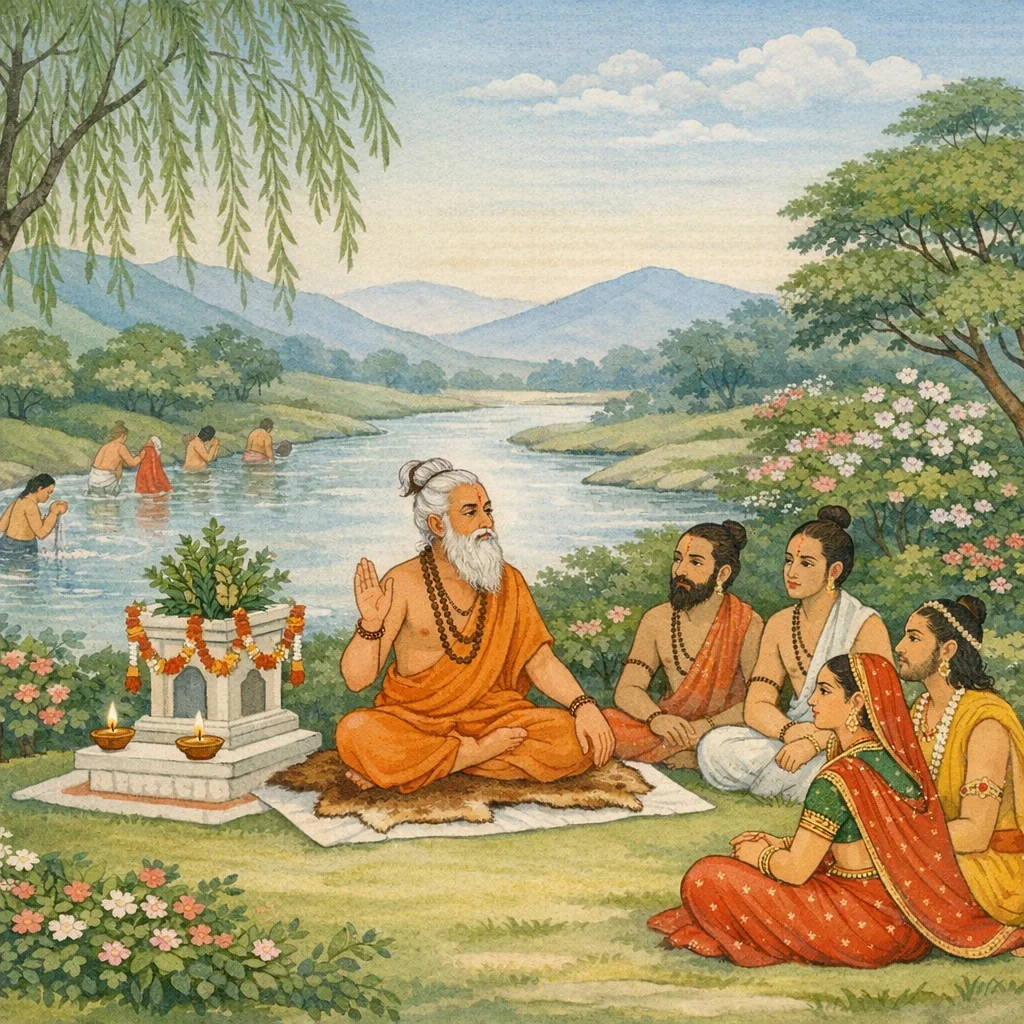
Adhyaya 50
Dialogue of Gobhila and Padmāvatī: Daitya Obstruction vs. the Power of Pativratā Dharma
PP.2.50 presents a moral confrontation: Gobhila, a Daitya soldier of Paulastya, openly admits predatory “Daitya conduct” (seizing wealth and women) while paradoxically boasting of mastery in Veda-śāstra and the arts. The narrative broadens into a critique of demonic obstruction—beings who watch for brāhmaṇa faults and sabotage tapas and yajña—yet concedes that they cannot endure the spiritual radiance of Hari, a virtuous brāhmaṇa, or a chaste, devoted wife (pativratā). Against this backdrop Gobhila turns didactic, naming as non-abandonable pillars: steadfastness to the sacred fire and agnihotra (agnihotra/agni), obedience and purity in service, and filial duty to one’s parents. The chapter then warns sternly against abandoning one’s husband, branding the transgressive woman a puṃścalī, while Padmāvatī defends her innocence, having been deceived by one who assumed the husband’s form. The episode closes with Gobhila’s departure and Padmāvatī’s sorrow, sharply contrasting dharma’s norms with asuric coercion.
Shlokas
Verse 1
सुकलोवाच । तस्यास्तु वचनं श्रुत्वा गोभिलो वाक्यमब्रवीत् । भवती शप्तुकामासि कस्मान्मे कारणं वद
Sukalā said: Hearing her words, Gobhila spoke: “You wish to curse me—tell me, for what reason?”
Verse 2
केन दोषेण लिप्तोस्मि यस्मात्त्वं शप्तुमुद्यता । गोभिलो नाम दैत्योस्मि पौलस्त्यस्य भटः शुभे
“By what fault am I tainted, that you are prepared to curse me? O auspicious lady, I am a Daitya named Gobhila, a soldier of Paulastya.”
Verse 3
दैत्याचारेण वर्तामि जाने विद्यामनुत्तमाम् । वेदशास्त्रार्थवेत्तास्मि कलासु निपुणः पुनः
“I conduct myself according to the ways of the Daityas, yet I know unsurpassed knowledge. I know the meanings of the Vedas and the śāstras, and I am skilled in the arts as well.”
Verse 4
एवं सर्वं विजानामि दैत्याचारं शृणुष्व मे । परस्वं परदारांश्च बलाद्भुंजामि नान्यथा
Thus I know all; now hear from me the conduct of the Daityas: by force I seize and enjoy others’ wealth and others’ wives—there is no other way for me.
Verse 5
वयं दैत्याः समाकर्ण्य दैत्याचारेण सांप्रतम् । वर्त्तामो ज्ञानिभावेन सत्यं सत्यं वदाम्यहम्
We are Daityas; having heard this, we now act in the Daitya manner—yet with the disposition of the wise. Truly, truly, I speak the truth.
Verse 6
ब्राह्मणानां हि च्छिद्राणि विपश्यामो दिने दिने । तेषां हि तपसो नाशं विघ्नैः कुर्मो न संशयः
Indeed, day after day we watch for the flaws of the brāhmaṇas; and without doubt, by creating obstacles, we bring about the ruin of their tapas, their austerity.
Verse 7
छिद्रं प्राप्य वयं देवि नाशयामो न संशयः । ब्राह्मणाञ्छ्रूयतां भद्रे देवयज्ञं वरानने
O Goddess, if we find a vulnerability, we will destroy it—there is no doubt. O auspicious one, O fair-faced lady, let the brāhmaṇas hear of the deva-yajña, the sacrifice to the Devas.
Verse 8
नाशयामो वयं यज्ञान्धर्मयज्ञं न संशयः । सुब्राह्मणान्परित्यज्य देवं नारायणं प्रभुम्
We will destroy the sacrifices—yes, even the sacrifice called ‘dharma’; of this there is no doubt—when the righteous brāhmaṇas are abandoned and Lord Nārāyaṇa, the supreme master, is forsaken.
Verse 9
पतिव्रतां महाभागां सुमतिं भर्तृतत्पराम् । दूरेणापि परित्यज्य तिष्ठामो नात्र संशयः
Even if we abandon her from afar, we shall remain here—of this there is no doubt; for Sumati is most blessed, a pativratā wholly devoted to her husband.
Verse 10
तेजो देवि सुविप्रस्य हरेश्चैव महात्मनः । नार्याः पतिव्रतायाश्च सोढुं दैत्याश्च न क्षमाः
O Goddess, the demons cannot endure the spiritual radiance of a virtuous brāhmaṇa, of great-souled Hari, or of a chaste, devoted wife—a pativratā.
Verse 11
पतिव्रताभयेनापि विष्णोः सुब्राह्मणस्य च । नश्यंति दानवाः सर्वे दूरं राक्षसपुंगवाः
By the very awe inspired by a pativratā—and likewise by Lord Viṣṇu and a righteous brāhmaṇa—all the dānavas are destroyed, and the foremost of rākṣasas flee far away.
Verse 12
अहं दानवधर्मेण विचरामि महीतलम् । कस्मात्त्वं शप्तुकामासि मम दोषो विचार्यताम्
I roam upon the earth in accordance with the code of the Dānavas. Why, then, do you wish to curse me? Let my fault be examined.
Verse 13
पद्मावत्युवाच । मम धर्मः सुकायश्च त्वयैव परिनाशितः । अहं पतिव्रता साध्वी पतिकामा तपस्विनी
Padmāvatī said: “My dharma and my fair body have been ruined by you alone. I am a pativratā, a virtuous woman—yearning for my husband and living the life of austerity.”
Verse 14
स्वमार्गे संस्थिता पाप मायया परिनाशिता । तस्मात्त्वामप्यहं दुष्ट आधक्ष्यामि न संशयः
O sinful one—though you stood upon your own path, you have been ruined by māyā (delusion). Therefore you too, wicked one, I shall strike down; of this there is no doubt.
Verse 15
गोभिल उवाच । धर्ममेव प्रवक्ष्यामि भवती यदि मन्यते । अग्निचिद्ब्राह्मणस्यापि श्रूयतां नृपनंदिनी
Gobhila said: “I shall indeed expound dharma, if you approve. O daughter of the king, listen also to the account of a brāhmaṇa who performed the Agnicayana (fire-altar rite).”
Verse 16
जुह्वन्देवं द्विकालं यो न त्यजेदग्निमंदिरम् । स चाग्निहोत्री भवति यजत्येव दिनेदिने
Whoever offers oblations to the divine Fire at both times of day and does not abandon the fire-sanctuary—he truly becomes an Agnihotrin, performing sacrifice day after day.
Verse 17
अन्यच्चैवं प्रवक्ष्यामि भृत्यधर्मं वरानने । मनसा कर्मणा वाचा विशुद्धो योऽपि नित्यशः
And further, O fair-faced one, I shall explain the duty of a servant: one who is ever pure—in mind, in deed, and in speech.
Verse 18
नित्यमादेशकारी यः पश्चात्तिष्ठति चाग्रतः । स भृत्यः कथ्यते देवि पुण्यभागी न संशयः
O Goddess, one who constantly carries out commands—standing behind and also in front in attendance—is called a true servant; he is a sharer in merit, without doubt.
Verse 19
यः पुत्रो गुणवाञ्ज्ञाता पितरं पालयेच्छुभः । मातरं च विशेषेण मनसा काय कर्मभिः
That son who is virtuous, discerning, and of good character should dutifully care for his father—and even more especially for his mother—through mind, body, and deeds.
Verse 20
तस्य भागीरथी स्नानमहन्यहनि जायते । अन्यथा कुरुते यो हि स पापीयान्न संशयः
For him, bathing in the Bhāgīrathī (Gaṅgā) should be performed day after day. But whoever acts otherwise—of him there is no doubt: he becomes more sinful.
Verse 21
अन्यच्चैवं प्रवक्ष्यामि पतिव्रतमनुत्तमम् । वाचा सुमनसा चैव कर्मणा शृणु भामिनि
And further, I shall now explain this unsurpassed ideal of the pativrata, the devoted wife. Listen, O fair one—how it is upheld in speech, in a virtuous mind, and in action.
Verse 22
शुश्रूषां कुरुते या हि भर्तुश्चैव दिन दिने । तुष्टे भर्त्तरि या प्रीता न त्यजेत्क्रोधनं पुनः
A wife who, day after day, renders attentive service to her husband, and who is affectionate when her husband is pleased, should not again fall into anger, but keep her self-control.
Verse 23
तस्य दोषं न गृह्णाति ताडिता तुष्यते पुनः । भर्त्तुः कर्मसु सर्वेषु पुरतस्तिष्ठते सदा
She does not hold his fault against him; even when struck, she becomes pleased again. In all her husband’s duties, she always stands before him, ever ready to serve.
Verse 24
सा चापि कथ्यते नारी पतिव्रतपरायणा । पतितोपि पितापुत्रैर्बहुदोषसमन्वितः
She indeed is called a woman wholly devoted to her husband’s sacred vow; even if the father has fallen, his sons regard him as one burdened with many faults.
Verse 25
कस्मादपि च न त्याज्यः कुष्ठितः क्रुधितोऽपि वा । एवं पुत्राः शुश्रूषंति पितरं मातरं किल
For no reason should one abandon one’s parents, even if they suffer from leprosy or even if they are angry. Thus indeed should sons dutifully serve their father and mother.
Verse 26
ते यांति परमं लोकं तद्विष्णोः परमं पदम् । एवं हि स्वामिनं ये वै उपाचरंति भृत्यकाः
They attain the highest realm—the supreme abode of Viṣṇu. Thus indeed do those servants who faithfully attend upon their master reach that goal.
Verse 27
पत्युर्लोकं प्रयांत्येते प्रसादात्स्वामिनस्तदा । अग्निं नैव त्यजेद्विप्रो ब्रह्मलोकं प्रयाति सः
By the grace of their lord, these then attain the world of their husband. But the brāhmaṇa should never abandon the sacred fire; he attains the world of Brahmā.
Verse 28
अग्नित्यागकरो विप्रो वृषलीपतिरुच्यते । स्वामिद्रोही भवेद्भृत्यः स्वामित्यागान्न संशयः
A brāhmaṇa who abandons the sacred fire is said to become like one wedded to a śūdra woman; and a servant who abandons his master becomes a betrayer of his master—of this there is no doubt.
Verse 29
अग्निं च पितरं चैव न त्यजेत्स्वामिनं शुभे । सदा विप्रः सुतो भृत्यः सत्यं सत्यं वदाम्यहम्
O auspicious one, never abandon the sacred fire, one’s father, or one’s master. A brāhmaṇa, a son, and a servant should ever remain steadfast—this is truth; truly, I tell you, this is truth.
Verse 30
परित्यज्य प्रगच्छंति ते यांति नरकार्णवम् । पतितं व्याधितं देवि विकलं कुष्ठिनं तथा
Those who abandon them and depart go on to the ocean of hell. This applies to one who forsakes the fallen, the sick, O Goddess, the disabled, and likewise the leper.
Verse 31
सर्वकर्मविहीनं च गतवित्तादिसंचयम् । भर्तारं न त्यजेन्नारी यदि श्रेय इहेच्छति
Even if her husband is bereft of all work and has lost his wealth and other possessions, a woman should not abandon him, if she seeks true good in this very life.
Verse 32
त्यक्त्वा कांतं व्रजेन्नारी अन्यत्कार्यमिहेच्छति । सा मता पुंश्चली लोके सर्वधर्मबहिष्कृता
A woman who abandons her beloved and goes elsewhere, seeking some other affair here, is deemed in the world fickle and is excluded from all dharmic honor.
Verse 33
गते भर्तरि या ग्रामं भोगं शृंगारमेव च । लौल्याच्च कुरुते नारी पुंश्चली वदते जनः
When her husband is away, the woman who, out of fickle craving, goes about the village, indulging in sensual pleasures and adornment—people call her a wanton woman.
Verse 34
एवं धर्मं विजानामि वेदशास्त्रैश्च संमतम् । दानवा राक्षसाः प्रेता धात्रा सृष्टा यदादितः
Thus I understand dharma, as affirmed by the Vedas and the śāstras: that the Dānavas, Rākṣasas, and Pretas were created by the Creator in the beginning.
Verse 35
तत्रेह कारणं सर्वं प्रवक्ष्यामि न संशयः । ब्राह्मणा दानवाश्चैव पिशाचाश्चैव राक्षसाः
Here I shall explain the entire cause without any doubt—concerning the Brāhmaṇas, the Dānavas, the Piśācas, and the Rākṣasas as well.
Verse 36
धर्मार्थं सकलं प्रोक्तमधीतं तैस्तु सुंदरि । विंदंति सकलं सर्वे आचरंति न दानवाः
All that pertains to dharma has been taught and studied by them, O fair one. All know it in full—yet the Dānavas do not practice it.
Verse 37
विधिहीनं प्रकुर्वंति दानवा ज्ञानवर्जिताः । अन्यायेन व्रजंत्येते मानवा विधिवर्जिताः
Devoid of proper injunctions, the Dānavas act without true understanding. Likewise, these humans—bereft of right procedure—proceed along the path of injustice.
Verse 38
तेषां शासनहेत्वर्थं कृता एतेपि नान्यथा । विधिहीनं प्रकुर्वंति ये हि धर्मं नराधमाः
These too have been established solely for the purpose of restraining them, and for no other reason—because those base men who practice dharma do so without regard for proper rule and procedure.
Verse 39
तान्वयं शासयामो वै दंडेन महता किल । भवत्या दारुणं कर्म कृतमेव सुनिर्घृणम्
Therefore we shall indeed punish them with a great chastisement; for by you a cruel deed—utterly merciless—has certainly been done.
Verse 40
गार्हस्थ्यं च परित्यज्य अत्रायाता किमर्थतः । वदस्येवं मुखेनापि अहं हि पतिदेवता
“Why have you abandoned household life and come here? How can you even say such words? For I am one whose very deity is her husband.”
Verse 41
कर्मणा नास्ति तद्दृष्टं पतिदैवत्यमेव ते । भर्तारं तं परित्यज्य किमर्थं त्वमिहागता
I do not see that this has happened because of karma; for you, devotion to your husband alone is the true divine duty. Having abandoned that husband, for what reason have you come here?
Verse 42
शृंगारं भूषणं वेषं कृत्वा तिष्ठसि निर्घृणा । किमर्थं हि कृतं पापे कस्यहेतोर्वदस्व मे
Having adorned yourself with finery—ornaments and dress—you stand there without compassion. Tell me, sinful one: for what purpose was this deed done, and for whose sake?
Verse 43
निःशंका वर्त्तसे चापि प्रमत्ता गिरिकानने । मया त्वं साधिता पापा दंडेन महता शृणु
You roam about without fear, reckless in the mountain forest. But I have now subdued you, O sinful one, with a great punishment—listen!
Verse 44
अधर्मचारिणी दुष्टा पतिं त्यक्त्वा समागता । क्वास्ते तत्पतिदेवत्वं दर्शय त्वं ममाग्रतः
O wicked woman who lives by unrighteous conduct—having abandoned your husband you have come here. Where is your so‑called devotion to your husband as a god? Show it to me here, before my eyes.
Verse 45
भवती पुंश्चली नाम यया त्यक्तः स्वकः पतिः । पृथक्छय्या यदा नारी तदा सा पुंश्चली मता
She is called a ‘puṃścalī’—a woman who has abandoned her own husband; and when a woman lies separately (from her husband), then she too is regarded as a puṃścalī.
Verse 46
योजनानां शतैकस्य सोन्तरेण प्रवर्त्तते । क्वास्ति ते पतिदैवत्यं पुंश्चल्याचारचारिणी
Within the span of a mere hundred yojanas you go about in that way. Where, then, is your devotion to your husband as your very deity—O woman who follows the conduct of a wanton?
Verse 47
निर्लज्जे निर्घृणे दुष्टे किं मे वदसि संमुखी । तपसः क्वास्ति ते भावः क्व तेजोबलमेव च
O shameless, merciless wicked one—why do you speak to me face to face? Where in you is the true spirit of austerity, and where indeed are your radiance and strength?
Verse 48
दर्शयस्व ममाद्यैव बलवीर्यपराक्रमम् । पद्मावत्युवाच । स्नेहेनापि समानीता श्रूयतामसुराधम
“Show me—this very day—your strength, valor, and prowess.” Padmāvatī said: “Though I have been brought here even by affection, listen, O vilest of asuras.”
Verse 49
भर्तुर्गेहादहं पित्रा क्वास्ते तत्र च पातकम् । नैव कामान्न लोभाच्च न मोहान्न च मत्सरात्
“My father took me away from my husband’s house—wherein lies my sin? It was not from desire, nor from greed, nor from delusion, nor from jealousy.”
Verse 50
इति श्रीपद्मपुराणे भूमिखंडे वेनोपाख्याने सुकलाचरित्रे । पंचाशत्तमोऽध्यायः
Thus ends the fiftieth chapter of the Bhūmi-khaṇḍa of the Śrī Padma Purāṇa, within the narrative of Vena, namely the account of Sukalā’s deeds.
Verse 51
भवंतं माथुरं ज्ञात्वा गताहं सम्मुखं तव । मायाविनं यदा जाने त्वामेवं दानवाधम
Knowing you to be a man born in Mathurā, I came to face you. But when I realized you are a deceiver—thus you are truly the lowest of the Dānavas.
Verse 52
एकेन हुंकृतेनैव भस्मीभूतं करोम्यहम् । गोभिल उवाच । चक्षुर्हीना न पश्यंति मानवाः शृणु सांप्रतम्
“With a single utterance of ‘huṃ’, I can reduce it to ashes.” Gobhila said: “People who lack true vision do not perceive reality. Listen now to what I say.”
Verse 53
धर्मनेत्रविहीना त्वं कथं जानासि मामिह । यदा ते भाव उत्पन्नः पितुर्गेहं प्रति शृणु
Devoid of the eye of dharma, how can you recognize me here? When right understanding arises in you, then listen—turn your attention toward your father’s house.
Verse 54
पतिध्यानं परित्यज्य मुक्ता ध्यानेन त्वं तदा । ज्ञाननेत्रं तदा नष्टं स्फुटं च हृदये तव
Abandoning meditation upon your husband, you then sought liberation through another meditation; at that time, the eye of true knowledge within your heart was plainly lost.
Verse 55
कथं मां त्वं विजानासि ज्ञानचक्षुर्हता भुवि । कस्या माता पिता भ्राता कस्याः स्वजनबांधवाः
How do you recognize me, when on this earth I have been deprived of the eye of knowledge? Whose mother am I, whose father, whose brother—and whose are my own kinsmen and relations?
Verse 56
सर्वस्थाने पतिर्ह्येको भार्यायास्तु न संशयः । इत्युक्त्वा हि प्रहस्यैव गोभिलो दानवाधमः
“In every circumstance, the husband alone is the wife’s lord—of this there is no doubt.” Having said this, Gobhila—the vilest of the Dānavas—laughed aloud.
Verse 57
न भयं विद्यते तेऽद्य ममापि शृणु पुंश्चलि । किं भवेत्तव शापेन वृथैव परिकंपसे
There is no fear for you today—listen to me as well, O wanton one. What could your curse possibly do? You tremble in vain.
Verse 58
ममगेहं समाश्रित्य भुंक्ष्व भोगान्मनोऽनुगान् । पद्मावत्युवाच । गच्छ पापसमाचार किं त्वं वदसि निर्घृणः
“Taking refuge in my house, enjoy the pleasures that suit your mind.” Padmāvatī said: “Go away, you whose conduct is sinful—what are you saying, you merciless one?”
Verse 59
सतीभावेन संस्थास्मि पतिव्रतपरायणा । धक्ष्यामि त्वां महापाप यद्येवं तु वदिष्यसि
I stand steadfast in the spirit of a chaste and faithful wife, wholly devoted to my husband. O great sinner—if you speak in this manner, I will burn you.
Verse 60
एवमुक्त्वा तथैकांते निषसाद महीतले । दुःखेन महताविष्टां तामुवाच स गोभिलः
Having spoken thus, he sat apart in a secluded place upon the ground; and Gobhila addressed her, who was overcome by great sorrow.
Verse 61
तवोदरे मया न्यस्तं स्ववीर्यं सुकृतं शुभे । तस्मादुत्पत्स्यते पुत्रस्त्रैलोक्यक्षोभकारकः
O auspicious lady, I have placed my own potent seed—an act of merit—within your womb; therefore a son will be born who will shake the three worlds.
Verse 62
एवमुक्त्वा जगामाथ गोभिलो दानवस्तदा । गते तस्मिन्दुराचारे दानवे पापचारिणी
Having spoken thus, Gobhila—the Dānava—then departed. When that wicked, evil-doing Dānava had gone, the sinful woman remained behind.
Verse 63
दुःखेन महताविष्टा नृपकन्या रुरोद ह
Overwhelmed by great sorrow, the king’s daughter wept.