Adhyaya 2
The Account of Śivaśarman (Dharmaśarmā’s Tapas, Dharma’s Boon, and the Amṛta Mission)
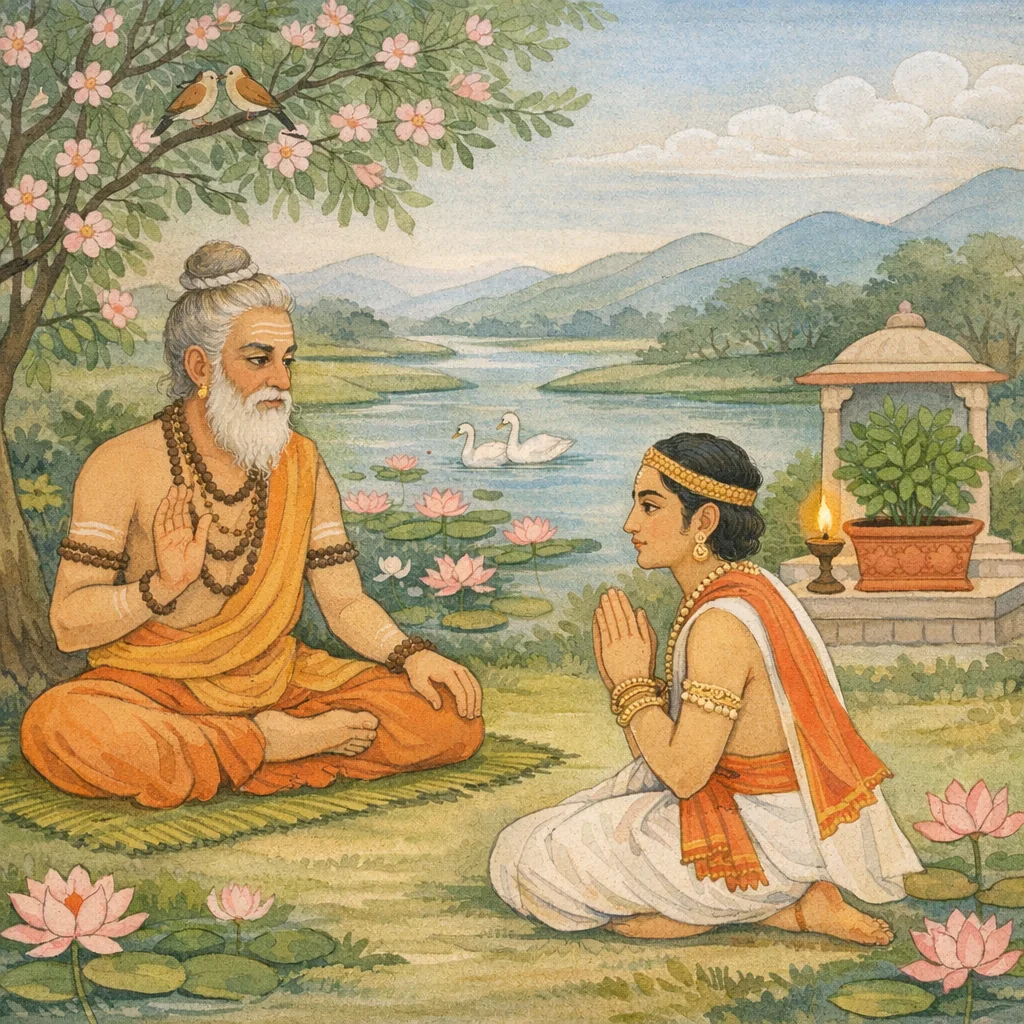
The chapter centers on Dharmaśarmā’s urgent resolve, empowered by truth and sustained tapas, which draws near personified Dharma and brings about a direct exchange. Dharma affirms the potency of self-restraint, purity, truthfulness, and austerity, and grants the boon that Dharmaśarmā’s brother Vedaśarmā will regain life. A petitioner’s prayer then links dharma with bhakti: devotion at a father’s feet, delight in righteousness, and finally mokṣa—revealing a hierarchy of aims (bhakti → dharma → liberation). When Vedaśarmā rises and speaks, the brothers return to their father, Śivaśarmā. A new tension follows: Śivaśarmā, absorbed in thought and longing for disease-destroying amṛta, commands Viṣṇuśarmā to go to Indra’s realm and fetch the nectar, setting the next movement of the narrative in motion.
Shlokas
Verse 1
सूत उवाच । तदादाय महात्माऽसौ निर्जगाम त्वरान्वितः । पितृभक्त्या तपोभिश्च सत्यार्जवबलेन सः
Sūta said: Taking that, the great-souled one set out at once in haste—supported by devotion to his father, by austerities, and by the strength of truthfulness and straightforwardness.
Verse 2
इति श्रीपद्मपुराणे भूमिखंडे शिवशर्मचरिते द्वितीयोऽध्यायः
Thus ends the second chapter, “The Account of Śivaśarman,” in the Bhūmi-khaṇḍa of the revered Padma Purāṇa.
Verse 3
धर्मशर्माणमायातं इदं वचनमब्रवीत् । कस्मात्त्वया समाहूतो धर्मशर्मन्समागतः
When Dharmaśarman arrived, he spoke these words: “Why have you summoned me? I, Dharmaśarman, have come as called.”
Verse 4
तन्मे कथय कार्यं त्वं तत्करोमि न संशयः । धर्मशर्मोवाच । यद्यस्ति गुरुशुश्रूषा यदि निष्ठाऽचलं तपः
“Tell me what I should do; I will do that—without any doubt.” Dharmaśarman said: “If there is devoted service to the guru, if there is unwavering steadfastness in austerity…”
Verse 5
तेन सत्येन मे धर्म वेदशर्मा स जीवतु । धर्म उवाच । दमशौचेन सत्येन तपसा तव सुव्रत
“By that truth, O Dharma, may Vedaśarmā live!” Dharma replied: “By your self-restraint and purity, by your truthfulness, and by your austerity, O you of excellent vows …”
Verse 6
पितृभक्त्या तव भ्राता वेदशर्मा महाभुजः । पुनरेव महात्मासौ जीवनं च लभिष्यति
Through your devotion to the ancestors, your brother Vedaśarmā, the mighty-armed one—this great soul—will indeed regain life once again.
Verse 7
तपसानेन तुष्टोस्मि पितृभक्त्या महामते । वरं वरय भद्रं ते दुर्लभं धर्मवित्तमैः
I am pleased with you because of this austerity and your devotion to your forefathers, O great-minded one. Choose a boon—may good befall you—for such a boon is rarely attained even by those who truly know dharma.
Verse 8
एवमाकर्णितं तेन सुवाक्यं धर्मशर्मणा । वैवस्वतं महात्मानं समुवाच महायशाः
Having thus heard the well-spoken words of Dharmaśarman, the illustrious one then addressed Vaivasvata, that great-souled being.
Verse 9
देहि मे त्वचलां भक्तिं पितुः पादार्हणे पुनः । धर्मे रतिं तथा मोक्षं सुप्रसन्नो यदा मम
Grant me unwavering devotion again in the worship of my father’s feet; grant me delight in righteousness, and liberation as well—whenever You are fully pleased with me.
Verse 10
तमुवाच ततो धर्मो मत्प्रसादाद्भविष्यति । एवमुक्ते महावाक्ये वेदशर्मा तदोत्थितः
Then Dharma said to him, “By my grace, righteousness shall arise.” When those great words were spoken, Vedaśarmā rose at once.
Verse 11
प्रसुप्तवन्महाप्राज्ञो धर्मशर्माणमब्रवीत् । क्व सा देवी गता भ्रातः क्व स तातो भवेदिति
Then the greatly wise one, as if newly awakened from sleep, said to Dharmaśarmā: “Brother, where has that Goddess gone? And where might that father be?”
Verse 12
समासेन समाख्यातं यथा पित्रा नियोजितः । समाज्ञाय ततो हृष्टो धर्मशर्मा तमब्रवीत्
When it was briefly explained how he had been appointed by his father, Dharmaśarmā understood it, rejoiced, and then spoke to him.
Verse 13
ममाद्यैव महाभाग शिरसा जीवितेन च । संमुखी भव वै भ्रातः कोन्यो मे त्वादृशो भुवि
O greatly fortunate one, even today I bow to you with my head and with my very life. Come before me, brother—who else on earth is there for me like you?
Verse 14
भ्रातरं चैवमाभाष्य उत्सुकः पितरं प्रति । गमनाय मतिं चक्रे भ्रात्रा च धर्मशर्मणा
Having thus spoken to his brother, eager to go to his father, he resolved to depart together with his brother Dharmaśarmā.
Verse 15
द्वावेतौ तु गतौ तत्र पितरं हृष्टमानसौ । द्वाभ्यां तत्र समास्थाय शिवशर्माणमुत्तमम्
Then those two went there to their father, their hearts filled with joy. There, sitting together, they approached and attended upon the excellent Śivaśarman.
Verse 16
धर्मशर्मा तदोवाच पितरं दीप्तिसंयुतम् । ममाद्यैव महाभाग तपसा जीवितेन च
Then Dharmaśarmā spoke to his father, endowed with radiance: “O greatly fortunate one, from this very day—by my austerity, and even by my very life…”
Verse 17
वेदशर्मा समानीतस्तं पुत्रं प्रगृहाण भोः । शिवशर्मा ततो हृष्टो भक्तिं विज्ञाय तस्य च
Vedaśarmā said, “I have brought your son—please accept him, sir.” Then Śivaśarmā, perceiving his devotion, became delighted.
Verse 18
न किंचिदब्रवीत्तं तु पुनश्चिंतामुपेयिवान् । पुरतो विनयेनापि वर्तमानं महामतिम्
But he said nothing to him; instead, he again fell into thought, even though the great-minded one stood before him with humility.
Verse 19
विष्णुशर्माणमाभाषीद्वत्स मे वचनं कुरु । इंद्रलोकं व्रजस्वाद्य तस्मादानय चामृतम्
He addressed Viṣṇuśarmā: “Dear one, do my bidding. Go at once to Indra’s world, and bring back the amṛta, the nectar, from there.”}]}
Verse 20
अनया कान्तया सार्द्धं स्थातुमिच्छामि सांप्रतम् । सागराद्यत्समुत्पन्नममृतं व्याधिनाशनम्
Now I wish to remain together with this beloved. For the amṛta—the nectar that arose from the ocean—is the destroyer of disease.
Verse 21
साधुनेच्छति मामेषा यथैनां तु लभाम्यहम् । तथा कुरुष्व शीघ्रं त्वमन्यथान्यं प्रयास्यति
This woman desires me as her husband, so that I may obtain her. Therefore do it quickly—otherwise she will go to someone else.
Verse 22
वृद्धं ज्ञात्वावमन्येत इयं बाला सुरूपिणी । अद्य देव्यानया सार्द्धं प्रियया भुवनत्रये
Knowing him to be old, one might disregard him; yet this maiden is beautiful in form. Today, together with the beloved goddess, (his glory will extend) across the three worlds.
Verse 23
निर्दोषो व्याधिनिर्मुक्तो यथा तात भवाम्यहम् । तथा कुरुष्व मे वत्स मद्भक्तोसि यदा भुवि
“O dear one, just as I become free from fault and released from illness, so do this for me, my child—since on earth you are my devotee.”
Verse 24
एवमाकर्ण्य तद्वाक्यं पितुस्तस्य महात्मनः । विष्णुशर्मा तदोवाच पितरं दीप्ततेजसम्
Having thus heard the words of his great-souled father, Viṣṇuśarmā then addressed his father, radiant with splendor.
Verse 25
सर्वमेतत्करिष्यामि भवतः सुखमुत्तमम् । एवमाभाष्य धर्मात्मा विष्णुशर्मा महामतिः
“I shall do all this, bringing you the highest happiness.” Having spoken thus, the righteous and great-minded Viṣṇuśarmā, of lofty intellect, declared.
Verse 26
पितरं तं नमस्कृत्य पुनः कृत्वा प्रदक्षिणम् । बलेन महता सोपि तपसा नियमेन च
Having bowed to his father and once again circumambulated him in reverence, he too—endowed with great strength—proceeded, sustained by tapas (austerity) and disciplined observances.
Verse 27
अंतरिक्षगतश्चासीद्गच्छमानस्य धीमतः । स महावायुवेगेन ऐंद्रं संप्रतिगच्छति
As the wise one proceeded, he rose into the mid-sky; and, borne along by the force of a mighty wind, he sped toward Indra’s realm.