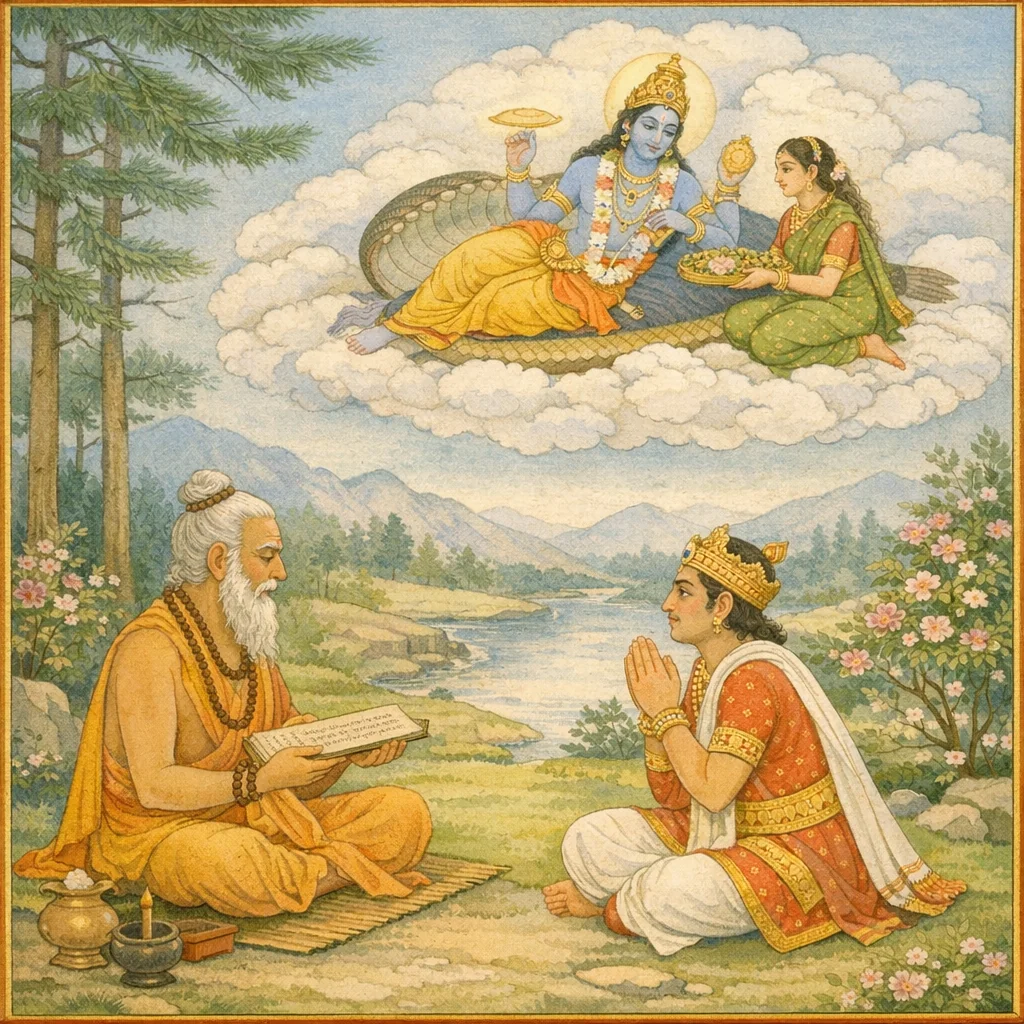
Adhyaya 71
Yayāti and Mātali on the Order of Divine Worlds, the Merit of Śiva’s Name, and the Unity of Śiva and Viṣṇu
The chapter opens with Yayāti affirming renewed faith after hearing a discerning account of dharma and adharma. A question is then put to Mātali about the famed numbers, gradations, and attainments of the gods’ worlds. Mātali sets forth a hierarchy of sovereignties and realms—through classes such as Rākṣasas, Gandharvas, and Yakṣas, rising to the domains of Indra, Soma, and Brahmā, and culminating in Śivapura—linking these attainments to tapas, yogic discipline, and inherited splendor. The teaching then turns to bhakti: salutations to Śiva, and even incidental utterance of Śiva’s name, bestow powerful, unfailing merit and evoke images of celestial ascent—a divine chariot and stars in myriad forms. Finally, non-difference is proclaimed: Śaiva and Vaiṣṇava forms are one essence; Śiva is in Viṣṇu and Viṣṇu in Śiva, and the triad Brahmā–Viṣṇu–Maheśvara is spoken of as a single embodied reality. Sukarma closes by noting Mātali’s silence after instructing Yayāti.
Shlokas
Verse 1
ययातिरुवाच । यत्त्वया सर्वमाख्यातं धर्माधर्ममनुत्तमम् । शृण्वतोऽथ मम श्रद्धा पुनरेव प्रवर्तते
Yayāti said: “As you have explained everything—unsurpassed in distinguishing dharma and adharma—while I listen, my faith is once again revived and set in motion.”
Verse 2
देवानां लोकसंस्थानां वद संख्याः प्रकीर्तिताः । यस्य पुण्यप्रसंगेन येन प्राप्तं च मातले
Tell me the renowned numbers and the arrangement of the worlds of the devas—by what meritorious association, and by whom, O Mātali, this realm has been attained.
Verse 3
मातलिरुवाच । योगयुक्तं प्रवक्ष्यामि तपसा यदुपार्जितम् । देवानां लोकसंस्थानं सुखभोगप्रदायकम्
Mātali said: “I shall describe, grounded in yogic discipline, the divine arrangement of the worlds of the devas—attained through austerity (tapas)—which bestows happiness and the enjoyment of pleasures.”
Verse 4
धर्मभावं प्रवक्ष्यामि आयासैरर्जितं पृथक् । उपरिष्टाच्च लोकानां स्वरूपं चाप्यनुक्रमात्
I shall expound the nature of dharma—distinctly, as it is won through effort—and also, in due sequence, the forms of the worlds that lie above.
Verse 5
तत्राष्टगुणमैश्वर्यं पार्थिवं पिशिताशिनाम् । तस्मात्सद्यो गतानां च नराणां तत्समं स्मृतम्
There, the flesh-eaters are said to possess an eightfold, earthly lordship. Therefore, for men who have just departed this world, that very condition is remembered as comparable to it.
Verse 6
रक्षसां षोडशगुणं पार्थिवानां च तद्विधम् । एवं निरवशेषं च यच्छेषं कुलतेजसाम्
For the Rākṣasas it is sixteenfold; for earthly kings it is of the same kind. Thus, without remainder, whatever is left pertains to the inherited splendor of noble lineages.
Verse 7
गंधर्वाणां च वायव्यं याक्षं च सकलं स्मृतम् । पांचभौतिकमिंद्रस्य चत्वारिंशद्गुणं महत्
For the Gandharvas it is said to be airy in nature; for the Yakṣas it is remembered as wholly of that class. For Indra, it is declared to be constituted of the five elements, and greatly—fortyfold in quality.
Verse 8
सोमस्य मानसं दिव्यं विश्वेशं पांचभौतिकम् । सौम्यं प्रजापतीशानामहंकारगुणाधिकम्
Of Soma, the mind-born form is divine—Lord of the universe, constituted of the five elements; gentle in nature, lord among the Prajāpatis, and predominantly endowed with the quality of ahaṅkāra (the ego-principle).
Verse 9
चतुष्षष्टिगुणं ब्राह्मं बौधमैश्वर्यमुत्तमम् । विष्णोः प्राधानिकं तंत्रमैश्वर्यं ब्रह्मणः पदम्
Brahmā’s sovereignty is said to be sixty-fourfold; the Buddha’s sovereignty is supreme. Viṣṇu’s is the primordial, principal tantra; and sovereignty itself is the station of Brahmā.
Verse 10
श्रीमच्छिवपुरे दिव्ये ऐश्वर्यं सर्वकामिकम् । अनंतगुणमैश्वर्यं शिवस्यात्मगुणं महत्
In the divine, splendid Śivapura there is lordly prosperity that fulfills every desire. That sovereignty—endowed with endless qualities—is the great intrinsic attribute of Śiva Himself.
Verse 11
आदिमध्यांतरहितं विशुद्धं तत्त्वलक्षणम् । सर्वावभासकं सूक्ष्ममनौपम्यं परात्परम्
That Reality is free from beginning, middle, and end; utterly pure, characterized as the highest Truth. It illumines all, is subtle, incomparable, and beyond even the beyond.
Verse 12
सुसंपूर्णं जगद्वेषं पशुपाशाविमोक्षणम् । यो यत्स्थानमनुप्राप्तस्तस्य भोगस्तदात्मकः
This teaching fully explains the world’s aversions and the release from the bonds (pāśa) that bind beings like cattle. Whatever state a person attains, the experience that follows—pleasure or suffering—is of the same nature as that state.
Verse 13
विमानं तत्समानं च भवेदीशप्रसादतः । नानारूपाणि ताराणां दृश्यंते कोटयस्त्विमा
By the Lord’s grace, one would obtain a celestial vimāna equal to that. And there, millions of stars of many different forms are seen.
Verse 14
अष्टविंशतिरेवं ते संदीप्ताः सुकृतात्मनाम् । ये कुर्वंति नमस्कारमीश्वराय क्वचित्क्वचित्
Thus these twenty-eight fruits of merit blaze forth for the righteous—those who, from time to time, offer salutations to the Lord.
Verse 15
संपर्कात्कौतुकाल्लोभात्तद्विमानं लभंति ते । नामसंकीर्तनाद्वापि प्रसंगेन शिवस्य यः
Through mere association, out of curiosity, or even out of greed, they attain that celestial vimāna; likewise, whoever—even incidentally—chants the name of Śiva attains it too.
Verse 16
कुर्याद्वापि नमस्कारं न तस्य विलयो भवेत् । इत्येता गतयस्तत्र महत्यः शिवकर्मणि
Even if one merely offers a salutation, there will be no downfall for that person. Such indeed are the great spiritual outcomes produced there through acts devoted to Śiva.
Verse 17
कर्मणाभ्यंतरेणापि पुंसामीशानभावतः । प्रसंगेनापि ये कुर्युः शंकरस्मरणं नराः
Even while engaged in their actions, those who, through devotion to Īśāna (Śiva), and even incidentally, bring about remembrance of Śaṅkara—such people gain merit.
Verse 18
तैर्लभ्यं त्वतुलं सौख्यं किं पुनस्तत्परायणैः । विष्णुचिंतां प्रकुर्वंति ध्यानेन गतमानसाः
Through them, incomparable happiness is attained—how much more so by those wholly devoted to Him. With minds absorbed in meditation, they continually engage in contemplation of Viṣṇu.
Verse 19
ते यांति परमं स्थानं तद्विष्णोः परमं पदम् । शैवं च वैष्णवं रूपमेकरूपं नरोत्तम
They attain the supreme abode—the highest state of Viṣṇu. The Śaiva and the Vaiṣṇava forms are in truth one single form, O best of men.
Verse 20
द्वयोश्च अंतरं नास्ति एकरूपमहात्मनोः । शिवाय विष्णुरूपाय शिवरूपाय विष्णवे
Between the two great-souled ones—who are of a single essence—there is no difference: salutations to Śiva who is in the form of Viṣṇu, and to Viṣṇu who is in the form of Śiva.
Verse 21
शिवस्य हृदयं विष्णुर्विष्णोश्च हृदयं शिवः । एकमूर्तिस्त्रयो देवा ब्रह्मविष्णुमहेश्वराः
Viṣṇu is the very heart of Śiva, and Śiva is the very heart of Viṣṇu. Though appearing as three—Brahmā, Viṣṇu, and Maheśvara—the gods are of a single embodied reality.
Verse 22
त्रयाणामंतरं नास्ति गुणभेदाः प्रकीर्तिताः । शिवभक्तोसि राजेंद्र तथा भागवतोसि वै
There is no real difference among the three; distinctions of guṇas are only spoken of. O lord of kings, you are a devotee of Śiva, and indeed you are also a devotee of Bhagavān (Viṣṇu).
Verse 23
तेन देवाः प्रसन्नास्ते ब्रह्मविष्णुमहेश्वराः । सुप्रीता वरदा राजन्कर्मणस्तव सुव्रत
By that act, those gods—Brahmā, Viṣṇu, and Maheśvara—became pleased. Fully delighted, they became bestowers of boons, O king, because of your deed, O man of excellent vows.
Verse 24
इंद्रादेशात्समायातः सन्निधौ तव मानद । ऐंद्रमेनं पदं याहि पश्चाद्ब्राह्मं महेश्वरम्
By Indra’s command he has come into your presence, O bestower of honor. Lead him first to Indra’s abode, and afterwards to the Brahmā-world, O Maheśvara.
Verse 25
वैष्णवं च प्रयाहि त्वं दाहप्रलयवर्जितम् । अनेनापि विमानेन दिव्येन सर्वगामिना
And you, too, go to the realm of Viṣṇu—free from the cataclysm of burning and dissolution—by means of this divine aerial chariot that can go everywhere.
Verse 26
दिव्यमूर्तिरतो भुंक्ष्व दिव्यभोगान्मनोरमान् । समारुह्य विमानं त्वं पुष्पकं सुखगामिनम्
Therefore, assume a divine form and enjoy delightful celestial pleasures. Then, mounting the Puṣpaka aerial chariot that travels with ease, go forth in comfort.
Verse 27
सुकर्मोवाच । एवमुक्त्वा द्विजश्रेष्ठ मौनवान्मातलिस्तदा । राजानं धर्मतत्त्वज्ञं ययातिं नहुषात्मजम्
Sukarma said: Having spoken thus, O best of twice-born, Mātali then fell silent before King Yayāti, son of Nahusha, who was a knower of the true principles of dharma.
Verse 71
इति श्रीपद्मपुराणे भूमिखंडे वेनोपाख्याने मातापितृतीर्थवर्णने ययाति । चरित्रे एकसप्ततितमोऽध्यायः
Thus, in the Śrī Padma Purāṇa, in the Bhūmi-khaṇḍa—within the episode of Vena, in the description of the Mother-and-Father sacred ford, and in the account of Yayāti—ends the seventy-first chapter.