Adhyaya 105
The Birth and Preservation of Nahuṣa (Guru-tīrtha Greatness within the Vena Episode)
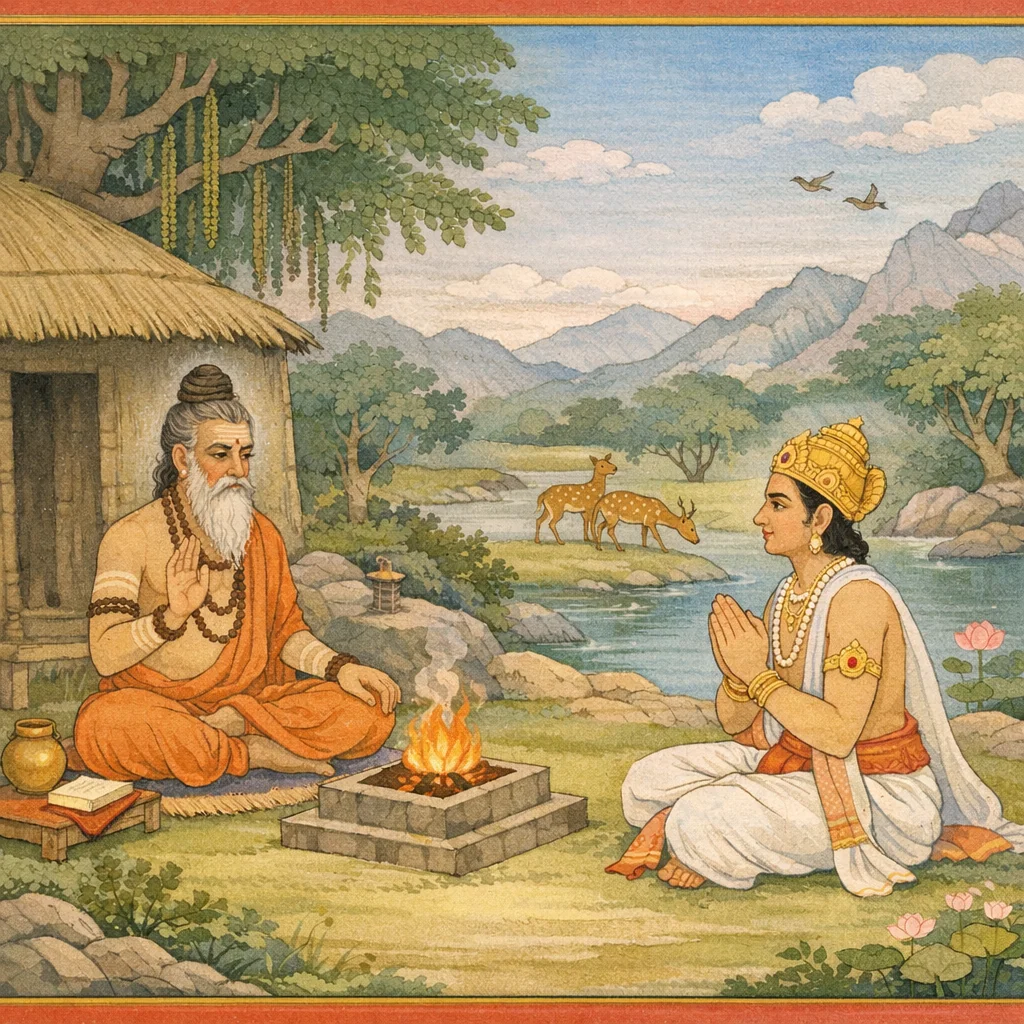
A prophecy foretells the birth of a hero destined to end Huṇḍa, casting sorrow and dread upon those entangled in the fate it announces. Queen Indumatī’s pregnancy is shielded by the radiance of Viṣṇu, so that Huṇḍa’s terrifying occult arts cannot prevail. After a hundred years she gives birth to a luminous son. Yet Huṇḍa, entering the palace through a wicked maidservant, abducts the newborn and commands his wife Vipulā to have the child cooked. Compassion awakens in the cook and the maid Sairandhrī; they secretly substitute meat and rescue the infant, carrying him to Vasiṣṭha’s hermitage. The sages discern the boy’s royal marks, receive him with reverence, and Vasiṣṭha names him Nahuṣa, performs the birth rites, and later trains him in Veda, dharma, kingship, and archery—revealing karma, dharma, and the protecting grace of the guru as the chapter’s spiritual axis.
Shlokas
Verse 1
कुंजल उवाच । गता सा नंदनवनं सखीभिः सह क्रीडितुम् । तत्राकर्ण्य महद्वाक्यमप्रियं तु तदा पितुः
Kuṃjala said: She went to the Nandana grove to play there together with her friends. But there she heard her father’s weighty words—unpleasant to her at that time.
Verse 2
चारणानां सुसिद्धानां भाषतां हर्षणेन तु । आयोर्गेहे महावीर्यो विष्णुतुल्यपराक्रमः
As the Cāraṇas and accomplished Siddhas spoke with delight, there was born in Ayor’s house a mighty hero, whose valor was equal to Viṣṇu’s.
Verse 3
भविष्यति सुतश्रेष्ठो हुंडस्यांतं करिष्यति । एवंविधं महद्वाक्यमप्रियं दुःखदायकम्
“The excellent son will arise and bring about Huṇḍa’s end.” Yet such a weighty utterance was unwelcome and a cause of sorrow.
Verse 4
समाकर्ण्य समायाता पितुरग्रे निवेदितम् । समासेन तया तस्य पुरतो दुःखदायकम्
Having heard of it, she came and reported it before her father; and, in brief, she related in his very presence what was painful and grief-causing.
Verse 5
पितुरग्रे जगादाथ पिता श्रुत्वा स विस्मितः । शापमशोकसुंदर्याः सस्मार च पुराकृतम्
Then he spoke in his father’s presence. Hearing it, the father was astonished and remembered the curse of Aśokasundarī, spoken long ago.
Verse 6
एतस्यार्थे तपस्तेपे सेयं चाशोकसुंदरी । गर्भस्य नाशनायैव इंदुमत्याः स दानवः
For this very purpose, Aśokasundarī performed austerities; and that demon acted only to destroy Indumatī’s pregnancy.
Verse 7
विचक्रे उद्यमं दुष्टः कालाकृष्टो दुरात्मवान् । छिद्रान्वेषी ततो भूत्वा इंदुमत्यास्तु नित्यशः
Driven on by Time, that wicked, evil-minded man set himself to action; thereafter, becoming a seeker of faults, he constantly looked for some weakness in Indumatī.
Verse 8
यदा पश्यति तां राज्ञीं रूपौदार्यगुणान्विताम् । दिव्यतेजः समायुक्तां रक्षितां विष्णुतेजसा
When he beholds that queen—endowed with beauty, nobility, and virtues—radiant with divine splendor, and protected by the energy of Viṣṇu.
Verse 9
दिव्येन तेजसा युक्तां सूर्यबिंबोपमां तु ताम् । तस्याः पार्श्वे महाभाग रक्षणार्थं स्थितः सदा
Endowed with divine radiance, she shone like the disc of the sun. And by her side, O greatly fortunate one, he always stood, stationed there for her protection.
Verse 10
दूरात्स दानवो दुष्टस्तस्याश्च बहुदर्शयन् । नानाविद्यां महोग्रां च भीषिकां सुविभीषिकाम्
From a distance, that wicked Dānava, displaying many things to her, employed various formidable arts—terrifying and exceedingly dreadful—intended to strike fear.
Verse 11
गर्भस्य तेजसा युक्ता रक्षिता विष्णुतेजसा । भयं न जायते तस्या मनस्येव कदापुनः
United with the radiance of her womb, and protected by the radiance of Viṣṇu, fear is never born in her—even within her mind; how much less at any time otherwise?
Verse 12
विफलो दानवो जात उद्यमश्च निरर्थकः । मनीप्सितं नैव जातं हुंडस्यापि दुरात्मनः
That demon’s efforts turned out to be fruitless and his exertion proved meaningless; even the wicked Huṁḍa did not obtain what he desired.
Verse 13
एवं वर्षशतं पूर्णं पश्यमानस्य तस्य च । प्रसूता सा हि पुत्रं च स्वर्भानोस्तनया तदा
Thus, when a full hundred years had passed—while he looked on—then Svarbhānu’s daughter gave birth to a son.
Verse 14
रात्रावेव सुतश्रेष्ठ तस्याः पुत्रो व्यजायत । तेजसातीव भात्येष यथा सूर्यो नभस्तले
That very night, O best of sons, her son was born; and he shines with extraordinary radiance, like the sun in the sky.
Verse 15
सूत उवाच । अथ दासी महादुष्टा काचित्सूतिगृहागता । अशौचाचारसंयुक्ता महामंगलवादिनी
Sūta said: Then a certain maidservant—most wicked—came into the lying-in chamber; acting in impurity, yet speaking words of great auspiciousness.
Verse 16
तस्याः सर्वं समाज्ञाय स हुंडो दानवाधमः । दास्या अंगं प्रविश्यैव प्रविष्टश्चायुमन्दिरे
Having learned everything about her, Huṇḍa—the vilest of the Dānavas—entered the maidservant’s body and, through it, gained entry into Āyu’s inner chambers.
Verse 17
महाजने प्रसुप्ते च निद्रयातीवमोहिते । तं पुत्रं देवगर्भाभमपहृत्य बहिर्गतः
When the whole household had fallen asleep, utterly stupefied by slumber, he abducted that son—radiant like a divine embryo—and went out.
Verse 18
कांचनाख्यपुरे प्राप्तः स्वकीये दानवाधमः । समाहूय प्रियां भार्यां विपुलां वाक्यमब्रवीत्
Having reached his own city called Kāñcanākhya, that vile demon summoned his beloved wife Vipulā and spoke these words.
Verse 19
वधस्वैनं महापापं बालरूपं रिपुं मम । पश्चात्सूदस्य वै हस्ते भोजनार्थं प्रदीयताम्
Kill this great sinner—this enemy of mine who has assumed a child’s form. Then let him be handed over into the cook’s hands for food.
Verse 20
नानाभेदैर्विभेदैश्च पाचयस्व हि निर्घृणम् । सूदहस्तान्महाभागे पश्चाद्भोक्ष्ये न संशयः
Cook it in many ways and with many variations, O merciless one. O noble lady, from the cook’s hands I shall eat afterward—of this there is no doubt.
Verse 21
वाक्यमाकर्ण्य तद्भर्तुर्विपुला विस्मिताभवत् । कस्मान्निर्घृणतां याति भर्त्ता मम सुनिष्ठुरः
Hearing those words of her husband, Vipulā was astonished: “Why has my husband—so harsh—become so merciless?”
Verse 22
सर्वलक्षणसंपन्नं देवगर्भोपमं सुतम् । कस्य कस्मात्प्रभक्ष्येत क्षमाहीनः सुनिर्घृणः
Who—devoid of forbearance and utterly merciless—would devour such a son, endowed with every auspicious mark and resembling a divine child in the womb? And whose child would he devour, and for what reason?
Verse 23
इत्येवं चिंतयामास कारुण्येन समन्विता । पुनः पप्रच्छ भर्तारं कस्माद्भक्ष्यसि बालकम्
Thinking thus, and filled with compassion, she again questioned her husband: “For what reason will you devour the child?”
Verse 24
कस्माद्भवसि संक्रुद्धो अतीव निरपत्रपः । सर्वं मे कारणं ब्रूहि तत्त्वेन दनुजेश्वर
“Why are you so enraged, and so utterly without shame? Tell me the entire reason—truthfully, O lord of the Dānava-s.”
Verse 25
आत्मदोषं च वृत्तांतं समासेन निवेदितम् । शापमशोकसुंदर्या हुंडेनापि दुरात्मना
He also briefly related his own fault and the whole account—how the wicked Huṇḍa had brought a curse upon Aśokasundarī.
Verse 26
तया ज्ञातं तु तत्सर्वं कारणं दानवस्य वै । वध्योऽयं बालकः सत्यं नो वा भर्त्ता मरिष्यति
Then she understood the entire cause behind that Dānava’s actions: “This boy is indeed destined to be slain—otherwise my husband will die.”
Verse 27
इत्येवं प्रविचार्यैव विपुला क्रोधमूर्च्छिता । मेकलां तु समाहूय सैरंध्रीं वाक्यमब्रवीत्
Having thus reflected, Vipulā—overcome by a swoon of anger—summoned Mekalā, the maidservant, and spoke these words.
Verse 28
जह्येनं बालकं दुष्टं मेकलेऽद्य महानसे । सूदहस्ते प्रदेहि त्वं हुण्डभोजनहेतवे
“Cast out this wicked boy today at Mekalā, into the great kitchen; place him into the cook’s hands, so that he may become food for the Huṇḍas.”
Verse 29
मेकला बालकं गृह्य सूदमाहूय चाब्रवीत् । राजादेशं कुरुष्वाद्य पचस्वैनं हि बालकम्
Mekalā, seizing the boy, summoned the cook and said: “Carry out the king’s command today—cook this boy indeed.”
Verse 30
एवमाकर्णितं तेन सूदेनापि महात्मना । आदाय बालकं हस्ताच्छस्त्रमुद्यम्य चोद्यतः
Having thus heard it, that noble cook too—seizing the boy by the hand—raised his weapon and prepared to strike.
Verse 31
एष वै देवदेवस्य दत्तात्रेयस्य तेजसा । रक्षितस्त्वायुपुत्रश्च स जहास पुनः पुनः
“Indeed, by the radiance of Dattātreya—the God of gods—this son of Vāyu was protected; and he laughed again and again.”
Verse 32
हसंतं तं समालोक्य स सूदः कृपयान्वितः । सैरंध्री च कृपायुक्ता सूदं तं प्रत्यभाषत
Seeing him smiling, the cook—moved by compassion—spoke. And the maidservant Sairandhrī too, filled with pity, addressed that cook.
Verse 33
नैष वध्यस्त्वया सूद शिशुरेव महामते । दिव्यलक्षणसंपन्नः कस्य जातः सुसत्कुले
O slayer, you must not kill him—he is only a child, O great-minded one. Endowed with divine marks, in whose noble and truly virtuous family was he born?
Verse 34
सूद उवाच । सत्यमुक्तं त्वया भद्रे वाक्यं वै कृपयान्वितम् । राजलक्षणसंपन्नो रूपवान्कस्य बालकः
Sūta said: “O noble lady, what you have spoken is true—indeed, words filled with compassion. This handsome boy, endowed with the marks of royalty—whose child is he?”
Verse 35
कस्माद्भोक्ष्यति दुष्टात्मा हुंडोऽयं दानवाधमः । येन वै रक्षितो वंशः पूर्वमेव सुकर्मणा
Why should this wicked-souled Huṇḍa—this most contemptible of Dānavas—be allowed to enjoy (these fruits), when the lineage was formerly protected by righteous deeds?
Verse 36
आपत्स्वपि स जीवेत दुर्गेषु नान्यथा भवेत् । सिंधुवेगेन नीतस्तु वह्निमध्ये गतोऽथवा
Even in times of calamity, he should strive to live; in perilous situations he should not act otherwise—whether he is swept away by the river’s torrent or has even fallen into the midst of fire.
Verse 37
जीवतेनात्र संदेहो यश्च कर्मसहायवान् । तस्माद्धि क्रियते कर्म धर्मपुण्यसमन्वितम्
For one who is alive there is no doubt—especially for one supported by righteous action. Therefore, one should indeed perform deeds endowed with dharma and merit.
Verse 38
आयुष्मंतो नरास्तेन प्रवदंति सुखं ततः । तारकं पालकं कर्म रक्षते जाग्रते हि तत्
By that righteous practice, people become long-lived and thereafter speak with ease and happiness. That vigilant karma—both saving and sustaining—indeed protects them.
Verse 39
मुक्तिदं जायते नित्यं मैत्रस्थानप्रदायकम् । दानपुण्यान्वितं कर्म प्रियवाक्यसमन्वितम्
That deed is ever born as a giver of liberation, bestowing the state of friendship; it is an act endowed with the merit of charity and accompanied by pleasing speech.
Verse 40
उपकारयुतं यश्च करोति शुभकृत्तदा । तमेव रक्षते कर्म सर्वदैव न संशयः
Whoever performs a righteous act accompanied by beneficence—then that very karma protects him at all times; of this there is no doubt.
Verse 41
अन्ययोनिं प्रयाति स्म प्रेरितः स्वेन कर्मणा । किं करोति पिता माता अन्ये स्वजनबान्धवाः
Driven by one’s own karma, a person indeed goes to another womb, another birth. What can a father or mother do—or any other kinsmen and relatives?
Verse 42
कर्मणा निहतो यस्तु न स्युस्तस्य च रक्षणे । सूत उवाच । येनैव कर्मणा चैव रक्षितश्चायुनंदनः
One who is struck down by his own karma—there are none who can protect him. Sūta said: Yet by that very karma itself, the descendant of Ayu was also protected.
Verse 43
तस्मात्कृपान्वितो जातः सूदः कर्मवशानुगः । सैरंध्री च तथा जाता प्रेरिता तस्य कर्मणा
Therefore, compelled by karma, a compassionate cook was born, following its sway; and likewise a maidservant (sairaṃdhrī) was born, impelled by the force of that karma.
Verse 44
द्वाभ्यामेव सुतश्चायो रक्षितश्चारुलक्षणः । रात्रावेव प्रणीतोऽसौ तस्माद्गेहान्महाश्रमे
That handsome son, adorned with auspicious marks, was protected by only the two of them; and in the very night he was led away from the house to the great hermitage.
Verse 45
वशिष्ठस्याश्रमे पुण्ये सैरंध्र्या पुण्यकर्मणा । शुभे पर्णकुटीद्वारे तस्मिन्नेव महाश्रमे
In Vasiṣṭha’s holy hermitage, by Sairaṃdhrī—whose deeds were meritorious—at the auspicious doorway of the leaf-hut, in that very great āśrama…
Verse 46
गता सा स्वगृहं पश्चान्निक्षिप्य बालकोत्तमम् । एणं निपात्य सूदेन पाचितं मांसमेव हि
Then she went back to her own house; after setting down the excellent child, she had a deer brought down, and the cook indeed prepared it as meat.
Verse 47
भोजयित्वा सुदैत्येंद्रो हुंडो हृष्टोभवत्तदा । शापमशोकसुंदर्या मोघं मेने तदासुरः
Having feasted them, Huṇḍa—the eminent lord among the noble Daityas—became delighted. At that time, that Asura deemed Aśokasundarī’s curse to be futile.
Verse 48
हर्षेण महताविष्टः स हुंडो दानवेश्वरः । कुंजल उवाच । प्रभाते विमले जाते वशिष्ठो मुनिसत्तमः
Overwhelmed with great joy, Huṇḍa—the lord of the Dānavas—rejoiced. Kuñjala said: “When the pure, stainless morning had dawned, Vasiṣṭha, the best among sages, appeared…”
Verse 49
बहिर्गतो हि धर्मात्मा कुटीद्वारात्प्रपश्यति । संपूर्णं बालकं दृष्ट्वा दिव्यलक्षणसंयुतम्
The righteous man went outside and looked from the doorway of the hut. Seeing a fully formed boy endowed with divine marks, he stood in wonder.
Verse 50
संपूर्णेंदुप्रतीकाशं सुंदरं चारुलोचनम् । वशिष्ठ उवाच । पश्यंतु मुनयः सर्वे यूयमागत्य बालकम्
Resplendent like the full moon, beautiful, with lovely eyes—Vasiṣṭha said: “Let all the sages come and behold this child.”
Verse 51
कस्य केन समानीतं रात्रौ द्वारांगणे मम । देवगंधर्वगर्भाभं राजलक्षणसंयुतम्
Whose was it, and by whom was it brought—at night—into the courtyard before my doorway: that radiant being, like the very essence of gods and gandharvas, endowed with the marks of royalty?
Verse 52
कंदर्पकोटिसंकाशं पश्यंतु मुनयोऽमलम् । महाकौतुकसंयुक्ता हृष्टा द्विजवरास्ततः
Then the spotless sages beheld him—radiant like ten million Kāmas; filled with great wonder, the best of the twice-born were delighted.
Verse 53
समपश्यन्सुतं ते तु आयोश्चैव महात्मनः । वशिष्ठः स तु धर्मात्मा ज्ञानेनालोक्य बालकम्
Then Vasiṣṭha—the righteous sage, dharma-souled—beheld the son of the great-souled Āyu; and, gazing upon the boy with his spiritual knowledge, he perceived his true condition.
Verse 54
आयुपुत्रं समाज्ञातं चरित्रेण समन्वितम् । वृत्तांतं तस्य दुष्टस्य हुण्डस्यापि दुरात्मनः
Having come to know Āyu’s son—his conduct and character—they learned as well the full account of that wicked Huṇḍa, evil-souled and depraved.
Verse 55
कृपया ब्रह्मपुत्रस्तु समुत्थाय सुबालकम् । कराभ्यामथ गृह्णाति यावद्द्विजो वरोत्तमः
Then, moved by compassion, Brahmā’s son rose and with both hands took hold of the good child, while that excellent brāhmaṇa remained there.
Verse 56
तावत्पुष्पसुवृष्टिं च चक्रुर्देवाः सुतोपरि । ललितं सुस्वरं गीतं जगुर्गंधर्वकिन्नराः
Then the gods sent down a lovely shower of flowers upon the son, while the Gandharvas and Kinnaras sang a graceful song in sweet tones.
Verse 57
ऋषयो वेदमंत्रैस्तु स्तुवंति नृपनंदनम् । वशिष्ठस्तं समालोक्य वरं वै दत्तवांस्तदा
The sages praised the prince with Vedic mantras. Then Vasiṣṭha, having looked upon him, indeed granted him a boon at that time.
Verse 58
नहुषेत्येव ते नाम ख्यातं लोके भविष्यति । हुषितो नैव तेनापि बालभावैर्नराधिप
“Nahuṣa”—thus indeed will your name become renowned in the world. Yet, O lord of men, even by that you will not truly be satisfied, for childish dispositions will still remain.
Verse 59
तस्मान्नहुष ते नाम देवपूज्यो भविष्यसि । जातकर्मादिकं कर्म तस्य चक्रे द्विजोत्तमः
Therefore your name shall be Nahuṣa, and you will become one who is honored even by the gods. Thus the excellent brāhmaṇa performed for him the rites beginning with the birth-ceremony (jātakarma) and the rest.
Verse 60
व्रतदानं विसर्गं च गुरुशिष्यादिलक्षणम् । वेदं चाधीत्य संपूर्णं षडंगं सपदक्रमम्
He learned of vows and charitable gifts, and also the rules of dismissal and the marks of teacher and disciple; and he fully studied the Veda together with its six auxiliaries and the word-by-word recitation method (padapāṭha).
Verse 61
सर्वाण्येव च शास्त्राणि अधीत्य द्विजसत्तमात् । वशिष्ठाच्च धनुर्वेदं सरहस्यं महामतिः
Having studied all the scriptures from that best of twice-born sages, the great-minded one also learned from Vasiṣṭha the science of archery (Dhanurveda), together with its secret teachings.
Verse 62
शस्त्राण्यस्त्राणि दिव्यानि ग्राहमोक्षयुतानि च । ज्ञानशास्त्रादिकं न्याय राजनीतिगुणादिकान्
He possessed divine weapons and astras, along with rites for release from seizure; and treatises on knowledge, the science of justice, and the virtues and principles of royal policy (rājadharma).
Verse 63
वशिष्ठादायुपुत्रश्च शिष्यरूपेण भक्तिमान् । एवं स सर्वनिष्पन्नो नाहुषश्चातिसुंदरः
And Āyu, the son of Vasiṣṭha, devoted and assuming the guise of a disciple—thus Nāhuṣa became fully accomplished in every way, and exceedingly handsome.
Verse 64
वशिष्ठस्य प्रसादाच्च चापबाणधरोभवत्
And by Vasiṣṭha’s gracious favor, he became a bearer of bow and arrows.
Verse 105
इति श्रीपद्मपुराणे भूमिखंडे वेनोपाख्याने गुरुतीर्थमाहात्म्ये च्यवनचरित्रे पंचोत्तरशततमोऽध्यायः
Thus ends the one-hundred-and-fifth chapter of the Śrī Padma Purāṇa, in the Bhūmi-khaṇḍa—within the Vena episode—describing the greatness of Guru-tīrtha, in the narrative of Cyavana.