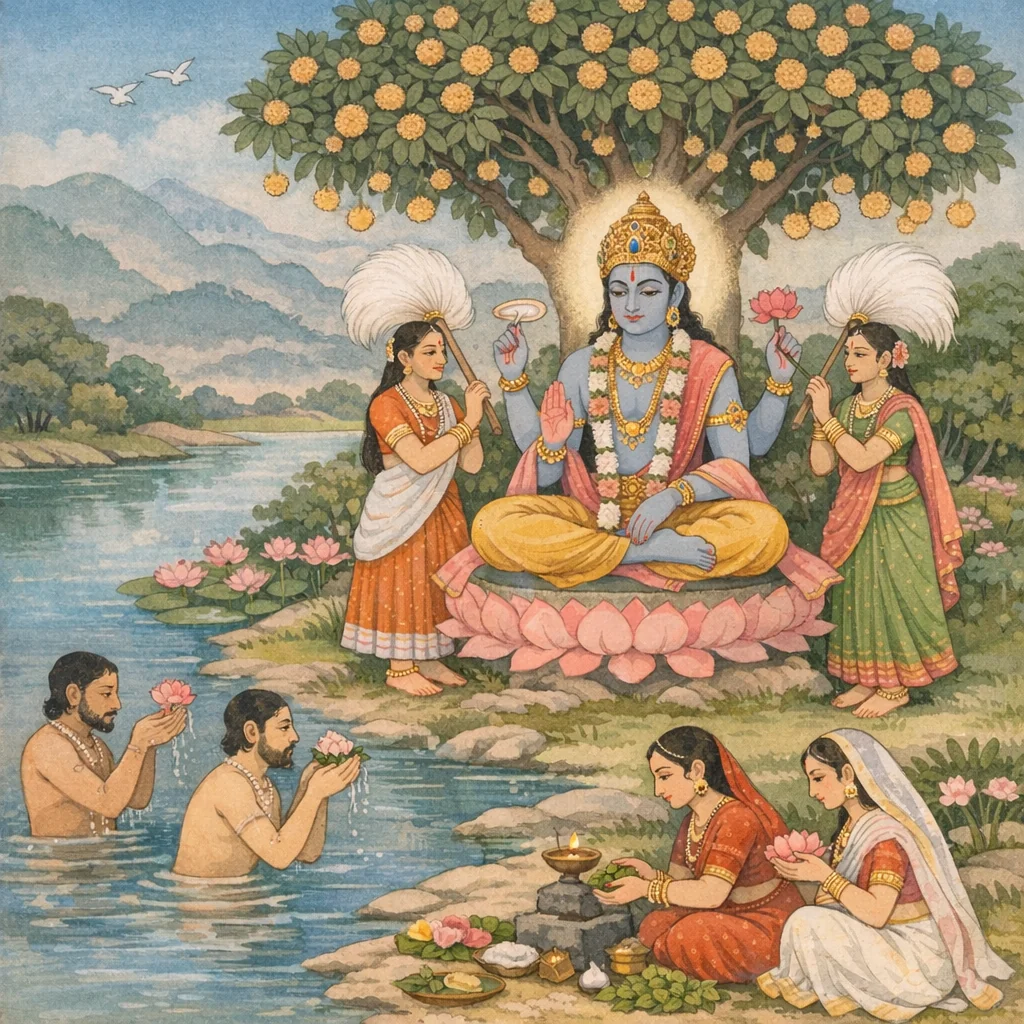
Adhyaya 42
Sukalā’s Account: Ikṣvāku and Sudevā; the Boar’s Resolve and the Dharma of Battle
Prompted by her companions, Sukalā begins a royal-ethical tale: in Ayodhyā, the Manu-line king Ikṣvāku weds the truth-speaking Sudevā and rules in righteousness. While hunting in the forest near the Gaṅgā groves, he comes upon the boar-king Kola/Varāha with his herd. The boar fears sinful hunters, yet senses in the king a quasi-divine presence, like Keśava/Viṣṇu embodied. Torn between flight and resistance, he argues that battle is a kṣatriya’s heroic duty and even a self-offering: to die in such combat is to attain Viṣṇu’s realm. Śūkarī laments the social ruin that follows a leader’s fall, while the sons insist on filial duty and the hellish consequence of abandoning parents. The chapter culminates in the herd’s dharma-guided resolve to stand in battle array as the royal hunter draws near.
Shlokas
Verse 1
द्विचत्वारिंशत्तमोऽध्यायः । सख्य ऊचुः । सुदेवा का त्वया प्रोक्ता किमाचारा वदस्व नः । त्वया प्रोक्तं महाभागे वद नः सत्यमेव च
The friends said: “Who is this Sudevā spoken of by you? What is her conduct—tell us. O fortunate lady, tell us truly what you have said.”
Verse 2
सुकलोवाच । अयोध्यायां महाराजः स आसीद्धर्मकोविदः । मनुपुत्रो महाभागः सर्वधर्मार्थतत्परः
Sukala said: In Ayodhyā there was a great king, well-versed in dharma—an illustrious son of Manu, devoted to all that pertains to righteousness and its aims.
Verse 3
इक्ष्वाकुर्नाम सर्वज्ञो देवब्राह्मणपूजकः । तस्य भार्या सदा पुण्या पतिव्रतपरायणा
There was a man named Ikṣvāku, all-knowing and devoted to honoring the gods and the brāhmaṇas. His wife was ever virtuous, always devoted to the vow of fidelity to her husband.
Verse 4
तया सार्द्धं यजेद्यज्ञं तीर्थानि विविधानि च । वेदराजस्य वीरस्य काशीशस्य महात्मनः
Together with her, one should perform the yajña and also visit the many sacred tīrthas—(all) belonging to the great-souled Kāśīśa, the heroic Vedarāja.
Verse 5
सुदेवा नाम वै कन्या सत्याचारपरायणा । उपयेमे महाराज इक्ष्वाकुस्तां महीपतिः
There was a maiden named Sudevā, devoted to truthful conduct. O great king, the sovereign Ikṣvāku married her.
Verse 6
सुदेवा चारुसर्वांगी सत्यव्रतपरायणा । तया सार्द्धं स वै राजा जनानां पुण्यनायकः
Sudevā, beautiful in every limb and devoted to the vow of truth—together with her that king indeed became a righteous guide for the people.
Verse 7
स रेमे नृपशार्दूलो नित्यं च प्रियया तया । एकदा तु महाराजस्तया सार्द्धं वनं ययौ
That tiger among kings delighted continually in the company of his beloved. Then, one day, the great king went to the forest together with her.
Verse 8
गंगारण्यं समासाद्य मृगयां क्रीडते सदा । सिंहान्हत्वा वराहांश्च गजांश्च महिषांस्तथा
Having reached the forest of the Gaṅgā, he always sported in hunting—killing lions, boars, elephants, and buffaloes as well.
Verse 9
क्रीडमानस्य तस्याग्रे वराहश्च समागतः । बहुशूकरयूथेन पुत्रपौत्रैरलंकृतः
As he was sporting, Varāha, the sacred Boar, came before him, accompanied by many herds of boars, adorned with sons and grandsons.
Verse 10
एका च शूकरी तस्य प्रियापार्श्वे प्रतिष्ठिता । वराहैः शूकरैस्तस्य तमेव परिवारिता
And one sow stood stationed beside his beloved; and he—surrounded by boars and pigs—was encircled by them alone.
Verse 11
दृष्ट्वा च राजराजेंद्रं दुर्जयं मृगयारतम् । पर्वताधारमाश्रित्य भार्यया सह शूकरः
And seeing the king of kings, Durjaya, intent on the hunt, the boar—together with his mate—took refuge at the base of a mountain.
Verse 12
तिष्ठत्येकः सुवीर्येण पुत्रान्पौत्रान्गुरूञ्छिशून् । ज्ञात्वा तेषां महाराज मृगाणां कदनं महत्
Knowing, O great king, the terrible slaughter wrought by those beasts, one man—through his own valor—stood firm, protecting his sons, grandsons, elders, and the children.
Verse 13
तानुवाच सुतान्पौत्रान्भार्यां तां च स शूकरः । कोशलाधिपतिर्वीरो मनुपुत्रो महाबलः
Then that Śūkara addressed his sons and grandsons, and also his wife—he, the heroic and mighty ruler of Kośala, a son of Manu.
Verse 14
क्रीडते मृगयां कांते मृगान्संहरते बहून् । स मां दृष्ट्वा महाराज एष्यते नात्र संशयः
Beloved, he is sporting in the hunt and slaughtering many deer. That great king, on seeing me, will come here; of this there is no doubt.
Verse 15
अन्येषां लुब्धकानां मे नास्ति प्राणभयं ध्रुवम् । ममरूपं नृपो दृष्ट्वा क्षमां नैव करिष्यति
From other hunters I certainly have no fear for my life; but when the king sees what I look like, he will not forgive me.
Verse 16
हर्षेण महताविष्टो बाणपाणिर्धनुर्द्धरः । श्वभिर्युक्तो महातेजा लुब्धकैः परिवारितः
Overcome with great exhilaration, the mighty, radiant bowman—arrow in hand, bearing his bow—came accompanied by dogs and surrounded by hunters.
Verse 17
प्रिये करिष्यते घातं ममाप्येवं न संशयः
Beloved, there is no doubt: in this very way, he will also cause my death.
Verse 18
शूकर्युवाच । यदायदा पश्यसि लुब्धकान्बहून्महावने कांत समायुधान्बहून् । एतैस्तु पुत्रैर्ममपौत्रकैः समं दूरं नु भो यासि पलायमानः
The sow said: “Whenever you see many hunters in the great forest, O beloved—many of them armed—why do you run far away in flight, together with these sons of mine and my grandsons?”
Verse 19
त्यक्त्वा सुधैर्यं बलपौरुषं महन्महाभयेनापि विषण्णचेतनः । दृष्ट्वा नृपेंद्रं पुरुषोत्तमोत्तमं करोषि किं कांत वदस्वकारणम्
You have cast away steady courage, great strength, and manly valor; your heart is dejected though the danger is grave. Having beheld the Lord of kings—Puruṣottama, the Supreme among the supreme—what are you doing, dear one? Tell me the reason.
Verse 20
तस्यास्तु वाक्यं सनिशम्य कोल उवाच तां शूकरराजौत्तरम् । यदर्थभीतोस्मि सुलुब्धकात्प्रिये दृष्ट्वा गतो दूर निशम्यशूकरान्
Hearing her words, Kola replied like a king among boars: “Beloved, for this reason I fear that exceedingly greedy hunter; having seen him, I went far away after hearing the boars.”
Verse 21
सुलुब्धकाः पापकराः शठाः प्रिये कुर्वंति पापं गिरिदुर्गकंदरे । सदैव दुष्टा बहुपापचिंतका जाताश्च सर्वे परिपापिनां कुले
“O beloved, they are exceedingly greedy, doers of sin, and deceitful; they commit wrongdoing in the caves and fastnesses of the mountain-forts. Ever wicked, ever scheming many sins, all of them are born in the lineage of the thoroughly sinful.”
Verse 22
तेषां हि हस्तान्मरणाद्बिभेमि मृतोपि यास्यामि पुनश्च पापम् । दूरं गिरिं पर्वतकंदरं च व्रजामि कांते अपमृत्युभीतः
I fear death at their hands; even if I die, I would fall into sin again. Therefore, O beloved, terrified of an untimely death, I shall go far away—to a mountain, even into its caves.
Verse 23
अयं हि पुण्यो नरनाथ आगतो विश्वाधिकः केशवरूप भूपः । युद्धं करिष्ये समरे महात्मना सार्द्धं प्रिये पौरुषविक्रमेण
This righteous king has indeed arrived—a sovereign surpassing the world, a ruler bearing the form of Keśava. Beloved, I shall wage war on the battlefield together with that great-souled one, with the valor born of manly prowess.
Verse 24
जेष्यामि भूपं यदि स्वेन तेजसा भोक्ष्यामि कीर्तिं त्वतुलां पृथिव्याम् । तेनाहतो वीरवरेण संगरे यास्यामि लोकं मधुसूदनस्य
If by my own valor I conquer the king, I shall enjoy unequaled fame upon the earth. And if I am struck down in battle by that foremost of heroes, I shall go to the realm of Madhusūdana (Viṣṇu).
Verse 25
ममांगभूतेन पलेनमेदसा तृप्तिं परां यास्यति भूमिनाथः । तृप्ता भविष्यंति सुलोकदेवता अस्मादयंचागतो वज्रपाणिः
With the flesh and fat that are parts of my own body, the lord of the land will attain supreme satisfaction. The deities of the heavenly worlds will also be satisfied; and because of this offering Vajrapāṇi (Indra) has come here.
Verse 26
अस्यैव हस्तान्मरणं यदाभवेल्लाभश्च मे सुंदरि कीर्तिरुत्तमा । तस्माद्यशो भूमितले जगत्त्रये व्रजामि लोकं मधुसूदनस्य
If death should come to me by this very hand, O beautiful one, I shall gain supreme renown as well. Therefore, having established my fame upon the earth and throughout the three worlds, I shall depart to the realm of Madhusūdana (Viṣṇu).
Verse 27
नैवं भीतोस्मि क्षुब्धोस्मि गतोऽहं गिरिसानुषु । पापाद्भीतो गतः कांतेधर्मं दृष्ट्वा स्थितोह्यहम्
I am not afraid like this, nor am I agitated. I went to the mountain-slopes; frightened of sin, I departed, O beloved. Having beheld dharma, I have indeed stood firm in it.
Verse 28
न जाने पातकं पूर्वमन्यजन्मनि चार्जितम् । येनाहं शौकरीं योनिं गतोऽहं पापसंचयात्
I do not know what sin I committed before, accumulated in some former birth; because of that heap of evil deeds, I have entered the womb of a sow.
Verse 29
क्षालयिष्याम्यहं घोरं पूर्वपातकसंचयम् । बाणोदकैर्महाघोरैः सुतीक्ष्णैर्निशितैः शतैः
I shall wash away the dreadful accumulation of former sins—by hundreds of streams, terribly fearsome, sharp and keen as arrows.
Verse 30
पुत्रान्पौत्रांस्तु वाराहि कन्यां कुटुंबबालकम् । गिरिं गच्छ गृहीत्वा तु मम मोहमिमं त्यज
O Vārāhī, take your sons and grandsons, your daughter and the children of your household; carry them and go to the mountain, and cast off this delusion of mine.
Verse 31
ममस्नेहं परित्यज्य हरिरेष समागतः । अस्य हस्तात्प्रयास्यामि तद्विष्णोः परमं पदम्
Casting off my attachment, this Hari has come. From his hand I shall depart to that supreme abode of Viṣṇu.
Verse 32
दैवेनापि ममाद्यैव स्वर्गद्वारमनुत्तमम् । उद्घाटितकपाटं तु यास्यामि सुमहादिवम्
By fate itself, today the unsurpassed gate of heaven has been opened for me—its doors unbarred; and so I shall depart to that most exalted, divine realm.
Verse 33
सुकलोवाच । तच्छ्रुत्वा वचनं तस्य शूकरस्य महात्मनः । उवाच तत्प्रिया सख्यः सीदमानांतरा तदा
Sukala said: Hearing the words of that great-souled Boar, his beloved companion then spoke, distressed within.
Verse 34
शूकर्युवाच । यस्मिन्यूथे भवान्स्वामी पुत्रपौत्रैरलंकृतः । मित्रैश्च भ्रातृभिश्चैव अन्यैः स्वजनबांधवैः
Śūkarya said: “In that household where you, the master, are honored—adorned with sons and grandsons, and surrounded by friends, brothers, and other kinsmen and relatives…”
Verse 35
त्वयैवालंकृतो यूथो भवता परिशोभते । त्वां विनायं महाभाग कीदृग्यूथो भविष्यति
This herd, adorned by you alone, shines beautifully because of you. Without you, O greatly fortunate one, what sort of herd will this be?
Verse 36
तवैव स्वबलेनापि गर्जमानाश्च शूकराः । विचरंति गिरौ कांत तनया मम बालकाः
By your own strength alone, the boars—roaring loudly—wander about on the mountain, O beloved; they are my sons, my little ones.
Verse 37
कंदान्मूलान्सुभक्षंति निर्भयास्तव तेजसा । दुर्गेषु वनकुंजेषु ग्रामेषु नगरेषु च
By the power of your radiance, they eat edible bulbs and roots without fear—whether in difficult terrains, in forest-groves, in villages, or in cities.
Verse 38
न कुर्वंति भयं तीव्रं सिंहानामिह पर्वते । मनुष्याणां महाबाहो पालितास्तव तेजसा
Here on this mountain, the lions do not cause intense fear to the people, O mighty-armed one, for they are protected by your splendor.
Verse 39
त्वया त्यक्ता अमी सर्वे बालका मम दारकाः । दीनाश्चैवाकुलाश्चैव भविष्यंति विचेतनाः
If you abandon them, all these children—my sons—will become wretched and distraught, and will live on as helpless, senseless beings.
Verse 40
नित्यमेव सुखं वर्त्म गत्वा पश्यंति बालकाः । पतिहीना यथा नारी शोभते नैव शोभना
Children, having taken to the path that is ever easy and pleasant, see only what lies ahead; like a woman without her husband, what is otherwise beautiful does not truly shine.
Verse 41
अलंकृता यथा दिव्यैरलंकारैः सकांचनैः । परिच्छदै रत्नवस्त्रैः पितृमातृसहोदरैः
As though adorned with divine ornaments of gold, and furnished with splendid accoutrements and jewel-like garments—together with father, mother, and siblings.
Verse 42
श्वश्रूश्वशुरकैश्चान्यैः पतिहीना न भाति सा । चंद्रहीना यथा रात्री पुत्रहीनं यथा कुलम्
Even when surrounded by her mother-in-law, father-in-law, and other relatives, a woman without her husband does not shine—like a night without the moon, and like a family without a son.
Verse 43
दीपहीनं यथा गेहं नैव भाति कदाचन । त्वां विनायं तथा यूथो नैव शोभेत मानद
Just as a house without a lamp never shines at any time, so too this assembly would not be splendid without you, O giver of honor.
Verse 44
आचारेण विना मर्त्यो ज्ञानहीनो यतिर्यथा । मंत्रहीनो यथा राजा तथायं नैव शोभते
A mortal without proper conduct is like an ascetic without true knowledge; and like a king without wise counsel—so too, this person does not shine at all.
Verse 45
कैवर्तेन विना नौर्वा संपूर्णा परिसागरे । न भात्येवं यथा सार्थः सार्थवाहेन वै विना
Even a fully equipped boat cannot succeed upon the vast ocean without a boatman; likewise, a caravan cannot prosper without a caravan-leader.
Verse 46
सेनाध्यक्षेण च विना यथा सैन्यं न भाति च । त्वां विना वै तथा सैन्यं शूकराणां महामते
Just as an army does not shine or succeed without its commander, so too, without you, O great-minded one, the army of boars is the same—ineffective and without splendor.
Verse 47
दीनो भविष्यति तथा वेदहीनो यथा द्विजः । मयि भारं कुटुंबस्य विनिवेश्य प्रगच्छसि
He will become destitute—like a twice-born who is bereft of the Veda. You, having placed the burden of the family upon me, are going away.
Verse 48
मरणं सुलभं ज्ञात्वा का प्रतिज्ञा तवेदृशी । त्वां विनाहं न शक्नोमि धर्तुं प्राणान्प्रियेश्वर
Knowing that death is easy to attain, what sort of vow is this of yours? Without you, my beloved lord, I am not able to sustain my very life-breaths.
Verse 49
त्वयैव सहिता स्वर्गं भूमिं वाथ महामते । नरकं वापि भोक्ष्यामि सत्यंसत्यं वदाम्यहम्
O great-minded one, united with you alone, I shall experience heaven or earth—or even hell. Truly, truly, I speak the truth.
Verse 50
त्वं वा पुत्रांस्तुपौत्रांस्तु गृहीत्वा यूथमुत्तमम् । आवां व्रजाव यूथेश दुर्गमेवं सुकंदरम्
“Either you—taking along your sons and grandsons, and gathering an excellent herd—or we two may go, O leader of the herd, to this difficult (to reach) yet beautiful place.”
Verse 51
जीवितव्यं परित्यज्य रणाय परिगम्यते । तत्र को दृश्यते लाभो मरणे वद सांप्रतम्
Abandoning what ought to be lived for, one goes off to battle. What gain is seen there—in death? Tell me plainly, right now.
Verse 52
वाराह उवाच । वीराणां त्वं न जानासि सुधर्मं शृणु सांप्रतम् । युद्धार्थिना हि वीरेण वीरं गत्वा प्रयाचितम्
Varāha said: “You do not know the true righteous code (dharma) of heroes; listen now. For a hero who seeks battle goes to another hero and formally challenges him.”
Verse 53
देहि मे योधनं संख्ये युद्धार्थ्यहं समागतः । परेण याचितं युद्धं न ददाति यदा नरः
“Grant me battle in the field; I have come seeking combat. When a man refuses the fight that is requested by another, …”
Verse 54
कामाल्लोभाद्भयाद्वापि मोहाद्वा शृणु वल्लभे । कुंभीपाके तु नरके वसेद्युगसहस्रकम्
Whether from lust, greed, fear, or delusion—listen, beloved—one who acts thus dwells in the hell called Kumbhīpāka for a thousand yugas.
Verse 55
क्षत्रियाणां परो धर्मो युद्धं देयं न संशयः । तद्युद्धं दीयमानेन रणभूमिगतेन वै
For kṣatriyas, the highest duty is to offer battle—there is no doubt. And that battle must indeed be given by one who has entered the battlefield.
Verse 56
निर्जितं तु परं तत्र यशःकीर्त्तिं प्रभुंजते । स वा हतो युध्यमानः पौरुषेणातिनिर्भयः
Even when defeated there, they attain the highest fame and renown. Indeed, one who is slain while fighting—through valor and utter fearlessness—still gains that glory.
Verse 57
वीरलोकमवाप्नोति दिव्यान्भोगान्प्रभुंजते । यावद्वर्षसहस्राणां विंशत्येकां प्रिये शृणु
He attains the world of heroes and enjoys divine delights—for as long as twenty-one thousand years. Beloved, listen.
Verse 58
वीरलोके वसेत्तावद्देवाचारैर्महीयते । मनुपुत्रः समायात अयं वीरो न संशयः
He dwells in the heroes’ world for that long and is honored by the rites and customs of the gods. This hero has arrived as the son of Manu—of this there is no doubt.
Verse 59
संग्रामं याचमानस्तु युद्धं देयं मया ध्रुवम् । युद्धातिथिः समायातो विष्णुरूपः सनातनः
When one asks for battle, I must surely grant that combat. The “guest of war” has arrived—eternal, in the form of Viṣṇu.
Verse 60
सत्कारो युद्धरूपेण कर्तव्यश्च मया शुभे । शूकर्युवाच । यदा युद्धं त्वया देयं राज्ञे चैव महात्मने
“O auspicious one, I must render due honor in the very form of battle.” Śūkarī said: “When you are to grant battle to the king, to that great-souled one as well…”
Verse 61
ततोऽहं पौरुषं कांत पश्यामि तव कीदृशम् । एवमुक्त्वा प्रियान्पुत्रान्समाहूय त्वरान्विता
“Then, beloved, I shall see what manner of manly prowess you truly possess.” Having spoken thus, she swiftly summoned her dear sons.
Verse 62
उवाच पुत्रका यूयं शृणुध्वं वचनं मम । युद्धातिथिः समायातो विष्णुरूपः सनातनः
He said: “O children, listen to my words. A guest has arrived for battle—eternal, bearing the form of Viṣṇu.”
Verse 63
मया तत्र प्रगंतव्यं यत्रायं हि गमिष्यति । यावत्तिष्ठति वै नाथो भवतां प्रतिपालकः
I must go there—where indeed he is bound to go—so long as the Lord, your protector, remains (here).
Verse 64
यूयं गच्छत वै दूरं दुर्गं गिरिगुहामुखम् । सुखं जीवत मे वत्सा वर्जयित्वा सुलुब्धकान्
Go indeed far away—to the hard-to-reach mountain stronghold at the mouth of the cave. Live happily, my dear children, avoiding the wicked hunters.
Verse 65
मया तत्रैव गंतव्यं यत्रैष हि गमिष्यति । भवतां श्रेष्ठोऽयं भ्राता यूथरक्षां करिष्यति
I too must go to that very place where he is indeed going. This brother of yours—the best among you—will protect the herd.
Verse 66
एते पितृव्यकाः सर्वे भवतां त्राणकारकाः । दूरं प्रयात वै सर्वे मां विहाय सुपुत्रकाः
All these paternal uncles are protectors and rescuers for you. Yet they have all gone far away, leaving me behind—O good sons.
Verse 67
पुत्रा ऊचुः । अयं हि पर्वतश्रेष्ठो बहुमूलफलोदकः । भयं तु कस्य वै नास्ति सुखं जीवनमस्ति वै
The sons said: “This indeed is an excellent mountain, rich in many roots, fruits, and waters. But for whom, truly, is there no fear? Yet life here is indeed comfortable.”
Verse 68
युवाभ्यां हि अकस्माद्वै इदमुक्तं भयंकरम् । तन्नो हि कारणं मातर्वद सत्यमिहैव हि
You two have suddenly spoken these frightening words. Therefore, O Mother, tell us the true reason for this—here and now.
Verse 69
शूकर्युवाच । अयं राजा महारौद्रः कालरूपः समागतः । क्रीडते मृगया लुब्धो मृगान्हत्वा बहून्वने
Śūkarī said: “This king has arrived—most fierce, bearing the form of Time (Kāla). Greedy for sport, he delights in the hunt, killing many animals in the forest.”
Verse 70
इक्ष्वाकुर्नाम दुर्धर्षो मनुपुत्रो महाबलः । संहरिष्यति कालोऽयं दूरं यात सुपुत्रकाः
There is a mighty son of Manu named Ikṣvāku, unconquerable. This Time will bring destruction—go far away, dear sons.”
Verse 71
पुत्रा ऊचुः । मातरं पितरं त्यक्त्वा यः प्रयाति स पापधीः । महारौद्रं सुघोरं तु नरकं प्रतिपद्यते
The sons said: “Whoever departs after abandoning his mother and father is of sinful understanding; he falls into the exceedingly dreadful hell called Mahāraudra.”
Verse 72
मातुः पुण्यं पयः पीत्वा पुष्टो भवति निर्घृणः । मातरं पितरं त्यक्त्वा यः प्रयाति सुदुर्बलः
Having drunk his mother’s meritorious milk, he grows strong yet becomes pitiless—he who abandons his mother and father and goes away, utterly base and wretched.
Verse 73
पूयं नरकमेतीह कृमिदुर्गंधसंकुलम् । मातुस्तस्मान्न यास्यामो गुरुं त्यक्त्वा इहैव च
Here one goes to the hell of pus, crowded with worms and foul stench. Therefore, we shall not go away from our mother, nor abandon the guru; we shall remain here, even in this very life.
Verse 74
एवं विषादः संजातस्तेषां धर्मार्थसंयुतः । व्यूहं कृत्वा स्थिताः सर्वे बलतेजः समाकुलाः
Thus sorrow arose among them, bound up with thoughts of dharma and advantage. Forming a battle-array, they all stood firm, their strength and fiery energy surging within.
Verse 75
साहसोत्साहसंपन्नाः पश्यंति नृपनंदनम् । नदंतः पौरुषैर्युक्ताः क्रीडमाना वने तदा
Endowed with boldness and high spirit, they then beheld the prince; roaring with manly vigor, they were sporting in the forest at that time.