Adhyaya 32
The Bestowal of Boons upon Aṅga
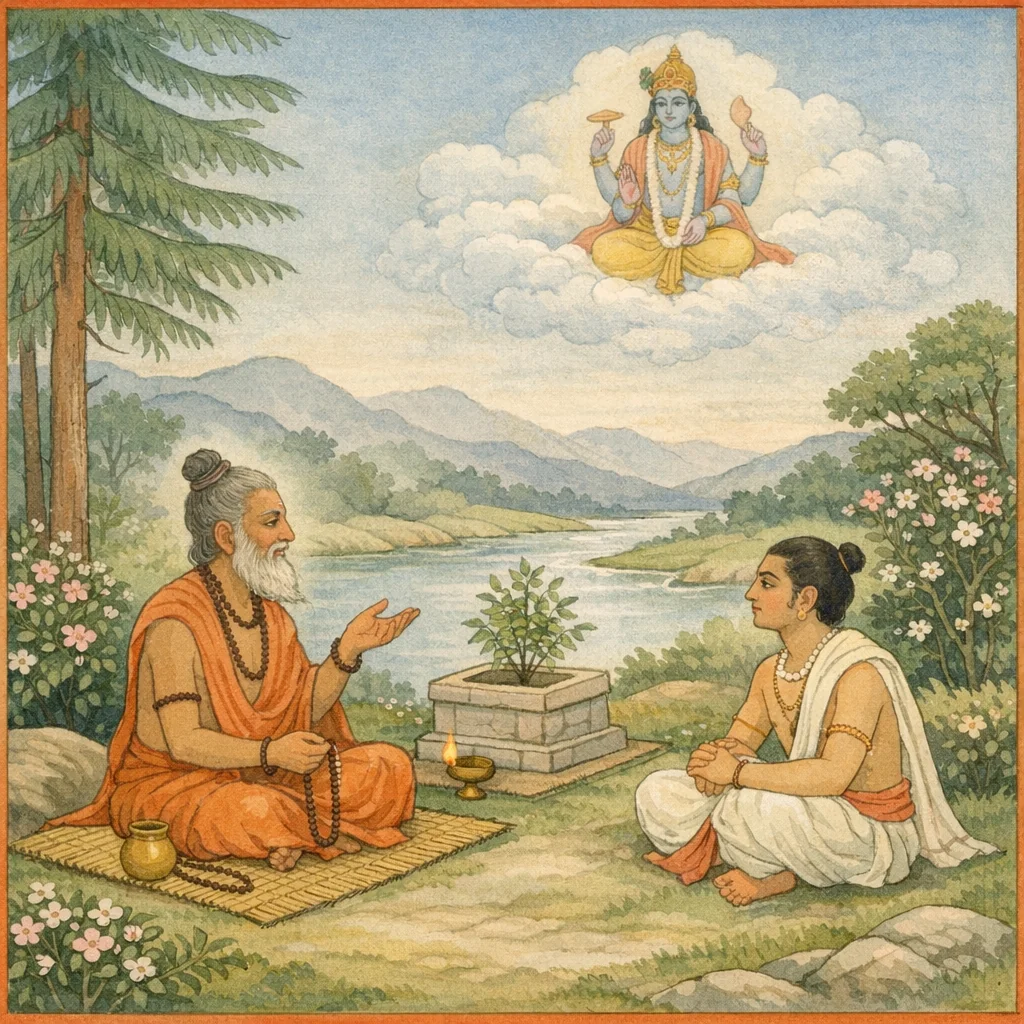
The chapter opens with a radiant portrayal of Mount Meru—jewel-bright slopes, sandalwood shade, the resonance of Vedic sound, and celestial music and dance—while the holy Gaṅgā emerges there, abundant in tīrthas that sanctify. Within this sacred setting, the sage Aṅga, virtuous son of Atri, enters a secluded cave on the Gaṅgā’s holy bank and performs long austerities (tapas), restraining the senses and meditating continuously on Hṛṣīkeśa. The Lord tests him through obstacles, yet Aṅga remains fearless and spiritually luminous. Viṣṇu then manifests in a splendid form—bearing conch, discus, mace, and lotus, seated upon Garuḍa—and invites him to choose a boon. Aṅga asks for a son of exceptional dharmic qualities, one who will uphold the lineage and protect the worlds. Janārdana grants the boon, instructs him to marry a virtuous maiden, and then disappears.
Shlokas
Verse 1
सूत उवाच । नानारत्नैः सुदीप्तांगो हाटकेनापि सर्वतः । राजमानो गिरिश्रेष्ठो यथा सूर्यः स्वरश्मिभिः
Sūta said: “Adorned with many kinds of jewels, his body shining brightly, and glittering on all sides with gold, that foremost of mountains stood resplendent—like the sun with its own rays.”
Verse 2
छायामशोकां संप्राप्य शीतलां सुखदायिनीम् । ध्यायंति योगिनः सर्वे उपविष्टा दृढासने
Having reached the sorrowless shade—cool and bestowing comfort—all the yogins meditate, seated firmly in steady postures.
Verse 3
क्वचित्तपंति मुनयः क्वचिद्गायंति किन्नराः । संतुष्टा ऋषिगंधर्वा वीणातालकराविलाः
In some places the sages perform tapas; in other places the Kinnaras sing. There are contented Ṛṣis and Gandharvas, their hands busy with the vīṇā and keeping time with tāla.
Verse 4
तालमानलये लीनाः स्वरैः सप्तभिरन्वितैः । मूर्च्छनारत्निसंयुक्तैर्व्यक्तं गीतं मनोहरम्
Absorbed in tāla, measure, and melodic mode (laya)—endowed with the seven svaras and joined with the mūrcchanā progressions—the song became clearly expressed and enchanting.
Verse 5
तस्मिन्वै पर्वतश्रेष्ठे चंदनच्छायसंश्रिताः । गंधर्वा गीततत्वज्ञा गीतं गायंति तत्पराः
On that foremost of mountains, the Gandharvas—resting in the shade of sandalwood trees and skilled in the true principles of song—sing with single-minded devotion.
Verse 6
नृत्यंति योषितस्तत्र देवानां पर्वत्तोत्तमे । पापहा पुण्यदो दिव्यः सुश्रेयसां प्रदायकः
There, upon that most excellent mountain of the devas, celestial women dance. It is divine—destroying sin, bestowing merit, and granting the highest welfare.
Verse 7
वेदध्वनिः समधुरः श्रूयते पर्वतोत्तमे । चंदनाशोकपुन्नागैः शालैस्तालैस्तमालकैः
On that excellent mountain, a perfectly sweet resonance of the Vedas is heard, amid sandalwood, aśoka, punnāga, śāla, tāla, and tamāla trees.
Verse 8
वटैस्तु मेघसंकाशै राजते पर्वतोत्तमः । संतानकैः कल्पवृक्षै रंभापादपसंकुलैः
That foremost of mountains shines, adorned with banyan trees like dark clouds, thronged with santānaka trees and wish-fulfilling kalpavṛkṣas, and with groves associated with Rambhā.
Verse 9
नगेंद्रो भाति सर्वत्र नाकवृक्षैः सुपुष्पितैः । नानाधातुसमाकीर्णो नानारत्नचयो गिरिः
Everywhere the king of mountains shines, adorned with heavenly trees in full bloom; this mountain is strewn with many kinds of minerals and heaped with many kinds of jewels.
Verse 10
नानाकौतुकसंयुक्तो नानामंगलसंयुतः । वेदवृंदैः सुसंजुष्टो ह्यप्सरोगणसंकुलः
Filled with many festive delights and adorned with manifold auspicious rites, it was richly attended by groups of Vedic chanters and crowded with hosts of apsarases.
Verse 11
ऋषिभिर्मुनिभिः सिद्धैर्गंधर्वैःपरिभातिसः । गजैश्चाचलसंकाशैः सिंहनादैर्विराजते
He shines forth, surrounded by ṛṣis, sages, siddhas, and gandharvas; and he is splendid with elephants resembling mountains and with lion-like roars.
Verse 12
शरभैर्मत्तशार्दूलैर्मृगधूर्तैरलंकृतः । वापीकूपतडागैश्च संपूर्णैर्विमलोदकैः
It was adorned with śarabhas, with maddened tigers, and with cunning deer; and with wells, stepwells, and ponds, all filled with clear, pure water.
Verse 13
हंसकारंडवाकीर्णैः सर्वत्र परिशोभते । कनकोत्पलैश्च श्वेतैश्च रक्तोत्पलैर्विराजते
Everywhere it shines, filled with swans and kāraṇḍava birds; it is resplendent with golden lotuses, white lotuses, and red lotuses.
Verse 14
नदीस्रवणसंघातैर्विमलैश्चोदकैस्तथा । शालतालैश्च रूपैश्च सगजैः स्फाटिकैस्तथा
With clusters of flowing rivers and with pure waters; with forms of śāla and tāla trees as well; and with elephants—shining like crystal—likewise.
Verse 15
विस्तीर्णैः कांचनैर्दिव्यैः सूर्यवह्निसमप्रभैः । शिलातलैश्च संपूर्णः शैलराजो विराजते
Adorned with broad, divine golden slabs, radiant like the sun and fire, and fully furnished with stone terraces, the king of mountains shines splendidly.
Verse 16
विमानैर्देवतानां च प्रासादैः पर्वतोत्तमैः । हंसचंद्रप्रतीकाशैर्हेमदंडैरलंकृतः
Adorned with the aerial chariots (vimānas) of the gods and with superb, mountain-like palaces, it was embellished with golden pillars gleaming like swans and the moon.
Verse 17
कलशैश्चामरैर्युक्तैः प्रासादैः परिशोभितः । नानागुणप्रमुदित देववृंदैश्च शोभितः
It was splendidly adorned with palatial mansions furnished with finials (kalaśas) and fly-whisks (cāmaras), and further beautified by throngs of gods, delighted by its many excellences.
Verse 18
देववृंदैरनेकैश्च गंधर्वैश्चारणैस्तथा । सर्वत्र राजते पुण्यो मेरुर्गिरिवरोत्तमः
Surrounded by many hosts of gods, and also by Gandharvas and Cāraṇas, the holy Meru—best of mountains—shines resplendently on every side.
Verse 19
तस्माद्गंगामहापुण्या पुण्यतोया महानदी । प्रसूता पुण्यतीर्थाढ्या हंसपद्मैः समाकुला
Therefore the Gaṅgā—supremely holy, with sanctifying waters, a great river—came forth, rich in sacred fords and pilgrimage-sites, and filled with swans and lotuses.
Verse 20
मुनिभिः सेव्यमाना सा ऋषिसंघैर्महानदी । एवंगुणं गिरिश्रेष्ठं पुण्यकौतुकमंगलम्
That great river, attended and revered by sages and multitudes of ṛṣis, is thus endowed with virtues—flowing by the foremost of mountains—bringing auspiciousness through sacred merit and holy delight.
Verse 21
अंगश्चात्रिसुतः पुण्यः प्रविवेश महामुनिः । गंगातीरे सुपुण्ये च एकांते चारुकंदरे
And Aṅga—the virtuous son of Atri, that great sage—entered a lovely cave in a secluded spot on the exceedingly holy bank of the Gaṅgā.
Verse 22
तत्रोपविश्य मेधावी कामक्रोधविवर्जितः । सर्वेंद्रियाणि संयम्य हृषीकेशं मनोगतम्
Seated there, the wise one—free from desire and anger—having restrained all the senses, should inwardly fix his mind upon Hṛṣīkeśa, the Lord of the senses.
Verse 23
ध्यायमानः स धर्मात्मा कृष्णं क्लेशापहं प्रभुम् । आसने शयने याने ध्याने च मधुसूदनम्
That righteous-souled one meditates on Lord Kṛṣṇa, the sovereign who removes afflictions—on the seat, on the bed, while travelling, and in formal contemplation—on Madhusūdana.
Verse 24
नित्यं पश्यति युक्तात्मा योगयुक्तो जितेंद्रियः । चराचरेषु जीवेषु तेषु पश्यति केशवम्
The disciplined soul—steadfast in yoga and master of the senses—constantly perceives; and in all beings, moving and unmoving, he beholds Keśava (Viṣṇu).
Verse 25
आर्द्रेषु चैव शुष्केषु सर्वेष्वन्येषु स द्विजः । एवं वर्षशतं जातं तप्यमानस्य तस्य च
In wet places and in dry ones, and in all other conditions as well, that twice-born sage remained the same; thus a full hundred years passed while he continued to practice austerity.
Verse 26
समालोक्य जगन्नाथश्चक्रपाणिर्द्विजोत्तमम् । बहुविघ्नान्सुघोरांश्च दर्शयत्येव नित्यशः
Beholding the best of the twice-born, Jagannātha—the discus-bearing Lord—indeed continually reveals many obstacles, most dreadful in nature.
Verse 27
तेजसा तस्य देवस्य नृसिंहस्य महात्मनः । निरातंकः स धर्मात्मा दहत्यग्निरिवेंधनम्
By the splendor of that divine, great-souled Narasiṃha, that righteous one becomes free from fear and burns (his foes or impurities) just as fire burns fuel.
Verse 28
नियमैः संयमैश्चान्यैरुपवासैर्द्विजोत्तमः । क्षीयमाणस्तु संजातो दीप्यमानः स्वतेजसा
Through vows, restraints, and other fasts, the best of the twice-born grew emaciated; yet even as he wasted away, he blazed with his own inner radiance.
Verse 29
सूर्यपावकसंकाशस्त्वंग एवं प्रदृश्यते । एवं तपःसु निरतं ध्यायमानं जनार्दनम्
Your body appears radiant like the sun and fire—thus it is seen. In this very way, Janārdana is to be meditated upon: absorbed in austerity and deep contemplation.
Verse 30
आविर्भूयाब्रवीद्देवो वरं वरय मानद । तं च दृष्ट्वा हृषीकेशमंगः परम निर्वृतः
Manifesting before him, the Lord said, “Choose a boon, O venerable one.” And upon seeing Hṛṣīkeśa, Aṅga became supremely delighted and at peace.
Verse 31
तुष्टाव प्रणतो भूत्वा वासुदेवं प्रसन्नधीः
With a serene mind, he bowed down and praised Vāsudeva.
Verse 32
इति श्रीपद्मपुराणे भूमिखंडे वेनोपाख्याने अंगवरप्रदानं । नाम द्वात्रिंशोऽध्यायः
Thus ends the thirty-second chapter, entitled “The Bestowal of Boons upon Aṅga,” in the Bhūmi-khaṇḍa of the Śrī Padma Purāṇa, within the episode of Vena.
Verse 33
गुणरूपाय गुह्याय गुणातीताय ते नमः । गुणाय गुणकर्त्रे च गुणाढ्याय गुणात्मने
Salutations to You—who assume the form of the guṇas, who are hidden and mysterious, and who transcend the guṇas; salutations to You who are the guṇas, the maker of the guṇas, abundant in the guṇas, and whose very essence is the guṇas.
Verse 34
भवाय भवकर्त्रे च भक्तानां भवहारिणे । भवोद्भवाय गुह्याय नमो भवविनाशिने
Salutations to Bhava (Śiva)—creator of worldly existence and remover of the bondage of becoming for devotees; to Him who arises from becoming and yet transcends it, the secret and mysterious Lord—to the destroyer of becoming, I bow.
Verse 35
यज्ञाय यज्ञरूपाय यज्ञेशाय नमोनमः । यज्ञकर्मप्रसंगाय नमः शंखधराय च
Again and again salutations to Him who is the sacrifice (Yajña) itself, whose form is sacrifice, and who is the Lord of sacrifice. Salutations to Him engaged in the rites of sacrifice, and also to the Conch-bearer (śaṅkha-dhara).
Verse 36
नमोनमो हिरण्याय नमो रथांगधारिणे । सत्याय सत्यभावाय सर्वसत्यमयाय च
Repeated salutations to the Golden One; salutations to the bearer of the discus. Salutations to Truth—to Him whose very nature is truth, and to Him who is wholly constituted of all truth.
Verse 37
धर्माय धर्मकर्त्रे च सर्वकर्त्रे च ते नमः । धर्मांगाय सुवीराय धर्माधाराय ते नमः
Salutations to You as Dharma itself, as the doer of Dharma, and as the doer of all. Salutations to You whose very body is Dharma, O noble hero, and to You, the foundation that upholds Dharma.
Verse 38
नमः पुण्याय पुत्राय ह्यपुत्राय महात्मने । मायामोहविनाशाय सर्वमायाकराय ते
Salutations to You—O holy One, O Son, yet the great-souled Lord who is without a son; destroyer of delusion born of māyā, and the source from whom all māyā arises.
Verse 39
मायाधराय मूर्ताय त्वमूर्ताय नमोनमः । सर्वमूर्तिधरायैव शंकराय नमोनमः
Salutations again and again to Śaṅkara—who bears māyā, who has form and yet is formless; salutations again and again to Him who alone upholds all forms.
Verse 40
ब्रह्मणे ब्रह्मरूपाय परब्रह्मस्वरूपिणे । नमस्ते सर्वधाम्ने च नमो धामधराय च
Salutations to Brahmā, whose form is Brahman, whose very nature is the Supreme Brahman. Salutations to You, the abode of all abodes, and salutations to the bearer of the Abode.
Verse 41
श्रीमते श्रीनिवासाय श्रीधराय नमोनमः । क्षीरसागरवासाय चामृताय च ते नमः
Salutations again and again to the glorious Lord Śrīnivāsa, to Śrīdhara. O You who dwell in the Ocean of Milk, and who are the very essence of amṛta (nectar)—unto You be my reverence.
Verse 42
महौषधाय घोराय महाप्रज्ञापराय च । अक्रूराय प्रमेध्याय मेध्यानां पतये नमः
Salutations to the Lord—who is the supreme remedy, awe-inspiring, devoted to great wisdom; who is free from cruelty, perfectly purifying, and the master of all that is pure.
Verse 43
अनंताय ह्यशेषाय चानघाय नमोनमः । आकाशस्य प्रकाशाय पक्षिरूपाय ते नमः
Salutations again and again to You—the Infinite, the All-encompassing, the Sinless. Salutations to You, the Radiance of the sky, who has assumed the form of a bird.
Verse 44
हुताय हुतभोक्त्रे च हवीरूपाय ते नमः । बुद्धाय बुधरूपाय सदाबुद्धाय ते नमः
Salutations to You as the oblation, as the enjoyer of the oblation, and as the very form of the sacrificial offering. Salutations to You as the awakened One, as the wise in the form of intellect, and as the ever-awake, ever-enlightened One.
Verse 45
नमो हव्यायकव्याय स्वधाकाराय ते नमः । स्वाहाकाराय शुद्धाय ह्यव्यक्ताय महात्मने
Salutations to You who are the offering to the gods and the offering to the ancestors; salutations to You who are the very utterance “svadhā.” Salutations to You who are the utterance “svāhā,” to the Pure One—to the Unmanifest, the great-souled Lord.
Verse 46
व्यासाय वासवायैव वसुरूपाय ते नमः । वासुदेवाय विश्वाय वह्निरूपाय ते नमः । हरये केवलायैव वामनाय नमोनमः
Salutations to You as Vyāsa; salutations to You as Vāsava; salutations to You whose form is the Vasus. Salutations to You as Vāsudeva, the All; salutations to You whose form is Fire. Salutations again and again to Hari alone, to Vāmana.
Verse 47
नमो नृसिंहदेवाय सत्वपालाय ते नमः
Salutations to Lord Narasiṃha; salutations to You, the protector of all living beings.
Verse 48
नमो गोविंदगोपाय नम एकाक्षराय च । नमः सर्वाक्षरायैव हंसरूपाय ते नमः
Salutations to You, Govinda, guardian of the cowherds. Salutations to You as the One Syllable, the sacred Oṁ. Salutations to You who are indeed all syllables. Salutations to You who manifest in the form of the Haṁsa.
Verse 49
त्रितत्त्वाय नमस्तुभ्यं पंचतत्त्वाय ते नमः । पंचविंशतितत्त्वाय तत्त्वाधाराय वै नमः
Salutations to You as the Tattva of the three realities; salutations to You as the Tattva of the five realities. Salutations indeed to You as the Tattva of the twenty-five realities, the very foundation that upholds all principles.
Verse 50
कृष्णाय कृष्णरूपाय लक्ष्मीनाथाय ते नमः । नमः पद्मपलाशाय आनंदाय पराय च
Salutations to You—unto Kṛṣṇa, unto Him whose very form is Kṛṣṇa, unto the Lord of Lakṣmī. Salutations to the Lotus-leaf-eyed One; to Bliss itself; and to the Supreme.
Verse 51
नमो विश्वंभरायैव पापनाशाय वै नमः । नमः पुण्यसुपुण्याय सत्यधर्माय ते नमः
Salutations to You, the Sustainer of the universe; salutations indeed to You, the Destroyer of sin. Salutations to You who are pure merit and supreme merit; salutations to You, the true Dharma.
Verse 52
नमोनमः शाश्वतअव्ययाय नमोनमः संघ नभोमयाय । श्रीपद्मनाभाय महेश्वराय नमामि ते केशवपादपद्मम्
Again and again, obeisance to You—the eternal and imperishable. Again and again, obeisance to You whose host of divine powers is of the nature of ether. O glorious Padmanābha, O great Lord: I bow to the lotus of Your feet, O Keśava.
Verse 53
आनंदकंद कमलाप्रिय वासुदेव सर्वेश ईश मधुसूदन देहि दास्यम् । पादौ नमामि तव केशव जन्मजन्म कृपां कुरुष्व मम शांतिद शंखपाणे
O Vāsudeva—source of bliss, beloved of Kamalā (Lakṣmī), Lord of all, Supreme Ruler, Madhusūdana—grant me the state of humble service. O Keśava, I bow to Your feet birth after birth; show me Your compassion, O bestower of peace, O bearer of the conch in hand.
Verse 54
संसारदारुणहुताशनतापदग्धं पुत्रादिबंधुमरणैर्बहुशोकतापैः । ज्ञानांबुदेन मम प्लावय पद्मनाभ दीनस्य मच्छरणरूपभवस्व नाथ
Burnt by the fierce heat of the fire of worldly existence, and tormented by many griefs due to the deaths of sons and other relatives—O Padmanābha, flood me with the ocean of knowledge. O Lord, become for me, the helpless one, a refuge in the form of Your feet.
Verse 55
एवं स्तोत्रं समाकर्ण्य त्वंगस्यापि महात्मनः । दर्शयित्वा स्वकं रूपं घनश्यामं महौजसम्
Thus, having heard this hymn of praise—offered also by the great-souled Tvaṅga—he revealed his own form, dark as a rain-cloud and blazing with great splendor.
Verse 56
शंखचक्रगदापाणिं पद्महस्तं महाप्रभुम् । वैनतेयसमारूढमात्मरूपं प्रदर्शितम्
He revealed his own true form—the great Lord bearing conch, discus, and mace in his hands, holding a lotus, and seated upon Vainateya (Garuḍa).
Verse 57
सर्वाभरणशोभांगं हारकंकणकुंडलैः । राजमानं परं दिव्यं निर्मलं वनमालया
His limbs shone with the splendor of every ornament—necklaces, bracelets, and earrings—radiant, supremely divine and immaculate, adorned with a garland of forest flowers.
Verse 58
अंगस्याग्रे हृषीकेशः शोभमान महत्प्रभः । श्रीवत्सांकेन पुण्येन कौस्तुभेन जनार्दनः
At Aṅga’s forefront stood Hṛṣīkeśa, radiant with immense splendor—Janārdana, bearing the holy Śrīvatsa upon His chest and adorned with the Kaustubha jewel.
Verse 59
दर्शयित्वा स्वकं देहं सर्वदेवमयो हरिः । स उवाच महात्मानं तमंगमृषिसत्तमम्
Having revealed His own body—Hari, who is the embodiment of all the gods—He then spoke to that great-souled sage, the foremost of the ṛṣis of Aṅga.
Verse 60
भो भो विप्र महाभाग श्रूयतां वचनं शुभम् । मेघगंभीरघोषेण समाभाष्य द्विजोत्तमम्
“O venerable, most fortunate brāhmaṇa, hear these auspicious words,” He said, addressing the best of the twice-born in a voice deep and resonant like thunderclouds.
Verse 61
तपसानेन तुष्टोस्मि वरं वरय शोभनम् । तुष्यमाणं हृषीकेशं तं दृष्ट्वा कमलापतिम्
“I am pleased with this austerity of yours; choose a splendid boon.” Seeing Hṛṣīkeśa—the Lord of the senses—gratified, and beholding that Lord, the consort of Kamalā (Lakṣmī)…
Verse 62
दीप्यमानं विराजंतं विश्वरूपं जनेश्वरम् । पादांबुजद्वयं तस्य प्रणम्य च पुनःपुनः
Having bowed again and again to the pair of lotus-feet of that radiant, resplendent Lord of beings—whose form is the entire universe—he then proceeded (or spoke further).
Verse 63
हर्षेण महताविष्टस्तमुवाच जनार्दनम् । दासोहं तव देवेश शंखचक्रगदाधर
Overwhelmed with great joy, he spoke to Janārdana: “O Lord of the gods, bearer of the conch, discus, and mace—I am Your servant.”
Verse 64
वरं मे दातुकामोसि देहि त्वं वंशजं सुतम् । दिवि शक्रो यथाऽभाति सर्वतेजः समन्वितः
Since You are willing to grant me a boon, grant me a son of my lineage—one who shines in heaven like Śakra (Indra), endowed with every splendor.
Verse 65
तादृशं देहि मे पुत्रं सर्वलोकस्य रक्षकम् । सर्वदेवप्रियं देव ब्रह्मण्यं धर्मपंडितम्
Grant me such a son—one who will protect all the worlds; who is dear to all the gods, O Lord; devoted to Brahmins and learned in dharma.
Verse 66
दातारं ज्ञानसंपन्नं धर्मतेजः समन्वितम् । त्रैलोक्यरक्षकं कृष्ण सत्यधर्मानुपालकम्
O Kṛṣṇa—giver of boons, endowed with true knowledge, radiant with the splendor of dharma; protector of the three worlds, steadfastly upholding the dharma of truth.
Verse 67
यज्वनामुत्तमं चैकं शूरं त्रैलोक्यभूषणम् । ब्रह्मण्यं वेदविद्वांसं सत्यसंधं जितेंद्रियम्
He was the foremost among sacrificers—peerless; a hero, an ornament of the three worlds; devoted to Brahmins and dharma; learned in the Vedas; steadfast in truth; and master of his senses.
Verse 68
अजितं सर्वजेतारं विष्णुं तेजःसमप्रभम् । वैष्णवं पुण्यकर्तारं पुण्यजं पुण्यलक्षणम्
Viṣṇu—unconquered, the conqueror of all, radiant with splendor—is the Vaiṣṇava Lord, the doer of merit; born of merit, and marked by merit itself.
Verse 69
शांतं तु तपसोपेतं सर्वशास्त्रविशारदम् । वेदज्ञं योगिनां श्रेष्ठं भवतो गुणसंनिभम्
Indeed, he is tranquil, endowed with austerity, and well-versed in all the scriptures—knowing the Vedas, the foremost among yogins, and possessed of virtues comparable to your own.
Verse 70
ईदृशं देहि मे पुत्रं दातुकामो यदा वरम् । श्रीवासुदेव उवाच । एभिर्गुणैः समोपेतस्तव पुत्रो भविष्यति
“Grant me a son of such a kind, when you are willing to bestow a boon.” Śrī Vāsudeva said: “Your son will indeed be endowed with these qualities.”
Verse 71
अत्रिवंशस्य वै धर्ता विश्वस्यास्य महामते । तेजसा यशसा पुण्यैः पितरं चोद्धरिष्यति
O great-minded one, he will be the upholder of Atri’s lineage; and by his radiance, renown, and merits, he will also uplift his father.
Verse 72
उद्धरिष्यति यः सत्यैः पितरं च पितामहम् । भवान्यास्यति मे स्थानं तद्विष्णोः परमं पदम्
Whoever, by truthful conduct, will uplift his father and grandfather—he shall attain my abode, that supreme state of Viṣṇu.
Verse 73
इत्युक्त्वा देवदेवेशस्तमंगं प्रति स द्विज । कस्यचित्पुण्यवीर्यस्य पुण्यां कन्यां विवाहय
Having spoken thus, O brāhmaṇa, the Lord of the gods addressed Aṅga: “Marry a virtuous maiden, the daughter of some man whose merit (puṇya) and spiritual potency are great.”
Verse 74
तस्यामुत्पादय सुतं शुभं पुण्यावह प्रियम् । स भविष्यति धर्मात्मा मत्प्रसादान्महामते
Beget upon her a son—auspicious, dear, and a bringer of merit (puṇya). By my grace, O great-minded one, he will become righteous-souled.
Verse 75
सर्वज्ञः सर्ववेत्ता च यादृशो वांछितस्त्वया । एवं वरं ततो दत्वा अंतर्धानं गतो हरिः
Thus Hari—omniscient and all-knowing—granted the boon exactly as you had desired, and then disappeared from sight.