Adhyaya 103
Aśokasundarī and Huṇḍa: Chastity, Karma, and the Foretold Rise of Nahuṣa
In Nandana, Aśokasundarī—Śiva’s daughter, also called Niścalā—sports in delight when Huṇḍa, son of Vipracitti, becomes enamored and seeks her hand. The Devī upholds pativratā-dharma and declares that her marriage is divinely ordained with Nahuṣa of the Lunar line, foretelling the birth of a son who will carry forward the royal destiny. Huṇḍa rejects the prophecy, argues from youth and age, and by māyā deceives her into his city upon Meru. There the Devī’s wrath takes form as a curse and a vow of austerity on the banks of the Gaṅgā, revealing karma and the inevitability of what is fated. Huṇḍa then consults his minister Kampana to forestall Nahuṣa’s coming. The narration turns to Āyu’s sorrow at having no heir and his meeting with Dattātreya, whose paradoxical ascetic bearing tests devotion and ends in a boon that secures the destined lineage.
Shlokas
Verse 1
कुंजल उवाच । अशोकसुंदरी जाता सर्वयोषिद्वरा तदा । रेमे सुनंदने पुण्ये सर्वकामगुणान्विते
Kuṃjala said: Then Aśokasundarī was born—foremost among all women—and she delighted in the holy grove called Sunandana, endowed with every quality that fulfills all desires.
Verse 2
सुरूपाभिः सुकन्याभिर्देवानां चारुहासिनी । सर्वान्भोगान्प्रभुंजाना गीतनृत्यविचक्षणा
Surrounded by beautiful, virtuous maidens, she smiled charmingly before the devas, enjoying every delight, and was skilled in song and dance.
Verse 3
विप्रचित्तेः सुतो हुंडो रौद्रस्तीव्रश्च सर्वदा । स्वेच्छाचारो महाकामी नंदनं प्रविवेश ह
Huṇḍa, the son of Vipracitti—ever fierce and violent, acting solely by his own will and driven by great lust—entered Nandana, the celestial pleasure-garden.
Verse 4
अशोकसुंदरीं दृष्ट्वा सर्वालंकारसंयुताम् । तस्यास्तु दर्शनाद्दैत्यो विद्धः कामस्य मार्गणैः
Seeing Aśokasundarī, adorned with every ornament, the daitya, merely by the sight of her, was struck by Kāma’s arrows.
Verse 5
तामुवाच महाकायः का त्वं कस्यासि वा शुभे । कस्मात्त्वं कारणाच्चात्र आगतासि वनोत्तमम्
Then the mighty-bodied one said to her: “Auspicious lady, who are you, and to whom do you belong? For what reason have you come here to this excellent forest?”
Verse 6
अशोकसुंदर्युवाच । शिवस्यापि सुपुण्यस्य सुताहं शृणु सांप्रतम् । स्वसाहं कार्तिकेयस्य जननी गोत्रजापि मे
Aśokasundarī said: “Hear me now—I am indeed the daughter of the most virtuous Śiva. I am also the sister of Kārtikeya; and his mother too is of my own lineage (gotra).”
Verse 7
बालभावेन संप्राप्ता लीलया नंदनं वनम् । भवान्कोहि किमर्थं तु मामेवं परिपृच्छति
In a childlike mood I came playfully to the Nandana grove. But who are you, and for what reason do you question me in this manner?
Verse 8
हुंड उवाच । विप्रचित्तेः सुतश्चाहं गुणलक्षणसंयुतः । हुंडेति नाम्ना विख्यातो बलवीर्यमदोद्धतः
Huṇḍa said: “I am the son of Vipracitti, endowed with qualities and distinguishing marks. I am renowned by the name ‘Huṇḍa,’ and I am puffed up with the pride of strength and valor.”
Verse 9
दैत्यानामप्यहं श्रेष्ठो मत्समो नास्ति राक्षसः । देवेषु मर्त्यलोकेषु तपसा यशसा कुले
“Even among the Daityas I am the foremost; among the Rakshasas there is none equal to me. Among the gods and in the world of mortals, by austerity, by fame, and by lineage I excel.”
Verse 10
अन्येषु नागलोकेषु धनभोगैर्वरानने । दर्शनात्ते विशालाक्षि हतः कंदर्पमार्गणैः
O fair-faced one, in other serpent-worlds there are riches and pleasures; yet, O large‑eyed one, merely by seeing you I have been struck by Kāma’s arrows.
Verse 11
शरणं ते ह्यहं प्राप्तः प्रसादसुमुखी भव । भव स्ववल्लभा भार्या मम प्राणसमा प्रिया
I have indeed come to you for refuge—be gracious and kind-faced. Become my beloved wife, dear to me as my very life-breath.
Verse 12
अशोकसुंदर्युवाच । श्रूयतामभिधास्यामि सर्वसंबंधकारणम् । भवितव्या सुजातस्य लोके स्त्री पुरुषस्य हि
Aśokasundarī said: “Listen; I shall declare the cause that brings forth every bond. Truly, in this world, for a well-born man a wife is destined.”
Verse 13
भवितव्यस्तथा भर्ता स्त्रिया यः सदृशो गुणैः । संसारे लोकमार्गोयं शृणु हुंड यथाविधि
Therefore a woman should have as her husband the one destined to be her fitting counterpart, akin to her in virtues. This is the customary path of worldly life; listen, Huṇḍa, as it is rightly ordained.
Verse 14
अस्त्येव कारणं चात्र यथा तेन भवाम्यहम् । सुभार्या दैत्यराजेंद्र शृणुष्व यतमानसः
Indeed, there is a reason here by which I have become as I am. O Indra among demon-kings, listen—O good wife—with a focused mind.
Verse 15
वृक्षराजादहं जाता यदा काले महामते । शंभोर्भावं सुसंगृह्य पार्वत्या कल्पिता ह्यहम्
O great-minded one, at the appointed time I was born from the king of trees; and, having well grasped Śambhu’s intent, I was fashioned by Pārvatī.
Verse 16
देवस्यानुमते देव्या सृष्टो भर्ता ममैव हि । सोमवंशे महाप्राज्ञः स धर्मात्मा भविष्यति
With the god’s consent, the goddess has indeed fashioned a husband for me. He will arise in the Lunar dynasty—highly wise and truly righteous in nature.
Verse 17
जिष्णुर्जिष्णुसमो वीर्ये तेजसा पावकोपमः । सर्वज्ञः सत्यसंधश्च त्यागे वैश्रवणोपमः
He is victorious; in valor he is equal to Jiṣṇu (Indra). In splendor he is like fire. He is all-knowing, steadfast in truth, and in generosity comparable to Vaiśravaṇa (Kubera).
Verse 18
यज्वा दानपतिः सोपि रूपेण मन्मथोपमः । नहुषोनाम धर्मात्मा गुणशील महानिधिः
He too performed sacrifices (yajñas) and was a lord of generosity; in beauty he was comparable to Manmatha (Kāma). That righteous one, named Nahuṣa, was virtuous in conduct and a great treasure of merits.
Verse 19
देव्या देवेन मे दत्तःख्यातोभर्ताभविष्यति । तस्मात्सर्वगुणोपेतं पुत्रमाप्स्यामि सुंदरम्
The renowned husband granted to me by the Goddess and the God will indeed become my spouse. Therefore I shall obtain a handsome son endowed with every virtue.
Verse 20
इंद्रोपेंद्र समं लोके ययातिं जनवल्लभम् । लप्स्याम्यहं रणे धीरं तस्माच्छंभोः प्रसादतः
By Śambhu’s grace, I shall obtain in battle a steadfast hero—Yayāti, beloved of the people—equal in this world to Indra and Upendra.
Verse 21
अहं पतिव्रता वीर परभार्या विशेषतः । अतस्त्वं सर्वथा हुंड त्यज भ्रांतिमितो व्रज
I am a devoted wife, O hero—indeed, I am especially another man’s lawful wife. Therefore, O Huṇḍa, abandon this delusion entirely and go away from here.
Verse 22
प्रहस्यैव वचो ब्रूते अशोकसुंदरीं प्रति । हुंड उवाच । नैव युक्तं त्वया प्रोक्तं देव्या देवेन चैव हि
Smiling, he spoke these words to Aśokasundarī. Huṇḍa said: “What you have spoken is not at all proper—nor is what has been spoken by the Goddess and by the God.”
Verse 23
नहुषोनाम धर्मात्मा सोमवंशे भविष्यति । भवती वयसा श्रेष्ठा कनिष्ठो न स युज्यते
In the Lunar dynasty there will arise a righteous-souled one named Nahuṣa. Yet you are greater in age; it is not fitting that he, being younger, should be joined to you in marriage.
Verse 24
कनिष्ठा स्त्री प्रशस्ता तु पुरुषो न प्रशस्यते । कदा स पुरुषो भद्रे तव भर्ता भविष्यति
A younger woman is indeed praised, but the man is not praised. O auspicious lady, when will that man become your husband?
Verse 25
तारुण्यं यौवनं चापि नाशमेवं प्रयास्यति । यौवनस्य बलेनापि रूपवत्यः सदा स्त्रियः
Youth and early adulthood also pass away, and in this manner go toward destruction. Even by the power of youth, beautiful women do not remain so forever.
Verse 26
पुरुषाणां वल्लभत्वं प्रयांति वरवर्णिनि । तारुण्यं हि महामूलं युवतीनां वरानने
O fair-complexioned lady, women come to be dear to men; for youthfulness is indeed the great root—the chief cause—for young women, O beautiful-faced one.
Verse 27
तस्या धारेण भुंजंति भोगान्कामान्मनोनुगान् । कदा सोभ्येष्यते भद्रे आयोः पुत्रः शृणुष्व मे
Sustained by her support, they enjoy pleasures and desires that follow the mind. “O auspicious lady, when will that son of Āyu return? Listen to me.”
Verse 28
यौवनं वर्ततेऽद्यैव वृथा चैव भविष्यति । गर्भत्वं च शिशुत्वं च कौमारं च निशामय
Youth abides only today; soon it becomes futile and passes away. Reflect also on life’s course through the womb, infancy, and childhood.
Verse 29
कदासौ यौवनोपेतस्तव योग्यो भविष्यति । यौवनस्य प्रभावेन पिबस्व मधुमाधवीम्
When will he, endowed with youth, become a fit match for you? By the power of youth, drink this honeyed Mādhavī, the sweet wine of spring.
Verse 30
मया सह विशालाक्षि रमस्व त्वं सुखेन वै । हुंडस्य वचनं श्रुत्वा शिवस्य तनया पुनः
“O large-eyed one, stay with me and enjoy yourself in happiness.” Hearing Huṇḍa’s words, the daughter of Śiva then responded again.
Verse 31
उवाच दानवेंद्रं तं साध्वसेन समन्विता । अष्टाविंशतिके प्राप्ते द्वापराख्ये युगे तदा
Accompanied by Sādhvasenā, she spoke to that lord of the Dānavas, when the twenty-eighth Dvāpara age had arrived.
Verse 32
शेषावतारो धर्मात्मा वसुदेवसुतो बलः । रेवतस्य सुतां दिव्यां भार्यां स च करिष्यति
Bala—Vasudeva’s son, righteous and an incarnation of Śeṣa—will take as his wife the divine daughter of Revata.
Verse 33
सापि जाता महाभाग कृताख्ये हि युगोत्तमे । युगत्रयप्रमाणेन सा हि ज्येष्ठा बलादपि
She too was born, O greatly fortunate one, in the most excellent age called Kṛta; and by the measure of three yugas she is indeed the eldest—by innate strength as well.
Verse 34
बलस्य सा प्रिया जाता रेवती प्राणसंमिता । भविष्यद्वापरे प्राप्त इह सा तु भविष्यति
She became the beloved of Bala—Revatī, as dear as life itself. Having come in the future Dvāpara age, she will indeed be his consort here.
Verse 35
मायावती पुरा जाता गंधर्वतनया वरा । अपहृत्य नियम्यैव शंबरो दानवोत्तमः
In former times Māyāvatī was born—an excellent daughter of the Gandharvas. Śambara, foremost of the Dānavas, abducted her and kept her under his control.
Verse 36
तस्या भर्ता समाख्यातो माधवस्य सुतो बली । प्रद्युम्नो नाम वीरेशो यादवेश्वरनंदनः
Her husband was renowned as the mighty son of Mādhava—Pradyumna by name—the lord of heroes, the beloved descendant of the Yādava sovereign.
Verse 37
तस्मिन्युगे भविष्येत भाव्यं दृष्टं पुरातनैः । व्यासादिभिर्महाभागैर्ज्ञानवद्भिर्महात्मभिः
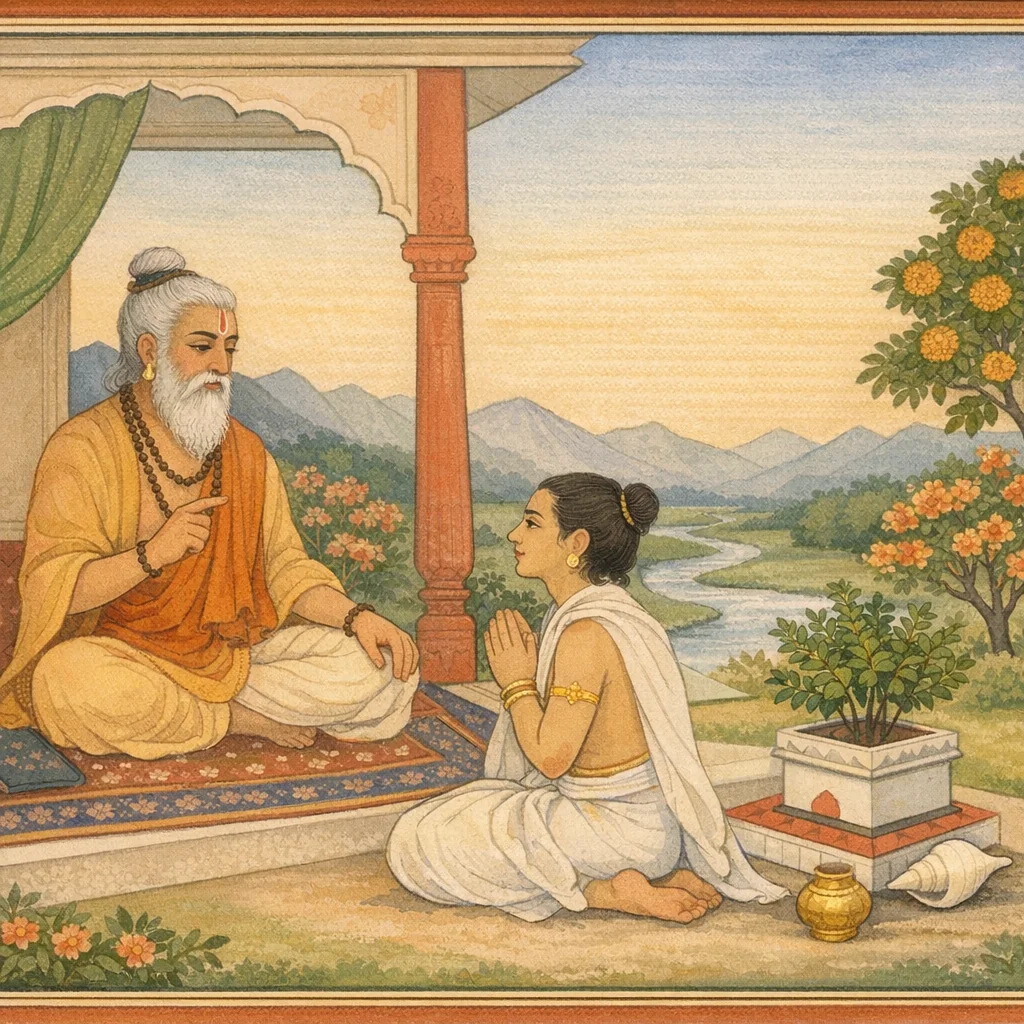
In that age, what is destined to occur will surely come to pass—foreseen long ago by the ancients, by the greatly fortunate sages such as Vyāsa, the wise and great-souled ones.
Verse 38
एवं हि दृश्यते दैत्य वाक्यं देव्या तदोदितम् । मां प्रति हि जगद्धात्र्या पुत्र्या हिमवतस्तदा
“Thus indeed, O Daitya, it is seen that these words were then spoken by the Goddess—by the Mother of the world, the daughter of Himavat—addressed to me at that time.”
Verse 39
त्वं तु लोभेन कामेन लुब्धो वदसि दुष्कृतम् । किल्बिषेण समाजुष्टं वेदशास्त्रविवर्जितम्
But you—blinded by greed and desire—speak of wrongdoing, steeped in sin and wholly devoid of the guidance of the Vedas and the śāstras.
Verse 40
यद्यस्यदिष्टमेवास्ति शुभं वाप्यशुभं दृढम् । पूर्वकर्मानुसारेण तत्तस्य परिजायते
Whatever destiny a person has—whether firmly auspicious or inauspicious—arises for that person in accordance with their previous actions (karma).
Verse 41
देवानां ब्राह्मणानां च वदने यत्सुभाषितम् । निःसरेद्यदि सत्यं तदन्यथा नैव जायते
Whatever well-spoken words arise from the mouths of the gods and the brāhmaṇas—if they are true, they come to pass; otherwise, they do not come into being at all.
Verse 42
मद्भाग्यादेवमाज्ञातं नहुषस्यापि तस्य च । समायोगं विचार्यैवं देव्या प्रोक्तं शिवेन च
By my good fortune, it has thus been understood—also the matter concerning Nahusha. Having reflected in this way upon the circumstances, it was spoken by the Goddess, and likewise by Śiva.
Verse 43
एवं ज्ञात्वा शमं गच्छ त्यज भ्रांतिं मनःस्थिताम् । नैव शक्तो भवान्दैत्य मे मनश्चालितुं ध्रुवम्
Knowing this, go to peace and composure; abandon the delusion lodged within your mind. You, O Daitya, are surely not able to shake my mind, steadfast as it is.
Verse 44
पतिव्रता दृढा चित्ते स को मे चालितुं क्षमः । महाशापेन धक्ष्यामि इतो गच्छ महासुर
I am a pativratā, a faithful wife, firm in resolve—who could ever shake me? With a great curse I shall burn you; depart from here, O mighty asura!
Verse 45
एवमाकर्ण्य तद्वाक्यं हुंडो वै दानवो बली । मनसा चिंतयामास कथं भार्या भवेदियम्
Hearing those words, Huṇḍa—the mighty Dānava—pondered within his mind: “How might this woman become my wife?”
Verse 46
विचिंत्य हुंडो मायावी अंतर्धानं समागतः । ततो निष्क्रम्य वेगेन तस्मात्स्थानाद्विहाय ताम् । अन्यस्मिन्दिवसे प्राप्ते मायां कृत्वा तमोमयीम्
Having reflected, Huṇḍa—the wielder of māyā—vanished from sight. Then, swiftly leaving that place and abandoning her, on another day, when the time had come, he fashioned an illusion (māyā) made of darkness.
Verse 47
दिव्यं मायामयं रूपं कृत्वा नार्यास्तु दानवः । मायया कन्यका रूपो बभूव मम नंदन
Assuming a divine form wrought of māyā as a woman, that Dānava—by his magic—became the very form of a maiden, my son.
Verse 48
सा कन्यापि वरारोहा मायारूपागमत्ततः । हास्यलीला समायुक्ता यत्रास्ते भवनंदिनी
That maiden too—fair and graceful—then assumed an illusory form and went to where Bhavanandinī was staying, accompanied by playful laughter and sport.
Verse 49
उवाच वाक्यं स्निग्धेव अशोकसुंदरीं प्रति । कासि कस्यासि सुभगे तिष्ठसि त्वं तपोवने
Speaking gently to Aśokasundarī, he said: “Who are you, auspicious one? Whose are you? Why do you remain here in this forest of austerities?”
Verse 50
किमर्थं क्रियते बाले कामशोषणकं तपः । तन्ममाचक्ष्व सुभगे किंनिमित्तं सुदुष्करम्
“For what purpose, O young one, is this austerity performed—this penance that dries up desire? Tell me, O fortunate one: for what reason is this undertaking so very difficult?”
Verse 51
तन्निशम्य शुभं वाक्यं दानवेनापि भाषितम् । मायारूपेण छन्नेन साभिलाषेण सत्वरम्
Hearing those auspicious words—even though they were spoken by a Dānava—he, concealed in a magical guise and filled with desire, acted at once.
Verse 52
आत्मसृष्टि सुवृत्तांतं प्रवृत्तं तु यथा पुरा । तपसः कारणं सर्वं समाचष्ट सुदुःखिता
Deeply distressed, she recounted in full the entire account of her self-origin and how it had come to pass in former times, and she explained that tapas—sacred austerity—was the cause of it all.
Verse 53
उपप्लवं तु तस्यापि दानवस्य दुरात्मनः । मायारूपं न जानाति सौहृदात्कथितं तया
Yet that wicked Dānava did not recognize the calamity impending upon him as a form of māyā—illusion—even though she had told him so out of affection.
Verse 54
हुंड उवाच । पतिव्रतासि हे देवि साधुव्रतपरायणा । साधुशीलसमाचारा साधुचारा महासती
Huṇḍa said: “O goddess, you are pativratā—devoted to your husband—wholly dedicated to holy vows; of noble character and righteous conduct, a great satī who walks the proper path.”
Verse 55
अहं पतिव्रता भद्रे पतिव्रतपरायणा । तपश्चरामि सुभगे भर्तुरर्थे महासती
“O gentle lady, I am pativratā, wholly intent upon the vow of fidelity to my husband; O fortunate one, I practice tapas—sacred austerities—for my husband’s sake, as a great and virtuous woman.”
Verse 56
मम भर्ता हतस्तेन हुंडेनापि दुरात्मना । तस्य नाशाय वै घोरं तपस्यामि महत्तपः
“My husband was slain by that wicked Huṇḍa. For his destruction, I undertake a dreadful and mighty tapas—a great austerity.”
Verse 57
एहि मे स्वाश्रमे पुण्ये गंगातीरे वसाम्यहम् । अन्यैर्मनोहरैर्वाक्यैरुक्ता प्रत्ययकारकैः
“Come to my own holy hermitage; I dwell on the bank of the Gaṅgā. I have also been addressed with other charming words—words meant to awaken faith and trust.”
Verse 58
हुंडेन सखिभावेन मोहिता शिवनंदिनी । समाकृष्टा सुवेगेन महामोहेन मोहिता
Śiva’s daughter, deluded by Huṇḍa under the guise of friendship, was swiftly drawn toward him—bewildered, utterly overcome by great infatuation.
Verse 59
आनीतात्मगृहं दिव्यमनौपम्यं सुशोभनम् । मेरोस्तु शिखरे पुत्र वैडूर्याख्यं पुरोत्तमम्
He brought him to his own celestial dwelling—matchless and splendid—upon the peak of Mount Meru, my son: the foremost city called Vaiḍūrya.
Verse 60
अस्ति सर्वगुणोपेतं कांचनाख्यं महाशिवम् । तुंगप्रासादसंबाधैः कलशैर्दंडचामरैः
There is a great shrine of Mahāśiva called “Kāñcana,” endowed with every excellence—thronged with lofty mansions and adorned with kalaśa finials, staffs, and ceremonial cāmara yak-tail fans.
Verse 61
नानवृक्षसमोपेतैर्वनैर्नीलैर्घनोपमैः । वापीकूपतडागैश्च नदीभिस्तु जलाशयैः
It was adorned with forests filled with many kinds of trees—dark-blue in hue, like dense clouds—and with water-reservoirs: stepwells (vāpīs), wells, ponds, rivers, and other bodies of water.
Verse 62
शोभमानं महारत्नैः प्राकारैर्हेमसंयतैः । सर्वकामसमृद्धार्थं संपूर्णं दानवस्य हि
It shone with mighty jewels, its ramparts and walls fitted with gold—perfect in every way, overflowing with all things that fulfill every desire; truly it belonged to the Dānava.
Verse 63
ददृशे सा पुरं रम्यमशोकसुंदरी तदा । कस्य देवस्य संस्थानं कथयस्व सखे मम
Then Aśokasundarī beheld a delightful city. “Tell me, my friend—whose divine abode is this; to which god does it belong?”
Verse 64
सोवाच दानवेंद्रस्य दृष्टपूर्वस्य वै त्वया । तस्य स्थानं महाभागे सोऽहं दानवपुंगवः
He said: “O fortunate lady, you have indeed seen the lord of the Dānavas before. I am that very foremost of the Dānavas, and this is his abode.”
Verse 65
मया त्वं तु समानीता मायया वरवर्णिनि । तामाभाष्य गृहं नीता शातकौंभं सुशोभनम्
“But, O lady of fair beauty, I brought you here by my māyā.” Having spoken thus, he led her into a splendid house, radiant and adorned with gold.
Verse 66
नानावेश्मैः समाजुष्टं कैलासशिखरोपमम् । निवेश्य सुंदरीं तत्र दोलायां कामपीडितः
In a residence graced with many mansions, like the summit of Mount Kailāsa, he placed the beautiful woman there upon a swing—while he himself, tormented by desire, was afflicted.
Verse 67
पुनः स्वरूपी दैत्येंद्रः कामबाणप्रपीडितः । करसंपुटमाबध्य उवाच वचनं तदा
Then the lord of the Daityas, returning to his own form and tormented by Kāma’s arrows, clasped his hands in reverence and spoke these words.
Verse 68
यं यं त्वं वांछसे भद्रे तं तं दद्मि न संशयः । भज मां त्वं विशालाक्षि भजंतं कामपीडितम्
Whatever you desire, O auspicious one, that I shall grant—of this there is no doubt. Worship me, O large-eyed lady—me, who am tormented by desire, even as I worship you.
Verse 69
श्रीदेव्युवाच । नैव चालयितुं शक्तो भवान्मां दानवेश्वरः । मनसापि न वै धार्यं मम मोहं समागतम्
Śrī Devī said: “O lord of the Dānavas, you are not able to move me in the least. Nor can the delusion that has come upon me be restrained even by the mind.”
Verse 70
भवादृशैर्महापापैर्देवैर्वा दानवाधमैः । दुष्प्राप्याहं न संदेहो मा वदस्व पुनः पुनः
By great sinners like you—or even by the Devas, or by the lowest of the Dānavas—I am difficult to attain, without doubt. Do not speak thus again and again.
Verse 71
स्कंदानुजा सा तपसाभियुक्ता जाज्वल्यमाना महता रुषा च । संहर्तुकामा परि दानवं तं कालस्य जिह्वेव यथा स्फुरंती
Skanda’s younger sister—disciplined by austerities—blazed forth, inflamed with mighty wrath. Longing to destroy that Dānava, she surged around him, flashing like the very tongue of Time (Death) itself.
Verse 72
पुनरुवाच सा देवी तमेवं दानवाधमम् । उग्रं कर्म कृतं पाप चात्मनाशनहेतवे
Then that Goddess spoke again to that wretched demon: “You have committed a fierce and sinful deed—one that becomes the cause of your own destruction.”
Verse 73
आत्मवंशस्य नाशाय स्वजनस्यास्य वै त्वया । दीप्ता स्वगृहमानीता सुशिखा कृष्णवर्त्मनः
To bring about the ruin of your own lineage and of your own kinsman, you have indeed brought into your house a blazing, well-flamed fire that follows a dark course.
Verse 74
यथाऽशुभः कूटपक्षी सर्वशोकैः समुद्गतः । गृहं तु विशते यस्य तस्य नाशं प्रयच्छति
Just as an inauspicious bird of ill omen, overwhelmed with every kind of sorrow, enters a person’s house and brings about that person’s ruin.
Verse 75
स्वजनस्य च सर्वस्य सधनस्य कुलस्य च । स द्विजो नाशमिच्छेत विशत्येव यदा गृहम्
When that twice-born man enters a house, he should not wish for the ruin of all his own people, of the household’s wealth, or of the family line.
Verse 76
तथा तेहं गृहं प्राप्ता तव नाशं समीहती । पुत्राणां धनधान्यस्य तव वंशस्य सांप्रतम्
So too, having come to your house, I now seek your destruction—of your sons, of your wealth and grain, and of your lineage at this very time.
Verse 77
जीवं कुलं धनं धान्यं पुत्रपौत्रादिकं तव । सर्वं ते नाशयित्वाहं यास्यामि च न संशयः
Your very life—your lineage, wealth, grain and stores, and your sons, grandsons, and all the rest—I shall destroy it all; then I will depart, without any doubt.
Verse 78
यथा त्वयाहमानीता चरंती परमं तपः । पतिकामा प्रवांच्छंती नहुषं चायुनंदनम्
Just as you brought me while I was practicing the highest austerity, so too—desiring a husband and seeking him—I sought Nahusha, the son of Āyu.
Verse 79
तथा त्वां मम भर्ता च नाशयिष्यति दानव । मन्निमित्तौपायोऽयं दृष्टो देवेन वै पुरा
So too, my husband will destroy you, O Dānava. This means—an expedient involving me—was indeed foreseen long ago by the god.
Verse 80
सत्येयं लौकिकी गाथा यां गायंति विदो जनाः । प्रत्यक्षं दृश्यते लोके न विंदंति कुबुद्धयः
This common saying is true, as the wise people sing: what is plainly seen in the world is not recognized by those of poor understanding.
Verse 81
येन यत्र प्रभोक्तव्यं यस्माद्दुःखसुखादिकम् । स एव भुंजते तत्र तस्मादेव न संशयः
Whatever pleasure or pain is to be experienced by someone—at whatever place and due to whatever cause—he alone experiences it there; of this there is no doubt.
Verse 82
कर्मणोस्य फलं भुंक्ष्व स्वकीयस्य महीतले । यास्यसे निरयस्थानं परदाराभिमर्शनात्
Enjoy upon this earth the fruit of your own deeds; but for violating another man’s wife, you shall go to the abode of hell.
Verse 83
सुतीक्ष्णं हि सुधारं तु सुखड्गं च विघट्टति । अंगुल्यग्रेण कोपाय तथा मां विद्धि सांप्रतम्
Even a very sharp, well-honed sword is struck to test its edge; likewise, by the tip of a finger—out of anger—know that I am thus provoked at present.
Verse 84
सिंहस्य संमुखं गत्वा क्रुद्धस्य गर्जितस्य च । को लुनाति मुखात्केशान्साहसाकारसंयुतः
Who, having gone right before an enraged, roaring lion, would dare—out of sheer recklessness—to pluck hairs from its mouth?
Verse 85
सत्याचारां दमोपेतां नियतां तपसि स्थिताम् । निधनं चेच्छते यो वै स वै मां भोक्तुमिच्छति
Whoever truly seeks death while established in truthful conduct, endowed with self-restraint, disciplined, and steadfast in austerity (tapas)—indeed, that person desires to partake of Me.
Verse 86
समणिं कृष्णसर्पस्य जीवमानस्य सांप्रतम् । गृहीतुमिच्छते सो हि यथा कालेन प्रेषितः
Just now, he wishes to seize the jewel of the black serpent while it is still alive—as though he were dispatched by Time (Death) itself.
Verse 87
भवांस्तु प्रेषितो मूढ कालेन कालमोहितः । तदा ते ईदृशी जाता कुमतिः किं नपश्यसि
You fool, you were dispatched by Time itself, and by Time you have been deluded. Therefore such perverse understanding has arisen in you—why do you not see it?
Verse 88
ऋते तु आयुपुत्रेण समालोकयते हि कः । अन्यो हि निधनं याति ममरूपावलोकनात्
But who indeed can look upon me—except the son of Āyu? For anyone else meets death simply by beholding my form.
Verse 89
एवमाभाषयित्वा तं गंगातीरं गता सती । सशोका दुःखसंविग्ना नियतानि यमान्विता
Having spoken to him thus, the virtuous lady went to the bank of the Gaṅgā—sorrowful, distressed by grief, and steadfastly devoted to the yamas, the restraints and observances of self-discipline.
Verse 90
पूर्वमाचरितं घोरं पतिकामनया तपः । तव नाशार्थमिच्छंती चरिष्ये दारुणं पुनः
Earlier I performed a dreadful austerity (tapas) out of the desire for a husband. Now, wishing for your destruction, I shall again undertake a harsh penance.
Verse 91
यदा त्वां निहतं दुष्टं नहुषेण महात्मना । निशितैर्वज्रसंकाशैर्बाणैराशीविषोपमैः
When you, the wicked one, were struck down by the great-souled Nahuṣa—by sharp arrows resembling thunderbolts, like deadly serpents—
Verse 92
रणे निपतितं पाप मुक्तकेशं सलोहितम् । गतासुं च प्रपश्यामि तदा यास्याम्यहं पतिम्
“O sinful one, if I behold my husband fallen in battle—his hair dishevelled, drenched in blood, and bereft of life—then I too shall go to my lord.”
Verse 93
एवं सुनियमं कृत्वा गंगातीरमनुत्तमम् । संस्थिता हुंडनाशाय निश्चला शिवनंदिनी
Thus, having undertaken a strict discipline, Niścalā—the daughter of Śiva—took her stand upon the unsurpassed bank of the Gaṅgā, steadfast in her resolve to destroy the Huṇḍas.
Verse 94
वह्नेर्यथादीप्तिमती शिखोज्ज्वला तेजोभियुक्ता प्रदहेत्सुलोकान् । क्रोधेन दीप्ता विबुधेशपुत्री गंगातटे दुश्चरमाचरत्तपः
As a blazing tongue of fire—radiant and charged with heat—could burn even entire worlds, so too, inflamed with wrath, the daughter of the Lord of the gods performed a most arduous austerity upon the bank of the Gaṅgā.
Verse 95
कुंजल उवाच । एवमुक्ता महाभाग शिवस्य तनया गता । गंगांभसि ततः स्नात्वा स्वपुरे कांचनाह्वये
Kuṃjala said: Thus addressed, the noble daughter of Śiva departed. Then, having bathed in the waters of the Gaṅgā, she went to her own city called Kāñcana.
Verse 96
तपश्चचार तन्वंगी हुंडस्य वधहेतवे । अशोकसुंदरी बाला सत्येन च समन्विता
The slender-limbed maiden Aśokasundarī performed austerities for the purpose of slaying Huṇḍa, and she was endowed with the virtue of truthfulness.
Verse 97
हुंडोपि दुःखितोभूतः शापदग्धेन चेतसा । चिंतयामास संतप्त अतीव वचनानलैः
Even Huṇḍa became distressed; his mind, scorched by the curse, was sorely tormented by the fire of harsh words, and he sank into anxious reflection.
Verse 98
समाहूय अमात्यं तं कंपनाख्यमथाब्रवीत् । समाचष्ट स वृत्तांतं तस्याः शापोद्भवं महत्
Then, summoning the minister named Kampana, he spoke and related the entire account—the great consequence that had arisen from her curse.
Verse 99
शप्तोस्म्यशोकसुंदर्या शिवस्यापि सुकन्यया । नहुषस्यापि मे भर्त्तुस्त्वं तु हस्तान्मरिष्यसि
“I am cursed—by Aśokasundarī, the virtuous daughter of Śiva. And you, at the hands of my husband Nahuṣa, shall indeed meet your death.”
Verse 100
नैव जातस्त्वसौ गर्भ आयोर्भार्या च गुर्विणी । यथा सत्याद्व्यलीकस्तु तस्याः शापस्तथा कुरु
That embryo has not been conceived at all, and Āyu’s wife is not pregnant. Therefore, as I speak the truth without deception, so let her curse take effect accordingly.
Verse 101
कंपन उवाच । अपहृत्य प्रियां तस्य आयोश्चापि समानय । अनेनापि प्रकारेण तव शत्रुर्न जायते
Kampana said: “Abduct his beloved and bring Āyus as well. By this method too, no enemy will arise for you.”
Verse 102
नो वा प्रपातयस्व त्वं गर्भं तस्याः प्रभीषणैः । अनेनापि प्रकारेण तव शत्रुर्न जायते
Otherwise, do not cause her womb to miscarry through dreadful threats; even in this way, no enemy of yours will be born.
Verse 103
इति श्रीपद्मपुराणे भूमिखंडे वेनोपाख्याने गुरुतीर्थमाहात्म्ये च्यवनचरित्रे त्र्यधिकशततमोऽध्यायः
Thus ends the one-hundred-and-third chapter of the Śrī Padma Purāṇa, in the Bhūmi-khaṇḍa—within the episode of Vena, in the section on the greatness of Guru-tīrtha, in the narrative of Cyavana.
Verse 104
एवं संमंत्र्य तेनापि कंपनेन स दानवः । अभूत्स उद्यमोपेतो नहुषस्य प्रणाशने
Thus, having conferred—prompted also by that trembling—this Dānava became resolute and set about the endeavor to bring about Nahuṣa’s destruction.
Verse 105
विष्णुरुवाच । एलपुत्रो महाभाग आयुर्नाम क्षितीश्वरः । सार्वभौमः स धर्मात्मा सत्यव्रतपरायणः
Viṣṇu said: “The illustrious son of Ela, a great and fortunate ruler named Āyu, was a sovereign emperor—righteous in spirit and devoted to the vow of truth.”
Verse 106
इंद्रोपेंद्रसमो राजा तपसा यशसा बलैः । दानयज्ञैः सुपुण्यैश्च सत्येन नियमेन च
That king was equal to Indra and Upendra, endowed with austerity, fame, and strength—also with highly meritorious gifts and sacrifices, and with truthfulness and self-restraint.
Verse 107
एकच्छत्रेण वै राज्यं चक्रे भूपतिसत्तमः । पृथिव्यां सर्वधर्मज्ञः सोमवंशस्य भूषणम्
That best of kings established sovereignty under a single royal umbrella over the realm; upon the earth he knew all dharma, an ornament of the Lunar Dynasty.
Verse 108
पुत्रं न विंदते राजा तेन दुःखी व्यजायत । चिंतयामास धर्मात्मा कथं मे जायते सुतः
The king did not obtain a son; therefore he became distressed. That righteous-souled one reflected: “How may a son be born to me?”
Verse 109
इति चिंतां समापेदे आयुश्च पृथिवीपतिः । पुत्रार्थं परमं यत्नमकरोत्सुसमाहितः
Thus King Āyu, the lord of the earth, fell into reflection; and, fully composed, he undertook the utmost effort to obtain a son.
Verse 110
अत्रिपुत्रो महात्मा वै दत्तात्रेयो महामुनिः । क्रीडमानः स्त्रिया सार्द्धं मदिरारुणलोचनः
Dattātreya, the great sage—Atri’s son and a noble soul—was sporting together with a woman, his eyes reddened as if from wine.
Verse 111
वारुण्या मत्त धर्मात्मा स्त्रीवृंदैश्च समावृतः । अंके युवतिमाधाय सर्वयोषिद्वरां शुभाम्
Intoxicated with vāruṇī, the man—though regarded as righteous—was surrounded by a throng of women; and, placing a young maiden upon his lap, he held that auspicious one, the finest among women.
Verse 112
गायते नृत्यते विप्रः सुरां च पिबते भृशम् । विना यज्ञोपवीतेन महायोगीश्वरोत्तमः
A brāhmaṇa sings and dances, and even drinks liquor to excess—yet, even without the yajñopavīta (sacred thread), he is called the supreme Lord among the great yogīs.
Verse 113
पुष्पमालाभिर्दिव्याभिर्मुक्ताहारपरिच्छदैः । चंदनागुरुदिग्धांगो राजमानो मुनीश्वरः
Adorned with divine garlands of flowers, with pearl necklaces and ornaments, his body anointed with sandalwood and aguru, the lord among sages shone resplendently.
Verse 114
तस्याश्रमं नृपो गत्वा तं दृष्ट्वा द्विजसत्तमम् । प्रणाममकरोन्मूर्ध्ना दण्डवत्सुसमाहितः
The king went to his hermitage, and on seeing that best of twice-born sages, he bowed his head—fully composed—prostrating himself like a staff.
Verse 115
अत्रिपुत्रः स धर्मात्मा समालोक्य नृपोत्तमम् । आगतं पुरतो भक्त्या अथ ध्यानं समास्थितः
That righteous son of Atri, seeing the best of kings approaching before him with devotion, then settled himself into dhyāna (meditation).
Verse 116
एवं वर्षशतं प्राप्तं तस्य भूपस्य सत्तम । निश्चलं शांतिमापन्नं मानसं भक्तितत्परम्
Thus, when a hundred years had passed for that excellent king, his mind became steady, attained peace, and remained wholly devoted to bhakti.
Verse 117
समाहूय उवाचेदं किमर्थं क्लिश्यसे नृप । ब्रह्माचारेण हीनोस्मि ब्रह्मत्वं नास्ति मे कदा
Having summoned him, he said: “Why do you trouble yourself, O king? I am bereft of brahmacarya; true brahmanhood is never present in me.”
Verse 118
सुरामांसप्रलुब्धोऽस्मि स्त्रियासक्तः सदैव हि । वरदाने न मे शक्तिरन्यं शुश्रूष ब्राह्मणम्
“I am addicted to liquor and meat, and ever attached to women. I have no power to grant boons; serve some other brāhmaṇa.”
Verse 119
आयुरुवाच । भवादृशो महाभाग नास्ति ब्राह्मणसत्तमः । सर्वकामप्रदाता वै त्रैलोक्ये परमेश्वरः
Āyu said: “O greatly fortunate one, O best of brāhmaṇas—none is like you. Truly, you are the Supreme Lord of the three worlds, the giver of all desired boons.”
Verse 120
अत्रिवंशे महाभाग गोविंदः परमेश्वरः । ब्राह्मणस्य स्वरूपेण भवान्वै गरुडध्वजः
O fortunate one, in the lineage of Atri, Govinda—the Supreme Lord—indeed appears; and you, bearing Garuḍa upon your banner, manifest in the form of a brāhmaṇa.
Verse 121
नमोऽस्तु देवदेवेश नमोऽस्तु परमेश्वर । त्वामहं शरणं प्राप्तः शरणागतवत्सल
Salutations to you, Lord of the gods; salutations to you, Supreme Lord. I have come to you for refuge, O tender guardian of those who seek shelter.
Verse 122
उद्धरस्व हृषीकेश मायां कृत्वा प्रतिष्ठसि । विश्वस्थानां प्रजानां तु विद्वांसं विश्वनायकम्
O Hṛṣīkeśa, rescue him. Having assumed Your māyā, You remain established in the world. Protect the wise one—the leader of the world—together with the creatures dwelling in the abodes of the universe.
Verse 123
जानाम्यहं जगन्नाथं भवंतं मधुसूदनम् । मामेव रक्ष गोविंद विश्वरूप नमोस्तु ते
I know You as Jagannātha, as Madhusūdana. Protect me alone, O Govinda—O One of Universal Form, salutations to You.
Verse 124
कुंजल उवाच । गते बहुतिथे काले दत्तात्रेयो नृपोत्तमम् । उवाच मत्तरूपेण कुरुष्व वचनं मम
Kuṁjala said: After a long time had passed, Dattātreya addressed the excellent king, speaking in an intoxicated guise: “Do as I say.”
Verse 125
कपाले मे सुरां देहि पाचितं मांसभोजनम् । एवमाकर्ण्य तद्वाक्यं स चायुः पृथिवीपतिः
“Pour liquor for me into my skull-bowl, and give me cooked meat as food.” Hearing those words, King Āyu, the lord of the earth, responded and acted accordingly.
Verse 126
उत्सुकस्तु कपालेन सुरामाहृत्य वेगवान् । पलं सुपाचितं चैव च्छित्त्वा हस्तेन सत्वरम्
Eagerly and swiftly, he brought liquor in a skull-bowl; then, in haste, he cut off with his hand a piece of well-cooked meat.
Verse 127
नृपेंद्रः प्रददौ चापि दत्तात्रेयाय सत्तम । अथ प्रसन्नचेताः स संजातो मुनिपुंगवः
That best of kings likewise bestowed the gift upon Dattātreya. Then, his heart made glad, he became foremost among the sages.
Verse 128
दृष्ट्वा भक्तिं प्रभावं च गुरुशुश्रूषणं परम् । समुवाच नृपेंद्रं तमायुं प्रणतमानसम्
Seeing his devotion, his spiritual potency, and his supreme service to the guru, he then addressed that king Āyu, whose mind was bowed in humility.
Verse 129
वरं वरय भद्रं ते दुर्लभं भुवि भूपते । सर्वमेव प्रदास्यामि यंयमिच्छसि सांप्रतम्
Choose a boon—may it be auspicious for you, O king. Though it is rare upon the earth, I will grant you everything, whatever you desire right now.
Verse 130
राजोवाच । भवान्दाता वरं सत्यं कृपया मुनिसत्तम । पुत्रं देहि गुणोपेतं सर्वज्ञं गुणसंयुतम्
The king said: “O best of sages, you are truly a giver of boons. Out of compassion, grant me a son endowed with virtues, all-knowing, and possessed of excellent qualities.”
Verse 131
देववीर्यं सुतेजं च अजेयं देवदानवैः । क्षत्रियै राक्षसैर्घोरैर्दानवैः किन्नरैस्तथा
Endowed with divine prowess and radiant splendor, he was unconquerable—by the Devas and the Dānavas alike, and also by kṣatriyas, dreadful rākṣasas, dānavas, and kinnaras.
Verse 132
देवब्राह्मणसंभक्तः प्रजापालो विशेषतः । यज्वा दानपतिः शूरः शरणागतवत्सलः
He is devoted to the gods and to the brāhmaṇas, and above all a protector of his subjects; a performer of yajñas, a lord of generosity, a hero, and tenderly compassionate to those who seek his refuge.
Verse 133
दाता भोक्ता महात्मा च वेदशास्त्रेषु पंडितः । धनुर्वेदेषु निपुणः शास्त्रेषु च परायणः
He is a generous giver and a worthy enjoyer, a great-souled man; learned in the Vedas and śāstras, skilled in Dhanurveda, the science of archery, and wholly devoted to the teachings of the scriptures.
Verse 134
अनाहतमतिर्धीरः संग्रामेष्वपराजितः । एवं गुणः सुरूपश्च यस्माद्वंशः प्रसूयते
Steadfast in resolve and courageous, unconquered in battles—endowed with such virtues and handsome form—he is one from whom a noble lineage is born.
Verse 135
देहि पुत्रं महाभाग ममवंशप्रधारकम् । यदि चापि वरो देयस्त्वया मे कृपया विभो
Grant me a son, O greatly fortunate one—one who will carry forward my lineage. If indeed a boon is to be granted by you, then bestow it upon me, out of compassion, O mighty Lord.
Verse 136
दत्तात्रेय उवाच । एवमस्तु महाभाग तव पुत्रो भविष्यति । गृहे वंशकरः पुण्यः सर्वजीवदयाकरः
Dattātreya said: “So be it, O noble one. A son will be born to you—one who will continue your lineage within your household, virtuous and compassionate to all living beings.”
Verse 137
एभिर्गुणैस्तु संयुक्तो वैष्णवांशेन संयुतः । राजा च सार्वभौमश्च इंद्रतुल्यो नरेश्वरः
Endowed with these virtues and joined with a portion of Viṣṇu’s essence, such a king becomes a universal sovereign—Indra-like, a true lord among men.
Verse 138
एवं खलु वरं दत्वा ददौ फलमनुत्तमम् । भूपमाह महायोगी सुभार्यायै प्रदीयताम्
Thus, having granted the boon, he bestowed an unsurpassed reward. The great yogin then said to the king, “Let it be given to your virtuous wife.”
Verse 139
एवमुक्त्वा विसृज्यैव तमायुं प्रणतं पुरः । आशीर्भिरभिनंद्यैव अंतर्द्धानमधीयत
Having spoken thus, he dismissed Āyu, who stood bowed before him; and, blessing and commending him, he then vanished from sight.