Adhyaya 122
Dialogue with the Parrot-Sage: Lineage, Ignorance, and the Vow of Learning
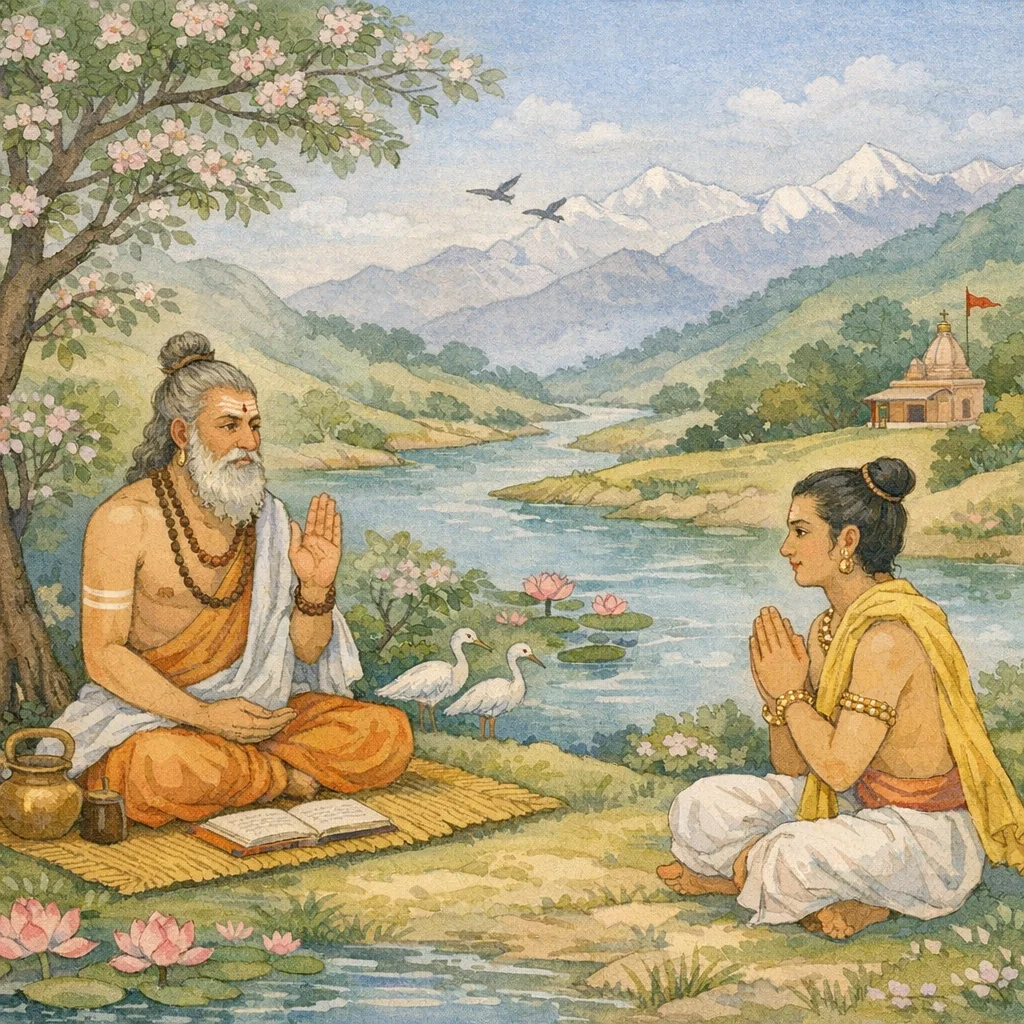
PP.2.122 opens with a framed instruction that points to Kuñjala, a parrot whose “wings are righteousness,” prompting a learned brāhmaṇa to question him beneath a banyan tree. Astonished by the bird’s mastery of dharma, the vipra suspects he may be a deity, gandharva, vidyādhara, or a siddha living under a curse. Kuñjala recognizes the brāhmaṇa’s lineage and begins a disclosure that moves from cosmic genealogy—Brahmā → Prajāpati → Bhṛgu, with Cyavana named in the Bhārgava line—into an intimate family account. A brāhmaṇa named Vidyādhara has three sons; among them Dharmaśarmā, the narrator, is ignorant and falls into disgrace. The chapter traces the moral psychology of shame, parental counsel, and the austerity of learning as a vow. In the end, a perfected yogin/siddha arrives at the shrine, and his questioning becomes the doorway to higher knowledge and liberation-oriented inquiry.
Shlokas
Verse 1
विष्णुरुवाच । कुंजलो धर्मपक्षी स इत्युक्त्वा तान्सुतान्प्रति । विरराम महाप्राज्ञः किंचिन्नोवाच तान्प्रति
Viṣṇu said: Having told his sons, “That Kuñjala is a bird whose wings are righteousness (Dharma),” the greatly wise one fell silent and spoke nothing more to them.
Verse 2
वटाधःस्थो द्विजश्रेष्ठस्तमुवाच महाशुकम् । को भवान्धर्मवक्ता हि पक्षिरूपेण वर्तते
Seated beneath a banyan tree, the best of the twice-born addressed the great parrot: “Who are you—indeed a teacher of dharma—who moves about in the form of a bird?”
Verse 3
किं वा देवोऽथ गंधर्वः किं वा विद्याधरो भवान् । कस्य शापादिमां प्राप्तो योनिं कीरस्य पातकीम्
Are you a god, or perhaps a Gandharva, or are you a Vidyādhara? By whose curse have you fallen into this sinful birth as a parrot?
Verse 4
कस्मात्ते ईदृशं ज्ञानं वर्ततेऽतीद्रियं शुक । सुपुण्यस्य तु कस्यापि कस्य वै तपसः फलम्
O Śuka, from what cause do you possess such extraordinary, sense-transcending knowledge? Of whose great merit is it born, and as the fruit of what austerity does it arise?
Verse 5
किं वा च्छन्नेन रूपेण अनेनापि महामते । कस्त्वं सिद्धोऽसि देवो वा तन्मे कथय कारणम्
Or why do you conceal yourself in this form, O great-minded one? Who are you—are you a Siddha or a god? Tell me the reason for it.
Verse 6
कुंजल उवाच । भोः सिद्ध त्वामहं जाने कुलं ते गोत्रमुत्तमम् । विद्यां तपःप्रभावं च यस्माद्भ्रमसि मेदिनीम्
Kuṁjala said: “O perfected one, I recognize you—your family and your excellent lineage. I also know your learning and the power born of your austerities, by which you wander over the earth.”
Verse 7
सर्वं विप्र प्रवक्ष्यामि स्वागतं तव सुव्रत । उपविश्यासने पुण्ये छायामाश्रयशीतलाम्
O brāhmaṇa, I shall tell you everything. Welcome, O you of good vows. Sit upon this sacred seat and take refuge in the cool shade.
Verse 8
अव्यक्तप्रभवो ब्रह्मा तस्माज्जज्ञे प्रजापतिः । ब्राह्मणस्तु गुणैर्युक्तो भृगुर्ब्रह्मसमो द्विजः
Brahmā arose from the Unmanifest; from him Prajāpati was born. And the brāhmaṇa Bhṛgu—endowed with virtues—was a twice-born equal to Brahmā.
Verse 9
भार्गवो नाम तस्यासीत्सर्वधर्मार्थतत्ववित् । तस्यान्वये भवान्विप्र च्यवनः ख्यातिमान्भुवि
He had a son named Bhārgava, a knower of the true principles of all dharma and worldly aims. In his lineage, O brāhmaṇa, you are the renowned Cyavana upon the earth.
Verse 10
नाहं देवो न गंधर्वो नाहं विद्याधरः पुनः । योहं विप्र प्रवक्ष्यामि तन्मे निगदतः शृणु
I am not a god, nor a Gandharva; nor again am I a Vidyādhara. O brāhmaṇa, I shall tell you who I am—listen to me as I speak.
Verse 11
कश्यपस्य कुले जातः कश्चिद्ब्राह्मणसत्तमः । वेदवेदांगतत्त्वज्ञः सर्वकर्मप्रकाशकः
In the lineage of Kaśyapa there was born a certain foremost brāhmaṇa—one who knew the true purport of the Vedas and their auxiliaries, and who illuminated the proper understanding of all rites and duties.
Verse 12
विद्याधरेति विख्यातः कुलशीलगुणैर्युतः । राजमानः श्रिया विप्र आचारैस्तपसा तदा
He was renowned by the name Vidyādhara, endowed with noble lineage, good conduct, and virtues; and at that time, O brāhmaṇa, he shone with prosperity, with right conduct, and with ascetic discipline.
Verse 13
संबभूवुः सुतास्तस्य विद्याधरस्य ते त्रयः । वसुशर्मा नामशर्मा धर्मशर्मा च ते त्रयः
That Vidyādhara had three sons: Vasuśarmā, Nāmaśarmā, and Dharmaśarmā—those three indeed.
Verse 14
तेषामहं धर्मशर्मा कनिष्ठो गुणवर्जितः । वसुशर्मा मम भ्राता वेदशास्त्रार्थकोविदः
Among them, I am Dharmaśarmā, the youngest—devoid of virtues. My brother is Vasuśarmā, well-versed in the meanings of the Vedas and the śāstras.
Verse 15
आचारेण सुसंपन्नो विद्यादिसुगुणैः पुनः । नामशर्मा महाप्राज्ञस्तद्वच्चासीद्गुणाधिकः
Nāmaśarmā was well-endowed with good conduct and with fine virtues such as learning; he was exceedingly wise. And the other, like him, was even richer in virtues.
Verse 16
अहमेको महामूर्खः संजातः शृणु सत्तम । विद्यानामुत्तमं विप्र भावमर्थं शुभं कदा
I alone have become a great fool—listen, O best of the virtuous. O brāhmaṇa, when will I ever attain that auspicious essence and meaning—the highest among knowledges?
Verse 17
न शृणोमि न वै यामि गुरुगेहमनुत्तमम् । ततस्तु जनको मे तु मामेवं परिचिंतयेत्
“I do not listen, nor do I go to the unsurpassed house of the teacher; then my father would think of me in this way.”
Verse 18
धर्मशर्मेति पुत्रस्य नामास्य तु निरर्थकम् । संजातः क्षितिमध्ये तु न विद्वान्मे गुणाकरः
“‘Dharmaśarman’ is indeed my son’s name, yet it has proved meaningless. Though born upon this earth, he is not learned, nor a repository of virtues.”
Verse 19
इति संचिंत्य धर्मात्मा मामुवाच सुदुःखितः । व्रज पुत्र गुरोर्गेहं विद्यार्थं परिसाधय
Having thus reflected, the righteous man, deeply distressed, said to me: “Go, my son, to the teacher’s house and duly accomplish your purpose of learning.”
Verse 20
एवमाकर्ण्य तत्तस्य पितुर्वाक्यं मयाशुभम् । नाहं तात गमिष्यामि गुरोर्गेहं सुदुःखदम्
Having heard that inauspicious statement spoken by my father, I said: “Father, I will not go to the teacher’s house—it is exceedingly sorrowful.”
Verse 21
यत्र वै ताडनं नित्यं भ्रूभंगादि च क्रोशनम् । अन्नं न दृश्यते तत्र कर्मणा शृणुसत्तम
“Where there is constant beating, and shouting with frowns and scowls, food is not to be found there—listen, O best of the virtuous, to the working of karma.”
Verse 22
दिवारात्रौ न निद्रास्ति नास्ति सुखस्य साधनम् । तस्माद्दुःखमयं तात न यास्ये गुरुमंदिरम्
By day and by night I find no sleep, nor do I have any means to secure happiness. Therefore, dear one, since it is filled with sorrow, I will not go to the teacher’s abode.
Verse 23
विद्याकार्यं करिष्ये न क्रीडार्थमहमुत्सुकः । भोक्ष्ये स्वप्स्ये प्रसादात्ते करिष्ये क्रीडनं पितः
I shall fulfill my duties of study; I am not eager merely for play. By your favor I shall eat and sleep, and, father, I shall also engage in play.
Verse 24
डिंभैः सार्द्धं सुखेनापि दिवारात्रमतंद्रितः । मामुवाच स धर्मात्मा मूढं ज्ञात्वा सुदुःखितः
Even while living comfortably among the little children, he remained unwearied day and night. Realizing that I was deluded, that righteous man—deeply distressed—spoke to me.
Verse 25
विद्याधर उवाच । मा पुत्र साहसं कार्षीर्विद्यार्थमुद्यमं कुरु । विद्यया प्राप्यते सौख्यं यशः कीर्तिस्तथातुला
Vidyādhara said: “My son, do not act rashly. Strive earnestly for learning. Through knowledge, happiness is attained—along with incomparable fame and renown.”
Verse 26
ज्ञानं स्वर्गश्च मोक्षश्च तस्माद्विद्यां प्रसाधय । पूर्वं सुदुःखमूला तु पश्चाद्विद्या सुखप्रदा
Knowledge brings heaven and liberation; therefore, cultivate learning. Though at first it is rooted in great hardship, in the end learning becomes a giver of happiness.
Verse 27
तस्मात्साधय पुत्र त्वं विद्यां गुरुगृहं व्रज । पितुर्वाक्यमकुर्वाणो अहमेवं दिनदिने
Therefore, my son, strive for learning—go to the teacher’s house. If you do not heed your father’s word, I shall go on suffering thus, day after day.
Verse 28
यत्रयत्र स्थितो नित्यमर्थहानिं करोम्यहम् । उपहासः कृतो लोकैर्ममविप्र प्रकुत्सनम्
Wherever I stay, I continually bring about loss of wealth. People mock me, O brāhmaṇa, and I am held in contempt.
Verse 29
मम लज्जा समुत्पन्ना जीवनाशकरी तदा । विद्यार्थमुद्यतो विप्र कं गुरुं प्रार्थयाम्यहम्
Then shame arose within me, as though it could destroy my very life. O brāhmaṇa, eager for learning, which teacher should I seek out and entreat?
Verse 30
इति चिंतापरो जातो दुःखशोकसमाकुलः । कथं विद्यामहं जाने कथं विंदाम्यहं गुणान्
Thus he became wholly absorbed in anxious thought, overwhelmed by sorrow and grief: “How shall I come to know true knowledge, and how shall I attain virtues?”
Verse 31
कथं मे जायते स्वर्गः कथं मोक्षं व्रजाम्यहम् । इत्येवं चिंतयन्विप्र वार्द्धक्यमगमं पुनः
“How shall I attain heaven? How shall I go to liberation (mokṣa)?”—thus, O brāhmaṇa, as he kept reflecting in this way, he again slipped into old age.
Verse 32
देवतायतने दुःखी उपविष्टस्त्वहं कदा । मद्भाग्यैः प्रेरितः कश्चित्सिद्ध एकः समागतः
Once, as I sat sorrowful in a deity’s shrine, a certain perfected sage—a siddha, prompted by my good fortune—came there.
Verse 33
निराश्रयो जिताहारः सदानंदस्तु निःस्पृहः । एकांतमास्थितो विप्र योगयुक्तो जितेंद्रियः
Without dependence on external supports, disciplined in diet, ever established in inner bliss and free from craving, O brāhmaṇa—abiding in solitude, engaged in yoga, and having conquered the senses.
Verse 34
परब्रह्मणि संलीनो ज्ञानध्यानसमाधिमान् । तमहं संश्रितो विप्र ज्ञानरूपं महामतिम्
Absorbed in the Supreme Brahman, endowed with knowledge, meditation, and samādhi—O brāhmaṇa—him, the great-souled one whose very form is knowledge, I have taken refuge in.
Verse 35
अहं शुद्धेन भावेन भक्त्या नमितकंधरः । नमस्कृत्य महात्मानं पुरतस्तस्य संस्थितः
With a pure intention, I bowed my neck in devotion; having paid obeisance to that great-souled one, I stood before him.
Verse 36
दीनरूपो ह्यहं जातो मंदभाग्यस्तथा पुनः । तेनाहं पृच्छितो विप्र कस्माद्भवान्प्रशोचति
“I have been born in a pitiable condition, and again I am of scant fortune. Therefore I ask you, O brāhmaṇa: why do you grieve?”
Verse 37
केनाभिप्रायभावेन दुःखमेव भुनक्ति वै । तेनेत्युक्तोस्मि विप्रेंद्र ज्ञानिना योगिना तदा
“With what intention and inner disposition does one truly experience only suffering?”—thus was I addressed at that time, O best of brāhmaṇas, by a wise knower and yogin.
Verse 38
सुमूढेन मया तस्य पूर्ववृत्तांतमेव हि । तमेवं श्रावितं सर्वं सर्वज्ञत्वं कथं व्रजेत्
In utter folly, I recounted to him only his own former account. Having thus been made to hear everything, how could he then attain omniscience?
Verse 39
एतदर्थं महादुःखी भवान्मम गतिः सदा । स चोवाच महात्मा मे सर्वं ज्ञानस्य कारणम्
For this reason I am deeply afflicted; you are always my refuge. And that great-souled one told me everything—the very cause and foundation of knowledge.