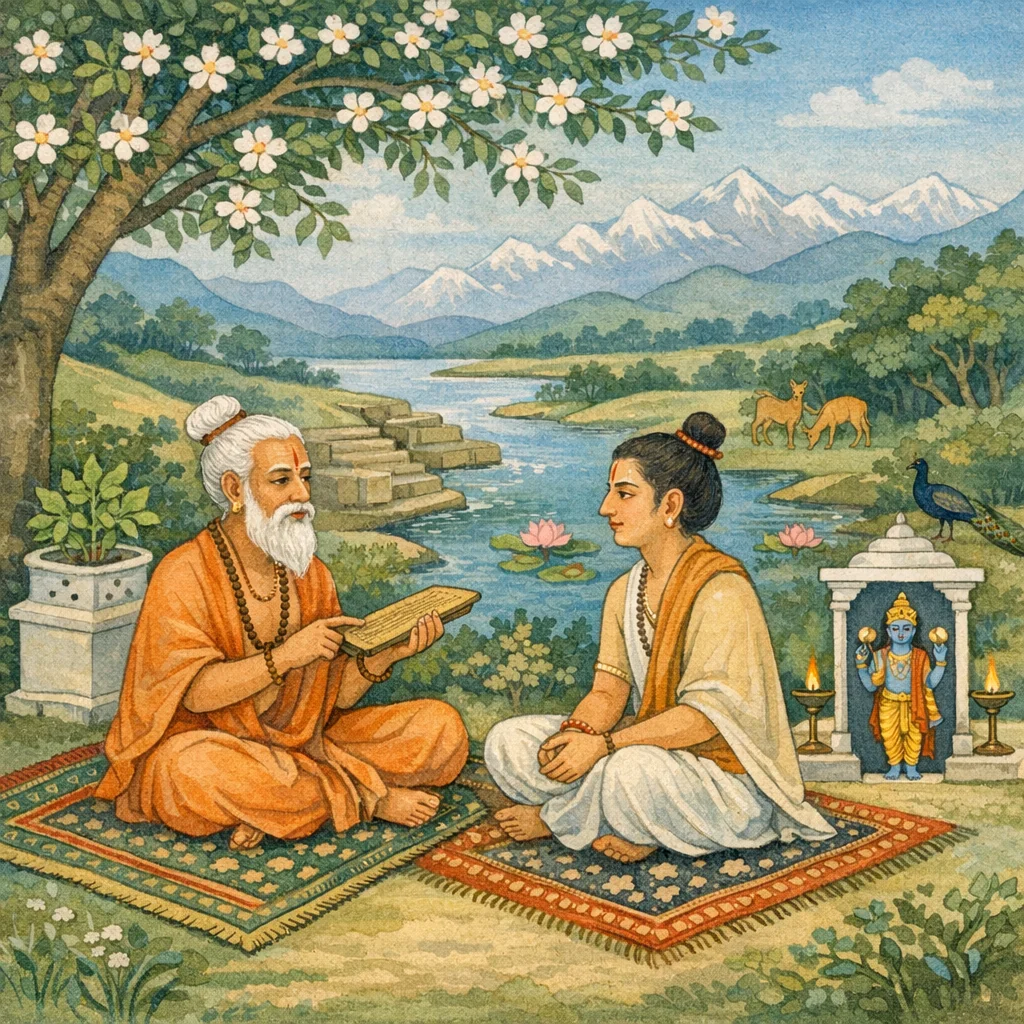
Adhyaya 69
The Teaching on Śiva-Dharma and the Supremacy of Food-Giving (within the Pitṛtīrtha–Yayāti Episode)
Chapter 69 defines Śiva-dharma as a many-branched tradition rooted in Śiva and lived through karma-yoga, stressing non-violence (ahiṃsā), purity, and the welfare of all beings, and setting forth a tenfold foundation of core virtues. It teaches that devotees attain Śivapura/Rudraloka, where enjoyments differ according to merit—especially the worthiness of the recipient and the giver’s faith. It distinguishes liberation through jñāna-yoga from rebirth driven by attachment to enjoyment, urging dispassion and true knowledge of Śiva. The chapter then exalts anna-dāna, the gift of food: food sustains the body, the instrument for all puruṣārthas, and is identified with Prajāpati, Viṣṇu, and Śiva. It explains offerings for the departed and the consequences of cruelty, concluding with a comparative account of destinations—Śiva’s city, Vaikuṇṭha, Brahmaloka, and Indraloka.
Shlokas
Verse 1
मातलिरुवाच । अथ धर्माः शिवेनोक्ताः शिवधर्मागमोत्तमाः । ज्ञेया बहुविधास्ते च कर्मयोगप्रभेदतः
Mātali said: Now, the dharmas taught by Śiva—supreme as the excellent tradition of Śiva-dharma—are to be known as manifold, distinguished according to the various divisions of karma-yoga.
Verse 2
हिंसादिदोषनिर्मुक्ताः क्लेशायासविवर्जिताः । सर्वभूतहिताः शुद्धाः सूक्ष्मायासा महत्फलाः
Free from faults such as violence, devoid of affliction and strain, intent on the welfare of all beings, and pure—these practices require only subtle effort, yet yield great results.
Verse 3
अनंतशाखाकलिताः शिवमूलैकसंश्रिताः । ज्ञानध्यानसुपुष्पाढ्याः शिवधर्माः सनातनाः
The eternal dharmas of Śiva are like a tree with countless branches, rooted solely in Śiva; they are richly adorned with the lovely blossoms of knowledge and meditation.
Verse 4
धारयंति शिवं यस्माद्धार्यते शिवभाषितैः । शिवधर्माः स्मृतास्तस्मात्संसारार्णवतारकाः
Because they uphold Śiva, and because Śiva is upheld by what Śiva has spoken, they are therefore remembered as the Śiva-dharmas—teachings that ferry one across the ocean of worldly existence, saṃsāra.
Verse 5
तथाऽहि सा क्षमा सत्यं ह्रीः श्रद्धेन्द्रियसंयमः । दानमिज्यातपोदानं दशकं धर्मसाधनम्
Indeed, these are: forgiveness, truthfulness, modesty, faith, and restraint of the senses; charity, worship (sacrificial devotion), austerity, and again giving—this set of ten is the means for establishing dharma.
Verse 6
अथ व्यस्तैः समस्तैर्वा शिवधर्मैरनुष्ठितैः । शिवैकरस्य संप्राप्तैर्गतिरेकैव कल्पिता
Now, whether the duties of Śiva are practiced separately or all together, for the devotee who attains exclusive devotion to Śiva, one—and indeed the same—supreme destination is declared.
Verse 7
यथा भूः सर्वभूतानां स्थानं साधारणं स्मृतम् । तत्तथा शिवभक्तानां तुल्यं शिवपुरंस्मृतम्
Just as the earth is remembered as the common abode of all beings, so too Śivapura is remembered as the shared abode of the devotees of Śiva.
Verse 8
यथेह सर्वभूतानां भोगाः सातिशयाः स्मृताः । नानापुण्यविशेषेण भोगाः शिवपुरे तथा
Just as, in this world, the enjoyments of all beings are said to vary in excellence, so too in Śiva’s city the enjoyments differ according to the distinct kinds of merit one has earned.
Verse 9
शुभाशुभफलं चापि भुज्यते सर्वदेहिभिः । शिवधर्मस्य चैकस्य फलं तत्रोपभुज्यते
All embodied beings experience the results of both auspicious and inauspicious deeds; but there, the fruit of the one path—the dharma of Śiva—is enjoyed as its distinct result.
Verse 10
यस्य यादृग्भवेत्पुण्यं श्रद्धापात्रविशेषतः । भोगाः शिवपुरे तस्य ज्ञेयाः सातिशयाः शुभाः
According to the degree of merit a person gains—especially depending on the excellence of the recipient and the giver’s faith—so should that person’s auspicious enjoyments in Śiva’s city be understood as exceptionally abundant.
Verse 11
स्थानप्राप्तिः परं तुल्या भोगाः शांतिमयाः स्थिताः । कुर्यात्पुण्यं महत्तस्मान्महाभोगजिगीषया
Attainment of the supreme state is, for the righteous, of equal worth, and the enjoyments there abide in peace. Therefore one should perform great merit, aspiring to win the highest enjoyments.
Verse 12
सर्वातिशयमेवैकं भावितं च सुरोत्तमैः । आत्मभोगाधिपत्यं स्याच्छिवः सर्वजगत्पतिः
This alone is supremely excellent, as affirmed by the best of the gods: Śiva is the lord of all worlds, possessing sovereign mastery over his own enjoyment.
Verse 13
केचित्तत्रैव मुच्यंते ज्ञानयोगरता नराः । आवर्तंते पुनश्चान्ये संसारे भोगतत्पराः
Some, devoted to the yoga of knowledge, are liberated right there; but others, intent on enjoyment, return again to worldly existence (saṃsāra).
Verse 14
तस्माद्विमुक्तिमिच्छंस्तु भोगासक्तिं च वर्जयेत् । विरक्तः शांतचित्तात्मा शिवज्ञानमवाप्नुयात्
Therefore, one who seeks liberation should renounce attachment to sense-enjoyments; becoming detached, with mind and self made peaceful, one attains the knowledge of Śiva.
Verse 15
ये चापीशान्यहृदया यजंतीशं प्रसंगतः । तेषामपि ददातीशः स्थानं भावानुरूपतः
And even those whose hearts are not devoted to Īśa, yet who worship the Lord only incidentally—Īśa still grants them a state of existence befitting the disposition of their own feelings.
Verse 16
तत्रार्चयंति ये रुद्रं सकृदुच्छिन्नकल्मषाः । तेषां पिशाचलोकेषु भोगानीशः प्रयच्छति
Those who worship Rudra there—even once—have their sins cut off; for them, the Lord bestows enjoyments in the worlds of the Piśācas.
Verse 17
संतप्ता दुःखभारेण म्रियंते सर्वदेहिनः । अन्नदः पुण्यदः प्रोक्तः प्राणदश्चापि सर्वदः
All embodied beings, scorched by the burden of suffering, perish. Therefore the giver of food is declared a giver of merit; indeed, the giver of food is also a giver of life—one who gives everything.
Verse 18
तस्मादन्नप्रदानेन सर्वदानफलं लभेत् । त्रैलोक्ये यानि रत्नानि भोगस्त्रीवाहनानि च
Therefore, by giving food one obtains the fruit of all charitable gifts—whatever jewels exist in the three worlds, and all enjoyments, women, and vehicles as well.
Verse 19
अन्नदानप्रदः सर्वमिहामुत्र फलं लभेत् । यस्यान्नपानपुष्टांगः कुरुते पुण्यसंचयम्
The giver of food obtains every reward, both in this world and in the next; for the person whose limbs are nourished by food and drink goes on to accumulate merit.
Verse 20
अन्नप्रदातुस्तस्यार्धं कर्तुश्चार्धं न संशयः । धर्मार्थकाममोक्षाणां देहः परमसाधनम्
Half of the merit belongs to the giver of food and half to the one who causes it to be given—of this there is no doubt. The body is the supreme instrument for attaining dharma, artha, kāma, and mokṣa.
Verse 21
स्थितिस्तस्यान्नपानाभ्यामतस्तत्सर्वसाधनम् । अन्नं प्रजापतिः साक्षादन्नं विष्णुः शिवः स्वयम्
Its sustenance rests upon food and drink; therefore food is the means by which all is accomplished. Food is truly Prajāpati himself; food is Viṣṇu; and food is Śiva in person.
Verse 22
तस्मादन्नसमं दानं न भूतं न भविष्यति । त्रयाणामपि लोकानामुदकं जीवनं स्मृतम्
Therefore no gift has ever been, nor will ever be, equal to the gift of food. For the three worlds, water is remembered as life itself.
Verse 23
पवित्रमुदकं दिव्यं शुद्धं सर्वरसायनम् । अन्नपानाश्व गो वस्त्र शय्या सूत्रासनानि च
Sacred water—divine and pure, a universal restorative—is to be offered, as well as food and drink, horses, cows, garments, beds, and seats made of woven cord.
Verse 24
प्रेतलोके प्रशस्तानि दानान्यष्टौ विशेषतः । एवं दानविशेषेण धर्मराजपुरं नरः
In the realm of the departed (Preta-loka), eight kinds of gifts are especially praised. By such distinguished acts of charity, a man reaches the city of Dharmarāja (Yama).
Verse 25
यस्माद्याति सुखेनैव तस्माद्धर्मं समाचरेत् । ये पुनः क्रूरकर्माणः पापादानविवर्जिताः
Since by this one attains well-being with ease, therefore one should practice dharma. But those who are cruel in their actions—devoid of giving and steeped in sin—do not follow this path.
Verse 26
भुंजते दारुणं दुःखं नरके नृपनंदन । तथा सुखं प्रभुंजंति दानकर्तार एव तु
O prince, they undergo dreadful suffering in hell; likewise, it is indeed the givers of charity alone who fully enjoy happiness.
Verse 27
तेषां तु संभवेत्सौख्यं कर्मयोगरतात्मनाम् । अप्रमेयगुणैर्दिव्यैर्विमानैः सर्वकामकैः
Indeed, happiness arises for those whose minds are devoted to karma-yoga, through divine aerial chariots endowed with immeasurable excellences and capable of granting every desired enjoyment.
Verse 28
असंख्यैस्तत्पुरं व्याप्तं प्राणिनामुपकारकैः । सहस्रसोमदिव्यं वा सूर्यतेजः समप्रभम्
That city was filled with countless beings who were benefactors to all creatures; it shone with a radiance equal to the sun’s brilliance—divine, as though lit by a thousand moons.
Verse 29
रुद्रलोकमिति प्रोक्तमशेषगुणसंयुतम् । सर्वेषां शिवभक्तानां तत्पुरं परिकीर्तितम्
It is called Rudraloka, endowed with every excellence; it is celebrated as the city, the abode, of all devotees of Śiva.
Verse 30
रुद्रक्षेत्रे मृतानां च जंगमस्थावरात्मनाम् । अप्येकदिवसं भक्त्या यः पूजयति शंकरम्
Even at Rudra-kṣetra, for those who have died there—whether beings that move or those that are immobile—whoever worships Śaṅkara with devotion, even for a single day, attains great merit.
Verse 31
सोपि याति शिवस्थानं किं पुनर्बहुशोर्चयन् । वैष्णवा विष्णुभक्ताश्च विष्णुध्यानपरायणाः
Even he attains Śiva’s abode—how much more one who worships again and again! Likewise the Vaiṣṇavas, devotees of Viṣṇu, wholly devoted to meditation on Viṣṇu, surely reach the highest goal.
Verse 32
तेपि गच्छंति वैकुंठे समीपं देवचक्रिणः । ब्रह्मवादी च धर्मात्मा ब्रह्मलोकं प्रयाति सः
They too go to Vaikuṇṭha, into the very presence of the Lord who bears the divine discus. And the righteous one, devoted to Brahman and a teacher of Brahman-knowledge, attains the world of Brahmā.
Verse 33
पुण्यकर्ता सुपुण्येन पुण्यलोकं प्रयाति च । तस्मादीशे सदा भक्तिं भावयेदात्मनात्मनि
A doer of meritorious deeds, through excellent merit, attains the world of the virtuous. Therefore one should always cultivate devotion to the Lord—within one’s own self, by one’s own self.
Verse 34
हरौ वापि महाराज युक्तात्मा ज्ञानवान्स्वयम् । तस्मात्सर्वविचारेण भावदोषविचारतः
Even in relation to Hari, O great king, one should be self-disciplined and truly wise. Therefore, after examining everything carefully—especially by scrutinizing the faults of one’s inner disposition—one should proceed rightly.
Verse 35
एवं विष्णुप्रभावेण विशिष्टेनापि कर्मणा । नरः स्थानमवाप्येतदेशभावानुरूपतः
Thus, by the power of Viṣṇu—and even through distinguished meritorious deeds—a person attains the destined state, in accordance with the nature and disposition shaped by that place.
Verse 36
इत्येतदपरं प्रोक्तं श्रीमच्छिवपुरं महत् । देहिनां कर्मनिष्ठानां पुनरावर्त्तकं स्मृतम्
Thus has this further matter been declared: the great and glorious Śivapura. It is remembered as the place that makes embodied beings—those steadfast in ritual action—return again to worldly rebirth.
Verse 37
ऊर्ध्वं शिवपुराज्ज्ञेयं वैष्णवं लोकमुत्तमम् । वैष्णवा मानवा यांति विष्णुध्यानपरायणाः
Above Śiva’s city one should know the supreme realm of Viṣṇu. Vaiṣṇava people—those devoted to meditation on Viṣṇu—go there.
Verse 38
ब्राह्मणा ब्रह्मलोकं तु सदाचारा नरोत्तमाः । प्रयांति यज्विनः सर्वे पुरीं तां तत्त्वकोविदाः
Brahmins—men of noble character and exemplary conduct—those who perform sacrifices (yajña) and are knowers of the truth, indeed go to Brahmaloka, to that city.
Verse 39
ऐंद्रं लोकं तथा यांति क्षत्रिया युद्धशालिनः । अन्ये च पुण्यकर्त्तारः पुण्यलोकान्प्रयांति ते
Valiant Kṣatriyas skilled in warfare likewise go to Indra’s world; and other doers of meritorious deeds go to the meritorious realms.
Verse 69
इति श्रीपद्मपुराणे भूमिखंडे वेनोपाख्याने पितृतीर्थे ययाति । चरिते एकोनसप्ततितमोऽध्यायः
Thus, in the Śrī Padma Purāṇa, in the Bhūmi-khaṇḍa, within the narrative concerning Vena—(in the section) on Pitṛtīrtha and the account of King Yayāti—ends the sixty-ninth chapter.