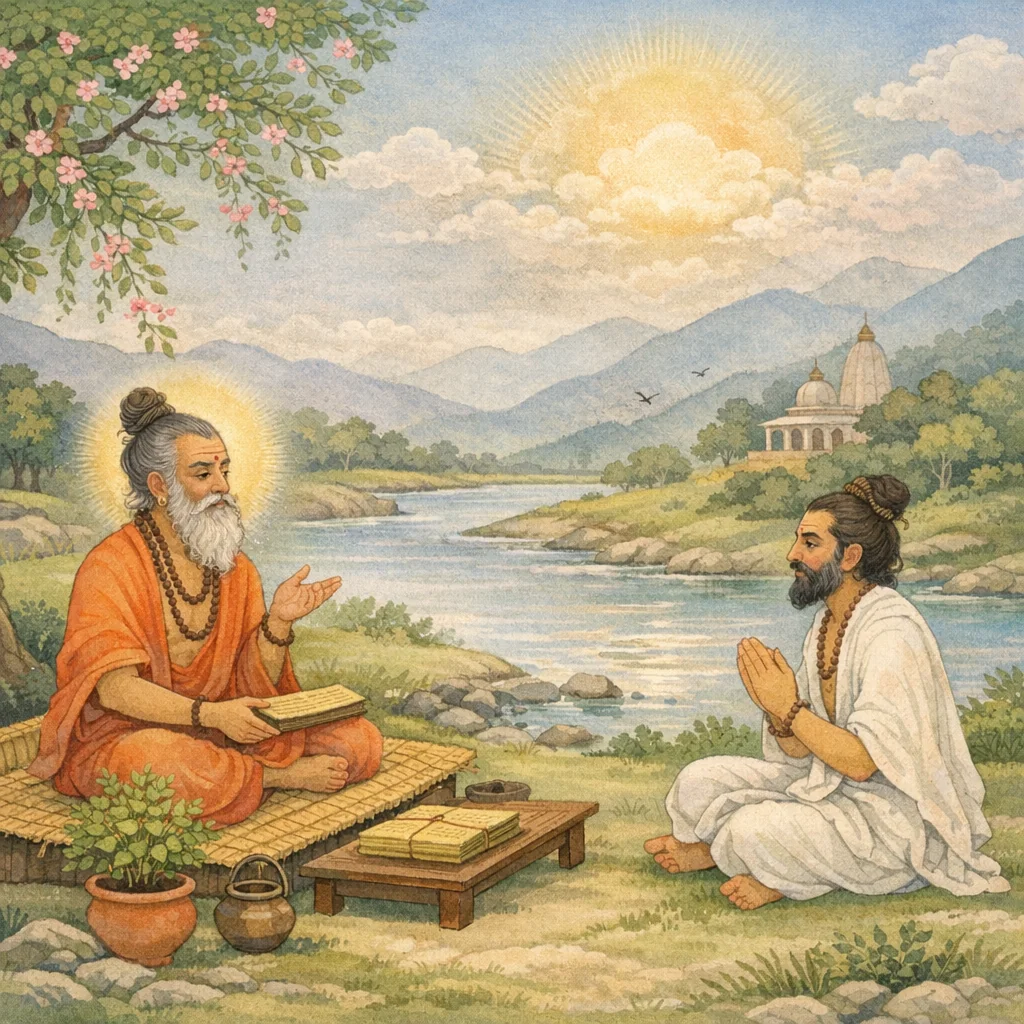
Adhyaya 83
Yayāti’s Ascent to Heaven (and Entry into Vaikuṇṭha)
Chapter 83 recounts King Yayāti’s departure after installing Pūru as sovereign. In an extraordinary act of loyalty to dharma and devotion to Viṣṇu, his subjects—across the four varṇas—choose to accompany him. Their procession is explicitly Vaiṣṇava, bearing conch-and-disc emblems, tulasī, and white banners. Yayāti is welcomed in turn by Indra and by Brahmā (Dhātṛ), and then honored by Śiva (Śaṅkara) in Umā’s presence. Śiva teaches the non-difference of Śiva and Viṣṇu and authorizes Yayāti’s onward journey to the supreme Vaiṣṇava realm. The text then describes Vaikuṇṭha’s splendor at length; before Nārāyaṇa, Yayāti asks not for pleasures but for perpetual service (sevā). Viṣṇu grants him residence in His world with the queen, and Yayāti abides eternally in the highest Vaiṣṇava abode.
Shlokas
Verse 1
सुकर्मोवाच । समाहूय प्रजाः सर्वा द्वीपानां वसुधाधिपः । हर्षेण महताविष्ट इदं वचनमब्रवीत्
Sukarma said: Having summoned all the subjects, the sovereign lord of the earth and its continents—overwhelmed with great joy—spoke these words.
Verse 2
इंद्रलोकं ब्रह्मलोकं रुद्रलोकमतः परम् । वैष्णवं सर्वपापघ्नं प्राणिनां गतिदायकम्
Beyond Indra’s world, Brahmā’s world, and Rudra’s world lies the realm of Viṣṇu—destroyer of all sins and the giver of the highest destination to living beings.
Verse 3
व्रजाम्यहं न संदेहो ह्यनया सह सत्तमाः । ब्राह्मणाः क्षत्रिया वैश्याः सशूद्रा श्च प्रजा मम
I shall depart—there is no doubt—along with her, O best of the virtuous. The brāhmaṇas, kṣatriyas, vaiśyas, and also the śūdras are my subjects.
Verse 4
सुखेनापि सकुटुंबैः स्थातव्यं तु महीतले । पूरुरेष महाभागो भवतां पालकस्त्विह
Even along with your families, you should live happily upon this earth. This noble Pūru here will indeed be your protector in this place.
Verse 5
स्थापितोस्ति मया लोका राजा धीरः सदंडकः । एवमुक्तास्तु ताः सर्वाः प्रजा राजानमब्रुवन्
“I have established the order of the people: the king is steadfast and resolute, ever bearing the rod of punishment.” Thus addressed, all those subjects then spoke to the king.
Verse 6
श्रूयते सर्ववेदेषु पुराणेषु नृपोत्तम । धर्म एवं यतो लोके न दृष्टः केन वै पुरा
O best of kings, it is heard in all the Vedas and the Purāṇas; for in this world such a form of dharma has never been seen by anyone before.
Verse 7
दृष्टोस्माभिरसौ धर्मो दशांगः सत्यवल्लभः । सोमवंशसमुत्पन्नो नहुषस्य महागृहे
We have beheld that Dharma—tenfold in its limbs and beloved of Truth—born in the Lunar line, within the great house of Nahuṣa.
Verse 8
हस्तपादमुखैर्युक्तः सर्वाचारप्रचारकः । ज्ञानविज्ञानसंपन्नः पुण्यानां च महानिधिः
Endowed with hands, feet, and mouth, he becomes the herald of all righteous conduct—abounding in knowledge and realized discernment, a vast treasury of merit.
Verse 9
गुणानां हि महाराज आकरः सत्यपंडितः । कुर्वंति च महाधर्मं सत्यवंतो महौजसः
O great king, the truthful and the wise are indeed a mine of virtues; and those who are truthful and of mighty vigor practice the highest Dharma.
Verse 10
तं धर्मं दृष्टवंतः स्म भवंतं कामरूपिणम् । भवंतं कामकर्तारमीदृशं सत्यवादिनम्
Truly we have seen that Dharma—namely you—who can assume any form at will, fulfill desires, and speak with such truth.
Verse 11
कर्मणा त्रिविधेनापि वयं त्यक्तुं न शक्नुमः । यत्र त्वं तत्र गच्छामः सुसुखं पुण्यमेव च
Even by the threefold modes of action, we cannot forsake you. Wherever you go, there we go as well—bringing great happiness and surely merit too.
Verse 12
नरकेपि भवान्यत्र वयं तत्र न संशयः । किं दारैर्धनभोगैश्च किं जीवैर्जीवितेन च
Even if it be in hell—wherever you are, there we shall be too; of this there is no doubt. What use are spouse, wealth, and enjoyments? What use are relatives—or even life itself?
Verse 13
त्वां विनासुमहाराज तेन नास्त्यत्र कारणम् । त्वयैव सह राजेंद्र वयं यास्याम नान्यथा
O great king, without you there is no purpose in this matter. O lord of kings, we shall go only together with you—no other way.
Verse 14
एवं श्रुत्वा वचस्तासां प्रजानां पृथिवीपतिः । हर्षेण महताविष्टः प्रजावाक्यमुवाच ह
Having thus heard the words of those subjects, the lord of the earth—overwhelmed with great joy—then spoke in reply to the people.
Verse 15
आगच्छंतु मया सार्द्धं सर्वे लोकाः सुपुण्यकाः । नृपो रथं समारुह्य तया वै कामकन्यया
“Let all worlds, rich in merit, come along with me.” Thus the king mounted the chariot together with that Kāma-maiden.
Verse 16
रथेन हंसवर्णेन चंद्रबिंबानुकारिणा । चामरैर्व्यजनैश्चापि वीज्यमानो गतव्यथः
He rode in a swan-hued chariot, resembling the disk of the moon; fanned with chowries and fans as well, he went forth with all pain dispelled.
Verse 17
केतुना तेन पुण्येन शुभ्रेणापि महीयसा । शोभमानो यथा देवो देवराजः पुरंदरः
By that auspicious, supremely pure merit—like a radiant banner—he shone forth, even as Indra, lord of the gods, Purandara, shines in glory.
Verse 18
ऋषिभिः स्तूयमानस्तु बंदिभिश्चारणैस्तथा । प्रजाभिः स्तूयमानश्च ययातिर्नहुषात्मजः
Praised by the ṛṣis, and likewise by the bards and the Cāraṇas, and also extolled by the people, stood Yayāti, the son of Nahuṣa.
Verse 19
प्रजाः सर्वास्ततो यानैः समायाता नरेश्वरम् । गजैरश्वै रथैश्चान्यैः प्रस्थिताश्च दिवं प्रति
Then all the subjects gathered with their vehicles before the king; and, mounted on elephants, horses, chariots, and other conveyances, they set forth toward heaven.
Verse 20
ब्राह्मणाः क्षत्रिया वैश्याः शूद्राश्चान्ये पृथग्जनाः । सर्वे च वैष्णवा लोका विष्णुध्यानपरायणाः
Brāhmaṇas, Kṣatriyas, Vaiśyas, Śūdras, and other people of various kinds—all were Vaiṣṇavas, devoted to meditation upon Viṣṇu.
Verse 21
तेषां तु केतवः शुक्ला हेमदंडैरलंकृताः । शंखचक्रांकिताः सर्वे सदंडाः सपताकिनः
Their banners were white, adorned with golden staffs; all were marked with the emblems of the conch and discus, furnished with poles and bearing pennants.
Verse 22
प्रजावृंदेषु भासंते पताका मारुतेरिताः । दिव्यमालाधरास्सर्वे शोभितास्तुलसीदलैः
Amid the assembled multitudes, banners stirred by the wind shone brightly; and all the bearers of divine garlands were adorned with tulasī leaves.
Verse 23
दिव्यचंदनदिग्धांगा दिव्यगंधानुलेपनाः । दिव्यवस्त्रकृता शोभा दिव्याभरणभूषिताः
Their limbs were anointed with divine sandalwood and perfumed with celestial fragrances. Their beauty was enhanced by heavenly garments, and they were adorned with divine ornaments.
Verse 24
सर्वे लोकाः सुरूपास्ते राजानमुपजग्मिरे । प्रजाशतसहस्राणि लक्षकोटिशतानि च
All those people—handsome in form—approached the king; their numbers were hundreds of thousands of subjects, even hundreds of lakhs and crores as well.
Verse 25
अर्वखर्वसहस्राणि ते जनाः प्रतिजग्मिरे । ते तु राज्ञा समं सर्वे वैष्णवाः पुण्यकारिणः
Those people set out in countless thousands. Along with the king, they all went together—devotees of Viṣṇu, doers of meritorious deeds.
Verse 26
विष्णुध्यानपराः सर्वे जपदानपरायणाः । सुकर्मोवाच । एवं ते प्रस्थिताः सर्वे हर्षेण महतान्विताः
All of them were devoted to meditation on Viṣṇu, and fully dedicated to japa-recitation and charitable giving. Sukarma said: thus they all set out, filled with great joy.
Verse 27
पूरुं पुत्रं महाराज स्वराज्ये परिषिच्य तम् । ऐंद्रं लोकं जगामाथ ययातिः पृथिवीपतिः
O great king, having anointed his son Pūru to his own sovereignty, Yayāti, lord of the earth, then departed to Indra’s world.
Verse 28
तेजसा तस्य पुण्येन धर्मेण तपसा तदा । ते जनाः प्रस्थिताः सर्वे वैष्णवं लोकमुत्तमम्
Then, through the radiance of his merit—born of righteousness and austerity—all those people set forth to the supreme Vaiṣṇava realm.
Verse 29
ततो देवाः सगंधर्वाः किन्नराश्चारणास्तथा । सहिता देवराजेन आगताः संमुखं तदा
Then the gods—along with the Gandharvas, the Kinnaras, and the Cāraṇas—accompanied by the king of the gods, came forward to meet him at that time.
Verse 30
तस्यैवापि नृपेंद्रस्य पूजयंतो नृपोत्तम । इंद्र उवाच । स्वागतं ते महाराज मम गेहं समाविश
While that king of kings was being honored, Indra said: “Welcome, O great king—enter my house.”
Verse 31
अत्र भोगान्प्रभुंक्ष्व त्वं दिव्यान्कामान्मनोऽनुगान् । राजोवाच । सहस्राक्ष महाप्राज्ञ तव पादांबुजद्वयम्
“Here, you may freely enjoy celestial pleasures—desires that follow the mind.” The king said: “O Thousand-eyed one, O greatly wise one, your pair of lotus-feet…”
Verse 32
नमस्करोम्यहं देव ब्रह्मलोकं व्रजाम्यहम् । देवैः संस्तूयमानश्च ब्रह्मलोकं जगाम ह
“O Lord, I bow to You; I am going to Brahmā’s world.” Thus, praised by the gods, he indeed departed for Brahmaloka.
Verse 33
पद्मयोनिर्महातेजाः सार्धं मुनिवरैस्तदा । आतिथ्यं च चकारास्य पाद्यार्घादि सुविष्टरैः
Then the lotus-born One, of great splendor, together with the foremost sages, honored him with sacred hospitality—offering water to wash the feet, the arghya oblation, and the like, in an excellent manner.
Verse 34
उवाच विष्णुलोकं हि प्रयाहि त्वं स्वकर्मणा । एवमाभाषिते धात्रा जगाम शिवमंदिरम्
He said, “Indeed, by the merit of your own deeds, go to Viṣṇu’s world.” Thus addressed by Dhātṛ, the Creator, he went to Śiva’s temple.
Verse 35
चक्रे आतिथ्यपूजां च उमया सह शंकरः । तस्यै वापि नृपेंद्रस्य राजानमिदमब्रवीत्
Śaṅkara, together with Umā, performed the rites of honoring the guest; then he spoke these words to that king, the lord of men.
Verse 36
कृष्णभक्तोसि राजेंद्र ममापि सुप्रियो भवान् । ततो ययाते राजेंद्र वस त्वं मम मंदिरम्
“O king, you are a devotee of Kṛṣṇa, and you are very dear to me as well. Therefore, O King Yayāti, dwell in my temple.”
Verse 37
सर्वान्भोगान्प्रभुंक्ष्व त्वं दुःखप्राप्यान्हि मानुषैः । अंतरं नास्ति राजेंद्र मम विष्णोर्न संशयः
O king of kings, enjoy all those pleasures that humans obtain only through suffering. There is no difference between me and Viṣṇu—of this there is no doubt.
Verse 38
योसौ विष्णुस्वरूपेण स वै रुद्रो न संशयः । यो रुद्रो विद्यते राजन्स च विष्णुः सनातनः
He who exists in the form of Viṣṇu is indeed Rudra—of this there is no doubt. And the Rudra who exists, O King, is that very eternal Viṣṇu.
Verse 39
उभयोरंतरं नास्ति तस्माच्चैव वदाम्यहम् । विष्णुभक्तस्यपुण्यस्यस्थानमेवददाम्यहम्
There is no difference between the two; therefore I say this: I declare that the merit of a devotee of Viṣṇu itself becomes a sacred abode, a worthy holy place.
Verse 40
तस्मादत्र महाराज स्थातव्यं हि त्वयानघ । एवमुक्तः शिवेनापि ययातिर्हरिवल्लभः
“Therefore, O great king, O sinless one, you must indeed remain here.” Thus addressed even by Śiva, Yayāti—dear to Hari—accepted the instruction.
Verse 41
भक्त्या प्रणम्य देवेशं शंकरं नतकंधरः । एतत्सर्वं महादेव त्वयोक्तमिह सांप्रतम्
Bowing with devotion to Śaṅkara, the Lord of the gods, with head lowered, he said: “O Mahādeva, all this has now been spoken here by you.”
Verse 42
युवयोरंतरं नास्ति एका मूर्तिर्द्विधाभवत् । वैष्णवं गंतुमिच्छामि पादौ तव नमाम्यहम्
There is no difference between you two; one divine form has become two. I long to go to the Vaiṣṇava realm—therefore I bow at your feet.
Verse 43
एवमस्तु महाराज गच्छ लोकं तु वैष्णवम् । समादिष्टः शिवेनापि प्रतस्थे वसुधाधिपः
“So be it, O great king. Go indeed to the Vaiṣṇava realm.” Thus instructed even by Śiva, the lord of the earth set forth.
Verse 44
पृथ्वीशस्तैर्महापुण्यैर्वैष्णवैर्विष्णुवल्लभैः । नृत्यमानैस्ततस्तैस्तु पुरतस्तस्य भूपतेः
That lord of the earth was preceded by those greatly meritorious Vaiṣṇavas—beloved of Viṣṇu—who danced here and there before him.
Verse 45
शंखशब्दैः सुपापघ्नैः सिंहनादैः सुपुष्कलैः । जगाम निःस्वनै राजा पूज्यमानः सुचारणैः
Amid the auspicious, sin-destroying sounds of conches and the powerful, far-resounding lion-roars, the king went forth in reverberating music, honored by noble bards.
Verse 46
सुस्वरैर्गीयमानस्तु पाठकैः शास्त्रकोविदैः । गायंति पुरतस्तस्य गंधर्वा गीततत्पराः
As learned reciters skilled in the śāstras sang of him in melodious tones, the Gandharvas—devoted to song—sang before him.
Verse 47
ऋषिभिः स्तूयमानश्च देववृंदैः समन्वितैः । अप्सरोभिः सुरूपाभिः सेव्यमानः स नाहुषिः
Praised by the sages and encompassed by hosts of gods, that Nahusha was attended upon by beautiful apsarās.
Verse 48
गंधर्वैः किन्नरैः सिद्धैश्चारणैः पुण्यमंगलैः । साध्यैर्विद्याधरै राजा मरुद्भिर्वसुभिस्तथा
The king was accompanied by Gandharvas, Kinnaras, Siddhas, and the holy, auspicious Cāraṇas—along with the Sādhyas, Vidyādharas, the Maruts, and likewise the Vasus.
Verse 49
रुद्रैश्चादित्यवर्गैश्च लोकपालैर्दिगीश्वरैः । स्तूयमानो महाराजस्त्रैलोक्येन समंततः
Praised on every side by the Rudras, the hosts of Ādityas, the world-guardians, and the lords of the directions, the great king was celebrated by the three worlds all around.
Verse 50
ददृशे वैष्णवं लोकमनौपम्यमनामयम् । विमानैः कांचनै राजन्सर्वशोभासमाविलैः
He beheld the Vaiṣṇava world—unequalled and free from all affliction—O King, filled everywhere with golden vimānas resplendent with every kind of beauty.
Verse 51
हंसकुंदेंदुधवलैर्विमानैरुपशोभितैः । प्रासादैः शतभौमैश्च मेरुमंदरसंनिभैः
It is adorned with celestial vimānas, white as swans, jasmine, and the moon, and with hundred-storied palaces resembling Mount Meru and Mandara.
Verse 52
शिखरैरुल्लिखद्भिश्च स्वर्व्योमहाटकान्वितैः । जाज्वल्यमानैः कलशैः शोभते सुपुरोत्तमम्
That most excellent city shines: its soaring peaks seem to scrape the sky, adorned with heavenly gold and crowned with brilliantly blazing kalaśas.
Verse 53
तारागणैर्यथाकाशं तेजः श्रिया प्रकाशते । प्रज्वलत्तेजोज्वालाभिर्लोचनैरिव लोकते
As the sky is made radiant in its splendor by multitudes of stars, so that being appears resplendent, as though seen with eyes formed of blazing flames of brilliance.
Verse 54
नानारत्नैर्हरेर्लोकः प्रहसद्दशनैरिव । समाह्वयति तान्पुण्यान्वैष्णवान्विष्णुवल्लभान्
Adorned with many kinds of jewels, Hari’s world—like one smiling with gleaming teeth—seems to beckon the meritorious Vaiṣṇavas, beloved of Viṣṇu.
Verse 55
ध्वज व्याजेन राजेंद्र चलिताग्रैः सुपल्लवैः । श्वसनांदोलितैस्तैश्च ध्वजाग्रैश्च मनोहरैः
O king, as though in the guise of banners, the lovely tender leaf-tips—moving at their ends and rocked by the wind—appeared like delightful flag-tops.
Verse 56
हेमदंडैश्च घंटाभिः सर्वत्रसमलंकृतम् । सूर्यतेजः प्रकाशैश्च गोपुराट्टालकैस्ततः
It was adorned everywhere with golden staffs and bells; and there, with gateway-towers and lofty watchtowers, it shone with radiance like the brilliance of the sun.
Verse 57
गवाक्षैर्जालमालैश्च वातायनमनोहरैः । प्रतोलीनां प्रकाशैश्च प्राकारैर्हेमरूपकैः
With lattice-windows and net-like garlands, with charming balconies; with radiant gateways and ramparts fashioned as though in the form of gold.
Verse 58
तोरणैः सुपताकाभिर्नानाशब्दैः सुमंगलैः । कलशाग्रैश्चक्रबिंबै रविबिंबसमप्रभैः
With festooned toranas and fine banners, with many auspicious sounds; and with the tops of sacred kalaśas and disc-like emblems, shining with a radiance equal to the orb of the sun.
Verse 59
सुभोगैः शतकक्षैश्च निर्जलांबुदसन्निभैः । दंडच्छत्रसमाकीर्णैः कलशैरुपशोभितैः
Adorned with excellent amenities and with hundreds of chambers, resembling waterless clouds; crowded with staffs and parasols, and beautified with finial pots (kalaśas).
Verse 60
प्रावृट्कालांबुदाकारैर्मदिरैरुपशोभितैः । कलशैः शोभमानैस्तैरृक्षैर्द्यौरिव भूतलम्
The earth, adorned with those shining kalaśas—swelling like monsoon clouds and beautified by intoxicating liquor—appeared like the sky filled with constellations.
Verse 61
दंडजालपताकाभिरृक्षजालसमप्रभैः । तादृशैः स्फाटिकाकारैः कांतिशंखेंदुसन्निभैः
With rows of staffs and streaming banners, shining like a net of stars; and with crystal-like forms, radiant—resembling the luster of a conch and the moon.
Verse 62
हेमप्रासादसंबाधैर्नानाधातुमयैस्ततः । विमानैरर्बुदसंख्यैः शतकोटिसहस्रकैः
There, that realm was densely filled with golden palaces fashioned from many kinds of metals, and with vimānas—celestial aerial chariots—numbered in arbuda (tens of millions), in hundreds, crores, and thousands.
Verse 63
सर्वभोगयुतैश्चैव शोभते हरिपत्तनम् । यैः समाराधितो देवः शंखचक्रगदाधरः
Hari’s sacred city shines, abounding in every enjoyment; it shines for those by whom the Lord—the bearer of conch, discus, and mace—has been duly worshipped.
Verse 64
ते प्रसादात्तस्य तेषु निवसंति गृहेषु च । सर्वपुण्येषु दिव्येषु भोगाढ्येषु च मानवाः
By his grace, people dwell in those houses, enjoying every kind of meritorious, divine prosperity—rich in pleasures and abundance.
Verse 65
वैष्णवाः पुण्यकर्माणो निर्धूताशेषकल्मषाः । एवंविधैर्गृहैः पुण्यैः शोभितं विष्णुमंदिरम्
The Vaiṣṇavas—righteous in deed, with every impurity washed away—thus adorn the temple of Viṣṇu with such holy dwellings.
Verse 66
नानावृक्षैः समाकीर्णं वनैश्चंदनशोभितैः । सर्वकामफलै राजन्सर्वत्र समलंकृतम्
O King, it is filled with many kinds of trees; its groves are beautified with sandalwood, and everywhere it is adorned with fruits that grant every desired aim.
Verse 67
वापीकुंडतडागैश्च सारसैरुपशोभितैः । हंसकारंडवाकीर्णैः कल्हारैरुपशोभितैः
Adorned with wells, ponds, and tanks, and beautified by spacious lakes; filled with swans and kāraṇḍava birds, and further graced by blooming kalhāra lotuses.
Verse 68
शतपत्रैर्महापद्मैः पद्मोत्पलविराजितैः । कनकोत्पलवर्णैश्च सरोभिश्च विराजते
It shines with great hundred-petaled lotuses, resplendent with padma lotuses and utpala water-lilies, and with lakes glowing in the golden hue of lotus blooms.
Verse 69
वैकुंठं सर्वशोभाढ्यं देवोद्यानैरलंकृतम् । दिव्यशोभासमाकीर्णं वैष्णवैरुपशोभितम्
Vaikuṇṭha, filled with every kind of splendor, is adorned with divine gardens; it is suffused with celestial radiance and further beautified by the Vaiṣṇavas.
Verse 70
वैकुंठं ददृशे राजा मोक्षस्थानमनुत्तमम् । देववृंदैः समाकीर्णं ययातिर्नहुषात्मजः
King Yayāti, the son of Nahuṣa, beheld Vaikuṇṭha—the unsurpassed abode of liberation (mokṣa)—thronged with hosts of gods (devas).
Verse 71
प्रविवेश पुरं रम्यं सर्वदाहविवर्जितम् । ददृशे सर्वक्लेशघ्नं नारायणमनामयम्
He entered a delightful city, wholly free from every burning affliction, and beheld Nārāyaṇa—free from all disease—who destroys every sorrow and hardship.
Verse 72
विमानैरुपशोभंतं सर्वाभरणशालिनम् । पीतवासं जगन्नाथं श्रीवत्सांकं महाद्युतिम्
Adorned by celestial vimānas, embellished with every ornament, clad in yellow garments—the Lord of the universe, bearing the mark of Śrīvatsa, radiant with great splendor.
Verse 73
वैनतेयसमारूढं श्रियायुक्तं परात्परम् । सर्वेषां देवलोकानां यो गतिः परमेश्वरः
Mounted upon Vainateya (Garuḍa), united with Śrī (Lakṣmī), transcendent beyond the highest—He, the Supreme Lord, is the ultimate refuge and goal of all the worlds of the gods.
Verse 74
परमानंदरूपेण कैवल्येन विराजते । सेव्यमानं महालोकैःसुपुण्यैर्वैष्णवैर्हरिम्
He shines in the form of supreme bliss, resplendent with the splendor of kaivalya (liberation)—Hari, worshiped and served by great-souled, highly meritorious Vaiṣṇavas.
Verse 75
देववृंदैः समाकीर्णं गंधर्वगणसेवितम् । अप्सरोभिर्महात्मानं दुःखक्लेशापहं हरिम्
Hari—the great-souled Lord who removes sorrow and affliction—was surrounded by hosts of devas, attended by companies of Gandharvas, and accompanied by Apsarās.
Verse 76
नारायणं ननामाथ स्वपत्न्या सह भूपतिः । प्रणेमुर्मानवाः सर्वे वैष्णवा मधुसूदनम्
Then the king, along with his queen, bowed to Nārāyaṇa; and all the people—Vaiṣṇava devotees—prostrated to Madhusūdana.
Verse 77
गता ये वैष्णवाः सर्वे सह राज्ञा महामते । पादांबुजद्वयं तस्य नेमुर्भक्त्या महामते
Then all those Vaiṣṇavas, together with the king, O wise one, bowed in devotion to his pair of lotus-feet, O wise one.
Verse 78
प्रणमंतं महात्मानं राजानं दीप्ततेजसम् । तमुवाच हृषीकेशस्तुष्टोऽहं तव सुव्रत
As the radiant king of great soul bowed down, Hṛṣīkeśa spoke to him: “O you of good vows, I am pleased with you.”
Verse 79
वरं वरय राजेंद्र यत्ते मनसि वर्तते । तत्ते ददाम्यसंदेहं मद्भक्तोसि महामते
O best of kings, choose a boon—whatever is in your mind. I shall grant it to you without doubt, for you are my devotee, O great-minded one.
Verse 80
राजोवाच । यदि त्वं देवदेवेश तुष्टोसि मधुसूदन । दासत्वं देहि सततमात्मनश्च जगत्पते
The king said: “If you, O Lord of the gods, O Madhusūdana, are pleased, then grant me constant servitude to you, O Lord of the universe.”
Verse 81
विष्णुरुवाच । एवमस्तु महाभाग मम भक्तो न संशयः । लोके मम महाराज स्थातव्यमनया सह
Viṣṇu said: “So be it, O fortunate one. You are indeed My devotee—there is no doubt. O great king, in My world you shall dwell together with her.”
Verse 82
एवमुक्तो महाराजो ययातिः पृथिवीपतिः । प्रसादात्तस्य देवस्य विष्णुलोकं प्रसाधितम्
Thus addressed, the great king Yayāti, lord of the earth, by the grace of that deity attained the blessed realm of Viṣṇu (Viṣṇuloka).
Verse 83
इति श्रीपद्मपुराणे भूमिखंडे वेनोपाख्याने पितृतीर्थवर्णने ययातिचरित्रे ययातेः स्वर्गारोहणं नाम त्र्यशीतितमोऽध्यायः
Thus ends the eighty-third chapter, entitled “Yayāti’s Ascent to Heaven,” in the Bhūmi-khaṇḍa of the Śrī Padma Purāṇa—within the narrative of Vena, the description of the ancestral pilgrimage-place (Pitṛ-tīrtha), and the account of King Yayāti.