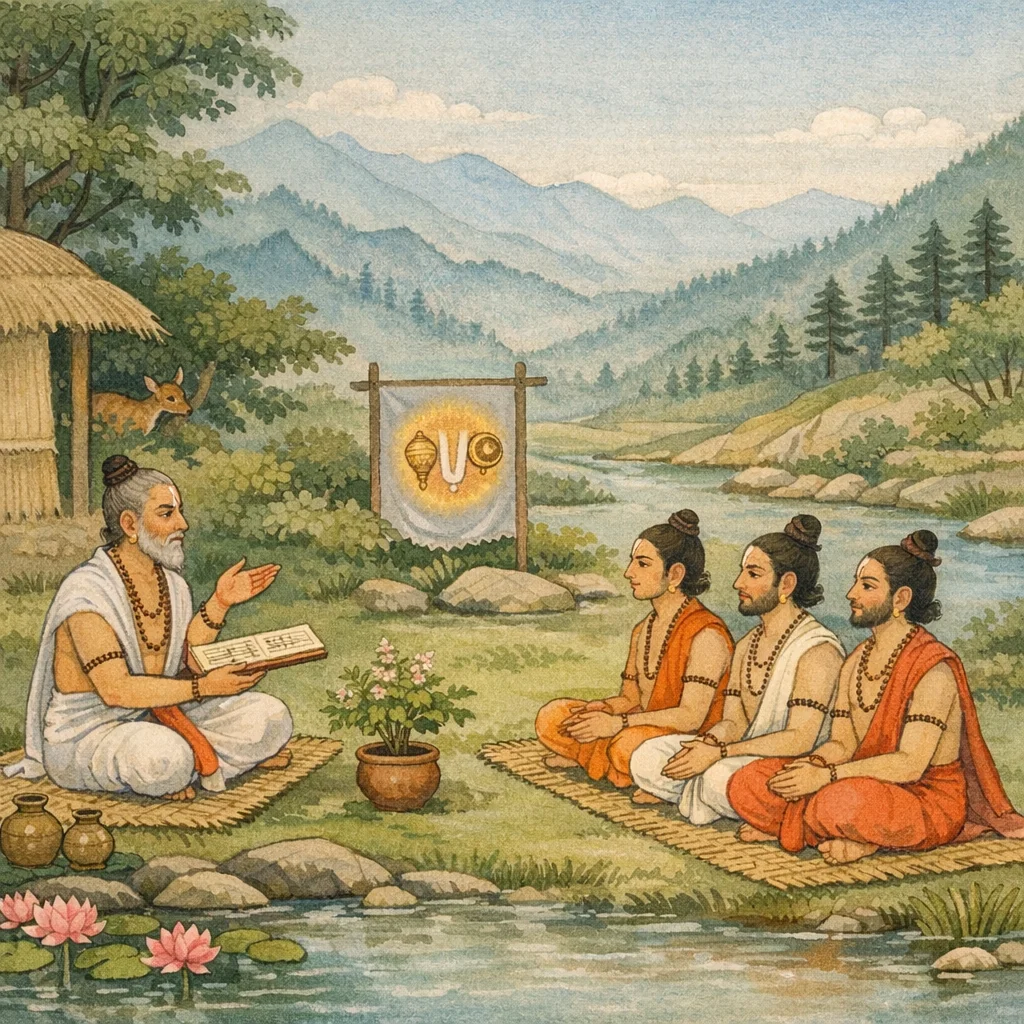
Adhyaya 14
Dharma as the Cause of Prosperity and the Signs of a Righteous Death
In PP.2.14, Somaśarmā asks Sumana how she has come to know a supremely meritorious teaching of dharma. Sumana grounds her authority in her father Cyavana of the Bhārgava line and recounts an embedded episode with Vedaśarmā of the Kauśika line. Cyavana grieves over childlessness and the threat of a broken lineage; an arriving siddha is duly honored and teaches that dharma is the foundation that yields a son, wealth, grain, and marital well-being. Somaśarmā then inquires about death and rebirth as governed by Dharma. Sumana describes the righteous person’s “good death”: departure without pain or bewilderment, amid sacred sound and praise, and under the holiness of places—by tīrtha-logic extending even to liminal sites. Summoned by Dharmarāja, remembering Janārdana, and leaving through the “tenth gate,” one is met by celestial conveyances, enjoys heavenly realms, and is reborn when merit is exhausted.
Shlokas
Verse 1
सोमशर्मोवाच । एवंविधं महापुण्यं धर्मव्याख्यानमुत्तमम् । कथं जानासि भद्रे त्वं कस्माच्चैव त्वया श्रुतम्
Somaśarmā said: “Such a supremely excellent exposition of dharma is of great merit. How do you know it, O auspicious lady—and from whom indeed have you heard it?”
Verse 2
सुमनोवाच । भार्गवाणां कुले जातः पिता मम महामते । च्यवनो नाम विख्यातः सर्वज्ञानविशारदः
Sumana said: “O great-minded one, my father was born in the lineage of the Bhārgavas; he was renowned by the name Cyavana, and was skilled in all branches of knowledge.”
Verse 3
तस्याहं प्रिय कन्या वै प्राणादपि च वल्लभा । यत्रयत्र व्रजत्येष तीर्थारामेषु सुव्रत
I am indeed his beloved daughter—dearer to him even than his own life. Wherever he goes, O you of excellent vows, he journeys among sacred fords and holy groves.
Verse 4
सभासु च मुनीनां तु देवतायतनेषु च । तेन सार्द्धं व्रजाम्येका क्रीडमाना सदैव हि
In the assemblies of sages and in the temples of the gods as well, I go together with him—alone—ever playing in sacred, divine sport.
Verse 5
कौशिकान्वयसंभूतो वेदशर्मा महामतिः । पितुर्मम सखा दैवादटमानः समागतः
The great-minded Vedaśarmā, born in the Kauśika lineage and a friend of my father, happened to arrive here by the turning of fate while wandering.
Verse 6
दुःखेन महताविष्टश्चिंतयानो मुहुर्मुहुः । समागतं महात्मानं तमुवाच पिता मम
Overwhelmed by great sorrow and again and again absorbed in anxious thought, my father spoke to that noble-souled great one when he arrived.
Verse 7
भवंतं दुःखसंतप्तमिति जानामि सुव्रत । कस्माद्दुःखी भवाञ्जातस्तस्मात्त्वं कारणं वद
O man of good vows, I know you are scorched by sorrow. For what reason have you become unhappy? Therefore tell me the cause.
Verse 8
एतद्वाक्यं ततः श्रुत्वा च्यवनस्य महात्मनः । तमुवाच महात्मानं पितरं मम सुव्रतः
Having heard these words of the great-souled Cyavana, the virtuous man of good vows spoke to my father, that great-souled one.
Verse 9
वेदशर्मा महाप्राज्ञ सर्वदुःखस्य कारणम् । मम भार्या महासाध्वी पातिव्रत्यपरायणा
O wise Vedaśarmā, you are the cause of all my sorrow. My wife is most virtuous, wholly devoted to wifely fidelity toward her husband.
Verse 10
अपुत्रा सा हि संजाता मम वंशो न विद्यते । एतत्ते कारणं प्रोक्तं प्रश्नितोस्मि यतस्त्वया
She has indeed become without a son; my lineage does not continue. This is the reason I have told you, since you questioned me.
Verse 11
एतस्मिन्नंतरे प्राप्तः कश्चित्सिद्धः समागतः । मम पित्रा तथा तेन ह्युत्थाय वेदशर्मणा
Meanwhile, a certain Siddha arrived there. My father—and Vedaśarman as well—rose up in reverence.
Verse 12
द्वाभ्यामपि च सिद्धोसौ पूजितो भक्तिपूर्वकैः । उपहारैस्स भोज्यान्नैर्वचनैर्मधुराक्षरैः
That accomplished one was worshipped by both of them with devotion—through offerings, through foods to be eaten, and through words of sweet syllables.
Verse 13
द्वाभ्यामन्तर्गतं पृष्टं पूर्वोक्तं च यथा त्वया । उभौ तौ प्राह धर्मात्मा ससखं पितरं मम
As you asked—embracing the two points and in keeping with what was said earlier—the righteous one spoke of them both: my father together with his friend.
Verse 14
धर्मस्य कारणं सर्वं मयोक्तं ते तथा किल । धर्मेण प्राप्यते पुत्रो धनं धान्यं तथा स्त्रियः
Indeed, I have told you all the causes and foundations of dharma. Through dharma one obtains a son, wealth, grain, and also a wife.
Verse 15
ततस्तेन कृतं धर्मं संपूर्णं वेदशर्मणा । तस्माद्धर्मात्सुसंजातं महत्सौख्यं सपुत्रकम्
Then Vedaśarman carried out that dharma fully; and from that very dharma there arose great happiness—together with the blessing of a son.
Verse 16
तेन संगप्रसंगेन ममैष मतिनिश्चयः । यथा कांत तव प्रोक्तं मयैव च परं शुभम्
Through that very association and its consequences, this is my settled conviction: just as you, beloved, have declared, so too do I affirm what is supremely auspicious.
Verse 17
तस्माच्छ्रुतं महासिद्धात्सर्वसंदेहनाशनम् । विप्रधर्मं समाश्रित्य अनुवर्त्तस्व सर्वदा
Therefore, having heard this teaching from the great accomplished siddha—destroyer of all doubts—take refuge in the dharma of a brāhmaṇa and follow it always.
Verse 18
सोमशर्मोवाच । धर्मेण कीदृशो मृत्युर्जन्म चैव वदस्व मे । उभयोर्लक्षणं कांते तत्सर्वं हि वदस्व मे
Somaśarman said: “Tell me—what are death and birth like when governed by Dharma? O beloved, explain to me completely the characteristics of both.”
Verse 19
सुमनोवाच । सत्य शौच क्षमा शांति तीर्थपुण्यादिकैस्तथा । धर्मश्च पालितो येन तस्य मृत्युं वदाम्यहम्
Sumana said: “I shall describe the death of that person who has upheld Dharma through truthfulness, purity, forgiveness, peace, and merits such as those gained from sacred pilgrimages and the like.”
Verse 20
रोगो न जायते तस्य न च पीडा कलेवरे । न श्रमो वै न च ग्लानिर्न च स्वेदो भ्रमस्तथा
For him, no disease arises, nor does any bodily pain occur. There is neither fatigue nor weariness, neither sweating nor dizziness or confusion.
Verse 21
दिव्यरूपधरा भूत्वा गंधर्वा ब्राह्मणास्तथा । वेदपाठसमायुक्ता गीतज्ञानविशारदाः
Assuming celestial forms, the Gandharvas—and likewise certain Brāhmaṇas—were engaged in Vedic recitation and were highly skilled in the knowledge of song and music.
Verse 22
तस्य पार्श्वं समायांति स्तुतिं कुर्वंति चातुलाम् । स्वस्थो हि आसने युक्तो देवपूजारतः किल
They come to his side and offer incomparable praise. For he sits composed and steady upon his seat, devoted—so it is said—to the worship of the Deity.
Verse 23
तीर्थं च लभते प्राज्ञः स्नानार्थं धर्मतत्परः । अग्न्यागारे च गोस्थाने देवतायतनेषु च
A wise person devoted to dharma obtains a sacred tīrtha for the purpose of bathing—even in a fire-sanctuary, in a cowshed, and in the precincts of a deity’s temple.
Verse 24
आरामे च तडागे च यत्राश्वत्थो वटस्तथा । ब्रह्मवृक्षं समाश्रित्य श्रीवृक्षं च तथा पुनः
In a grove and at a pond—where there are sacred trees such as the aśvattha (sacred fig) and the vaṭa (banyan)—one should also take refuge near the ‘brahma-tree’ and again near the ‘śrī-tree’ as well.
Verse 25
अश्वस्थानं समाश्रित्य गजस्थानगतो नरः । अशोकं चूतवृक्षं च समाश्रित्य यदास्थितः
A man who takes refuge in the horse-station and goes to the elephant-station, and who, at that time, stays sheltered beneath the aśoka and mango trees—
Verse 26
संनिधौ ब्राह्मणानां च राजवेश्मगतोथवा । रणभूमिं समाश्रित्य पूर्वं यत्र मृतो भवेत्
Whether in the presence of Brāhmaṇas, or upon entering the king’s palace, or taking refuge on the battlefield—wherever one may have formerly met death, in such a place (it is said).
Verse 27
मृत्युस्थानानि पुण्यानि केवलं धर्मकारणम् । गोग्रहं तु सुसंप्राप्य तथा चामरकंटकम्
Even places associated with death become sacred, solely because they are causes of dharma. Having duly reached Gograha, and likewise Amarakaṇṭaka, (one gains religious merit).
Verse 28
शुद्धधर्मकरो नित्यं धर्मतो धर्मवत्सलः । एवं स्थानं समाप्नोति यदा मृत्युं समाश्रितः
One who ever practices pure dharma, devoted to dharma and affectionate toward righteousness—when death at last comes upon him, he attains such an abode.
Verse 29
मातरं पश्यते पुण्यं पितरं च नरोत्तमः । भ्रातरं श्रेयसा युक्तमन्यं स्वजनबांधवम्
That best of men beholds his virtuous mother and his father, and also a brother endowed with auspicious fortune, and other relatives and kinsmen.
Verse 30
बंदीजनैस्तथा पुण्यैः स्तूयमानं पुनःपुनः । पापिष्ठं नैव पश्येत मातृपित्रादिकं पुनः
Praised again and again by bards and by the virtuous, he will not look again upon the most sinful—nor again upon his mother, father, and other kin.
Verse 31
गीतं गायंति गंधर्वाः स्तुवंतिस्तावकाः स्तवैः । मंत्रपाठैस्तथा विप्रा माता स्नेहेन पूजयेत्
The Gandharvas sing songs; the devotees praise her with hymns; and the brāhmaṇas recite mantras. Thus should the mother be honored with affectionate devotion.
Verse 32
पितास्वजनवर्गाश्च धर्मात्मानं महामतिम् । एवं दूताः समाख्याताः पुण्यस्थानानि ते विभो
“They include one’s father and one’s own kinsmen—righteous in soul and great in mind. Thus have the messengers been described; and so too, O Lord, have your sacred places of merit.”
Verse 33
प्रत्यक्षान्पश्यते दूतान्हास्यस्नेहसमाविलान् । न च स्वप्नेन मोहेन क्लेदयुक्तेन नैव सः
He beholds the messengers directly—faces clouded with mocking laughter and cruel, feigned affection. It is no dream, no delusion, no stupefying confusion; for him, it is certainly real.
Verse 34
धर्मराजो महाप्राज्ञो भवंतं तु समाह्वयेत् । एह्येहि त्वं महाभाग यत्र धर्मः स तिष्ठति
Dharmarāja, the supremely wise, will surely summon you: “Come, come, O greatly fortunate one—go to where Dharma abides.”
Verse 35
तस्य मोहो न च भ्रांतिर्न ग्लानिः स्मृतिविभ्रमः । जायते नात्र संदेहः प्रसन्नात्मा स तिष्ठति
For him there arises neither delusion nor confusion, neither despondency nor disturbance of memory. Of this there is no doubt: he remains established with a serene mind.
Verse 36
ज्ञानविज्ञानसंपन्नः स्मरन्देवं जनार्दनम् । तैः सार्द्धं तु प्रयात्येवं संतुष्टो हृष्टमानसः
Endowed with spiritual knowledge and realized wisdom, he remembered the Lord Janārdana; and thus, together with them, he set forth—content, with a heart filled with joy.
Verse 37
एकत्वं जायते तत्र त्यजतः स्वंकलेवरम् । दशमद्वारमाश्रित्य आत्मा तस्य स गच्छति
There, upon casting off one’s own body, a state of oneness arises; and taking refuge in the ‘tenth gate’, the self of that person departs along that path.
Verse 38
शिबिका तस्य आयाति हंसयानं मनोहरम् । विमानमेव चायाति हयो वा गज उत्तमः
For him there arrives a palanquin—delightful, like a swan-carriage. Indeed, a celestial vimāna comes; or else an excellent horse, or a splendid elephant.
Verse 39
छत्रेण ध्रियमाणेन चामरैर्व्यजनैस्तथा । वीज्यमानः स पुण्यात्मा पुण्यैरेवं समंततः
With a parasol held over him, and fanned as well with cāmara whisks and fans, that righteous-souled one was thus attended on every side by the virtuous.
Verse 40
गीयमानस्तु धर्मात्मा स्तूयमानस्तु पंडितैः । बंदिभिश्चारणैर्दिव्यैर्ब्राह्मणैर्वेदपारगैः
That righteous-souled one was being sung of and praised—celebrated by learned men, by bards and divine cāraṇas, and by brāhmaṇas who had mastered the Vedas.
Verse 41
साधुभिः स्तूयमानस्तु सर्वसौख्यसमन्वितः । यथादानप्रभावेण फलमाप्नोति तत्र सः
Praised by the virtuous and endowed with every happiness, he attains there the fruit in accordance with the power of his charitable giving.
Verse 42
आरामवाटिकामध्ये स प्रयाति सुखेन वै । अप्सरोभिः समाकीर्णो दिव्याभिर्मंगलैर्युतः
He moves about happily within the garden-groves, surrounded by apsarās and endowed with divine, auspicious splendour.
Verse 43
देवैः संस्तूयमानस्तु धर्मराजं प्रपश्यति । देवाश्च धर्मसंयुक्ता जग्मुः संमुखमेव तम्
While being praised by the gods, he beheld Dharmarāja; and the gods, aligned with righteousness, went straight forward to meet him face to face.
Verse 44
एह्येहि वै महाभाग भुंक्ष्व भोगान्मनोनुगान् । एवं स पश्यते धर्मं सौम्यरूपं महामतिम्
“Come, come, O greatly fortunate one; enjoy the pleasures that follow your heart.” Thus he beholds Dharma—gentle in form and of great understanding.
Verse 45
स्वस्य पुण्यप्रभावेण भुंक्ते च स्वर्गमेव सः । भोगक्षयात्सधर्मात्मा पुनर्जन्म प्रयाति वै
By the power of his own merit (puṇya) he indeed enjoys heaven; but when those enjoyments are exhausted, that righteous soul certainly goes again to rebirth.
Verse 46
निजधर्मप्रसादात्स कुलं पुण्यं प्रयाति वै । ब्राह्मणस्य सुपुण्यस्य क्षत्रियस्य तथैव च
By the grace of one’s own righteous dharma, one’s lineage truly attains sanctity; so it is for the greatly meritorious Brāhmaṇa, and likewise for the Kṣatriya.
Verse 47
धनाढ्यस्य सुपुण्यस्य वैश्यस्यैव महामते । धर्मेण मोदते तत्र पुनः पुण्यं करोति सः
O wise one, that wealthy and greatly meritorious Vaiśya rejoices there through dharma, and again he performs further virtuous deeds.