Adhyaya 59
The Sukalā Account in the Vena Episode: Krikala, Pilgrimage, and the Primacy of Wifely-Dharma
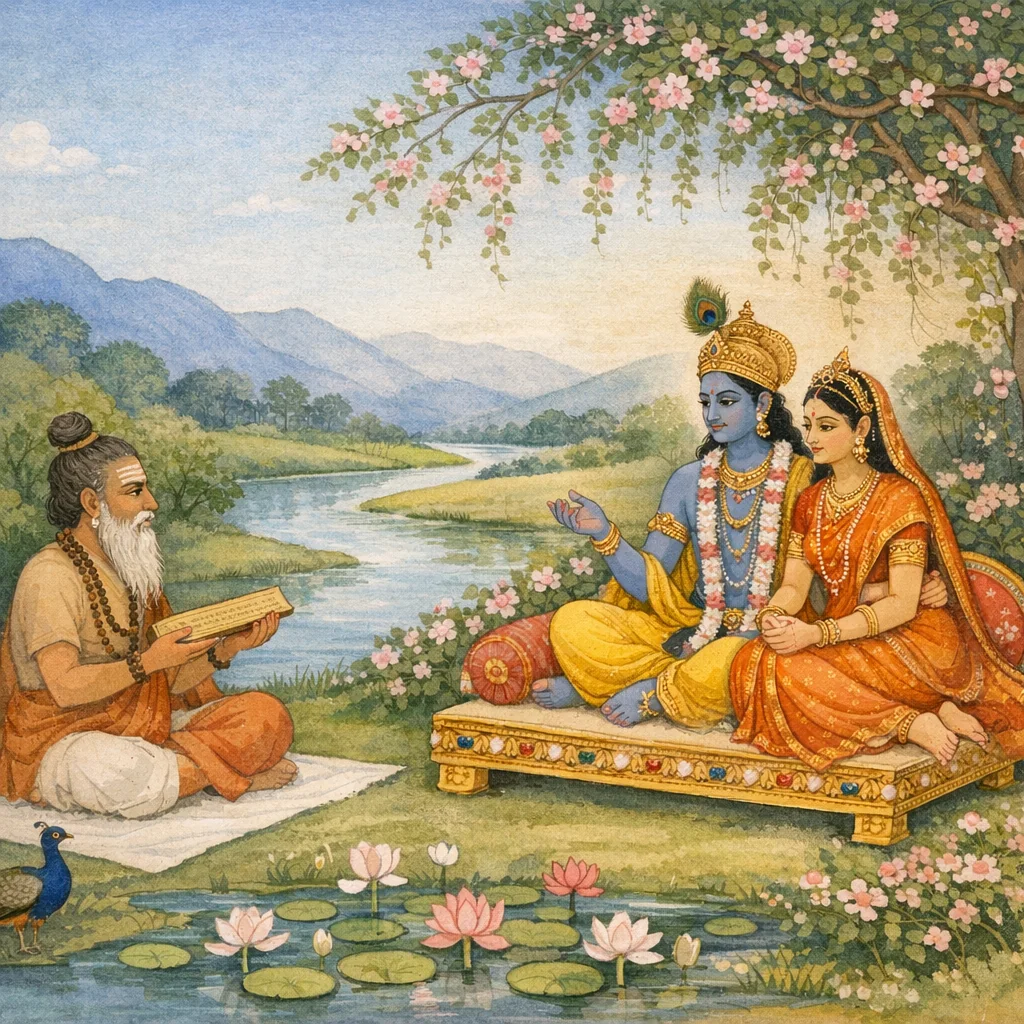
Kṛkala returns joyfully after visiting many tīrthas, convinced that his life and his ancestors’ destiny are secured. A divine rebuke follows: Brahmā (Pitāmaha) appears, binds the Pitṛs, and declares that Kṛkala lacks the highest merit; another imposing figure adds that the pilgrimage has borne no fruit. Grief-stricken, Kṛkala asks why his merit has failed and why the Pitṛs are bound. Dharma explains the fault: he abandoned his pure, virtuous wife, and performing rites—especially śrāddha—without her makes merit futile. The chapter extols the wife as the householder’s indispensable partner, teaching that when she is honored the home itself becomes a confluence of tīrthas. Thus dharma without the wife is incomplete and fruitless, while proper household order satisfies the Pitṛs and sustains sacrificial life.
Shlokas
Verse 1
विष्णुरुवाच । कृकलः सर्वतीर्थानि साधयित्वा गृहं प्रति । प्रस्थितः सार्थवाहेन महानंदसमन्वितः
Viṣṇu said: Having duly visited and completed the observances at all the sacred tīrthas, Kṛkala set out for his home, accompanied by a caravan-leader, filled with great joy.
Verse 2
एवं चिंतयते नित्यं संसारः सफलो मम । तृप्ताः स्वर्गं प्रयास्यंति पितरो मम नान्यथा
Thinking thus every day: “My life in the world is truly fruitful. Being satisfied, my forefathers will surely go to heaven—there is no other outcome.”
Verse 3
तावत्प्रत्यक्षरूपेण बद्ध्वा तस्य पितामहान् । पुरतस्तस्य संब्रूते नहि ते पुण्यमुत्तमम्
Then, assuming a visible form, the Grandfather (Brahmā) restrained him and spoke to him directly before his eyes: “You do not possess the highest merit.”
Verse 4
दिव्यरूपो महाकायः कृकलं वाक्यमब्रवीत् । तव तीर्थफलं नास्ति श्रममेव वृथा कृथाः
Divine in form and vast in stature, he spoke these words to Kṛkala: “For you there is no fruit from this pilgrimage; you are only undertaking pointless exertion in vain.”
Verse 5
स्वयं संतोषमाप्नोषि नहि ते पुण्यमुत्तमम् । एवं श्रुत्वा ततो वैश्यः कृकलो दुःखपीडितः
“You attain satisfaction for yourself, but you do not gain the highest merit.” Hearing this, the merchant Kṛkala was then afflicted with sorrow.
Verse 6
भवान्कः संवदस्येवं कस्माद्बद्धाः पितामहाः । केन दोषप्रभावेण तन्मेत्वं कारणं वद
Who are you to speak in this manner? Why have the grandfathers been bound? Under the influence of what fault has this happened? Tell me the reason.
Verse 7
कस्मात्तीर्थफलं नास्ति मम यात्रा कथं नहि । सर्वमेव समाचक्ष्व यदि जानासि संस्फुटम्
Why is there no fruit of pilgrimage for me? How can my journey not bear results? Tell me everything clearly, if you truly know.
Verse 8
धर्म उवाच । पूतां पुण्यतमां स्वीयां भार्यां त्यक्त्वा प्रयाति यः । तस्य पुण्यफलं सर्वं वृथा भवति नान्यथा
Dharma said: Whoever departs after abandoning his own wife—pure and most virtuous—finds that the entire fruit of his merit becomes futile; it cannot be otherwise.
Verse 9
धर्माचारपरां पुण्यां साधुव्रतपरायणाम् । पतिव्रतरतां भार्यां सुगुणां पुण्यवत्सलाम्
A wife devoted to dharma and righteous conduct—pure, steadfast in the vows of the virtuous, delighting in fidelity to her husband—endowed with good qualities and affectionate toward holy merit.
Verse 10
तामेवापि परित्यज्य धर्मकार्यं प्रयाति यः । वृथा तस्य कृतः सर्वो धर्मो भवति नान्यथा
Whoever, abandoning even that rightful duty, goes off to perform a so‑called act of dharma—every dharmic deed done by him becomes futile; it cannot be otherwise.
Verse 11
सर्वाचारपरा भव्या धर्मसाधनतत्परा । पतिव्रतरता नित्यं सर्वदा ज्ञानवत्सला
She is devoted to all proper conduct, intent on the means of righteousness; ever steadfast in the vow of pativrata, and always affectionate toward sacred knowledge.
Verse 12
एवं गुणा भवेद्भार्या यस्य पुण्या महासती । तस्य गेहे सदा देवास्तिष्ठंति च महौजसः
Blessed indeed is the man whose wife possesses such virtues—pious and truly great in chastity; in his home the radiant gods ever dwell.
Verse 13
पितरो गेहमध्यस्थाः श्रेयो वांछंति तस्य च । गंगाद्याः पुण्यनद्यश्च सागरास्तत्र नान्यथा
The ancestors (pitṛs), dwelling within his house, desire his welfare. There, indeed, are the Gaṅgā and other holy rivers, and even the oceans—there is no doubt of it.
Verse 14
पुण्या सती यस्य गेहे वर्तते सत्यतत्परा । तत्र यज्ञाश्च गावश्च ऋषयस्तत्र नान्यथा
In the home where a virtuous and chaste wife dwells, devoted to truth, there indeed are sacrifices (yajñas), cows, and sages (ṛṣis) present—never otherwise.
Verse 15
तत्र सर्वाणि तीर्थानि पुण्यानि विविधानि च । भार्यायोगेन तिष्ठंति सर्वाण्येतानि नान्यथा
There, all the tīrthas—manifold and holy—abide only through union with one’s wife; truly, in no other way do they exist.
Verse 16
पुण्यभार्याप्रयोगेण गार्हस्थ्यं संप्रजायते । गार्हस्थ्यात्परमो धर्मो द्वितीयो नास्ति भूतले
Through association with a virtuous wife, the householder’s state truly comes into being. On earth there is no dharma higher than the householder’s path; it has no second.
Verse 17
गृहस्थस्य गृहः पुण्यः सत्यपुण्यसमन्वितः । सर्वतीर्थमयो वैश्य सर्वदेवसमन्वितः
The house of a householder is meritorious, endowed with truth and virtue. O Vaiśya, it is verily composed of all tīrthas and endowed with the presence of all the gods.
Verse 18
गार्हस्थ्यं च समाश्रित्य सर्वे जीवंति जंतवः । तादृशं नैव पश्यामि अन्यमाश्रममुत्तमम्
Relying upon the householder’s way of life, all living beings sustain their lives. I do not see any other āśrama superior to one such as this.
Verse 19
मंत्राग्निहोत्रं देवाश्च सर्वे धर्माः सनातनाः । दानाचाराः प्रवर्तंते यस्य पुंसश्च वै गृहे
In that man’s house, mantra-recitation and the Agnihotra flourish; as though all the gods are present; the eternal duties of dharma are upheld; and the customary practices of dāna (charitable giving) proceed.
Verse 20
एवं यो भार्यया हीनस्तस्यगेहं वनायते । यज्ञाश्च वै न सिध्यंति दानानि विविधानि च
Thus, for a man bereft of a wife, his home becomes like a forest; and indeed, neither the yajñas reach fulfillment, nor the various acts of dāna come to completion.
Verse 21
भार्याहीनस्य पुंसोपि न सिध्यति महाव्रतम् । धर्मकर्माणि सर्वाणि पुण्यानि विविधानि च
For a man without a wife, even a great religious vow does not reach fulfillment; likewise, all duties of dharma and the many kinds of meritorious acts do not attain completion.
Verse 22
नास्ति भार्यासमं तीर्थं धर्मसाधनहेतवे । शृणुष्व त्वं गृहस्थस्य नान्यो धर्मो जगत्त्रये
For accomplishing dharma, there is no tīrtha equal to one’s wife. Listen: for the householder (gṛhastha), there is no other dharma in the three worlds.
Verse 23
यत्र भार्या गृहं तत्र पुरुषस्यापि नान्यथा । ग्रामे वाप्यथवारण्ये सर्वधर्मस्य साधनम्
Where the wife is, there indeed is the home for the husband—there is no other true home. Whether in a village or even in the forest, she is the means for the fulfillment of all dharma.
Verse 24
नास्ति भार्यासमं तीर्थं नास्ति भार्यासमं सुखम् । नास्ति भार्यासमं पुण्यं तारणाय हिताय च
There is no tīrtha equal to a wife; there is no happiness equal to a wife. There is no puṇya equal to a wife—both for one’s deliverance and for one’s welfare.
Verse 25
धर्मयुक्तां सतीं भार्यां त्यक्त्वा यासि नराधम । गृहं धर्मं परित्यज्य क्वास्ते धर्मस्य ते फलम्
O lowest of men, having cast away your virtuous and faithful wife, you depart. Abandoning home and dharma alike—where, then, is the fruit of your dharma to be found?
Verse 26
तया विना यदा तीर्थे श्राद्धदानं कृतं त्वया । तेन दोषेण वै बद्धास्तव पूर्वपितामहाः
When you performed the śrāddha offering at the sacred tīrtha without her, by that very fault your forefathers—the earlier grandfathers—have indeed become bound.
Verse 27
भवांश्चौरो ह्यमी चौरा यैस्तु भुक्तं सुलोलुपैः । त्वया दत्तस्य श्राद्धस्य अन्नमेवं तया विना
You too are a thief—and these are thieves as well—for, being exceedingly greedy, they consumed the food of the śrāddha you offered in this manner, without her.
Verse 28
सुपुत्रः श्रद्धया युक्तः श्राद्धदानं ददाति यः । भार्या दत्तेन पिंडेन तस्य पुण्यं वदाम्यहम्
I shall declare the merit of that man whose worthy son, endowed with faith, gives offerings in the śrāddha rite; and when the wife offers the piṇḍa, the puṇya arising from that offering belongs to him.
Verse 29
यथाऽमृतस्य पानेन नृणां तृप्तिर्हि जायते । तथा पितॄणां श्राद्धेन सत्यंसत्यं वदाम्यहम्
Just as men are satisfied by drinking amṛta, so too are the Pitṛs satisfied by the śrāddha rite—this is the truth; truly, truly, I declare it.
Verse 30
गार्हस्थ्यस्य च धर्मस्य भार्या भवति स्वामिनी । त्वयैषा वंचिता मूढ चौरकर्मकृतं वृथा
In the dharma of household life, the wife is the mistress of the home. But you, fool, have deceived her—your conduct has been mere thievery, done in vain.
Verse 31
अमी पितामहाश्चौरा यैर्भुक्तं तु तया विना । भार्या पचति चेदन्नं स्वहस्तेनामृतोपमम्
Those forefathers are thieves, indeed—who eat food without her. But if the wife cooks the meal with her own hands, it becomes like nectar.
Verse 32
तदन्नमेवभुंजंति पितरो हृष्टमानसाः । तेनैव तृप्तिमायांति संतुष्टाश्च भवंति ते
The Pitṛs (ancestors), delighted at heart, partake of that very food; by that alone they attain satisfaction, and thus they become fully content.
Verse 33
तस्माद्भार्यां विना धर्मः पुरुषस्य न सिध्यति । नास्ति भार्यासमं तीर्थं पुंसां सुगतिदायकम्
Therefore, without a wife, a man’s dharma does not come to fruition. For men, there is no sacred ford (tīrtha) equal to a wife—one that bestows a good destiny.
Verse 34
भार्यां विना च यो धर्मः स एव विफलो भवेत्
Any dharma practiced without a wife is, indeed, rendered fruitless.
Verse 59
इति श्रीपद्मपुराणे भूमिखंडे वेनोपाख्याने सुकलाचरित्रे एकोनषष्टितमोऽध्यायः
Thus ends the fifty-ninth chapter—the account of Sukalā—within the Vena episode, in the Bhūmi-khaṇḍa of the sacred Padma Purāṇa.