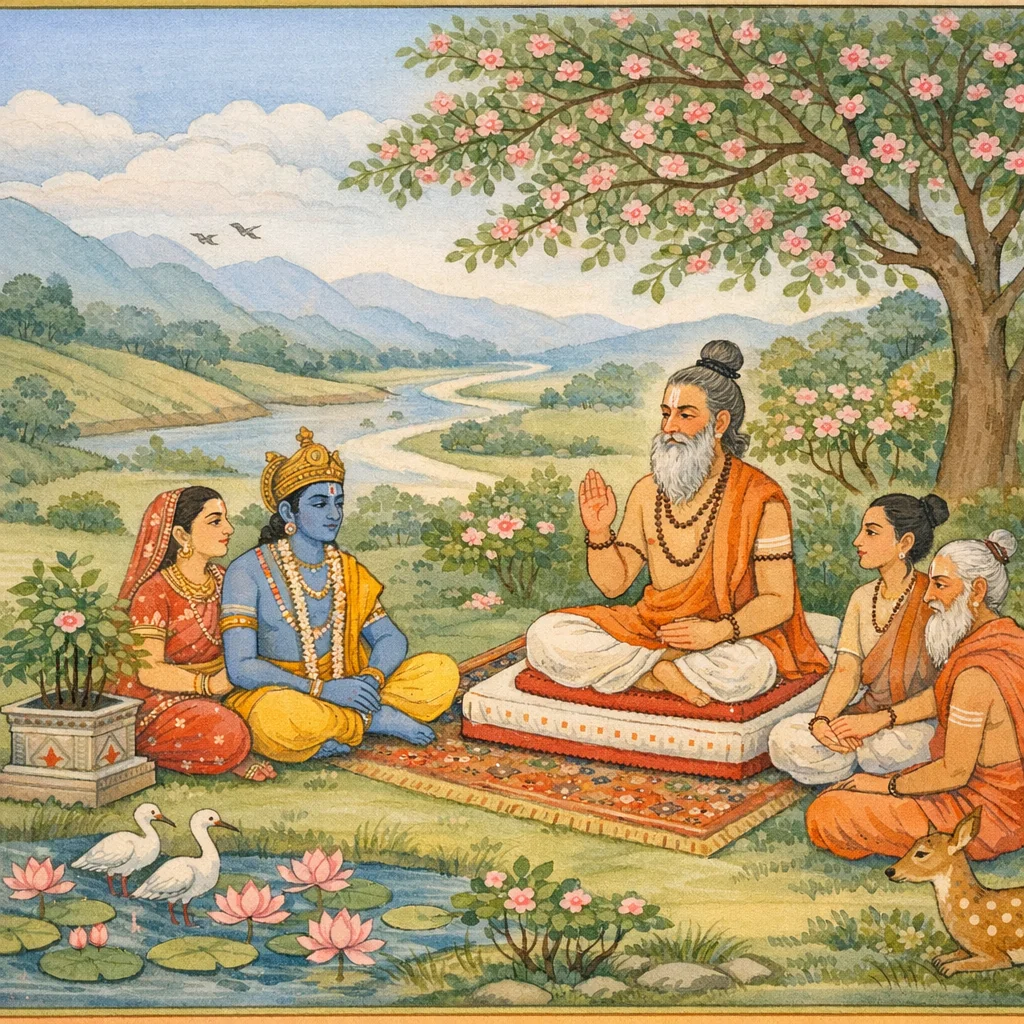
Adhyaya 28
The Birth of King Pṛthu: Vena’s Fall, the Sages’ Churning, and Earth’s Surrender
The sages ask to hear again the account of King Pṛthu’s birth and how the Earth was “milked” by various beings. The narrator lays down strict rules of transmission—this teaching is for the faithful—and proclaims its phalaśruti: hearing or reciting it destroys sins gathered over many births and benefits all varṇas. In the lineage, Aṅga begets Vena through Sunīthā. Vena rejects Vedic dharma, forbids study, sacrifice, and giving, and proclaims himself to be Viṣṇu/Brahmā/Rudra. The enraged sages restrain him and churn his body: from the left thigh arise the Niṣādas and other marginalized groups; from the right emerges the radiant Pṛthu, anointed by gods and brāhmaṇas. Under Pṛthu, abundance and ritual order return. Later, when famine strikes and Earth withholds her produce, Pṛthu pursues Bhūdevī as she shifts forms, until she finally surrenders. As Dhātrī/Vasundharā she pleads for non-violence toward women and cows, and instructs him in rightful means to sustain the world. Pṛthu prepares to answer her appeal.
Shlokas
Verse 1
ऋषय ऊचुः । विस्तरेण समाख्याहि जन्म तस्य महात्मनः । पृथोश्चैव महाभाग श्रोतुकामा वयं पुनः
The sages said: “O fortunate one, narrate in detail the birth of that great-souled person—and also of Pṛthu. We wish to hear it again.”
Verse 2
राज्ञा तेन यथा दुग्धा इयं धात्री महात्मना । पुनर्देवैश्च पितृभिर्मुनिभस्तत्त्ववेदिभिः
Just as that great-souled king once ‘milked’ this nurturing Earth to yield her riches, so too was she again ‘milked’ by the gods, the ancestors (pitṛs), and the sages who know the truth.
Verse 3
यथा दैत्यैश्च नागैश्च यथा यक्षैर्यथा द्रुमैः । शैलैश्चैव पिशाचैश्च गंधर्वैः पुण्यकर्मभिः
Just as with the Daityas and the Nāgas, just as with the Yakṣas and the trees; so too with the mountains, the Piśācas, and the Gandharvas who perform meritorious deeds.
Verse 4
ब्राह्मणैश्च तथा सिद्धै राक्षसैर्भीमविक्रमैः । पूर्वमेव यथा दुग्धा अन्यैश्च सुमहात्मभिः
It had already been ‘milked’ before—by brāhmaṇas and likewise by siddhas, by rākṣasas of dreadful prowess, and by other great-souled beings as well.
Verse 5
तेषामेव हि सर्वेषां विशेषं पात्रधारणम् । क्षीरस्यापि विधिं ब्रूहि विशेषं च महामते
Indeed, for all of them, explain the specific distinctions regarding the keeping and safeguarding of vessels. Also tell me the prescribed procedure concerning milk—its special details as well, O great-minded one.
Verse 6
वेनस्यापि नृपस्यैव पाणिरेव महात्मनः । ऋषिभिर्मथितः पूर्वं स कस्मादिह कारणात्
Even the hand of King Vena—of that great-souled one—was once churned by the sages. For what reason, then, did that occur here?
Verse 7
क्रुद्धश्चैव महापुण्यैः सूतपुत्र वदस्व नः । विचित्रेयं कथा पुण्या सर्वपापप्रणाशिनी
O Sūta’s son, though we are angered, speak to us with your great merit. This wondrous, holy narrative is virtuous and destroys all sins.
Verse 8
श्रोतुकामा महाभाग तृप्तिर्नैव प्रजायते । सूत उवाच । वैन्यस्य हि पृथोश्चैव तस्य विस्तरमेव च
O fortunate one, though eager to hear, satisfaction does not arise at all. Sūta said: I shall relate in detail the account of Pṛthu, the son of Vena, and his full narrative as well.
Verse 9
जन्मवीर्यं तथा क्षेत्रं पौरुषं द्विजसत्तमाः । प्रवक्ष्यामि यथा सर्वं चरित्रं तस्य धीमतः
O best of the twice-born, I shall describe—just as it truly is—his birth and vigor, his domain, his valor, and the full account of that wise one’s life-story.
Verse 10
शुश्रूषध्वं महाभागा मामेवं द्विजसत्तमाः । अभक्ताय न वक्तव्यमश्रद्धाय शठाय च
Listen attentively to me in this manner, O greatly fortunate ones, O best of the twice-born. This should not be spoken to one without bhakti, nor to one without śraddhā, nor to a deceitful person.
Verse 11
सुमूर्खाय सुमोहाय कुशिष्याय तथैव च । श्रद्धाहीनाय कूटाय सर्वनाशाय मा द्विजाः
O twice-born ones, do not impart this to one who is utterly foolish, deluded, a bad disciple, devoid of śraddhā, deceitful, or bent on total ruin.
Verse 12
अन्यथा पठते यो हि निरयं च प्रयाति हि । भवंतो भावसंयुक्ताः सत्यधर्मपरायणाः
But whoever recites it otherwise, incorrectly, indeed goes to hell. You, however—endowed with right understanding and bhāva—are devoted to truth and dharma.
Verse 13
भवतामग्रतः सर्वं चरित्रं पापनाशनम् । संप्रवक्ष्याम्यशेषेण शृणुध्वं द्विजसत्तमाः
Before you all, I shall now relate in full this entire account that destroys sin; listen, O best of the twice-born.
Verse 14
स्वर्ग्यं यशस्यमायुष्यं धन्यं वेदैश्च संमितम् । रहस्यमृषिभिः प्रोक्तं प्रवक्ष्यामि द्विजोत्तमाः
O best of the twice-born, I shall now expound that secret teaching which leads to svarga, brings fame and long life, bestows auspiciousness, is in harmony with the Vedas, and was declared by the rishis.
Verse 15
यश्चैनं कीर्तयेन्नित्यं पृथोर्वैन्यस्य विस्तरम् । ब्राह्मणेभ्यो नमस्कृत्वा न स शोचेत्कृताकृतम्
Whoever continually recites this full account of Pṛthu, the son of Vena—having first bowed in reverence to the Brāhmaṇas—does not grieve over what was done or left undone.
Verse 16
सप्तजन्मार्जितं पापं श्रुतमात्रेण नश्यति । ब्राह्मणो वेदविद्वांश्च क्षत्रियो विजयी भवेत्
Sin gathered through seven births is destroyed merely by hearing (this sacred account). A Brāhmaṇa becomes a knower of the Vedas, and a Kṣatriya becomes victorious.
Verse 17
वैश्यो धनसमृद्धः स्याच्छूद्रः सुखमवाप्नुयात् । एवं फलं समाप्नोति पठनाच्छ्रवणादपि
A Vaiśya becomes prosperous in wealth, and a Śūdra attains happiness. Thus this fruit is obtained, whether by reading or by hearing as well.
Verse 18
पृथोर्जन्मचरित्रं च पवित्रं पापनाशनम् । धर्मगोप्ता महाप्राज्ञो वेदशास्त्रार्थकोविदः
The account of Pṛthu’s birth and deeds is holy and destroys sin. He was a protector of dharma, greatly wise, and skilled in the meanings of the Vedas and the śāstras.
Verse 19
अत्रिवंशसमुत्पन्नः पूर्वमत्रिसमः प्रभुः । स्रष्टा सर्वस्य धर्मस्य अंगो नाम प्रजापतिः
Born in the lineage of Atri, and in former times a lord equal to Atri, there was the Prajāpati named Aṅga—the creator and establisher of all dharma.
Verse 20
य आसीत्तस्य पुत्रो वै वेनो नाम प्रजापतिः । धर्ममेवं परित्यज्य सर्वदैव प्रवर्तते
His son, indeed, was the Prajāpati named Vena; having thus forsaken dharma, he ever acted in opposition to it.
Verse 21
मृत्योः कन्या महाभागा सुनीथा नाम नामतः । तां तु अंगो महाभागः सुनीथामुपयेमिवान्
Mṛtyu had a most fortunate daughter named Sunīthā. The illustrious Aṅga took that Sunīthā as his wife.
Verse 22
तस्यामुत्पादयामास वेनं धर्मप्रणाशनम् । मातामहस्य दोषेण वेनः कालात्मजात्मजः
From her he begot Vena, a destroyer of dharma; and due to the fault of his maternal grandfather, Vena was the grandson of Kāla’s son.
Verse 23
निजधर्मं परित्यज्य अधर्मनिरतोभवत् । कामाल्लोभान्महामोहात्पापमेव समाचरत्
Abandoning his own prescribed duty, he became devoted to unrighteousness; driven by desire, greed, and great delusion, he committed nothing but sin.
Verse 24
वेदाचारमयं धर्मं परित्यज्य नराधिपः । अन्ववर्तत पापेन मदमत्सरमोहितः
Abandoning the dharma grounded in Vedic conduct, the king followed the path of sin, deluded by pride, envy, and infatuation.
Verse 25
वेदाध्यायं विना लोके प्रावर्तंत तदा जनाः । निःस्वाध्यायवषट्काराः प्रजास्तस्मिन्प्रजापतौ
Then people in the world began to live without the study of the Veda; under that Prajāpati, the subjects were without svādhyāya (sacred self-recitation) and without the sacrificial exclamation “vaṣaṭ.”
Verse 26
प्रवृत्तं न पपुः सोमं हुतं यज्ञेषु देवताः । इत्युवाच स दुष्टात्मा ब्राह्मणान्प्रति नित्यशः
“The gods do not drink the Soma that has been duly prepared and offered in the yajñas.” Thus that wicked-minded man would repeatedly say this to the brāhmaṇas.
Verse 27
नाध्येतव्यं न होतव्यं न देयं दानमेव च । न यष्टव्यं न होतव्यमिति तस्य प्रजापतेः
“One should not study; one should not offer oblations; one should not give—nor even make gifts. One should not perform sacrifices, nor offer oblations”: such was the injunction of that Prajāpati.
Verse 28
आसीत्प्रतिज्ञा क्रूरेयं विनाशे प्रत्युपस्थिते । अहमिज्यश्च यष्टा च यज्ञश्चेति पुनः पुनः
When destruction had drawn near, this harsh resolve arose again and again: “I alone am to be worshipped; I alone am the sacrificer; and I alone am the sacrifice.”
Verse 29
मयि यज्ञा विधातव्या मयि होतव्यमित्यपि । इत्यब्रवीत्सदा वेनो ह्यहं विष्णुः सनातनः
“Sacrifices must be performed for me; and the oblations must be offered into me as well.” Thus King Vena would constantly declare: “For I am Viṣṇu, the Eternal.”
Verse 30
अहं ब्रह्मा अहं रुद्रो मित्र इंद्रः सदागतिः । अहमेव प्रभोक्ता च हव्यं कव्यं न संशयः
I am Brahmā; I am Rudra; I am Mitra and Indra, the ever-abiding refuge. I alone am the Lord who partakes of the offerings—havya for the devas and kavya for the ancestors; of this there is no doubt.
Verse 31
अथ ते मुनयः क्रुद्धा वेनं प्रति महाबलाः । ऊचुस्ते संगताः सर्वे राजानं पापचेतनम्
Then those mighty sages, angered, gathered together and spoke to Vena, the king of sinful intent.
Verse 32
ऋषय ऊचुः । राजा हि पृथिवीनाथः प्रजां पालयते सदा । धर्ममूर्तिः स राजेंद्र तस्माद्धर्मं हि रक्षयेत्
The sages said: “Indeed, the king is the lord of the earth and ever protects his subjects. O best of kings, he is the very embodiment of dharma; therefore he must surely safeguard dharma.”
Verse 33
वयं दीक्षां प्रवेक्ष्यामो यज्ञे द्वादशवार्षिकीम् । अधर्मं कुरु मा यागे नैष धर्मः सतां गतिः
“We are about to enter dīkṣā, the consecratory vow, for a twelve-year yajña. Do not commit adharma in the sacrifice—this is not dharma, nor is it the path of the virtuous.”
Verse 34
कुरु धर्मं महाराज सत्यं पुण्यं समाचर । प्रजाहं पालयिष्यामि इति ते समयः कृतः
“Practice dharma, O great king; follow truth and perform meritorious deeds. For you have made this pledge: ‘I will protect the people.’”
Verse 35
तांस्तथाब्रुवतः सर्वान्महर्षीनब्रवीत्तदा । वेनः प्रहस्य दुर्बुद्धिरिममर्थमनर्थकम्
As all those great sages spoke thus, Vena—laughing, and of wicked intellect—then replied with a hollow, senseless utterance.
Verse 36
वेन उवाच । स्रष्टा धर्मस्य कश्चान्यः श्रोतव्यं कस्य वा मया । श्रुतवीर्यतपः सत्ये मया वा कः समो भुवि
Vena said: “Who else is the maker of dharma? And whom should I heed? In fame, valor, austerity, and truth—who on earth is equal to me?”
Verse 37
प्रभवं सर्वभूतानां धर्माणां च विशेषतः । संमूढा न विदुर्नूनं भवंतो मां विचेतसः
I am the source of all beings—and especially of all dharmas. Yet you, bewildered and without discernment, surely do not recognize me.
Verse 38
इच्छन्दहेयं पृथिवीं प्लावयेयं जलैस्तथा । द्यां भुवं चैव रुंधेयं नात्र कार्या विचारणा
If I wished, I could burn the earth; likewise, I could flood it with waters. I could even obstruct the heaven and the mid-world—there is no need for deliberation about this.
Verse 39
यदा न शक्यते मोहादवलेपाच्च पार्थिव । अपनेतुं तदा वेनं ततः क्रुद्धा महर्षयः
O king, when, through delusion and arrogance, Vena could not be restrained or turned from his course, then the great sages became enraged.
Verse 40
विस्फुरंतं तदा वेनं बलाद्गृह्य ततो रुषा । वेनस्य तस्य सव्योरुं ममंथुर्जातमन्यवः
Then, seizing Vena by force as he struggled, and in anger, those whose wrath had arisen churned Vena’s left thigh.
Verse 41
कृष्णांजनचयोपेतमतिह्रस्वं विलक्षणम् । दीर्घास्यं च विरूपाक्षं नीलकंचुकवर्चसम्
Smeared with a thick coating of black collyrium, exceedingly short and strange in appearance—long-faced, with misshapen eyes, and shining in a blue tunic-like covering.
Verse 42
लंबोदरं व्यूढकर्णमतिभीतं दुरोदरम् । ददृशुस्ते महात्मानो निषीदेत्यब्रुवंस्ततः
They saw him—pot-bellied, with spread-out ears, greatly frightened, and gaunt of belly; then those great souls said to him, “Sit down.”
Verse 43
तेषां तद्वचनं श्रुत्वा निषसाद भयातुरः । पर्वतेषु वनेष्वेव तस्य वंशः प्रतिष्ठितः
Hearing their words, he sat down, distressed with fear. His lineage became established only in the mountains and forests.
Verse 44
निषादाश्च किराताश्च भिल्लानाहलकास्तथा । भ्रमराश्च पुलिंदाश्च ये चान्ये म्लेच्छजातयः
Niṣādas, Kirātas, Bhillas, and Āhalakas; Brāmaras and Puliṇḍas as well—along with whatever other communities are classed as mlecchas (foreign or non-Vedic peoples).
Verse 45
पापाचारास्तु ते सर्वे तस्मादंगात्प्रजज्ञिरे । अथ ते ऋषयः सर्वे प्रसन्नमनसस्ततः
All those of sinful conduct were born from that limb. Thereupon, all the sages became pleased in mind.
Verse 46
गतकल्मषमेवं तं जातं वेनं नृपोत्तमम् । ममंथुर्दक्षिणं पाणिं तस्यैव च महात्मनः
Thus, Vena—the best of kings—was born free from impurity; and those sages churned the right hand of that very great soul.
Verse 47
मथिते तस्य पाणौ तु संजातं स्वेदमेव हि । पुनर्ममंथुस्ते विप्रा दक्षिणं पाणिमेव च
As his hand was being churned, sweat indeed arose in his palm. Then those brāhmaṇas churned again—this time his right hand as well.
Verse 48
सुकरात्पुरुषो जज्ञे द्वादशादित्यसन्निभः । तप्तकांचनवर्णांगो दिव्यमाल्यांबरावृतः
From the boar there was born a man, radiant like the twelve Ādityas; his limbs were the color of heated gold, and he was adorned with divine garlands and garments.
Verse 49
दिव्याभरणशोभांगो दिव्यगंधानुलेपनः । मुकुटेनार्कवर्णेन कुंडलाभ्यां विराजते
His limbs shine with celestial ornaments; he is anointed with divine fragrance. He is resplendent with a diadem radiant like the sun, and with a pair of earrings.
Verse 50
महाकायो महाबाहू रूपेणाप्रतिमो भुवि । खड्गबाणधरो धन्वी कवची च महाप्रभुः
He was of vast stature and mighty arms, unmatched in form upon the earth—bearing sword and arrows, a bowman clad in armor, a great and radiant lord.
Verse 51
सर्वलक्षणसंपन्नः सर्वालंकारभूषणः । तेजसा रूपभावेन सुवर्णैश्च महामतिः
Endowed with every auspicious mark and adorned with all ornaments, he—through splendor, beauty of form, and golden radiance—appeared as one great and wise.
Verse 52
दिवि इंद्रो यथा भाति भुवि वेनात्मजस्तथा । तस्मिञ्जाते महाभागे देवाश्च ऋषयोमलाः
As Indra shines in heaven, so did Vena’s son shine upon the earth. When that most fortunate one was born, the gods and the stainless sages rejoiced.
Verse 53
उत्सवं चक्रिरे सर्वे वेनस्य तनयं प्रति । दीप्यमानः स्ववपुषा साक्षादग्निरिवोज्ज्वलः
All of them held a festival in honor of Vena’s son. Radiant with his own splendor, he shone brilliantly—like fire itself made manifest.
Verse 54
आद्यमाजगवं नाम धनुर्गृह्य महावरम् । शरान्दिव्यांश्च रक्षार्थे कवचं च महाप्रभम्
First he took up the mighty bow named Ājagava; and for protection he also took divine arrows and a splendid coat of mail, great in power.
Verse 55
जाते सति महाभागे पृथौ वीरे महात्मनि । संप्रह्रष्टानि भूतानि समस्तानि द्विजोत्तम
When the greatly fortunate Pṛthu—the heroic, great-souled one—was born, all living beings rejoiced, O best of the twice-born.
Verse 56
सर्वतीर्थानि तोयानि पुण्यानि विविधानि च । तस्याभिषेके विप्रेंद्राः सर्व एव प्रतस्थिरे
All the sacred waters of every tīrtha, and many other kinds of holy waters besides, were gathered; and for his consecratory bathing (abhiṣeka) all the foremost brāhmaṇas set forth.
Verse 57
पितामहाद्या देवास्तु भूतानि विविधानि च । स्थावराणि चराण्येव अभ्यषिंचन्नराधिपम्
Then the gods beginning with Pitāmaha (Brahmā), along with the many kinds of beings—both the immobile and the mobile—anointed the king.
Verse 58
महावीरं प्रजापालं पृथुमेव द्विजोत्तम । पृथुर्वैन्यो राजराज्ये अभिगम्य चराचरैः
O best of brāhmaṇas, Pṛthu alone was great in valor and a protector of his subjects. When Pṛthu Vainya attained the sovereignty of kingship, all beings, moving and unmoving, came to pay him homage.
Verse 59
देवैर्विप्रैस्तथा सर्वैरभिषिक्तो महामनाः । राज्ञां समधिराज्ये वै पृथुर्वैन्यः प्रतापवान्
Then the high-minded, mighty Pṛthu Vainya was anointed by the gods and the brāhmaṇas—indeed by all—and was established as the paramount sovereign among kings.
Verse 60
तस्य पित्रा प्रजाः सर्वाः कदा नैवानुरंजिताः । तेनानुरंजिताः सर्वा मुमुदिरे सुखेन वै
By his father, all the subjects were never truly delighted at any time; but delighted by him, they all rejoiced happily indeed.
Verse 61
अनुरागात्तस्य वीरस्य नाम राजेत्यजायत । प्रयातस्य सुवीरस्य समुद्रस्य द्विजोत्तम
Out of affection, that hero came to be known by the name “Rāja.” And when that valiant one set forth, O best of the twice-born, he went to the ocean.
Verse 62
आपस्तस्तंभिरे सर्वा भयात्तस्य महात्मनः । दुर्गं मार्गं विलोप्यैव सुमार्गं पर्वता ददुः
Out of fear of that great-souled one, all the waters became motionless; and the mountains, erasing the perilous route, provided an easy path.
Verse 63
ध्वजभंगं न चक्रुस्ते गिरयः सर्व एव ते । अकृष्टपच्या पृथिवी सर्वत्र कामधेनवः
Those mountains—all of them—did not cause the breaking of the banner. The earth yielded crops without ploughing, and everywhere there were wish-fulfilling cows.
Verse 64
पर्जन्यः कामवर्षी च वेदयज्ञान्महोत्सवान् । कुर्वंति ब्राह्मणाः सर्वे क्षत्रियाश्च तथा परे
Parjanya, the giver of rain, becomes a fulfiller of desires; and all the Brāhmaṇas—along with the Kṣatriyas and others—perform the grand festivals of Vedic sacrifices.
Verse 65
सर्वकामफला वृक्षास्तस्मिञ्छासति पार्थिवे । न दुर्भिक्षं न च व्याधिर्नाकालमरणं नृणाम्
When that king ruled, the trees bore fruits that fulfilled every desire. There was no famine, no disease, and no untimely death among the people.
Verse 66
सर्वे सुखेन जीवंति लोका धर्मपरायणाः । तस्मिञ्छासति दुर्धर्षे राजराजे महात्मनि
All people, devoted to dharma, lived happily while that unconquerable, great-souled king of kings was ruling.
Verse 67
एतस्मिन्नेव काले तु यज्ञे पैतामहे शुभे । सूत सूत्यां समुत्पन्नः सौम्येहनि महात्मनि
At that very time, during the auspicious ancestral sacrifice, the paitāmaha-yajña, O Sūta, a noble son was born to your wife—on a gentle and holy day.
Verse 68
तस्मिन्नेव महायज्ञे जज्ञे प्राज्ञोऽथ मागधः । पृथोःस्तवार्थं तौ तत्र समाहूतौ महर्षिभिः
In that very great sacrifice, the wise bard named Māgadha was born. For the purpose of praising King Pṛthu, the two of them were summoned there by the great sages.
Verse 69
सूतस्य लक्षणं वक्ष्ये महापुण्यं द्विजोत्तमाः । शिखासूत्रेण संयुक्तो वेदाध्ययनतत्परः
O best of the twice-born, I shall describe the characteristics of the Sūta—highly meritorious: he is endowed with the śikhā and the sacred thread, and is devoted to the study of the Vedas.
Verse 70
सर्वशास्त्रार्थवेत्तासावग्निहोत्रमुपासते । दानाध्ययनसंपन्नो ब्रह्माचारपरायणः
He knows the purport of all śāstras and duly performs the sacred Agnihotra. Endowed with charity and holy study, he is devoted to the discipline of brahmacarya.
Verse 71
देवानां ब्राह्मणानां च पूजनाभिरतः सदा । याचकस्तावकैः पुण्यैर्वेदमंत्रैर्यजेत्किल
Ever devoted to the worship of the devas and the brāhmaṇas, the supplicant should indeed perform the yajña with your meritorious deeds and with Vedic mantras.
Verse 72
ब्रह्माचारपरो नित्यं संबंधं ब्राह्मणैः सह । एवं स मागधो जज्ञे वेदाध्ययनवर्जितः
Though ever devoted to brahmacarya and keeping company with brāhmaṇas, that Māgadha was nonetheless born deprived of Vedic study.
Verse 73
बंदिनश्चारणाः सर्वे ब्रह्माचारविवर्जिताः । ज्ञेयास्ते च महाभागाः स्तावकाः प्रभवंति ते
All bards and heavenly minstrels are devoid of the discipline of brahmacarya; know, O fortunate one, that they arise as mere panegyrists, as simple praisers.
Verse 74
स्तवनार्थमुभौ सृष्टौ निपुणौ सूतमागधौ । तावूचुरृषयः सर्वे स्तूयतामेष पार्थिवः
For the purpose of eulogy, two skilled bards—Sūta and Māgadha—were created. Then all the ṛṣis said to them, “Let this king be praised.”
Verse 75
कर्मैतदनुरूपं च यादृशोयं नराधिपः । तावूचतुस्तदा सर्वांस्तानृषीन्बंदिमागधौ
“This outcome accords with karma, and it befits the nature of this king.” Then the Bard and the Māgadha addressed all those sages.
Verse 76
आवां देवानृषींश्चैव प्रीणयावः स्वकर्मभिः । न चास्य विद्वो वै कर्म न तथा लक्षणं यशः
“By our own deeds we shall indeed please the devas and the sages. Yet, O wise one, his action is not of that kind, nor do his marks and fame correspond to it.”
Verse 77
कर्मणा येन कुर्यावः स्तोत्रमस्य महात्मनः । जानीवस्तन्न विप्रेंद्रा अविज्ञातगुणस्य हि
By what act, by what means, could we compose a hymn of praise for this great-souled one? For, O best of brāhmaṇas, we do not know—since his qualities are not yet fully known.
Verse 78
भविष्यैस्तैर्गुणैः पुण्यैः स्तोतव्योयं नरोत्तमः । कृतवान्यानि कर्माणि पृथुरेव महायशाः
This best of men should be praised for those future, virtuous, and meritorious qualities—just as the greatly renowned King Pṛthu is praised for the deeds he performed.
Verse 79
ऊचुस्ते मुनयः सर्वे गुणान्दिव्यान्महात्मनः । सत्यवाञ्ज्ञानसंपन्नो बुद्धिमान्ख्यातविक्रमः
Then all those sages spoke of the divine virtues of that great-souled one: truthful, endowed with knowledge, intelligent, and renowned for his valor.
Verse 80
सदा शूरो गुणग्राही पुण्यवांस्त्यागवान्गुणी । धार्मिकः सत्यवादी च यज्ञानां याजकोत्तमः
He is ever courageous, a discerner of virtue; meritorious, generous, and endowed with noble qualities. Righteous and truthful, he is the finest performer of sacrificial rites (yajña).
Verse 81
प्रियवाक्सत्यवादी च धान्यवान्धनवान्गुणी । गुणज्ञः सगुणग्राही धर्मज्ञः सत्यवत्सलः
He speaks with pleasing words and is truthful; rich in grain and wealth, and possessed of virtues. He knows true merit, cherishes good qualities, understands dharma, and is devoted to truth.
Verse 82
सर्वगः सर्ववेत्ता च ब्रह्मण्यो वेदवित्सुधीः । प्रज्ञावान्सुस्वरश्चैव वेदवेदांगपारगः
He is all-pervading and all-knowing; devoted to Brahman, a wise knower of the Vedas. Endowed with insight and a pleasing voice, he has mastered the Vedas and their auxiliary disciplines (Vedāṅgas).
Verse 83
धाता गोप्ता प्रजानां स विजयी समरांगणे । राजसूयादिकानां तु यज्ञानां राजसत्तमः
He is the sustainer and protector of the people; victorious on the battlefield, he is the foremost of kings, fit to perform royal sacrifices such as the Rājasūya.
Verse 84
आहर्ता भूतले चैकः सर्वधर्मसमन्वितः । एते गुणा अस्य चांगे भविष्यंति महात्मनः
On earth there will arise one unrivaled leader, endowed with all the virtues of dharma. These qualities will manifest in the very person of that great-souled one.
Verse 85
ऋषिभिस्तौ नियुक्तौ तु कुर्वाणौ सूतमागधौ । गुणैश्चैव भविष्यैश्च स्तोत्रं तस्य महात्मनः
Appointed by the sages, those two—Sūta and Māgadha—were composing a hymn to that great-souled one, praising him for his virtues and for the deeds he would yet accomplish.
Verse 86
तदा प्रभृति वै लोकास्तवैस्तुष्टा महामते । पुरतश्च भविष्यंति दातारः स्तावनैर्गुणैः
From that time onward, O great-minded one, people, pleased by your hymns, will come before you as benefactors, stirred by praises of your virtues.
Verse 87
ततः प्रभृति लोकेस्मिन्स्तवेषु द्विजसत्तमाः । आशीर्वादाः प्रयुज्यंते तेषां द्रविणमुत्तमम्
From that time onward in this world, O best of the twice-born, blessings are uttered within hymns; and for those who speak them, that blessing becomes the highest wealth.
Verse 88
सूताय मागधायैव बंदिने च महोदयम् । चारणाय ततः प्रादात्तैलंगं देशमुत्तमम्
He then bestowed the prosperous region of Mahodaya upon the Sūta, the Māgadha, and the Bard (Bandin); and to the Cāraṇa he granted the excellent land of Tailaṅga (Teliṅga).
Verse 89
पृथुः प्रसादाद्धर्मात्मा हैहयं देशमेव च । रेवातीरे पुरं कृत्वा स्वनाम्ना नृपनंदनः
The righteous Pṛthu, by his favor, also granted the Haihaya country; and the king’s son built a city on the bank of the Revā, naming it after himself.
Verse 90
ब्राह्मणेभ्यो द्विजश्रेष्ठ यजन्दाता पृथुः पुरा । सर्वज्ञं सर्वदातारं धर्मवीर्यं नरोत्तमम्
O best of the twice-born, in ancient times King Pṛthu—giving gifts while performing sacrifices—honored the Brāhmaṇas: the omniscient one, the giver to all, the champion of dharma, the foremost among men.
Verse 91
तं ददृशुः प्रजाः सर्वा मुनयश्च तपोमलाः । ऊचुः परस्परं पुण्या एष राजा महामतिः
All the people saw him, and the sages—purified by austerity—beheld him as well. Those virtuous ones said to one another, “This is a great-minded king.”
Verse 92
देवादीनां वृत्तिदाता अस्माकं च विशेषतः । प्रजानां पालकश्चैव वृत्तिदो हि भविष्यति
He will indeed become the provider of livelihood for the gods and others—and especially for us; he will also be the protector of the subjects, a true giver of sustenance.
Verse 93
इयं धात्री महाप्राज्ञा उप्तं बीजं पुरा किल । जीवनार्थं प्रजाभिस्तु ग्रासयित्वा स्थिराभवत्
This Earth (Dhātrī), of great wisdom, is said to have once swallowed the seed that had been sown; and for the sake of sustaining living beings, she became firm and stable.
Verse 94
ततः पृथुं द्विजश्रेष्ठ प्रजाः समभिदुद्रुवुः । विधत्स्वेति सुवृत्तिं नो मुनीनां वचनं तदा
Then, O best of the twice-born, the subjects hurried together to Pṛthu, saying, “Establish for us a good livelihood and a well-ordered way of life”—so ran the sages’ word at that time.
Verse 95
ग्रासयित्वा तदान्नानि पृथ्वी जाता सुनिश्चला । भयं प्रजानां सुमहत्स दृष्ट्वा राजसत्तमः
When the grains and crops were devoured, the earth became utterly motionless; seeing the people’s immense fear, that best of kings then responded.
Verse 96
महर्षिवचनात्सोपि प्रगृह्य सशरं धनुः । अभ्यधावत वेगेन पृथ्वीं क्रुद्धो नराधिपः
At the sage’s instruction, he too seized his bow with an arrow fitted; and, enraged, the king rushed at great speed toward the earth.
Verse 97
कौंजरं रूपमास्थाय भयात्तस्य तु मेदिनी । वनेषु दुर्गदेशेषु गुप्ता भूत्वा चचार सा
Out of fear of him, the Earth—Medinī—assumed the form of an elephant; and, keeping herself hidden, she roamed through forests and inaccessible regions.
Verse 98
न पश्यति महाप्राज्ञः कुरूपं द्विजसत्तमाः । आचचक्षुर्महाप्राज्ञं कुंजरं रूपमास्थिता
The truly wise do not behold ugliness, O best of the twice-born. They perceived the great sage as an elephant, for he had assumed that form.
Verse 99
ततः कुंजररूपांतामभिदुद्राव पार्थिवः । ताड्यमाना च सा तेन निशितैर्मार्गणैस्ततः
Then the king charged straight at her in her elephant-form; and she, struck by him with sharp arrows, thereupon responded.
Verse 100
हरिरूपं समास्थाय पलायनपराभवत् । हरेरूपं समास्थाय अभिदुद्राव पार्थिवः
Assuming the form of Hari, he was overcome by the urge to flee; and the king too—having assumed the form of Hari—rushed forward in pursuit.
Verse 101
सोतिक्रुद्धो महाप्राज्ञो रोषारुणसुलोचनः । सुबाणैर्निशितैस्तीक्ष्णैराजघान स मेदिनीम्
Enraged to the utmost, that highly wise one—his fine eyes reddened with wrath—then struck Medinī, the Earth, with sharp, keen arrows.
Verse 102
आकुलव्याकुला जाता बाणाघातहता तदा । माहिषं रूपमास्थाय पलायनपराभवत्
Then, struck by the blow of arrows, she became utterly agitated; assuming the form of a buffalo, she turned wholly intent on fleeing.
Verse 103
अभ्यधावत वेगेन बाणपाणिर्धनुर्धरः । सा गौर्भूत्वा द्विजश्रेष्ठा स्वर्गमेव गता ध्रुवम्
The bowman, an archer with an arrow in hand, rushed forward with speed. But that foremost among the twice-born, having become a cow, surely went to heaven alone.
Verse 104
ब्रह्मणः शरणं प्राप्ता विष्णोश्चैव महात्मनः । रुद्रादीनां च देवानां त्राणस्थानं न विंदति
Even after taking refuge in Brahmā, in great-souled Viṣṇu, and in the gods beginning with Rudra, one still does not find a true place of deliverance—a sure refuge.
Verse 105
अलभंती भृशं त्राणं वैन्यमेवान्वविंदत । तस्य पार्श्वं पुनः प्राप्ता बाणघातसमाकुला
Unable to obtain any effective protection, she found refuge with Vainya; and, struck and shaken by the blows of arrows, she again reached his side.
Verse 106
बद्धांजलिपुटाभूत्वा तं पृथुं वाक्यमब्रवीत् । त्राहित्राहीति राजेंद्र सा राजानमभाषत
With her hands joined in reverence, she addressed King Pṛthu, saying, “Save me, save me!”—thus, O lord of kings, she spoke to the ruler.
Verse 107
अहं धात्री महाभाग सर्वाधारा वसुंधरा । निहतायां मयि नृप निहतं लोकसप्तकम्
I am the Sustainer, O noble one—the Earth who bears all, the universal support. If I am struck down, O king, then the entire sevenfold world is struck down.
Verse 108
कृतांजलिपुटा भूत्वा पूज्या लोकैस्त्रिभिः सदा । उवाच चैनं राजानमवध्या स्त्री सदा नृप
Having folded her hands in reverence, she—ever worthy of honor in the three worlds—spoke to that king: “A woman is always not to be harmed, O ruler.”
Verse 109
स्त्रीणां वधे महत्पापं दृष्टमस्ति द्विजोत्तमैः । गवां वधे महत्पापं दृष्टमस्ति द्विजोत्तमैः
The foremost among the twice-born have declared that killing women is a great sin. The foremost among the twice-born have declared that killing cows is a great sin.
Verse 110
मया विना महाराज कथं धारयसे प्रजाः । अहं यदास्थिरा राजंस्तदा लोकाश्चराचराः
O great king, how can you sustain your subjects without me? When I become unsteady, O king, then the worlds—both moving and unmoving—are cast into instability.
Verse 111
स्थिरत्वं यांति ते सर्वे स्थिरीभूता यदा ह्यहम् । मां विना तु इमे लोका विनश्येयुश्चराचराः
All these attain stability when I become established; but without me, these worlds—both moving and unmoving—would perish.
Verse 112
ततः प्रजा विनश्येयुर्मम नाशे समागते । कथं धारयिता चासि प्रजा राजन्मया विना
Then, if my destruction were to occur, the subjects would perish. O King, how could you sustain and protect the people without me?
Verse 113
मयि लोकाः स्थिरा राजन्मयेदं धार्यते जगत् । मद्विनाशे विनश्येयुः प्रजाः सर्वा न संशयः
O king, the worlds rest firmly in me; it is by me that this entire universe is sustained. If I were to perish, all beings would perish—of this there is no doubt.
Verse 114
न मामर्हसि वै हंतुं श्रेयश्चेत्त्वं चिकीर्षसि । प्रजानां पृथिवीपाल शृणु देव वचो मम
If you truly wish to do what is best, you ought not to kill me. O protector of the earth, ruler of people—O lord—listen to my words.
Verse 115
उपायैश्च महाभाग सुसिद्धिं यांत्युपक्रमाः । समालोक्य ह्युपायं त्वं प्रजा येन धरिष्यति
O noble one, undertakings attain complete success through proper means. Therefore, having carefully considered the right method, uphold and protect the people by that means.
Verse 116
मां हत्वा त्वं महाराज धारणे पालने सदा । पोषणे च महाप्राज्ञ मद्विना हि कथं नृप
O great king—having killed me, how indeed will you, without me, always manage the sustaining, protecting, and nourishing of the realm, O supremely wise ruler?
Verse 117
धरिष्यसि प्रजां चेमां कोपं यच्छ त्वमात्मनः । अन्नमयी भविष्यामि धरिष्यामि प्रजामिमाम्
You will sustain this very population—restrain your own anger. I shall become abundant nourishment, and I shall sustain this people.
Verse 118
अहं नारी अवध्या च प्रायश्चित्ती भविष्यसि । अवध्यां तु स्त्रियं प्राहुस्तिर्यग्योनिगतामपि
“I am a woman and therefore not to be slain; you shall instead incur an expiation. For they declare a woman to be inviolable—even if she has fallen into an animal womb.”
Verse 119
विचार्यैवं महाराज न धर्मं त्यक्तुमर्हसि । एवं नानाविधैर्वाक्यैरुक्तो धात्र्या नराधिपः
“Having reflected in this way, O great king, you should not abandon dharma.” Thus, with many kinds of words, the ruler of men was addressed by the nurse/attendant.
Verse 120
कोपमेनं महाराज त्यज दारुणमेव हि । प्रसन्ने त्वयि राजेंद्र तदा स्वस्था भवाम्यहम्
O great king, abandon this fierce anger. For when you are pleased, O lord of kings, then I shall become calm and well again.
Verse 121
एवमुक्तस्तया राजा पृथुर्वैन्यः प्रजापतिः । तामुवाच महाभागां धरित्रीं द्विजसत्तमाः
Thus addressed by her, King Pṛthu Vainya, the Prajāpati, then spoke to that most fortunate Dharitrī (the Earth), O best of the twice-born.