Adhyaya 95
Qualities and Faults of Heaven; Karma-Bhumi vs Phala-Bhumi; Turning to Viṣṇu’s Supreme Abode
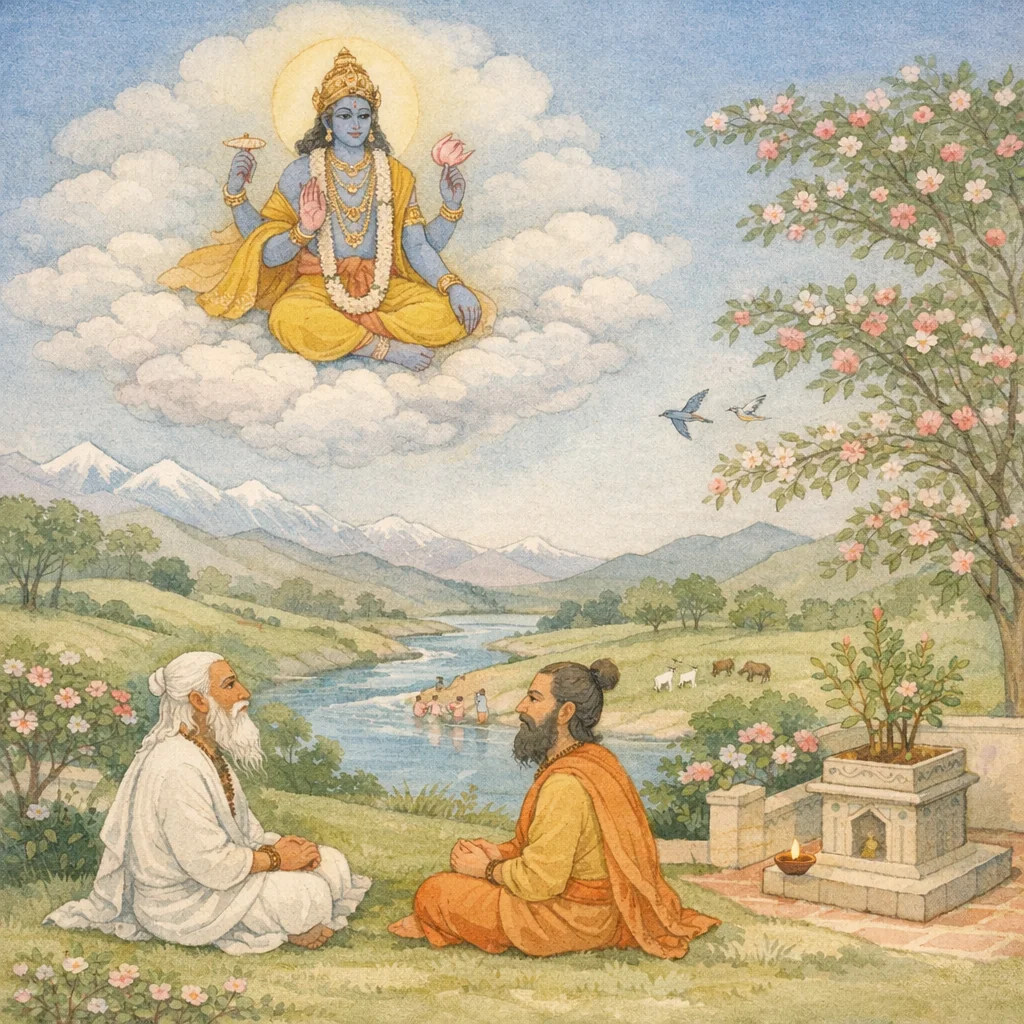
King Subāhu asks Jaimini to describe the nature of heaven. Jaimini portrays svarga as filled with divine groves, wish-fulfilling trees, celestial vehicles, and a life free from hunger, disease, and death, inhabited by the virtuous—truthful, compassionate, and disciplined. He then explains svarga’s defects: merit (puṇya) is spent through enjoyment, higher striving may cease, and envy arises at others’ prosperity, opening the way to downfall. The chapter sets forth the doctrinal contrast: Earth is karma-bhūmi, where actions are performed, while heaven is phala-bhūmi, where their results are consumed. Therefore Subāhu rejects charity or sacrifice pursued for heavenly rewards and resolves to worship Viṣṇu through meditation. The teaching affirms that righteous yajña and dāna, rightly oriented, lead to Viṣṇu’s supreme realm beyond pralaya, and that hearing this account dissolves sin and fulfills one’s aims.
Shlokas
Verse 1
सुबाहुरुवाच । स्वर्गस्य मे गुणान्ब्रूहि सांप्रतं द्विजसत्तम । एतत्सर्वं द्विजश्रेष्ठ करिष्यामि स्वभाविकम्
Subāhu said: “Now tell me the qualities of heaven, O best of the twice-born. O foremost of brāhmaṇas, I will carry out all this in the proper manner, as is fitting by nature.”
Verse 2
जैमिनिरुवाच । नंदनादीनि रम्याणि दिव्यानि विविधानि च । तत्रोद्यानानि पुण्यानि सर्वकामयुतानि च
Jaimini said: “There are delightful heavenly groves such as Nandana and others, manifold and divine. There, too, are sacred gardens, endowed with every desired enjoyment.”
Verse 3
सर्वकामफलैर्वृक्षैः शोभनानि समंततः । विमानानि सुदिव्यानि सेवितान्यप्सरोगणैः
All around were splendid celestial vimānas, encircled by trees that grant every desired fruit, and attended by hosts of Apsarās.
Verse 4
सर्वत्रैव विचित्राणि कामगानि वशानि च । तरुणादित्यवर्णानि मुक्ताजालांतराणि च
Everywhere there were wondrous things: those that moved as one wished, those wholly obedient, shining with the hue of the rising sun, and adorned with lattices of pearls.
Verse 5
चंद्रमंडलशुभ्राणि हेमशय्यासनानि च । सर्वकामसमृद्धाश्च सर्वदुःखविवर्जिताः
They have golden beds and seats, radiant like the orb of the moon; fulfilled in every desire, they are free from all sorrow.
Verse 6
नराः सुकृतिनस्तेषु विचरंति यथा भुवि । न तत्र नास्तिका यांति न स्तेना नाजितेंद्रियाः
In that realm, people endowed with meritorious conduct move about with ease, as they do upon the earth. There, those lacking reverence for sacred dharma find no place; neither do the dishonest, nor those who have not cultivated self-restraint.
Verse 7
न नृशंसा न पिशुना न कृतघ्ना न मानिनः । सत्यास्तपःस्थिताः शूरा दयावंतः क्षमापराः
They are not cruel, not slanderous, not ungrateful, and not proud; they are truthful, steadfast in austerity, courageous, compassionate, and devoted to forgiveness.
Verse 8
यज्वानो दानशीलाश्च तत्र गच्छंति ते नराः । न रोगो न जरामृत्युर्न शोको न हिमातपौ
Those men who perform yajñas and are devoted to dāna (sacred giving) go there. There is no disease, no old age or death, no sorrow, and neither cold nor scorching heat.
Verse 9
न तत्र क्षुत्पिपासा च कस्य ग्लानिर्न विद्यते । एते चान्ये च बहवो गुणाः स्वर्गस्य भूपते
There, no one suffers hunger or thirst, and no one is overcome by weariness. These and many other virtues belong to heaven, O king.
Verse 10
दोषास्तत्रैव ये संति ताञ्छृणुष्व च सांप्रतम् । शुभस्य कर्मणः कृत्स्नं फलं तत्रैव भुज्यते
Now listen to the faults that exist there itself: the entire fruit of a virtuous deed is enjoyed there itself.
Verse 11
न चात्र क्रियते भूयः सोऽत्र दोषो महान्स्मृतः । असंतोषश्च भवति दृष्ट्वा दीप्तां परां श्रियम्
And no further effort is made there; this is remembered as a great fault. And discontent arises on seeing another’s blazing, supreme prosperity.
Verse 12
सुखव्याप्तमनस्कानां सहसा पतनं तथा । इह यत्क्रियते कर्म फलं तत्रैव भुज्यते
Those whose minds are engulfed in worldly pleasures may suddenly fall; and whatever action is performed here, its fruit is indeed experienced right here, in this very life.
Verse 13
कर्मभूमिरियं राजन्फलभूमिरसौ स्मृता । सुबाहुरुवाच । महांतस्तु इमे दोषास्त्वया स्वर्गस्य कीर्तिताः
O King, this is called the land of action (karma-bhūmi), while that is remembered as the land where results are experienced (phala-bhūmi). Subāhu said: “These, indeed, are the great faults of heaven that you have described.”
Verse 14
निर्दोषाः शाश्वता येन्ये तांस्त्वं लोकान्वद द्विज । जैमिनिरुवाच । आब्रह्मसदनादेव दोषाः संति च वै नृप
“O twice-born one, tell me of those other worlds that are faultless and everlasting.” Jaimini said: “O king, faults indeed exist—even up to Brahmā’s own abode.”
Verse 15
अतएव हि नेच्छंति स्वर्गप्राप्तिं मनीषिणः । आब्रह्मसदनादूर्ध्वं तद्विष्णोः परमं पदम्
Therefore the wise do not desire attainment of heaven, for beyond even Brahmā’s abode lies that supreme state—the highest abode of Viṣṇu.
Verse 16
शुभं सनातनं ज्योतिः परंब्रह्मेति तद्विदुः । न तत्र मूढा गच्छंति पुरुषा विषयात्मकाः
The wise know That as the auspicious, eternal Light—indeed, as the Supreme Brahman. Deluded men, whose nature is bound to sense-objects, do not go there.
Verse 17
दंभमोहभयद्रोह क्रोधलोभैरभिद्रुताः । निर्ममा निरहंकारा निर्द्वंद्वास्संयतेंद्रियाः
Assailed by hypocrisy, delusion, fear, malice, anger, and greed, they become free from possessiveness and ego, rise beyond the pairs of opposites, and keep their senses restrained.
Verse 18
ध्यानयोगरताश्चैव तत्र गच्छंति साधवः । एतत्ते सर्वमाख्यातं यन्मां त्वं परिपृच्छसि
And the virtuous sages, devoted to the yoga of meditation, go there. Thus I have explained to you everything that you asked me.
Verse 19
एवं स्वर्गगुणं श्रुत्वा सुबाहुः पृथिवीपतिः । तमुवाच महात्मानं जैमिनिं वदतांवरम्
Having thus heard of the qualities of heaven, King Subāhu, lord of the earth, addressed the great-souled Jaimini, foremost among speakers.
Verse 20
सुबाहुरुवाच । नाहं स्वर्गं गमिष्यामि न चैवेच्छाम्यहं मुने । यस्माच्च पतनं प्रोक्तं तत्कर्म न करोम्यहम्
Subāhu said: “I will not go to heaven, nor do I even desire it, O sage. Since that act has been declared to lead to a fall, I do not perform such a deed.”
Verse 21
दानमेकं महाभाग नाहं दास्येकदाध्रुवम् । दानाच्च फललोभाच्च तस्मात्पतति वै नरः
“O fortunate one, I will not give charity just once—certainly not. For through giving driven by craving for results, a man indeed falls from dharma.”
Verse 22
इत्येवमुक्त्वा धर्मात्मा सुबाहुः पृथिवीपतिः । ध्यानयोगेन देवेशं यजिष्ये कमलाप्रियम्
Having spoken thus, the righteous King Subāhu, lord of the earth, declared: “By the discipline of meditation, I shall worship the Lord of the gods—He who is beloved of Kamalā (Lakṣmī).”
Verse 23
दाहप्रलयसंवर्जं विष्णुलोकं व्रजाम्यहम् । जैमिनिरुवाच । सत्यमुक्तं त्वया भूप सर्वश्रेयः समाकुलम्
“I go to Viṣṇu’s world, which is beyond the consuming dissolution (pralaya) by fire.” Jaimini said: “What you have spoken is true, O king—filled with every kind of highest good.”
Verse 24
राजानो धर्मशीलाश्च महायज्ञैर्यजंति ते । सर्वदानानि दीयंते यज्ञेषु नृपनंदन
O prince, those kings devoted to dharma perform great sacrifices; and in those rites, every kind of gift and charity is bestowed.
Verse 25
आदावन्नं तु यज्ञेषु वस्त्रं तांबूलमेव च । कांचनं भूमिदानं च गोदानं प्रददंति च
At the outset of the sacrifices, they offer food, garments, and betel; they also give gold, donate land, and bestow cows in charity.
Verse 26
सुयज्ञैर्वैष्णवं लोकं ते प्रयांति नरोत्तमाः । दानेन तृप्तिमायांति संतुष्टाः संति भूमिपाः
By well-performed sacrifices, those best of men attain the realm of Viṣṇu. By giving gifts, kings become fulfilled and remain content.
Verse 27
तपस्विनो महात्मानो नित्यमेवं यजंति ते । सुभिक्षां याचयित्वा तु स्वस्थानं तु समागताः
Those great-souled ascetics, steadfast in tapas, always worship in this manner. Having asked for abundant provisions, they then returned to their own abode.
Verse 28
भिक्षार्थं तस्य भागानि प्रकुर्वंति च भूपते । ब्राह्मणाय विभागैकं गोग्रासं तु महामते
O king, they apportion it into shares for alms: one portion is assigned to a brāhmaṇa, and one mouthful is set aside for a cow, O wise one.
Verse 29
सुपार्श्ववर्तिनां चैकं प्रयच्छंति तपोधनाः । तस्यान्नस्य प्रदानेन फलं भुंजंति मानवाः
The ascetics, rich in austerity, also grant a single share to those standing nearby; by offering that food, people partake of its merit and reward.
Verse 30
क्षुधातृषाविहीनास्ते विष्णुलोकं व्रजंति वै । तस्मात्त्वमपि राजेंद्र देहि न्यायार्जितं धनम्
Freed from hunger and thirst, they indeed go to Viṣṇu’s realm. Therefore, O best of kings, you too should give wealth earned righteously.
Verse 31
दानाज्ज्ञानं ततः प्राप्य ज्ञानात्सिद्धिं प्रयास्यति । य इदं शृणुयान्मर्त्यः पुण्याख्यानमनुत्तमम्
From giving (dāna) one attains knowledge; having gained that, through knowledge one approaches spiritual perfection. Any mortal who listens to this unsurpassed, meritorious sacred narrative likewise gains such benefit.
Verse 32
तस्य सर्वार्थसिद्धिः स्यात्पापं सर्वं विलीयते । विमुक्तः सर्वपापेभ्यो विष्णुलोकं सगच्छति
For him, all aims are fulfilled; all sin dissolves away. Freed from every sin, he goes to Viṣṇu’s world.
Verse 95
इति श्रीपद्मपुराणे भूमिखंडे वेनोपाख्याने गुरुतीर्थे च्यवनचरित्रे पंचनवतितमोऽध्यायः
Thus ends the ninety-fifth chapter in the Bhūmi-khaṇḍa of the Śrī Padma Purāṇa, within the episode of Vena, concerning Guru-tīrtha and the account of Cyavana.