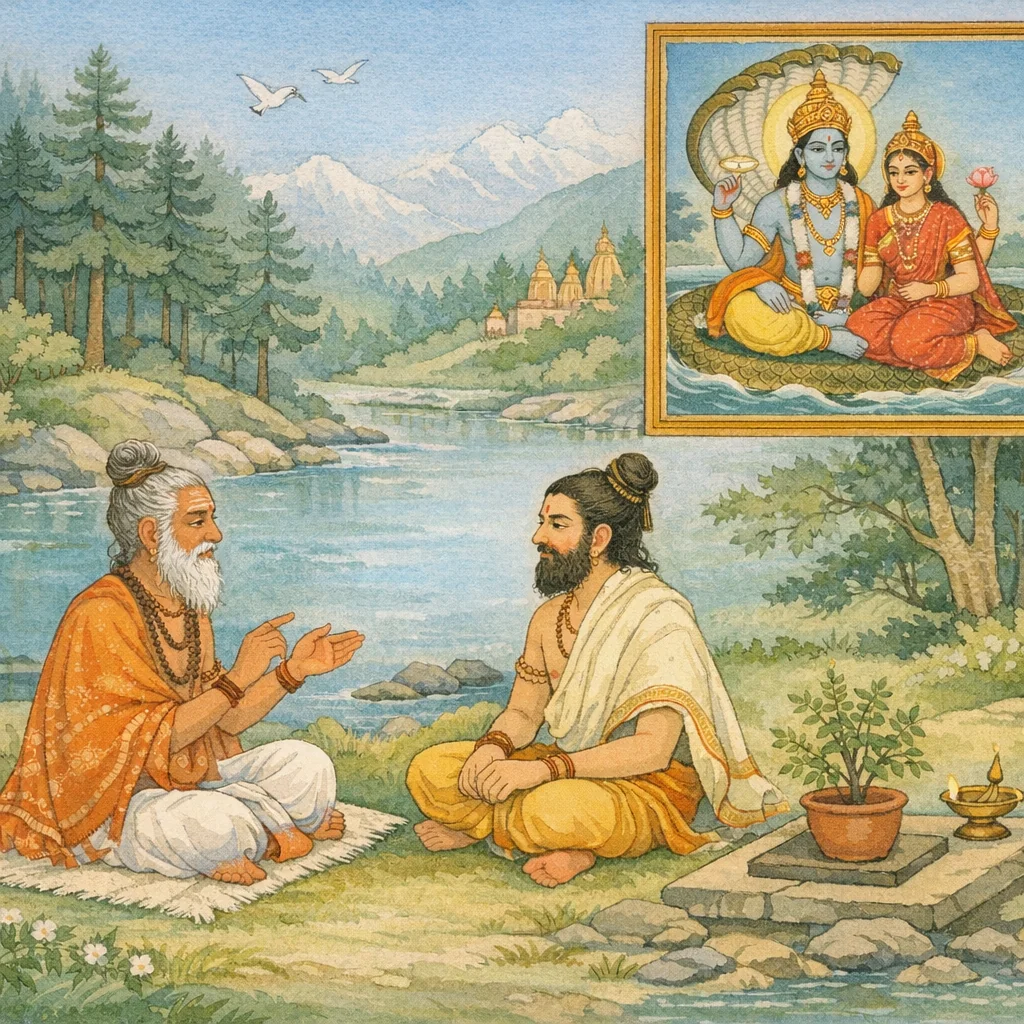
Adhyaya 81
Yayāti Episode: Indra’s Anxiety, the Messenger Motif, and a Discourse on Time (Kāla) and Karma
Chapter 81 begins with Sukarma asking why Indra fears the great-souled King Yayāti, son of Nahuṣa, famed for prowess and merit. Indra answers by sending the apsaras Menakā as a messenger to summon the king, setting in motion a courtly, dramatic episode in which Aśrubindumatī, a female interlocutor, binds Yayāti to truth and dharma. The narrative then turns to sustained instruction: Time (kāla) and karma rule embodied life, shaping destiny and suffering, and even the conditions of birth and death. The text stresses the inevitability of karmic fruition, the limits of human contrivance, and the shadow-like persistence of one’s deeds. Facing anxiety and the ripening of past actions, Yayāti reflects inwardly on fate and the law of works. In the end he seeks refuge in Hari—Kṛṣṇa/Madhusūdana—and offers a supplicatory prayer for protection.
Shlokas
Verse 1
सुकर्मोवाच । यथेंद्रोसौ महाप्राज्ञः सदा भीतो महात्मनः । ययातेर्विक्रमं दृष्ट्वा दानपुण्यादिकं बहु
Sukarma said: “How was it that Indra, the greatly wise, was ever afraid of that great-souled king, after beholding Yayāti’s valor and his many merits—charity and other pious deeds?”
Verse 2
मेनकां प्रेषयामास अप्सरां दूतकर्मणि । गच्छ भद्रे महाभागे ममादेशं वदस्व हि
He dispatched the apsaras Menakā on the duty of a messenger, saying: “Go, dear and fortunate one; indeed, convey my command.”
Verse 3
कामकन्यामितो गत्वा देवराजवचो वद । येनकेनाप्युपायेन राजानं त्वमिहानय
“Go from here to Kāmakanyā and convey the words of the king of the gods; by whatever means, bring the king here.”
Verse 4
एवं श्रुत्वा गता सा च मेनका तत्र प्रेषिता । समाचष्ट तु तत्सर्वं देवराजस्य भाषितम्
Having heard thus, Menakā—sent there—went and reported in full all the words spoken by Indra, the king of the gods.
Verse 5
एवमुक्ता गता सा च मेनका तत्प्रचोदिता । गतायां मेनकायां तु रतिपुत्री मनस्विनी
Thus instructed, Menakā—urged on by her—departed. And when Menakā had gone, Rati’s daughter, strong of mind, remained and acted with resolve.
Verse 6
राजानं धर्मसंकेतं प्रत्युवाच यशस्विनी । राजंस्त्वयाहमानीता सत्यवाक्येन वै पुरा
The illustrious lady replied to the king, a very standard of dharma: “O King, it was you who long ago brought me here by your truthful word.”
Verse 7
स्वकरश्चांतरे दत्तो भवनं च समाहृता । यद्यद्वदाम्यहं राजंस्तत्तत्कार्यं हि वै त्वया
I have placed my own hand in yours, and the household has been made ready. Whatever I say to you, O King, that indeed must be carried out by you.
Verse 8
तदेवं हि त्वया वीर न कृतं भाषितं मम । त्वामेवं तु परित्यक्ष्ये यास्यामि पितृमंदिरम्
Indeed, O hero, you have not done what I asked and spoke. Therefore I shall abandon you in this state and go to my father’s house.
Verse 9
राजोवाच । यथोक्तं हि त्वया भद्रे तत्ते कर्त्ता न संशयः । असाध्यं तु परित्यज्य साध्यं देवि वदस्व मे
The king said: “O auspicious lady, just as you have spoken, there is no doubt you are able to accomplish it. But setting aside what is impossible, O goddess, tell me what can be achieved.”
Verse 10
अश्रुबिंदुमत्युवाच । एतदर्थे महीकांत भवानिह मया वृतः । सर्वलक्षणसंपन्नः सर्वधर्मसमन्वितः
Aśrubindumatī said: “For this very purpose, O beloved lord of the earth, I have chosen you here—endowed with every auspicious mark and possessed of all virtues and duties of dharma.”
Verse 11
सर्वं साध्यमिति ज्ञात्वा सर्वधर्तारमेव च । कर्त्तारं सर्वधर्माणां स्रष्टारं पुण्यकर्मणाम्
Knowing that all can be accomplished through Him, and that He alone is the sustainer of all—(knowing Him as) the doer of all dharmas and the creator of meritorious deeds—
Verse 12
त्रैलोक्यसाधकं ज्ञात्वा त्रैलोक्येऽप्रतिमं च वै । विष्णुभक्तमहं जाने वैष्णवानां महावरम्
Knowing Him to be the fulfiller of the aims of the three worlds, and truly unrivaled in the three worlds, I recognize Him as a devotee of Viṣṇu—the greatest among the Vaiṣṇavas.
Verse 13
इत्याशया मया भर्त्ता भवानंगीकृतः पुरा । यस्य विष्णुप्रसादोऽस्ति स सर्वत्र परिव्रजेत्
With this intention, I accepted you as my husband long ago. He who has the grace of Viṣṇu may wander everywhere freely.
Verse 14
दुर्लभं नास्ति राजेंद्र त्रैलोक्ये सचराचरे । सर्वेष्वेव सुलोकेषु विद्यते तव सुव्रत
O king of kings, in the three worlds—among all beings, moving and unmoving—nothing is truly unattainable. In every blessed realm, your noble vow is found.
Verse 15
विष्णोश्चैव प्रसादेन गगने गतिरुत्तमा । मर्त्यलोकं समासाद्य त्वयैव वसुधाधिप
By Viṣṇu’s grace alone, your movement through the sky has become excellent; and having reached the mortal world, it is you indeed, O lord of the earth, who accomplished this.
Verse 16
जरापलितहीनास्तु मृत्युहीना जनाः कृताः । गृहद्वारेषु सर्वेषु मर्त्यानां च नरर्षभ
People were made free from old age and grey hair, and even free from death; and at the doorways of all mortals’ homes, O bull among men, this condition prevailed.
Verse 17
कल्पद्रुमा अनेकाश्च त्वयैव परिकल्पिताः । येषां गृहेषु मर्त्यानां मुनयः कामधेनवः
Many wish-fulfilling trees have indeed been fashioned by you; and those mortals in whose homes sages reside truly possess wish-granting Kāmadhenu cows.
Verse 18
त्वयैव प्रेषिता राजन्स्थिरीभूताः सदा कृताः । सुखिनः सर्वकामैश्च मानवाश्च त्वया कृताः
O King, by you alone were they dispatched; by you they were made ever established and steady. By you, too, people were made happy and endowed with every desired object.
Verse 19
गृहैकमध्ये साहस्रं कुलीनानां प्रदृश्यते । एवं वंशविवृद्धिश्च मानवानां त्वया कृता
Within a single household, a thousand noble descendants are seen. Thus, the increase of the human lineage has been brought about by you.
Verse 20
यमस्यापि विरोधेन इंद्रस्य च नरोत्तम । व्याधिपापविहीनस्तु मर्त्यलोकस्त्वया कृतः
O best of men, even in defiance of Yama and Indra, you have made the mortal world free from disease and sin.
Verse 21
स्वतेजसाहंकारेण स्वर्गरूपं तु भूतलम् । दर्शितं हि महाराज त्वत्समो नास्ति भूपतिः
By the power of your own splendor and royal pride, you have made the earth appear like heaven. Truly, O great king, there is no ruler equal to you.
Verse 22
नरो नैव प्रसूतो हि नोत्पत्स्यति भवादृशः । भवंतमित्यहं जाने सर्वधर्मप्रभाकरम्
Truly, no man like you has ever been born, nor will one like you be born again. I recognize you as the illuminator of all dharmas.
Verse 23
तस्मान्मया कृतो भर्ता वदस्वैवं ममाग्रतः । नर्ममुक्त्वा नृपेंद्र त्वं वद सत्यं ममाग्रतः
Therefore, I have chosen you as my husband—say so openly before me. Setting aside jest, O king, speak the truth in my presence.
Verse 24
यदि ते सत्यमस्तीह धर्ममस्ति नराधिप । देवलोकेषु मे नास्ति गगने गतिरुत्तमा
If truth and righteousness truly exist in you here, O king, then for me there is no higher course in the sky—even among the worlds of the gods.
Verse 25
सत्यं त्यक्त्वा यदा च त्वं नैव स्वर्गं गमिष्यसि । तदा कूटं तव वचो भविष्यति न संशयः
When you abandon truth, you will certainly not attain heaven. Then your speech will become crooked and deceitful—of this there is no doubt.
Verse 26
पूर्वंकृतं हि यच्छ्रेयो भस्मीभूतं भविष्यति । राजोवाच । सत्यमुक्तं त्वया भद्रे साध्यासाध्यं न चास्ति मे
“Indeed, whatever good was done before will be reduced to ashes.” The king said: “What you have spoken is true, O noble lady; for me there is nothing that cannot be accomplished.”
Verse 27
सर्वंसाध्यं सुलोकं मे सुप्रसादाज्जगत्पते । स्वर्गं देवि यतो नैमि तत्र मे कारणं शृणु
O Lord of the world, by your gracious favor everything has become attainable for me, and my destiny is a blessed realm. O Goddess, since I am going to heaven, hear from me the reason for that.
Verse 28
आगंतुं तु न दास्यंति लोके मर्त्ये च देवताः । ततो मे मानवाः सर्वे प्रजाः सर्वा वरानने
But the gods will not permit them to come into the mortal world. Therefore, O fair-faced one, all my people—indeed all my subjects—(will be affected accordingly).
Verse 29
मृत्युयुक्ता भविष्यंति मया हीना न संशयः । गंतुं स्वर्गं न वाञ्छामि सत्यमुक्तं वरानने
“Deprived of me, they will surely become bound to death—of this there is no doubt. I do not wish to go to heaven. I have spoken the truth, O fair-faced one.”
Verse 30
देव्युवाच । लोकान्दृष्ट्वा महाराज आगमिष्यसि वै पुनः । पूरयस्व ममाद्यत्वं जातां श्रद्धां महातुलाम्
The Goddess said: “O great king, after beholding the worlds, you will indeed return again. Fulfill my wish today—an immense faith has arisen in me.”
Verse 31
राजोवाच । सर्वमेवं करिष्यामि यत्त्वयोक्तं न संशयः । समालोक्य महातेजा ययातिर्नहुषात्मजः
The king said: “So it shall be—I will do everything as you have spoken; of this there is no doubt.” Having beheld all this, the greatly radiant Yayāti, son of Nahuṣa, then acted and spoke further.
Verse 32
एवमुक्त्वा प्रियां राजा चिंतयामास वै तदा । अंतर्जलचरो मत्स्यः सोपि जाले न बध्यते
Having spoken thus to his beloved, the king then reflected: “Even a fish that dwells and moves within the water is not always bound in a net.”
Verse 33
मरुत्समानवेगोपि मृगः प्राप्नोति बंधनम् । योजनानां सहस्रस्थमामिषं वीक्षते खगः
Even a deer swift as the wind comes to bondage; yet a bird can behold its prey even from a thousand yojanas away.
Verse 34
सकंठलग्नपाशं च न पश्येद्दैवमोहितः । कालः समविषमकृत्कालः सन्मानहानिदः
Deluded by fate, one does not even notice the noose fastened upon one’s own neck. Time—bringing about both fair and unfair turns—robs one of honor and respect.
Verse 35
परिभावकरः कालो यत्रकुत्रापि तिष्ठतः । नरं करोति दातारं याचितारं च वै पुनः
Time, which brings humiliation and reversal, wherever it may abide, turns a man—again and again—into a giver and also into a beggar.
Verse 36
भूतानि स्थावरादीनि दिवि वा यदि वा भुवि । सर्वं कलयते कालः कालो ह्येक इदं जगत्
All beings—beginning with the immovable—whether in heaven or on earth: Time measures and governs them all. Indeed, Time alone is this entire world.
Verse 37
अनादिनिधनो धाता जगतः कारणं परम् । लोकान्कालः स पचति वृक्षे फलमिवाहितम्
The Creator—without beginning or end—is the supreme cause of the universe. He, as Time, ripens the worlds, just as fruit ripens on a tree once it has formed.
Verse 38
न मंत्रा न तपो दानं न मित्राणि न बांधवाः । शक्नुवंति परित्रातुं नरं कालेन पीडितम्
Neither mantras, nor austerity, nor charity—nor friends, nor relatives—are able to protect a man when he is afflicted by Time.
Verse 39
त्रयः कालकृताः पाशाः शक्यंते नातिवर्तितुम् । विवाहो जन्ममरणं यदा यत्र तु येन च
Three nooses fashioned by Time cannot be overstepped: marriage, birth-and-death, and the circumstances of when, where, and by whom they occur.
Verse 40
यथा जलधरा व्योम्नि भ्राम्यंते मातरिश्वना । तथेदं कर्मयुक्तेन कालेन भ्राम्यते जगत्
Just as clouds wander in the sky, driven by the wind, so too this world is made to wander by Time, yoked to karma.
Verse 41
सुकर्मोवाच । कालोऽयं कर्मयुक्तस्तु यो नरैः समुपासितः । कालस्तु प्रेरयेत्कर्म न तं कालः करोति सः
Sukarma said: “This Time, joined with action and revered by people—Time indeed impels action; yet Time itself does not perform that action.”
Verse 42
उपद्रवा घातदोषाः सर्पाश्च व्याधयस्ततः । सर्वे कर्मनियुक्तास्ते प्रचरंति च मानुषे
From that arise calamities, destructive afflictions, snakes, and diseases. All of them, appointed by karma, move about among human beings.
Verse 43
सुखस्य हेतवो ये च उपायाः पुण्यमिश्रिताः । ते सर्वे कर्मसंयुक्ता न पश्येयुः शुभाशुभम्
Whatever means are said to be causes of happiness, even when mixed with merit, are all bound up with karma; therefore one should not regard them as inherently auspicious or inauspicious.
Verse 44
कर्मदा यदि वा लोके कर्मसंबधि बांधवाः । कर्माणि चोदयंतीह पुरुषं सुखदुःखयोः
Whether in the world there are benefactors or relatives connected through action, it is one’s own deeds here that impel a person toward happiness and suffering.
Verse 45
सुवर्णं रजतं वापि यथा रूपं विनिश्चितम् । तथा निबध्यते जंतुः स्वकर्मणि वशानुगः
Just as the form of gold or silver is determined, so too a living being—submissive to the force of its own past deeds—is bound fast within its own karma.
Verse 46
पंचैतानीह सृज्यंते गर्भस्थस्यैव देहिनः । आयुः कर्म च वित्तं च विद्यानिधनमेव च
Here, for the embodied being—even while still in the womb—five things are ordained: lifespan, karma, wealth, knowledge, and death.
Verse 47
यथा मृत्पिंडतः कर्ता कुरुते यद्यदिच्छति । तथा पूर्वकृतं कर्म कर्तारमनुगच्छति
Just as a potter fashions from a lump of clay whatever he wishes, so one’s previously performed karma follows the doer.
Verse 48
देवत्वमथ मानुष्यं पशुत्वं पक्षिता तथा । तिर्यक्त्वं स्थावरत्वं च प्राप्यते च स्वकर्मभिः
By one’s own actions, one attains godhood or human birth, and likewise the state of an animal or a bird; by those very deeds one also reaches other subhuman conditions and even the immobile, plant-like state.
Verse 49
स एव तत्तथा भुंक्ते नित्यं विहितमात्मना । आत्मना विहितं दुःखं चात्मना विहितं सुखम्
He alone continually experiences exactly what is ordained by his own self: by oneself is suffering fashioned, and by oneself is happiness fashioned.
Verse 50
गर्भशय्यामुपादाय भुंजते पूर्वदैहिकम् । संत्यजंति स्वकं कर्म न क्वचित्पुरुषा भुवि
Taking up the bed of the womb, they experience the results of their former embodied deeds; for nowhere on earth do people ever abandon their own karma.
Verse 51
बलेन प्रज्ञया वापि समर्थाः कर्तुमन्यथा । सुकृतान्युपभुंजंति दुःखानि च सुखानि च
Even if, by strength or by intelligence, people are able to act otherwise, they still partake of the fruits of past merit—both sorrows and joys.
Verse 52
हेतुं प्राप्य नरो नित्यं कर्मबंधैस्तु बध्यते । यथा धेनुसहस्रेषु वत्सो विंदति मातरम्
Having obtained the fitting cause, a person is ever bound by the fetters of karma—just as, among thousands of cows, a calf finds its own mother.
Verse 53
तथा शुभाशुभं कर्म कर्तारमनुगच्छति । उपभोगादृते यस्य नाश एव न विद्यते
So too, both auspicious and inauspicious karma follows its doer; without being experienced as its result, it does not perish at all.
Verse 54
प्राक्तनं बंधनं कर्म कोन्यथा कर्तुमर्हति । सुशीघ्रमपि धावंतं विधानमनुधावति
Karma—an ancient, binding force—cannot be made otherwise by anyone. Even one who runs very swiftly is still pursued by destiny’s ordinance.
Verse 55
शेते सह शयानेन पुरा कर्म यथाकृतम् । उपतिष्ठति तिष्ठंतं गच्छंतमनुगच्छति
As one lies down, the karma once performed lies down with him; as one rises, it rises; as one stands, it stays near; and as one goes, it follows—such is karma, exactly as previously done.
Verse 56
करोति कुर्वतः कर्मच्छायेवानु विधीयते । यथा छायातपौ नित्यं सुसंबद्धौ परस्परम्
A person’s deed follows the doer like a shadow; just as shade and sunlight are ever bound to one another.
Verse 57
तद्वत्कर्म च कर्ता च सुसंबद्धौ परस्परम् । ग्रहा रोगा विषाः सर्पाः शाकिन्यो राक्षसास्तथा
Likewise, an action and its doer are closely bound to one another. So too are afflictive forces—seizing spirits, diseases, poisons, serpents, and also śākinīs and rākṣasas.
Verse 58
पीडयंति नरं पश्चात्पीडितं पूर्वकर्मणा । येन यत्रोपभोक्तव्यं सुखं वा दुःखमेव वा
Later, a man—already afflicted by his former deeds—is further tormented, so that in whatever manner and in whatever place he must experience the results: whether happiness or only suffering.
Verse 59
स तत्र बद्ध्वा रज्ज्वा वै बलाद्दैवेन नीयते । दैवः प्रभुर्हि भूतानां सुखदुःखोपपादने
There, bound with a rope, one is forcibly led along by destiny. For destiny indeed is the master of beings in bringing about pleasure and pain.
Verse 60
अन्यथा चिंत्यते कर्म जाग्रता स्वपतापि वा । अन्यथा स तथा प्राज्ञ दैव एवं जिघांसति
A person plans an action one way—whether awake or even in sleep—but it turns out otherwise. Thus, O wise one, destiny acts so, as if intending to strike down one’s intentions.
Verse 61
शस्त्राग्नि विष दुर्गेभ्यो रक्षितव्यं च रक्षति । अरक्षितं भवेत्सत्यं तदेवं दैवरक्षितम्
One should be guarded from weapons, fire, poison, and peril; and what is protected truly becomes a protector. Indeed, what is left unguarded comes to ruin—thus it is preserved by divine protection.
Verse 62
दैवेन नाशितं यत्तु तस्य रक्षा न दृश्यते । यथा पृथिव्यां बीजानि उप्तानि च धनानि च
That which fate has destroyed finds no protection—just as on the earth, seeds that have been sown, and even treasures, may still be lost.
Verse 63
तथैवात्मनि कर्माणि तिष्ठंति प्रभवंति च । तैलक्षयाद्यथा दीपो निर्वाणमधिगच्छति
So too, within the Self, actions abide and from it they arise; just as a lamp, when its oil is exhausted, attains extinction.
Verse 64
कर्मक्षयात्तथा जंतुः शरीरान्नाशमृच्छति । कर्मक्षयात्तथा मृत्युस्तत्त्वविद्भिरुदाहृतः
When karma is exhausted, a living being likewise meets the dissolution of the body. The knowers of truth declare that death occurs when karma is exhausted.
Verse 65
विविधाः प्राणिनस्तस्य मृत्यो रोगाश्च हेतवः । तथा मम विपाकोयं पूर्वं कृतस्य नान्यथा
For that being, the causes of death and disease are manifold. Likewise, this result I now experience is only the ripening of what I did before—nothing else.
Verse 66
संप्राप्तो नात्र संदेहः स्त्रीरूपोऽयं न संशयः । क्व मे गेहं समायाता नाटका नटनर्तकाः
He has surely arrived—there is no doubt of it. And there is no doubt that he has assumed a woman’s form. Where has my house been carried—together with the actors, the performers, and the dancers?
Verse 67
तेषां संगप्रसंगेन जरा देहं समाश्रिता । सर्वं कर्मकृतं मन्ये यन्मे संभावितं ध्रुवम्
Through continued association with them, old age has taken hold of my body. I deem it all the fruit of my own past karma—whatever has befallen me is surely fixed.
Verse 68
तस्मात्कर्मप्रधानं च उपायाश्च निरर्थकाः । पुरा वै देवराजेन मदर्थे दूतसत्तमः
Therefore karma is paramount, and mere stratagems are futile. Long ago indeed, the king of the devas sent, on my behalf, an excellent messenger.
Verse 69
प्रेषितो मातलिर्नाम न कृतं तस्य तद्वचः । तस्य कर्मविपाकोऽयं दृश्यते सांप्रतं मम
A messenger named Mātali was sent, yet I did not act according to his words. Now I behold before me the ripening consequence of that deed.
Verse 70
इति चिंतापरो भूत्वा दुःखेन महतान्वितः । यद्यस्याहि वचः प्रीत्या न करोमि हि सर्वथा
Thus, absorbed in anxious thought and overwhelmed by great sorrow, he reflected: “If I do not, with goodwill, carry out his words in every way…”.
Verse 71
सत्यधर्मावुभावेतौ यास्यतस्तौ न संशयः । सदृशं च समायातं यद्दृष्टं मम कर्मणा
Indeed, these two—Truth and Dharma—will surely attain their destined goal; of this there is no doubt. And what has come to pass accords with what I myself had foreseen through the fruit of my own deeds.
Verse 72
भविष्यति न संदेहो दैवो हि दुरतिक्रमः । एवं चिंतापरो भूत्वा ययातिः पृथिवीपतिः
“It will come to pass—there is no doubt; for destiny is indeed hard to overcome.” Thinking thus, King Yayāti, lord of the earth, became absorbed in anxious reflection.
Verse 73
कृष्णं क्लेशापहं देवं जगाम शरणं हरिम् । ध्यात्वा नत्वा ततः स्तुत्वा मनसा मधुसूदनम्
He sought refuge in Hari—Kṛṣṇa, the divine remover of afflictions. Having meditated on Him, bowed to Him, and then praised Him, he worshiped Madhusūdana with his mind.
Verse 74
त्राहि मां शरणं प्राप्तस्त्वामहं कमलाप्रिय
Protect me—I have come to You for refuge, O beloved of Kamalā (Lakṣmī).
Verse 81
इति श्रीपद्मपुराणे भूमिखंडे वेनोपाख्याने मातापितृतीर्थवर्णने ययातिचरित्रे एकाशीतितमोऽध्यायः
Thus ends the eighty-first chapter—on the story of Yayāti, within the account of Vena and the description of the sacred tīrthas connected with one’s mother and father—in the Bhūmi-khaṇḍa of the holy Padma Purāṇa.