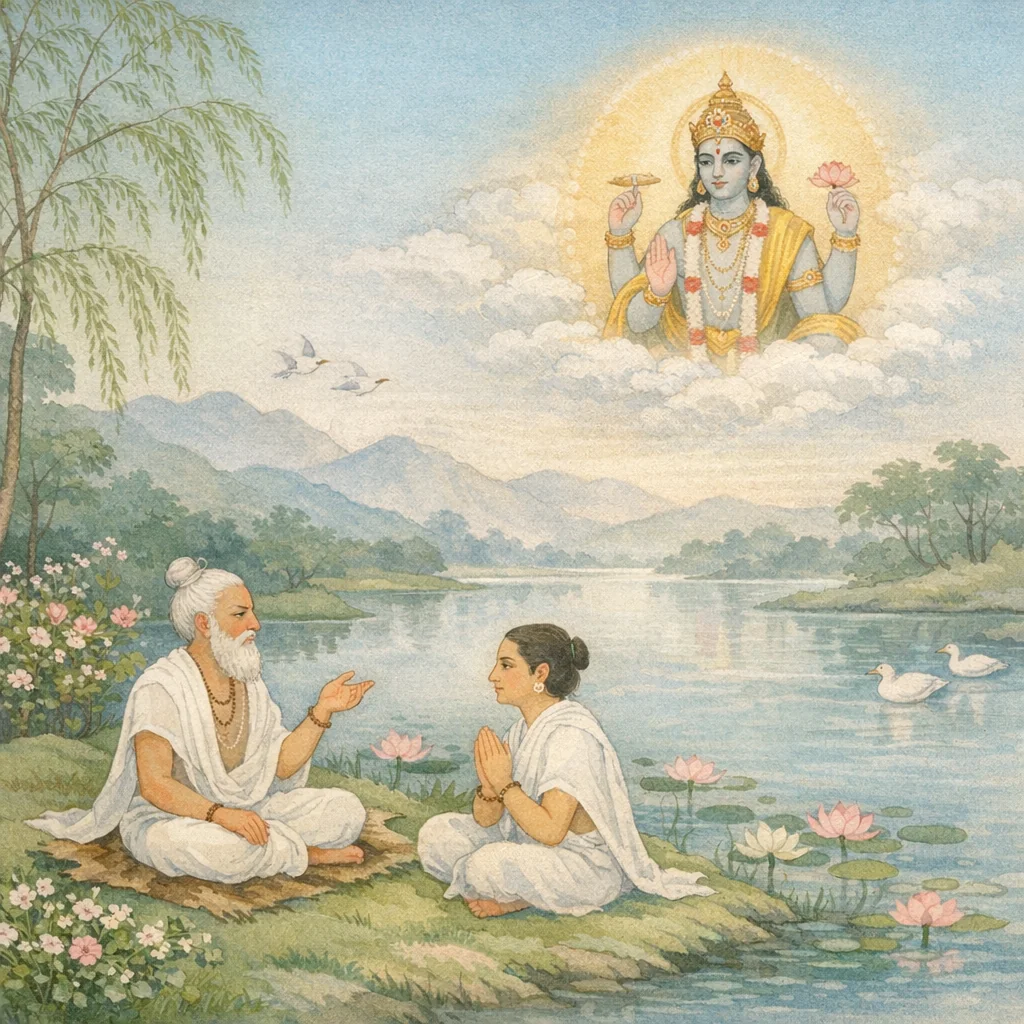
Adhyaya 123
The Nature of Knowledge, the Guru as Living Tīrtha, and the Law of Final Remembrance
Chapter PP.2.123 opens with an inquiry into jñāna (knowledge): it is said to be bodiless, without limbs or sense-organs, yet the supreme light that destroys darkness and reveals the Supreme Abode. The teaching then turns practical, prescribing peace, restraint of the senses, moderation, solitude, and discernment as the inner conditions by which knowledge arises. A narrative exemplum follows: Kuṃjala recounts how delusion and harmful association led to a fall into animal birth, while the Guru’s grace and inner yoga restored stainless knowledge. The chapter culminates in the law that one’s final state of mind shapes the next birth, and it exalts the Guru as the highest “moving tīrtha,” a living place of pilgrimage. Viṣṇu/Hari then concludes the episode, directing Vena toward sacrifice and charity, and promising liberation through divine grace.
Shlokas
Verse 1
सिद्ध उवाच । श्रूयतामभिधास्यामि ज्ञानरूपं तवाग्रतः । ज्ञानस्य नास्ति वै देहो हस्तौ पादौ च चक्षुषी
The Siddha said: “Listen; I shall describe before you the true nature of knowledge. Knowledge indeed has no body—no hands, no feet, and no eyes.”
Verse 2
नासाकर्णौ न ज्ञानस्य नास्ति चैवास्थिसंग्रहः । केन दृष्टं तु वै ज्ञानं कानि लिंगानि तस्य वै
Knowledge has neither nose nor ears, nor does it possess a framework of bones. By what, then, is knowledge truly seen—and what are its distinguishing marks?
Verse 3
आकारैर्वर्जितं नित्यं सर्वं वेत्ति स सर्ववित् । दिवाप्रकाशकः सूर्यो रात्रौ प्रकाशयेच्छशी
He who is ever free from all forms knows all; he is the All-knowing. The Sun illumines the day, and the Moon illumines the night.
Verse 4
गृहं प्रकाशयेद्दीपो लोकमध्ये स्थिता अमी । तत्पदं केन वै धाम्ना दृश्यते शृणु सत्तम
Just as a lamp illumines a house, so too these lights stand amid the world. Now hear, O best of the virtuous: by what radiance is That Supreme Abode perceived?
Verse 5
न विंदंति हि मूढास्ते मोहिता विष्णुमायया । कायमध्ये स्थितं ज्ञानं ध्यानदीप्तमनौपमम्
Those deluded fools, bewitched by Viṣṇu’s māyā, do not realize the incomparable knowledge that abides within the body—illumined by meditation.
Verse 6
तत्पदं तेन दृश्येत चंद्रसूर्यादिभिर्न च । हस्तपादौ विना ज्ञानमचक्षुः कर्णवर्जितम्
That Supreme Abode is seen only through That (through the Supreme itself), not by the moon, the sun, and the like. That knowledge is without hands and feet—without eyes, and devoid of ears.
Verse 7
तस्य सर्वत्र गतिरस्ति सर्वं गृह्णाति पश्यति । सर्वमाघ्राति विप्रेंद्र शृणोत्येवं न संशयः
He moves everywhere; he grasps and sees all. He smells all as well, O best of brahmins, and he hears likewise—of this there is no doubt.
Verse 8
नास्ति ज्ञानसमो दीपः सर्वांधकारनाशने । स्वर्गे भूमौ च पाताले स्थाने स्थाने च दृश्यते
There is no lamp equal to knowledge for the destruction of all darkness; it is seen everywhere—in heaven, on earth, and in the netherworld.
Verse 9
कायमध्ये स्थितं ज्ञानं न विंदंति कुबुद्धयः । ज्ञानस्थानं प्रवक्ष्यामि यस्माज्ज्ञानं प्रजायते
Wisdom abides within the body, yet the misguided do not find it. I shall describe the seat of knowledge, from which true understanding arises.
Verse 10
प्राणिनां हृदये नित्यं निहितं सर्वदा द्विज । कामादीन्सुमहाभोगान्महामोहादिकांस्तथा
O twice-born one, within the hearts of living beings there are always and continually lodged desire and the rest—great enjoyments, and likewise great delusion and related states.
Verse 11
विवेकवह्निना सर्वान्दिधक्षति सदैव यः । सर्वशांतिमयोभूत्वा इंद्रियार्थं प्रमर्द्दयेत्
He who continually burns up everything with the fire of discernment, becoming wholly composed of peace, should subdue the sense-objects.
Verse 12
ततस्तु जायते ज्ञानं सर्वतत्त्वार्थदर्शकम् । तत्त्वमूलमिदं ज्ञानं निर्मलं सर्वदर्शकम्
Then arises knowledge that reveals the meaning of all principles (tattvas). Rooted in truth, this knowledge is stainless and all-illuminating.
Verse 13
तस्माच्छांतिं कुरुष्व त्वं सर्वसौख्यप्रवर्द्धिनीम् । समः शत्रौ च मित्रे च यथात्मनि तथापरे
Therefore, cultivate peace—the increaser of all happiness. Be even-minded toward enemy and friend alike, and toward others just as you are toward yourself.
Verse 14
भव स्वनियतो नित्यं जिताहारो जितेंद्रियः । मैत्रं नैव प्रकर्तव्यं वैरं दूरे परित्यजेत्
Be ever self-disciplined; be moderate in food and master of the senses. Do not hastily form intimacies, and cast enmity far away.
Verse 15
निःसंगो निःस्पृहो भूत्वा एकांतस्थानमाश्रितः । सर्वप्रकाशको ज्ञानी सर्वदर्शी भविष्यसि
Becoming unattached and free from craving, and taking refuge in a solitary place, you will become a knower who illumines all things, a wise one who sees everything.
Verse 16
एकस्थानस्थितो वत्स त्रैलोक्ये यद्भविष्यति । वृत्तांतं वेत्स्यसि त्वं तु मत्प्रसादान्न संशयः
Remaining in a single place, dear child, you will come to know whatever will occur in the three worlds. By my grace, you will indeed know the whole account—of this there is no doubt.
Verse 17
कुंजल उवाच । सिद्धेन तेन मे विप्र ज्ञानरूपं प्रकाशितम् । तस्य वाक्ये स्थितो नित्यं तद्भावेनापि भावितः
Kuṃjala said: “O brāhmaṇa, through that perfected siddha, the true form of knowledge was revealed to me. Ever established in his instruction, I have also been shaped and imbued by his very state of being.”
Verse 18
त्रैलोक्ये वर्त्तते यद्यदेकस्थाने स्थितो ह्यहम् । तत्तदेव प्रजानामि प्रसादात्तस्य सद्गुरोः
Though I remain stationed in a single place, whatever occurs throughout the three worlds—exactly that I come to know, by the grace of that true Guru.
Verse 19
एतत्ते सर्वमाख्यातमात्मवृत्तांतमेव हि । अन्यत्किं ते प्रवक्ष्यामि तद्ब्रूहि द्विजसत्तम
All this has been told to you—indeed, it is only the account of my own story. What else should I explain to you? Tell me, O best of twice-born.
Verse 20
च्यवन उवाच । कीरयोनिं कथं प्राप्तो भवाञ्ज्ञानवतां वरः । तन्मे त्वं कारणं ब्रूहि सर्वसंदेहनाशनम्
Cyavana said: “How did you come to attain birth in the womb of a parrot, though you are the foremost among the wise? Tell me the cause of this—something that will dispel all doubts.”
Verse 21
कुंजल उवाच । संसर्गाज्जायते पापं संसर्गात्पुण्यमेव हि । तस्माद्विवर्जयेच्छुद्धो भव्यं विरुद्धमेव च
Kuṃjala said: From association, sin is born; from association, merit too indeed arises. Therefore, a pure-minded person should avoid association with what is improper and with what is contrary to dharma.
Verse 22
लुब्धकेनापि पापेन केनाप्येकः शुकः शिशुः । बंधयित्वा समानीतो विक्रयार्थं समुद्यतः
A certain sinful hunter captured a single baby parrot, bound it, brought it along, and set out intending to sell it.
Verse 23
चाटुकांर सुरूपं तं पटुवाक्यं समीक्ष्य च । गृहीतो ब्राह्मणैकेन मम प्रीत्या समर्पितः
Observing that he was given to flattery, fair in form, and skilled in speech, a certain brāhmaṇa accepted him and, out of affection for me, presented him to me.
Verse 24
ज्ञानध्यानस्थितो नित्यमहमेव द्विजोत्तम । समे बालस्वभावेन कौतुकात्करसंस्थितः
Ever established in knowledge and meditation, I alone remain thus, O best of the twice-born. On level ground, with a childlike nature, I stay poised in the hand out of sheer curiosity.
Verse 25
तस्य कौतुकवाक्यैर्वा मुग्धोऽहं द्विजसत्तम । शुकस्य पुत्ररूपस्य नित्यं तत्परमानसः
O best of brahmins, I was captivated by his playful words, and my mind was ever devoted to him—he who appeared in the form of Śuka’s son.
Verse 26
मामेवं वदते सोपि ताततातेति आस्यताम् । स्नातुं गच्छ महाभाग देवमर्चय सांप्रतम्
As I spoke thus, he too replied, “Dear one, dear one—please sit.” Then he said, “Go now, fortunate one, to bathe, and worship the Deity at once.”
Verse 27
इत्यादिचाटुकैर्वाक्यैर्मामेवं परिभाषयेत् । तस्यवाक्यविनोदेन विस्मृतं ज्ञानमुत्तमम्
With such flattering words he addressed me in this manner; and by the amusement of his speech, my highest knowledge slipped from memory.
Verse 28
पुष्पार्थं फलभोगार्थं गतोहं वनमेव च । नीतः शुको बिडालेन मम दुःखस्य हेतवे
I went to the forest for flowers and to partake of its fruits; but a cat carried off the parrot, and thus became the cause of my sorrow.
Verse 29
मम संसर्गिभिः सर्वैर्वयस्यैः साधुचारिभिः । बिडालेन हतः पक्षी तेनैव भक्षितो हि सः
In the presence of all my companions—my friends of good conduct—a cat killed the bird, and indeed that very cat ate it.
Verse 30
श्रुत्वा मृत्युं गतं विप्र शुकं तं चाटुकारकम् । महता दुःखभावेन असुखेनातिदुःखितः
O brāhmaṇa, hearing that Śuka—the flatterer—had died, he became exceedingly distressed, overwhelmed by great sorrow and deep anguish.
Verse 31
तस्य दुःखेन मुग्धोस्मि तीव्रेणापि सुपीडितः । महता मोहजालेन बद्धोऽहं द्विजपुंगव
I am bewildered by his suffering and sorely afflicted by its intensity. O best of brahmins, I am bound fast in a great net of delusion.
Verse 32
प्रालपं रामचंद्रेति शुकराजेति पंडित । श्लोकराजेति तं विप्र मोहाच्चलितमानसः
His mind shaken by delusion, he kept babbling, “Rāmacandra!” and “Śukarāja!”—and, O learned brāhmaṇa, he even called him “Ślokarāja.”
Verse 33
ततोऽहं दुःखसंतप्तः संजातः स्वेनकर्मणा । वियोगेनापि विप्रेंद्र शुकस्य शृणु सांप्रतम्
Then I was scorched by sorrow, brought to this state by my own deeds. And now, O best of brāhmaṇas, hear also of Śuka—of his separation.
Verse 34
विस्मृतं तन्मया ज्ञानं सिद्धेनापि प्रकाशितम् । संस्मरञ्छोकसंतप्तस्तं शुकं चाटुकारकम्
That knowledge, though revealed by a perfected sage, was forgotten by me. Remembering that flattering parrot, Śuka, I am scorched with grief.
Verse 35
वत्सवत्सेति नित्यं वै प्रलपञ्छृणु भार्गव । गद्यपद्यमयैर्वाक्यैः संस्कृताक्षरसंयुतैः
O Bhārgava, listen to him continually prattling, “vatsa, vatsa!”—speaking in sentences of both prose and verse, composed with refined Sanskrit syllables.
Verse 36
त्वां विना कश्च मां वत्स बोधयिष्यति सांप्रतम् । कथाभिस्तु विचित्राभिः पक्षिराजप्रसाद्य माम्
Without you, dear child, who will enlighten me at this moment? So, O king of birds, with wondrous stories, please gladden me and grant me your favor.
Verse 37
अस्मिन्सुनिर्जनोद्याने विहाय क्व गतो भवान् । केन दोषेण लिप्तोस्मि तन्मे कथय सांप्रतम्
In this very lonely garden, having left me, where have you gone? By what fault am I tainted? Tell me that right now.
Verse 38
एवंविधैरहं वाक्यैः करुणैस्तैस्तु मोहितः । एवमादि प्रलप्याहं शोकेनापि सुपीडितः
Deluded by such compassionate words, I spoke on in this manner—lamenting thus, and grievously tormented by sorrow.
Verse 39
मृतोहं तेन मोहेन तद्भावेनापि मोहितः । मरणे यादृशो भावो मतिश्चासीच्च यादृशी
I died because of that delusion, and I was also bewildered by that very state of mind. As was the feeling at the time of death, so too were my disposition and understanding.
Verse 40
तादृशेनापि भावेन जातोऽहं द्विजसत्तम । गर्भवासो मया प्राप्तो ज्ञानस्मृतिविधायकः
Even with such a disposition, O best of Brahmins, I was born; and I obtained a stay in the womb that bestows knowledge and remembrance.
Verse 41
स्मृतं पूर्वकृतं कर्म स्वयमेव विचेष्टितम् । मया पापेन मूढेन किं कृतं ह्यकृतात्मना
I have remembered the deed I once committed—an act I myself deliberately carried out. What have I, a sinful and deluded person of undisciplined self, done?
Verse 42
गर्भयोगसमारूढः पुनस्तं चिंतयाम्यहम् । तेन मे निर्मलं ज्ञानं जातं वै सर्वदर्शकम्
Established again in garbha‑yoga, I meditate upon Him once more. Through that, stainless knowledge has arisen in me—indeed, a vision that sees all.
Verse 43
गुरोस्तस्य प्रसादाच्च प्राप्तं वै ज्ञानमुत्तमम् । तस्यवाक्योदकैः स्वच्छैः कायस्य मलमेव च
Through the grace of that guru, the highest knowledge is truly attained; and by the guru’s words—clear like water—even the impurity of the body is, as it were, washed away.
Verse 44
सबाह्याभ्यंतरं विप्र क्षालितं निर्मलं कृतम् । तिर्यक्त्वं च मया प्राप्तं शुकजातिसमुद्भवम्
O brāhmaṇa, I have been washed—outwardly and inwardly—and made pure; and I have also come to obtain an animal birth, arising in the species of a parrot.
Verse 45
शुकस्य ध्यानभावेन मरणे समुपस्थिते । तस्मिन्काले मृतो विप्र तद्भावेनापि भावितः
When death drew near through the power of meditation upon Śuka, that brāhmaṇa died at that very time—his consciousness thoroughly shaped by that same state of contemplation.
Verse 46
तादृशोऽस्मि पुनर्जातः शुकरूपो महीतले । मरणे यादृशो भावः प्राणिनां परिजायते
Thus I was born again upon the earth in the form of a boar; for whatever state of mind arises in living beings at the time of death, accordingly their next birth comes to be.
Verse 47
तादृशाः स्युस्तु सत्वास्ते तद्रूपास्तत्परायणाः । तद्गुणास्तत्स्वरूपास्ते भावभूता भवंति हि
Beings indeed become just like the object of contemplation: they take on its form, become wholly devoted to it, assume its qualities, and—having become constituted of that very disposition—truly come to be in that state.
Verse 48
मृत्यकालस्य विप्रेंद्र भावेनापि न संशयः । अतुलं प्राप्तवाञ्ज्ञानमहमत्र महामते
O best of brāhmaṇas, there is no doubt—even in one’s inward disposition—about the time of death. Here, O great-minded one, I have attained incomparable knowledge.
Verse 49
तेन सर्वं विपश्यामि यद्भूतं यद्भविष्यति । वर्तमानं महाप्राज्ञ ज्ञानेनापि महामते
By that power, I clearly perceive everything—what has been, what will be, and what is present—O greatly wise one, O great-minded one, even through knowledge itself.
Verse 50
सर्वं विदाम्यहं ह्यत्र संस्थितोपि न संशयः । तारणाय मनुष्याणां संसारे परिवर्तताम्
Here, even while remaining present, I know everything—there is no doubt. I do so for the deliverance of human beings who keep revolving in saṃsāra.
Verse 51
नास्ति तीर्थं गुरुसमं बंधच्छेदकरं द्विज । एतत्ते सर्वमाख्यातं शृणु भार्गवनंदन
O brāhmaṇa, there is no tīrtha equal to the Guru, who cuts the bonds of worldly bondage. All this has been explained to you; now listen, O beloved son of Bhṛgu.
Verse 52
यत्त्वया पृच्छितं विप्र तत्ते सर्वं प्रकाशितम् । स्थलजाच्चोदकात्सर्वं बाह्यं मलं प्रणश्यति
O brāhmaṇa, everything you asked has been fully explained to you. Through water, all external impurity—whether arising from contact with the ground or otherwise—perishes.
Verse 53
जन्मांतरकृतान्पापान्गुरुतीर्थं प्रणाशयेत् । संसारतारणायैव जंगमं तीर्थमुत्तमम्
The Guru’s holy presence, as a sacred tīrtha, destroys sins wrought in other births; and for crossing beyond saṃsāra, the living, moving tīrtha is truly supreme.
Verse 54
विष्णुरुवाच । शुक एवं महाप्राज्ञश्च्यवनाय महात्मने । तत्त्वं प्रकाशयित्वा तु विरराम नृपोत्तम
Viṣṇu said: Thus Śuka, the greatly wise, having revealed the truth to the great-souled Cyavana, then fell silent, O best of kings.
Verse 55
एतत्ते सर्वमाख्यातं जंगमं तीर्थमुत्तमम् । वरं वरय भद्रं ते यत्ते मनसि वर्त्तते
Thus I have told you all about this supreme movable tīrtha, the living sacred ford. Now choose a boon—blessings upon you—whatever abides in your mind.
Verse 56
वेन उवाच । नाहं राज्यस्य कामार्थी नान्यत्किंचित्प्रकामये । सदेहो गंतुमिच्छामि तव कायं जनार्दन
Vena said: “I do not desire kingship out of lust for power, nor do I long for anything else. O Janārdana, I wish to enter—body intact—into Your divine form.”
Verse 57
एवं वरमहं मन्ये यदि दातुमिहेच्छसि । विष्णुरुवाच । यज त्वमश्वमेधेन राजसूयेन भूपते
“This is the boon I deem fitting, if you truly wish to grant it here.” Viṣṇu said: “O king, perform the Aśvamedha and the Rājasūya sacrifices.”
Verse 58
गो भू स्वर्णाम्बुधान्यानां कुरु दानं महामते । दानान्नश्यति वै पापं ब्रह्मवध्यादिघोरकम्
O great-minded one, give in charity cows, land, gold, water, and grain. By such gifts, sin truly perishes—even dreadful sins such as brahmahatyā (the killing of a brāhmaṇa) and the like.
Verse 59
चतुर्वर्गस्तु दानेन सिद्ध्यत्येव न संशयः । तस्माद्दानं प्रकर्तव्यं मामुद्दिश्य च भूपते
The four aims of human life are indeed accomplished through charitable giving—of this there is no doubt. Therefore, O king, charity should be performed, dedicating it to me.
Verse 60
यादृशेनापि भावेन मामुद्दिश्य ददाति यः । तादृशं तस्य वै भावं सत्यमेवं करोम्यहम्
Whoever makes an offering, keeping Me in mind, with whatever attitude he has—truly, I respond by bringing about for him a result in keeping with that very attitude.
Verse 61
ऋषीणां दर्शनात्स्पर्शाद्भ्रष्टस्ते पापसंचयः । आगमिष्यसि यज्ञांते मम देहं न संशयः
By the sight and touch of the sages, your accumulated store of sins has fallen away. At the conclusion of the sacrifice you will come to my body—of this there is no doubt.
Verse 62
एवमाभाष्य तं वेनमंतर्द्धानं गतो हरिः
Having spoken thus to Vena, Hari (Viṣṇu) vanished from sight.