Adhyaya 12
Marks of the Debt-Bound/Enemy Son, Filial Dharma, Detachment, and the Durvāsā–Dharma Episode
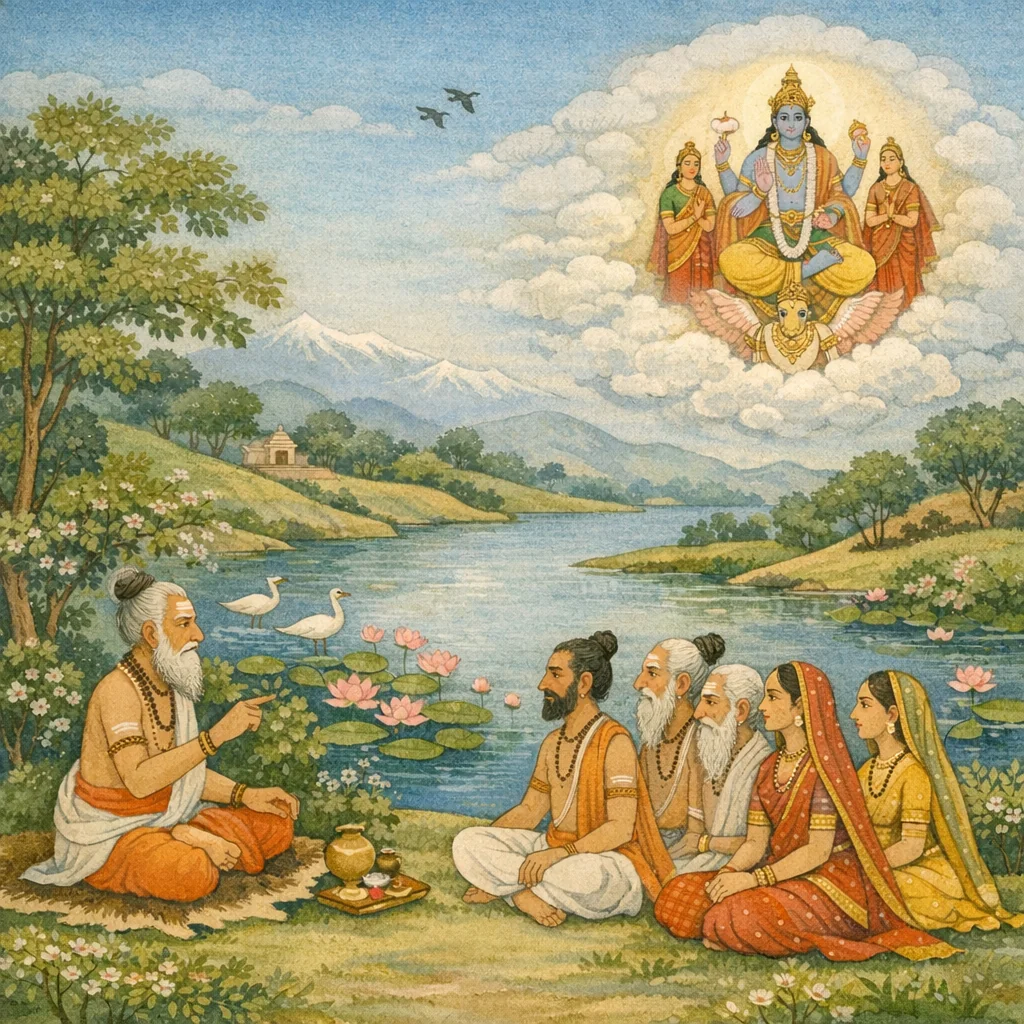
Chapter PP.2.12 first sets out a moral typology of harmful kinship by describing the “debt-bound” or enemy-like son—deceptive, greedy, abusive to his parents, and negligent of śrāddha and charity. In contrast, it praises the ideal son who, from childhood through adulthood, delights his parents, serves them, and fulfills the rites and duties of care. The teaching then turns to vairāgya (detachment): wealth and relationships are impermanent, and one departs alone; therefore one should take refuge in dharma and cultivate virtue. In the embedded episode, Dharma appears with personified virtues and addresses Durvāsā’s anger; yet Durvāsā still curses Dharma into degraded births, later understood as Dharma’s incarnations (Yudhiṣṭhira, Vidura) and as the dharmic trial of Hariścandra. The chapter closes by reaffirming karma: deeds shape birth and death, and puṇya is grown through disciplined ethical limbs.
Shlokas
Verse 1
सुमनोवाच । ऋणसंबंधिनं पुत्रं प्रवक्ष्यामि तवाग्रतः । ऋणं यस्य गृहीत्वा यः प्रयाति मरणं किल
Sumana said: “I shall explain to you, here before you, the son who is connected with a debt—the case when someone takes another’s loan and then indeed goes to death.”
Verse 2
अर्थदाता सुतो भूत्वा भ्राता चाथ पिता प्रिया । मित्ररूपेण वर्त्तेत अतिदुष्टः सदैव सः
Becoming a son who gives wealth, a brother, and even a dear father, he behaves in the guise of a friend—yet he is always exceedingly wicked.
Verse 3
गुणं नैव प्रपश्येत स क्रूरो निष्ठुराकृतिः । जल्पते निष्ठुरं वाक्यं सदैव स्वजनेषु च
He does not perceive virtue at all; he is cruel and hard-hearted by nature. He always speaks harsh words—especially toward his own people.
Verse 4
मिष्टंमिष्टं समश्नाति भोगान्भुंजति नित्यशः । द्यूतकर्मरतो नित्यं चौरकर्मणि सस्पृहः
He eats delicacies again and again and continually indulges in sensual pleasures; ever devoted to gambling, he is greedily drawn toward deeds of theft.
Verse 5
गृहद्रव्यं बलाद्भुंक्ते वार्यमाणः स कुप्यति । पितरं मातरं चैव कुत्सते च दिनेदिने
He consumes the household’s property by force; when restrained, he becomes angry. And day after day he reviles his father and mother as well.
Verse 6
द्रावकस्त्रासकश्चैव बहुनिष्ठुरजल्पकः । एवं भुक्त्वाथ तद्द्रव्यं सुखेन परितिष्ठति
A man who extorts, who intimidates, and who speaks many harsh words—having thus consumed that ill-gotten wealth, he thereafter lives at ease.
Verse 7
जातकर्मादिभिर्बाल्ये द्रव्यं गृह्णाति दारुणः । पुनर्विवाहसंबंधान्नानाभेदैरनेकधा
Even in childhood, that cruel person appropriates wealth on the pretext of rites such as the birth-ceremony; and through connections formed by remarriage, he does so in many ways, by numerous stratagems.
Verse 8
एवं संजायते द्रव्यमेवमेतद्ददात्यपि । गृहक्षेत्रादिकं सर्वं ममैव हि न संशयः
Thus wealth is amassed; and even when it is given away, one still thinks: ‘This house, this land, and everything else is mine alone—there is no doubt.’
Verse 9
पितरं मातरं चैव हिनस्त्येव दिनेदिने । सुखंडैर्मुशलैश्चैव सर्वघातैः सुदारुणैः
Day after day he truly assaults his father and mother as well, striking them with broken pieces of wood, with pestles, and with every other exceedingly cruel kind of blow.
Verse 10
मृते तु तस्मिन्पितरि मातर्येवातिनिष्ठुरः । निःस्नेहो निष्ठुरश्चश्चैव जायते नात्र संशयः
But when that father has died, he becomes exceedingly harsh even toward his mother; he turns loveless and cruel—of this there is no doubt.
Verse 11
श्राद्धकर्माणि दानानि न करोति कदैव सः । एवंविधाश्च वै पुत्राः प्रभवंति महीतले
He never performs the rites of Śrāddha, nor does he give gifts in charity. Indeed, sons of such a kind come to be born upon the earth.
Verse 12
रिपुं पुत्रं प्रवक्ष्यामि तवाग्रे द्विजपुंगव । बाल्ये वयसि संप्राप्ते रिपुत्वे वर्तते सदा
O best of the twice-born, I shall describe to you the ‘enemy’ called the son: when youth is attained after childhood, he ever remains in the state of enmity.
Verse 13
पितरं मातरं चैव क्रीडमानो हि ताडयेत् । ताडयित्वा प्रयात्येव प्रहस्यैव पुनःपुनः
While playing, he strikes even his father and mother; having struck them, he goes away, laughing again and again.
Verse 14
पुनरायाति संत्रस्तः पितरं मातरं प्रति । सक्रोधो वर्तते नित्यं कुत्सते च पुनःपुनः
Frightened, he returns again to his father and mother. Ever filled with anger, he continually reviles them again and again.
Verse 15
एवं संवर्तते नित्यं वैरकर्मणि सर्वदा । पितरं मारयित्वा च मातरं च ततः पुनः
Thus he persists continually, ever engaged in deeds of enmity—having killed his father, he then turns again to kill his mother as well.
Verse 16
प्रयात्येवं स दुष्टात्मा पूर्ववैरानुभावतः । अथातः संप्रवक्ष्यामि यस्माल्लभ्यं भवेत्प्रियम्
Thus does that wicked-minded person meet his end, driven by the force of former enmity. Now I shall explain that by which what is dear may be attained.
Verse 17
जातमात्रः प्रियं कुर्याद्बाल्ये लालनक्रीडनैः । वयः प्राप्य प्रियं कुर्यान्मातृपित्रोरनन्तरम्
From the moment of birth one should be made happy; in childhood, through affectionate care and play. And when one comes of age, one should thereafter please one’s mother and father.
Verse 18
भक्त्या संतोषयेन्नित्यं तावुभौ परितोषयेत् । स्नेहेन वचसा चैव प्रियसंभाषणेन च
One should always please those two with devotion; one should satisfy them both—through affectionate words and through gentle, pleasing conversation.
Verse 19
मृते गुरौ समाज्ञाय स्नेहेन रुदते पुनः । श्राद्धकर्माणि सर्वाणि पिंडदानादिकां क्रियाम्
Knowing that the teacher has died, one weeps again and again out of affection; yet one should perform all the śrāddha rites—such as the acts beginning with offering piṇḍas, the funeral rice-balls.
Verse 20
करोत्येव सुदुःखार्तस्तेभ्यो यात्रां प्रयच्छति । ऋणत्रयान्वितः स्नेहाद्भुंजापयति नित्यशः
Even when afflicted by intense sorrow, he still provides them with the means to undertake pilgrimage; and, bound by the threefold debts, out of affection he continually causes them to be fed day after day.
Verse 21
यस्माल्लभ्यं भवेत्कांत प्रयच्छति न संशयः । पुत्रो भूत्वा महाप्राज्ञ अनेन विधिना किल
O beloved, whatever is sought becomes attainable—of this there is no doubt. Indeed, by this very procedure, one becomes a son who is greatly wise.
Verse 22
उदासीनं प्रवक्ष्यामि तवाग्रे प्रिय सांप्रतम् । उदासीनेन भावेन सदैव परिवर्तते
Beloved, I shall now explain to you, here and at present, the state of detachment; for one who abides in a detached disposition is ever transformed inwardly.
Verse 23
ददाति नैव गृह्णाति न च कुप्यति तुष्यति । नो वा ददाति संत्यज्य उदासीनो द्विजोत्तम
He neither gives nor accepts; he neither grows angry nor becomes pleased. Having renounced all, he neither gives nor withholds—such is the detached one, the best of the twice-born.
Verse 24
तवाग्रे कथितं सर्वं पुत्राणां गतिरीदृशी । यथा पुत्रस्तथा भार्या पिता माताथ बांधवाः
All has already been told to you concerning the sons—what their destiny is like. As it is for the son, so it is for the wife, the father, the mother, and the other relatives as well.
Verse 25
भृत्याश्चान्ये समाख्याताः पशवस्तुरगास्तथा । गजा महिष्यो दासाश्च ऋणसंबंधिनस्त्वमी
Servants and other dependents are also reckoned; likewise cattle and horses; elephants, buffaloes, and slaves as well—these all are regarded as bound up with debt, that is, with obligation.
Verse 26
गृहीतं न ऋणं तेन आवाभ्यां तु न कस्यचित् । न्यासमेवं न कस्यापि कृतं वै पूर्वजन्मनि
He took no debt; nor did either of us incur any debt from anyone. Likewise, in a former birth no one ever placed any deposit—any entrusted property—with us.
Verse 27
धारयावो न कस्यापि ऋणं कांत शृणुष्वहि । न वैरमस्ति केनापि पूर्वजन्मनि वै कृतम्
O beloved, listen: we owe no debt to anyone. Nor is there any enmity with anyone, fashioned in a former birth.
Verse 28
आवाभ्यां हि न विप्रेंद्र न त्यक्तं हि तथापते । एवं ज्ञात्वा शमं गच्छ त्यज चिंतामनर्थकीम्
O best of brāhmaṇas, surely we have not abandoned you—nor has your husband. Knowing this, go in peace and relinquish this futile, purposeless anxiety.
Verse 29
कस्य पुत्राः प्रिया भार्या कस्य स्वजनबांधवाः । हृतं न चैव कस्यापि नैव दत्तं त्वया पुनः
Whose are the sons, whose the beloved wife, and whose are one’s own kinsmen and relatives? Truly, you have stolen nothing from anyone—nor have you really given anything away again.
Verse 30
कथं हि धनमायाति विस्मयं व्रज माधव । प्राप्तव्यमेव यत्रैव भवेद्द्रव्यं द्विजोत्तम
How indeed does wealth come about? Do not be astonished, O Mādhava. Whatever wealth is destined to be obtained will surely arise there itself, O best of brāhmaṇas.
Verse 31
अनायासेन हस्ते हि तस्यैव परिजायते । यत्नेन महता चैव द्रव्यं रक्षति मानवः
Indeed, without any effort it comes into his very hand; yet a man protects his wealth only with great exertion.
Verse 32
व्रजमानो व्रजत्येव धनं तत्रैव तिष्ठति । एवं ज्ञात्वा शमं गच्छ जहि चिंतामनर्थकीम्
A person who departs goes on alone, while his wealth remains right there. Knowing this, go to peace of mind, and abandon futile, harmful worry.
Verse 33
कस्य पुत्राः प्रिया भार्या कस्य स्वजनबांधवाः । कः कस्य नास्ति संसारे असंबंधाद्द्विजोत्तम
Whose are the sons, whose the beloved wife, and whose the kinsmen and relatives? In this world, O best of Brahmins, who does not at some time become unrelated to another—since relationships are not permanent?
Verse 34
महामोहेन संमूढा मानवाः पापचेतसः । इदं गृहमयं पुत्र इमा नार्यो ममैव हि
Utterly deluded by great infatuation, people of sinful disposition think, “This house is mine; this son is mine; these women are indeed mine.”
Verse 35
अनृतं दृश्यते कांत संसारस्य हि बंधनम् । एवं संबोधितो देव्या भार्यया प्रियया तदा
“O beloved, falsehood is seen to be a bondage of worldly existence.” Thus, at that time, he was addressed by the goddess—his dear wife.
Verse 36
पुनः प्राह प्रियां भार्यां सुमनां ज्ञानवादिनीम् । सोमशर्मोवाच । सत्यमुक्तं त्वया भद्रे सर्वसंदेहनाशनम्
Then Somaśarmā again spoke to his beloved wife Sumanā, eloquent in wisdom: “Dear one, what you have said is true, and it dispels all doubts.”
Verse 37
तथापि वंशमिच्छंति साधवः सत्यपंडिताः । यथा पुत्रस्य मे चिंता धनस्य च तथा प्रिये
Even so, virtuous sages who know the truth still desire a lineage. Just as I worry about a son, so too, O beloved, I worry about wealth.
Verse 38
येनकेनाप्युपायेन पुत्रमुत्पादयाम्यहम् । सुमनोवाच । पुत्रेण लोकाञ्जयति पुत्रस्तारयते कुलम्
“By whatever means possible, I will beget a son.” Sumanā said: “Through a son one conquers the worlds; a son delivers and saves the family line.”
Verse 39
सत्पुत्रेण महाभाग पिता माता च जंतवः । एकः पुत्रो वरो विद्वान्बहुभिर्निर्गुणैस्तु किम्
O fortunate one, through a virtuous son the father and mother are truly fulfilled. One excellent, wise son is best—what use are many sons who are without merit?
Verse 40
एकस्तारयते वंशमन्ये संतापकारकाः । पूर्वमेव मया प्रोक्तमन्ये संबंधगामिनः
One uplifts and delivers the lineage, while others become causes of distress. As I said earlier, there are also those who merely follow along through connections and associations.
Verse 41
पुण्येन प्राप्यते पुत्रः पुण्येन प्राप्यते कुलम् । सुगर्भः प्राप्यते पुण्यैस्तस्मात्पुण्यं समाचर
By merit (puṇya) a son is obtained; by merit a noble family is attained. By merits one gains a good pregnancy and healthy offspring; therefore, practice merit.
Verse 42
जातस्य मृतिरेवास्ति जन्म एव मृतस्य च । सुजन्म प्राप्यते पुण्यैर्मरणं तु तथैव च
For one who is born, death alone is certain; and for one who has died, birth surely follows. By merit one attains a good birth—and likewise, one’s manner of death accords with one’s deeds.
Verse 43
सुखं धनचयः कांत भुज्यते पुण्यकर्मभिः । सोमशर्मोवाच । पुण्यस्याचरणं ब्रूहि तथा जन्मान्यपि प्रिये
“Beloved, happiness and the accumulation of wealth are enjoyed through meritorious deeds.” Somaśarmā said: “O dear one, tell me about the practice of merit (puṇya), and also about its effects across other births.”
Verse 44
सुपुण्यः कीदृशो भद्रे वद पुण्यस्य लक्षणम् । सुमनोवाच । आदौ पुण्यं प्रवक्ष्यामि यथा पुण्यं श्रुतं मया
“O auspicious lady, what is a person of great merit like? Tell me the defining mark of puṇya.” Sumanā said: “First, I shall explain puṇya, just as I have heard of it.”
Verse 45
पुरुषो वाथवा नारी यथा नित्यं च वर्तते । यथा पुण्यैः समाप्नोति कीर्तिं पुत्रान्प्रियान्धनम्
Whether man or woman, according to how one conducts oneself each day—by meritorious deeds one attains renown, beloved sons, and wealth.
Verse 46
पुण्यस्य लक्षणं कांत सर्वमेव वदाम्यहम् । ब्रह्मचर्येण सत्येन मखपंचकवर्तनैः
O beloved, I shall tell you completely the marks of puṇya: through brahmacarya (celibate discipline), through truthfulness, and through the observance of the five sacrificial duties.
Verse 47
दानेन नियमैश्चापि क्षमाशौचेन वल्लभ । अहिंसया सुशक्त्या च अस्तेयेनापि वर्तनैः
Through dāna (charity) and disciplined observances, through forgiveness and purity, O beloved; through ahiṃsā (non-violence) and steadfast strength, and also through conduct free from stealing—
Verse 48
एतैर्दशभिरंगैस्तु धर्ममेवं प्रपूरयेत् । संपूर्णो जायते धर्मो ग्रासैर्भोगो यथोदरे
Thus, by these ten limbs one should fully cultivate dharma. Dharma becomes complete—just as nourishment becomes complete in the belly through mouthfuls of food.
Verse 49
धर्मं सृजति धर्मात्मा त्रिविधेनैव कर्मणा । तस्य धर्मः प्रसन्नात्मा पुण्यमेवं तु प्रापयेत्
The dharma-souled person brings forth Dharma through action of three kinds; and with a clear, serene heart, that very Dharma bestows merit upon him in this same way.
Verse 50
यं यं चिंतयते प्राज्ञस्तं तं प्राप्नोति दुर्लभम् । सोमशर्मोवाच । कीदृङ्मूर्तिस्तु धर्मस्य कान्यंगानि च भामिनि
Whatever a wise person contemplates, that very goal he attains—even if it is hard to obtain. Somaśarmā said: “O lovely lady, what form does Dharma have, and what are his limbs (constituent parts)?”
Verse 51
प्रीत्या कथय मे कांते श्रोतुं श्रद्धा प्रवर्तते । सुमनोवाच । लोके धर्मस्य वै मूर्तिः कैर्दृष्टा न द्विजोत्तम
“Tell me with affection, O beloved; my faith is stirred to listen.” Sumanā said: “In this world, by whom has the very embodiment of Dharma been seen, O best of the twice-born?”
Verse 52
अदृश्यवर्त्मा सत्यात्मा न दृष्टो देवदानवैः । अत्रिवंशे समुत्पन्नो अनसूयात्मजो द्विजः
His course is unseen; his very nature is Truth. He was not beheld even by gods and asuras. Born in the lineage of Atri, he is the twice-born son of Anasūyā.
Verse 53
तेन दृष्टो महाधर्मो दत्तात्रेयेण वै सदा । द्वावेतौ तु महात्मानौ कुर्वाणौ तप उत्तमम्
Through him, Dattātreya always beheld the great Dharma. Indeed, these two great-souled ones were performing the highest austerity.
Verse 54
धर्मेण वर्तमानौ तौ तपसा च बलेन च । इंद्राधिकेन रूपेण प्रशस्तेन भविष्यतः
Abiding in Dharma, and endowed with tapas (austerity) and strength, those two shall attain a blessed, praised form surpassing even Indra’s.
Verse 55
दशवर्षसहस्रं तौ यावत्तु वनसंस्थितौ । वायुभक्षौ निराहारौ संजातौ शुभदर्शनौ
For as long as they remained in the forest—ten thousand years—they lived on air alone, without food, and came to bear an auspicious, radiant appearance.
Verse 56
दशवर्षसहस्रं तु तावत्कालं तपोर्जितम् । सुसाध्यमानयोश्चैव तत्र धर्मः प्रदृश्यते
For ten thousand years, throughout that entire span, tapas was amassed; and as those observances were well accomplished, Dharma clearly manifested there.
Verse 57
पंचाग्निः साध्यते द्वाभ्यां तावत्कालं द्विजोत्तम । त्रिकालं साधितं तावन्निराहारं कृतं तथा
O best of the twice-born, the five-fire austerity for that duration is accomplished in two (measures); and for that very span the thrice-daily discipline is fulfilled—so too is fasting, the abstaining from food, deemed complete.
Verse 58
जलमध्ये स्थितौ तावद्दत्तात्रेयो यतिस्तथा । दुर्वासास्तु मुनिश्रेष्ठस्तपसा चैव कर्षितः
Then, while the two remained in the midst of the waters, Dattātreya was there as well, a yati renunciant; and Durvāsā, foremost among sages, was also present, emaciated by tapas.
Verse 59
धर्मं प्रति स धर्मात्मा चुक्रोध मुनिपुंगवः । क्रुद्धे सति महाभाग तस्मिन्मुनिवरे तदा
That righteous-souled sage—foremost among ascetics—grew wrathful concerning Dharma. And when that eminent muni became enraged, O fortunate one, then…
Verse 60
अथ धर्मः समायातः स्वरूपेण च वै तदा । ब्रह्मचर्यादिभिर्युक्तस्तपोभिश्च स बुद्धिमान्
Then Dharma indeed arrived there at that time in his own true form—endowed with brahmacarya and the other disciplines, and with tapas; he was wise.
Verse 61
सत्यं ब्राह्मणरूपेण ब्रह्मचर्यं तथैव च । तपस्तु द्विजवर्योस्ति दमः प्राज्ञो द्विजोत्तमः
Truthfulness is the very form of a brāhmaṇa; so too is the discipline of brahmacarya. A noble twice-born is marked by tapas, and the wise best of the dvija is characterized by self-control (dama).
Verse 62
नियमस्तु महाप्राज्ञो दानमेव तथैव च । अग्निहोत्रिस्वरूपेण ह्यात्रेयं हि समागताः
But niyama—O greatly wise one—and likewise giving (dāna): indeed, the Ātreya sages have assembled here in the very form of Agnihotrin priests, performers of the fire-offering.
Verse 63
क्षमा शांतिस्तथा लज्जा चाहिंसा च ह्यकल्पना । एताः सर्वाः समायाताः स्त्रीरूपास्तु द्विजोत्तम
Forgiveness, peace, modesty, non-violence (ahiṃsā), and freedom from fanciful imagining—O best of the twice-born—these all have come together, embodied in the form of a woman.
Verse 64
बुद्धिः प्रज्ञा दया श्रद्धा मेधा सत्कृति शांतयः । पंचयज्ञास्तथा पुण्याः सांगा वेदास्तु ते तदा
Intellect, wisdom, compassion, faith, retentive intelligence, good repute, and states of peace; likewise the meritorious five great sacrifices, and the Vedas together with their auxiliaries, were yours at that time.
Verse 65
स्वस्वरूपधराश्चैव ते सर्वे सिद्धिमागताः । अग्न्याधानादयः पुण्या अश्वमेधादयस्तथा
Assuming their own proper forms, they all attained perfection. Likewise, the meritorious rites beginning with the establishing of the sacred fire, and those beginning with the Aśvamedha sacrifice, became effective and fruitful.
Verse 66
रूपलावण्यसंयुक्ताः सर्वाभरणभूषिताः । दिव्यमाल्यांबरधरा दिव्यगंधानुलेपनाः
Endowed with beauty and charm, adorned with every kind of ornament, wearing divine garlands and garments, and anointed with celestial fragrances.
Verse 67
किरीटकुंडलोपेता दिव्याभरणभूषिताः । दीप्तिमंतः सुरूपास्ते तेजोज्वालाभिरावृताः
Adorned with crowns and earrings, embellished with heavenly ornaments, they were radiant and beautiful, enveloped on all sides by blazing flames of splendor.
Verse 68
एवं धर्मः समायातः परिवारसमन्वितः । यत्र तिष्ठति दुर्वासाः क्रोधनः कालवत्तथा
Thus Dharma arrived there, accompanied by his retinue, at the place where Durvāsā, fierce in anger, abides like Time itself.
Verse 69
धर्म उवाच । कस्मात्कोपः कृतो विप्र भवांस्तपस्समन्वितः । क्रोधो हि नाशयेच्छ्रेयस्तप एव न संशयः
Dharma said: “Why have you become angry, O brāhmaṇa, though you are endowed with tapas? For anger destroys one’s welfare, whereas austerity brings it about—of this there is no doubt.”
Verse 70
सर्वनाशकरस्तस्मात्क्रोधं तत्र विवर्जयेत् । स्वस्थो भव द्विजश्रेष्ठ उत्कृष्टं तपसः फलम्
Therefore, since anger brings total ruin, one should avoid it in that situation. Be composed, O best of the twice-born; serenity is the highest fruit of austerity.
Verse 71
दुर्वासा उवाच । भवान्को हि समायात एतैर्द्विजवरैः सह । सप्त नार्यः प्रतिष्ठंति सुरूपाः समलंकृताः
Durvāsā said: “Who are you that have come here, together with these excellent brāhmaṇas? And why are seven women—beautiful in form and well adorned—standing here?”
Verse 72
कथयस्व ममाग्रे त्वं विस्तरेण महामते । धर्म उवाच । अयं ब्राह्मणरूपेण सर्वतेजः समन्वितः
“O great sage, tell it to me here in full detail.” Dharma replied: “This one, in the form of a brāhmaṇa, is endowed with every kind of splendor and spiritual radiance.”
Verse 73
दंडहस्तः सुप्रसन्नः कमंडलुधरस्तथा । तवाग्रे ब्रह्मचर्योयं सोयं पश्य समागतः
Staff in hand, serene and gracious, and bearing a water-pot (kamaṇḍalu)—this very brahmacārin has come before you. Look, he has arrived.
Verse 74
अन्यं पश्यस्व वै त्वं च दीप्तिमंतं द्विजोत्तम । कपिलं पिंगलाक्षं च सत्यमेनं द्विजोत्तम
O best of brāhmaṇas, behold this other one—radiant, capila-hued, with tawny-brown eyes. Truly, O best of brāhmaṇas, he is real, just as you see him.
Verse 75
तादृशं पश्य धर्मात्मन्वैश्वदेवसमप्रभम् । यत्तपो हि त्वया विप्र सर्वदेवसमाश्रितम्
Behold such splendour, O righteous one—radiant like the host of the Viśvedevas; for the austerity you have practiced, O brāhmaṇa, is truly upheld and supported by all the gods.
Verse 76
एतं पश्य महाभाग तव पार्श्वसमागतम् । प्रसन्नवाग्दीप्तियुक्तः सर्वजीवदयापरः
O fortunate one, look upon this person who has come to your side—endowed with gracious speech and radiant brilliance, wholly devoted to compassion toward all living beings.
Verse 77
दम एव तथायं ते यः पोषयति सर्वदा । जटिलः कर्कशः पिंगो ह्यतितीव्रो महाप्रभुः
Indeed, it is this very self-restraint that always sustains you—matted-haired, austere and harsh, tawny-hued, exceedingly fierce, and greatly powerful.
Verse 78
नाशको हि स पापानां खड्गहस्तो द्विजोत्तम । अभिशांतो महापुण्यो नित्यक्रियासमन्वितः
O best of the twice-born, he is indeed the destroyer of sins, sword in hand—fully pacified, greatly meritorious, and steadfast in daily sacred observances.
Verse 79
नियमस्तु समायातस्तव पार्श्वे द्विजोत्तम । अनिर्मुक्तो महादीप्तः शुद्धस्फटिकसन्निभः
But Niyama has come to your side, O best of Brahmins—unceasing, greatly radiant, resembling pure crystal.
Verse 80
पयःकमंडलुकरो दंतकाष्ठधरो द्विजः । शौच एष समायातो भवतः सन्निधाविह
A twice-born man, holding a water-pot filled with milk and carrying a tooth-stick, has come here to your presence for the purpose of purification.
Verse 81
अतिसाध्वी महाभागा सत्यभूषणभूषिता । सर्वभूषणशोभांगी शुश्रूषेयं समागता
“She is exceedingly virtuous and most fortunate—adorned with truth as her ornament. With limbs made radiant by every good ornament, she has come here to render service.”
Verse 82
अतिधीरा प्रसन्नांगी गौरी प्रहसितानना । पद्महस्ता इयं धात्री पद्मनेत्रा सुपद्मिनी
She is exceedingly steadfast and wise, with a serene and gracious form—fair-complexioned, her face smiling. This Supporter (Dhātrī) is lotus-handed, lotus-eyed, and supremely lotus-like.
Verse 83
दिव्यैराभरणैर्युक्ता क्षमा प्राप्ता द्विजोत्तम । अतिशांता सुप्रतिष्ठा बहुमंगलसंयुता
O best of the twice-born, Kṣamā, the personification of forbearance, appeared adorned with divine ornaments—exceedingly tranquil, well-established in dignity, and endowed with many auspicious qualities.
Verse 84
दिव्यरत्नकृता शोभा दिव्याभरणभूषिता । तव शांतिर्महाप्राज्ञ ज्ञानरूपा समागता
Adorned with splendor wrought from divine jewels and arrayed in celestial ornaments—O greatly wise one—your Peace has arrived, taking the very form of Knowledge.
Verse 85
परोपकारकरणा बहुसत्यसमाकुला । मितभाषा सदैवासौ अकल्पा ते समागता
Devoted to the welfare of others, abounding in many truths, and ever restrained in speech—those blameless ones had assembled.
Verse 86
प्रसन्ना सा क्षमायुक्ता सर्वाभरणभूषिता । पद्मासना सुरूपा सा श्यामवर्णा यशस्विनी
She was serene and endowed with forbearance, adorned with every ornament. Seated upon a lotus, she was beautiful in form—dark-complexioned and illustrious.
Verse 87
अहिंसेयं महाभागा भवंतं तु समागता । तप्तकांचनवर्णांगी रक्तांबरविलासिनी
O greatly fortunate one, Lady Ahimsā has come into your presence—her limbs radiant like heated gold, delighting in red garments.
Verse 88
सुप्रसन्ना सुमंत्रा च यत्र तत्र न पश्यति । ज्ञानभावसमाक्रांता पुण्यहस्ता तपस्विनी
Ever serene and well-counseled, she does not look here and there. Overcome by a state of spiritual knowing, that ascetic woman—whose hands are holy—remains absorbed.
Verse 89
मुक्ताभरणशोभाढ्या निर्मला चारुहासिनी । इयं श्रद्धा महाभाग पश्य पश्य समागता
Adorned with the splendor of pearl ornaments, pure and sweetly smiling—O greatly fortunate one, look, look: Śraddhā herself has arrived.
Verse 90
बहुबुद्धिसमाक्रांता बहुज्ञानसमाकुला । सुभोगासक्तरूपा सा सुस्थिता चारुमंगला
She was endowed with abundant intelligence, filled with manifold knowledge; attached to refined enjoyments, yet firmly poised—fair and auspicious in appearance.
Verse 91
सर्वेष्टध्यानसंयुक्ता लोकमाता यशस्विनी । सर्वाभरणशोभाढ्या पीनश्रोणि पयोधरा
Absorbed in meditation upon all that is most desired, the glorious Mother of the world—adorned with the splendor of every ornament—was full-hipped and full-breasted.
Verse 92
गौरवर्णा समायाता माल्यवस्त्रविभूषिता । इयं मेधा महाप्राज्ञ तवैव परिसंस्थिता
Fair-complexioned, she has arrived, adorned with garlands, garments, and ornaments. O greatly wise one, this is Medhā, established here solely for you.
Verse 93
हंसचंद्रप्रतीकाशा मुक्ताहारविलंबिनी । सर्वाभरणसंभूषा सुप्रसन्ना मनस्विनी
She shone with the radiance of the hamsa and the moon, wore a dangling necklace of pearls, was adorned with every ornament, and appeared exceedingly serene and noble-minded.
Verse 94
श्वेतवस्त्रेण संवीता शतपत्रं शयेकृतम् । पुस्तककरा पंकजस्था राजमाना सदैव हि
Clad in white garments, she is made to recline upon a hundred‑petalled lotus; holding a book in her hand, seated upon a lotus, she ever shines in splendor.
Verse 95
एषा प्रज्ञा महाभाग भाग्यवंतं समागता । लाक्षारससमावर्णा सुप्रसन्ना सदैव हि
O noble one, this wisdom has come to the fortunate; it is of the hue of lac‑juice and is ever exceedingly serene indeed.
Verse 96
पीतपुष्पकृतामाला हारकेयूरभूषणा । मुद्रिका कंकणोपेता कर्णकुंडलमंडिता
She wore a garland made of yellow flowers, adorned with necklace and armlets; furnished with rings and bracelets, and ornamented with earrings.
Verse 97
पीतेन वाससा देवी सदैव परिराजते । त्रैलोक्यस्योपकाराय पोषणायाद्वितीयका
Clad in yellow garments, the Goddess ever shines resplendently—unparalleled in nurturing, for the welfare and sustenance of the three worlds.
Verse 98
यस्याः शीलं द्विजश्रेष्ठ सदैव परिकीर्तितम् । सेयं दया सु संप्राप्ता तव पार्श्वे द्विजोत्तम
O best of Brahmins, her virtuous conduct is always celebrated. That very Compassion (Dayā) has now indeed come and reached your side, O foremost among the twice-born.
Verse 99
इयं वृद्धा महाप्राज्ञ भावभार्या तपस्विनी । मम माता द्विजश्रेष्ठ धर्मोहं तव सुव्रत
This aged woman is supremely wise—a devoted wife and an ascetic. She is my mother, O best of the twice-born; and I am your Dharma, O you of excellent vows.
Verse 100
इति ज्ञात्वा शमं गच्छ मामेवं परिपालय । दुर्वासा उवाच । यदि धर्मः समायातो मत्समीपं तु सांप्रतम्
“Knowing this, go in peace, and protect me in this way.” Durvāsā said: “If Dharma has indeed come now into my presence…”
Verse 101
एतन्मे कारणं ब्रूहि किं ते धर्म करोम्यहम् । धर्म उवाच । कस्मात्क्रुद्धोसि विप्रेन्द्र किमेतैर्विप्रियं कृतम्
“Tell me the reason for this. What duty—what dharma—shall I perform for you?” Dharma replied: “Why are you angry, O best of brāhmaṇas? What displeasing thing has been done to you by these?”
Verse 102
तन्मे त्वं कारणं ब्रूहि दुर्वासो यदि मन्यसे । दुर्वासा उवाच । येनाहं कुपितो देव तदिदं कारणं शृणु
“If you think it proper, O Durvāsā, tell me the reason.” Durvāsā said: “O Lord, listen to this very reason by which I became angered.”
Verse 103
दमशौचैः सुसंक्लेशैः शोधितं कायमात्मनः । लक्षवर्षप्रमाणं वै तपश्चर्या मया कृता
By self-restraint and purity—through intense hardships—I purified my own body. Indeed, I performed austerities (tapas) for a measure of one hundred thousand years.
Verse 104
एवं पश्यसि मामेवं दया तेन प्रवर्तते । तस्मात्क्रुद्धोस्मि तेद्यैव शापमेवं ददाम्यहम्
Since you look upon me in this manner, compassion is stirred within me; yet for that very reason I am angry with you even today—therefore I now pronounce this curse upon you.
Verse 105
एवं श्रुत्वा तदा तस्य तमुवाच महामतिः । धर्म उवाच । मयि नष्टे महाप्राज्ञ लोको नाशं समेष्यति
Having heard this, the great-minded one addressed him then. Dharma said: “O greatly wise one, if I am destroyed, the world will go to ruin.”
Verse 106
दुःखमूलमहं तात निकर्शामि भृशं द्विज । सौख्यं पश्चादहं दद्मि यदि सत्यं न मुंचति
O dear one—O brāhmaṇa—I will thoroughly uproot the very source of suffering; afterward I shall grant happiness, if he does not abandon truth.
Verse 107
पापोयं सुखमूलस्तु पुण्यं दुःखेन लभ्यते । पुण्यमेवं प्रकुर्वाणः प्राणी प्राणान्विमुंचति
Sin is rooted in pleasure, whereas merit (puṇya) is gained through hardship. Thus, a living being who performs merit in this way eventually gives up the vital breaths.
Verse 108
महत्सौख्यं ददाम्येवं परत्र च न संशयः । दुर्वासा उवाच । सुखं येनाप्यते तेन परं दुःखं प्रपद्यते
“Thus I grant great happiness—also in the hereafter; of this there is no doubt.” Durvāsā said: “That by which one obtains pleasure, by that very means one falls into greater sorrow.”
Verse 109
तत्तु मर्त्यः परित्यज्य अन्येनापि प्रभुज्यते । तत्सुखं को विजानाति निश्चयं नैव पश्यति
A mortal abandons that possession, and it is enjoyed even by another. Who can truly know the happiness that comes from it? For no certainty is seen at all.
Verse 110
तच्छ्रेयो नैव पश्यामि अन्याय्यं हि कृतं तव । येन कायेन क्रियते भुज्यते नैव तत्सुखम्
I see no good in that; what you have done is indeed unjust. When an act is contrary to dharma, its pleasure is not truly enjoyed by the very body that performs it.
Verse 111
अन्येन क्रियते क्लेशमन्येनापि प्रभुज्यते । तत्सुखं को विजानाति चान्यायं धर्ममेव वा
One person undergoes the hardship, while another enjoys the result. Who, then, can truly know that happiness—and who can discern whether it is injustice or indeed dharma?
Verse 112
अन्येन क्रियते क्लेशमन्येनापि सुखं पुनः । भुनक्ति पुरुषो धर्म तत्सर्वं श्रेयसा युतम्
By one person hardship is brought about, and by another again happiness; yet it is the person himself who experiences the fruit of dharma—therefore all of this is bound up with one’s own higher good (śreyas).
Verse 113
पुण्यं चैव अनेनापि अनेन फलमश्नुते । क्रियमाणं पुनः पुण्यमन्येन परिभुज्यते
Merit (puṇya), too, is gained in this way, and in this way its fruit is enjoyed; yet merit that is being performed may again be appropriated and consumed by another.
Verse 114
तत्सर्वं हि सुखं प्रोक्तं यत्तथा यस्य लक्षणम् । धर्मशास्त्रोदितं चैव कृतं सर्वत्र नान्यथा
All that is declared to bring well-being is precisely what accords with a person’s true marks of nature; and it should be practiced everywhere exactly as enjoined in the Dharmaśāstras—never otherwise.
Verse 115
येन कायेन कुर्वंति तेन दुःखं सहन्ति ते । परत्र तेन भुंजंति अनेनापि तथैव च
With whatever body they perform their deeds, with that very body they endure suffering; and in the next world they experience the fruits through that same instrument, and likewise in this world as well.
Verse 116
इति ज्ञात्वा स धर्मात्मा भवान्समवलोकयेत् । यथा चौरा महापापाः स्वकायेन सहंति ते
Knowing this, you—being righteous—should reflect well upon it: just as thieves, great sinners, suffer along with their own bodies.
Verse 117
दुःखेन दारुणं तीव्रं तथा सुखं कथं नहि । धर्म उवाच । येन कायेन पापाश्च संचरन्ति हि पातकम्
“If there is fierce and intense suffering, why should there not also be happiness?” Dharma replied: “That very body through which sins move about, bringing transgression—(is the cause).”
Verse 118
तेन पीडां सहंत्येव पातकस्य हि तत्फलम् । दंडमेकं परं दृष्टं धर्मशास्त्रेषु पंडितैः
By that, one indeed endures suffering—this is the very fruit of sin. The learned, in the Dharmaśāstras, have recognized punishment as the single supreme corrective.
Verse 119
तं धर्मपूर्वकं विद्धि एतैर्न्यायैस्त्वमेव हि । दुर्वासा उवाच । एवं न्यायं न मन्येहं तथैव शृणु धर्मराट्
Know this to be grounded in dharma; indeed, you yourself establish it by these principles. Durvāsā said: “I do not accept such reasoning; nevertheless, listen further, O king of dharma.”
Verse 120
शापत्रयं प्रदास्यामि क्रुद्धोहं तव नान्यथा । धर्म उवाच । यदा क्रुद्धो महाप्राज्ञ मामेव हि क्षमस्व च
“I shall bestow upon you a threefold curse; I am angry with you—there is no other way.” Dharma said: “When you are angry, O greatly wise one, forgive me indeed.”
Verse 121
नैव क्षमसि विप्रेंद्र दासीपुत्रं हि मां कुरु । राजानं तु प्रकर्तव्यं चांडालं च महामुने
“O best of brāhmaṇas, do not tolerate this—do not make me the son of a maidservant. Rather, O great sage, the king should be made a caṇḍāla.”
Verse 122
प्रसादसुमुखो विप्र प्रणतस्य सदैव हि । दुर्वासाश्च ततः क्रुद्धो धर्मं चैव शशाप ह
O brāhmaṇa, he is ever gracious and kindly to one who bows in reverence. But then Durvāsā, inflamed with wrath, pronounced a curse—even upon Dharma himself.
Verse 123
दुर्वासा उवाच । राजा भव त्वं धर्माद्य दासीपुत्रश्च नान्यथा । गच्छ चांडालयोनिं च धर्म त्वं स्वेच्छया व्रज
Durvāsā said: “From today, O Dharma, you shall become a king—yet as the son of a maidservant, and not otherwise. Go also into a caṇḍāla birth; O Dharma, proceed there of your own will.”
Verse 124
एवं शापत्रयं दत्त्वा गतोसौ द्विजसत्तमः । अनेनापि प्रसंगेन दृष्टो धर्मः पुरा किल
Thus, having pronounced a threefold curse, that foremost of Brahmins departed. And through this very incident, it is said, Dharma was seen—made manifest—long ago.
Verse 125
सोमशर्मोवाच । धर्मस्तु कीदृशो जातस्तेन शप्तो महात्मना । तद्रूपं तस्य मे ब्रूहि यदि जानासि भामिनि
Somaśarmā said: “What manner of being did Dharma become, when he was cursed by that great-souled one? Tell me his form, O fair lady, if you know.”
Verse 126
सुमनोवाच । भरतानां कुले जातो धर्मो भूत्वा युधिष्ठिरः । विदुरो दासीपुत्रस्तु अन्यं चैव वदाम्यहम्
Sumana said: “In the lineage of the Bhāratas, Dharma himself was born as Yudhiṣṭhira. Vidura, however, was the son of a maidservant; and I shall also speak of another.”
Verse 127
यदा राजा हरिश्चंद्रो विश्वामित्रेण कर्षितः । तदा चांडालतां प्राप्तः स हि धर्मो महामतिः
When King Hariścandra was tormented by Viśvāmitra, he then fell into the state of a caṇḍāla; yet even that, O great-minded one, was truly dharma.
Verse 128
एवं कर्मफलं भुक्तं धर्मेणापि महात्मना । दुर्वाससो हि शापाद्वै सत्यमुक्तं तवाग्रतः
Thus, even that great-souled one—though righteous—experienced the fruit of his deeds; for, due to Durvāsā’s curse, what was spoken before you has indeed proved true.