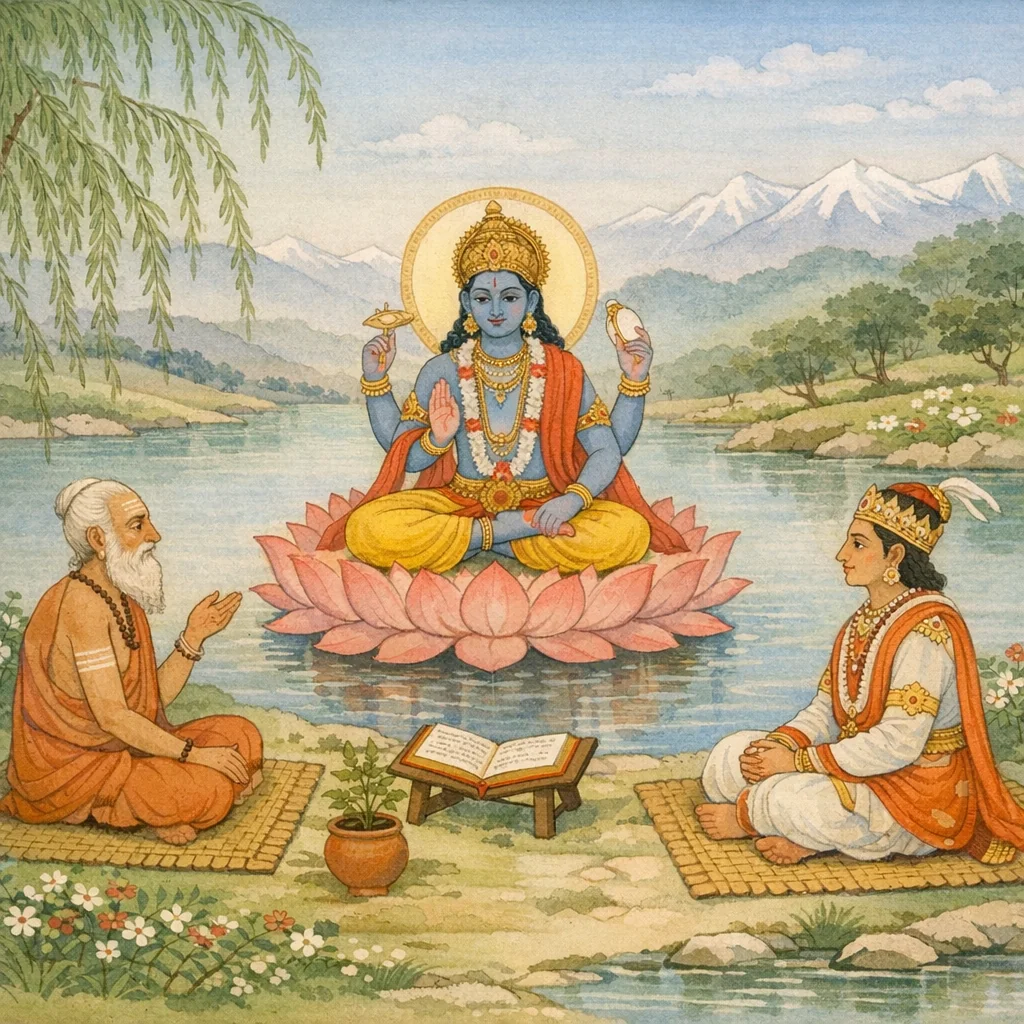
Adhyaya 39
The Episode of Vena: Purification, the ‘Vāsudevābhidhā’ Hymn, and the Dharma of Charity (Times, Tīrthas, Worthy Recipients)
The Ṛṣis ask how the sinful King Vena attained heaven. Sūta replies that by the company of sages sin is, as it were, churned out from the body. Vena performs austerities at Tṛṇabindu’s hermitage on the southern bank of the Revā, pleases Viṣṇu, and seeks the highest boon—bodily ascent to Viṣṇu’s abode together with his parents—being turned from delusion to devotion. The chapter then shifts to doctrine: the sin-destroying hymn called Vāsudevābhidhā, taught in an earlier precedent to Brahmā, declaring Viṣṇu’s all-pervasion and the names arising from His emanations. From this it unfolds applied dharma—charity’s supremacy, proper daily and occasional times, the nature of tīrthas (rivers and sanctifying places), and the marks of worthy recipients (pātras) and those to be avoided—culminating in śraddhā, faithful trust, as the decisive principle that makes giving bear fruit.
Shlokas
Verse 1
ऋषय ऊचुः । कथं वेनो गतः स्वर्गं पापं त्यक्त्वा प्रदूरतः । तन्नो विस्तरतोऽत्रापि वद सत्यवतां वर
The sages said: “How did Vena go to heaven, having cast off his sin far away? Tell us this here also, in full detail, O best among the truthful.”
Verse 2
सूतौवाच । ऋषीणां पुण्यसंसर्गात्संवादाच्च द्विजोत्तम । कायस्य मथनात्पापो बहिस्तस्य विनिर्गतः
Sūta said: “O best of the twice-born, through holy association with the sages and through their discourse, the sin within him—churned from his very body—came forth and went outside.”
Verse 3
पश्चाद्वेनः स पुण्यात्मा ज्ञानं लेभे च शाश्वतम् । रेवाया दक्षिणे कूले तपश्चचार स द्विजाः
Afterwards, that righteous Vena attained eternal spiritual knowledge; and, O brāhmaṇas, he practiced austerities on the southern bank of the Revā (Narmadā).
Verse 4
तृणबिन्दोरृषेश्चैव आश्रमे पापनाशने । वर्षाणां तु शतं साग्रं कामक्रोधविवर्जितः
In the sin-destroying hermitage of the sage Tṛṇabindu, he lived for a little over a hundred years, free from desire and anger.
Verse 5
तस्योग्रतपसादेवः शंखचक्रगदाधरः । प्रसन्नोभून्महाभागा निष्पापस्य नृपस्य वै
Pleased by his intense austerities, the Lord—bearing the conch, discus, and mace—became gracious toward that fortunate, truly sinless king.
Verse 6
उवाच च प्रसन्नोऽस्मि व्रियतां वरौत्तमः । वेन उवाच । यदि देव प्रसन्नोऽसि देहि मे वरमुत्तमम्
He said, “I am pleased—choose the best of boons.” Vena replied, “If, O Lord, you are pleased, then grant me the highest boon.”
Verse 7
अनेनापि शरीरेण गंतुमिच्छामि त्वत्पदम् । पित्रा सार्धं महाभाग मात्रा चैव सुरेश्वर । तवैव तेजसा देव तद्विष्णोः परमं पदम्
With this very body I wish to go to Your abode—together with my father, O greatly fortunate one, and also with my mother, O Lord of the gods. By Your own radiance, O Deva, grant us access to that supreme station of Viṣṇu.
Verse 8
श्रीवासुदेव उवाच । क्वगतोऽसौ महामोहो येन त्वं मोहितो नृप । लोभेन मोहयुक्तेन तमोमार्गे निपातितः
Śrī Vāsudeva said: “Where has that great delusion gone by which you, O king, were bewildered—cast down onto the path of darkness by greed joined with confusion?”
Verse 9
वेन उवाच । यन्मे पूर्वकृतं पापं तेनाहं मोहितो विभो । अतो मामुद्धरास्मात्त्वं पापाच्चैव सुदारुणात्
Vena said: “By the sin I committed in the past, O Lord, I have become deluded. Therefore, rescue me from this—indeed from this most dreadful sin.”
Verse 10
प्रजप्तव्यमथो पठ्यं तद्वदानुग्रहाद्विभो । भगवानुवाच । साधु भूप महाभाग पापं ते नाशमागतम्
“It should be recited and studied—so indeed—by your grace, O mighty one.” The Lord said: “Well done, O king, great-souled one; your sin has come to destruction.”
Verse 11
शुद्धोसि तपसा च त्वं ततः पुण्यं वदाम्यहम् । पुरा वै ब्रह्मणा तात पृष्टोहं भवता यथा
You have been purified by austerity; therefore I shall tell you what is meritorious. Formerly, dear child, Brahmā questioned me in the very manner you are questioning me now.
Verse 12
तस्मै यदुदितं वत्स तत्ते सर्वं वदाम्यहम् । एकदा ब्रह्मणा ध्यानस्थितेन नाभिपंकजे
My dear child, I shall tell you in full everything that was spoken to him. Once, when Brahmā was absorbed in meditation upon the lotus of the navel,
Verse 13
प्रादुरास तदा तस्य वरदानाय सुव्रत । तेन पृष्टं महत्पुण्यं स्तोत्रं पापप्रणाशनम्
Then, O virtuous one, he manifested before him in order to grant a boon. Asked by him, he then taught a greatly meritorious hymn—one that destroys sins.
Verse 14
वासुदेवाभिधानं च सुगतिप्रदमिच्छता । स्तोत्राणां परमं तस्मै वासुदेवाभिधं महत्
One who desires the gift of a blessed destiny should also embrace the Name of Vāsudeva; for him, the supreme of hymns is that great hymn known as “Vāsudevābhidha.”
Verse 15
सर्वसौख्यप्रदं नॄणां पठतां जपतां सदा । उपादिशं महाभाग विष्णुप्रीतिकरं परम्
“O greatly fortunate one, teach me that supreme practice or mantra which always grants all happiness to people who recite and repeat it, and which is most pleasing to Viṣṇu.”
Verse 16
विष्णुरुवाच । एतत्सर्वं जगद्व्याप्तं मया त्वव्यक्तमूर्तिना । अतो मां मुनयः प्राहुर्विष्णुं विष्णुपरायणाः
Viṣṇu said: This entire universe is pervaded by Me, whose form is unmanifest. Therefore the sages devoted to Viṣṇu call Me “Viṣṇu,” the All-pervading One.
Verse 17
वसंति यत्र भूतानि वसत्येषु च यो विभुः । स वासुदेवो विज्ञेयो विद्वद्भिरहमादरात्
Where beings dwell—and where the all-pervading Lord dwells within them—He is to be known as Vāsudeva. Thus do I declare with reverence to the learned.
Verse 18
संकर्षति प्रजाश्चांते ह्यव्यक्ताय यतो विभुः । ततः संकर्षणो नाम्ना विज्ञेयः शरणागतैः
Because the all-pervading Lord draws all beings at the end of time back into the Unmanifest, those who seek refuge should therefore know Him as “Saṅkarṣaṇa.”
Verse 19
इंगिते कामरूपोहं बहु स्यामिति काम्यया । प्रद्युम्नोहं बुधैस्तस्माद्विज्ञेयोस्मि सुतार्थिभिः
By mere intention I can assume any form; out of desire I become many. Therefore the wise know Me as Pradyumna—so I am to be recognized by those who seek a son.
Verse 20
अत्र लोके विना चेशौ सर्वेशौ हरकेशवौ । निरुद्धोहं योगबलान्न केनातोनिरुद्धवत्
In this world, apart from the two supreme Lords—Hara and Keśava—there is no other Lord of all. By the power of yoga I have restrained Myself; therefore I am not restrained by anyone else, as though I were bound.
Verse 21
विश्वाख्योहं प्रतिजगज्ज्ञानविज्ञानसंयुतः । अहमित्यभिमानी च जाग्रच्चिंतासमाकुलः
I am known as Viśva—endowed in every world with knowledge and discernment. Yet I am also possessed of the “I”-notion (ego), and in the waking state I am filled with anxious thoughts.
Verse 22
तैजसोहं जगच्चेष्टामयश्चेंद्रियरूपवान् । ज्ञानकर्मसमुद्रिक्तः स्वप्नावस्थां गतो ह्यहम्
I am the luminous Taijasa—made of the activity of the world and endowed with the form of the senses. Abounding in knowledge and action, I have indeed entered the dream-state.
Verse 23
प्राज्ञोहमधिदैवात्मा विश्वाधिष्ठानगोचरः । सुषुप्तावास्थितो लोकादुदासीनो विकल्पितः
I am Prājña—the divine Self presiding over the deities, moving in the sphere that supports the universe. Abiding in deep sleep, detached from the world, I remain as the one conceived through mental distinctions.
Verse 24
तुरीयोऽहं निर्विकारी गुणावस्थाविवर्जितः । निर्लिप्तः साक्षिवद्विश्व प्रतिबिंबित विग्रहः
I am the Fourth, Turīya—changeless and free from all conditions of the guṇas. Unstained, I stand as the witness—my form appearing in the universe like a reflection.
Verse 25
चिदाभासश्चिदानंदश्चिन्मयश्चित्स्वरूपवान् । नित्योक्षरो ब्रह्मरूपो ब्रह्मन्नेवमवेहि माम्
I am the reflection of Consciousness, the bliss of Consciousness, wholly made of Consciousness, and of the very nature of Consciousness. I am eternal and imperishable; I am of the form of Brahman. O Brahman, know Me thus.
Verse 26
भगवानुवाच । इत्युक्त्वांतर्दधे विष्णुः स्वरूपं ब्रह्मणे पुरा । सोपि ज्ञात्वा जगद्व्याप्तिं कृतात्मा समभूत्क्षणात्
The Blessed Lord said: Having spoken thus, Viṣṇu of old withdrew His own form from before Brahmā and vanished. And Brahmā too, understanding the Lord’s all-pervasiveness throughout the universe, became inwardly fulfilled at once.
Verse 27
राजंस्त्वमपि शुद्धात्मा पृथोर्जन्मन एव च । तथाप्याराधय विभुं स्तोत्रेणानेन सुव्रत
O King, you too are pure-souled, and so was Pṛthu from the very moment of his birth. Even so, worship the Almighty Lord with this hymn, O you of excellent vows.
Verse 28
तुष्टो विष्णुस्तमभ्याह वरं वरय मानद । वेन उवाच । सुगतिं देहि मे विष्णो दुष्कृतात्तारयस्व माम्
Pleased, Viṣṇu said to him, “O bestower of honor, choose a boon.” Vena replied, “O Viṣṇu, grant me a blessed end and deliver me from my evil deeds.”
Verse 29
शरणं त्वां प्रपन्नोस्मि कारणं वद सद्गतेः । विष्णुरुवाच । पूर्वमेव महाभाग त्वंगेनापि महात्मना
“I have taken refuge in You; tell me the cause of attaining the true good, the right destiny.” Viṣṇu said: “O greatly fortunate one, long ago you too, along with the noble King Aṅga, …”
Verse 30
अहमाराधितस्तेन तस्मै दत्तो वरो मया । प्रयास्यसि महाभाग वैष्णवं लोकमुत्तमम्
“He worshipped Me; therefore I granted him a boon. O greatly fortunate one, you shall depart to the supreme Vaiṣṇava world.”
Verse 31
कर्मणा स्वेन विप्रेंद्र पुण्येन नृपनंदन । आत्मार्थे त्वं महाभाग वरमेव प्रयाचय
O best of brāhmaṇas, O prince—by your own meritorious deeds, O fortunate one, ask for a boon solely for your own spiritual welfare.
Verse 32
शृणु वेन महाभाग वृत्तांतं पूर्वसंभवम् । तव मात्रे पुरा दत्तः शापः क्रुद्धेन भूपते
Listen, O noble Vena, to the account of what happened in the past. Long ago, O king, a curse was pronounced upon your mother by one who was enraged.
Verse 33
सुशंखेन सुनीथायै बाल्ये पूर्वं महात्मना । ततस्त्वंगे वरो दत्तो मयैव विदितात्मना
Formerly, in her childhood, the great-souled Suśaṅkha bestowed a boon upon Sunīthā. Thereafter, O Aṅga, I myself—being self-aware—granted you a boon as well.
Verse 34
त्वां समुद्धर्त्तुकामेन सुपुत्रस्ते भविष्यति । एवमुक्त्वा तु पितरं तवाहं गुणवत्सल
“Desiring to deliver and uplift you, a virtuous son will be born to you.” Having thus spoken to your father, O lover of virtue, I …
Verse 35
भवदंगात्समुद्भूतः करिष्ये लोकपालनम् । दिवींद्रो हि यथा भाति तथाहं भूतले स्थितः
Born from your own body, I shall carry out the protection and governance of the worlds. As Indra shines in heaven, so shall I shine, established upon the earth.
Verse 36
आत्मा वै जायते पुत्र इति सत्यवती श्रुतिः । अतस्त्वं सुगतिं वत्स लभिष्यसि वरान्मम
“The son is indeed born as one’s very ātman”—so declares the truth-bearing Vedic Śruti. Therefore, dear child, by the boon I grant, you shall attain a blessed destiny.
Verse 37
गत्यर्थमात्मनो राजन्दानमेकं समाचर । यस्त्वां पातकरूपोऽहं सुनीथायाः परंतप
O King, to secure the welfare of your own ātman in the hereafter, perform a single act of dāna (sacred charity). I—who have become the very embodiment of sin—have come to you, O scorcher of foes, on behalf of Sunīthā.
Verse 38
अब्रुवन्नग्नरूपेण कर्तुं त्वां तु विधर्मगम् । अन्यथा तु सुशंखस्य वाक्यमेवान्यथा भवेत्
They said, “We shall make you stray from dharma by assuming a naked form; otherwise, Suśaṅkha’s statement would prove false.”
Verse 39
इति श्रीपद्मपुराणे पंचपंचाशत्सहस्रसंहितायां भूमिखंडे । वेनोपाख्याने एकोनचत्वारिंशोऽध्यायः
Thus ends the thirty-ninth chapter, “The Episode of Vena,” in the Bhūmi-khaṇḍa of the Śrī Padma Purāṇa, within the compilation of fifty-five thousand verses.
Verse 40
दानमेव परं श्रेष्ठं दानं सर्वप्रभावकम् । तस्माद्दानं ददस्व त्वं दानात्पुण्यं प्रवर्तते
Dāna (charity) alone is the highest; dāna is effective in every way. Therefore, give dāna—for from giving, puṇya (merit) arises and grows.
Verse 41
दानेन नश्यते पापं तस्माद्दानं ददस्व हि । अश्वमेधादिभिर्यज्ञैर्यजस्व नृपसत्तम
By charity sin is destroyed; therefore, indeed, give gifts. And perform sacrifices (yajñas) such as the Aśvamedha and others, O best of kings.
Verse 42
भूमिदानादिकं दानं ब्राह्मणेभ्यो ददस्व वै । सुदानात्प्राप्यते भोगः सुदानात्प्राप्यते यशः
Therefore, do give gifts—such as the gift of land and the like—to brāhmaṇas. From good giving one attains enjoyment and prosperity, and from good giving one attains fame.
Verse 43
सुदानाज्जायते कीर्तिः सुदानात्प्राप्यते सुखम् । दानेन स्वर्गमाप्नोति फलं तत्र भुनक्ति च
From good giving, fame is born; from good giving, happiness is attained. By charity one reaches heaven, and there one enjoys its fruit as well.
Verse 44
दत्तस्यापि सुदानस्य श्रद्धायुक्तस्य सत्तम । काले प्राप्ते व्रजेत्तीर्थं पुण्यस्यापि फलं त्विदम्
O best of the good, even when a noble gift has been given with faith, when the proper time arrives one should go to a tīrtha, a sacred place of pilgrimage—this, indeed, is the fruit even of that merit.
Verse 45
पात्रभूताय विप्राय श्रद्धापूतेन चेतसा । यो ददाति महादानं मयि भावं निवेश्य च
Whoever, with a mind purified by faith, gives a great gift to a worthy brāhmaṇa—placing his devotion in Me—truly offers it to Me.
Verse 46
तस्याहं सकलं दद्मि मनसा यंयमिच्छति । वेन उवाच । कालं दानस्य मे ब्रूहि कीदृक्कालस्य लक्षणम्
“I grant him all that he desires within his mind.” Vena said: “Tell me the proper time for giving; what are the marks of such a time?”
Verse 47
तीर्थस्यापि च यद्रूपं पात्रस्यापि सुलक्षणम् । दानस्यापि जगन्नाथ विधिं विस्तरतो वद
O Jagannātha, please explain in detail the true nature of a sacred tīrtha, the auspicious marks of a worthy recipient, and the proper procedure of dāna (charitable giving).
Verse 48
प्रसादसुमुखो भूत्वा दया मे यदि वर्त्तते । श्रीकृष्ण उवाच । दानकालं प्रवक्ष्यामि नित्यं नैमित्तिकं नृप
With a gracious and kindly countenance—if compassion abides in you—Śrī Kṛṣṇa said: “O king, I shall explain the times for dāna, both the daily (regular) and the occasional (ritual) kinds.”
Verse 49
काम्यं चान्यं महाराज चतुर्थप्रापकं पुनः । सूर्योदयस्य वेलायां पापं नश्यति सर्वतः
O great king, there is also another desired observance, which again brings the fourth attainment: at the time of sunrise, sin is destroyed on every side.
Verse 50
अंधकाराधिका घोरा नराणां नाशकारकाः । दिवि सूर्यो ममांशोऽयं तेजसां कल्पितो निधिः
Dreadful forces, ruled by darkness, become destroyers of human beings. Yet in the heavens, the Sun—this portion of Myself—has been established as a treasury of splendor and light.
Verse 51
तस्यैव तेजसा दग्धा भस्मतां यांति किल्बिषाः । उदयंतं ममांशं यो दृष्ट्वा दत्ते तु वार्यपि
By that very radiance, sins are burned and reduced to ashes. And whoever, upon seeing my rising portion, offers even water—his demerit is destroyed.
Verse 52
तस्य किं कथ्यते भूप नित्यं पुण्यविवर्द्धनम् । संप्राप्तायां सुवेलायां तस्यां पुण्यकरो नरः
O king, what more can be said? It ever increases merit. When that auspicious time arrives, a person becomes a doer of merit by acting then.
Verse 53
स्नात्वाभ्यर्च्य पितॄन्देवान्दानदाता भवेत्पुनः । यथाशक्तिप्रभावेन श्रद्धापूतेन चेतसा
After bathing and worshipping the Pitṛs and the gods, one should again become a giver of gifts—according to one’s capacity—acting with a mind purified by faith.
Verse 54
अन्नं पयः फलं पुष्पं वस्त्रं तांबूलभूषणम् । हेमरत्नादिकं चैव तस्य पुण्यमनंतकम्
By offering food, milk, fruit, flowers, clothing, betel, ornaments, and also gold, gems, and the like, one thereby gains inexhaustible religious merit.
Verse 55
मध्याह्ने तु ततो राजन्नपराह्णे तथैव च । मामुद्दिश्य च यो दद्यात्तस्य पुण्यमनंतकम्
At midday, and likewise in the afternoon too, O King—whoever gives a gift dedicating it to me, for him the merit is endless.
Verse 56
खाद्यपानादिकं मिष्ट लेपनं गंधकुंकुमम् । कर्पूरादिकमेवापि वस्त्रालंकारसंयुतम्
Sweet foods and drinks, fragrant unguents, perfumes and kunkuma, camphor and the like as well—together with garments and ornaments.
Verse 57
अविच्छिन्नं ददात्येवं भोगसौख्यप्रदायकम् । नित्यकालो मया ख्यातो दानपूजार्थिनां शुभः
Thus, without interruption, it bestows that which grants worldly enjoyment and happiness. I have declared this time to be ever-available and auspicious for those who seek dāna (charity) and pūjā (worship).
Verse 58
अथातः संप्रवक्ष्यामि नैमित्तिकमनुत्तमम् । त्रिकालेष्वपि दातव्यं दानमेव न संशयः
Now indeed I shall explain the unsurpassed naimittika, the occasion-based rite. Even in the three times one should certainly give—there is no doubt that dāna is to be performed.
Verse 59
शून्यं दिनं न कर्तव्यमात्मनो हितमिच्छता । यस्मिन्काले प्रदत्तं हि किंचिद्दानं नराधिप
One who seeks one’s own welfare should not let a day pass in vain; for at any time, O king, even a small gift given as dāna bears fruit.
Verse 60
तत्प्रभावान्महाप्राज्ञो बहुसामर्थ्यसंयुतः । धनाढ्यो गुणवान्प्राज्ञः पंडितोऽपि विचक्षणः
By its influence, one becomes highly wise and endowed with many capabilities—wealthy, virtuous, intelligent, learned, and discerning.
Verse 61
पक्षं मासं दिनं यावन्न दत्तं वै यदाशनम् । तमेव वारयाम्येव भक्ष्याच्चैव नरोत्तमम्
So long as the food that ought to be given has not been given—whether for a fortnight, a month, or even a day—I restrain that noble man from eating.
Verse 62
स्वमलं भक्षितं चैव अदत्वा दानमुत्तमम् । उत्पादयाम्यहं रोगं सर्वभोगनिवारणम्
Having eaten one’s own filth and yet not giving the highest charity, I bring forth a disease that blocks all enjoyments.
Verse 63
तेषां कायेष्वसंतुष्टो बहुपीडाप्रदायकम् । मंदानलेन संयुक्तं ज्वरसंतापकारकम्
Dissatisfied with their bodies, it brings them many afflictions; joined with a weak digestive fire, it produces the burning distress of fever.
Verse 64
त्रिकालेषु न दत्तं यैर्ब्राह्मणेषु सुरेषु च । स्वयमश्नाति मिष्टं तु तेन पापं महत्कृतम्
Whoever, at the three times of day, does not give offerings to Brahmins and to the gods, yet eats sweet food himself—by that he incurs great sin.
Verse 65
प्रायश्चित्तेन रौद्रेण तमेवं परिशोधयेत् । उपवासैर्महाराज कायशोषकरादिकैः
Thus, O great king, he should be purified by a severe expiation—by fasts and other disciplines that emaciate and restrain the body.
Verse 66
चर्मकारो यथा चर्म कुंडस्थोपरि निर्घृणः । शोधयेच्च कषायैश्च तच्चर्मस्फोटयेद्यथा
Just as a pitiless leatherworker, over a vat, cleans a hide with astringent decoctions and beats it until the skin is fully processed—
Verse 67
तथाहं पापकर्तारं शोधयामि न संशयः । औषधीनां सुयोगाच्च कषायैः कटुकैर्ध्रुवम्
Thus I purify the doer of sin—of this there is no doubt—surely by the proper application of medicinal herbs, through astringent and bitter decoctions.
Verse 68
उष्णोदकैश्च संतापैर्वैद्यरूपेण नान्यथा । अन्ये भुंजन्ति तस्योग्र भोगान्पुण्यान्मनोनुगान्
Through scalding waters and burning torments—appearing in the guise of a physician and in no other way—others then undergo his fierce experiences, which are (yet) shaped by merit and accord with the mind’s own tendencies.
Verse 69
किं करोति समर्थश्च न दत्तं दानमुत्तमम् । महता पापरूपेण तमेवं परितापये
What can a capable man accomplish if he has not given the highest gift (dāna, sacred charity)? In this way I torment him through the great form of sin.
Verse 70
नित्यकालस्य यद्दानमात्मार्थं पापिभिर्यथा । न दत्तं राजराजेंद्र श्रद्धापूतेन चेतसा
O emperor among kings, that ‘charity’ which sinners give at the prescribed time merely for their own benefit is not truly given with a mind purified by faith.
Verse 71
तथा ताञ्जारयाम्येतानुपायैर्दारुणैः किल । वासुदेव उवाच । नैमित्तिकं तथा कालं पुण्यं चैव तवाग्रतः
“Thus indeed shall I wear them down by harsh means.” Vāsudeva said: “And so, before you stand the auspicious occasion (naimittika), the proper time, and merit itself (puṇya).”
Verse 72
प्रवक्ष्यामि नरश्रेष्ठ सुबुद्ध्या शृणु तत्परः । अमावास्या महाराज पौर्णमासी तथैव च
I shall explain it, O best of men—listen with clear understanding and steadfast attention. Concerning the new-moon day (amāvasyā), O great king, and likewise the full-moon day (paurṇamāsī)—
Verse 73
यदा भवति संक्रांतिर्व्यतीपातो नरेश्वर । वैधृतिश्च यदा प्रोक्ता यदा एकादशी भवेत्
O king, whenever there occurs a Saṅkrānti (solar transition), or Vyatīpāta, or when Vaidhṛti is declared, or when it is Ekādaśī—
Verse 74
महामाघी तथाषाढी वैशाखी कार्तिकी तथा । अमासोमसमायोगे मन्वादिषु युगादिषु
Likewise (are to be observed) the rites of the great Māgha and of Āṣāḍha; of Vaiśākha and also of Kārtika—(and those performed) at the conjunction of the new-moon with the moon, and at the beginnings of Manvantaras and of Yugas.
Verse 75
गजच्छाया तथा प्रोक्ता पितृक्षया तथैव च । एते नैमित्तिकाः ख्यातास्तवाग्रे नृपसत्तम
‘Elephant-shadow’ (gajacchāyā) has also been described, and likewise ‘the decline of the Pitṛs’ (pitṛkṣayā). These are known as occasional signs (naimittika), O best of kings, as set forth before you.
Verse 76
एतेषु दीयते दानं तस्य दानस्य यत्फलम् । तत्फलं तु प्रवक्ष्यामि श्रूयतां नृपसत्तम
Whatever gift is given among these, and whatever fruit arises from that giving—I shall now declare that fruit. Listen, O best of kings.
Verse 77
मामुद्दिश्य नरो भक्त्या ब्राह्मणाय प्रयच्छति । तस्याहं निर्विकल्पेन प्रयच्छामि न संशयः
When a person, with devotion, gives a gift to a brāhmaṇa dedicating it to Me, I in turn bestow the reward upon him unfailingly—of this there is no doubt.
Verse 78
गृहं सौख्यं महाराज स्वर्गमोक्षादिकं बहु । काम्यं कालं प्रवक्ष्यामि दानस्य फलदायकम्
O great king, through giving one gains a happy home, comfort, and many other results such as heaven and liberation. I shall now explain the auspicious times for making gifts—times that yield the fruits of charity.
Verse 79
व्रतानामेव सर्वेषां देवादीनां तथैव च । दानस्य पुण्यकालं तु संप्रोक्तं द्विजसत्तमैः
Indeed, for all vows—as well as for rites beginning with those for the gods—the auspicious time for giving has been declared by the best of Brahmins.
Verse 80
आभ्युदयिकमेवापि कालं वक्ष्यामि ते नृप । मखानामेव सर्वेषां वैवाहिकमनुत्तमम्
O king, I shall also tell you the proper time for the ābhyudayika rite; among all sacrificial ceremonies, the wedding sacrifice is the most excellent.
Verse 81
पुत्रस्य जातमात्रस्य चौलमौंज्यादिकं तथा । प्रासादध्वजदेवानां प्रतिष्ठादिककर्मणि
For a son just born—rites such as the first tonsure (cūḍā/caula), the investiture with the sacred girdle (mauñjī), and the like—as well as ritual acts such as the consecration and installation (pratiṣṭhā) of palaces, flags, and deities.
Verse 82
वापीकूपतडागानां गृहवास्तुमयं नृप । तदाभ्युदयिकं प्रोक्तं मातॄणां यत्र पूजनम्
O king, the rites connected with wells, stepwells (vāpī), and ponds, and those pertaining to a house-site and dwelling—these are declared to be ‘abhyudayika’ rites, auspicious and prosperity-bringing, in which the Mothers (Mātṛs) are worshipped.
Verse 83
तस्मिन्काले ददेद्दानं सर्वसिद्धिप्रदायकम् । आभ्युदयिक एवायं कालः प्रोक्तो नृपोत्तम
At that time one should give charity, for it bestows every success. This time, O best of kings, is declared to be ‘abhyudayika’—auspicious and prosperity-bringing.
Verse 84
अन्यच्चैव प्रवक्ष्यामि पापपीडानिवारणम् । मृत्युकाले च संप्राप्ते क्षयं ज्ञात्वा नरोत्तम
And I shall also explain another remedy that removes the affliction of sin—when the time of death has arrived and a man, O best of men, knows that his end is near.
Verse 85
तत्र दानं प्रदातव्यं यममार्गसुखप्रदम् । नित्यनैमित्तिकाः कालाः काम्याभ्युदयिकास्तथा
Therefore, charity should be given then, for it grants comfort on the road to Yama. There are times prescribed for regular and occasional rites, and likewise for desire-motivated observances and for ‘abhyudayika’ rites that promote prosperity.
Verse 86
अंत्यःकालो महाराज समाख्यातस्तवाग्रतः । एते कालाः समाख्याताः स्वकर्मफलदायकाः
O great king, the final time of life has been explained to you here. These times have been described as those that bestow the fruits of one’s own actions.
Verse 87
तीर्थस्य लक्षणं राजन्प्रवक्ष्यामि तवाग्रतः । सुतीर्थानामियं गंगा भाति पुण्या सरस्वती
O King, I shall explain to you, here before you, the defining marks of a sacred ford (tīrtha). Among excellent tīrthas, this Gaṅgā shines forth, and the holy Sarasvatī as well.
Verse 88
रेवा च यमुना तापी तथा चर्मण्वती नदी । सरयूर्घर्घरा वेणा सर्वपापप्रणाशिनी
Reva, Yamunā, Tāpī, and the river Carmaṇvatī; likewise Sarayū, Ghargharā, and Veṇā—these sacred rivers are destroyers of all sins.
Verse 89
कावेरी कपिला चान्या विशाला विश्वतारणी । गोदावरी समाख्याता तुंगभद्रा नरोत्तम
Kāverī, Kapilā, and another river called Viśālā—also known as Viśvatāraṇī—are spoken of; likewise the river named Godāvarī, and Tuṅgabhadrā, O best of men.
Verse 90
पापानां भीतिदा नित्यं भीमरथ्या प्रपठ्यते । देविका कृष्णगंगा च अन्याः सरिद्वरोत्तमाः
Bhīmarathī is constantly recited as the one that ever instills fear in sins. Likewise, Devikā, Kṛṣṇagaṅgā, and other excellent rivers are supreme among sacred streams.
Verse 91
एतासां पुण्यकालेषु संति तीर्थान्यनेकशः । ग्रामे वा यदि वारण्ये नद्यः सर्वत्र पावनाः
In these auspicious seasons there are many sacred fords (tīrthas). Whether in a village or in the wilderness, rivers are purifying everywhere.
Verse 92
तत्र तत्र प्रकर्तव्याः स्नानदानादिकाः क्रियाः । यदा न ज्ञायते नाम तासां तीर्थस्य सत्तमाः
In every place, acts such as bathing and charitable giving should be performed—especially when the name of that sacred ford (tīrtha) is not known, O best among the virtuous.
Verse 93
नामोच्चारं प्रकुर्वीत विष्णुतीर्थमिदं नृप । तीर्थस्य देवता तद्वदहमेव न संशयः
O king, one should utter the divine Name—this is the Viṣṇu-tīrtha. Likewise, the presiding deity of this sacred ford is none other than I myself; of this there is no doubt.
Verse 94
मामेवमुच्चरेद्यो वै तीर्थे देवेषु साधकः । तस्य पुण्यफलं जातं मन्नाम्ना नृपनंदन
O prince, whoever—being a spiritual practitioner—recites thus about Me at a sacred ford or in the presence of the gods, for him the meritorious fruit is produced through My very Name.
Verse 95
अज्ञातानां सुतीर्थानां देवानां नृपसत्तम । स्नाने दाने महाराज मन्नाम हि समुच्चरेत्
O best of kings, for the sake of unknown sacred fords and deities, O great king—at the time of bathing and giving charity one should indeed utter My name.
Verse 96
तीर्थानामेव राजेंद्र धात्रा धात्र्य इमाः कृताः । सिंधवः सर्वपुण्यानां सर्वस्थाः क्षितिमंडले
O best of kings, these rivers were fashioned by the Creator as true tīrthas, sacred fords. They bear all merit and are present everywhere upon the circle of the earth.
Verse 97
यत्रतत्र प्रकर्त्तव्यं स्नानदानादिकं नृप । अक्षयं फलमाप्नोति सुतीर्थानां प्रसादतः
O king, wherever one may be, one should perform acts such as sacred bathing, charity, and the like; by the grace of the excellent tīrthas one attains imperishable merit.
Verse 98
तीर्थरूपा महापुण्याः सागरा सप्त एव च । मानसाद्यास्तथा राजन्सरस्यश्च प्रकीर्तिताः
The seven oceans are themselves in the form of tīrthas and are exceedingly meritorious. Likewise, O king, the lakes beginning with Mānasa are also celebrated as holy.
Verse 99
निर्झराः पल्वलाः प्रोक्तास्तीर्थरूपा न संशयः । स्वल्पा नद्यो महाराज तासु तीर्थं प्रतिष्ठितम्
Springs and ponds are indeed declared to be tīrthas in form—there is no doubt of it. Even small rivers, O great king, have a tīrtha established within them.
Verse 100
खातेष्वेवं च सर्वेषु वर्जयित्वा च कूपकम् । पर्वतास्तीर्थरूपाश्च मेर्वाद्याश्च महीतले
Thus, in all such excavated water-holding places—excluding wells—the mountains upon the earth, beginning with Meru, are also in the form of tīrthas.
Verse 101
यज्ञभूमिश्च यज्ञश्च अग्निहोत्रे यथा स्थितः । श्राद्धभूमिस्तथा शुद्धा देवशाला तथा पुनः
Just as the sacrificial ground and the sacrifice are rightly established in the Agnihotra rite, so too the ground for Śrāddha should be kept pure—and likewise again, the shrine-hall of the Devas.
Verse 102
होमशाला तथा प्रोक्ता वेदाध्ययनवेश्म च । गृहेषु पुण्यसंयुक्तं गोस्थानं वरमुत्तमम्
In a household, a hall for homa—fire-offerings—and a place for Vedic study are praised; yet among all auspicious features of a home, a cowshed joined with merit is declared the best and highest.
Verse 103
सोमपायी भवेद्यत्र तीर्थं तत्र प्रतिष्ठितम् । आरामो यत्र वै पुण्यो अश्वत्थो यत्र तिष्ठति
Where the Soma-drinker is found, a tīrtha is established there; where there is a holy grove, and where the sacred aśvattha (pipal) tree stands, that place becomes sanctified.
Verse 104
ब्रह्मवृक्षो भवेद्यत्र वटवृक्षस्तथैव च । अन्ये च वन्यसंस्थाने तत्र तीर्थं प्रतिष्ठितम्
Where the brahma-tree is found, and likewise the vaṭa (banyan) tree, and other wild trees stand together in a forest setting—there a sacred tīrtha is established.
Verse 105
एते तीर्थाः समाख्याताः पितामाता तथैव च । पुराणं पठ्यते यत्र गुरुर्यत्र स्वयं स्थितः
These have been declared to be sacred tīrthas—so too one’s father and mother; and the place where the Purāṇa is recited, and where the Guru himself resides, is also a tīrtha.
Verse 106
सुभार्या तिष्ठते यत्र तत्र तीर्थं न संशयः । सुपुत्रस्तिष्ठते यत्र तत्र तीर्थं न संशयः
Where a virtuous wife dwells, that place is a tīrtha—of this there is no doubt. Where a worthy son dwells, that place is a tīrtha—of this there is no doubt.
Verse 107
एते तीर्थाः समाख्याता राजवेश्म तथैव च । वेन उवाच । पात्रस्य लक्षणं ब्रूहि यस्मै देयं सुरोत्तम
“These tīrthas have been described, and the royal palace as well.” Vena said: “O best among the devas, tell me the marks of a worthy recipient—one to whom a gift (dāna) should be given.”
Verse 108
प्रसादसुमुखो भूत्वा कृपया मम माधव । वासुदेव उवाच । शृणु राजन्महाप्राज्ञ पात्रस्यापि सुलक्षणम्
“Be gracious and compassionate to me, O Mādhava.” Vāsudeva said: “Listen, O king of great wisdom, to the excellent marks of a worthy recipient.”
Verse 109
यस्मै देयं सुदानं च श्रद्धापूतैर्महात्मभिः । ब्राह्मणं सुकुलोपेतं वेदाध्ययनतत्परम्
To such a brāhmaṇa—of good lineage and devoted to the study of the Veda—should noble-hearted people, purified by faith, offer excellent gifts (dāna).
Verse 110
शांतं दांतं तपोयुक्तं शुक्लमेव विशेषतः । प्रज्ञावंतं ज्ञानवंतं देवपूजनतत्परम्
He is peaceful, self-restrained, devoted to tapas (austerity), and most especially pure; endowed with wisdom and knowledge, and intent on the worship of the devas.
Verse 111
सत्यवंतं महापुण्यं वैष्णवं ज्ञानपंडितम् । धर्मज्ञं मुक्तलौल्यं च पाखंडैस्तु विवर्जितम्
He is truthful, greatly meritorious, a devotee of Viṣṇu, and a learned scholar of sacred knowledge; he knows dharma, is free from greed and fickle craving, and is wholly devoid of heretical hypocrisy.
Verse 112
एवं पात्रं समाख्यातमन्यदेवं वदाम्यहम् । एवमेतैर्गुणैर्युक्तं स्वसृपुत्रं नरोत्तमम्
Thus I have described what constitutes a worthy recipient; now I shall speak of another matter as well: a noble man—one’s sister’s son—endowed with these very qualities.
Verse 113
एतं पात्रं विजानीहि दुहितुस्तनयं ततः । जामातरं महाराज भावैरेतैश्च संयुतम्
Know this man to be a worthy recipient—your daughter’s son; and thereafter, O great king, accept him as your son-in-law, endowed with these very virtues and dispositions.
Verse 114
गुरुं च दीक्षितं चैव पात्रभूतं नरोत्तम । एतान्येव सुपात्राणि दानयोग्यानि सत्तम
O best among men: the spiritual teacher, one who has received dīkṣā (initiation), and one who is truly qualified as a worthy recipient—these alone are the excellent recipients, fit to receive gifts, O foremost of the virtuous.
Verse 115
वेदाचारसमोपेतस्तृप्तिं नैव च गच्छति । वर्जयेत्किल तं विप्रं तथा काणं सुधूर्तकम्
Even if he appears to be endowed with Vedic conduct, he never attains contentment. Therefore one should avoid such a brāhmaṇa—likewise one who is one-eyed, and one who is a thorough rogue.
Verse 116
अतिकृष्णं महाराज कपिलं परिवर्जयेत् । कर्कटाक्षं सुनीलं च श्यावदन्तं विवर्जयेत्
O great king, one should avoid one who is excessively black, and one of tawny (kapila) hue; and also avoid one with crab-like eyes, one who is very dark-blue, and one whose teeth are darkened.
Verse 117
नीलदंतं तथा राजन्पीतदंतं तथैव च । गोघ्नं सुकृष्णदंतं च बर्बरं चातिपांशुलम्
And also, O King: the blue-toothed, likewise the yellow-toothed; the slayer of cows; the one with exceedingly dark teeth; the barbarian; and the one excessively covered in dust.
Verse 118
हीनांगमधिकांगं च कुष्ठिनं कुनखं तथा । दुश्चर्माणं महाराज खल्वाटं परिवर्जयेत्
O great king, one should avoid a person with a missing limb or an extra limb; one afflicted with leprosy, with diseased nails, with a severe skin disorder, or with baldness.
Verse 119
अन्यायेषु रता यस्य जाया विप्रस्य कस्य च । तस्मै दानं न दातव्यं यदि ब्रह्मसमो भवेत्
One should not give charity to that brāhmaṇa—whoever he may be—whose wife is devoted to unrighteous conduct, even if he were equal to Brahmā.
Verse 120
स्त्रीजिताय न दातव्यं शाखारंडे महामते । व्याधिताय न दातव्यं मृतभोजिषु भूपते
O great sage, one should not give this to a man dominated by a woman, nor to a hypocritical ascetic; O king, one should not give it to the sick, nor among those who partake of food connected with the dead.
Verse 121
चोराय च न दातव्यं स यद्यत्रिसमो भवेत् । अतृप्ताय न दातव्यं शावं तु परिवर्जयेत्
One should not give dāna to a thief, even if he were to become equal to the sage Atri. One should not give to the insatiable; and one should avoid offering what is impure, such as carrion.
Verse 122
अतिस्तब्धाय नो देयं शठाय च विशेषतः । वेदशास्त्रसमायुक्तः सदाचारेण वर्जितः
One should not give to the excessively arrogant, and especially not to the deceitful. Even if a person is learned in the Vedas and śāstras, if he is devoid of good conduct, he is to be avoided.
Verse 123
श्राद्धे दाने च राजेंद्र नैव युक्तः कदा भवेत् । अथ दानं प्रवक्ष्यामि सफलं पुण्यदायकम्
O king, one should never be negligent in matters of śrāddha and charitable giving. Now I shall explain that donation which is truly fruitful and bestows puṇya (merit).
Verse 124
कालतीर्थसुपात्राणां श्रद्धा योगात्प्रजायते । नास्ति श्रद्धासमं पुण्यं नास्ति श्रद्धासमं सुखम्
Through the discipline of yoga, faith arises regarding the proper time, sacred tīrthas, and worthy recipients. There is no merit equal to śraddhā, and no happiness equal to śraddhā.
Verse 125
नास्ति श्रद्धासमं तीर्थं संसारे प्राणिनां नृप । श्रद्धाभावेन संयुक्तो मामेवं परिसंस्मरेत्
O king, in this world there is no tīrtha for living beings equal to śraddhā. Even one joined with a lack of faith should still remember Me in this way, with steady recollection.
Verse 126
पात्रहस्ते प्रदातव्यं स्वल्पमेव नृपोत्तम । एवंविधस्य दानस्य विधियुक्तस्य यत्फलम्
O best of kings, even a small gift should be placed directly into the hands of a worthy recipient. The fruit of such dāna—given in this manner and according to proper rule—is as follows:
Verse 127
अनंतं तदवाप्नोति मत्प्रसादात्सुखी भवेत्
By my grace, he attains the Infinite and becomes happy.