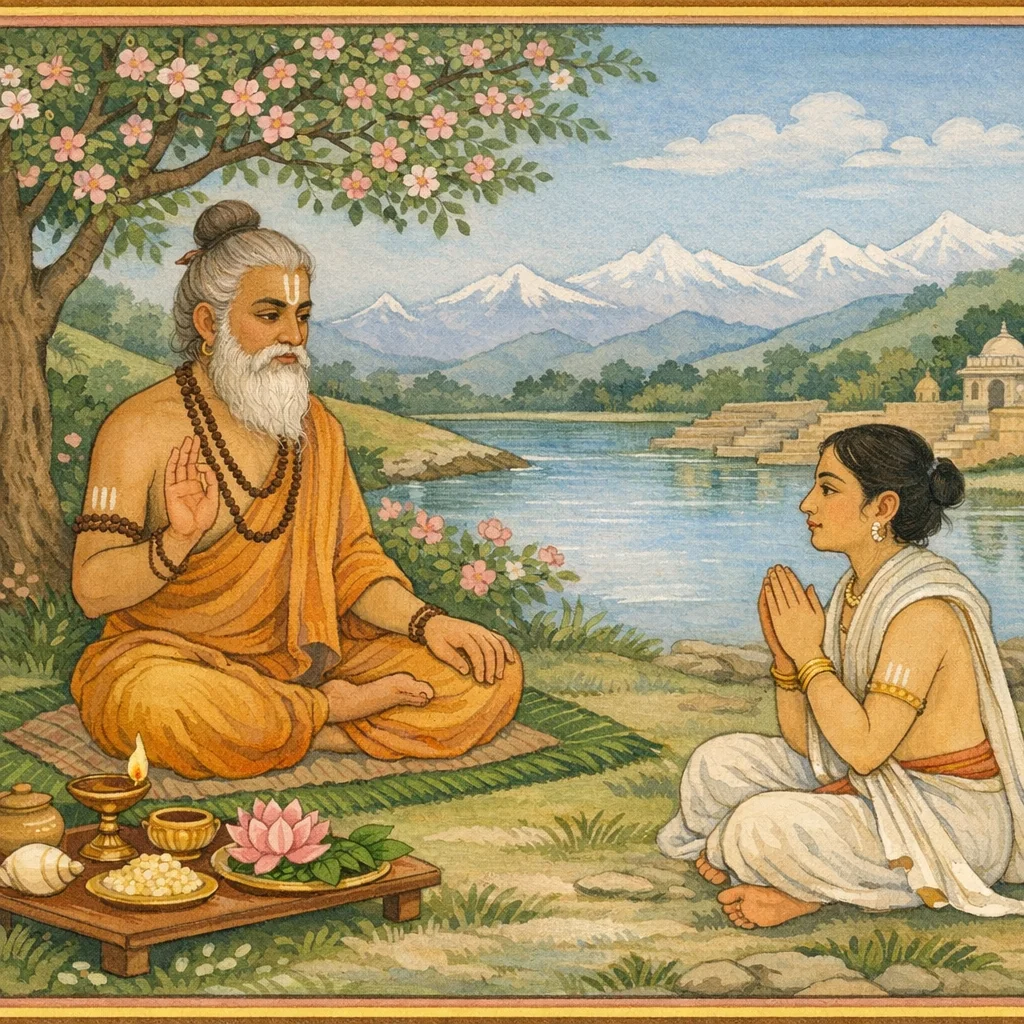
Adhyaya 121
The Tale of Kāmodā and Vihuṇḍa: Tear-Born Lotuses on the Gaṅgā and the Ethics of Worship
Chapter 121 begins with a theological question: if the universe dissolves into the One Self and saṃsāra is māyā, why would Hari enter transmigration at all. Nārada answers through a karmic account: at Bhṛgu’s sacrifice, a vow to safeguard the rite became entangled with Indra’s command and the Dānavas’ ruin of the yajña, leading Bhṛgu to curse that Hari must undergo ten births. The scene then shifts to the bank of the Gaṅgā, where a grieving maiden’s tears fall into the river and become lotuses. Vihuṇḍa, a Dānava deluded by Viṣṇu’s māyā and driven by desire, gathers these sorrow-born lotuses for worship, and Devī/Śrī offers an ethical rebuke: the fruit of worship accords with the worshipper’s bhāva—intention and inner disposition—and with the moral quality of what is offered. Disguised as a brāhmaṇa, Devī confronts the demon; when he turns violent, she slays him. Cosmic well-being is restored, and the chapter reaffirms karma, right intention, and the integrity of sacred rites.
Shlokas
Verse 1
कामोदोवाच । न विदुर्देवताः सर्वा यस्यांतं रूपमेव च । यस्मिल्लींनस्तु सर्वोयं स चैकात्मा प्रकथ्यते
Kāmoda said: All the deities do not know His limit, nor even His true form. He in whom this entire universe is dissolved is spoken of as the One Self.
Verse 2
यस्या मायाप्रपंचस्तु संसारः शृणु नारद । कस्मात्प्रयाति संसारं मम स्वामी जगत्पतिः
O Nārada, listen: saṃsāra is but the vast display of His māyā. Then why does my Lord—the Master of the world—enter into saṃsāra at all?
Verse 3
पापैश्चापि सुपुण्यैश्च नरोबद्धस्तु कर्मभिः । संसारं सरते विप्र हरिः कस्माद्व्रजेद्वद
Bound by actions—both sinful and highly meritorious—a man moves through saṃsāra. O brāhmaṇa, then why and how would Hari ever enter transmigration? Tell me.
Verse 4
नारद उवाच । शृणु देवि प्रवक्ष्यामि यत्कृतं तेन चक्रिणा । भृगोरग्रे प्रतिज्ञातं यज्ञरक्षां करोम्यहम्
Nārada said: “Listen, O Goddess; I shall recount what was done by the Lord who bears the discus. Before Bhṛgu he made this vow: ‘I will protect the sacrifice (yajña).’”
Verse 5
इंद्रस्य वचनात्सद्यो गतोऽसौ दानवैः सह । योद्धुं विहाय गोविंदो भृगोश्चैव मखोत्तमम्
At Indra’s command, he departed at once with the Dānavas; Govinda set aside the intent to fight and went to Bhṛgu’s most excellent sacrifice (yajña).
Verse 6
मखं त्यक्त्वा गते देवे पश्चात्तैर्दानवोत्तमैः । आगत्य ध्वंसितः सर्वः स यज्ञः पापचेतनैः
After the deity had departed, those foremost among the Dānavas came afterward and, with sinful intent, completely destroyed that sacrifice (yajña).
Verse 7
हरिं क्रुद्धः स योगींद्रः शशाप भृगुरेव तम् । दशजन्मानि भुंक्ष्व त्वं मच्छापकलुषीकृतः
Enraged, that lord of yogins—Bhṛgu—cursed Hari himself: “For ten births you shall suffer, tainted by my curse.”
Verse 8
कर्मणः स्वस्य संभोगं संभोक्ष्यति जनार्दनः । तन्निमित्तं त्वया देवि दुःस्वप्नः परिवीक्षितः
Janārdana will indeed experience the consequences of his own deeds; therefore, O Goddess, it is for that very reason that you have seen this ominous dream.
Verse 9
इत्युक्त्वा तां गतो विप्रो ब्रह्मलोकं स नारदः । कृष्णस्यापि सुदुःखेन दुःखिता साभवत्तदा
Having spoken thus to her, the sage Nārada departed for Brahmaloka. And she, too, became sorrowful then, distressed by Kṛṣṇa’s intense grief.
Verse 10
रुरोद करुणं बाला हाहेति वदती मुहुः । गङ्गातीरोपविष्टा सा जलांते शृणु नन्दन
The young girl wept piteously, crying “Alas, alas!” again and again. Seated on the bank of the Gaṅgā, she remained at the water’s edge—listen, O son.
Verse 11
सुनेत्राभ्यां तथाश्रूणि दुःखेनापि प्रमुंचति । तान्यश्रूणि प्रमुक्तानि गंगातोये पतंत्यपि
From his beautiful eyes he sheds tears, even out of sorrow; and those tears, once released, fall into the waters of the Gaṅgā as well.
Verse 12
जले चैव निमज्जंति तस्याश्चाप्यश्रुबिंदवः । संभवंति पुनस्तात पद्मरूपाणि तानि च
And those tear-drops of hers sink into the water; then, dear one, they are born again there as lotuses, taking the form of lotus-flowers.
Verse 13
गंगातोये प्रफुल्लानि वाहितानि प्रयांति वै । ददृशे दानवश्रेष्ठो विष्णुमायाप्रमोहितः
In the waters of the Gaṅgā, fully-bloomed flowers were indeed seen being carried along by the current. The foremost of the Dānavas beheld this, deluded by Viṣṇu’s māyā.
Verse 14
दुःखजानि न जानाति मुनिना कथितान्यपि । हर्षेण महताविष्टः परिजग्राह सोऽसुरः
Even the sorrowful consequences spoken by the sage did not enter his understanding. Overwhelmed by great delight, that asura accepted it.
Verse 15
पद्मैस्तु पुष्पितैः सोपि पूजयेद्गिरिजाप्रियम् । सप्तकोटिभिर्दैत्येंद्रो विष्णुमायाप्रमोहितः
He too should worship the beloved of Girijā—Śiva—with blossoming lotuses. The lord of the Dānavas, deluded by Viṣṇu’s māyā, performed that worship with seven crores of lotuses.
Verse 16
अथ क्रुद्धा जगद्धात्री शंकरं वाक्यमब्रवीत् । पश्यैतस्य विकर्म त्वं दानवस्य महामते
Then the Mother of the world, angered, spoke these words to Śaṅkara: “O great-minded one, behold the evil deed of this Dānava.”
Verse 17
शोकोत्पन्नानि पद्मानि गंगातोयगतानि वै । अयमेष प्रगृह्णाति कामाकुलितचेतनः
Lotuses born of sorrow were indeed borne along in the waters of the Gaṅgā; and this very man—his mind confused by desire—goes about gathering them.
Verse 18
पूजयेच्चापि दुष्टात्मा शोकसंतापकारकैः । दुःखजैः शोकजैः पुष्पैस्तैः सुश्रेयः कथं भवेत्
Even if a wicked-minded person performs worship with offerings that bring sorrow and torment—flowers born of misery and grief—how could true auspicious merit arise from that?
Verse 19
यादृशेनापि भावेन मामेव परिपूजयेत् । तादृशेनापि भावेन अस्य सिद्धिर्भविष्यति
Whatever the disposition with which a person worships Me alone, by that very disposition his spiritual attainment will come to fruition.
Verse 20
सत्यध्यानविहीनोयं कामोदा न्यस्तमानसः । संजातः पापचारित्रो जहि देवि स्वतेजसा
This Kāmodā—bereft of true contemplation and with her mind cast down—has now become of sinful conduct. O Goddess, destroy her by your own radiance.
Verse 21
एवमाकर्ण्य तद्वाक्यं शंभोश्चैव महात्मनः । अस्यैव संक्षयं शंभो करिष्ये तव शासनात्
Having thus heard those words of Śambhu—the great-souled Lord—O Śambhu, by your command I shall put an end to this very doubt.
Verse 22
एवमुक्त्वा ततो देवी तस्यापि वधकांक्षया । वर्त्तते हि विहुंडस्य वधोपायं व्यचिंतयत्
Having spoken thus, the Goddess—desiring his death as well—remained intent, and indeed she began to contemplate the means of slaying Vihuṇḍa.
Verse 23
कृत्वा मायामयं रूपं ब्राह्मणस्य महात्मनः । पूजयेच्छंकरं नाथं सुपुष्पैः पारिजातजैः
Assuming, through māyā, the form of a great-souled brāhmaṇa, he should worship Lord Śaṅkara, the Protector, with excellent flowers of the pārijāta tree.
Verse 24
समेत्य दानवः पापो दिव्यां पूजां विनाशयेत् । कामाकुलः सुदुःखार्तस्तद्गतो भावतत्परः
Having come there, the sinful Dānava would destroy the divine worship; driven by desire and afflicted by intense sorrow, his mind fixed on that alone and wholly intent upon it.
Verse 25
विष्णोश्चैव महामायां पूर्वदृष्टां स दानवः । सस्मार दानवः पापः कामबाणैः प्रपीडितः
That wicked Dānava, tormented by the arrows of desire, remembered again Viṣṇu’s great Māyā whom he had seen before.
Verse 26
तस्याः स्मरणमात्रेण कंदर्पेण बलीयसा । विरहाकुलदुःखार्तो रोदते हि मुहुर्मुहुः
By the mere remembrance of her—overpowered by mighty Kāma—he, tormented by the sorrow of separation, repeatedly breaks into tears again and again.
Verse 27
कालाकृष्टः स दुष्टात्मा शोकजातानि तानि सः । परिगृह्य समायातः पूजनार्थी महेश्वरम्
Dragged along by Time, that wicked-souled one gathered up those sorrow-born things and came there, intending to worship Maheśvara (Śiva).
Verse 28
देव्या कृतां हि पूजां च सुपुष्पैः पारिजातजैः । तां निर्णाश्य सुलोभेन शोकजैः परिपूजयेत्
One should remove the worship that was performed for the Goddess with fine pārijāta flowers, and then, out of greedy desire, perform a substitute worship using flowers born of sorrow.
Verse 29
नेत्राभ्यां तस्य दुष्टस्य बिंदवस्तेऽश्रुसंभवाः । अविरलास्ततो वत्स पतंति लिंगमस्तके
From the eyes of that wicked man, O dear one, drops born of tears fall unceasingly upon the crown of the liṅga.
Verse 30
देवी ब्राह्मणरूपेण तमुवाच महामते । को भवान्पूजयेद्देवं शोकाकुलमनाः सदा
The Goddess, assuming the form of a brāhmaṇa, spoke to him: “O great-minded one, who would worship the Lord while the heart remains forever distressed?”
Verse 31
पतंत्यश्रूणि देवस्य मस्तके शोकजानि ते । अपवित्राणि मे ब्रूहि एतमर्थं ममाग्रतः
Those sorrow-born tears are falling upon the god’s head. Tell me plainly, here before me, why they are impure.
Verse 32
विहुंड उवाच । पूर्वं दृष्टा मया नारी सर्वसौभाग्यसंपदा । सर्वलक्षणसंपन्ना कामस्यायतनं महत्
Vihuṃḍa said: “Earlier I saw a woman endowed with every treasure of good fortune, possessed of all auspicious marks—indeed, a great abode of desire.”
Verse 33
तस्या मोहेन संदग्धः कामेनाकुलतां गतः । तया प्रोक्तं हि संभोगे देहि मे दायमुत्तमम्
Scorched by infatuation for her and thrown into turmoil by desire, I became unsettled. And she, at the time of union, indeed said: “Give me the finest dāya, the most excellent share.”
Verse 34
कामोदसंभवैः पुष्पैः पूजयस्व महेश्वरम् । तेषां पुष्पकृतां मालां मम कंठे परिक्षिप
Worship Maheśvara with flowers born of Kāmodā; and place upon my neck a garland fashioned from those flowers.
Verse 35
कोटिभिः सप्तसंख्यातैः पूजयस्व महेश्वरम् । तदर्थं पूजयाम्येव ईश्वरं फलदायकम्
Worship Maheśvara with seven crores of offerings. For that very purpose, I indeed worship the Lord—the bestower of fruits (results).
Verse 36
कामोदसंभवैः पुष्पैर्दुर्लभैर्देवदानवैः । श्रीदेव्युवाच । क्व ते भावः क्व ते ध्यानं क्व ते ज्ञानं दुरात्मनः
With flowers born of passion—rare even for gods and demons—Śrī Devī said: “Where is your true devotion? Where is your meditation? Where is your knowledge, O wicked-minded one?”
Verse 37
ईश्वरस्यापि संबंधो नास्ति किंचित्त्वयैव हि । कामोदाया वरं रूपं कीदृशं वद सांप्रतम्
Even with the Lord you truly have no connection whatsoever. Now tell me—what is the excellent form of Kāmodā like at present?
Verse 38
क्व लब्धानि सुपुष्पाणि तस्या हास्योद्भवानि च । विहुंड उवाच । भावं ध्यानं न जानामि न दृष्टा सा मया कदा
“Where were those lovely flowers obtained, and those things that arose from her laughter?” Vihuṇḍa said: “I do not know her devotion or meditation; I have never seen her at any time.”
Verse 39
गंगातोयगतान्येव परिगृह्णामि नित्यशः । तैरहं पूजयाम्येकं शंकरं प्रवदाम्यहम्
I continually accept only those things that have touched the waters of the Gaṅgā. With them I worship the one Śaṅkara—this I proclaim.
Verse 40
ममाग्रे कथितं विप्र शुक्रेणापि महात्मना । वचनात्तस्य देवेशमर्चयामि दिनदिने
O brāhmaṇa, this was spoken in my presence even by the great-souled Śukra; and at his instruction I worship the Lord of the gods day after day.
Verse 41
एतत्ते सर्वमाख्यातं यच्च पृष्टोस्मि सांप्रतम् । श्रीदेव्युवाच । कामोदारोदनाज्जातैः पुष्पैस्तैर्दुःखसंभवैः
“All this has been told to you, just as I have been asked at present.” Śrī Devī said: “With those flowers that were born from Kāma’s grievous weeping—flowers that have their origin in sorrow— …”
Verse 42
लिंगमर्चयसे दुष्ट प्रभाते नित्यमेव च । यादृशेनापि भावेन पुष्पैश्च यादृशैस्त्वया
O wicked one, you worship the Liṅga every morning without fail; yet whatever intention you hold, and whatever flowers you offer,
Verse 43
अर्चितो देवदेवेशस्तादृशं फलमाप्नुहि । दिव्यपूजां विनाश्यैवं शोकपुष्पैः प्रपूजसि
Though you worship the Lord of gods, you will obtain a result of that very kind. For, having ruined the divine worship, you now offer worship with flowers of grief.
Verse 44
असौ दोषस्तवैवाद्य समुत्पन्नः सुदारुणः । तस्माद्दण्डं प्रदास्यामि भुंक्ष्व स्वकर्मजं फलम्
This grievous fault has arisen in you today alone; therefore I shall impose punishment—endure the fruit born of your own actions.
Verse 45
तस्या वाक्यं समाकर्ण्य कालकृष्टो बभाष ताम् । रे रे दुष्ट दुराचार मम कर्मप्रदूषक
Hearing her words, the one driven by Time spoke to her: “Hey! You wicked, ill-conducted one—corrupter of my duty (karma)!”
Verse 46
हन्मि त्वामिह खड्गेन अनेनापि न संशयः । इत्युक्त्वा ब्राह्मणं तं स निशितं खड्गमाददे
“I will strike you down here with this sword—of this there is no doubt.” Having said this to that brāhmaṇa, he took up a sharpened sword.
Verse 47
हंतुकामः स दुष्टात्मा अभ्यधावत दानवः । सा देवी विप्ररूपेण संक्रुद्धा परमेश्वरी
Intent on killing, that wicked-souled demon rushed forward. But the Goddess—supreme in power—became enraged, appearing in the form of a brāhmaṇa.
Verse 48
हन्मि त्वामिह खड्गेन अनेनापि न संशयः । स्वस्थानमागतं दृष्ट्वा हुंकारं विससर्ज ह । तेन हुंकारनादेन पतितो दानवाधमः
“Here and now I shall strike you with this sword—of that there is no doubt.” Seeing him return to his own position, he let out a fierce roar; and by the sound of that roar, the vilest of the Dānavas fell down.
Verse 49
निश्चेष्टः कामरूपेण वज्राहत इवाचलः । पतिते दानवे तस्मिन्सर्वलोकविनाशके
Struck by Kāmarūpa, he lay motionless, like a mountain shattered by a thunderbolt, when that world-destroying demon fell.
Verse 50
लोकाः स्वास्थ्यं गताः सर्वे दुःखतापविवर्जिताः । एतस्मात्कारणाद्वत्स सा स्त्री वै परिदेवति
All the worlds have returned to well-being, free from sorrow and torment. For this very reason, dear child, that woman indeed laments.
Verse 51
गंगातीरे वरारोहा दुःखव्याकुलमानसा । एतत्ते सर्वमाख्यातं यत्त्वया परिपृच्छितम्
On the bank of the Gaṅgā, O noble lady, your mind distressed with sorrow—everything that you asked about has now been fully explained to you.
Verse 52
विष्णुरुवाच । एवमुक्त्वा सुपुत्रं तं कुंजलो अंडजेश्वरः । विरराम महाप्राज्ञः किञ्चिन्नोवाच भूपते
Viṣṇu said: Having thus spoken to that good son, Kuñjala—the lord of the egg-born (birds)—fell silent. The greatly wise one spoke no further at all, O king.