Adhyaya 61
Vena’s Inquiry into Pitṛ-tīrtha: Pippala’s Austerity, the Vidyādhara Boon, and the Crane’s Rebuke of Pride
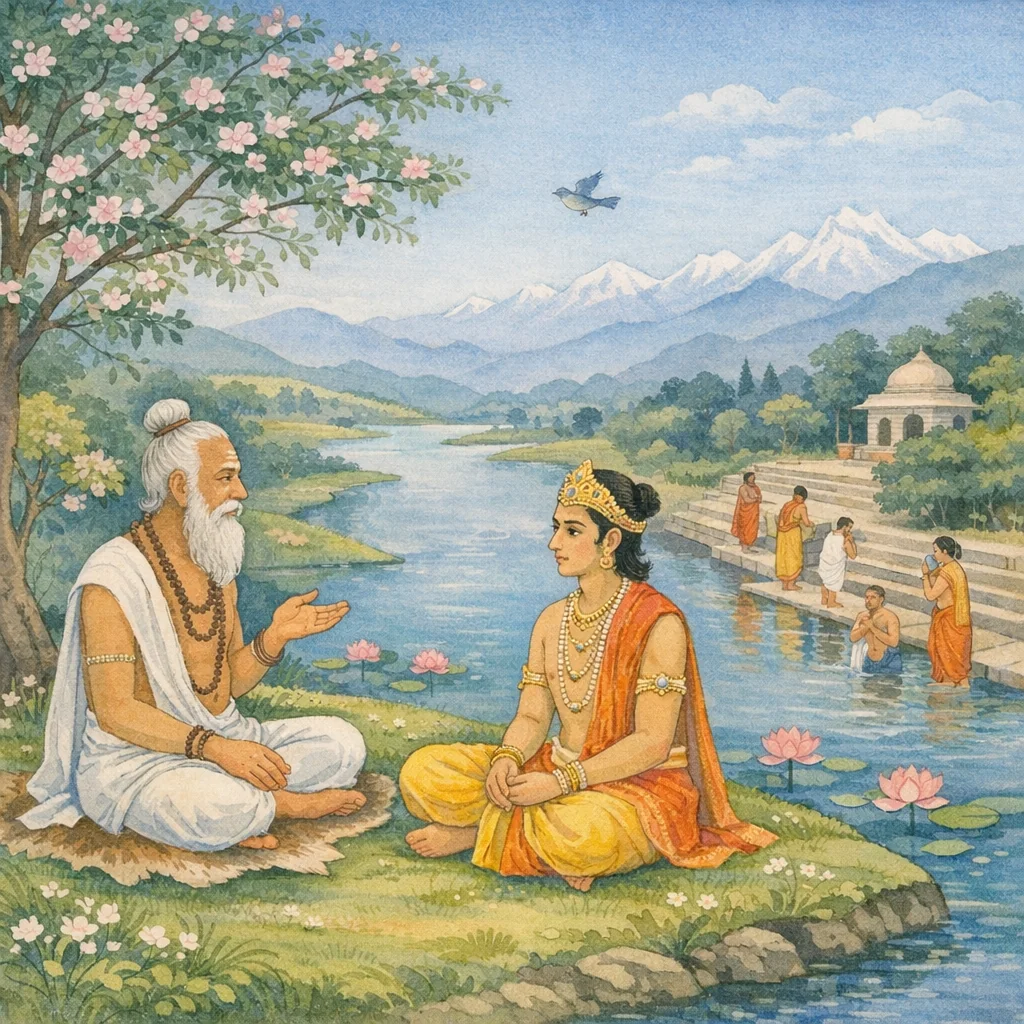
Chapter 61 begins with Vena asking Viṣṇu to teach him about Pitṛ-tīrtha, praised as “supreme for the deliverance of sons.” Within this inquiry-frame, the narrative turns to models of reverence and right conduct. Sukarmā, son of Kuṇḍala in Kurukṣetra, is commended for tireless guru-sevā and respectful behavior, alongside the injunction to serve and honor one’s mother and father. The main account follows the brāhmaṇa Pippala, son of Kaśyapa, who performs extreme tapas in Daśāraṇya for millennia, enduring serpents, anthills, and the hardships of the elements. Pleased, the gods grant him a boon and the status of a Vidyādhara. When pride and the wish for universal mastery arise in him, Sārasa the crane rebukes him, declaring that austerity without right intention is not dharma, and that power is not the measure of truth. The chapter closes by directing Pippala toward deeper knowledge beyond his deluded self-assessment.
Shlokas
Verse 1
वेन उवाच । भार्यातीर्थं समाख्यातं सर्वतीर्थोत्तमोत्तमम् । पितृतीर्थं समाख्याहि पुत्राणां तारणं परम्
Vena said: “The Bhāryā-tīrtha has been described as the best of the best among all sacred fords. Now explain the Pitṛ-tīrtha—supreme for the deliverance of sons.”
Verse 2
विष्णुरुवाच । कुरुक्षेत्रे महाक्षेत्रे कुंडलो नाम ब्राह्मणः । सुकर्मा नाम सत्पुत्रः कुंडलस्य महात्मनः
Viṣṇu said: In Kurukṣetra, that great sacred field, there lived a brāhmaṇa named Kuṇḍala. His noble son was named Sukarmā, born of that great-souled Kuṇḍala.
Verse 3
गुरू तस्य महावृद्धौ धर्मज्ञौ शास्त्रकोविदौ । द्वावेतौ तु महात्मानौ जरया परिपीडितौ
His two teachers were very aged—knowers of dharma and learned in the scriptures. Those two great-souled men were afflicted by old age.
Verse 4
तयोः शुश्रूषणं चक्रे भक्त्या च परया ततः । धर्मज्ञो भावसंयुक्तो अहर्निशमनारतम्
Then he rendered service to them with supreme devotion—knowing dharma, filled with heartfelt reverence, and constantly engaged in it day and night.
Verse 5
तस्माद्वेदानधीते स पितुः शास्त्राण्यनेकशः । सर्वाचारपरो दक्षो धर्मज्ञो ज्ञानवत्सलः
Therefore he studied the Vedas and, many times over, the treatises of his father. He was devoted to all proper conduct, capable and efficient, a knower of dharma, and affectionate toward knowledge.
Verse 6
अंगसंवाहनं चक्रे गुर्वोश्च स्वयमेव सः । पादप्रक्षालनं चैव स्नानभोजनकीं क्रियाम्
He himself massaged the limbs of his two teachers, and likewise performed the washing of their feet, as well as the duties connected with their bathing and meals.
Verse 7
भक्त्या चैव स्वभावेन तद्ध्याने तन्मयो भवेत् । मातापित्रोश्च राजेंद्र उपचर्यां प्रकारयेत्
By devotion, and also by one’s own natural disposition, one becomes absorbed in meditation upon That. And, O king, one should duly render attentive and reverent service to one’s mother and father.
Verse 8
सूत उवाच । तद्वर्तमानकाले तु बभूव नृपसत्तम । पिप्पलो नाम वै विप्रः कश्यपस्य महात्मनः
Sūta said: O best of kings, at that time there lived a brāhmaṇa named Pippala, the noble son of the great sage Kaśyapa.
Verse 9
तपस्तेपे निराहारो जितात्मा जितमत्सरः । दयादानदमोपेतः कामं क्रोधं विजित्य सः
He practiced austerity while fasting, self-controlled and free from jealousy. Endowed with compassion, charity, and restraint, he conquered desire and anger.
Verse 10
दशारण्यगतो धीमाञ्ज्ञानशांतिपरायणः । सर्वेंद्रियाणि संयम्य तपस्तेपे महामनाः
Having gone to Daśāraṇya, the wise one—devoted to knowledge and inner peace—restrained all his senses and, great-souled, performed austerities.
Verse 11
तपःप्रभावतस्तस्य जंतवो गतविग्रहाः । वसंति सुयुगे तत्र एकोदरगता इव
By the power of his austerity, the creatures there became free from bodily limitation; in that excellent age they dwelt together as though they had entered into a single womb.
Verse 12
तत्तपस्तस्य मुनयो दृष्ट्वा विस्मयमाययुः । नेदृशं केनचित्तप्तं यथासौ तप्यते मुनिः
Beholding that sage’s austerity, the other munis were filled with wonder: “Never has anyone undertaken such penance as this muni now performs.”
Verse 13
देवाश्च इंद्रप्रमुखाः परं विस्मयमाययुः । अहो अस्य तपस्तीव्रं शमश्चेंद्रियसंयमः
The gods, led by Indra, were struck with the greatest amazement: “Ah! How intense is his austerity—how great his tranquility and his restraint of the senses!”
Verse 14
निर्विकारो निरुद्वेगः कामक्रोधविवर्जितः । शीतवातातपसहो धराधर इवस्थितः
Unchanged and unagitated, free from desire and anger, enduring cold, wind, and heat—he stood firm like a mountain.
Verse 15
विषये विमुखो धीरो मनसोतीतसंग्रहम् । न शृणोति यथा शब्दं कस्यचिद्द्विजसत्तमः
Turning away from sense-objects, the steadfast wise one—whose mind has transcended all grasping—does not even hear another’s words, as it were, O best of the twice-born.
Verse 16
संस्थानं तादृशं गत्वा स्थित्वा एकाग्रमानसः । ब्रह्मध्यानमयो भूत्वा सानंदमुखपंकजः
Having gone to such a place and remaining there with a one-pointed mind, becoming absorbed in meditation on Brahman, his lotus-like face shone with bliss.
Verse 17
अश्मकाष्ठमयो भूत्वा निश्चेष्टो गिरिवत्स्थितः । स्थाणुवद्दृश्यते चासौ सुस्थिरो धर्मवत्सलः
As though made of stone and wood, motionless and standing like a mountain, he appeared as an unshaken pillar—steadfast, well-composed, and devoted to dharma.
Verse 18
तपःक्लिष्टशरीरोति श्रद्धावाननसूयकः । एवं वर्षसहस्रैकं संजातं तस्य धीमतः
His body was worn and afflicted by austerities; yet he was full of faith and free from envy. Thus, for that wise one, a full thousand years passed.
Verse 19
पिपीलिकाभिर्बह्वीभिः कृतं मृद्भारसंचयम् । तस्योपरि महाकायं वल्मीकं निजमंदिरम्
Built by many ants, a heap of accumulated earth arose; upon it stood a huge anthill—their own dwelling-place.
Verse 20
वल्मीकोदरमध्यस्थो जडीभूत इवस्थितः । स एवं पिप्पलो विप्रस्तपते सुमहत्तपः
Stationed within the hollow of an anthill, he stood as if turned inert. Thus the brāhmaṇa Pippala performed exceedingly great austerity.
Verse 21
कृष्णसर्पैस्तु सर्वत्र वेष्टितो द्विजसत्तमः । तमुग्रतेजसं विप्रं प्रदशंति विषोल्बणाः
Then the best of the twice-born was everywhere encircled by black serpents; those fierce, venom-laden snakes bit that brāhmaṇa of terrible radiance.
Verse 22
संप्राप्य गात्रमर्माणि विषं तस्य न भेदयेत् । तेजसा तस्य विप्रस्य नागाः शांतिमथागमन्
Even when the poison reached the vital points of his body, it could not pierce him. By the spiritual radiance of that brāhmaṇa, the serpents were pacified and entered into calm.
Verse 23
तस्य कायात्समुद्भूता अर्चिषो दीप्ततेजसः । नानारूपाः सुबहुशो दृश्यंते च पृथक्पृथक्
From his body arose blazing flames of radiant splendor; assuming many different forms, they were seen in great numbers, each appearing separately.
Verse 24
यथा वह्नेः खरतरास्तथाविधा नरोत्तम । यथामेघोदरे सूर्यः प्रविष्टो भाति रश्मिभिः
O best of men, just as the fiercest flames blaze in that very manner, so too does the sun—though entered into the belly of a cloud—still shine forth with its rays.
Verse 25
वल्मीकस्थस्तथाविप्रः पिप्पलो भाति तेजसा । सर्पा दशंति विप्रं तं सक्रोधा दशनैरपि
And the brāhmaṇa, seated within the anthill, shone with spiritual radiance like the sacred pippala. Even so, the serpents—angered—kept biting that brāhmaṇa with their fangs.
Verse 26
न भिंदंति च दंष्ट्राग्राच्चर्म भित्त्वा नृपोत्तम । एवं वर्षसहस्रैकं तप आचरतस्ततः
O best of kings, even after piercing the skin, the tips of their fangs do not break. In this manner, thereafter, he performed austerity (tapas) for a full thousand years.
Verse 27
गतं तु राजराजेंद्र मुनेस्तस्य महात्मनः । त्रिकालं साध्यमानस्य शीतवर्षातपान्वितः
But, O king of kings, time passed for that great-souled sage as he practiced his discipline three times each day, enduring cold, rain, and burning heat.
Verse 28
गतः कालो महाराज पिप्पलस्य महात्मनः । तद्वच्च वायुभक्षं तु कृतं तेन महात्मना
O great king, time passed for the noble-souled Pippala; and likewise that great man then undertook to live on air alone.
Verse 29
त्रीणि वर्षसहस्राणि गतानि तस्य तप्यतः । तस्य मूर्ध्नि ततो देवैः पुष्पवृष्टिः कृता पुरा
When three thousand years had passed as he continued his austerities, the gods of old then showered flowers upon his head.
Verse 30
ब्रह्मज्ञोसि महाभाग धर्मज्ञोसि न संशयः । सर्वज्ञानमयोऽसि त्वं संजातः स्वेनकर्मणा
O greatly fortunate one, you are a knower of Brahman; you are a knower of dharma—there is no doubt. You are filled with all knowledge, having been born as the fruit of your own past deeds.
Verse 31
यं यं त्वं वांछसे कामं तं तं प्राप्स्यसि नान्यथा । सर्वकामप्रसिद्धस्त्वं स्वत एव भविष्यसि
Whatever desire you long for—exactly that you shall attain, and not otherwise. Of your own accord you will become renowned as one whose every wish is fulfilled.
Verse 32
समाकर्ण्य महद्वाक्यं पिप्पलोपि महामनाः । प्रणम्य देवताः सर्वा भक्त्या नमितकंधरः
Having heard that great utterance, even Pippala, the high-souled one, bowed down; with devotion he prostrated to all the deities, his neck bent in reverence.
Verse 33
हर्षेण महताविष्टो वचनं प्रत्युवाच सः । इदं विश्वं जगत्सर्वं ममवश्यं यथा भवेत्
Overwhelmed with great joy, he replied: “May this entire universe—this whole world—come under my control.”
Verse 34
तथा कुरुध्वं देवेंद्रा विद्याधरो भवाम्यहम् । एवमुक्त्वा स मेधावी विरराम नृपोत्तम
“So be it—do as you wish, O lord of the gods; I shall become a Vidyādhara.” Having spoken thus, that wise, excellent king fell silent.
Verse 35
एवमस्त्विति ते प्रोचुर्द्विजश्रेष्ठं सुरास्तदा । दत्वा वरं महाभाग जग्मुस्तस्मै महात्मने
Then the gods said, “So be it,” to the best of the twice-born. Having granted the boon, O greatly fortunate one, they departed from that great-souled sage.
Verse 36
गतेषु तेषु देवेषु पिप्पलो द्विजसत्तमः । ब्रह्मण्यं साधयेन्नित्यं विश्ववश्यं प्रचिंतयेत्
When those gods had departed, Pippala—the foremost of the twice-born—should continually cultivate brahmaṇya, devotion to Brahman and reverence for Brahmins, and should meditate upon the power by which the whole world is brought under control.
Verse 37
तदाप्रभृति राजेंद्र पिप्पलो द्विजसत्तमः । विद्याधरपदं लब्ध्वा कामगामी महीयते
From that time onward, O best of kings, Pippala—the foremost among brahmins—having attained the status of a Vidyādhara, could travel at will and was greatly honored.
Verse 38
एवं स पिप्पलो विप्रो विद्याधरपदं गतः । संजातो देवलोकेशः सर्वशास्त्रविशारदः
Thus the brahmin Pippala attained the rank of a Vidyādhara and was born as a lord in the divine world, fully versed in all the śāstras.
Verse 39
एकदा तु महातेजाः पिप्पलः पर्यचिंतयत् । विश्ववश्यं भवेत्सर्वं मम दत्तो वरोत्तमः
Once, the greatly radiant Pippala reflected: “By the supreme boon that has been granted to me, may the entire world become subject to my will.”
Verse 40
तदर्थं प्रत्ययं कर्तुमुद्यतो द्विजपुंगवः । यं यं चिंतयते कर्तुं तं तं हि वशमानयेत्
To accomplish that aim and to make it certain, the best of the twice-born set himself to the task; whatever he intends to accomplish, that very thing he should indeed bring under his control.
Verse 41
एवं स प्रत्यये जाते मनसा पर्यकल्पयत् । द्वितीयो नास्ति वै लोके मत्समः पुरुषोत्तमः
When such a conviction arose, he imagined in his mind: “Indeed, in the world there is no second person equal to me, O Supreme Person (Puruṣottama).”
Verse 42
सूत उवाच । एवं हि कल्पमानस्य पिप्पलस्य महात्मनः । ज्ञात्वा मानसिकं भावं सारसस्तमुवाच ह
Sūta said: Thus, as the great-souled Pippala was reflecting, the crane, having understood his state of mind, spoke to him.
Verse 43
सरस्तीरगतो राजन्सुस्वरं व्यंजनान्वितम् । स्वनं सौष्ठवसंयुक्तमुक्तवान्पिप्पलं प्रति
O King, having gone to the shore of the lake, he addressed Pippala with a well-modulated voice—clear in articulation and endowed with graceful refinement of tone.
Verse 44
कस्मादुद्वहसे गर्वमेवं त्वं परमात्मकम् । सर्ववश्यात्मिकीं सिद्धिं नाहं मन्ये तवैव हि
Why do you carry such pride, thinking yourself to be the Supreme Self? Indeed, I do not believe that the attainment of mastery—by which all become subject to one’s will—truly belongs to you.
Verse 45
वश्यावश्यमिदं कर्म अर्वाचीनं प्रशस्यते । पराचीनं न जानासि पिप्पल त्वं हि मूढधीः
This action—whether it brings mastery or dependence—is praised as something immediate and worldly. But you do not understand what is transcendent and ancient, O Pippala; for your intellect is deluded.
Verse 46
वर्षाणां तु सहस्राणि यावत्त्रीणि त्वया तपः । समाचीर्णं ततो गर्वं कुरुषे किं मुधा द्विज
You have practiced austerity for as many as three thousand years; why then do you indulge in pride in vain, O brāhmaṇa?
Verse 47
कुंडलस्य सुतो धीरः सुकर्मानाम यः सुधीः । वश्यावश्यं जगत्सर्वं तस्यासीच्छृणु सांप्रतम्
Kundala’s son was steadfast and wise, a man of noble deeds. The whole world—pliant or unpliant—fell under his sway; now hear what befell him.
Verse 48
अर्वाचीनं पराचीनं स वै जानाति बुद्धिमान् । लोके नास्ति महाज्ञानी तत्समः शृणु पिप्पल
That wise one truly knows what is near and what is far, what came before and what comes after. In this world there is no great knower equal to him—listen, O Pippala.
Verse 49
न कुंडलस्य पुत्रेण सदृशस्त्वं सुकर्मणा । न दत्तं तेन वै दानं न ज्ञानं परिचिंतितम्
In noble conduct you are not at all like Kuṇḍala’s son. He has never truly given dāna (charity), nor has he reflected upon jñāna (spiritual knowledge).
Verse 50
हुतयज्ञादिकं कर्म न कृतं तेन वै कदा । न गतस्तीर्थयात्रायां न च वह्नेरुपासनम्
He never performed rites such as homa and yajña; he never went on pilgrimage to sacred tīrthas, nor did he engage in the worship of the sacred fire.
Verse 51
स कदा कृतवान्विप्र धर्मसेवार्थमुत्तमम् । स्वच्छंदचारी ज्ञानात्मा पितृमातृसुहृत्सदा
O brāhmaṇa, he never performed any noble act in the service of dharma; living as he pleased, he was ‘wise’ only in name, and was ever opposed to his father, mother, and well-wishers.
Verse 52
वेदाध्ययनसंपन्नः सर्वशास्त्रार्थकोविदः । यादृशं तस्य वै ज्ञानं बालस्यापि सुकर्मणः
Even one accomplished in Vedic study and skilled in the meanings of all the śāstras—his knowledge is not of the same kind as that found even in a mere child devoted to righteous action.
Verse 53
तादृशं नास्ति ते ज्ञानं वृथा त्वं गर्वमुद्वहेः । पिप्पल उवाच । को भवान्पक्षिरूपेण मामेवं परिकुत्सयेत्
You do not have knowledge of that kind; in vain you bear pride. Pippala said: Who are you, in the form of a bird, that you would thus disparage me?
Verse 54
कस्मान्निंदसि मे ज्ञानं पराचीनं तु कीदृशम् । तन्मे विस्तरतो ब्रूहि त्वयि ज्ञानं कथं भवेत्
Why do you disparage my knowledge? And what, indeed, is this ‘ancient’ (traditional) knowledge like? Explain it to me in detail—how can such knowledge arise in you?
Verse 55
अर्वाचीनगतिं सर्वां पराचीनस्य सांप्रतम् । वद त्वमंडजश्रेष्ठ ज्ञानपूर्वं सुविस्तरम्
Tell me now, O best of the egg-born, in full detail and with true understanding, the entire later course of events as well as the earlier one, as it stands at present.
Verse 56
किं वा ब्रह्मा च विष्णुश्च किं वा रुद्रो भविष्यसि । सारस उवाच । नास्ति ते तपसो भावः फलं नास्ति च तस्य तु
“Will you become Brahmā and Viṣṇu, or will you become Rudra?” Sārasa said: “Your tapas lacks true intent; therefore its fruit, too, does not exist.”
Verse 57
त्वया न परितप्तस्य तपसः सांप्रतं शृणु । कुंडलस्यापि पुत्रस्य बालस्यापि यथा गुणः
Now hear of the austerity you have not fully undertaken—how, even in Kuṇḍala’s son, though still a mere child, its power manifested according to his innate merit.
Verse 58
तथा ते नास्ति वै ज्ञानं परिज्ञातं न तत्पदम् । इतो गत्वापि पृच्छ त्वं मम रूपं द्विजोत्तम
So too, you truly do not possess that knowledge, nor have you realized that supreme state. Even after going from here, ask about my form, O best of brāhmaṇas.
Verse 59
स वदिष्यति धर्मात्मा सर्वं ज्ञानं तवैव हि । विष्णुरुवाच । एवमाकर्ण्य तत्सर्वं सारसेन प्रभाषितम्
That righteous-souled one will indeed tell you all the knowledge. Viṣṇu said: Having thus heard everything spoken by Sārasa,
Verse 60
निर्जगाम स वेगेन दशारण्यं महाश्रमम्
He swiftly set out and reached Daśāraṇya, the great hermitage-forest.
Verse 61
इति श्रीपद्मपुराणे भूमिखंडे वेनोपाख्याने एकषष्टितमोऽध्यायः
Thus ends the sixty-first chapter, the account of Vena, in the Bhūmi-khaṇḍa of the sacred Padma Purāṇa.