Adhyaya 116
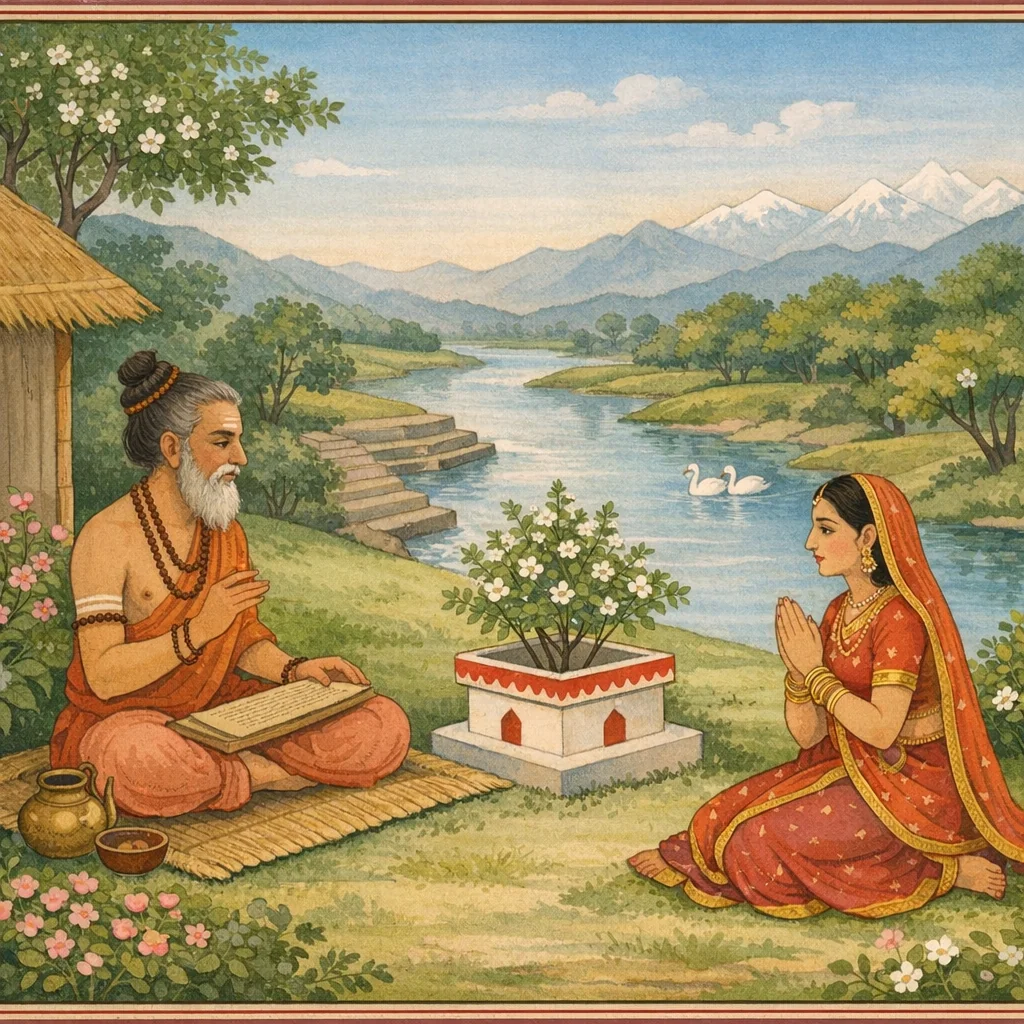
The Marriage of Nahuṣa and Aśokasundarī at Vasiṣṭha’s Hermitage (within the Gurutīrtha Glorification)
Aśokasundarī, portrayed as a tapasvinī and the gods’ appointed lawful wife, approaches the hero Nahuṣa and asks for marriage as an act of dharma. Nahuṣa agrees, grounding his assent in guru-vākya, and rides with Rambhā in a chariot to Vasiṣṭha’s āśrama. After reporting his victory in battle and the slaying of the demon, Vasiṣṭha rejoices and solemnizes the marriage at an auspicious tithi and lagna before the sacred fire and brāhmaṇas, then sends the couple to meet Nahuṣa’s parents. Meanwhile Menikā consoles Indumatī with news of the son’s victorious return; the royal household prepares celebration and remembers Viṣṇu. The chapter ends by extolling Vaiṣṇava liberation and, in a Śiva–Devī aside, recalling Dattātreya and a Viṣṇu-aṃśa son destined to destroy the Dānavas, linking family restoration with cosmic dharma.
Shlokas
Verse 1
कुंजल उवाच । अशोकसुंदरी पुण्या रंभया सह हर्षिता । नहुषं प्राप्य विक्रांतं तमुवाच तपस्विनी
Kuñjala said: The virtuous Aśokasundarī, rejoicing together with Rambhā, approached the valiant Nahuṣa; and that ascetic woman spoke to him.
Verse 2
अहं ते धर्मतः पत्नी देवैर्दिष्टा तपस्विनी । उद्वाहयस्व मां वीर यदि धर्ममिहेच्छसि
I am your lawful wife according to dharma, appointed by the gods—an ascetic woman. Marry me, O hero, if you truly desire righteousness here in this world.
Verse 3
सदैव चिंत्यमाना च त्वामहं तपसि स्थिता । भवान्धर्मप्रसादेन मया प्राप्तो नृपोत्तम
Ever thinking of you, I remained steadfast in austerities; by the grace of your dharma, I have attained you, O best of kings.
Verse 4
नहुष उवाच । मदर्थे नियता भद्रे यदि त्वं तपसि स्थिता । गुरोर्वाक्यान्मुहूर्तेन तव भर्ता भवाम्यहम्
Nahuṣa said: “O auspicious lady, if you remain steadfast in austerity for my sake, then by my guru’s word, in but a moment I shall become your husband.”
Verse 5
अनया रंभया सार्द्धमावां गच्छाव भामिनि । समारोप्य रथे तां तु तां रंभां तु मनोरमाम्
“O passionate one, let us go together with this Rambhā. Having lifted up that lovely Rambhā, place her upon the chariot.”
Verse 6
तेनैव रथवर्येण वशिष्ठस्याश्रमं प्रति । जगाम लघुवेगेन ताभ्यां सह महायशाः
In that very excellent chariot, the illustrious one set out with swift speed toward Vasiṣṭha’s hermitage, together with those two.
Verse 7
तमाश्रमगतं विप्रं समालोक्य प्रणम्य च । तया सार्द्धं महातेजा हर्षेण महतान्वितः
Seeing the brāhmaṇa who had come to that hermitage, the mighty and radiant one bowed in reverence; and, together with her, he became filled with great joy.
Verse 8
यथा युद्धं रणे जातं निहतो दानवाधमः । निवेदयामास सर्वं वशिष्ठाय महात्मने
He reported in full to the great-souled Vasiṣṭha how the battle occurred on the battlefield and how the vile demon was slain.
Verse 9
वशिष्ठोऽपि समाकर्ण्य नहुषस्य विचेष्टितम् । हर्षेण महताविष्ट आशीर्भिरभिनंद्य तम्
Vasiṣṭha too, having heard of Nahuṣa’s conduct, was filled with great joy and praised him with blessings.
Verse 10
तिथौ लग्ने शुभे प्राप्ते तयोस्तु मुनिपुंगवः । विवाहं कारयामास अग्निब्राह्मणसन्निधौ
When the auspicious tithi and favorable ascendant had arrived, the foremost sage caused their marriage to be performed in the presence of the sacred fire and the brāhmaṇas.
Verse 11
आशीर्भिरभिनंद्यैव मिथुनं प्रेषितं पुनः । मातरं पितरं पश्य द्रुतं गत्वा महामते
Having blessed and congratulated the couple, he sent them forth again: “Go swiftly, O wise one, and behold your mother and your father.”
Verse 12
त्वां च दृष्ट्वा हि ते माता पितासौ तव सुव्रत । हर्षेण वृद्धिमाप्नोतु पर्वणीव तु सागरः
And upon seeing you, may your mother and that father of yours—O you of noble vows—increase in joy, just as the ocean swells at the time of the moon’s tides.
Verse 13
एवं संप्रेषितो वीरो मुनिना ब्रह्मसूनुना । तेनैव रथवर्येण जगाम लघुविक्रमः
Thus dispatched by the sage, the son of Brahmā, the heroic man—swift in valor—set out in that very excellent chariot.
Verse 14
नमस्कृत्य द्विजेंद्रं तं गतो मातलिना तदा । स्वपुरं पितरं द्रष्टुं तथैव च स्वमातरम्
Having paid obeisance to that foremost of brāhmaṇas, he then departed with Mātali, going to his own city to see his father, and likewise his mother.
Verse 15
सूत उवाच । अप्सरा मेनिका नाम प्रेषिता दैवतैस्ततः । आयोर्भार्या सुदुःखेन पतिता शोकसागरे
Sūta said: Then the gods dispatched an apsaras named Menikā. Ayo’s wife, overwhelmed by intense sorrow, had fallen into an ocean of grief.
Verse 16
तामुवाच महाभागां देवीमिंदुमतीं प्रति । मुंच शोकं महाभागे तनयं पश्य सस्नुषम्
She spoke to the noble lady, the goddess Indumatī: “Cast off your grief, O fortunate one; behold your son, together with his daughter-in-law.”
Verse 17
निहत्य दानवं पापं तव पुत्रापहारकम् । समायांतं सभायां च वीरश्रियासमन्वितम्
Having slain the sinful demon who had abducted your son, he returned to the royal assembly, endowed with the splendor of heroism.
Verse 18
सुवृत्तं संगरे तस्य नहुषेण यथा कृतम् । तस्यै निवेदयामास इंदुमत्यै च मेनिका
Menikā reported to Indumatī all that had occurred in that battle—exactly as it had been done by Nahuṣa.
Verse 19
मेनिकाया वचः श्रुत्वा हर्षेण महतान्विता । सखि सत्यं ब्रवीषि त्वमित्युवाच सगद्गदम्
Hearing Menikā’s words, she was filled with great joy. She said, her voice choked with emotion, “Friend, you speak the truth.”
Verse 20
सामृतं सुप्रियं प्रोक्तं मनःप्रोत्साहकारकम् । जीवादिकं मया देयं त्वयि सर्वस्वमेव हि
I have spoken what is nectar-like and most dear—what heartens the mind. I should offer even my very life and all else to you, for truly you are my everything.
Verse 21
एवमाभाष्य तां देवी राजानमिदमब्रवीत् । तव पुत्रो महाबाहुः समायातो हि सांप्रतम्
Having thus addressed him, the goddess said to the king: “Your son, the mighty-armed one, has indeed arrived just now.”
Verse 22
आख्याति च महाराज एषा मे वै वराप्सराः । भर्तारमेवमाभाष्य विरराम सुहर्षिता
And she said, “O great king, this indeed is my excellent apsaras.” Having thus addressed her husband, she fell silent, greatly delighted.
Verse 23
समाकर्ण्य नृपेंद्रस्तु तामुवाच प्रियां प्रति । पुरा प्रोक्तं महाभागे मुनिना नारदेन हि
Hearing this, the king spoke to his beloved: “O most fortunate one, this was formerly told by the sage Nārada.”
Verse 24
पुत्रं प्रति न कर्तव्यं दुःखं राजंस्त्वया कदा । तं निहत्य सुवीर्येण दानवं चैष्यते सुतः
O King, you should never cause sorrow to your son. Having slain that Dānava with heroic valor, your son will return.
Verse 25
संजातं सत्यमेवं वै मुनिना भाषितं पुरा । अन्यथा वचनं तस्य कथं देवि भविष्यति
Thus it has indeed come to pass as truth, just as the sage spoke long ago. O Goddess, how could his word ever turn out otherwise?
Verse 26
दत्तात्रेयो मुनिश्रेष्ठः साक्षाद्देवो भविष्यति । शुश्रूषितस्त्वया देवि मया च तपसा पुरा
Dattātreya, the best of sages, will indeed become a deity manifest in person. O Goddess, he was formerly served by you, and by me through austerities.
Verse 27
पुत्ररत्नं तेन दत्तं वैष्णवांशप्रधारकम् । सदा हनिष्यति परं दानवं पापचेतनम्
To him was granted a jewel of a son, a bearer of a portion of Viṣṇu. He will always strike down that wicked-minded Dānava.
Verse 28
सर्वदैत्यप्रहर्ता च प्रजापालो महाबलः । दत्तात्रेयेण मे दत्तो वैष्णवांशः सुतोत्तमः
He is the slayer of all demons, the mighty protector of the subjects. Dattātreya has granted him to me—this excellent son, a portion of Viṣṇu.
Verse 29
एवं संभाष्य तां देवीं राजा चेंदुमतीं तदा । महोत्सवं ततश्चक्रे पुत्रस्यागमनं प्रति
Having thus spoken with Queen Indumatī, the king then arranged a great festival in anticipation of his son’s arrival.
Verse 30
हर्षेण महताविष्टो विष्णुं सस्मार वै पुनः
Overwhelmed with great joy, he once again remembered Lord Viṣṇu.
Verse 31
सर्वोपपन्नं सुरवर्गयुक्तमानंदरूपं परमार्थमेकम् । क्लेशापहं सौख्यप्रदं नराणां सद्वैष्णवानामिह मोक्षदं परम्
Fully endowed, joined with the celestial hosts, bliss in essence and the one supreme truth—removing afflictions and granting happiness to humankind—this, for the true Vaiṣṇavas here, is the highest bestower of liberation (mokṣa).
Verse 116
इति श्रीपद्मपुराणे भूमिखंडे वेनोपाख्याने गुरुतीर्थमाहात्म्ये च्यवनचरित्रे नहुषाख्याने षोडशाधिकशततमोऽध्यायः
Thus, in the Śrī Padma Purāṇa, in the Bhūmi-khaṇḍa—within the episode of Vena, the glorification of the sacred ford called Gurutīrtha, the narrative of Cyavana, and the account of Nahuṣa—ends the one-hundred-and-sixteenth chapter.