Adhyaya 121: Kailasa, Manasarovara, and the Sevenfold Descent of the Ganga (Sacred Geography of the Himavat)
कैलास-मानस-गङ्गासप्तस्रोतः-वर्णनम्
Speaker: Suta
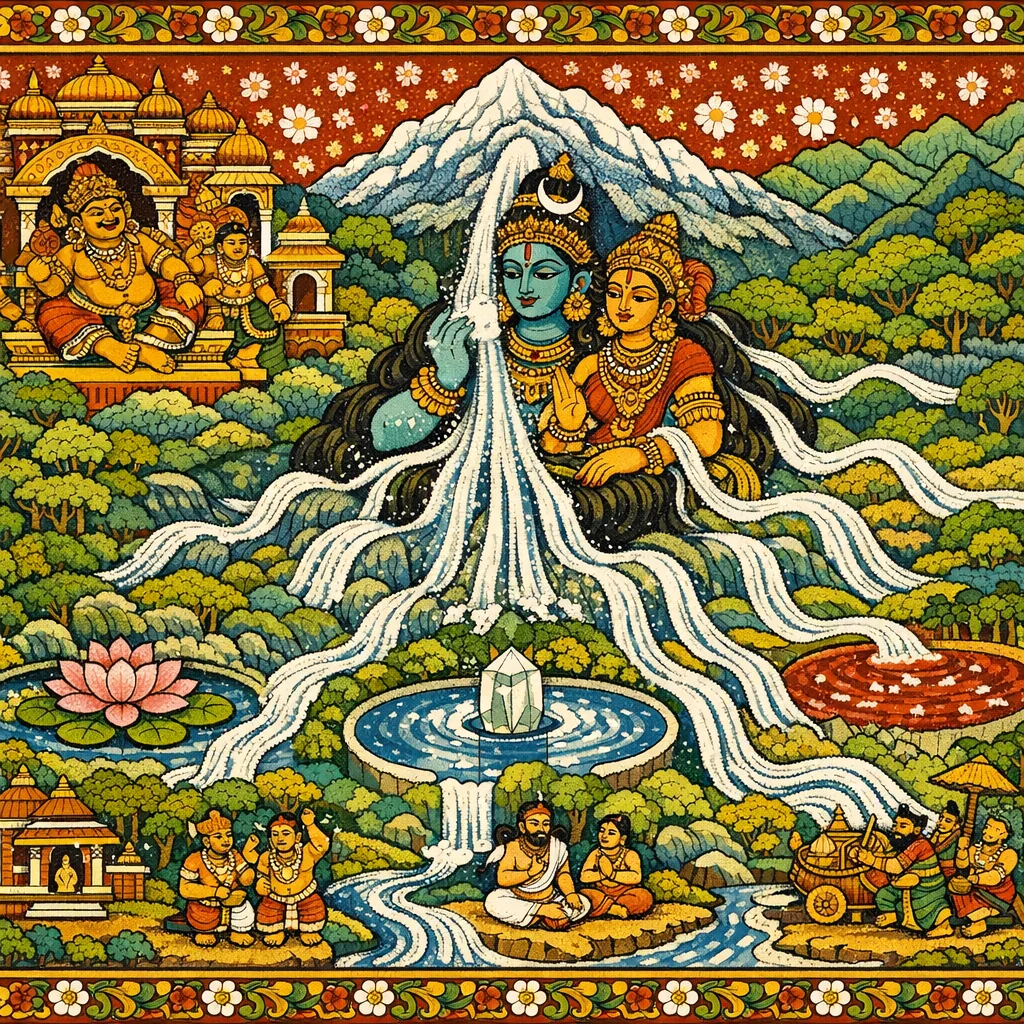
In Sūta’s narration, the scene shifts to the northern sacred mountain-region around Himavat and Kailāsa. He lists divine peaks, forests, and lakes, places Kubera in Alakā with the Guhyakas, and names Yakṣa figures stationed across these terrains. The account then turns to the origin of Tripathagā (Gaṅgā): Bhagiratha’s long austerities to liberate his ancestors, Gaṅgā’s descent, her fall upon Śiva’s head, Śiva’s restraint and later release, and the ordering of Gaṅgā into seven branches. Sūta further traces how these waters spread and inundate various lands and peoples, and closes with wider cosmographic notes on lakes, the distribution of rainfall, the oceanic fire (Vaḍavāmukha/Aurva), wingless mountains entering the salt ocean, and Earth as the universal support.
Key Concepts
Shlokas in Adhyaya 121
Verse 1
*सूत उवाच तस्याश्रमस्योत्तरतस् त्रिपुरारिनिषेवितः नानारत्नमयैः शृङ्गैः कल्पद्रुमसमन्वितैः //
Sūta said: To the north of that hermitage was a sacred mountain-region frequented by the foe of Tripura (Śiva), its peaks studded with many kinds of jewels and adorned with wish-fulfilling trees.
Verse 2
मध्ये हिमवतः पृष्ठे कैलासो नाम पर्वतः तस्मिन्निवसति श्रीमान् कुबेरः सह गुह्यकैः //
In the central region, upon the back (northern heights) of the Himavat, stands the mountain named Kailāsa; there the illustrious Kubera dwells, together with the Guhyakas.
Verse 3
अप्सरो ऽनुगुप्तो राजा मोदते ह्यलकाधिपः कैलासपादसम्भूतं पुण्यं शीतजलं शुभम् //
Protected by celestial nymphs, the king—lord of Alakā—rejoices, for there is there the auspicious, sacred, cool water that arises from the very foot of Kailāsa.
Verse 4
मन्दोदकं नाम सरः पयस्तु दधिसंनिभम् तस्मात् प्रवहते दिव्या नदी मन्दाकिनी शुभा //
There is a lake called Mandodaka, whose water is like curd in appearance; from it flows the divine river Mandākinī, auspicious and sacred.
Verse 5
दिव्यं च नन्दनं तत्र तस्यास्तीरे महद्वनम् प्रागुत्तरेण कैलासाद् दिव्यं सौगन्धिकं गिरिम् //
There, too, is the celestial Nandana grove; upon its bank lies a vast forest. To the northeast of Mount Kailāsa stands the divine mountain called Saugaṇdhika.
Verse 6
सर्वधातुमयं दिव्यं सुवेलं पर्वतं प्रति चन्द्रप्रभो नाम गिरिः यः शुभ्रो रत्नसंनिभः //
Facing the divine Suvela mountain stands a peak named Candraprabha, gleaming white and shining like a jewel, formed of all kinds of metals.
Verse 7
तत्समीपे सरो दिव्यम् अच्छोदं नाम विश्रुतम् तस्मात्प्रभवते दिव्या नदी ह्यच्छोदका शुभा //
Near that place there is a divine lake, renowned by the name Acchoda; from it arises the holy, celestial river called Acchodakā, auspicious in nature.
Verse 8
तस्यास्तीरे वनं दिव्यं महच्चैत्ररथं शुभम् तस्मिन्गिरौ निवसति मणिभद्रः सहानुगः //
On its bank lies a divine forest—vast, auspicious, and famed as Caitraratha. Upon that mountain dwells Maṇibhadra, attended by his retinue.
Verse 9
यक्षसेनापतिः क्रूरो गुह्यकैः परिवारितः पुण्या मन्दाकिनी नाम नदी ह्यच्छोदका शुभा //
There stands a fierce commander of the Yakṣa host, surrounded by the Guhyakas. The river named Mandākinī is sacred, auspicious, and truly clear-watered.
Verse 10
महीमण्डलमध्ये तु प्रविष्टे तु महोदधिम् कैलासदक्षिणे प्राच्यां शिवं सर्वौषधिं गिरिम् //
Within the terrestrial sphere, where the great ocean extends inward, to the east of the southern side of Kailāsa lies the mountain called Śiva, also known as Sarvauṣadhi—“the mountain of all medicinal herbs.”
Verse 11
मनःशिलामयं दिव्यं सुवेलं पर्वतं प्रति लोहितो हेमशृङ्गस्तु गिरिः सूर्यप्रभो महान् //
Facing the divine Suvela mountain—formed of manaḥśilā (red arsenic)—stands the great mountain Lohita, whose peaks are golden and whose radiance is like that of the sun.
Verse 12
तस्य पादे महद्दिव्यं लोहितं सुमहत्सरः तस्मात्प्रभवते पुण्यो लौहित्यश्च नदो महान् //
At his foot there is a vast, divine lake called Lohita. From that lake arises the holy and mighty river known as Lauhitya.
Verse 13
दिव्यारण्यं विशोकं च तस्य तीरे महद्वनम् तस्मिन्गिरौ निवसति यक्षो मणिधरो वशी //
There is a divine forest called Viśoka, and on its bank lies a vast woodland. On that mountain dwells a Yakṣa named Maṇidhara, powerful and self-controlled.
Verse 14
सौम्यैः सुधार्मिकैश्चैव गुह्यकैः परिवारितः कैलासात्पश्चिमोदीच्यां ककुद्मानौषधीगिरिः //
To the west-northwest of Mount Kailāsa lies Kakudmān, the Mountain of Medicinal Herbs—encircled by gentle, truly righteous Guhyakas.
Verse 15
ककुद्मति च रुद्रस्य उत्पत्तिश्च ककुद्मिनः तदञ्जनं त्रैककुदं शैलं त्रिककुदं प्रति //
There, at Kakudmatī, the manifestation of Rudra is spoken of, and likewise the origin of Kakudmin. That region is Anjana—also called Traikakuda—the mountain known as Trikakuda.
Verse 16
सर्वधातुमयस्तत्र सुमहान्वैद्युतो गिरिः तस्य पादे महद्दिव्यं मानसं सिद्धसेवितम् //
There stands a vast mountain, radiant like lightning, formed of every kind of mineral; and at its foot lies the great, divine Mānasarovara, frequented and revered by the Siddhas.
Verse 17
तस्मात्प्रभवते पुण्या सरयूर्लोकपावनी यस्यास्तीरे वनं दिव्यं वैभ्राजं नाम विश्रुतम् //
From that sacred source arises the holy Sarayū, purifier of the worlds; upon her bank lies a divine forest, renowned everywhere by the name Vaibhrāja.
Verse 18
कुबेरानुचरस्तस्मिन् प्रहेतितनयो वशी ब्रह्मधाता निवसति राक्षसो ऽनन्तविक्रमः //
There dwells a mighty Rākṣasa of boundless prowess—Brahmadhātā by name—an attendant of Kubera, self-controlled and powerful, the son of Praheti.
Verse 19
कैलासात्पश्चिमामाशां दिव्यः सर्वौषधिगिरिः वरुणः पर्वतश्रेष्ठो रुक्मधातुविभूषितः //
To the west of Kailāsa lies the divine mountain Varuṇa—foremost among mountains—an ‘all-medicinal’ peak, adorned with deposits of golden ore.
Verse 20
भवस्य दयितः श्रीमान् पर्वतो हैमसंनिभः शातकौम्भमयैर्दिव्यैः शिलाजालैः समाचितः //
A splendid mountain, dear to Bhava (Śiva), shone like gold and was filled and adorned with wondrous lattices and networks of rocks fashioned of śātakaumbha-gold.
Verse 21
शतसङ्ख्यैस् तापनीयैः शृङ्गैर्दिवमिवोल्लिखन् शृङ्गवान्सुमहादिव्यो दुर्गः शैलो महाचितः //
With hundreds of golden peaks, as though scraping the very sky, that lofty, radiant, peak-crowned mountain stood as a formidable natural fortress—vast and awe-inspiring.
Verse 22
तस्मिन्गिरौ निवसति गिरिशो धूम्रलोहितः तस्य पादात्प्रभवति शैलोदं नाम तत्सरः //
Upon that mountain dwells Girīśa (Śiva), the smoke-hued and ruddy one. From his foot there arises the lake known as Śailoda.
Verse 23
तस्मात्प्रभवते पुण्या नदी शैलोदका शुभा सा चक्षुसी तयोर्मध्ये प्रविष्टा पश्चिमोदधिम् //
From there arises the auspicious and meritorious river Śailodakā. Flowing between the two Cakṣuṣī, she enters the western ocean.
Verse 24
अस्त्युत्तरेण कैलासाच् छिवः सर्वौषधो गिरिः गौरं तु पर्वतश्रेष्ठं हरितालमयं प्रति //
To the north of Kailāsa there is a mountain called Śiva, abundant in every kind of medicinal herb; and facing it stands the excellent mountain Gaura, as though made of haritāla (yellow orpiment).
Verse 25
हिरण्यशृङ्गः सुमहादिव्यौषधिमयो गिरिः तस्य पादे महद्दिव्यं सरः काञ्चनवालुकम् //
There is a mountain called Hiraṇyaśṛṅga (“Golden-peaked”), exceedingly vast and composed of celestial, divine herbs. At its very foot lies a great, wondrous lake whose sands are of gold.
Verse 26
रम्यं बिन्दुसरो नाम यत्र राजा भगीरथः गङ्गार्थे स तु राजर्षिर् उवास बहुलाः समाः //
There is a lovely lake named Bindusara, where King Bhagiratha—the royal sage (rājarṣi)—dwelt for many years, performing austerities to bring down the Gaṅgā.
Verse 27
दिवं यास्यन्तु मे पूर्वे गङ्गातोयाप्लुतास्थिकाः तत्र त्रिपथगा देवी प्रथमं तु प्रतिष्ठिता //
May my departed ancestors—whose bones have been washed by the waters of the Gaṅgā—attain heaven. For there the Goddess Tripathagā (Gaṅgā), who flows through the three realms, was first established.
Verse 28
सोमपादात्प्रसूता सा सप्तधा प्रविभज्यते यूपा मणिमयास्तत्र विमानाश्च हिरण्मयाः //
Born from Soma’s quarter called Somapāda, that formation is divided into seven parts. In that arrangement, the sacrificial posts (yūpas) are made of gems, and the vimānas—celestial edifices—are made of gold.
Verse 29
तत्रेष्ट्वा क्रतुभिः सिद्धः शक्रः सुरगणैः सह दिव्यश्छायापथस् तत्र नक्षत्राणां तु मण्डलम् //
There, having performed sacrifices (kratus) and attained accomplishment, Śakra (Indra) is established together with the hosts of gods. There is the divine Chāyāpatha, the celestial “path of shadow,” and there indeed is the Nakṣatra-maṇḍala, the circular array of the constellations.
Verse 30
दृश्यते भासुरा रात्रौ देवी त्रिपथगा तु सा अन्तरिक्षं दिवं चैव भावयित्वा भुवं गता //
At night she is seen shining with brilliant radiance—the goddess Tripathagā (Gaṅgā); having pervaded the mid-region and heaven with her presence, she then proceeds to the earthly realm.
Verse 31
भवोत्तमाङ्गे पतिता संरुद्धा योगमायया तस्या ये बिन्दवः केचित् क्रुद्धायाः पतिता भुवि //
Falling upon Bhava’s (Śiva’s) head, she was restrained by Yogamāyā; and some drops (bindu-s) of that enraged goddess fell down upon the earth.
Verse 32
कृतं तु तैर्बहुसरस् ततो बिन्दुसरः स्मृतम् ततस्तस्या निरुद्धाया भवेन सहसा रुषा //
Then they made a lake called Bahu-saras; thereafter it became renowned as Bindu-saras. After that, when she was restrained, Bhava (Śiva) reacted in sudden anger.
Verse 33
ज्ञात्वा तस्या ह्यभिप्रायं क्रूरं देव्याश्चिकीर्षितम् भित्त्वा विशामि पातालं स्रोतसा गृह्य शंकरम् //
Knowing her cruel intention and what the goddess meant to do, I will break through and enter Pātāla; and, seizing Śaṅkara in the current, I shall carry him away.
Verse 34
अथावलेपं तं ज्ञात्वा तस्याः क्रुद्धस्तु शंकरः तिरोभावयितुं बुद्धिर् आसीदङ्गेषु तां नदीम् //
Then, having understood her arrogance, Śaṅkara became enraged; and the thought arose in him to make that river disappear within his own limbs.
Verse 35
एतस्मिन्नेव काले तु दृष्ट्वा राजानमग्रतः धमनीसंततं क्षीणं क्षुधाव्याकुलितेन्द्रियम् //
At that very time, seeing the king before him—his veins standing out, his body wasted away, and his senses distressed by hunger—(he/they) were moved to act.
Verse 36
अनेन तोषितश्चाहं नद्यर्थे पूर्वमेव तु बुद्ध्वाऽस्य वरदानं तु ततः कोपं न्ययच्छत //
By this, I was indeed gratified earlier in the matter of the river; and, realizing that he had already granted a boon, he thereafter restrained his anger.
Verse 37
ब्रह्मणो वचनं श्रुत्वा यदुक्तं धारयन्नदीम् ततो विसर्जयामास संरुद्धां स्वेन तेजसा //
Having heard Brahmā’s instruction, he held back the river as directed; then, by his own spiritual power (tejas), he released the waters that had been restrained.
Verse 38
नदीं भगीरथस्यार्थे तपसोग्रेण तोषितः ततो विसर्जयामास सप्त स्रोतांसि गङ्गया //
Pleased by Bhagiratha’s fierce austerities undertaken for that purpose, he then released the river Gaṅgā, letting her flow forth in seven streams.
Verse 39
त्रीणि प्राचीमभिमुखं प्रतीचीं त्रीण्यथैव तु स्रोतांसि त्रिपथायास्तु प्रत्यपद्यन्त सप्तधा //
Of Tripathagā (the Gaṅgā), three streams turned eastward-facing, and likewise three streams turned westward; thus her flow came to be arranged in seven branches.
Verse 40
नलिनी ह्लादिनी चैव पावनी चैव प्राच्यगा सीता चक्षुश्च सिन्धुश्च तिस्रस्ता वै प्रतीच्यगाः //
Nalinī, Hlādinī, and Pāvanī are the rivers that flow eastward; and Sītā, Cakṣu, and Sindhu—these three indeed—are the rivers that flow westward.
Verse 41
सप्तमी त्वनुगा तासां दक्षिणेन भगीरथम् तस्माद्भागीरथी सा वै प्रविष्टा दक्षिणोदधिम् //
But the seventh stream, following after them, went along the southern course of the Bhāgīratha; therefore that branch is indeed called Bhāgīrathī, having entered the Southern Ocean.
Verse 42
सप्त चैताः प्लावयन्ति वर्षं तु हिमसाह्वयम् प्रसूताः सप्त नद्यस्तु शुभा बिन्दुसरोद्भवाः //
These seven streams flood and water the mountain-region called Himavat. They are seven auspicious rivers, born forth from Bindusaras, the lake named Bindusaras.
Verse 43
तान्देशान्प्लावयन्ति स्म म्लेच्छप्रायांश्च सर्वशः सशैलान्कुकुरान्रौध्रान् बर्बरान्यवनान्खसान् //
They then inundated those regions everywhere—lands largely inhabited by mlecchas—submerging even the mountainous tracts, including the Kukuras, the Raudhras, the Barbaras, the Yavanas, and the Khasas.
Verse 44
पुलिकांश्च कुलत्थांश्च अङ्गलोक्यान्वरांश्च यान् कृत्वा द्विधा हिमवन्तं प्रविष्टा दक्षिणोदधिम् //
Having divided (the peoples/regions) such as the Pulikas and the Kulatthas, and also the folk of Aṅga and the Varas—splitting the Himavat in two—it then entered the Southern Ocean.
Verse 45
अथ वीरमरूंश्चैव कालिकांश्चैव शूलिकान् तुकरान्बर्बराकारान् पह्लवान्पारदाञ्छकान् //
Then (the text) mentions the Vīramarūs, the Kālikas, the Śūlikas, the Tukaras, those of barbarous appearance, the Pahlavas, the Pāradas, and the Śakas.
Verse 46
एताञ्जनपदांश्चक्षुः प्लावयित्वोदधिं गता दरदोर्जगुडांश्चैव गान्धारानौरसान्कुहून् //
Having flooded these territories, the river Cakṣu flowed onward into the ocean—(passing through) the lands of the Daradas, the Jagaudas, the Gandhāras, the Aurasas, and the Kuhūs.
Verse 47
शिवपौरानिन्द्रमरून् वसतीन्समतेजसम् सैन्धवानुर्वसान्बर्बान् कुपथान्भीमरोमकान् //
He (the text) also mentions the Śivapauras, the Indramarus, the Vasatis, the Samatejasas; likewise the Saindhavas, the Urvasas, the Barbas, the Kupathas, and the Bhīmaromakas—as groups of peoples/tribes.
Verse 48
शुनामुखांश्चोर्दमरून् सिन्धुरेतान्निषेवते गन्धर्वान्किन्नरान्यक्षान् रक्षोविद्याधरोरगान् //
The Sindhu region is inhabited by the Śunāmukhas and the Urdamarus; there also dwell the Gandharvas, Kinnaras, Yakṣas, Rākṣasas, Vidyādharas, and the serpent-beings (Nāgas).
Verse 49
कलापग्रामकांश्चैव तथा किम्पुरुषान्नरान् किरातांश्च पुलिन्दांश्च कुरून्वै भारतानपि //
Likewise (the text) describes the Kalāpa-grāmakas, the Kimpuruṣas and other men, the Kirātas and the Pulindas, and also the Kurus—indeed, even the Bhāratas.
Verse 50
पाञ्चालान्कौशिकान्मत्स्यान् मागधाङ्गांस्तथैव च ब्रह्मोत्तरांश्च वङ्गांश्च ताम्रलिप्तांस्तथैव च //
He also mentioned the Pāñcālas, the Kauśikas, the Matsyas, and likewise the Māgadhas and the Aṅgas; as well as the Brahmottaras, the Vaṅgas, and the people of Tāmraliptā.
Verse 51
एताञ्जनपदानार्यान् गङ्गा भावयते शुभा ततः प्रतिहता विन्ध्ये प्रविष्टा दक्षिणोदधिम् //
This auspicious Gaṅgā sanctifies these noble countries; then, being checked by the Vindhya range, she entered the Southern Ocean.
Verse 52
ततस्तु ह्लादिनी पुण्या प्राचीनाभिमुखी ययौ प्लावयन्त्युपकांश्चैव निषादानपि सर्वशः //
Then the sacred river Hlādinī, bringing delight, flowed eastward, inundating everywhere the Upakā people as well as the Niṣādas, the forest-dwellers.
Verse 53
धीवरानृषिकांश्चैव तथा नलिमुखानपि केकरानेककर्णांश्च किरातानपि चैव हि //
And also the Dhīvaras, the fisherfolk, the Ṛṣikas, as well as the Nalimukhas; likewise the Kekaras, the Ekakarṇas, the ‘one-eared’, and indeed the Kirātas too.
Verse 54
कालञ्जरान्विकर्णांश्च कुशिकान्स्वर्गभौमकान् सा मण्डले समुद्रस्य तीरे भूत्वा तु सर्वशः //
And (she/that sacred power) became present all around on the seashore—within the ocean’s coastal circuit—among the Kālañjaras, the Vikarṇas, and the Kuśikas, including those called the Svarga-bhaumakas.
Verse 55
ततस्तु नलिनी चापि प्राचीमेव दिशं ययौ कुपथान्प्लावयन्ती सा इन्द्रद्युम्नसरांस्यपि //
Then the river Nalinī, too, flowed eastward, flooding the misguided channels and even inundating the lakes of Indradyumna.
Verse 56
तथा खरपथान्देशान् वेत्रशङ्कुपथानपि मध्येनोज्जानकमरून् कुथप्रावरणान्ययौ //
Then he also passed through the lands known as Kharapatha and Vetraśaṅkupatha; moving through the middle regions, he went on to Ujjānaka and the people of Marū, and to those who wear garments of kuthā (coarse wool or blankets).
Verse 57
इन्द्रद्वीपसमीपे तु प्रविष्टा लवणोदधिम् ततस्तु पावनी प्रायात् प्राचीमाशां जवेन तु //
Near Indradvīpa it entered the salt ocean; thereafter the river Pāvanī swiftly proceeded toward the eastern quarter.
Verse 58
तोमरान्प्लावयती च हंसमार्गान्समूहकान् पूर्वान्देशांश्च सेवन्ती भित्त्वा सा बहुधा गिरिम् कर्णप्रावरणान्प्राप्य गता साश्वमुखानपि //
It floods the Tomara lands and the clustered routes known as the Haṃsa-paths; moving through the eastern countries, it repeatedly cleaves the mountain range in many places. Reaching the Karṇaprāvaraṇa region, it then goes on even to the Aśvamukha country as well.
Verse 59
सिक्त्वा पर्वतमेरुं सा गत्वा विद्याधरानपि शैमिमण्डलकोष्ठं तु सा प्रविष्टा महत्सरः //
After bathing (or sprinkling with sacred water) at Mount Meru, she went on even to the realm of the Vidyādharas; then she entered the great lake, into the chambered enclosure of the Śaimi-maṇḍala.
Verse 60
तासां नद्युपनद्यो ऽन्याः शतशो ऽथ सहस्रशः उपगच्छन्ति ता नद्यो यतो वर्षति वासवः //
Into those rivers flow other rivers and tributaries—by the hundreds and even by the thousands—for from there Vāsava (Indra) sends down the rains.
Verse 61
तीरे वंशौकसारायाः सुरभिर्नाम तद्वनम् हिरण्यशृङ्गो वसति विद्वान्कौबेरको वशी //
On the bank of the Vaṃśaukasārā River lies a forest named Surabhi. There dwells Hiraṇyaśṛṅga—wise, self-controlled, and a Kauberaka (a Yakṣa of Kubera’s retinue).
Verse 62
यज्ञादपेतः सुमहान् अमितौजाः सुविक्रमः तत्रागस्त्यैः परिवृता विद्वभिर्द्ब्रह्मराक्षसैः //
There, Agastya—most great, of immeasurable vigor and mighty prowess—had turned away from the sacrifice, and was surrounded by learned brahmarākṣasas.
Verse 63
कुबेरानुचरा ह्येते चत्वारस्तत्समाश्रिताः एवमेव तु विज्ञेया सिद्धिः पर्वतवासिनाम् //
These four are indeed attendants of Kubera and remain under his protection. In this very manner, the siddhi (occult attainment/power) of those who dwell upon the mountains is to be understood.
Verse 64
परस्परेण द्विगुणा धर्मतः कामतो ऽर्थतः हेमकूटस्य पृष्ठे तु सर्पाणां तत्सरः स्मृतम् //
In that region, the fruits of merit are said to be doubled in comparison with other holy places—whether sought for dharma, for kāma (desire), or for artha (worldly prosperity). On the back-slope of Hemakūṭa, that lake is remembered as belonging to the Nāgas (serpent beings).
Verse 65
सरस्वती प्रभवति तस्माज्ज्योतिष्मती तु या अवगाढे ह्युभयतः समुद्रौ पूर्वपश्चिमौ //
From there the river Sarasvatī arises; and the river Jyotiṣmatī, plunging deep, reaches both seas—the eastern and the western.
Verse 66
सरो विष्णुपदं नाम निषधे पर्वतोत्तमे यस्मादग्रे प्रभवति गन्धर्वानुकुले च ते //
In Niṣadha, on that excellent mountain, there is a lake called Viṣṇupada; from it, in ancient times, a manifestation arose, and it is also a place favorable to the Gandharvas.
Verse 67
मेरोः पार्श्वात्प्रभवति ह्रदश्चन्द्रप्रभो महान् जम्बूश्चैव नदी पुण्या यस्यां जाम्बूनदं स्मृतम् //
From the flank of Mount Meru arises the great lake called Candraprabha; and also the sacred river Jambū, in which the famed gold known as jāmbūnada is said to be found.
Verse 68
पयोदस्तु ह्रदो नीलः स शुभ्रः पुण्डरीकवान् पुण्डरीकात्पयोदाच्च तस्माद् द्वे सम्प्रसूयताम् //
Payoda is a lake—deep blue, yet gleaming white, and filled with lotuses. From Puṇḍarīka and from Payoda, therefore, two streams (or two offspring) are said to be brought forth.
Verse 69
सरसस्तु सरस्त्वेतत् स्मृतमुत्तरमानसम् मृग्या च मृगकान्ता च तस्माद् द्वे सम्प्रसूयताम् //
This lake, born from the lake (Saras), is remembered as Uttara-Mānasa. And from it, the two—Mṛgyā and Mṛgakāntā—are said to arise.
Verse 70
ह्रदाः कुरुषु विख्याताः पद्ममीनकुलाकुलाः नाम्ना ते वै जया नाम द्वादशोदधिसंनिभाः //
In the land of the Kurus there are renowned lakes, filled with lotuses and throngs of fish. They are called “Jayā”—twelve in number—vast and splendid, like oceans.
Verse 71
तेभ्यः शान्ती च मध्वी च द्वे नद्यौ सम्प्रसूयताम् किम्पुरुषाद्यानि यान्यष्टौ तेषु देवो न वर्षति //
From those regions are born the two rivers Śāntī and Madhvī. In the eight lands beginning with Kimpuruṣa, the god of rain does not send rainfall.
Verse 72
उद्भिदान्युदकान्यत्र प्रवहन्ति सरिद्वराः बलाहकश्च ऋषभो चक्रो मैनाक एव च //
Here, excellent rivers flow forth like upwelling waters; they are known as Balāhaka, Ṛṣabha, Cakra, and also Maināka.
Verse 73
विनिविष्टाः प्रतिदिशं निमग्ना लवणाम्बुधिम् चन्द्रकान्तस्तथा द्रोणः सुमहांश्च शिलोच्चयः //
Set in position in every direction and sunk down into the salt ocean are great rocky masses—Candrakānta, Droṇa, and other enormous stone-peaks.
Verse 74
उद्गायता उदीच्यां तु अवगाढा महोदधिम् चक्रो बधिरकश्चैव तथा नारदपर्वतः //
In the northern quarter lies Udgāyatā; Avagāḍha is also there, reaching down to the great ocean. Likewise are Cakra and Badhiraka, and also the mountain known as Nārada.
Verse 75
प्रतीचीमायतास्ते वै प्रतिष्ठास्ते महोदधिम् जीमूतो द्रावणश्चैव मैनाकश्चन्द्रपर्वतः //
Those mountains indeed extend westward, standing firm up to the Great Ocean—namely Jīmūta, Drāvaṇa, Maināka, and Candraparvata.
Verse 76
आयतास्ते महाशैलाः समुद्रं दक्षिणं प्रति चक्रमैनाकयोर्मध्ये दिवि सन् दक्षिणापथे //
Those great mountain ranges stretch toward the southern ocean; and in Dakṣiṇāpatha, as though standing in the sky, they lie between Cakra and Maināka.
Verse 77
तत्र संवर्तको नाम सो ऽग्निः पिबति तज्जलम् अग्निः समुद्रवासस्तु और्वो ऽसौ वडवामुखः //
There, the fire called Saṃvartaka drinks up that water. That ocean-dwelling fire is the Aurva, known as the Mare’s Mouth (Vaḍavāmukha).
Verse 78
इत्येते पर्वताविष्टाश् चत्वारो लवणोदधिम् छिद्यमानेषु पक्षेषु पुरा इन्द्रस्य वै भयात् //
Thus, these four, having taken refuge as mountains, entered the Salt Ocean—when, in ancient times, the mountains’ wings were being cut off, out of fear of Indra.
Verse 79
तेषां तु दृश्यते चन्द्रे शुक्ले कृष्णे समाप्लुतिः ते भारतस्य वर्षस्य भेदा येन प्रकीर्तिताः //
In their case, a convergence is observed in the Moon, through the bright fortnight and the dark fortnight. It is by this lunar basis that the divisions of Bhārata-varṣa have been set forth.
Verse 80
इहोदितस्य दृश्यन्ते अन्ये त्वन्यत्र चोदिताः उत्तरोत्तरमेतेषां वर्षम् उद्रिच्यते गुणैः //
Of what has been taught here, some features are seen, while other features are taught elsewhere. Among these varṣas (regions), each succeeding one is said to surpass the former in excellence and qualities.
Verse 81
आरोग्यायुःप्रमाणाभ्यां धर्मतः कामतो ऽर्थतः समन्वितानि भूतानि तेषु वर्षेषु भागशः //
In those varṣas (regions), beings are endowed—each according to its allotted share—with health, lifespan, and bodily measure, and likewise with dharma, kāma (desire), and artha (prosperity).
Verse 82
वसन्ति नानाजातीनि तेषु सर्वेषु तानि वै इत्येतद्धारयद्विश्वं पृथ्वी जगदिदं स्थिता //
Countless kinds of beings dwell upon her; all of them indeed live within her. Thus does the Earth uphold the universe—on her this entire moving world stands established.
Frequently Asked Questions
The chapter teaches that sacred waters and landscapes are not merely physical but are carriers of dharma and merit: Gaṅgā’s descent is enabled by tapas (Bhagiratha), regulated by divine restraint (Śiva), and distributed for world-purification through seven streams. It frames tirthas (Kailāsa, Mānasarovara, Bindusara and associated rivers) as cosmically authorized sources of purification, prosperity, and ancestral benefit.
The focus is Creation/Cosmography (Bhuvanakośa) and Dharma through tirtha-power: sacred geography of Kailāsa–Himavat; roles of Śiva and Kubera; origin and branching of Gaṅgā; lists of peoples/regions affected by rivers; and varṣa-wise qualities like lifespan and prosperity. Vāstu and royal polity are not primary here, and genealogy appears only indirectly via Bhagiratha and the pitṛ motif.
Three east-flowing streams are named Nalinī, Hlādinī, and Pāvanī; three west-flowing streams are Sītā, Cakṣu, and Sindhu; the seventh follows the southern course as Bhāgīrathī, entering the southern ocean.
Key lakes include Mandodaka, Acchoda, Lohita, Śailoda, Mānasarovara, and Bindusara. From these arise rivers such as Mandākinī, Acchodakā, Lauhitya, Śailodakā, and the sevenfold Gaṅgā streams; Sarasvatī and Jyotiṣmatī are also mentioned as originating from sacred lake-regions.