Adhyaya 15
Yamamārga, Antyeṣṭi-vidhi, and Daśāhika Piṇḍa-dāna (Road to Yama and Ten-Day Offerings)
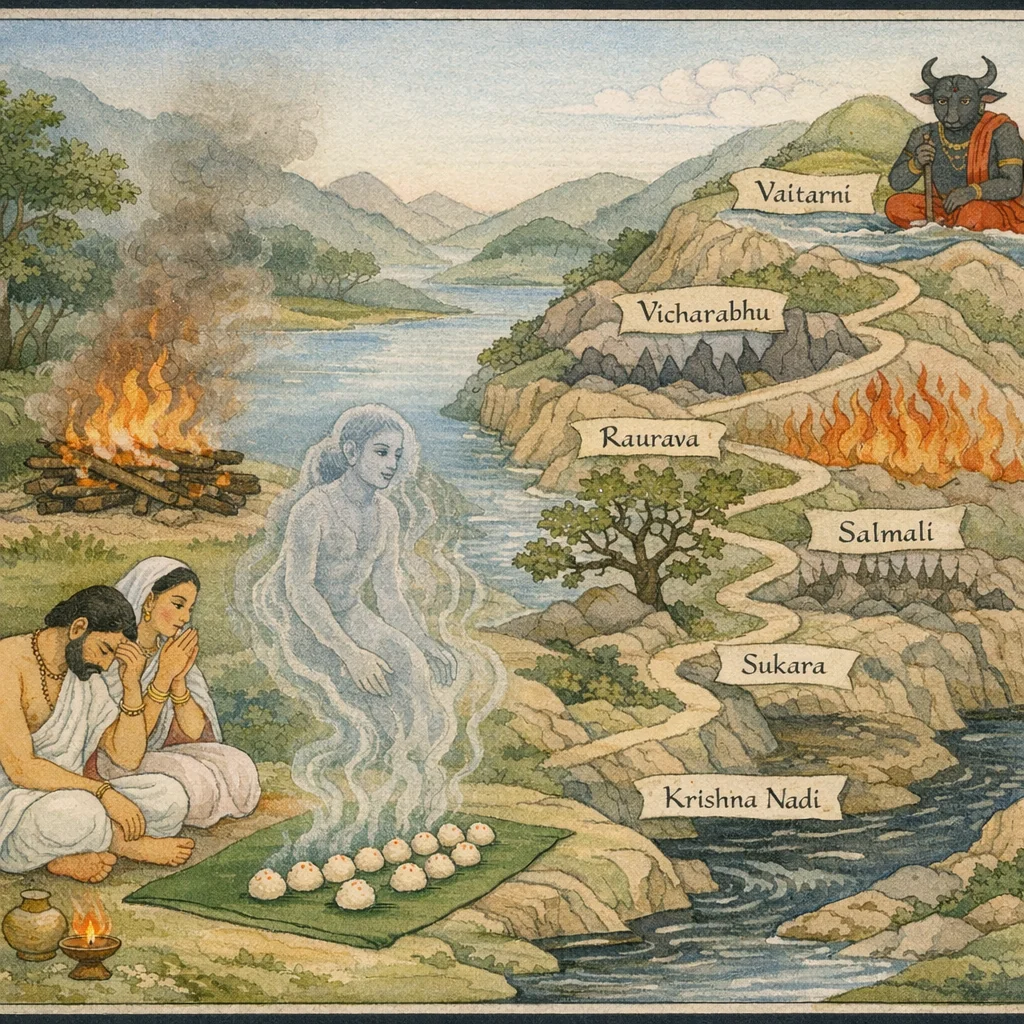
Continuing the instructive dialogue, Garuḍa asks for a definitive account of Yama’s realm and the post-death road. Viṣṇu answers by stating the distance to Yamaloka and affirming karma as the determining cause of death and after-death experience. The chapter then details antyeṣṭi practice: preparing the dying/dead with tulasī, Śālagrāma, gold, sesame, and darbha; transporting and cremating with prescribed orientations, fuels, and fire-offerings to Yama, Antaka, Mṛtyu, and Brahmā; and post-cremation observances such as water offerings, restraint from excessive wailing, and communal rites. Central is the preta doctrine: from day one, daily piṇḍas and jalāñjali are offered for ten days, said to build the preta-body limb by limb, culminating in hunger on the tenth day, with the preta designation continuing through the eleventh and twelfth. The narrative then opens onto the onward journey: the preta is driven along the harsh Yamamārga (gentle for the righteous), moving in measured stages through named stations toward Yama’s city, while moral reflection deepens—lamenting missed charity, tapas, tīrtha-sevā, and cow-related gifts. Thus the chapter links immediate funerary procedure to the coming description of the Yamamārga’s topography and the karmic adjudication awaiting the traveler.
Shlokas
Verse 1
गोदानवृषोत्सर्गदशदानभूरिदानादिनिरूपणं नाम चतुर्दशो ऽध्यायः गरुड उवाच / बगवन्ब्रूहि मे सर्वं यमलोकस्य निर्णयम् / जन्तोः प्रयाणमारभ्य माहात्म्यं वर्त्मविस्तरम्
(This is) the fourteenth chapter, called “An exposition of the gifts of cows, the release of a bull, the tenfold gifts, abundant gifts, and related rites.” Garuḍa said: “O Blessed Lord, tell me fully the settled account of Yama’s realm—beginning from the moment a being sets out (at death), and the greatness and detailed extent of the path (beyond).”
Verse 2
श्रीभगवानुवाच / शृणु तार्क्ष्य प्रवक्ष्यामि यममार्गस्य निर्णयम् / प्रयाणकानि सर्वाणि नगराणि च षोडश
The Blessed Lord said: “Listen, O Tārkṣya (Garuḍa). I shall explain the definite account of the road to Yama—its stages of departure in full, and the sixteen cities (stations) along the way.”
Verse 3
षाडशीतिसहस्राणि योजनानां प्रमाणतः / यमलोकस्य चोर्ध्वं वै अन्तरा मानुषस्य च
Measured in yojanas, the distance between the human world and Yama’s realm—upwards toward Yamaloka—is said to be eighty-six thousand yojanas.
Verse 4
कुकृतं दुष्कृतं वापि भुक्त्वा लोके यथार्जितम् / कर्मयोगाद्यदा कश्चिद्व्याधिरुत्पद्यते खग
Having experienced in this world the results of whatever good or evil one has earned, when—through the linkage of karma—some disease arises, O Bird (Garuḍa),
Verse 5
निमित्तमात्रं सर्वेषां कृतकर्मानुसारतः / यस्य यो विहितो मृत्युः स तं ध्रुवमवाप्नुयात्
For all beings, external causes are only incidental, in accordance with the deeds they have performed. Whatever kind of death has been ordained for a person, that very death he surely attains.
Verse 6
कर्मयोगाद्यदा देही मुञ्चत्यत्र निजं वपुः / तदा भूमिगतं कुर्याद्गोमयेनोपलिप्य च
When, by the force of karma and its bonds, the embodied being casts off his own body here, then one should lay him upon the ground and smear the spot with purifying cow-dung.
Verse 7
तिलान्दर्भान्विकीर्याथ मुखे स्वर्णं विनिः क्षिपेत् / तुलसींसन्निधौ कृत्वा शालग्रामशिलां तथा
Then one should scatter sesame seeds and darbha grass, and place gold into the mouth of the departed. This should be done in the presence of tulasī, and likewise with the sacred Śālagrāma stone.
Verse 8
सेतु (एवं) सामादिसूक्तैस्तु मरणं मुक्तिदायकम् / शलाकास्वर्णविक्षपैः प्रतप्राणिगृहेषुच
Thus the ‘setu’, the bridge of passage, is established: by reciting the Sāman and other sacred hymns, even death becomes a giver of liberation; and likewise by distributing gold and small ritual gifts in the homes of the living.
Verse 9
एका वक्त्रे तु दातव्या घ्राणयुग्मे तथा पुनः / अक्ष्णोश्च कर्णयोश्चैव द्वेद्वे देये यथाक्रमम्
One offering should be given to the mouth; likewise again to the pair of nostrils. For the eyes and for the ears as well, two and two should be offered respectively, in due order.
Verse 10
करयुग्मे च कण्ठे च तुलसीं च प्रदापयेत्
One should place sacred tulasī in both hands and also at the throat of the departing person.
Verse 11
वस्त्रयुग्मं च दातव्यं कङ्कुमैश्चाक्षतैर्यजेत् / पुष्पमालायुतं कुर्यादन्यद्वारेण सन्नयेत्
One should donate a pair of garments and perform worship with saffron and unbroken grains of rice. One should also arrange the offering together with a garland of flowers, and bring it in through a different doorway.
Verse 12
पुत्रस्तु बान्धवैः सार्धं विप्रस्तु पुरवासिभिः / पितुः प्रेतं स्वयं पुत्रः स्कन्धमारोप्य बान्धवैः
The son should proceed together with the kinsmen, and the brāhmaṇa along with the townspeople. The son himself, with the relatives, should lift his father’s departed body and place it upon the shoulder.
Verse 13
गत्वा श्मशानदेशे तु प्राड्मुखश्चोत्तरामुखम् / अदग्धपूर्वा या भूमिश्चितां तत्रैव कारयेत्
Having gone to the cremation ground, one should place the body with the head facing east or north, and there itself construct the funeral pyre on ground that has not previously been used for burning.
Verse 14
श्रीखण्डतुलसीकाष्ठसमित्पालाशसंभृताम् / विकलेन्द्रियसङ्घाते चैतन्ये जडतां गते
Made up of sandalwood, tulasī-wood, sacred fuel-sticks (samit), and palāśa leaves—when the aggregate of the senses has become impaired, and consciousness has lapsed into inertness.
Verse 15
प्रचलन्ति ततः प्राणा याम्यैर्निकटवर्तिभिः / एकीभूतं जगत्पश्येद्दैवी दृष्टिः प्रजायते
Then the life-breaths (prāṇa) are set in motion by the attendants of Yama who stand close by; and one begins to perceive the world as a single unified whole—thus a divine mode of vision arises.
Verse 16
बीभत्सं दारुणं रूपं प्रणैः कण्ठं समाश्रितैः / फेनमुद्गिरते कोपि मुखं लालाकुलं भवेत्
A person may take on a hideous and dreadful form; when the vital breaths lodge in the throat, one may foam at the mouth, and the face becomes overwhelmed with drool.
Verse 17
दुरात्मानश्च ताड्यन्ते किङ्करैः पाशबन्धनैः / सुखेन कृतिनस्तत्र नीयन्ते नाकनायकैः
The wicked are beaten by Yama’s attendants and bound with nooses; but the righteous, rich in merit, are led onward there with ease by the leaders of heaven.
Verse 18
दुः खेन पापिनो यान्ति यममार्गे च दुर्गमे / यमश्चतुर्भुजो भूत्वा शङ्खचक्रगदादिभृत्
Sinners proceed in misery along the difficult path that leads to Yama. And Yama, assuming a four-armed form, bears the conch, discus, mace, and other weapons.
Verse 19
पुण्यकर्मरतान्सम्यक् शुभान्मित्रवदाचरेत् / आहूय पापिनः सर्वान्यमो दण्डेन रज्जयेत्
Yama treats those devoted to meritorious deeds—the virtuous—properly, like friends. But summoning all sinners, Yama subdues and disciplines them with punishment.
Verse 20
प्रलयाम्बुदनिर्घोषस्त्वञ्जनाद्रिसमप्रभः / महिषस्थो दुराराध्यो विद्युत्तेजः समद्युतिः
He roars like the clouds at the time of cosmic dissolution, shines like the dark Anjana mountain, rides upon a buffalo, is difficult to appease, and blazes with lightning-like energy and equal radiance.
Verse 21
योजनत्रयविस्तारदेहो रौद्रो ऽतिभीषणः / लोहदण्डधरो भीमः पाशपाणिर्दुराकृतिः
His body spans three yojanas in breadth; he is fierce and exceedingly terrifying, dreadful in form—bearing an iron staff, formidable, and holding a noose (pāśa) in his hand.
Verse 22
वक्रनेत्रो ऽतिभयदो दर्शनं याति पापिनाम् / अङ्गुष्ठमात्रः पुरुषो हाहा कुर्वन् कलेवरात्
A crooked-eyed, exceedingly fearsome being comes into the sight of sinners. From that body there emerges a person, only thumb-sized, crying out “hā hā!” in distress.
Verse 23
तदैव नीयते दूतैर्याम्यैर्वोक्षन्स्वकं गृहम् / निर्विचेष्टं शरीरं तु प्राणैर्मुक्तं जुगुप्सितम्
At that very moment, the messengers of Yama lead the departed away, saying, “Come—let us take you to your own abode, the realm shaped by your deeds.” Meanwhile the body, released from the vital breaths, lies motionless—abandoned and repulsive.
Verse 24
अस्पृश्यं जायते तूर्णं दुर्गन्धं सर्वनिन्दितम् / त्रिधावस्था हि देहस्य कृमिविड्मस्मसंज्ञिता
The body quickly becomes untouchable—foul-smelling and despised by all. Indeed, the body has three conditions: the worm-ridden state, the excremental state, and the ash state.
Verse 25
को गर्वः क्रियते तार्क्ष्य क्षणविध्वंसिभिर्नरैः / दानं वित्तादृता वाचः कीर्तिधर्मौ तथायुषः
O Tārkṣya (Garuda), what pride can be held by men whose life is destroyed in a moment? Wealth is for giving (dāna); speech is to be guarded—truthful and restrained; and likewise fame, dharma, and lifespan are all fleeting.
Verse 26
परोपकरणं कायादसतः सारमुद्धृतम् / तस्यैवं नीयमानस्य दूताः सन्तर्जयन्ति हि
From the perishable, unreal body, the only true essence drawn forth is service rendered for the sake of others. Yet, as the soul is thus led away (after death), Yama’s messengers indeed threaten and intimidate him.
Verse 27
दर्शयन्तो भयं तीव्रं नरकाय पुनः पुनः / शीघ्रं प्रचल दुष्टात्मन् गतो ऽसित्वं यमालये
Showing him again and again the fierce terror of hell, they say: “Move quickly, O wicked-souled one; you have now come to Yama’s abode.”
Verse 28
कुंभीपाकादिनरकांस्त्वां नेष्यामश्च मा चिरम् / एवं वाचस्तदा शृण्वन्बन्धूनां रुदितं तथा
“We shall take you—without delay—to the hells such as Kumbhīpāka.” Hearing such words at that time, he also hears the weeping of his relatives.
Verse 29
उच्चैर्हाहेति विलपन्नीयते यमकिङ्करैः / स्थाने श्राद्धं प्रकुर्वीत तथा चेकादशे ऽहनि
Crying aloud, “Alas! Alas!”, the departed one is led away by Yama’s attendants. Therefore, śrāddha should be performed in the proper place, and also on the eleventh day.
Verse 30
मृस्योत्क्रान्तिसमयात्षट् पिण्डान्क्रमशो ददेत् / मृतस्थाने तथा द्वारे चत्वरे तार्क्ष्य कारणात्
From the time of a person’s departure (death), one should offer six piṇḍas in due sequence—at the place where death occurred, at the doorway, and at the crossroads—O Tārkṣya (Garuda), for the prescribed reason.
Verse 31
विश्रामे काष्ठचयने तथा सञ्चयने च षट् / शृणु तत्कारणं तार्क्ष्य षट् पिण्डपरिकल्पने
In the rites concerning the resting-place, the piling of the funeral wood, and the gathering of the remains, there are six observances. Hear, O Tārkṣya (Garuda), the reason for these six in the prescribed preparation of the piṇḍa (funerary offering).
Verse 32
मृतस्थाने शवो नाम तेन नाम्ना प्रदीयते / तेन दत्तेन तृप्यन्ति गृहवास्त्वधिदेवताः
At the place of death, an offering is given in the departed one’s name as “Śava”; by that offering, the presiding deities of the house and dwelling are satisfied.
Verse 33
तेन भूमिर्भवेत्तुष्टातदधिष्ठातृदेवता / द्वारे तु पिण्डं देयं च पान्थमित्यभिधाय तु
By that offering, the Earth becomes pleased, along with the deity who presides over her. Then, at the doorway, a piṇḍa should be given, calling it “for the traveller on the path.”
Verse 34
दत्तेन तेन प्रीणन्ति द्वारस्था गृहदेवताः / चत्वरे खेचरो नाम तमुद्दिश्य प्रदापयेत्
By that offering, the household deities stationed at the doorway are satisfied. At the crossroads, one should make an offering, dedicating it to the being named Khecara.
Verse 35
न चोपघातं कुर्वन्ति भूताद्या देवयोनयः / विश्रामे भूतसंज्ञो ऽयं तेन तत्र प्रदापयेत्
And the divine-born beings—such as bhūtas and the like—do not inflict harm there. At the resting place, this offering is known as “bhūta”; therefore one should offer it there.
Verse 36
पिशाचा राक्षसा यक्षा ये चान्ये दिशि वासिनः / तस्य होतव्यदेहस्यनैवायोग्यत्वकारकाः
Piśācas, Rākṣasas, Yakṣas, and other beings dwelling in the quarters do not in any way render unfit the body that is to be offered in the funeral rite.
Verse 37
चितापिण्ढप्रभृतितः प्रेतत्वमुपजायते / चितायां साधकं नाम वदन्त्येके खगेश्वर
From the moment the funeral pyre (citā) and the piṇḍa offerings are begun, the state of being a preta arises. Some say, O lord of birds (Garuda), that upon the pyre it is called the “sādhaka” state.
Verse 38
केचित्तं प्रेतमेवाहुर्यथा कल्पविदो बुधाः / तदादि तत्रतत्रापि प्रेतनाम्ना प्रदीयते
Some learned authorities, wise in ritual and sacred ordinances, declare that state to be precisely “preta”; and from that point onward, in various contexts, it is repeatedly designated by the name “preta”.
Verse 39
इत्येवं पञ्चभिः पिण्डैः शवस्याहुतियोग्यता / अन्यथा चोपघाताय पूर्वोक्तास्ते भवन्ति हि
Thus, by means of these five piṇḍas, the dead body becomes fit to receive the ritual āhutis. Otherwise, those very rites described earlier indeed become a cause of harm.
Verse 40
उत्क्रामे प्रथमं पिण्डं तथा चार्धपयेपि च / चितायां तु तृतीयं स्यात्त्रयः पिण्डाश्च कल्पिताः
At the time of departure from the body, the first piṇḍa is to be offered; likewise at the half-way stage. Upon the funeral pyre (citā), the third is to be offered—thus three piṇḍa offerings are prescribed.
Verse 41
विधाता प्रथमे पिण्डे द्वितीये गरुडध्वजः / तृतीये यमदूताश्च प्रयोगः परिकीर्तितः
It is declared that the first piṇḍa is assigned to Vidhātā, the Ordainer; the second to Garuḍadhvaja (Viṣṇu, whose banner bears Garuḍa); and the third to Yama’s messengers—such is the prescribed ritual application.
Verse 42
दत्ते तृतीये पिण्डे ऽस्मिन्देहदोषैः प्रमुच्यते / आधारभूतजीवश्चज्वलनैर्ज्वालयेच्चिताम्
When the third piṇḍa is offered, this being is freed from the impurities of the body; and the jīva, becoming the sustaining support, kindles the funeral pyre (citā) by means of fire.
Verse 43
संमृज्य चोपलिप्याथ उल्लिख्योद्धृत्य वेदिकाम् / अभ्युक्ष्योपसमाधाय वह्निं तत्रः विधानतः
Having swept the place and then plastered it, one should mark out and prepare the vedikā, the altar-platform; sprinkling it with water, one should duly establish the sacred fire (vahni) there according to the prescribed rule.
Verse 44
पुष्पाक्षतैश्च सम्पूज्य देवं क्रव्यादसंज्ञकम् / त्वं भूतकृज्जगद्योने त्वं लोकपरिपालकः
Having duly worshipped the deity known as Kravyāda with flowers and akṣata (unbroken rice-grains), one should pray: “You are the creator of beings, the womb of the universe; you are the protector and guardian of the worlds.”
Verse 45
उपसंहारकस्तस्मादेनं स्वर्गं मृतं नय / इति क्रव्यादमभ्यर्च्य शरीराहुतिमाचरेत्
Therefore, the one who performs the concluding rite should lead the departed toward heaven. Saying thus, having duly worshipped Kravyāda—the consuming, flesh-devouring fire—one should perform the offering of the body as āhuti.
Verse 46
अर्धदग्धे तथा देहे दद्यादाज्याहुतिं ततः / लोमभ्यः स्वोतिवाक्येन कुर्याद्धोमं यथाविधि
If the body has been burnt only halfway, one should first offer an oblation of ghee. Thereafter, addressing the hairs with the prescribed mantra, one should perform the homa (fire-offering) properly, in accordance with rule.
Verse 47
चितामारोप्य तं प्रेतं हुनेदाज्याहुतिं ततः / यमाय चान्तकायेति मृत्यवे ब्रह्मणे तथा
Having placed that departed one, as a preta, upon the funeral pyre, one should then offer oblations of ghee into the fire, invoking: “to Yama” and “to Antaka”; likewise (offer) to Mṛtyu and also to Brahmā.
Verse 48
जातवेदोमुके देया एका प्रेतमुखे तथा / ऊर्ध्वं तु ज्वालयेद्वह्निं पूर्वभागे चितां पुनः
One firebrand should be placed at the mouth of Jātavedas, the consecrated fire, and likewise one at the mouth of the preta. Then the fire should be kindled upward, and again the pyre should be ignited on its eastern side.
Verse 49
अस्मात्त्वमधिजातोसि त्वदयं जायतां पुनः / असौ स्वर्गाय लोकाय स्वाहा ज्वलति पावकः
From this you have been duly brought forth; and from you, may this be born again. For the attainment of the heavenly world, the fire Pāvaka blazes with the utterance of “svāhā.”
Verse 50
एवमाज्याहुतिं दत्त्वा तिलमिश्रां समन्त्रकाम् / ततो दाहः प्रकर्तव्यः पुत्रेण किल निश्चितम्
Thus, after offering the ghee-oblation mixed with sesame, accompanied by the prescribed mantras, the cremation should then be carried out; indeed, it is firmly ordained that the son perform it.
Verse 51
रोदितव्यं ततो गाढमेवं तस्य सुखं भवेत् / दाहस्यानन्तरं तत्र कृत्वा सञ्चयनक्रियाम्
Therefore one should weep deeply for the departed; thus comfort comes to him. And after the cremation, one should there perform the rite of collecting the bones and ashes.
Verse 52
प्रेतपिण्डं प्रदद्याच्च दाहार्तिशमनं खग / तावद्भूताः प्रतीक्षन्ते तं प्रेतं बान्धवार्थिनम्
O Khaga (Garuda), one should offer the preta-piṇḍa, which soothes the departed’s burning anguish. Until it is done, the bhūtas keep waiting for that preta, who longs for the help and support of his relatives.
Verse 53
दाहस्यानन्तरं कार्यं पुत्रैः स्नानं सचैलकम् / तिलोदकं ततो दद्यान्नामगोत्रेण तिष्ठतु
After the cremation is completed, the sons should bathe while still wearing their clothes. Thereafter they should offer water mixed with sesame (tilodaka), making the offering while stating the deceased’s name and gotra (lineage).
Verse 54
ततो जनपदैः सर्वैर्दातव्या करतालिका / विष्णुर्विष्णुरिति ब्रूयाद्गुणैः प्रेतमुदीरयेत्
Then all the people of the community should clap their hands; one should say, “Vishnu, Vishnu,” and by praising His virtues, rouse and steady the preta (the departed spirit).
Verse 55
जनाः सर्वे समास्तस्य गृहमागत्य सर्वशः / द्वारस्य दक्षिणे भागे गोमयं गौरसर्षपान्
All the people, gathering together, come to his house from every side; at the right (southern) side of the doorway they place cow-dung and white mustard seeds.
Verse 56
निधाय वरुणं देवमन्तर्धाय स्ववेश्मनि / भक्षयेन्निम्बपत्राणि घृतं प्राश्य गृहं व्रजेत्
Having installed (invoked) the god Varuṇa and then ritually dismissed him within one’s own dwelling, one should eat neem leaves; after sipping clarified butter (ghee), one should return home.
Verse 57
केचिद्दुग्धेन सिञ्चन्ति चितास्थानं खगेश्वर / अश्रुपातं न कुर्वीत दद्यादस्मै जलाञ्जलीन्
Some people sprinkle the place of the funeral pyre with milk, O Lord of Birds. One should not let tears fall there; instead, one should offer water-libations (añjalifuls of water) for the departed.
Verse 58
श्लेष्माश्रु बान्धवैर्मुक्तं प्रेतो भुङ्क्ते यतो ऽवशः / अतो न रोदितव्यं हि क्रियाः कार्याः स्वशक्तितः
The preta, being helpless, is forced to consume the phlegm and tears released by the relatives. Therefore one should not wail; rather, one should perform the prescribed rites according to one’s capacity.
Verse 59
दुग्धं च मृन्मये पात्रे तोयं दद्याद्दिनत्रयम् / सूर्ये चास्तं गते तार्क्ष्य वलभ्यां चत्वरे ऽपि वा
And milk, placed in an earthen vessel, along with water should be offered for three days. O Tārkṣya (Garuda), it should be given after the sun has set—either at the doorway/verandah or even at a crossroads.
Verse 60
बद्धः संमूढहृदयो देहमिच्छन्कृतानुगः / श्मशानं चत्वरं गेहं वीक्षन्याम्यैः स नीयते
Bound fast, with a bewildered heart, still longing for the body and driven along by his own deeds, he is led by Yama’s servants—looking back at the cremation-ground, the crossroads, and his home.
Verse 61
गर्ते पिण्डा दशाहं च दातव्याश्च दिनेदिने / जलाञ्जलीः प्रदातव्याः प्रेतमुद्दिश्य नित्यशः
In the pit prepared for the rite, piṇḍa-offerings should be given for ten days, day after day; and water-libations (jalāñjali) should likewise be offered daily, ever dedicating them to the preta, the departed spirit.
Verse 62
तावद्वृद्धिश्च कर्तव्या यावत्पिण्डं दशाहिकम् / पुत्त्रेण हि क्रिया कार्या भार्यया तदभावतः
The prescribed observances and arrangements are to be maintained until the ten-day piṇḍa rite is completed. Indeed, the funeral and post-death rites should be performed by the son; if he is absent, then by the wife.
Verse 63
तदभावे च शिष्येण तदभावे सहोदरः / श्मशाने चान्यतीर्थे वा जलं पिण्डं च दापयेत्
If the eligible performer is unavailable, then the disciple should perform it; if even the disciple is unavailable, then a brother should do so. Whether at the cremation ground (śmaśāna) or at another sacred ford (tīrtha), one should have water-offerings and piṇḍa-offerings made.
Verse 64
ओदनानि च सक्तूंश्च शाकमूलफलादिना / प्रथमे ऽहनि यद्दद्यात्तद्दद्यादुत्तरे ऽहनि
Rice preparations (odana) and parched-flour offerings (saktu), together with vegetables, roots, fruits, and the like—whatever one gives on the first day, that same should be given again on the following day.
Verse 65
दिनानि दश पिण्डांश्च कुर्वन्त्यत्र सुतादयः / प्रत्यहं ते विभज्यन्ते चतुर्भागाः खगेश्वर
For ten days here, the sons and other relatives prepare the piṇḍas. Each day, O Lord of Birds (Garuda), those offerings are apportioned into four parts.
Verse 66
भागद्वयं तु देहार्थं प्रीतिदं भूतपञ्चके / तृतीयं यमदूतानां चतुर्थं चोपजीव्यति
Two portions are for the departed one’s embodiment, bringing satisfaction to the five elements. A third portion belongs to Yama’s messengers, and a fourth is the share that sustains them as their due.
Verse 67
अहोरात्रैस्तु नवभिः प्रेतो निष्पत्तिमाप्नुयात् / जन्तोर्निष्पन्नदेहस्य दशमे वलवत्क्षुधा
Over nine cycles of day and night, the departed attains full formation as a preta. For the being whose (preta-)body has thus formed, on the tenth day a powerful hunger arises.
Verse 68
न विधिर्नैव मन्त्रश्च न स्वधावाहनाशिषः / नाम गोत्रं समुच्चार्य यद्दत्तं तद्दशाहिकम्
In the ten-day rite (daśāhika) there is no elaborate procedure, no mantras, and no invocations or blessings beginning with “svadhā”. Simply pronouncing the deceased’s name and gotra (lineage), whatever is then offered—that alone is the daśāhika offering.
Verse 69
दग्धे देहे पुनर्देहमेवमुत्पद्यते खग / प्रथमे ऽहनि यः पिण्डस्तेन मूर्धा प्रजायते
O Bird (Garuda), when the physical body has been burned, another body arises again in this manner. From the piṇḍa offered on the first day, the head is formed.
Verse 70
ग्रीवा स्कन्धौ द्वितीये च तृतीये हृदयं भवेत् / चतुर्थेन भवेत्पृष्ठं पञ्चमे नाभिरेव च
From the second offering arise the neck and shoulders; from the third, the heart. By the fourth, the back is formed, and by the fifth, the navel indeed comes into being.
Verse 71
षट् सप्तमे कटी गुह्यमृरू चाप्यष्टमे तथा / तालू पादौ च नवमे दशमे ऽह्नि क्षुधा भवेत्
On the seventh day, the hips, the secret parts, and the thighs are formed/affected; likewise on the eighth. On the ninth, the palate and the feet are formed/affected. On the tenth day, hunger arises.
Verse 72
देहं प्राप्तः क्षुधाविष्टो गृहे द्वारे च तिष्ठति / दशमे ऽहनि यः पिण्डस्तं दद्यादामिषेण तु
Having obtained a subtle body and being tormented by hunger, he stands at the doorway of his house. Therefore, the piṇḍa offered on the tenth day should be given together with āmiṣa—meat as an offering.
Verse 73
यतो देहे समुत्पन्ने प्रेतो ऽतीव क्षुधान्वितः / अतस्त्वामिषबाह्येन क्षुधा तस्य न नश्यति
For when the body of the preta-state has arisen, the departed one is intensely afflicted by hunger. Therefore, if he is kept without food-offerings (āmiṣa), his hunger does not subside.
Verse 74
एकादशे द्वादशाहे प्रेतो भुङ्क्ते दिनद्वयम् / योषितः पुरुषास्यापि प्रेतशब्दं समुच्चरेत्
On the eleventh and the twelfth day, the preta partakes of the offerings for two days. Therefore, whether the deceased is a woman or a man, one should pronounce the designation “preta” in the rites.
Verse 75
दीपमन्नं जलं वस्त्रं यत्किञ्चिद्वस्तु दीयते / प्रेतशब्देन तद्देयं मृस्यानन्ददायकम्
A lamp, food, water, clothing—whatever item is given—should be offered in the name of the preta. Such a gift becomes a true giver of comfort and joy to the departed.
Verse 76
त्रयोदशे ऽह्नि स प्रेतो नीयते च महापथे / पिण्डजं देहमाश्रित्य दिवा नक्तं बुभुक्षितः
On the thirteenth day, that preta (departed spirit) is led along the Great Path. Taking refuge in a body formed from the funeral piṇḍas, it remains hungry by day and by night.
Verse 77
शीतोष्णशङ्कुक्रव्यादवह्निमार्गस्तु पापिनाम् / क्षुधा तृष्णात्मिका चैव सव्व सौम्यं कृतात्मनाम्
For sinners, the route is a dreadful path of extremes of cold and heat, piercing spikes, flesh-eating creatures, and fire. But for the self-controlled and righteous, everything along the way becomes gentle and auspicious, with hunger and thirst no longer tormenting them.
Verse 78
मार्गे चैतानि दुः खानि असिपत्रवनान्विते / क्षुत्पिपासार्दितो नित्यं यमदृतैः प्रपीडितः
On that road—beset with the forest of sword-like leaves—these are the sufferings: the departed soul is constantly tormented by hunger and thirst, and is relentlessly oppressed by Yama’s messengers.
Verse 79
अहन्यहनि वै प्रेतो योजनानां शतद्वयम् / चत्वारिंशत्तथा सप्त अहोरात्रेण गच्छति
Day after day, the preta indeed travels two hundred yojanas; and in a single day-and-night it goes forty-seven (yojanas).
Verse 80
गृहीतो यमपाशैश्च हाहेति रुदिते तु सः / स्वगृहं तु परित्यज्य याम्यं पुरमनुव्रजेत्
Seized by Yama’s nooses, he cries out “Alas!”; abandoning his own home, he is then led along to Yama’s city.
Verse 81
क्रमेण याति स प्रेतः पुरं याम्यं शुभाशुभम् / अतीत्य तानितान्येव मार्गे पुरवराणि च
Step by step, that preta—the departed spirit—goes on to Yama’s city, the realm where the fruits of both merit and sin are met; and along the way it passes beyond the many excellent cities (stations) that lie upon the route.
Verse 82
याम्यं सौरिपुरं नगेन्द्रभवनं गन्धर्वशैलागमौ / क्रोञ्चं क्रूरपुरं विचित्रभवनं बह्वापदं दुः खदम्
There are regions known as Yāmya, Sauripura, Nagendra-bhavana, and the Gandharva mountain-range; also Kroñca, Krūra-pura, and Vicittra-bhavana—places filled with many calamities, bringing sorrow and suffering.
Verse 83
नानाक्रन्दपुरं सुतप्रभवनं रौद्रं पयोवर्षणं शीताढ्यं बहुधर्मभीतभवनं याम्यं पुरं चाग्रतः
Ahead lies Yama’s city: the town of many wailings; the place where offspring are brought forth; the fierce realm where rain pours down; the ice-laden region; and the dwelling where, in manifold ways, those fearful of Dharma abide.
Verse 84
त्रयोदशे ऽह्नि स प्रेतो गृहीतो यमकिङ्करैः / तस्मिन्मार्गे ब्रजत्येको गृहीत इव मर्कटः
On the thirteenth day, that preta is seized by Yama’s servants. Along that path he is made to go alone—like a monkey that has been caught and dragged away.
Verse 85
तथव स व्रजन्मार्गे पुत्रपुत्रेति च ब्रुवन् / हाहेति क्रन्दते नित्यं कीदृशं तु मया कृतम्
Thus, as he goes along the path of departure, he repeatedly cries, “O son! O grandson!”, and continually wails, “Alas! Alas!”—thinking, “What kind of deeds have I done?”
Verse 86
मानुष्यं लभ्यते कस्मादिति ब्रूते प्रसर्पति / महता पुण्ययोगेन मानुष्यं जन्म लभ्यते
“How is the human state obtained?”—thus one asks and inquires. By a great conjunction of merit (puṇya), one attains human birth.
Verse 87
न तत्प्राप्य प्रदत्तं हि याचकेभ्यः स्वकं धनम् / पराधीनं तदभवदिति ब्रूते (रौति) सगद्गदः
Not obtaining that, he laments: “Indeed, I did not give my own wealth to those who begged; now that very wealth has become subject to others.” Saying so, he speaks—or wails—with a choked, trembling voice.
Verse 88
किङ्करैः पीड्यते ऽत्यर्थं स्मरते पूर्वदैहिकम्
When grievously tormented by the attendants of Yama, the being remembers its former embodied life.
Verse 89
सुखस्य दुः खस्य न कोपि दाता परो ददातीति कुबुद्धिरेषा / पुरा कृतं कर्म सदैव भुज्यते देहिन्क्वचिन्निस्तर यत्त्वया कृतम्
No one else is the giver of one’s happiness or suffering; the notion that another bestows them is misguided. Deeds done in the past are inevitably experienced by the embodied being—there is no escaping what you yourself have done.
Verse 90
मया न दत्तं न हुतं हुताशने तपो न तप्तं हिमशैलगह्वरे / न सेवितं गाङ्गमहो महाजलं देहिन्क्वचिन्निस्तर यत्त्वया कृतम्
“I gave no charity, I offered no oblations into the sacred fire; I performed no austerity in the caves of snowy mountains; I did not bathe in or serve the great, sacred waters of the Ganga. O embodied one—what act of yours will ever carry you across (this terrible after-death passage)?”
Verse 91
न नित्यदानं न गावाह्निकं कृतं न वेददानं न च शास्त्रपुस्तकम् / पुरा नदृष्टं न च सेवितो ऽध्वा देहिन्क्वचिन्निस्तर यत्त्वया कृतम्
You have performed neither daily charity nor the customary daily rites for cows; you have given neither the Vedas nor books of sacred teaching. Formerly you neither beheld the truth nor practiced the path—O embodied soul, what deed of deliverance have you ever done at any time?
Verse 92
जलाशयो नैव कृतो हि निर्जले मनुष्यहेतोः पशुपक्षिहेतवे / गोतृप्तिहेतोर्न कृतं हि गोचरं देहिन्क्वचिन्नस्तर यत्त्वया कृतम्
In a waterless place you made no reservoir—neither for the sake of people nor for cattle and birds. Nor did you ever provide grazing land to satisfy the cows. O embodied one, you have done nothing for us anywhere—O Astara.
Verse 93
मया न भुक्तं पतिसङ्गसौख्यं वह्निप्रवेशो न कृतो मृते सति / तस्मिन्मृते तद्व्रतपालनं वा देहिन्क्वचिन्निस्तर यत्त्वया कृतम्
“I did not enjoy the happiness of union with my husband; nor did I enter the fire when he died. After he passed away, I did not even observe the vows (vrata) meant for him. O embodied one, tell me—what deliverance, if any, has been achieved by what you have done?”
Verse 94
मासोपवासैर्न विशोषितं वपुश्चान्द्रायणैर्वा नियमैश्च संहतैः / नारीशरीरं बहुदुः खभाजनं लब्धं मया पूर्वकृतैर्विकर्मभिः
I did not wither this body by month-long fasts, nor by Cāndrāyaṇa observances or rigorous vows. Therefore, through my former misdeeds (vikarma), I have obtained a woman’s body—an embodiment that becomes a vessel of many sufferings.
Verse 95
उक्तानि वाच्यानि मया नराणामतः शृणुष्वावहितो ऽपि पक्षिन् / स्त्रीणां शरीरं प्रतिलभ्य देही ब्रवीति कर्माणि कृतानि पूर्वम्
I have spoken the words that must be spoken concerning human beings; therefore listen attentively, O winged one. Having obtained a woman’s body, the embodied soul speaks of the actions it had performed in the past.
Frequently Asked Questions
In this chapter they function as sanctifying supports (ādhāra) that frame death as a dhārmic passage. Their presence, along with mantra-recitation and gifts, is described as forming a ‘setu’ (bridge) that aids the departing being’s transition and aligns the rite with Viṣṇu-bhakti.
The text presents a direct karma-ritual linkage: daily piṇḍas and water-libations are not merely symbolic but are said to materially constitute the preta’s subtle body in sequence (head from day one, then neck/shoulders, heart, back, navel, etc.), culminating in hunger on the tenth day; timely offerings therefore relieve suffering and stabilize the preta for the onward journey.
Because the preta is portrayed as compelled to consume the relatives’ tears and phlegm, which increases distress. Hence the instruction is to prioritize prescribed rites (jalāñjali, piṇḍa, and proper observances) over uncontrolled lamentation.
It illustrates karma-vipāka as an impersonal moral order administered through Yama: the virtuous are guided with ease, while sinners are restrained, threatened, and shown hell-terrors—emphasizing that one’s own deeds, not external agents, determine post-death experience.