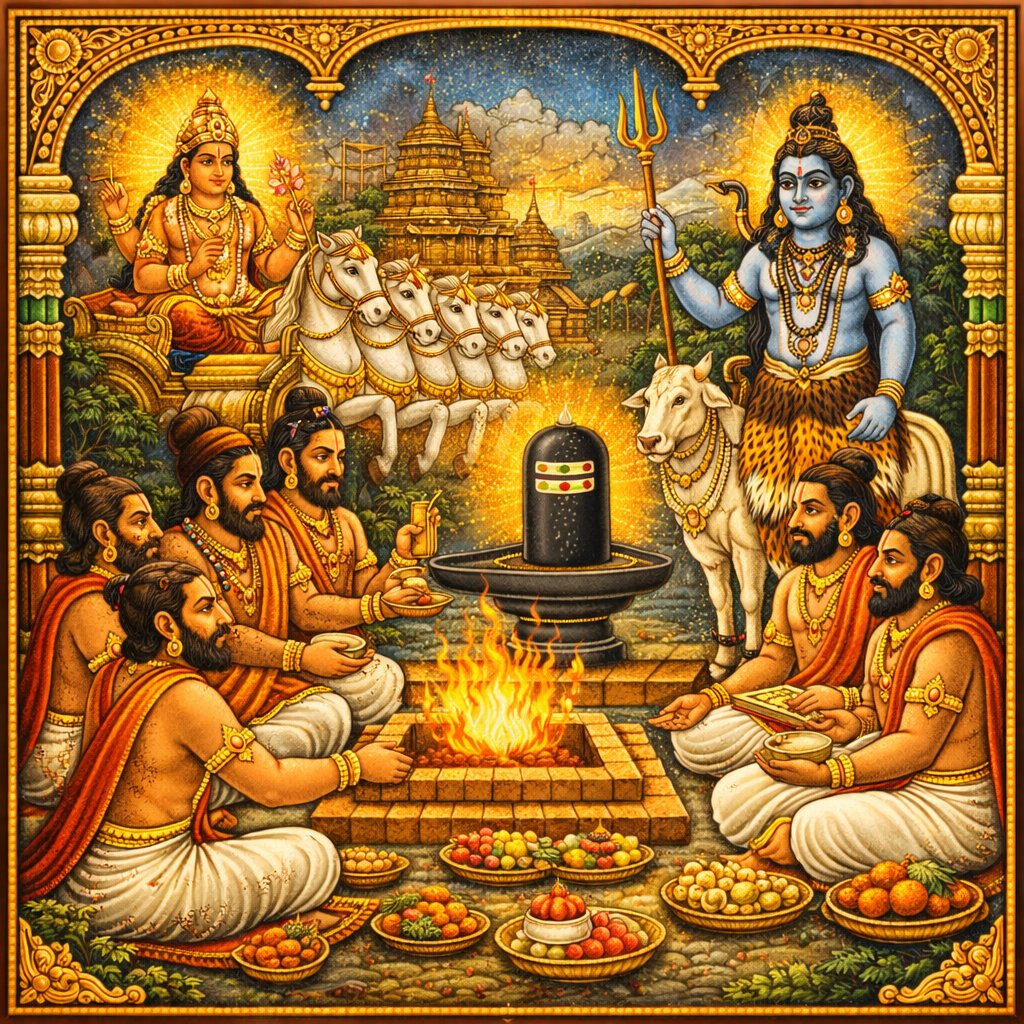
Vastu-Pratishtha & Isana-kalpa
Temple Architecture & Sacred Installation
Detailed prescriptions for temple construction (vastu-shastra), deity installation (pratishtha), and the Isana-kalpa rituals for sanctification.
Adhyayas in Vastu-Pratishtha & Isana-kalpa
Adhyaya 43
Chapter 43 — प्रासाददेवतास्थापनम् (Installation of Deities in a Temple)
Lord Agni teaches that a temple becomes ritually effective through proper deity-sthāpana (installation) and correct icon preparation. It begins with pañcāyatana placement: Vāsudeva/Nārāyaṇa at the center, with deities assigned to directions—Vāmana in Āgneya, Nṛhari (Nṛsiṃha) in Nairṛti, Hayagrīva in Vāyavya, Varāha in Īśāna—along with alternate layouts such as navadhāma, wider arrays (lokapālas, grahas, Daśāvatāra sets), and a thirteen-shrine scheme centered on Viśvarūpa-Hari. The chapter then treats pratimā-lakṣaṇa, listing acceptable media (clay, wood, metal, jewels, stone, fragrant substances, flowers) and affirming that timely worship yields desired fruits. Detailed rules for selecting stone follow, including varṇa-linked colors and a remedial substitution using Siṃha-vidyā when ideal stone is unavailable. Finally it outlines pre-carving consecrations: securing forest land, Vrajayāga, bali offerings, tool-worship, sprinkling with the Astra-mantra, Nṛsiṃha protection, pūrṇāhuti, bhūta-bali, appeasing or relocating local beings, dream-mantra diagnosis, and the artisan’s identification with Viṣṇu/Viśvakarman before transporting and ritually honoring the stone blank in the workshop.
Adhyaya 44
Vāsudevādi-pratimā-lakṣaṇa-vidhiḥ (Iconographic and Iconometric Procedure for Vāsudeva and the Vyūha Forms)
This chapter shifts from pacificatory rites to the technical yet devotional science of Pratimā-lakṣaṇa for Vāsudeva and the allied Vyūha forms. It opens with placement rules: icons are to be installed to the north of the temple, facing east or north, aligning iconography with Vāstu-based spatial dharma. After installation and bali offerings, the central marking slab is divided into nine, and measurements are set through aṅgula units (svāṅgula, golaka/kālanetra) and tāla canons. A detailed proportional grid is then given for crown, face, neck, chest, abdomen, thighs, shanks, and feet, along with dense facial and limb metrics—eyes, brows, nose, ears, lips, head-circumference, arm and forearm lengths, palm and finger joints, waist and leg girths. Ornamentation standards are included, and the chapter concludes with identifying emblems: chakra and padma on the right, śaṅkha and gadā on the left, plus attendant figures (Śrī, Puṣṭi, Vidyādharas) and halo/pedestal specifications. The result is a complete iconometric blueprint meant to sustain correct worship and dharmic presence.
Adhyaya 45
Chapter 45 — Piṇḍikā-Lakṣaṇa (Characteristics and Measurements of the Pedestal/Plinth)
Bhagavān Agni opens a technical yet ritually charged teaching on piṇḍikā-lakṣaṇa, treating the pedestal/plinth as essential for proper installation and iconographic correctness. He sets key proportional canons: the piṇḍikā’s length equals the image, its height is half the image, and its construction follows sixty-four puṭa (courses/layers), marking a standardized architectural grammar. The chapter then gives procedural rules—leaving specified blank bands/lines, forming and purifying the koṣṭhaka (compartment/cell), and maintaining symmetry on both sides—expressing the vāstu principle that purity, evenness, and measured segmentation yield auspiciousness and durability. Later verses extend measurement to iconographic detail using traditional units (yava, gola, aṃśa, kalā, tāla, aṅgula), prescribing proportions for facial features and bodily breadths and linking the auspicious result with Lakṣmī. It concludes with compositional elements—personified wealth, attendant women with cāmara, Garuḍa, and emblems such as the cakra—showing pedestal, icon, and entourage as one consecration-ready sacred ensemble within Isāna-kalpa praxis.
Adhyaya 46
Chapter 46 — शालग्रामादिमूर्तिलक्षणकथनं (Exposition of the Characteristics of Śālagrāma and Other Sacred Forms)
Continuing the Vāstu–Pratiṣṭhā and Īśāna-kalpa stream, Lord Agni expounds Pratimā-Lakṣaṇa through a diagnostic reading of Śālagrāma (sacred stone forms) and allied mūrti-signatures. These forms are framed as bhukti-mukti-pradā—bestowing worldly well-being while guiding the devotee toward liberation—thus placing iconographic taxonomy within soteriology. A sequence of divine identifications (Vāsudeva, Saṅkarṣaṇa, Pradyumna, Aniruddha, Nārāyaṇa, Viṣṇu, Narasiṃha, Varāha, Kūrma, Hayagrīva, Vaikuṇṭha, Matsya, Śrīdhara, Vāmana, Trivikrama, Ananta, Sudarśana, Lakṣmī-Nārāyaṇa, Acyuta, Janārdana, Puruṣottama) is mapped to observable markers—cakra counts, hue, lines (rekhā), dots (bindu), perforations (chidra/śuṣira), whorls (āvarta), and emblem-shapes such as gadā-ākṛti. The chapter is both liturgical and classificatory: correct recognition supports correct worship and consecratory handling, aligning sacred material media with dharmic intention.
Adhyaya 47
Chapter 47 — शालग्रामादिपूजाकथनं (Teaching the Worship of Śālagrāma and Related Sacred Forms)
Bhagavān Agni sets forth a structured ritual science for worship of Śālagrāma and cakra-marked forms of Hari, classifying worship as kāmya (desire-motivated), akāmya (obligatory/desireless), and mixed (ubhayātmikā). He links specific form-classes (beginning with Mīna) to intended results, notes emblematic signs such as a cakra with a subtle bindu, and connects worship to liberative aims associated with Varāha, Narasiṃha, and Vāmana. The chapter then turns from taxonomy to procedure: mandala geometry (a cakrābja within a square; later sixteen-spoked and eight-petalled designs), installation of the praṇava in the heart, ṣaḍaṅga-nyāsa on hands and body, and the proper sequence of mudrās. Directional worship is laid out as a protective perimeter—Guru, Gaṇa, Dhātṛ, Vidhātṛ/Kartṛ/Hartṛ, Viśvaksena, and Kṣetrapāla—followed by establishing Vedic supports, cosmic layers (ādhāra-anantaka, bhū, pīṭha, padma), and solar-lunar-fire mandalas. It stresses that without first honoring Viśvaksena/Cakra/Kṣetrapāla, Śālagrāma worship becomes “fruitless,” affirming that āgamic correctness joined to inner disposition is the basis of siddhi and dharmic efficacy.
Adhyaya 48
Chapter 48 — Account of the Hymn to the Twenty-Four Forms (Caturviṁśati-mūrti-stotra-kathana)
In the Vāstu-pratiṣṭhā and Īśāna-kalpa setting, Lord Agni (speaking as Bhagavān in the transmitted frame) enumerates the twenty-four Vaiṣṇava forms beginning with Keśava and Nārāyaṇa, defining each by the ordered arrangement of divine emblems—padma (lotus), śaṅkha (conch), cakra (discus), and gadā (mace), with occasional mention of Śārṅga and Kaumodakī. The chapter serves as a practical iconographic key (pratimā-lakṣaṇa) and a ritual recitation unit: each name is tied to a recognizable emblem-sequence fit for worship, circumambulation, and protective invocation. It then grounds the theology in the vyūha doctrine (Vāsudeva → Saṅkarṣaṇa → Pradyumna → Aniruddha), aligning mantra-recitation with cosmological emanation. The text concludes by identifying the hymn as a Dvādaśākṣara-linked stotra embodying the twenty-four forms, declaring that recitation or even hearing brings purification and complete attainment—presenting iconographic precision as a sādhanā granting both bhukti (protection, enjoyment, sustenance) and mukti (liberative purity).
Adhyaya 49
Chapter 49 — मत्स्यादिलक्षणवर्णनम् (Description of the Characteristics of Matsya and the Other Incarnations)
Lord Agni (as Bhagavān) presents a technical yet devotional account of pratima-lakṣaṇa—the canonical marks for identifying installable (pratiṣṭhā) images of the Daśāvatāra and related Vaiṣṇava forms within Vāstu and Īśāna-kalpa. The chapter treats each form in turn: Matsya and Kūrma by bodily type; Varāha with earth-lifting iconography, attendants (Kṣmā/Dharā, Ananta, Śrī), and promised worldly and spiritual fruits (sovereignty and crossing saṃsāra). Narasiṃha is defined in a dramatic narrative posture and also as a standard four-armed icon with emblems. Vāmana and multiple Rāma/Balarāma variants are given through weapon-placement schemes. Buddha and Kalki are described by demeanor, attire, and end-time function. The scope then widens to the Vāsudevādi ninefold group and allied forms (Brahmā, Viṣṇu on Garuḍa, Viśvarūpa, a Hayagrīva-like horse-headed Hari, Dattātreya, Viśvaksena), noting manuscript variants that reflect śāstric concern for accurate transmission alongside ritual usability.
Adhyaya 50
Chapter 50 — देवीप्रतिमालक्षणकथनं (Devi-Pratimā-Lakṣaṇa: Characteristics of the Goddess Image)
Agni moves from general pratimā-lakṣaṇa to a technical account of Devī iconography within the Vāstu–Pratiṣṭhā and Īśāna-kalpa sphere. It prescribes Caṇḍī/Durgā’s weapon-sets and arm-counts (twenty-, eighteen-, sixteen-, ten-, and eight-armed forms) and places her worship in a navapadma (nine-lotus) maṇḍala with tattva-ordered placements. The chapter then broadens the iconographic world around Devī: fierce named forms such as Rudracaṇḍā, classifications by color and gait, installation aims (progeny and prosperity), and attendant deities including Lakṣmī, Sarasvatī, Gaṅgā (Jāhnavī), Yamunā, and Mātṛkā-like powers. It also gives proportional and measurement canons for Vināyaka (notably trunk length in aṅgulas and kalā/nāḍī metrics) and notes on Skanda and related forms. It culminates with fierce protective deities and gaṇas—Cāmuṇḍā variants, Bhairavī, Ambāṣṭaka, and Ghantakarṇa—linking precise form to ritual efficacy, protection, siddhi, and the proper fruits of consecration.
Adhyaya 51
अध्याय ५१: सूर्यादिप्रतिमालक्षणम् (Characteristics of the Images of Sūrya and Others)
Continuing from the prior chapter on Devī images, Lord Agni describes Sūrya and the divine arrangements essential for temple installation and āvaraṇa design. He prescribes Sūrya’s canonical chariot form—seven horses, a single wheel, lotus emblems and auxiliary implements—along with threshold/side attendants (such as Piṅgala with a staff, fan-bearers) and a consort termed “niṣprabhā” (lusterless), reflecting a specific ritual-aesthetic convention. An alternate form depicts Sūrya mounted on a horse, granting boons and holding lotuses. The teaching then expands to the cosmic perimeter: Dikpālas and intermediate-direction deities are placed in ordered positions (notably on a lotus with a specified petal structure), each with distinct weapons and attributes. The chapter lists solar names and aspects, zodiacal/monthly stations, and varied color-types, integrating mantra/nyāsa logic with visual form. It proceeds to Navagraha iconography (Moon through Ketu) and includes nāga lists and protective/liminal beings—kinnaras, vidyādharas, piśācas, vetālas, kṣetrapālas, pretas—showing how sacred space is completed by a full hierarchy of beneficent, regulatory, and apotropaic figures.
Adhyaya 52
Chapter 52: देवीप्रतिमालक्षणं (Devī-pratimā-lakṣaṇa) — Characteristics of Goddess Images
Continuing the Pratimā-lakṣaṇa sequence, Lord Agni announces a systematic teaching on Yoginī-groups in an “eight-and-eight” (aṣṭāṣṭaka) series, from the Aindrī set through the pacifying Śāntā set. The chapter then lists many Yoginī/Devī epithets and power-names, preserving manuscript-variant traditions on weapons and iconographic particulars. After the name-catalogues it turns to prescription: attendant goddesses should be shown with four or eight arms, bearing chosen weapons and bestowing siddhis. Bhairava’s form is defined in detail—fierce demeanor, matted jaṭā with a lunar emblem, and a full armament of sword, goad (aṅkuśa), axe (paraśu), bow, trident, khaṭvāṅga, and noose (pāśa), together with the varada boon-giving gesture. Ritual instructions follow, emphasizing aviloma (reverse) sequencing up to Agni, mantra division, and ṣaḍaṅga application. The chapter concludes with focused iconographic templates for Vīrabhadra, Gaurī/Lalitā, and a vivid Caṇḍikā mounted on a lion, striking down a buffalo with her trident—uniting theology, image-science, and installation-ritual into a single Āgamic blueprint.
Adhyaya 53
Chapter 53 — Liṅga-lakṣaṇa (Characteristics and Proportions of the Śiva-liṅga and Piṇḍikā)
In this chapter, Bhagavān instructs the Lotus-born (Brahmā) in the technical and ritual geometry (māna, rekha, vibhāga) required to fashion a Śiva-liṅga and its pedestal (piṇḍikā/pīṭha) for Vāstu-Pratiṣṭhā and Īśāna-kalpa. The teaching moves from abstract proportional rules—dividing length and breadth into prescribed parts and steps (krama)—to progressively refined forms: square-based layouts and multi-angled faceting (8, 16, 32, 64), culminating in circular perfection. It specifies the umbrella-like contour of the liṅga’s head, the proportional relation of height to diameter, and the division of Brahmā- and Rudra-associated zones along the central axis (madhya-sūtra). After establishing “general” (sādhāraṇa) characteristics, it sets out universally applicable construction of the base: pīṭha elevation, central recess (khāta), mekhalā band, ornamental members (vikārāṅga), and the praṇāla water outlet placed to the north. Manuscript variants are noted, reflecting a living technical transmission. Overall, the chapter exemplifies Agneya Vidyā’s method: precise architectural science presented as a dharmic act enabling stable worship and consecrated presence.
Adhyaya 54
Liṅga-māna-ādi-kathana (Measurements and Related Particulars of the Liṅga)
Lord Agni continues the Pratiṣṭhā-focused teaching, moving from general liṅga-lakṣaṇa to a technical canon of dravya (materials), māna (measure), and vidhi (procedure). The chapter first ranks liṅgas by substance—from cloth and clay (baked preferred) through wood and stone to metals and precious media (pearl, iron, gold; also silver, copper, brass, tin, and rasa-liṅga)—and explicitly links certain materials with bhukti–mukti results. It then sets out placement logic and modular measurement: household liṅgas are scaled in aṅgulas (1–5), while shrine worship uses ratios derived from the doorway and garbha-gṛha, forming a taxonomy of measures (36×3 and their synthesis into 108). Portable (cala) classes are defined (1–5, 6–10, 11–15 aṅgulas), along with proportional “sūtra” (cord/guide-line) systems and hasta-based expansions. The latter half turns to iconometric geometry and auspicious diagnostics (remaining aṅgulas as omens; dhvaja/siṃha/vṛṣa classes; auspiciousness by svara), then enumerates structural forms and sectional theology (Brahmā–Viṣṇu–Śiva distribution), culminating in mukha-liṅga and head-form typologies with proportional directives for facial features and projections.
Adhyaya 55
Chapter 55 — Piṇḍikā-lakṣaṇa-kathana (Defining Features of the Pedestal/Base for Icons)
Continuing the Vāstu–Pratiṣṭhā and Īśāna-kalpa stream, Lord Agni moves from the prior chapter’s metaphysical frame (manifest and unmanifest) into precise rules for icon-installation. He defines the piṇḍikā (pedestal/base) by proportion: its length is set in relation to the image, while breadth and the mekhalā banding follow fractional measures. He then prescribes foundation practice—pit dimensions, a slight northern slope, and the praṇāla (drainage spout) exit-point—showing how ritual purity is safeguarded through water-management design. The chapter standardizes layered height divisions (a sixteen-part scheme) and details component segmentation for the lower, middle, and neck portions. It extends these norms to “common” images, links shrine-door proportion to the temple-door measure, and directs prabhā ornamentation with gaja and vyālaka motifs. Finally, it universalizes iconometric standards: male deities follow the Śiṣṇu/Hari measure and goddesses follow Lakṣmī’s measure, ensuring śobha (aesthetic harmony) as a dharmic requirement.
Adhyaya 56
Chapter 56 — दिक्पालयागकथनम् (Account of the Worship of the Guardians of the Directions)
Bhagavān explains the pratiṣṭhā-pañcaka by mapping icon, pedestal-base, and consecration into a metaphysical triad: the pratimā is ensouled by Puruṣa, the piṇḍikā corresponds to Prakṛti, and Lakṣmī signifies the stabilizing act of pratiṣṭhā; their conjunction is called yogaka. The rite begins for wish-fulfillment (iṣṭa-phala) and proceeds through spatial and architectural preliminaries: drawing the garbha-sūtra axis, classifying and measuring the maṇḍapa, arranging snāna and kalaśa functions, and preparing yāga-dravyas. The altar (vedī) is set by proportion (one-third/one-half measures), adorned with kalaśas, ghaṭikās, and canopies, and all materials are purified with pañcagavya. The guru self-consecrates by meditating on Viṣṇu and worshipping the self as the ritual locus, while qualified mūrtipās are installed at each kuṇḍa. Gateways (toraṇas) and posts are assigned woods by direction; the setup includes mantra-worship (“syonā pṛthvī”), sprouts at pillar-bases, the Sudarśana emblem, banner rules, and extensive kalaśa placement. Finally, the dikpālas are invoked into pots and worshipped in order—Indra (east), Agni (southeast), Yama (south), Nairṛta, Varuṇa (west), Vāyu (northwest), Soma/Kubera (north), Īśāna (northeast), Brahman for the zenith, and Ananta for the nadir—each charged to guard the corresponding gate and quarter, sealing the ritual space as a protected cosmic mandala.
Adhyaya 57
Chapter 57 — कुम्भाधिवासविधिः (Kumbhādhivāsa-vidhi: Rite of Installing/Consecrating the Ritual Jar)
Lord Agni sets forth a stepwise Āgamic procedure for preparing the ritual ground and installing the kalaśa(s) used for abhiṣeka in Vāstu-Pratiṣṭhā. It begins with bhūmi-parigraha (ritual taking of the site), protective scattering of rice and mustard, and rākṣoghna purification through the Nārasiṃha-mantra and pañcagavya sprinklings. Worship then moves from the ground to the pot, to Hari with aṅga-rites, and to auxiliary vessels by the Astra-mantra, stressing unbroken consecratory flow (acchinna-dhārā) and circumambulation. A śayyā (bed) is installed within the maṇḍala with the “yoge yoge” mantra; Viṣṇu forms are assigned by direction in the snāna-maṇḍapa, with Īśāna given special placement. Multiple kumbhas are set for bathing and anointing, and a detailed inventory of leaves, woods, clays, herbs, grains, metals, gems, waters, and lamps is arranged by prescribed directions for arghya, pādya, ācamana, nīrājana, and related offerings. The chapter exemplifies Agneya Vidyā as ritual engineering, stabilizing sacred presence through calibrated substances, spatial order, mantra, and sequence.
Adhyaya 58
Chapter 58 — स्नानादिविधिः (Snānādi-vidhiḥ): Rules for Ritual Bathing and Related Consecration Rites
Continuing the Vāstu–Pratiṣṭhā sequence after kalaśādhivāsa, Lord Agni teaches the snānādi (snapana and ancillary) protocol that transforms an artisan-made icon into an awakened, purified presence fit for public worship. The ācārya kindles a Vaiṣṇava fire in the Īśāna (north-east) quarter, performs intensive Gāyatrī homa, and consecrates the kalaśa jars by sampāta; purification extends to the workshop and the ritual party, with music and the protective kautuka bound on the right hand (including for the deśika). The icon is installed, praised, and entreated to be free of śilpi-doṣa, then led to the bathing pavilion for netronmīlana (“opening of the eyes”) with prescribed mantras and offerings. A detailed snapana follows—anointing, rubbing, warm-water washing, sprinkling, and bathing with river/tīrtha waters, fragrant substances, herbs, pañcagavya, and multiple mantra-frames—culminating in Viṣṇu’s invocation with many kalaśas. The rite proceeds to kautuka-mocana, madhuparka, pavitraka preparation, and a full suite of upacāras (incense, añjana, tilaka, garlands, royal insignia), concluding with procession and aṣṭamaṅgala arrangements, applicable also to other deities (including Hara) and specifying snapana placement such as the “Nidrā” pot at the head-region.
Adhyaya 59
Chapter 59 — अधिवासनकथनं (Adhivāsana: The Rite of Inviting and Stabilizing Hari’s Presence)
Chapter 59 defines adhivāsana as the ritual procedure that brings about and stabilizes Hari’s (Viṣṇu’s) presence for installation rites. Agni begins with inner discipline: the officiant yokes awareness to Oṁ, recenters consciousness, and performs a graded laya (re-absorption)—earth into wind, wind into space, space into mind, mind into ahaṅkāra, ahaṅkāra into mahat, and mahat into the unmanifest (avyakta), known as Vāsudeva, pure knowledge. The chapter then reverses into creation-mapping (Vyūha/cosmogenesis), listing tanmātras, senses, organs of action, and the gross body so the cosmos may be ritually “rebuilt” as a consecrated body. It teaches detailed mantra-nyāsa assigning bīja syllables to tattvas and body-loci, followed by Vaiṣṇava name-nyāsa (Keśava–Dāmodara) and ṣaḍaṅga-nyāsa. A mandala sequence (twelve-spoked cakra, solar and lunar kalās, retinue worship) culminates in installing Hari in the icon, kindling the Vaiṣṇava fire, performing homa and śānti rites, establishing sacred rivers, feeding brāhmaṇas, offering bali to the dikpatis, and keeping a night vigil with sacred recitation—thus consecrating every portion of the rite through adhivāsana.
Adhyaya 60
Chapter 60 — वासुदेवप्रतिष्ठादिविधिः (Procedure for the Installation of Vāsudeva and Related Rites)
Agni sets forth a stepwise consecration manual (pratiṣṭhā-vidhi) centered on Vāsudeva/Hari. It begins with the spatial canon: the garbhagṛha is divided into seven sectors, and the image is established in the Brahmā-bhāga while honoring the allotted shares of gods, humans, and spirit-beings. The rite proceeds through piṇḍikā-sthāpana and, when required, ratna-nyāsa, linked with Narasiṃha oblations, varṇa-nyāsa, and the depositing of offerings (rice, gems, tridhātu, metals, sandalwood) into nine directional pits with Indra-ādi mantras, encircled by guggulu. A homa-square (khaṇḍila) is prepared; kalaśas are set in eight directions; fire is invoked with an eight-syllabled formula; Gāyatrī-led offerings culminate in pūrṇāhuti and śāntyudaka poured upon the deity’s head. The image is then conveyed in brahma-yāna, processed to the temple with song and Vedic sound, bathed with eight auspicious pots, and fixed at an auspicious lagna upon the pedestal with salutation to Trivikrama. The chapter culminates in inner theology as ritual: jīva-āvāhana and sānnidhya-karaṇa mark the descent of consciousness into the bimba, followed by installation of attendant deities, dikpālas, Garuḍa, and Viśvaksena, bali to bhūtas, and the ethics of dakṣiṇā—ending with a rule of standardization: root-mantras differ by deity, but the remaining procedure is shared across consecrations.
Adhyaya 61
Chapter 61 — द्वारप्रतिष्ठाध्वजारोहाणादिविधिः (Gateway Installation, Flag Hoisting, and Allied Rites)
This chapter codifies an Agneya Vidyā sequence that links temple building to living ritual power. It opens with concluding purification (avabhṛtha-snānā) and a grid installation of kumbhas in eighty-one positions, completing the mandalization of space before Hari is established. The doorway (dvāra) is then consecrated through offerings, bali, honoring the guru, depositing gold beneath the threshold, and a prescribed homa; guardian deities Caṇḍa–Pracaṇḍa and Śrī/Lakṣmī are placed at key structural points, and Śrī Sūkta worship with dakṣiṇā completes the social-ritual economy. The text turns to hṛt-pratiṣṭhā (heart-installation): a consecrated kumbha containing eight gems, herbs, metals, seeds, iron, and water is animated as prāṇa by Narasiṃha-mantra sampāta and Nārāyaṇa-tattva nyāsa. A hallmark Vāstu-śāstra doctrine follows, contemplating the prāsāda as Puruṣa with architectural members mapped to organs (door as mouth, śukanāśā as nose, praṇāla as lower orifices, sudhā as skin, kalaśa as hair/topknot). The chapter culminates in dhvajarohana, detailing proportions, placement (Īśāna/Vāyavya), banner materials and ornaments, cakra construction (8/12 spokes), layered nyāsa (Sūtrātman in the staff; niṣkala in the flag), and concludes with circumambulation, mantras, gifts, and the royal merit of banner-dāna.
Adhyaya 62
Chapter 62 — Lakṣmīpratiṣṭhāvidhiḥ (The Procedure for Installing Lakṣmī)
Lord Agni instructs Vasiṣṭha in an integrated (samudāyena) sequence of deity-installation, beginning with Lakṣmī and extending to the full assemblage of goddesses. After the pavilion and ablution preliminaries, Śrī is placed on a bhadra-seat and eight kalaśas are set up. Consecration proceeds by anointing and pañcagavya bathing, netronmīlana (opening of the eyes), and offerings such as madhuratraya, with manuscript variants noted for certain ritual phrases and placements. Directional sprinklings follow with distinct mantras for each quarter, culminating in an Īśāna-focused head-bath measured as eighty-one pitchers, after which the water is released to the earth. The rite is intensified through consecrated fragrance and flowers, identity/absorption via tanmayāvaha, and recitation of the ‘Ānanda’ ṛk. Presence is stabilized by Śāyantīya nyāsa on the bed, Śrī-sūkta for sānnidhya, and Lakṣmī-bīja to awaken cicchakti, followed by homa offerings (lotus or karavīra) in prescribed counts. The chapter closes with consecration of implements and temple, piṇḍikā formation, verse-by-verse Śrī-sūkta recitation, guru/brāhmaṇa dāna, and meditation on fruits such as heaven—showing ritual precision as a technology of auspiciousness and dharma.
Adhyaya 63
Chapter 63 — सुदर्शनचक्रादिप्रतिष्ठाकथनं (Procedure for Consecrating the Sudarśana Discus and Other Divine Emblems)
Bhagavān Agni extends Viṣṇu-pratiṣṭhā procedure to allied forms and emblems—Tārkṣya (Garuḍa), Sudarśana, Brahmā, and Narasiṃha—stating that each installation is done “as in the case of Viṣṇu,” yet enlivened by its own mantra. The chapter first gives a forceful Sudarśana-mantra for protection and combat, portraying the discus as śānta to the righteous and bhayaṅkara to the wicked, able to consume hostile spirits and counter inimical mantras. It then teaches an expansive Narasiṃha-vidyā called Pātāla, aimed at subduing netherworld/asuric powers and dissolving doubt and calamity through Hari’s fierce form. Iconographic rules follow for Trailokya-mohana, installed with corresponding “Trilokya-mohana” mantras, with specified attributes (mace; two or four arms) and an ensemble including chakra and Pāñcajanya, along with Śrī–Puṣṭi and Bala–Bhadrā. The scope widens to installations of many Viṣṇu-forms and avatāras, plus syncretic Śaiva-Śākta figures (Liṅga as Rudra-mūrti, Ardhanārīśvara, Hari-Śaṅkara, Mātṛkās) and solar/planetary deities with Vināyaka. The latter half uniquely details pustaka-pratiṣṭhā (book consecration): svastika-maṇḍala worship, honoring writing tools and manuscript, Nāgarī script, precious stylus/casket protocol, Īśāna-facing seating, mirror-darśana, sprinkling, “opening of eyes,” nyāsa (Pauruṣa-sūkta), enlivening (sajīvīkaraṇa), homa, procession, and continued veneration at recitation boundaries. It culminates by exalting vidyā-dāna (gifting manuscripts) as inexhaustible merit, ranking Sarasvatī/learning among supreme gifts and linking lasting merit to the manuscript’s material extent (leaves/letters), fusing ritual technology, iconography, and textual transmission into one dharmic economy.
Adhyaya 64
Chapter 64 — कूपादिप्रतिष्ठाकथनं (The Account of the Consecration of Wells and Other Water-Works)
Agni teaches Vasiṣṭha a Varuṇa-centered pratiṣṭhā for water-works—wells, stepwells, ponds, and tanks—honoring water as the living presence of Hari (Viṣṇu), Soma, and Varuṇa. It first prescribes a Varuṇa icon (gold/silver/gem) with dhyāna-lakṣaṇa: two-armed, swan-seated, granting abhaya and holding the nāga-pāśa; then lays out the ritual setting—maṇḍapa, vedi, kuṇḍa, toraṇa, and the vāruṇa-kumbha. A calibrated eight-kumbha scheme assigns waters to directions (ocean, Gaṅgā, rain, springs, rivers, plant-drawn water, tīrtha water), with fallback rules and mantra consecrations. The rite proceeds through purification, netronmīlana, abhiṣeka, offerings (madhuparka, vastra, pavitra), adhi-vāsa, and sajīvakaraṇa, supported by homa sequences, bali to the ten directions, and śānti-toya. Finally, the installation is anchored by a central yūpa/marker set in the water body with measures for each reservoir, followed by jagacchānti, dakṣiṇā, feeding, and a strong dharma teaching that free, unrestricted gifting of water yields merit surpassing great sacrifices.
Adhyaya 65
Chapter 65 — सभास्थापनकथनं (Account of Establishing an Assembly-hall)
Lord Agni opens the teaching on sabhā-sthāpana by grounding construction in ritual legitimacy: after examining the site, the patron must perform the Vāstu-yāga, aligning the ground with cosmic order before any social or political use begins. He then gives practical siting rules—an assembly hall should stand at a village four-road junction or at the village edge, not in a deserted place—so civic life remains accessible and protected. Ethics and design are joined: one may build according to means, but spending beyond one’s capacity is a doṣa; the preferred layout is the defect-free catuḥśāla, while triśāla/dviśāla/ekaśāla are assessed conditionally with directional cautions. Technical-ritual method appears through ‘kararāśi’ computations, divisions by eight, interpretive schemes attributed to Garga’s science, and direction-based omen reading (banner, smoke, lion, and the like). The chapter closes by moving from building to inhabiting: communal permissions, dawn purification with a herb-bath, feeding brāhmaṇas, auspicious adornments, and a prosperity-mantra invoking Nandā, Vāśiṣṭhī, Jayā, Pūrṇā, Bhadrā, Kāśyapī, Bhārgavī, and Iṣṭakā—seeking stability, increase of wealth, people, and livestock, and the successful pratiṣṭhā of the dwelling and sacred brick.
Adhyaya 66
Chapter 66: साधारणप्रतिष्ठाविधानम् (The Procedure for General Consecration)
Agni sets forth a standardized sādhāraṇa (general) consecration rite usable for many deities and sacred establishments, from individual installations to communal (samūha) consecrations on the Vāsudeva model. It opens with an invocation sequence—Ādityas, Vasus, Rudras, Sādhyas, Viśvedevas, Aśvins, and Ṛṣis—then explains mantra formation: extracting a bīja from the deity’s name by phonetic segmentation according to mātrā (quantity) and long elements, and completing it with bindu, praṇava (Oṁ), and a reverential formula. Agni then details the ritual order: preparatory fasting on the monthly Dvādaśī, arranging ritual bases and vessels, cooking barley caru with kapilā-cow milk while reciting “tad viṣṇoḥ,” consecrating with Oṁ, and performing a homa cycle with vyāhṛtis, Gāyatrī, and deity-specific offerings to Sūrya, Prajāpati, Antarikṣa, Dyauḥ, Brahmā, Pṛthivī, Soma, and Indra. The rite extends to planetary and cosmic powers (grahas, lokapālas, mountains, rivers, oceans) and concludes with pūrṇāhuti, release of vows, dakṣiṇā, feeding Brahmins, and merit statements linking gifts (maṭha, prapā, house, roads/bridges) to heavenly rewards—showing the Agni Purana’s characteristic fusion of Vāstu, ritual, and social Dharma.
Adhyaya 67
Jīrṇoddhāra-vidhāna (Procedure for Renovation / Replacement of Dilapidated Installations)
Continuing the teaching on collective consecration, Lord Agni instructs Sage Vasiṣṭha on jīrṇoddhāra—the proper procedure for dealing with sacred images and installations that are worn, defective, or broken. The rite begins by preparing and bathing the adorned image, then deciding whether it should be retained (if stable/immovable and fit for service) or discarded (if excessively decayed). When replacement is required, the officiating ācārya installs the substitute “as before” and performs saṃhāra-vidhi, ritually withdrawing the tattvas (constitutive principles) from the old form back into their source. Disposal is prescribed by material: wooden forms are split and consigned to fire, stone forms are cast into water, and metal or gem forms are respectfully carried away on a conveyance, covered with cloth. The process concludes with Nārasiṃha-mantra oblations, musical accompaniment for water-offerings, and suitable dakṣiṇā to the guru, stressing that correct measures and materials must be fixed on the same day. Renovation of public waterworks—wells, ponds, and tanks—is singled out as yielding great religious merit, linking civic infrastructure to sacred duty.
Adhyaya 68
Chapter 68 — यात्रोत्सवविधिकथनं (Account of the Procedure for the Processional Festival / Yātrā-Utsava Vidhi)
Lord Agni tells Vasiṣṭha that a deity’s installation (pratiṣṭhā) is ritually incomplete without an utsava; therefore the yātrā-festival should be held soon after installation—optionally for one, three, or eight nights—and also at calendrical junctions such as solstices and equinoxes. The rite opens with auspicious preliminaries: planting sprouts (aṅkura) in proper vessels with grains and legumes, then making directional bali-offerings and performing a lamp-lit night circumambulation of the town, extending the temple’s sanctity into civic space. The guru formally seeks the deity’s leave to begin a tīrtha-yātrā, performs adhivāsana by placing the icon on a svastika within a four-pillared pavilion, and conducts all-night auspicious services—ghee anointing/stream, nīrājana, music, worship, and crownings with sacred powders. The festival-icon is set on a chariot and processed with royal insignia, then installed on a prepared altar for homa offerings and the invocation of sacred tīrthas through Vedic water-formulas. After purification (aghāmarṣaṇa) and bathing rites, the consecrated presence is returned to the temple; the officiating guru is praised as granting both bhukti and mukti through correct utsava performance.
Adhyaya 69
Chapter 69 — स्नानविधानम् (Rules for Ritual Bathing / Snapanotsava-vidhi)
Lord Agni teaches the snapanotsava, an elaborate ceremonial bathing festival held before the temple within consecratory and festive cycles. It begins with dhyāna, arcana, and homa to Hari, completed by pūrṇāhuti. A maṇḍala is prepared in a pavilion, and consecrated kalaśas—adorned with thread and garlands—are installed within a square enclosure divided into Rudra-sections. Offerings are arranged by direction: grains and seeds, sacred waters, fruits, flowers, medicinal herbs, fragrances, and mineral/ratna elements; central pots are assigned for ghee (Indra-set), honey (Agneya-set), sesame oil (Yāmya/south), milk (Nairṛta/southwest), and curd (Saumya/east), showing a systematic navaka layout. Decoctions, sacred earths (mṛttikā), and auspicious sounds (conches) complete the bath’s material and sensory fullness. Bathing is done with the root-mantra, followed by fire-worship, bali to all beings, feeding and dakṣiṇā, and the note that a full snapanotsava may use 1008 kalaśas. The bath is also framed as a preliminary rite for other festivals (such as Gaurī–Lakṣmī weddings), integrating utsava-vidhi with pratishtha purity.
Adhyaya 70
Chapter 70 — वृक्षादिप्रतिष्ठाकथनम् (Consecration of Trees and Related Objects)
In this chapter, Bhagavān teaches a structured pratiṣṭhā-vidhi for trees (vṛkṣa/vanaspati) and garden spaces, explicitly promising both bhukti and mukti through the sacralization of living vegetation. The rite begins with unction using medicinally infused water and ornamentation with garlands and cloth-wrapping, followed by a symbolic kārṇavedha (ear-piercing) with a golden needle and the application of añjana with a golden implement. The altar sequence prescribes adhivāsa of seven fruits and bali offerings for each ghaṭa, then adhivāsa for Indra and other deities and a homa to Vanaspati. A distinctive act—releasing a cow from the middle of the tree—precedes abhiṣeka performed with the prescribed abhiṣeka-mantras. Snāpana is carried out with Ṛg/Yajur/Sāma mantras, Varuṇa-mantras, auspicious sounds, and kumbhas arranged on a wooden vedikā. The chapter also defines yajamāna support, dakṣiṇā (cows, land, ornaments, garments), four-day milk-based feeding, homa with sesame and palāśa fuel, doubled honorarium to the ācārya, and concludes that consecrating tree-groves destroys sin and brings spiritual consummation, transitioning toward further consecrations of Hari’s retinue.
Adhyaya 71
Gaṇeśa-pūjā-vidhiḥ (The Procedure for Worship of Gaṇeśa)
In the Vāstu-Pratiṣṭhā and Īśāna-kalpa setting, Īśvara sets forth a Gaṇeśa-worship procedure to secure nirvighnatā (freedom from obstacles) before undertaking major rites. It begins with mantra-nyāsa, placing Gaṇapati’s epithets upon bodily loci (hṛdaya, śiras, śikhā, varma, netra, astra) to consecrate the practitioner’s body as a ritual instrument. The worship then unfolds around a mandala, honoring Gaṇa, the Guru and pādukā, Śakti and Ananta, Dharma, and the diagram’s structural layers (the principal “bone-circle” with upper and lower coverings), thus integrating lineage, power, cosmic support, and order. Goddess-forms—Padmakarṇikā-bījā, Jvālinī, Nandayā, Sūryeśā, Kāmarūpā, Udayā, Kāmavartinī—are invoked, followed by notes on textual variants and a brief mapping of bīja phonemes to elemental functions used in ritual preparation. The chapter concludes with a Gaṇapati gāyatrī and a litany of Gaṇeśa’s names, emphasizing him as Vighnanāśaka for successful pratiṣṭhā and dharmic accomplishment.
Adhyaya 72
Chapter 72 — स्नानविशेषादिकथनम् (Special Rules of Bathing, Mantra-Purification, and Sandhyā)
This chapter (in the Vāstu-Pratiṣṭhā & Īśāna-kalpa stream) establishes ritual purification as the technical basis of worship and consecration. The Lord teaches Skanda daily and occasional bathing (snāna), beginning with ritual use of earth/clay (mṛd) purified by the astra-mantra, then a sequence of bodily washing with grass divisions, breath-restraint and immersion, remembrance of the hṛdyāstra, and post-bath purification, followed by Astra-sandhyā and vidhisnāna. It further describes mudrā-governed acts (aṅkuśa, saṃhāra), directional projection of mantra, and Śiva-centered cooling and auspicious recitations applied from head to feet, including the closing of sensory apertures (sammukhīkaraṇa). Specialized baths (Agneya, Māhendra, mantra-snāna, mānasa-snānā) and situational purifications (after sleep, food, contact) are mapped. The Sandhyā-vidhi follows: ācamana, prāṇāyāma, mental japa, deity-meditations for morning/midday/evening, a fourth “witness” sandhyā for knowers, and an esoteric inner sandhyā. Finally, it details hand-tīrthas, mārjana and aghamarṣaṇa, arghya and Gāyatrī-japa, and a structured tarpaṇa sequence to deities, ṛṣis, pitṛs, directions, and protective beings—affirming purity as the gateway to successful pratiṣṭhā and Īśāna-oriented worship.
Adhyaya 73
अध्याय ७३: सूर्यपूजाविधिः (Sūrya-pūjā-vidhi — The Procedure for Sun-Worship)
This chapter teaches a structured Sūrya-upāsanā in the Īśāna-kalpa ritual idiom, emphasizing nyāsa, bīja-mantra placements on the body, mudrā rites, and layered protection (rakṣā/avaguṇṭhana). It begins with consecratory placements on hands and limbs and an identity-filled contemplation—“I am Sūrya, made of radiance”—then offers arghya as the chief act of reverence. A red mark/diagram is prepared and worshipped as the ritual locus; materials are sprinkled, and worship proceeds facing east. The rite expands into spatial/protective mapping: Gaṇeśa is worshipped at prescribed points, the Guru is honored in the fire, and the central pedestal/seat is established for the solar form. A lotus-mandala is populated with solar bījas and śaktis (rāṃ, rīṃ, raṃ, rūṃ, reṃ, raiṃ; roṃ, rauṃ), culminating in installing the ṣaḍakṣara solar form on the arkāsana. Invocation mantras (including “Hrāṃ Hrīṃ Saḥ”) accompany vimba-, padma-, and bilva-mudrās; aṅga-nyāsa (heart, head, śikhā, kavaca, netra, astra) is performed with directional assignments. Planetary obeisance is integrated through bīja worship (Soma, Budha, Bṛhaspati, Śukra; plus Mars, Saturn, Rāhu, Ketu). The rite closes with japa, arghya, stuti, a formal request for forgiveness, subtle withdrawal/compaction (saṃhāriṇī upasaṃskṛti), and the claim that through Ravi, japa, dhyāna, and homa become efficacious.
Adhyaya 75
Agnisthāpana-vidhi (Procedure for Establishing the Sacred Fire) and Protective Īśāna-kalpa Homa Sequences
This chapter sets forth a stepwise prayoga for installing and enlivening the sacrificial fire within a regulated ritual enclosure. The officiant approaches the agnyāgāra with the argha vessel, examines the north-facing kuṇḍa, and establishes protection through prokṣaṇa, kuśa-tapping, the astra-mantra, and varma/kavaca safeguards. The kuṇḍa is prepared outwardly (removing excavated earth, filling, leveling, plastering, and drawing lines), while inward preparation proceeds by nyāsa, bīja-dhyāna, and the invocation of Vāgīśvarī and Īśā. Agni is brought from a perpetual source, consecrated and purified, unified as anala-traya, and sealed with dhenu-mudrā and circumambulation. The rite then extends to support household saṃskāras (garbhādhāna, puṃsavana, sīmantonnayana, jātakarma) through prescribed oblation sets and pañcabrahma sequences (Sadyojāta–Īśāna), including vaktra-udghāṭana and vaktra-ekīkaraṇa (unifying the five faces). Finally it details homa measures, the alignment of subtle channels (nāḍī) between yāgāgni and Śiva, and concludes with inner and outer bali offerings to Rudras, Mātṛkās, Gaṇas, Yakṣas, Nāgas, Grahas, Rākṣasas, and Kṣetrapāla, withdrawn by saṃhāra-mudrā for ritual closure and a plea for forgiveness.
Adhyaya 76
Chapter 76 — चण्डपूजाकथनम् (Narration of the Worship of Caṇḍa/Caṇḍeśa)
This chapter sets out an Īśāna-kalpa ritual sequence in a Śaiva-Agamic setting focused on Caṇḍa/Caṇḍeśa. After approaching Śiva, the practitioner performs worship and homa, asking that the rite’s merit be accepted. It emphasizes offering arghya with the udbhava mudrā and a mantra order in which the hṛd-bīja precedes the root-mantra, followed by praise, prostration, and a distinctive arghya offered while turning away with an explicit plea for forgiveness, expressing ritual humility and acknowledgment of faults. Inner yogic-ritual acts then follow: withdrawal of inner energies using an astra-mantra with Nārāca-mudrā ending in phaṭ, and empowerment of the liṅga by mūrti-mantra. Caṇḍa is worshiped through invocation, aṅga/nyāsa-type mantras (heart, head, śikhā, kavaca, astra), and dhyāna describing his form—born of Rudra–Agni, dark-hued, bearing trident and ṭaṅka, with rosary and kamaṇḍalu. The chapter notes manuscript variants for key mantra readings, prescribes proportional japa (aṅgas at one-tenth), restricts certain material gifts, and by Śiva’s command redirects offerings to nirmālya and food remnants. It concludes with a saṃhāra (dissolution) rite using saṃhāra-mudrā and mantra, purification of the disposal area with cow-dung water, disposal of remnants, ācamana, and continuation of remaining rites.
Adhyaya 77
Kapilādipūjāvidhāna — Procedure for Worship Beginning with Kapilā
Īśvara teaches a stepwise household ritual regimen that blends Vāstu-pratiṣṭhā principles with the purity disciplines of Īśāna-kalpa. It begins with worship of Kapilā, the sacred cow, using prescribed mantras and confessional prāyaścitta formulas, honoring her as cosmic Mother and remover of sin. The rite then moves to midday Śiva-upāsanā through the Aṣṭapuṣpikā observance (pedestal-form and Śiva’s limbs/aspects), and to sanctifying cooked food by reciting the Mṛtyuñjaya-mantra and sprinkling darbha-consecrated water. A cullikā-homa follows, interpreted through inner-fire symbolism (nābhi-agni, recaka, vahni-bīja, and letter-position movements), and concludes with offerings, kṣamā (seeking forgiveness), and visarjana (dismissal). The ritual map expands into household Vāstu-bali placements—doorway, mortar/pestle area, broom-space, bedchamber, and central pillar—assigning deities such as Vighnarāja, Kāma, and Skanda. Finally, the chapter codifies disciplined eating (pure vessels, silence, avoidances), prāṇa-upacāras and offerings to subsidiary vāyus, ending with post-meal rinsing and notes on manuscript variants that preserve a living ritual tradition.
Adhyaya 78
Chapter 78 — पवित्रारोहणकथनं (Pavitrārohaṇa: Installing the Sanctifying Thread/Garland)
This chapter inaugurates the Pavitrārohaṇa rite (installing the sanctifying thread/garland), an Agamic completion-practice that “fills” omissions in worship and consecration. The Lord defines two modes (nitya and naimittika) and appoints calendrical windows (Āṣāḍha–Bhādrapada; bright/dark fortnights; the 14th and 8th tithis; or alternatively the Kārttikī observance). It then details materials (gold/silver/copper by yuga; in Kali, cotton/silk/lotus-fibre) and technical rules: thread counts, knot numbers, spacing, measures (aṅgula/hasta), and classes of granthi with named powers (Prakṛti, Pauruṣī, Vīrā, Aparājitā; Jayā/Vijayā, etc.). A full ritual sequence follows—space purification, doorway and dvārapāla worship through kalā-theology, Vāstu and bhūta-śuddhi, kalaśa/vardhanī installations, continuous root-mantra recitation, protective astra, homa series, bali offerings to rudras/kṣetrapālas/dikpālas, and expiatory vidhi-cchidra-pūraṇa to repair ritual breaches. The rite culminates in offering the pavitraka for universal protection—especially for Śiva, the guru, and the sacred text—followed by regulated vigil, purity disciplines, and rest in remembrance of Īśa.
Adhyaya 79
पवित्रारोहणविधिः (The Rite of Raising/Placing the Pavitra)
This chapter teaches the pavitrārohaṇa—the raising/placing of the pavitra (purificatory ring/cord)—as a rite that completes and corrects deficiencies in Vāstu-pratiṣṭhā and Īśāna-kalpa. After morning purity (snāna, sandhyā), the officiant enters the maṇḍapa and sets the pavitras in a clean vessel in the Īśāna (north-east) quarter without dismissing the invoked presence. Following formal dismissals and purification, it unfolds into elaborate naimittika worship of Sūrya (Bhānu/Āditya), gate-deities, dikpālas, Kumbheśa/Īśāna, Śiva, and Agni, culminating in mantra-tarpaṇa, prāyaścitta-homa, 108 oblations, and pūrṇāhuti. The central arc is confession of lapses in mantra, kriyā, and dravya, prayer for completion, and the “Gaṅgā-avatāraka” descent-prayer that gathers all errors into a single thread of divine command. The chapter then prescribes fourfold homas (vyāhṛti and Agni/Soma sequences), offerings to dikpālas with pavitra, guru-pūjā as Śiva-pūjā, feeding of dvijas, and final dismissals/mergings (including nāḍī-yoga internalization), ending with Caṇḍeśvara worship and the assurance that the pavitra-rite requires guru-sannidhi even at a distance.
Adhyaya 80
दमनकारोहणविधिः (Dāmanaka-ārohaṇa-vidhi) — Procedure for Raising/Placing the Dāmanaka Garland
This chapter prescribes an Īśāna (north-east)–oriented ritual for offering and raising/placing the dāmanaka garland within Vāstu-Pratiṣṭhā consecratory worship. It is mythically authorized: Bhairava, born from Hara’s wrath, subdues the gods, and Śiva declares the rite’s unfailing fruit for its performer. The practitioner chooses auspicious tithis (7th or 13th), worships and ritually “awakens” a sacred tree with a Śaiva utterance, formally invites it, and performs adhivāsana in the late afternoon. After worshipping Sūrya, Śaṅkara, and Pāvaka (Agni), the ritual parts (root, head, stalk, leaf, flower, fruit) are placed in exact directions around the deity, with special emphasis on Śiva worship in Īśāna. Morning bathing and Jagannātha worship follow, then damana offerings, añjali-based recitations of Ātmavidyā, Śivātman, and mūla-to-Īśvara mantras, and a concluding prayer to rectify excess/defect and gain the Caitra-month merit leading to heavenly attainment.
Adhyaya 81
Chapter 81 — समयदीक्षाविधानम् (Procedure for Samaya Initiation)
This chapter defines samaya-dīkṣā as an initiation that awakens knowledge in the disciple and grants both bhukti and mukti by cutting the bonds of mala and māyā. It classifies embodied states through kalā-typology (pralaya-ākala; sakala) and distinguishes dīkṣā as nirādhārā (supportless, arising from intense śakti-nipāta) versus sādhārā (with ritual supports), further as savījā (“with seed”) or nirvījā (“seedless”) according to samayācāra and eligibility. It then lays out a rigorous Śaiva-Āgamic rite: obstacle-removal, bhūta-śuddhi, special arghya, pañcagavya, protective astra/kavaca acts, and creative/identity nyāsas culminating in the certainty “Śivo’ham.” Śiva is installed in the maṇḍala, kalaśa, fire, and the disciple, making the rite both outer consecration and inner liberation. Detailed homa procedures follow (offerings and counts, dīpana/tarpaṇa, caru preparation, pūrṇāhuti), along with disciple-guidelines for bhukti versus mukti, purification by mantra-water and ash, pāśa-bheda symbolism, and the final bestowal of śiva-hasta authorizing continued Bhava-worship. The chapter concludes that samaya-dīkṣā makes one fit (yogya) for Śaiva arcana.
Adhyaya 82
अध्याय 82 — संस्कारदीक्षाकथनम् (Saṃskāra-Dīkṣā: Consecratory Initiation)
This chapter closes the account of Samaya-dīkṣā and immediately begins Saṃskāra-dīkṣā as a more transformative consecration. Grounded in Āgamic ritual logic, it invokes Maheśa in the sacrificial fire, performs heart-centered nyāsa, and offers a precisely counted pañcāhuti (five-oblation) sequence to stabilize divine presence. The inner rite intensifies through Astra-mantra consecration—striking the “child” at the heart and visualizing a star-like flash of consciousness—while breath disciplines (recaka, pūraka, kumbhaka) align with the bīja “huṃ” and mudrās (Saṃhāra, Udbhava) to withdraw, install, and seal mantra-energy in the practitioner and then in the disciple’s heart-lotus (karṇikā). It also gives practical diagnostics: homa succeeds with a blazing, smokeless fire and fails with a weak, smoky one, and it lists auspicious fire-signs. Ethical and disciplinary vows follow—non-blasphemy, reverence for śāstra and nirmālya, lifelong worship of Śiva–Agni–Guru, and compassionate giving according to capacity. The rite culminates in making the disciple fit for Āgamic knowledge of fire-offerings, linking initiation, purity, and competence for Vāstu-Pratiṣṭhā and Īśāna-kalpa applications.
Adhyaya 83
Chapter 83 — निर्वाणदीक्षाकथनम् (Description of the Nirvāṇa Initiation)
This chapter moves from Samaya-dīkṣā to Nirvāṇa-dīkṣā, outlining a liberation-oriented initiation within Īśāna-kalpa practice. It begins with mantra-dīpana (activation) of the mūla-mantra and aṅga-nyāsa placements at the heart, head, and mouth, then sets out homa patterns—single or triple oblations, vaṣaṭ/vauṣaṭ endings, and dhruvā formulas—suited to fierce, pacificatory, and prosperity rites. A key ritual device is the consecrated sūtra (thread), contemplated as Suṣumṇā and installed through mudrā-actions (especially Saṃhāra-mudrā), nāḍī operations, and protective avaguṇṭhana. Repeatedly, the aim is to establish sannidhi (divine presence) through triad oblations and use of the hṛdaya-mantra. The chapter then expands into purification and binding procedures involving kalā-pāśa (the noose of kalās), grahaṇa–bandhana (seizing and binding), and tattva-based visualizations, including śāntyatīta contemplations beyond pacification. It concludes with expiatory homas, disciple handling (orientation, bathing, dietary observances), dismissal rites (visarjana, Caṇḍeśa worship), and the closing dīkṣā-adhivāsana (overnight preparatory) observance, uniting technical precision with the stated goal of mokṣa.
Adhyaya 84
अधिवासनं नाम निर्वाणदीक्षायाम् (Adhivāsana in the Nirvāṇa-dīkṣā)
This chapter is the preparatory threshold (adhivāsana) for Nirvāṇa-dīkṣā. It sets the ritual setting and the guru’s purity as prerequisites for initiatory efficacy. Rising before dawn, the guru bathes and performs daily purifications, and keeps sāttvika dietary discipline by avoiding curd, raw meat, intoxicants, and related impurities. Auspicious and inauspicious dream-omens are noted as signs of subtle conditions; adverse signs are pacified through a Ghora-based śānti-homa. The text thus links outer observance (ācāra) with inner readiness, presenting initiation as a convergence of ethics, omen-science, and mantra-ritual technology in the Agni Purāṇa. This adhivāsana frame prepares for the later sequence: entering the yāgālaya, undertaking purifying vidyā, and aligning the practitioner with the rite’s soteriological aim.
Adhyaya 85
Pratiṣṭhā-Kalaśa-Śodhana-Ukti (Instruction on Purifying the Consecration Pitcher) — Chapter 85
This chapter follows the purification of the Nivṛtti-kalā and turns to a technical Isāna-kalpa rite: purifying and activating the consecration water-pot (pratiṣṭhā-kalaśa). Īśvara teaches a sandhāna, a ritual “joining” of pure and impure principles through regulated phonetic measures (short/long) and through stages of sound—nāda, no-sound, and sound’s cessation—thus linking mantra-phonology with tattva-śuddhi. The cosmology is then installed in the consecration-space: the tattvas are contemplated as seated there (including puruṣa as the “twenty-fourth,” completing the full count of twenty-five), together with a prescribed akṣara series. A long catalogue of Rudra-forms and their associated worlds follows, serving as a protective and ontological grid for the pratiṣṭhā. The procedure becomes initiatory: the thread is led into the body, the binding power (pāśa) is separated and transferred into the kumbha by mudrā and breath-control, and Viṣṇu is invoked as the adhikāra-holder to authorize dīkṣā. The chapter ends with expiatory japa, weapon-mantras to cut bonds, homa counts, surrender of entitlement, and final purification through pūrṇāhuti, declaring the pratiṣṭhā “purified.”
Adhyaya 86
Vidyā-viśodhana-vidhāna (Procedure for Purifying Mantra-Vidyā)
Lord Agni (Īśvara) turns from the earlier purification of the consecration kalaśa to the purification of mantra-vidyā within the Nirvāṇa-dīkṣā. He teaches a sandhāna (ritual joining) marked by specific bīja-signs and sets the rite upon a septad of tattvas—rāga, śuddhavidyā, niyati with kalā, kāla, māyā, and avidyā—so it rests on a metaphysical map, not mere technique. The text then gives letter-sets and the count of sacred padāni beginning with the praṇava, along with variant manuscript readings that preserve multiple recitational lineages. Agni next presents a Rudra-cosmology: Vāmadeva as the first Rudra and a succession of names culminating in twenty-five. The ritual science intensifies as two bījas, nāḍīs, and vāyus are named, and sensory objects/guṇas are briefly related to perception. From the heart-region the practitioner performs tāḍana (striking), chedana (cutting), praveśa (insertion), yojana (fixing), and ākarṣaṇa-grahaṇa (drawing and seizing), deposits kalā into the kuṇḍa, invokes Rudra as kāraṇa, and installs the presence into the initiate (child). The chapter concludes with expiatory homa (100 oblations), worship of Rudrāṇī, installation of consciousness into the pāśa-sūtra, a pūrṇāhuti, and the rule that vidyā-purification is done with one’s own bīja—thus completing the vidyā-śodhana.
Adhyaya 87
Śānti-Śodhana-Kathana (Instruction on the Purification of Śānti) — Agni Purāṇa, Adhyāya 87
Continuing the Nirvāṇa-dīkṣā sequence, Lord Īśvara teaches that Vidyā (mantric discipline) must be conjoined with Śānti (the pacificatory rite) according to rule, showing the doctrinal dissolution of the dual principles Bhāveśvara and Sadāśiva within the Śānti-state. The chapter then maps phonemic and cosmic correspondences—especially the letters ha and kṣa—and enumerates Rudra-forms established for the Śānti operation. A twelve-pāda Puruṣa formulation is given as a litany of Śiva’s all-pervasiveness, with ritual supports such as kavaca/mantra pairings, bīja notions, nāḍī and vāyu references, and sense–object correlations. The practitioner is instructed in tāḍana (impulsion), bheda (splitting), praveśa (insertion), and viyojana (separation), followed by internalization and depositing a kalā into the kuṇḍa. The rite includes formal petition (vijñāpanā), installation of caitanya, ‘womb’ implantation into Devī, nyāsa-like applications for bodily generation and purification, loosening and severing pāśa (bondage) through japa and homa, Astra-mantras, fee-offerings (śulka) symbolized by buddhi and ahaṅkāra, and concludes with bestowal of amṛta-bindu and the pūrṇā completion offering—emphasizing purification accomplished without affliction.
Adhyaya 88
Adhyāya 88 — निर्वाणदीक्षाकथनं (Teaching of the Nirvāṇa-Initiation)
Following the purification of the Śānti rite, this chapter teaches the nirvāṇa-dīkṣā within an Īśāna (Śiva) framework. The Lord sets out sandhāna (mantra-linkages) and a Śakti–Śiva tattva orientation, detailing sixteen phonemic varṇas (from a to visarga) and subtle-body correspondences (nāḍīs Kuhū/Śaṅkhinī; vāyus Devadatta/Dhanañjaya). The Śānti-atīta procedure then unfolds: striking and splitting the kalā-pāśa, entering and separating through specific mantra endings (phaḍ/namo), and coordinating mudrā with prāṇāyāma (pūraka–kumbhaka–recaka) to draw the pāśa upward and install fire in the kuṇḍa. Sadāśiva is invoked and worshipped; the disciple is ritually enlivened (caitanya-vibhāga), placed into Devī’s womb-symbolism, and freed through japa and precisely counted homa offerings (25, then 5 and 8). The chapter culminates in adhikāra-samarpana to Sadāśiva, laya practice up to dvādaśānta, sixfold guṇāpadāna, post-rite soothing with amṛta-drops, blessings, and the formal conclusion of the makha.
Adhyaya 89
Teaching of the One-Principle (Ekatattva) Initiation (एकतत्त्वदीक्षाकथनम्)
Lord Agni, speaking to Sage Vasiṣṭha, presents a concise initiation system called Ekatattva-dīkṣā, set forth as a streamlined method within the wider Īśāna-kalpa and pratiṣṭhā setting. The chapter opens by instructing the practitioner to complete preliminary rites in proper sequence, including personally binding the ritual cord (sūtra-bandha). Its central contemplation is to internalize the entire tattva-series—from Kālāgni up to Śiva—within one equal Reality, like gems held together by a single thread. After invoking the deity beginning with Śiva-tattva, the officiant performs the sacramental rites (such as garbhādhāna and related steps) as previously taught, specifically empowered by the root-mantra (mūla-mantra), and includes the formal offering of all due fees (śulka) for ritual completeness. The teaching culminates in granting a “full” transmission bearing the living force of tattva (tattva-vāta), said to be sufficient by one method for the disciple’s attainment of nirvāṇa. The sequence concludes with Śiva-kumbha abhiṣeka, using designated pots for yojanā (ritual arrangement) and sthiratva (stability).
Adhyaya 90
Abhiṣeka-Ādi-Kathana (Consecratory Bathing and Related Rites)
This chapter shifts from the prior topic of initiation to a practical manual on abhiṣeka as a Śaiva rite that empowers the disciple and bestows auspicious prosperity. It begins with Śiva-worship and the ordered placement of nine kumbhas starting from Īśāna (north-east), each linked to symbolic “oceans” such as salt-water, milk, curds, ghee, sugarcane-juice, kādambarī, sweet water, clear water, and whey. A structured installation then follows: eight Vidyeśvaras and Rudra-forms (including Śikhaṇḍin, Śrīkaṇṭha, Tri-mūrta, the One-eyed, the ‘Subtle-named’, and the ‘Infinite’), with Śiva, samudra, and the Śiva-mantra set at the center of a specially built snāna-maṇḍapa functioning as a yāgālaya. The disciple, seated facing east, is purified by nirmañchana with prescribed substances and bathed with kumbha-water while observing ritual restraints; he is then clothed in white and honored with emblems of authority (turban, yogic band, crown, etc.). The rite culminates in formal instruction, prayers to remove obstacles, mantra-cakra worship through five sets of five oblations, ritual marking, and a protective royal abhiṣeka mantra for kings and householders—showing the Agni Purāṇa’s integration of spatial-ritual engineering with soteriological discipline.
Adhyaya 91
Chapter 91 — विविधमन्त्रादिकथनम् (Teaching of Various Mantras and Related Matters)
After completing the prior teaching on abhiṣeka, the chapter links consecration to ongoing worship: amid auspicious instrumental music, the practitioner bathes the deity with pañcagavya and performs pūjā to Śiva, Viṣṇu, Sūrya, and allied deities. It then turns from rite to vidyā, promising merit for direct study of the marked/annotated sacred text, and presenting ritual offerings—especially ghee and sandal—as purifying and status-elevating. A compact technical core follows with mantric/divinatory analytics: triads and tetrads encode jīva, mūladhātu, and knowledge-categories; auspicious and inauspicious results are read through positional ends and middles; number-clusters and birch-bark inscriptions are prescribed with deity-mantras. The chapter also outlines line-drawing sequences, a 64-fold scheme tied to marut/vyoma categories, and metrical groupings (samā, hīnā, viṣamā). It culminates in mantra-śāstra proper: Tripurā name-mantras derived from vowels and ka-series phonemes, bīja syllables for major deities, and a concluding discipline of japa/maṇḍala counts (360 per cycle) for Ravi, Īśa, Devī, and Viṣṇu, integrated with meditation and guru-led dīkṣā—thus uniting Vāstu-pratiṣṭhā ritual authority with īśāna-kalpa mantra practice.
Adhyaya 92
Chapter 92 — प्रतिष्ठाविधिकथनम् (Narration of the Consecration / Installation Procedure)
Īśvara speaks to Guha, defining the metaphysical heart of temple installation (pratiṣṭhā): the pīṭha is Śakti, the liṅga is Śiva, and their effective union occurs through Śiva’s subtle potencies (śivāṇu), so pratiṣṭhā is essentially the invocation of caitanya (living consciousness). The chapter lists five modes of pratiṣṭhā, stressing the distinctive role of the brahma-śilā (foundation stone) and distinguishing procedures such as sthāpana (proper placement), sthita-sthāpana (fixed establishment), and utthāpana (re-installation after uddhāra). It then sets out Vāstu-śāstra protocols: fivefold examination of soil for temple-building, land qualities suited to social class, directional preferences, purification of defiled ground, and repeated conditioning of land by excavation, cattle-settlement, or ploughing. A detailed ritual sequence follows—maṇḍapa rites, Aghora-astra protection, drawing lines with auspicious substances, worship of Śiva in the Īśāna compartment, and consecration of tools—culminating in boundary-marking, arghya, and formal parigraha (taking possession) of the site. Next come śalya-doṣa diagnostics (harmful buried objects) using omens, animal sounds, and Mātr̥kā letter-group mappings to directions. Finally, it gives a technical program for selecting and consecrating śilās (including nava-śilā sets), bathing and anointing rites, and an elaborate tattva-nyāsa: installing Śiva-, Vidyā-, and Ātma-tattvas with their presiding deities, lokapālas, bījas, kumbhas, prākāra-protection, homa, and Astra offerings to remove defects and purify the Vāstu-bhūmi.
Adhyaya 93
Chapter 93 — वास्तुपूजादिविधानम् (Procedure for Vāstu-worship and Related Rites)
Lord Agni begins a technical yet ritually grounded guide to Vāstu-pratiṣṭhā in the Īśāna-kalpa orientation. After setting out the temple plan, the practitioner establishes the Vāstu-maṇḍapa/maṇḍala on a level, vedi-like polygonal site and divides it into canonical grids—especially the 64-square layout, with mention of 81, 100, 25, 16, and 9-square schemes for houses, cities, and altars. The chapter explains measuring tools (bamboo rods and cords), directional and diagonal placements, and the visualization of the Vāstu-Puruṣa lying supine, asura-like, facing north for structural setting. It then assigns deities to the Vāstu body and grid, names corner-lords and multi-pada occupants (single, double, six, nine), and warns against building on marmas (vital junctions) marked by symbols such as the svastika, vajra, and triśūla. A long offering sequence prescribes specific naivedyas and materials for the directional deities and associated beings, including outer-circuit bhūta-padas like Carakī, Vidārī, and Pūtanā. The chapter closes by reaffirming proportional modules (the five-cubit standard) and prescribing sweet-rice offerings for installations, uniting precise craft with dharmic consecration.
Adhyaya 94
Chapter 94 — शिलाविन्यासविधानम् (The Procedure for Laying the Foundation Stones)
Lord Īśvara teaches the śilā-vinyāsa rite (laying the foundation stones) in ordered stages, continuing the earlier Vāstu-pūjā. It opens with external worship of Īśa and related deities (including the Carakya group), offering three oblations to each in sequence. At an auspicious lagna, bhūta-bali is given to harmonize elemental and liminal forces; then Śakti is placed on the central cord-line (madhya-sūtra) together with a kumbha and Ananta. A stone is steadied in the pot by a mantra-root linked to the syllable “na,” and eight kumbhas (beginning with Subhadrā/Sabhadrā) are arranged by direction from the East. Nyāsa is performed with Lokapāla portions/selves; Śaktis are installed in pits; Ananta is assigned near or at the end depending on recension; and Nandā with allied powers is established upon the stones. Śambara measuring-cords locate presiding deities at wall-centers, while Dharma and related principles are apportioned corner-to-corner. Visualization culminates with Brahmā above and Maheśvara as all-pervading, with ādhāna in the vyoma-prasāda. Obstacles are removed by bali and the Astra-mantra; the pūrṇa-śilā is set at the center, and the rite concludes with sky-meditation, tattva-traya nyāsa, an expiatory offering, and formal dismissal of the sacrifice.
Adhyaya 95
Pratiṣṭhā-sāmagrī-vidhāna — Prescription of Materials and Conditions for Consecration
In this chapter, Īśvara teaches the pratiṣṭhā of installing the Liṅga in a temple as a rite that bestows both worldly enjoyment and liberation, when performed on an auspicious “divine day” under supportive astrological conditions. It first fixes ritual timing: a Māgha-based five‑month window (excluding Caitra), suitable tithis, rules of avoidance, and favored nakṣatras and lagnas. It then explains planetary placements, aspects, and house-based beneficence, linking success to jyotiṣa diagnostics. Next it moves from time to space: auxiliary land allotment, maṇḍapa layout, the square vedī with its post, and the number, placement, shapes, and measurements of kuṇḍas and mekhalās, including the yoni feature and its directional orientation. Finally it catalogs consecration materials (sāmagrī): toraṇas, banners, poles, sacred earths, astringents, waters, medicinal roots, protective and cleansing substances, kumbhas and their arrangements, homa implements, offerings, gifts to the ācārya, and lists of gems, metals, minerals, and grains—presenting consecration as an integrated technology of sanctity across cosmos, site, and substance.
Adhyaya 96
Adhivāsana-vidhi (Procedure for Preliminary Consecration in Vāstu–Pratiṣṭhā / Īśāna-kalpa)
Chapter 96 begins the adhivāsana-vidhi as a disciplined entry into temple installation (pratiṣṭhā): the guru, purified by bath and daily rites, enters the sacrificial pavilion (yajña-maṇḍapa) with assistants and priests to establish protection, order, and divine presence. Worship of toraṇas and the systematic placement of dvārapālas and protective implements remove obstacles and safeguard the kratu. Directional and threshold security is strengthened through dhvaja-devatās, kṣetrapālas, and lokapālas set on kalaśas, with prescribed mantras, offerings, and contemplations. The focus then turns from outer architecture to inner architecture—bhūtaśuddhi, antaryāga, mantra-dravya śodhana, and layered nyāsa—culminating in installing the all-pervading, niṣkala Śiva into the liṅga. Fire rites (homa), Veda-recitation assignments by śākhā, and abhiṣeka sequences (pañcagavya, pañcāmṛta, tīrtha waters, medicinal streams) lead into icon-handling, couching, and Lakṣmī-avataraṇa/marking procedures with proportional metrics. The chapter closes by defining adhivāsa as regulated overnight residence (or shorter alternatives), affirming efficacy even when abbreviated, and presenting precise ritual as a bridge between dharmic success and Śiva-realization.
Adhyaya 97
Śiva-pratiṣṭhā-kathana — Account of Installing Śiva (Liṅga-Pratiṣṭhā within Vāstu-Pratiṣṭhā & Īśāna-kalpa)
This chapter moves from the prior adhivāsana rites into a detailed Śaiva protocol for Śiva’s consecration and liṅga-pratiṣṭhā within vāstu and the Īśāna-kalpa. The day opens with nitya-karma and worship of the threshold guardians (dvārapālas), establishing ritual eligibility before entering the sanctum. The officiant then worships the dikpālas, the Śiva-kumbha, and the vardhanī, and performs protective expulsions of obstacles with astra-mantras, especially “huṃ phaṭ.” A crucial vāstu rule follows: the liṅga should not be set at the exact center, lest bedha-doṣa arise; it must be slightly offset by a yava-based measure. The foundation is sacralized in Īśāna orientation and Anantā is installed as the all-supporting base, with sṛṣṭi-yoga/āsana-mantras and stabilizing mudrās. The chapter enumerates deposits (metals, gems, herbs, grains), quarter-pit (garta) placements, doorway prescriptions, pedestal binding, nyāsa sequences (tri-tattva, ṣaḍ-arcā), and abhiṣeka with pañcāmṛta, along with a strong framework for fault-remediation (Śiva-śānti, Mṛtyuñjaya-japa, completion prayers). It concludes with post-pratiṣṭhā festival and charity observances, rules for ordinary versus exceptional liṅgas, restrictions on Caṇḍa officiants for certain types, installer honoraria, and extensions to movable liṅgas and other deities’ installations—showing Agni’s systematic synthesis of spatial science, mantra-technology, and devotional intent.
Adhyaya 98
Chapter 98 — गौरीप्रतिष्ठाकथनम् (Gaurī-Pratiṣṭhā: Installation and Worship of Gaurī; Īśāna-kalpa Elements)
Chapter 98 begins with a brief text-critical note on variant manuscript readings, then formally opens the account of Gaurī-pratiṣṭhā (the installation and worship of Gaurī). Īśvara teaches that the rite starts with preparing the maṇḍapa and preliminary arrangements, after which the installation site is raised and set in place. The practitioner performs a systematic nyāsa of mantras—from the Mūrti-mantras through those connected with the śayyā (ritual bed)—including the Guha-mantra and the sequence from Ātmavidyā up to Śiva, culminating in Īśāna-niveśana (the invocation/installation of Īśa/Īśāna). Next, Parā-Śakti is installed by nyāsa, with homa and japa carried out as previously prescribed; the invoked powers are “united,” and a piṇḍī is formed as the embodiment of kriyā-śakti (ritual action-power). The Goddess is visualized as all-pervading within the ritual area; gems and offerings are duly placed, and she is then assigned into the icon/seat. Finally, placements are distinguished: kriyā-śakti upon the pīṭha (seat) and jñāna (knowledge-power) upon the vigraha (icon), after which Ambikā/Śivā is reverently approached (ritual touch/handling) and worshiped with complete offerings.
Adhyaya 99
Sūrya-pratiṣṭhā-kathana (Account of Installing Sūrya)
In this chapter, the Lord sets forth a Sūrya-pratiṣṭhā (installation of Sūrya) rite within the framework of Vāstu–pratiṣṭhā and the Īśāna-kalpa. The ceremony begins with mantra–letter sequences (bīja/varṇa groupings) and proceeds “as previously taught” through maṇḍapa arrangements and preliminaries such as snāna (ritual bathing) and śuddhi (purifications). Upon the Vidyā-āsana/śayyā, the officiant performs aṅga-nyāsa for Bhāskara, then installs the tri-tattva, followed by the khādi-pañcaka together with the vowels, indicating a layered placement of sound (mantra), principle (tattva), and form (the installation locus). After re-purifying the piṇḍī, nyāsa is extended through the tattva-pañcaka up to the specified sa-deśa-pada (designated locus). The guru then establishes the sarvatomukhī Śakti and, with his own hand, installs Sūrya endowed with Śakti. Finally, naming conventions ending in “svāmin” and the previously taught Sūrya-mantras are reaffirmed as authoritative for the installation.
Adhyaya 100
Chapter 100 — द्वारप्रतिष्ठाकथनम् (Dvāra-pratiṣṭhā-kathana: Procedure for Door Consecration)
In this adhyāya, Īśvara teaches a specialized pratiṣṭhā (consecration/installation) rite for the doorway (dvāra), treating the threshold as a ritually sensitive interface needing purification, protection, and correct energetic placement. The rite begins by preparing the door-components with decoctions and other purificants and placing them on the śayana (consecration-bed). A triadic nyāsa is then performed on the root, middle, and tip—installing a sequence from Ātman through intermediate principles up to Īśvara—followed by stabilization (sanniveśa), homa, and japa so the installed form is realized “according to its proper form.” Worship continues at the doorway with Vāstu-pūjā under the protection of the Ananta-mantra, along with placing a ratna-pañcaka (five precious items) and performing a śānti-homa to pacify obstacles. The chapter lists protective materia (herbs, grains, and substances) and prescribes a rakṣā-pōṭalī (protective packet) tied with udumbara support while invoking praṇava. Orientation is specified (a slight northern inclination), and further nyāsa places ātma-tattva below, vidyā-tattva on the side-members, and Śiva in the “space-region,” culminating in installation by the mūla-mantra. The rite concludes with offerings to door-attendant deities and supports (talpa etc.) in flexible counts according to capacity, followed by expiatory offerings to remedy deficiencies, directional bali, and appropriate dakṣiṇā.
Adhyaya 101
Chapter 101 — प्रासादप्रतिष्ठा (Prāsāda-pratiṣṭhā): Consecration and Installation of the Temple
In this chapter, Lord Agni sets forth a Prāsāda-pratiṣṭhā (temple consecration and installation) sequence that unites Vāstu placement with tantric-āgamic interiorization. The installation point is fixed near the end of the śukanāśā, centered on the eastern altar-platform, establishing the temple’s spatial grammar of vitality. A lotus-seat is installed from Ādhāra-śakti and sealed with praṇava; a ritual base on gold (or equivalent) is then prepared with sanctifying substances including pañcagavya. A kumbha is set with honey and milk, furnished with a fivefold deposit of precious items, and adorned with cloth, garlands, fragrance, flowers, and incense; auxiliary implements and auspicious mango pallavas are arranged. The rite turns inward: through prāṇāyāma (pūraka/recaka) and nyāsa, the guru awakens Śambhu, draws a fire-like spark from dvādaśānta, and installs it into the kumbha as a tantric conduit of presence. The deity-form is completed by integrating attributes, kalās, Kṣānti, Vāgīśvara, the networks of nāḍīs and prāṇas, indriyas and their deities, and all-pervading Śiva through mudrā, mantra, homa, sprinkling, touch, and japa—culminating in a threefold sectional arrangement of the kumbha for stable divine indwelling.
Adhyaya 102
Chapter 102 — ध्वजारोपणं (Dhvajāropaṇa: Raising/Installing the Temple Flag)
This chapter continues the Vāstu–Pratiṣṭhā sequence by prescribing the consecration and installation of the cūlaka (finial/crest), dhvaja-daṇḍa (flagstaff), and dhvaja (banner), treating the rite as a Śaiva-Āgamic operation within Īśāna-kalpa. It specifies forms and identifying marks (such as Vaiṣṇava emblems on the kumbha, the Agracūla designation, and an Īśaśūla finial on a liṅga) and gives omenology: breakage during raising is inauspicious for the king or yajamāna. The ritual sequence includes śānti measures, worship of dvārapālas, tarpaṇa to mantra-deities, bathing/sprinkling with the astramantra, followed by nyāsa and aṅga-pūjā. The installation is explicitly cosmological: Śiva is meditated upon as sarva-tattvamaya and all-pervading, with Ananta and Kālarudra, lokapālas, bhuvanas, and Rudra-hosts envisioned in a brahmāṇḍa schema. The dhvaja becomes a vertical cosmogram, deploying tattvas, śaktis (including Kuṇḍalinī), nāda, and protective presences. The chapter ends with circumambulation for desired results, protective arrangements through Pāśupata contemplation, expiations for ritual defects, dakṣiṇā, and the long-lasting merit promised to makers of images, liṅgas, and altars.
Adhyaya 103
जीर्णोद्धारः (Jīrṇoddhāra) — Renovation and Ritual Handling of Defective Liṅgas and Old Shrines
This chapter, following the banner-hoisting rites, teaches jīrṇoddhāra—the rule-bound renovation and recovery of sacred installations. Īśvara lists the defects that make a Śiva-liṅga ritually troublesome: loss of auspiciousness, breakage, swelling/thickening, lightning-strike, enclosure, cracking, deformity, instability, misalignment, directional confusion, and toppling. Remedies include adding supports such as the piṇḍī (pedestal) and vṛṣa (bull emblem), and performing a staged rite: pavilion construction, doorway worship, sthaṇḍila preparation, mantra-satisfaction, Vāstu-deva worship, and external directional bali. The priest petitions Śambhu, performs śānti-homa with prescribed materials and counts, applies aṅga-mantras and the astra-mantra, releases hostile/obstructive presences bound to a kopa-liṅga, then proceeds with sprinkling, kuśa-touch, japa, and reverse-order arghya to the tattva-lords. The liṅga is bound, led, immersed, followed by puṣṭi-homa and protective rites. A key constraint is repeated: consecrated liṅgas—and even old or broken shrines—should not be moved; renovation must preserve sanctity. The chapter ends with an architectural warning: excessive constriction inside the temple portends death, while excessive expansion brings loss of wealth.
Adhyaya 104
Prāsāda-Lakṣaṇa (Characteristics of Temples): Site Division, Proportions, Doorways, Deity-Placement, and Bedha-Doṣa
Lord Īśvara instructs Śikhadhvaja on the general lakṣaṇas of a prāsāda (temple), beginning with disciplined division of the building-site and the proportional logic governing the garbha (sanctum core), piṇḍikā (pedestal/plinth element), interior void, and bhitti (wall band). Recensional variants are acknowledged, reflecting living architectural lineages and alternative modular schemes (four-, five-, and sixteenfold divisions), while upholding the primacy of authoritative pramāṇa (standard measure). The teaching then moves from plan to elevation: jagatī and encircling bands (nemi), perimeter segmentation, and rathakā projections. Sacred geometry is joined to theology through directional installation of deities (Ādityas in the east; Yama and others in their quarters; Skanda–Agni in the vāyu domain) and the prescription of external pradakṣiṇā (circumambulation). A taxonomy of temple/building forms and subtypes is given (Prāsāda, Meru, Mandara, Vimāna; Balabhī, Gṛharāja, Śālāgṛha), including shape-based derivations (square, circular, elongated, octagonal) and their ninefold subdivisions. Finally, it details doorway canons—directional rules (no inter-cardinal doors), graded sizes in aṅgulas, śākhā counts, placement of dvārapālas, and omens tied to defects (bedha/biddha)—concluding with conditions under which boundary-violation faults do not arise.
Adhyaya 105
नगरादिवास्तुकथनं (Discourse on Vāstu for Cities and Related Settlements)
Lord Īśvara teaches the ritual-technical basis of prosperity for settlements—cities, villages, and forts—by prescribing Vāstu worship through the 81-pada (9×9) maṇḍala. The chapter then inscribes subtle divine order onto space: it names eastern nāḍīs, lists epithets tied to the maṇḍala’s “feet”/padas, and assigns deities and forces to directions, interdirections, and petal-like sub-divisions (including specialized placements such as Māyā, Āpavatsa, Savitṛ/Sāvitrī/Vivasvān, Viṣṇu, Mitra, and others). Moving from cosmology to construction, it specifies plan-types (ekāśīpada temple, śatāṅghrika maṇḍapa), compartment placements, and proportional rules for walls, streets (vīthī/upavīthī), and layout variants (e.g., Bhadrā, Śrī-jaya). It introduces house typologies (one-, two-, three-, four-, eight-hall) and omen/diagnostic readings tied to directional deficiencies and marks (śūla/triśūla/triśālā). Finally, it gives functional zoning by direction (sleeping, weapons, wealth, cattle, initiation spaces), a remainder-based method for classifying house-types, and detailed doorway-result phalas—integrating Vāstu-śāstra as a Dharmic discipline aligning built form with devatā order for stable Bhukti and auspicious living.
Adhyaya 106
Chapter 106 — नगरादिवास्तुः (Vāstu Concerning Towns and Related Settlements)
Lord Agni (as Īśvara) instructs Vasiṣṭha in vāstu principles for founding and ordering towns to increase royal prosperity (rājya-vṛddhi). It begins with site selection measured in yojanas, then gives consecratory preliminaries—worship of vāstu-deities and bali offerings—before prescribing a 30-pada vāstu-maṇḍala with gates set by direction: east in the Sūrya sector, south in Gandharva, west in Varuṇa, and north in Saumya. Gate dimensions are specified for elephant passage; inauspicious gate-forms are censured, and protective, peace-making (śānti-kṛt) layouts are recommended for civic defense. The chapter then assigns occupational and administrative quarters (craftsmen, performers, ministers, justice officials, merchants, physicians, cavalry) and fixes the locations of cremation grounds, cattle enclosures, and cultivators. It stresses that a settlement without installed deities is ‘nirdaivata’ and prone to afflictions, whereas a deity-guarded city grants victory, enjoyment, and liberation. It concludes with internal house zoning (kitchen, treasury, grain store, deity-room) and a typology of house-forms (catuḥśālā, triśālā, dviśālā, ekaśālā; ālinda/dalinda variants), linking civic order with ritual protection and dharmic governance.