Adhyaya 44
Vāsudevādi-pratimā-lakṣaṇa-vidhiḥ (Iconographic and Iconometric Procedure for Vāsudeva and the Vyūha Forms)
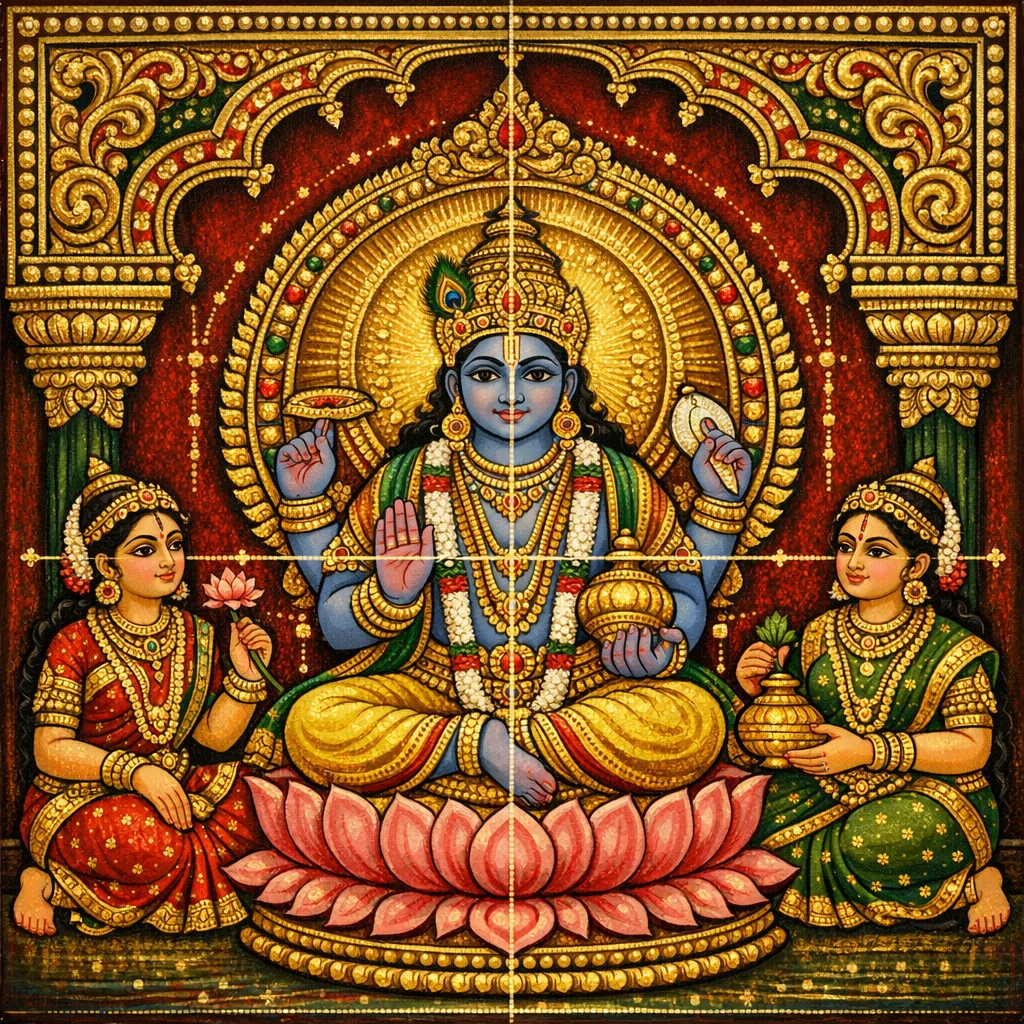
This chapter shifts from pacificatory rites to the technical yet devotional science of Pratimā-lakṣaṇa for Vāsudeva and the allied Vyūha forms. It opens with placement rules: icons are to be installed to the north of the temple, facing east or north, aligning iconography with Vāstu-based spatial dharma. After installation and bali offerings, the central marking slab is divided into nine, and measurements are set through aṅgula units (svāṅgula, golaka/kālanetra) and tāla canons. A detailed proportional grid is then given for crown, face, neck, chest, abdomen, thighs, shanks, and feet, along with dense facial and limb metrics—eyes, brows, nose, ears, lips, head-circumference, arm and forearm lengths, palm and finger joints, waist and leg girths. Ornamentation standards are included, and the chapter concludes with identifying emblems: chakra and padma on the right, śaṅkha and gadā on the left, plus attendant figures (Śrī, Puṣṭi, Vidyādharas) and halo/pedestal specifications. The result is a complete iconometric blueprint meant to sustain correct worship and dharmic presence.
Shlokas
Verse 1
इत्य् आदि महापुराणे आग्नेये शान्त्यादिवर्णनं नाम त्रिचत्वारिंशो ऽध्यायः अथ चतुश् चत्वारिंशो ऽध्यायः वासुदेवादिप्रतिमालक्षणविधिः भगवानुवाच वासुदेवादिप्रतिमालक्षणं प्रवदामि ते प्रासादस्योत्तरे पूर्वमुखीं वा चोत्तराननां
Thus ends, in the Agni Mahāpurāṇa, the forty-third chapter entitled “Description of pacificatory rites and related topics.” Now begins the forty-fourth chapter: “The procedure for the iconographic characteristics of Vāsudeva and the other (Vyūha) forms.” The Blessed Lord said: “I shall declare to you the defining characteristics of the images of Vāsudeva and the rest. (They are to be placed) to the north of the temple—either facing east or with the face turned north.”
Verse 2
संस्थाप्य पूज्य च बलिं दत्वाथो मध्यसूचकं शिलां शिल्पी तु नवधा विभज्य नवमे ऽंशके
Having set it in place, worshipped it, and offered the bali (ritual oblation), the artisan should then take the stone-slab used for indicating the centre and divide it into nine parts; on the ninth division (the ninth share) the central indication is to be fixed/marked.
Verse 3
सूर्पभक्तैः शिलायां तु भागं स्वाङ्गुलमुच्यते द्व्यङ्गुलं गोलकं नाम्ना कालनेत्रं तदुच्यते
On a measuring stone, a division made by the marks of a sūrpa (winnowing-fan) is called a ‘svāṅgula’ (one’s own finger-breadth). A measure of two aṅgulas is termed ‘golaka’; that itself is also called ‘kālanetra’.
Verse 4
भागमेकं त्रिधा भक्त्वा पार्ष्णिभागं प्रकल्पयेत् भागमेकं तथा जानौ ग्रीवायां भागमेव च
Dividing one unit of measure into three parts, one should determine the portion for the heel; likewise, one unit is assigned for the knee, and one unit as well for the neck.
Verse 5
मुकुटं तालमात्रं स्यात्तालमात्रं तया मुखं तालेनैकेन कण्ठन्तु तालेन हृदयं तथा
The crown (mukuṭa) should measure one tāla; the face, by that same measure, should also be one tāla. The neck should be one tāla, and likewise the region of the heart (chest) should be one tāla.
Verse 6
नाभिमेढ्रान्तरन्तालं द्वितालावूरुकौ तथा तालद्वयेन जङ्घा स्यात् सूत्राणि शृणु साम्प्रतं
The interval between the navel and the genital region is one tāla; the thighs are two tālas; and the shanks (lower legs) are two tālas. Now listen to the sūtras, the canons of measurement.
Verse 7
कार्यं सूत्रद्वयं पादे जङ्घामध्ये तथापरं जानौ सूत्रद्वयं कार्यमूरूमध्ये तथापरं
Two measuring cords (sūtras) should be placed on the foot; likewise another pair in the middle of the calf. Two cords should be placed at the knee; likewise another pair in the middle of the thigh.
Verse 8
मेढ्रे तथापरं कार्यं कट्यां सूत्रन्तथापरं मेखलाबन्धसिद्ध्यर्थं नाभ्यां चैवापरन्तथा
Likewise, another marking should be made at the genital region; and likewise a cord should be placed at the waist. For the proper securing of the girdle (mekhalā), another marking/placement should be made at the navel as well.
Verse 9
हृदये च तथा कार्यं कण्ठे सूत्रद्वयं तथा ललाते चापरं कार्यं मस्तके च तथापरं
Likewise, it should be done at the heart; at the throat, a pair of threads should be placed as well. Another placement should be done on the forehead, and likewise another on the head (crown).
Verse 10
मुकुटोपरि कर्तव्यं सूत्रमेकं विचक्षणैः सूत्राण्यूर्ध्वं प्रदेयानि सप्तैव कमलोद्भव
The discerning should place a single sūtra upon the crown (mukuta). Above it, seven sūtras are to be set, O Lotus-born (Brahmā).
Verse 11
कक्षात्रिकान्तरेणैव घट् सूत्राणि प्रदापयेत् मध्यसूत्रं तु सन्त्यज्य सूत्राण्येव निवेदयेत्
At intervals of three cubits (or three arm-spans), one should place the pot-threads; but, setting aside the central thread, one should offer only the threads.
Verse 12
ललाटं नासिकावक्त्रं कर्तव्यञ्चतुरङ्गुलं ग्रीवाकर्णौ तु कर्तव्यौ आयामाच्चतुरङ्गुलौ
The forehead, the nose, and the face should each be made four aṅgulas in measure; and the neck and the ears should likewise be made four aṅgulas in length.
Verse 13
द्व्यङ्गुले हनुके कार्ये विस्ताराच्चिबुकन्तथा अष्टाङ्गुलं ललाटन्तु विस्तारेण प्रकीर्तितम्
The jaw (hanū) is to be made two aṅgulas in breadth; likewise the chin (cibuka) in breadth. The forehead (lalāṭa) is taught to be eight aṅgulas in breadth.
Verse 14
परेण द्व्यङ्गुलौ शङ्खौ कर्तव्यावलकान्वितौ चतुरङ्गुलमाख्यातमन्तरं कर्णनेत्रयोः
Further, the temples (śaṅkha) should be made two aṅgulas, furnished with the proper curve (avalaka). The interval between the ear and the eye is declared to be four aṅgulas.
Verse 15
द्व्यङ्गुलौ पृथुकौ कर्णौ कर्णापाङ्गार्धपञ्चमे भ्रूसमेन तु सूत्रेण कर्णश्रोत्रं प्रकीर्तितम्
The ears are declared to be two aṅgulas broad. By the measuring cord aligned with the eyebrows, the ear-opening (auditory aperture) is stated to lie at the midpoint between the ear and the outer corner of the eye.
Verse 16
विद्धं षडङ्गुलं कर्णमविद्धञ्चतुरङ्गुलम् चिवुकेन समं विद्धमविद्धं वा षडङ्गुलम्
The pierced portion of the ear should measure six aṅgulas, and the unpierced portion four aṅgulas. It should be pierced in even alignment with the chin; or it may be left unpierced, in which case it should be six aṅgulas.
Verse 17
गन्धपात्रं तथावर्तं शष्कुलीं कल्पयेत्तथा द्व्यङ्गुलेनाधरः कार्यस्तस्यार्धेनोत्तराधरः
Likewise one should fashion the perfume-vessel, the spiral ornament (āvarta), and also the śaṣkulī form. The lower lip is to be made two aṅgulas in measure, and the upper lip half of that.
Verse 18
अर्धाङ्गुलं तथा नेत्रं वक्त्रन्तु चतुरङ्गुलम् आयामेन तु वैपुल्यात् सार्धमङ्गुलमुच्यते
The eye is to be made half an aṅgula; the face, however, four aṅgulas. In length and in breadth it is stated to be one and a half aṅgulas.
Verse 19
अव्यात्तमेवं स्याद्वक्त्रं व्यात्तं त्र्यङ्गुलमिष्यते नासावंशसमुच्छ्रायं मूले त्वेकाङ्गुलं मतम्
Thus, when the mouth is shown unopen, it should remain so; but when the mouth is depicted as open, an opening of three aṅgulas is prescribed. The projection of the nasal ridge (nāsā-vaṃśa) at its base is considered to be one aṅgula.
Verse 20
उच्छ्राया द्व्यङ्गुलं चाग्रे करवीरोपमाः स्मृताः मुकुटोपरि इति ख, चिह्नितपुस्तकपाठः तथा गोजी इति ख, चिह्नितपुस्तकपाठः अन्तरं चक्षुषोः कार्यं चतुरङ्गुलमानतः
At the front, their projection is said to be two aṅgulas, resembling the bud-like form of the karavīra (oleander). (A marked manuscript reading adds “above the crown/diadem”; another marked reading has “gojī”.) The spacing between the two eyes should be made four aṅgulas in measure.
Verse 21
द्व्यङ्गुलं चाक्षिकोणं च द्व्यङ्गुलं चान्तरं तयोः तारा नेत्रत्रिभागेण दृक्तारा पञ्चमांशिका
The corner (angle) of the eye is to be two aṅgulas, and the interval between the two corners is likewise two aṅgulas. The tārā (iris) should be one-third of the eye, and the dṛk-tārā (pupil) one-fifth of the tārā.
Verse 22
त्र्यङ्गुलं नेत्रविस्तारं द्रोणी चार्धाङ्गुला मता तत्समाणा भ्रुवोर्लेखा भ्रुवौ चैव समे मते
The width of the eye is prescribed as three aṅgulas; the droṇī (the measure of the eye-socket/eye-bowl) is held to be one and a half aṅgulas. The arching line of the two eyebrows should be of the same measure, and the eyebrows themselves are to be even and symmetrical.
Verse 23
भ्रूमध्यं द्व्यङ्गुलं कार्यं भ्रूदैर्घ्यं चतुराङ्गुलम् षट्त्रिंशदङ्गुलायामम्मस्तकस्य तु वेष्टनम्
The space between the eyebrows should be made two aṅgulas; the length of each eyebrow should be four aṅgulas. The encircling measure (veṣṭana, circumference) of the head should be thirty-six aṅgulas.
Verse 24
मूर्तीनां केशवादीनां द्वात्रिंशद्वेष्टनं भवेत् पञ्चनेत्रा त्वधोग्रीवा विस्ताराद्वेष्टनं पुनः
For the images (mūrtis) of Keśava and the other forms beginning with Keśava, the wrap-measure (veṣṭana) should be thirty-two. But for the five-eyed form, with the neck set lower (adho-grīvā), the wrap-measure is again determined according to breadth (vistāra).
Verse 25
त्रिगुणन्तु भवेदूर्ध्वं विस्तृताष्टाङ्गुलं पुनः ग्रीवात्रिगुणमायामं ग्रीवावक्षोन्तरं भवेत्
Above that, it should be made threefold; and again its breadth should be eight aṅgulas. The neck should have a length of three units, and the interval from the neck to the chest should be set in accordance with that.
Verse 26
स्कन्धावष्टाङ्गुलौ कार्यौ त्रिकलावंशकौ शुभौ सप्तनेत्रौ स्मृतौ बाहू प्रबाहू षोडशाङ्गुलौ
The shoulders are to be made eight aṅgulas (finger-breadths) in measure. The upper arms (bāhu) are auspicious when fashioned according to the standard of three kalās and one vaṁśa. The arms are remembered as seven netras in length, and the forearms (prabāhu) as sixteen aṅgulas.
Verse 27
त्रिकलौ विस्तृतौ बाहू प्रबाहू चापि तत्समौ बाहुदण्डोर्ध्वतो ज्ञेयः परिणाहः कला नव
The arms (bāhu), when fully outstretched, measure three kalās, and the forearms (prabāhu) are of the same measure. Above the arm-staff (bāhu-daṇḍa), the circumference (pariṇāha) should be understood as nine kalās.
Verse 28
सप्तदशाङ्गुलो मध्ये कूर्पारोर्धे च षोडश कूर्पारस्य भवेन्नाहः त्रिगुणः कमलोद्भव
O Lotus-born (Brahmā), the measure at the middle is seventeen aṅgulas, and above the elbow it is sixteen. The circumference (nāha) of the elbow-region is said to be threefold, according to the stated standard.
Verse 29
नाहः प्रबाहुमध्ये तु षोडशाङ्गुल उच्यते अग्रहस्ते परीणाहो द्वादशाङ्गुल उच्यते
The nāha (circumference/measure) at the middle of the forearm (prabāhu) is said to be sixteen aṅgulas; and at the front of the hand (agra-hasta), the circumference is said to be twelve aṅgulas.
Verse 30
विस्तरेण करतलं कीर्तितं तु षडङ्गुलम् दैर्घ्यं सप्ताङ्गुलं कार्यं मध्या पज्चाङ्गुला मता
In breadth, the palm (karatala) is declared to be six aṅgulas; its length should be made seven aṅgulas; and the middle measure is considered to be five aṅgulas.
Verse 31
तर्जन्यनामिका चैव तस्मादर्धाङ्गुलं विना कनिष्ठाङ्गुष्ठकौ कार्यौ चतुरङ्गुलसम्मितौ
The index finger and the ring finger should be made shorter than that measure by half an aṅgula; and the little finger and the thumb should be made to a measure of four aṅgulas.
Verse 32
भ्रूदैर्घ्याच्चतुरङ्गुला इति ङ, चिह्नितपुस्तकपाठः द्विपर्वोङ्गुष्ठकः कार्यः शेषागुल्यस्त्रिपर्विकाः सर्वासां पर्वणोर्धेन नखमानं विधीयते
“Four aṅgulas from the length of the eyebrow”—so reads the marked (variant) recension. The thumb should be fashioned with two joints, while the remaining fingers with three; and for all of them the nail’s measure is prescribed as half a joint.
Verse 33
वक्षसो यत् प्रमाणन्तु जठरं तत्प्रमाणतः अङ्गुलैकं भवेन्नाभी वेधेन च प्रमाणतः
Whatever proportion is measured for the chest, the belly should be of that same measure. The navel should extend one aṅgula, and it too should be gauged by the prescribed method of measurement (vedha).
Verse 34
ततो मेढ्रान्तरं कार्यं तालमात्रं प्रमाणतः नाभिमध्ये प्रीणाहो द्विचत्वारिंशदङ्गुलैः
Then the spacing in the genital region should be made according to measure, to the extent of one tāla; and at the middle of the navel the proper circumference (prīṇāha) is to be set at forty-two aṅgulas.
Verse 35
अन्तरं स्तनयोः कार्यं तालमात्रं प्रमाणतः चिवुकौ यवमानौ तु मण्डलं द्विपदं भवेत्
The space between the breasts should be made in correct proportion, measuring one tāla. The two protrusions (civuka) are to be of one yava in measure, and the circular disk (maṇḍala) should be two padas in size.
Verse 36
चतुःषष्ट्यङ्गुलं कार्यं वेष्टनं वक्षसःस्फुटम् चतुर्मुखञ्च तदधोवेष्टनं परिकीर्तितम्
The wrapping (band or garment arrangement) across the broad chest should be made sixty-four aṅgulas in measure. The lower wrapping beneath it is described as “four-faced,” that is, arranged with four folds or sides.
Verse 37
परिणाहस् तथा कट्या चतुःपञ्चाशदङ्गुलैः विस्तारश्चोरुमूले तु प्रोच्यते द्वादशङ्गुलः
The circumference at the waist (parināha) is to be forty-four aṅgulas, and the breadth at the root of the thigh is declared to be twelve aṅgulas.
Verse 38
तस्मादभ्यधिकं मध्ये ततो निम्नतरं क्रमात् विस्तृताष्टाङ्गुलं जानुत्रिगुणा परिणाहतः
Therefore it should be slightly higher in the middle and then gradually lower in sequence; the breadth should be eight aṅgulas, and the circumference at the knee should be three times that breadth.
Verse 39
जङ्घामध्ये तु विस्तारः सप्ताङ्गुल उदाहृतः त्रिगुणा परिधिश्चास्य जङ्घाग्रं पञ्चविस्तरात्
At the middle of the lower leg (jaṅghā), the breadth is stated to be seven aṅgulas. Its circumference is three times that breadth, and the breadth at the front/upper end of the shin (jaṅghā-agra) is five aṅgulas.
Verse 40
त्रिगुणा परिधिश्चास्य पादौ तालप्रमाणकौ आयामादुत्थितौ पादौ चतुरङ्गुलमेव च
Its circumference is threefold. The feet are in tāla-measure. The feet, projecting forward from the lengthwise axis, should extend by exactly four aṅgulas.
Verse 41
गुल्फात् पूर्वं तु कर्तव्यं प्रमाणाच्चतुरङ्गुलम् त्रिकलं विस्तृतौ पादौ त्र्यङ्गुलो गुह्यकः स्मृतः
From the ankle (gulpha) onward, one should fashion it according to the standard measure as four aṅgulas (finger-breadths). The two feet, when spread, are said to be three kalas in breadth; and the genital region (guhyaka) is remembered as three aṅgulas in measure.
Verse 42
पञ्चाङ्गुलस्तु नाहोस्य दीर्घा तद्वत् प्रदेशिनी अष्टमाष्टांशतोन्यूनः शेषाङ्गुल्यः क्रमेण तु
The measure of the navel-region is five aṅgulas. The forefinger (pradeśinī) is of the same length as the stated standard. The remaining fingers, in proper order, are each successively shorter by one-eighth of an eighth-part, a minute fractional decrease.
Verse 43
सपादाङ्गुलमुत्सेधमङ्गुष्टस्य प्रकीर्तितं यवोनमङ्गुलं कार्यमङ्गुष्ठस्य नखं तथा
The projection (height) of the thumb is declared to be one and a quarter aṅgulas (1¼). The thumb’s nail likewise is to be made one aṅgula minus one yava (a barley-grain measure).
Verse 44
चूचुकौ इति ङ, चिह्नितपुस्तकपाठः अर्धाङ्गुलं तथान्यासां क्रमान् न्यूनं तु कारयेत् अङ्गुलौ वृषणौ कार्यौ मेढ्रं तु चतुरङ्गुलम्
“The two nipples”—so reads the marked book-recension. For the remaining features, one should make the measures successively less, each step reduced by half an aṅgula. The testicles are to be made two aṅgulas in measure, and the penis four aṅgulas.
Verse 45
परिणाहोत्र कोषाग्रं कर्तव्यञ्चतुरङ्गुलम् षडङ्गुलपरीणाहौ वृषणौ परिकीर्तितौ
In girth (circumference), the tip of the prepuce (koṣāgra) should be made four aṅgulas; and the two testicles (vṛṣaṇau) are declared to have a girth of six aṅgulas.
Verse 46
प्रतिमा भूषणाढ्या स्यादेतदुद्देशलक्षणम् अनयैव दिशा कार्यं लोके दृष्ट्वा तु लक्षणम्
The icon (pratimā) should be richly adorned with ornaments—this is the general defining characteristic stated here. In this very manner, the proper orientation should be arranged, after observing the characteristic marks as they are seen in the world.
Verse 47
दक्षिणे तु करे चक्रमधस्तात् पद्ममेव च वामे शङ्खं गदाधस्ताद्वासुदेवस्य लक्षणात्
In the right hand is the discus (cakra); below it, the lotus. In the left are the conch (śaṅkha), and below it the mace (gadā)—these are the identifying marks of Vāsudeva.
Verse 48
श्रीपुष्टौ वापि कर्तव्ये पद्मवीणाकरान्विते ऊरुमात्रोच्छितायामे मालाविद्याधरौ तथा
Śrī and Puṣṭi also should be fashioned as icons, bearing in their hands a lotus and a vīṇā; their height should be one “thigh-measure.” Likewise, the Vidyādharas should be made holding garlands.
Verse 49
प्रभामण्डलसंस्थौ तौ प्रभा हस्त्यादिभूषणा पद्माभं पादपीठन्तु प्रतिमास्वेवमाचरेत्
Those two figures should be placed within a halo-disc (prabhāmaṇḍala); the radiance should be adorned with ornaments such as elephants and the like. The foot-pedestal (pādapīṭha), however, should be lotus-like. Thus one should proceed in making the images.
Frequently Asked Questions
A rigorous tala–aṅgula iconometric canon: defining units (svāṅgula, golaka/kālanetra), center-marking, sūtra placements, and precise proportions for head, face, limbs, girths, and emblem positioning for Vāsudeva.
By treating correct proportion, orientation, and emblematic accuracy as dharmic disciplines that make the icon a fit locus for prāṇa-pratiṣṭhā and worship—aligning craftsmanship (śilpa) with devotion (bhakti) and ritual efficacy toward puruṣārtha.