Adhyaya 106
Chapter 106 — नगरादिवास्तुः (Vāstu Concerning Towns and Related Settlements)
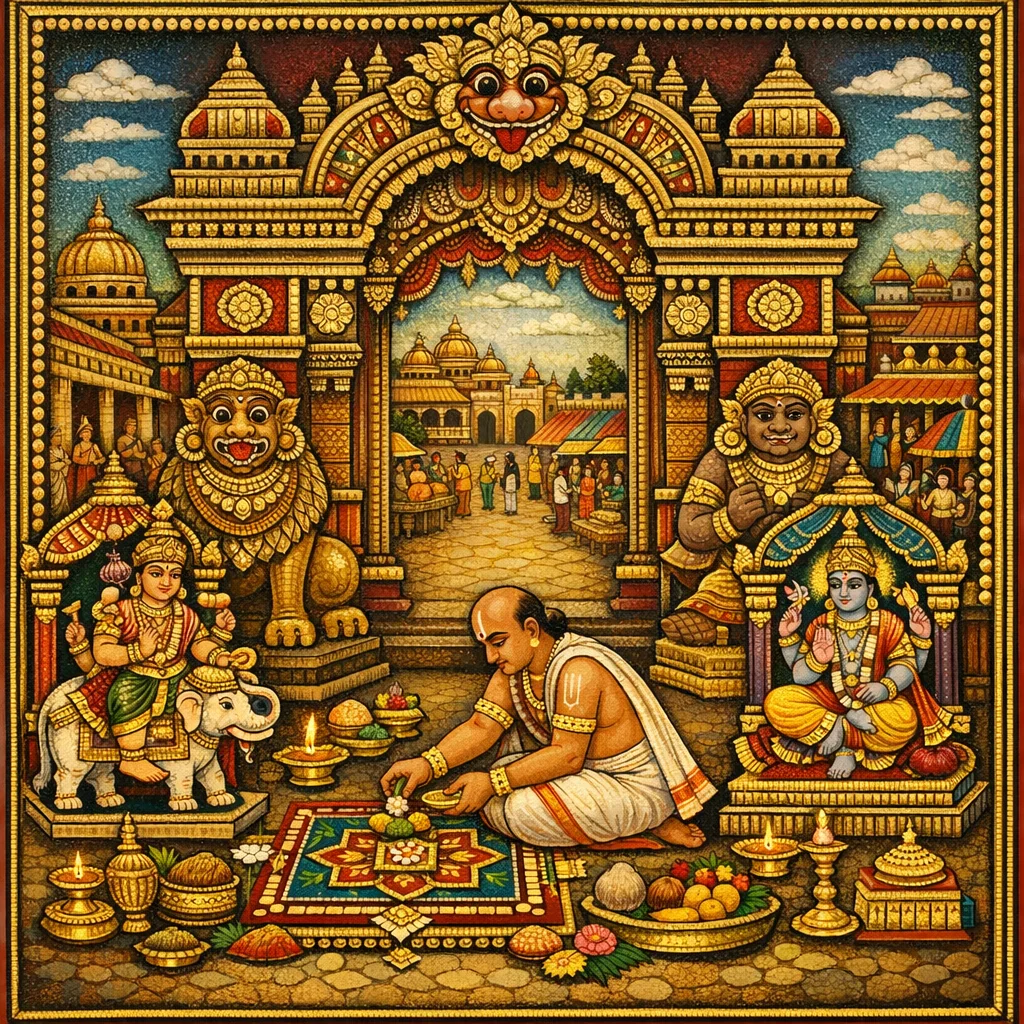
Lord Agni (as Īśvara) instructs Vasiṣṭha in vāstu principles for founding and ordering towns to increase royal prosperity (rājya-vṛddhi). It begins with site selection measured in yojanas, then gives consecratory preliminaries—worship of vāstu-deities and bali offerings—before prescribing a 30-pada vāstu-maṇḍala with gates set by direction: east in the Sūrya sector, south in Gandharva, west in Varuṇa, and north in Saumya. Gate dimensions are specified for elephant passage; inauspicious gate-forms are censured, and protective, peace-making (śānti-kṛt) layouts are recommended for civic defense. The chapter then assigns occupational and administrative quarters (craftsmen, performers, ministers, justice officials, merchants, physicians, cavalry) and fixes the locations of cremation grounds, cattle enclosures, and cultivators. It stresses that a settlement without installed deities is ‘nirdaivata’ and prone to afflictions, whereas a deity-guarded city grants victory, enjoyment, and liberation. It concludes with internal house zoning (kitchen, treasury, grain store, deity-room) and a typology of house-forms (catuḥśālā, triśālā, dviśālā, ekaśālā; ālinda/dalinda variants), linking civic order with ritual protection and dharmic governance.
Shlokas
Verse 1
इत्य् आग्नेये महापुराणे गृहादिवास्तुर्नाम पञ्चाधिकशततमो ऽध्यायः अथ षडधिकशततमो ऽध्यायः नगरादिवास्तुः ईश्वर उवाच नगरादिकवास्तुश् च वक्ष्ये राज्यादिवृद्धये योजनं योजनार्धं वा तदर्थं स्थानमाश्रयेत्
Thus, in the Agni Mahāpurāṇa, the one-hundred-and-fifth chapter called “Vāstu concerning houses and the like” concludes. Now begins the one-hundred-and-sixth chapter: “Vāstu concerning towns and the like.” The Lord said: “I shall describe the principles of vāstu for towns and related settlements, for the increase and prosperity of the kingdom and its resources. For that purpose, one should select and take up a suitable site—of one yojana, or half a yojana, in extent.”
Verse 2
हनमिति घ धर्मः कलिश्चेत्यादिः, मृतिर्धनमित्यन्तः पाठो झ पुस्तके नास्ति आयुः प्रावाह्यशस्यानीति ख , छ च भोगं च पत्यं चेति ख , छ च द्वारतः प्रोक्त इति घ भोजनार्धन्तदर्धं च इति घ , ङ च अभ्यर्च्य वास्तु नगरं प्राकाराद्यन्तु कारयेत् ईशादित्रिंशत्पदके पूर्वद्वारं च सूर्यके
“Hana” (thus): in the Gha manuscript the reading begins with “Dharma, Kali, etc.”; the concluding reading “Mṛti, Dhana” is not found in the Jha manuscript. In the Kha and Cha manuscripts there is also the variant “āyuḥ prāvāhyaśasyāni”, and likewise “bhogaṃ ca patyaṃ ca”. In the Gha manuscript there is the reading “dvārataḥ proktaḥ”. In Gha and Ṅa there is also “bhojanārdham tadardhaṃ ca”. Having worshipped the Vāstu-deities, one should cause a city to be built together with ramparts and other fortifications. In the thirty-square Vāstu-maṇḍala beginning from Īśāna (the north-east), the eastern gate is to be placed in the Sūrya (solar) sector.
Verse 3
गन्धर्वाभ्यां दक्षिणे स्याद्वारुण्ये पश्चिमे तथा सौम्यद्वारं सौम्यपदे कार्या हट्टास्तु विस्तराः
On the southern side the gate should be placed in the Gandharva sector; likewise, on the western side in the Varuṇa sector. The northern gate should be constructed in the Saumya sector, and the market-streets (haṭṭas) should be laid out broad.
Verse 4
येनेभादि सुखं गच्छेत् कुर्याद् द्वारं तु षट्करं छिन्नकर्णं विभिन्नञ्च चन्द्रार्धाभं पुरं न हि
A gate should be made with a sixfold measure (six hasta/cubits), so that elephants and the like may pass through comfortably. A city should not, however, have a gate that is “cut-eared” (defective at the sides), split/cleft, or shaped like a half-moon.
Verse 5
वज्रसूचीमुखं नेष्टं सकृद् द्वित्रिसमागमं चापाभं वज्रनागाभं पुरारम्भे हि शान्तिकृत्
The arrowhead form called “Vajra-sūcī-mukha” (vajra needle-point) is not recommended. Preferred is the type with a single junction, or with a double/triple junction (dvi/tri-samāgama); likewise the bow-shaped (cāpābha) and the “vajra-nāga”-shaped (vajranāgābha). At the commencement of a siege or attack on a town (purārambhe), these are said to be śānti-kṛt—pacificatory, used to quell ill-omens and resistance.
Verse 6
प्रार्च्य विष्णु हरार्कादीन्नत्वा दद्याद् बलिं बली आग्नेये स्वर्णकर्मारान् पुरस्य विनिवेशयेत्
Having duly worshipped Viṣṇu, Hara (Śiva), the Sun, and the other deities, and having bowed to them, the patron should offer the bali (ritual oblation). In the Agneya (south-east) quarter of the city he should settle the goldsmiths and metal-workers.
Verse 7
दक्षिणे नृत्यवृत्तीनां वेश्यास्त्रीणां गृहाणि च नटानाञ्चक्रिकादीनां कैवर्तादेश् च नैरृते
On the southern side should be placed the dwellings of those who earn their livelihood by dance, and of courtesan-women; and in the south-west (nairṛta) should be placed the quarters of actors, cakrikā-type performers and the like, and of fisherfolk and related communities.
Verse 8
रथानामायुधानाञ्च कृपाणाञ्च वारुणे शौण्डिकाः कर्माधिकृता वायव्ये परिकर्मणः
In the Vāruṇa department, officials should be appointed in charge of chariots, weapons, and swords; and in the Vāyavya department, attendants (parikarmaṇaḥ) should be appointed for auxiliary services and maintenance work.
Verse 9
ब्राह्मणा यतयः सिद्धाः पुण्यवन्तश् च चोत्तरे फलाद्यादिविक्रयिण ईशाने च वणिग्जनाः
In the northern quarter are Brahmins—ascetics (yatis), accomplished siddhas, and other meritorious persons; in the north-east (Īśāna) are sellers of fruits and the like, and also merchant folk.
Verse 10
पूर्वतश् च बलाध्यक्षा आग्नेये विविधं बलं स्त्रीणामादेशिनो दक्षे काण्डारान्नैरृते न्यसेत्
On the eastern side the commanders of troops should be stationed; in the south-east (Agneya) the various divisions of the army should be placed. In the south the supervisors of the women’s quarters should be positioned; and in the south-west (nairṛta) the storehouses/armouries (kāṇḍāra) should be set.
Verse 11
पश्चिमे च महामात्यान् कोषपालांश् च कारुकान् व्यायतं वज्रनासाभमिति घ चापाभं चक्रनाभाभमिति ङ स्तुत्वा नत्वा बलिं बली इति ङ आग्नेये तु कर्मकारानिति ख दक्षिणे भृत्यधूर्तानामिति छ नटानां वाह्लिकादीनामिति ख , ज च परिकर्मण इति छ , ज च उत्तरे दण्डनाथांश् च नायकद्विजसङ्कुलान्
In the western direction should be assigned the great ministers, the guardians of the treasury, and the artisans. Having praised and bowed to the deity, one should present the bali-offering. In the south-east (Agneya) should be assigned the craftsmen and workers. In the southern direction should be assigned servants and rogues; also actors and peoples such as the Vāhlikas; and likewise attendants engaged in service. In the northern direction should be assigned the daṇḍanāthas (chiefs of justice and punishment) and leaders, together with assemblies of Brahmins.
Verse 12
पूर्वतः क्षत्रियान् दक्षे वैश्याञ्छून्द्रांश् च पश्चिमे दिक्षु वैद्यान् वाजिनश् च बलानि च चतुर्दिशं
To the east he should station the Kṣatriyas; to the south, the Vaiśyas; and to the west, the Śūdras. In the other directions he should place the physicians and the cavalry, and he should deploy the forces on all four sides.
Verse 13
पूर्वेण चरलिङ्ग्यादीञ्छ्मशानादीनि दक्षिणे पश्चिमे गोधनाद्यञ्च कृषिकर्तॄंस्तथोत्तरे
To the east one should place the wandering ascetics and the like; to the south, cremation-grounds and similar inauspicious sites; to the west, cattle-wealth and related enclosures; and likewise to the north, cultivators (farmers).
Verse 14
न्यसेन्म्लेच्छांश् च कोणेषु ग्रामादिषु तथा स्मृतिं श्रियं वैश्रवणं द्वारि पूर्वे तौ पश्यतां श्रियं
One should place the Mlecchas in the corner-regions of a village and the like. Likewise, at the eastern doorway one should install Smṛti, Śrī, and Vaiśravaṇa (Kubera), so that those who behold them may obtain prosperity.
Verse 15
देवादीनां पश्चिमतः पूर्वास्यानि गृहाणि हि पूर्वतः पश्चिमास्यानि दक्षिणे चोत्तराननान्
To the west of the deities (in the layout), their dwellings should be east-facing; to the east, they should be west-facing; and on the southern side, they should be north-facing.
Verse 16
नाकेशविष्ण्वादिधामानि रक्षार्थं नगरस्य च निर्दैवतन्तु नगरग्रामदुर्गगृहादिकं
For the protection of a city, one should establish shrines or abodes of Nākeśa (Indra), Viṣṇu, and other deities; but a city, village, fort, house, and the like that is without a presiding deity is regarded as “without divine protection”.
Verse 17
भुज्यते तत् पिशाचाद्यै रोगाद्यैः परिभूयते नगरादि सदैवं हि जयदं भुक्तिमुक्तिदं
That place—household or settlement—is as though “consumed” by piśācas and the like, and it is overpowered by diseases and other afflictions. But a town, and any inhabited place, when endowed with proper divine protection, is ever victorious, bestowing worldly enjoyment and liberation (mukti).
Verse 18
पूर्वायां श्रीगृहं प्रोक्तमाग्नेय्यां वै महानसं शनयं दक्षिणस्यान्तु नैरृत्यामायुधाश्रयं
In the eastern quarter, the auspicious chamber called śrīgṛha is prescribed; in the south-east (Agneya), the kitchen; the store-room (śanaya) on the southern side; and in the south-west (Nairṛtya), the repository for weapons.
Verse 19
भोजनं पश्चिमायान्तु वायव्यां धान्यसङ्ग्रहः उत्तरे द्रव्यसंस्थानमैशान्यां देवतागृहं
Let the dining area be toward the west; in the north-west (Vāyavya) let there be storage of grains; in the north, a repository for valuables; and in the north-east (Īśānya), the house or shrine of the deities.
Verse 20
चतुःशालं त्रिशालं वा द्विशालं चैकशालकं चतुःशालगृहाणान्तु शालालिन्दकभेदतः
A house may be of the four-hall type (catuḥśālā), the three-hall type (triśālā), the two-hall type (dviśālā), or the single-hall type. In four-hall houses, the subtypes are determined according to the distinctions among the halls (śālā) and the verandah/portico (alindaka).
Verse 21
इ इति ग पूर्वत इति ख दक्षिणे चोत्तरेण चेति ख , ग , घ च नगरस्य हीति ख , छ च रोगाद्यैर् अभिभूयते इति ज दक्षिणायां त्विति ग , घ , झ च देवतालयमिति झ शालालिन्दप्रभेदत इति क शतद्वयन्तु जायन्ते पञ्चाशत् पञ्च तेष्वपि त्रिशालानि तु चत्वारि द्विशालानि तु पञ्चधा
From the variations of the śālā (hall/house-unit) and its alinda/alindaka (verandah or portico), two hundred types arise, and further fifty-five more. Among these, the triśālā (three-hall type) is of four kinds, and the dviśālā (two-hall type) is of five kinds.
Verse 22
एकशालानि चत्वारि एकालिन्दानि वच्मि च अष्टाविंशदलिन्दानि गृहाणि नगराणि च
I shall describe the four kinds of single-hall houses, and also the single-ālinda type; and further, the twenty-eight dalinda-type layouts, applicable to houses as well as to towns.
Verse 23
चतुर्भिः सप्रभिश् चैव पञ्चपञ्चाशदेव तु षडलिन्दानि विंशैव अष्टाभिर्विंश एव हि
With four (syllabic units) and also with seven ‘prabhas’; and indeed with fifty-five. With six ālindas there are twenty; and with eight there are likewise twenty.
Verse 24
अष्टालिन्दं भवेदेवं नगरादौ गृहाणि हि
Thus, at the outset of a town’s planned layout, the houses should be made with an eight-ālinda (eightfold portico/verandah arrangement).
Frequently Asked Questions
Directional planning using a 30-pada vāstu-maṇḍala: fixed gate sectors (east–Sūrya, south–Gandharva, west–Varuṇa, north–Saumya), gate sizing for elephant passage, and avoidance of defective gate shapes; plus systematic zoning of occupations and civic functions by quarter.
By making civic space a ritualized, deity-protected field: devārcana and bali sacralize the settlement, while installing shrines and aligning functions by direction reduces afflictions and supports dharma—so prosperity and security (bhukti) become supports for devotion and liberation (mukti).