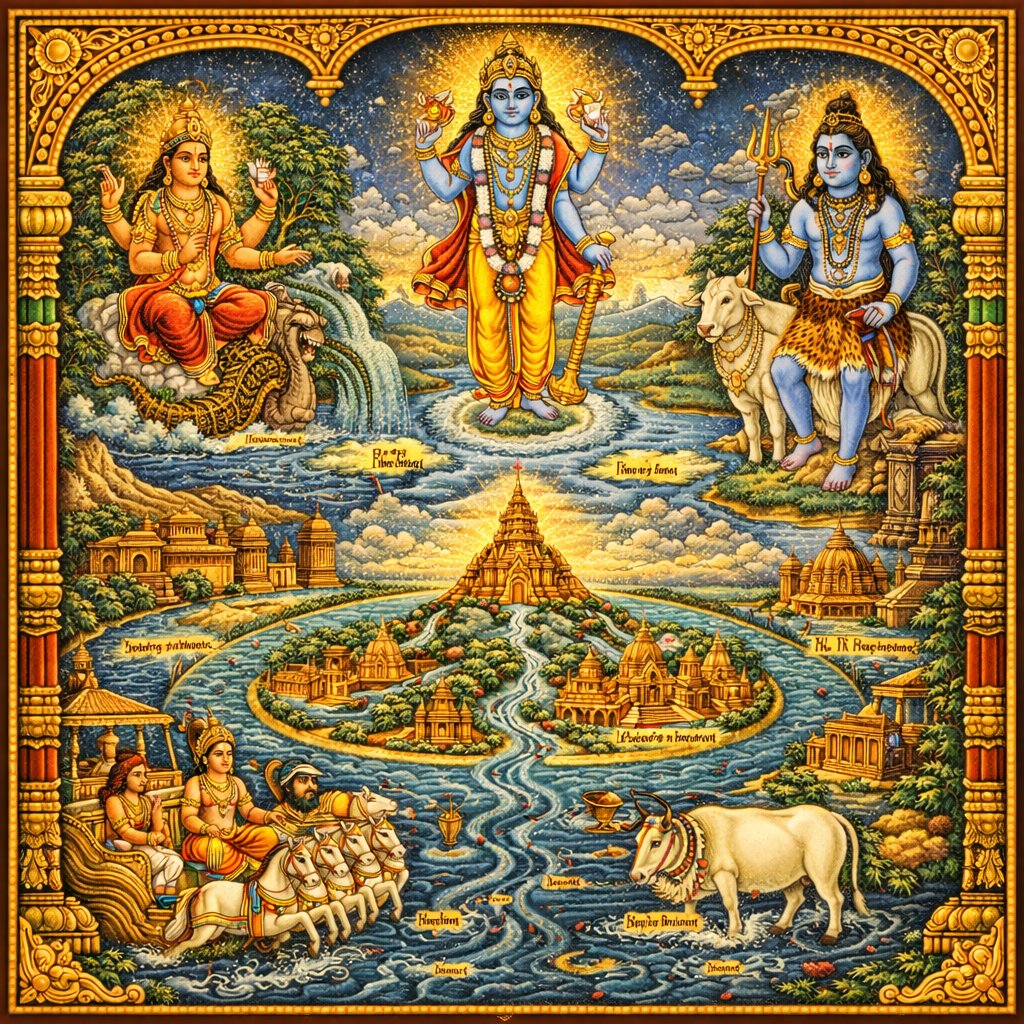
Bhuvanakosha & Tirtha-mahatmya
Sacred Geography & Pilgrimage
A cosmographic survey of the universe (bhuvanakosha) and the greatness (mahatmya) of sacred pilgrimage sites across Bharata.
Adhyayas in Bhuvanakosha & Tirtha-mahatmya
Adhyaya 107
The Creation of Svāyambhuva (Manu) — Bhuvanakośa, Seven Dvīpas, Varṣas, and Lineages
Lord Agni turns from architectural teaching (nagarādi-vāstu) to a cosmological account, promising an ordered description of the world-sheath (bhuvana-kośa), earthly geography, and key progenitors. Priyavrata is said to distribute the seven dvīpas among his sons—Jambū, Plakṣa, Śālmalā, Kuśa, Krauñca, Śāka, and Puṣkara—presenting sacred geography as dharmic governance. The chapter then details Jambūdvīpa’s internal divisions (varṣas and boundary mountains) centered on Meru/Ilāvṛta, and portrays the northern regions as free from fear of aging and death, in an egalitarian state beyond yuga distinctions. The narrative shifts to a sanctified kingship-to-renunciation ideal: Priyavrata, and later Ṛṣabha and Bharata, attain Viṣṇu at Śālagrāma, linking royal lineage with tīrtha-based liberation. A genealogy runs from Bharata through Sumati to Indradyumna and further descendants, concluding by identifying this exposition as the Svāyambhuva creation marked by the succession of yugas (Kṛta, Tretā, and so on).
Adhyaya 108
Chapter 108 — भुवनकोषः (Bhuvana-kośa: The Structure of the Worlds)
Lord Agni begins a systematic cosmographic survey for Vasiṣṭha by enumerating the seven dvīpas and their seven encircling oceans, establishing the world’s macro-structure as a sacred, ordered field of dharma. He then centers the account on Jambūdvīpa and Mount Meru, giving explicit measurements and lotus symbolism (Meru as the pericarp of the world-lotus), and outlines the boundary mountains and varṣa-regions arranged around Meru: Bhārata, Kiṁpuruṣa, Harivarṣa to the south; Ramyaka, Hiraṇmaya, Uttarakuru to the north; Ilāvṛta at the center. Geography is layered with divine presence—directional mountains, celestial groves, Brahmā’s city on Meru, and the domains of the lokapālas. Rivers descending from Viṣṇu’s Foot (notably Śītā and Ālakanandā) link heaven to earth, turning hydrology into a theological corridor. The chapter culminates by turning toward tīrtha-discourse: rivers become tīrthas, and Bhārata is highlighted as a land where sacredness is also conferred through dharmic recognition, preparing for a tirtha-mahātmya catalog.
Adhyaya 109
Chapter 109 — Tīrtha-mahātmya (The Glory of Sacred Pilgrimage Places)
Agni begins by defining tīrtha-fruit (tīrtha-phala) as inseparable from self-restraint: disciplined hands, feet, and mind, a light diet, conquered senses, and avoidance of taking gifts are the ethical conditions that make pilgrimage spiritually effective. The text then equates pure pilgrimage and a three-night fast (kept without turning to other fords) with the merit of all sacrifices, presenting tīrtha-yātrā as a practical alternative to costly yajñas for those unable to perform elaborate rites. Pushkara is praised as a supreme tīrtha where divine presence intensifies at the three sandhyās; residence, japa, and śrāddha there are said to uplift lineages, grant Aśvamedha-like merit, and lead to Brahmaloka. The chapter proceeds as a catalogue of sacred geography, naming rivers, confluences, forests, mountains, and famed cities (Kurukṣetra, Prayāga, Vārāṇasī, Avanti, Ayodhyā, Naimiṣa, etc.), repeatedly linking bathing, dāna (especially food-giving in Kārttika), and remembrance/utterance with purification, heaven, or Brahmaloka. Kurukṣetra receives special emphasis: even its dust is salvific, and the presence of Sarasvatī and Viṣṇu-associated divinities makes it a high-intensity field of dharma.
Adhyaya 110
गङ्गामाहात्म्यं (The Greatness of the Gaṅgā)
Continuing the Tīrtha-māhātmya, Lord Agni turns from the general glory of pilgrimage to a focused praise of the Gaṅgā as the supreme purifier in sacred geography. Lands touched by her flow are declared inherently sanctified, making geography itself a bearer of dharma. The Gaṅgā is set forth as the decisive ‘gati’ (refuge/way) for beings seeking the highest course, able through sustained worship to uplift both ancestral lines—forebears and descendants. Simple devotional acts—seeing, touching, drinking her waters, and reciting her praises—are extolled as immensely fruitful, surpassing severe penances; a month of devotion on her banks is equated with the fruit of all sacrifices. The funerary dimension is stressed: bone-remains placed in the Gaṅgā secure heavenly residence for as long as they remain there. The chapter ends by universalizing grace: even the hindered, such as the blind, attain godlike status through Gaṅgā-tīrtha, presenting the river as an accessible path to bhukti and mukti.
Adhyaya 111
प्रयागमाहात्म्यम् (The Greatness of Prayāga)
Agni opens the Prayāga-māhātmya by proclaiming Prayāga the supreme tīrtha, granting both bhukti and mukti, and a meeting-place of the gods (Brahmā, Viṣṇu, and others) and the ṛṣis. Its sanctity is taught through concrete ritual means: clay from the Gaṅgā’s bank, when carried or applied, destroys sin as the Sun dispels darkness, joining bodily practice to inner purification. Prayāga is then mapped through sacred anatomy and cosmography: the Gaṅgā–Yamunā interval is the Earth’s “jaghana,” with Prayāga as its inner upastha, making geography a theological body. Subsidiary tīrthas (Pratiṣṭhāna, Kambalā, Aśvatara, Bhogavatī) are identified as Prajāpati’s altar, and the Vedas and yajñas are said to be “embodied” there, so even name-chanting yields merit. At the saṅgama, dāna, śrāddha, and japa become imperishable, and the text notes the unwavering resolve of those who seek death at Prayāga. It concludes by listing eminent sites (Haṃsa-prapatana, Koṭitīrtha, Aśvamedha-tīrtha, Mānasatīrtha, Vāsaraka), praising the potency of Māgha month and the Gaṅgā’s rare triad of supreme places: Gaṅgādvāra, Prayāga, and Gaṅgā-sāgara.
Adhyaya 112
Prayāga-māhātmya (Conclusion Notice)
This unit serves as a transitional colophon marking the completion of the Prayāga-māhātmya within the Agneya Purāṇa’s tīrtha corpus. By formally closing the preceding discourse, it preserves the Purāṇic pedagogy that teaches sacred geography as applied dharma: particular places are presented as means of merit (puṇya), purification, and aligning worldly life with liberation (mokṣa). The closure also signals the systematic progression of Agneya Vidyā, moving from one tīrtha’s ritual-theological profile to the next and building a coherent map of kṣetras that supports the Purāṇa’s wider encyclopedic aims (ritual, iconography, governance, and allied sciences).
Adhyaya 113
Narmadā-ādi-māhātmya (The Greatness of the Narmadā and Other Tīrthas)
In this tīrtha-mahātmya section, Lord Agni begins a focused account of sacred geography by praising the Narmadā as a supreme purifier and by enumerating the vastness and abundance of its many tīrthas. The chapter frames a comparative pilgrimage theology: the Gaṅgā grants immediate purification through darśana (sight), whereas the Narmadā purifies through water-contact and immersion, marking distinct ways of gaining merit (puṇya). Agni then turns to the Amarakantaka region, locating numerous tīrthas around the mountain and introducing Śrīparvata and the auspicious confluence with the Kāverī. A mythic etiological thread explains Śrīparvata’s sanctity: Gaurī performs tapas, receives the boon of adhyātma (spiritual realization), and the place is named accordingly. The chapter concludes with ritual efficacy: dāna, tapas, japa, and śrāddha performed here become akṣaya (inexhaustible), and death at this tīrtha leads to Śivaloka, with Hara and Devī portrayed as present and sportive, grounding geography in lived soteriology.
Adhyaya 114
Chapter 114 — Gayā-māhātmya (The Greatness of Gayā)
Agni tells Vasiṣṭha of Gayā’s supremacy as a highest tīrtha, recounting Gayāsura’s tapas that unsettles the gods. Viṣṇu grants a boon that makes the asura «sarva-tīrtha-maya» (embodying all tīrthas), and the gods seek a stabilizing remedy. At Viṣṇu’s direction Brahmā asks for Gayāsura’s body as the sacrificial ground; the asura consents and becomes the altar, yet shifts, so a devamayī śilā (divine stone), upheld by Dharma, is installed. A secondary legend explains the śilā’s sanctity through Dharmavratā/Devavrata, Marīci’s curse, and the gods’ boon that all deities dwell in the stone, marked by divine footprints. Viṣṇu manifests as Gadādhara, the “primeval mace-bearer,” to ensure immovability; Brahmā completes the pūrṇāhuti, and Gayāsura receives the boon that his body becomes a kṣetra jointly sanctified by Viṣṇu, Śiva, and Brahmā, famed for granting Brahmaloka to the pitṛs. The chapter ends with a warning against greed in dharma-rites and a charter legitimizing tīrtha-based priestly livelihood at Gayā, concluding with Gayā’s naming and its link to the Pāṇḍavas’ worship of Hari.
Adhyaya 115
अध्याय ११५ — गयायात्राविधिः (Procedure for the Pilgrimage to Gayā)
Lord Agni prescribes a stepwise Gayā-yātrā centered on śrāddha and piṇḍa-dāna as a salvific means for the pitṛs and for the pilgrim’s own purification. The aspirant begins with the prescribed śrāddha, adopts a kārpaṭī (mendicant-like) discipline, proceeds with self-restraint without accepting gifts, and treats each step as merit aiding ancestral ascent. The chapter exalts Gayā above other claims (such as dying in a cowshed or residing at Kurukṣetra), declaring that a son who reaches Gayā becomes the ancestors’ “rescuer.” It then lays out a ritual itinerary across named tīrthas: Uttara-Mānasa and Dakṣiṇa-Mānasa for bathing and tarpaṇa; Kanakhala and Phalgu (Gayāśiras) as supreme sites where prosperity “bears fruit” and ancestors attain Brahmaloka; Dharmāraṇya/Mataṅga-āśrama, Brahma-saras, and the Brahma-yūpa for further rites; and culminating stations such as Rudrapāda, Viṣṇupada, Brahmapada, and the fire-places (Dakṣiṇāgni/Gārhapatya/Āhavanīya). The text integrates mantra-forms, lineage-inclusion formulas (known/unknown, maternal/paternal, lapsed rites), and merit-claims (hundreds of generations uplifted, ten Aśvamedhas, non-rebirth). It closes by praising Akṣayavaṭa and the imperishable merit of feeding brāhmaṇas, affirming the Gayā pilgrimage as highly fruitful even when performed outside strict order.
Adhyaya 116
Chapter 116 — गयायात्राविधिः (Gayā-yātrā-vidhiḥ) | The Procedure for the Gayā Pilgrimage
Lord Agni lays down a step-by-step ritual itinerary (vidhi) for the Gayā pilgrimage, centered on bathing while reciting the Gāyatrī, observing the tri-sandhyā, and performing morning and midday śrāddha with piṇḍa-dāna. Gayā is presented as a dense tīrtha-network in which particular stations—footprints (pada), kuṇḍas, śilās, gates, and deity-presences—are ritually “activated” through offerings, prostration, and mantra. The route carries soteriological assurances: passing the yoni-dvāra signifies non-return to saṃsāra; dedicating the Vaitaraṇī cow uplifts twenty-one generations; darśana of Puṇḍarīkākṣa (Viṣṇu) removes the threefold debt (ṛṇa-traya). The chapter then broadens into integrated worship of Viṣṇu’s forms (Gadādhara, Hṛṣīkeśa, Mādhava, Nārāyaṇa, Varāha, Narasiṃha, Vāmana), Śiva-liṅgas (including “secret” aṣṭa-liṅgas), Devīs, and Gaṇeśa, framing pilgrimage as a complete liturgical synthesis. It culminates in a Gadādhara stotra-prayer for dharma-artha-kāma-mokṣa, affirming debt-release and the doctrine of akṣaya-śrāddha: Gayā rites yield imperishable merit and guide ancestors toward Brahmaloka.
Adhyaya 117
अध्याय ११७ — श्राद्धकल्पः (The Procedure for Śrāddha)
This chapter shifts from the Gayā pilgrimage account to a technical śrāddha-kalpa, portraying śrāddha as a rite whose merit is greatly intensified at tīrthas—especially at Gayā and on saṅkrānti. It sets out eligibility and preparation: auspicious timing in the śukla-pakṣa (from caturthī onward), inviting guests the previous day, choosing worthy recipients (yati, sādhus, snātaka, śrotriya) and excluding the ritually unfit. The procedure is then given step by step: seating three representatives for the paternal and maternal lines; observing brahmacarya-like restraints; arranging kuśa/darbha and pavitra; invoking the Viśvedevas and the Pitṛs by scattering barley and sesame; offering arghya and water with prescribed mantras; and distinguishing deva vs pitṛ circumambulation (savyā and apasavyā). It explains homa for agnihotrin householders and hand-offerings for those without sacred fires, followed by feeding, asking about satisfaction, handling leftovers, placing piṇḍas, bestowing akṣayya-udaka blessings, reciting svadhā, and giving dakṣiṇā. The chapter concludes by summarizing ekoddiṣṭa, sapiṇḍīkaraṇa, and abhyudayika śrāddhas, listing food-based “tṛpti” durations, the qualifications of paṅkti-pāvana brāhmaṇas, desire-linked tithi results, akṣaya times, and the chief tīrthas (Gayā, Prayāga, the Gaṅgā, Kurukṣetra, etc.) where śrāddha merit becomes imperishable.
Adhyaya 118
Bhāratavarṣa (भारतवर्षम्) — Definition, Divisions, Mountains, Peoples, and Rivers
Lord Agni defines Bhāratavarṣa as the land between the southern ocean and the Himālaya, gives its traditional extent in yojanas, and praises it as the karmabhūmi where human action can yield both svarga (heavenly ascent) and apavarga (liberation). The chapter then adopts a Bhuvanakośa-style catalogue: major ranges are named as kulaparvatas, forming the subcontinent’s geomythic backbone. Agni lists dvīpas/islands and the oceans enclosing them, and introduces a ninefold division of Bhārata to order regional identity. Peoples such as Kirātas and Yavanas, along with the varṇa-ordered society beginning with Brāhmaṇas, are placed within this scheme. Finally, river-systems are enumerated by their mountain sources—Vindhya, Sahya, Malaya, Mahendra, Śuktimat, and Himālaya—linking sacred hydrology to topography, so that landforms become dharmic coordinates and rivers living conduits of ritual merit and tīrtha-centered practice.
Adhyaya 119
Mahādvīpādi (The Great Continents and Related Cosmography) — Agni Purana Chapter 119
Agni moves from the earlier account of Bhāratavarṣa into a systematic cosmographic survey (mahādvīpādi), widening the view from the human realm to the full sapta-dvīpa scheme. He begins with Jambūdvīpa—measured at one lakh yojanas, divided ninefold, and encircled by the Kṣīra (Milk) ocean. The exposition then proceeds outward in concentric rings: Plakṣa-dvīpa (with rulers descended from Medhātithi, named varṣas, principal rivers, and varṇāśrama-ordered dharma), followed by Śālmala and the later dvīpas, each marked by a different surrounding ocean—salt, sugarcane-juice, surā/suroda, ghee, whey/curd-water, and sweet water. Agni catalogs the logic of regional names (varṣa), the genealogies of their lords, associated mountains and rivers, and characteristic forms of worship—Soma, Vāyu, Brahmā, Sūrya, and Hari—showing cosmography as a theology of place-based devotion. The chapter culminates in the boundary principle: the golden, lifeless Svādūdakā land, the darkness-veiled Lokāloka mountain, and the cosmic shell (aṇḍa-kaṭāha), presenting a Purāṇic vision of a finite, measured world-order within an encasing cosmos.
Adhyaya 120
Adhyaya 120 — भुवनकोषः (Bhuvanakośa: Cosmic Geography and Cosmological Measures)
Agni teaches Vasiṣṭha a systematic cosmography: the earth’s dimensions, the seven netherworlds (Atala through Pātāla) with their varied terrains, and Śeṣa/Ananta as the tāmasa support of the earth. The account then rises through the hell-realms below, the Sun’s illumination of the world, and a graded set of astronomical distances—Sun, Moon, the nakṣatra-maṇḍala, and the planetary spheres—culminating in Dhruva and the higher lokas (Maharloka, Janaloka, Tapoloka, Satyaloka/Brahmaloka). It describes the cosmic egg (brahmāṇḍa) and its successive envelopes (water, fire, wind, space, bhūtādi, mahat, pradhāna), blending Sāṅkhya-like tattva language with Vaiṣṇava theology: Viṣṇu and Śakti as the causal power of manifestation. A jyotiḥśāstra-style section details the Sun’s chariot, the time-wheel, horses as Vedic metres, and the śiśumāra-form in the heavens with Dhruva at its tail; Gaṅgā’s celestial emergence is praised, and remembrance of her is said to destroy sin. The chapter closes by affirming Viṣṇu as the ground of being and knowledge, and by promising spiritual merit to one who recites this Bhuvanakośa.