Adhyaya 51
अध्याय ५१: सूर्यादिप्रतिमालक्षणम् (Characteristics of the Images of Sūrya and Others)
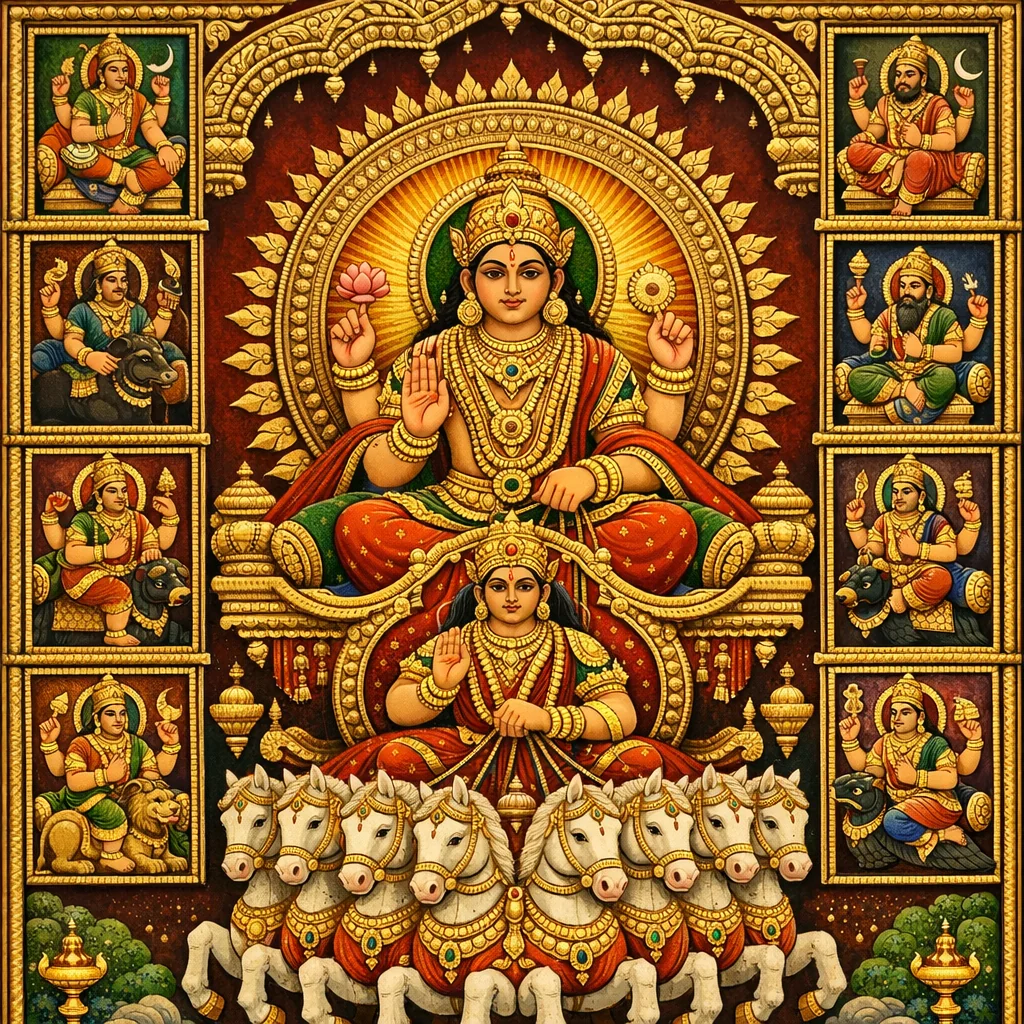
Continuing from the prior chapter on Devī images, Lord Agni describes Sūrya and the divine arrangements essential for temple installation and āvaraṇa design. He prescribes Sūrya’s canonical chariot form—seven horses, a single wheel, lotus emblems and auxiliary implements—along with threshold/side attendants (such as Piṅgala with a staff, fan-bearers) and a consort termed “niṣprabhā” (lusterless), reflecting a specific ritual-aesthetic convention. An alternate form depicts Sūrya mounted on a horse, granting boons and holding lotuses. The teaching then expands to the cosmic perimeter: Dikpālas and intermediate-direction deities are placed in ordered positions (notably on a lotus with a specified petal structure), each with distinct weapons and attributes. The chapter lists solar names and aspects, zodiacal/monthly stations, and varied color-types, integrating mantra/nyāsa logic with visual form. It proceeds to Navagraha iconography (Moon through Ketu) and includes nāga lists and protective/liminal beings—kinnaras, vidyādharas, piśācas, vetālas, kṣetrapālas, pretas—showing how sacred space is completed by a full hierarchy of beneficent, regulatory, and apotropaic figures.
Shlokas
Verse 1
इत्य् आदिमहापुराणे आग्नेये देवीप्रतिमालक्षणं नाम पञ्चाशो ऽध्यायः अथ एकपञ्चाशो ऽध्यायः सूर्यादिप्रतिमालक्षणं भगवानुवाच ससप्ताश्वे सैकचक्रे रथे सूर्यो द्विपद्मधृक् मसीभाजनलेखन्यौ बिभ्रत्कुण्डी तु दक्षिणे
Thus, in the Agni Purāṇa—the primordial great Purāṇa—the fiftieth chapter, called “The characteristics of the Goddess-images,” is concluded. Now begins the fifty-first chapter, “The characteristics of the images of Sūrya and others.” The Blessed Lord said: “Sūrya should be depicted on a chariot drawn by seven horses, having a single wheel; he should hold two lotuses. He should bear an inkpot and a writing stylus, and also a kuṇḍī, a water-pot, on his right side.”
Verse 2
वामे तु पिङ्गलो द्वारि दण्डभृत् स रवेर्गणः शिवाच्युतेति ख, चिह्नितपुस्तकपाठः वज्रदृष्टय इति ख, चिह्नितपुस्तकपाठः महारथ्यो रूपिण्यो ऽप्सरस इति ख, चिह्नितपुस्तकपाठः विस्फोटकरुणर्दन इति ग, ङ, चिह्नितपुस्तकपाठः बालव्यजनधारिण्यौ पार्श्वे राज्ञी च निष्प्रभा
On the left, at the doorway, stands Piṅgala, bearing a staff—an attendant of Ravi (the Sun). At the sides are two youthful attendants holding fans; and the queen (consort) is described as lusterless, devoid of radiance.
Verse 3
अथवाश्वारूढः कार्य एकस्तु भास्करः वरदा द्व्यब्जनः सर्वे दिक्पालास्त्रकराः क्रमात्
Alternatively, the Sun (Bhāskara) should be fashioned as a single figure mounted upon a horse, with hands showing the boon-bestowing gesture and holding two lotuses. Likewise, all the directional guardians (Dikpālas) should, in proper order, be made with weapons in their hands.
Verse 4
मुद्गरशूलचक्राब्जभृतोग्न्यादिविदिक्स्थिताः सूर्यार्यमादिरक्षोन्ताश् चतुर्हस्ता द्विषड्दले
In the intermediate directions beginning with Agni (the south-east), four-armed deities are to be placed, bearing a mace, a trident, a discus, and a lotus. Beginning with Sūrya and Aryamā and ending with the guardian of the north-east, they are arranged upon a lotus with two sets of six petals.
Verse 5
वरुणः सूर्यनामा च सहस्रांशुस् तथापरः धाता तपनसञ्ज्ञश् च सविताथ गभस्तिकः
“(He is called) Varuṇa; and also by the name ‘Sūrya’; and ‘Sahasrāṃśu’ (the thousand-rayed); likewise ‘Apara’; ‘Dhātṛ’; ‘Tapana’ as an epithet; ‘Savitṛ’; and ‘Gabhastika’ (the radiant-rayed one).”
Verse 6
रविश् चैवाथ पर्जन्यस्त्वष्टा मित्रोथ विष्णुकः मेषादिराशिसंस्थाश् च मार्गादिकार्त्तिकान्तकाः
Ravi, Parjanya, Tvaṣṭṛ, Mitra, and also Viṣṇuka—these are stationed over the zodiacal signs beginning with Aries (Meṣa); and the corresponding divisions run from Mārgaśīrṣa up to the end of Kārttika.
Verse 7
कृष्णो रक्तो मनाग्रक्तः पीतः पाण्डरकः सितः कपिलः पीतवर्णश् च शुकाभो धवलस् तथा
Black; red; slightly reddish; yellow; pale-reddish (or whitish-fawn); white; tawny (kapila); yellow-hued; parrot-like green; and likewise bright white—these are the named color-types.
Verse 8
धूम्रो नीलः क्रमाद्वर्णाः शक्तयः केशराग्रगाः इडा सुषुम्ना विश्वार्चिरिन्दुसञ्ज्ञा प्रमर्दिनी
Their colors, in order, are smoky and blue. These Powers (Śaktis) move at the tip of the hair-tuft; they are called Iḍā, Suṣumnā, Viśvārcis, Indu, and Pramardinī.
Verse 9
प्रहर्षिणी महाकाली कपिला च प्रबोधनी नीलाम्बरा घनान्तस्था अमृताख्या च शक्तयः
The Powers (Śaktis) are: Praharṣiṇī, Mahākālī, Kapilā, Prabodhanī, Nīlāmbarā, Ghanāntasthā, and the one called Amṛtā.
Verse 10
वरुणादेश् च तद्वर्णाः केशराग्रेषु विन्यसेत् तेजश् चण्डो महावक्रो द्विभुजः पद्मखद्गभृत्
One should place (nyāsa) Varuṇa’s syllabic assignment and its corresponding colors upon the tips of the hair. (Meditate on him as) radiant, fierce, greatly curved in form, two-armed, bearing a lotus and a sword.
Verse 11
कुण्डिकाजप्यामालीन्दुः कुजः शक्त्यक्षमालिकः बुधश्चापाक्षपाणिः स्याज्जीवः कुण्ड्यक्षमालिकः
The Moon (Indu) is to be depicted holding a water-pot (kuṇḍikā) and a rosary for japa. Mars (Kuja) holds a spear (śakti) and a rosary. Mercury (Budha) should be shown with a bow and a rosary in his hands. Jupiter (Jīva) holds a water-pot and a rosary.
Verse 12
प्रवर्धनी इति ङ, चिह्नितपुस्तकपाठः महारक्त इति ख, चिह्नितपुस्तकपाठः मार्तण्डश् च महारक्त इति ङ, चिह्नितपुस्तकपाठः पद्मखड्गधृगिति ग, घ, चिह्नितपुस्तकपुस्तकपाठः खड्गचर्मभृदिति ङ, चिह्नितपुस्तकपाठः शुक्रः कुण्ड्यक्षमाली स्यात् किण्किणीसूत्रवाञ्छनिः अर्धचन्द्रधरो राहुः केतुः खड्गी च दीपभृत्
[(Variant readings noted in the marked manuscripts: “pravardhanī”; “mahārakta”; “mārtaṇḍa and mahārakta”; “bearing a lotus and a sword”; “bearing a sword and a shield/armour”.)] Venus (Śukra) should be depicted wearing an ear-ornament and an akṣa-bead rosary (akṣa-mālā), adorned with a girdle/cord set with small bells. Rāhu bears the crescent-moon emblem. Ketu is sword-bearing and also holds a lamp.
Verse 13
अनन्तस्तक्षकः कर्कः पद्मो महाब्जः शङ्खकः कुलिकः सूत्रिणः सर्वे फणवक्त्रा महाप्रभाः
Ananta, Takṣaka, Karka, Padma, Mahābja, Śaṅkhaka, Kulika, and Sūtrin—these are all great, radiant Nāgas, whose faces are crowned with hoods.
Verse 14
इन्द्रो वज्री गजारूढश्छागगोग्निश् च शक्तिमान् यमो दण्डी च महिषे नैरृतः खड्गवान् करे
Indra wields the vajra and is mounted upon an elephant. Agni rides a goat, mighty, bearing the śakti (spear). Yama, holding the daṇḍa (staff), rides a buffalo. Nairṛta holds a sword in his hand.
Verse 15
मकरे वरुणः पाशी वायुर्ध्वजधरो मृगे गदी कुवेरो मेषस्थ ईशानश् च जटी वृषे
In Makara (Capricorn) is Varuṇa, bearing the pāśa (noose); in Dhanu (Sagittarius) is Vāyu, holding the dhvaja (banner); in Meṣa (Aries) is Kubera, carrying the gadā (mace); and in Vṛṣa (Taurus) is Īśāna, wearing matted locks (jaṭā).
Verse 16
द्विबाहवो लोकपाला विश्वकर्माक्षसूत्रभृत् हनूमान् वज्रहस्तः स्यात् पद्भ्यां सम्पीडिताश्रयः
The Lokapālas should be depicted as two-armed. Viśvakarman is to be shown holding an akṣa-sūtra (rosary). Hanūmān should be shown with a vajra in his hand, and with both feet pressing down upon a supporting base (or a subdued support).
Verse 17
वीणाहस्ताः किन्नराः स्युर्मालाविद्याधराश् च खे दुर्बलाङ्गाः पिशाचाः स्युर्वेताला विकृताननाः क्षेत्रपालाः शूलवन्तः प्रेता महोदराः कृशाः
The Kinnaras are said to have vīṇās in their hands; and the Vidyādharas in the sky bear mālās (garlands). The Piśācas are said to have feeble limbs; the Vetālas have distorted faces. The Kṣetrapālas bear śūlas (spears/tridents); the Pretas are gaunt, with large bellies.
Frequently Asked Questions
Canonical iconographic specification: Sūrya’s vehicle (seven horses, single wheel), hand-held emblems/implements (lotuses, inkpot, stylus, water-pot), named attendants (Piṅgala, fan-bearers), and ordered āvaraṇa placement of Dikpālas/vidik-deities with defined weapons and lotus-petal arrangement; plus Navagraha attribute-mapping for image-making.
By treating image-form, placement, and attendant hierarchies as dharmic ‘applied theology’: correct pratimā-lakṣaṇa and āvaraṇa ordering sacralize space, support disciplined visualization (dhyāna), and align ritual action with cosmic guardianship—integrating worldly craft (śilpa/vāstu) with inner purification toward the puruṣārthas, including mokṣa.