Adhyaya 85
Pratiṣṭhā-Kalaśa-Śodhana-Ukti (Instruction on Purifying the Consecration Pitcher) — Chapter 85
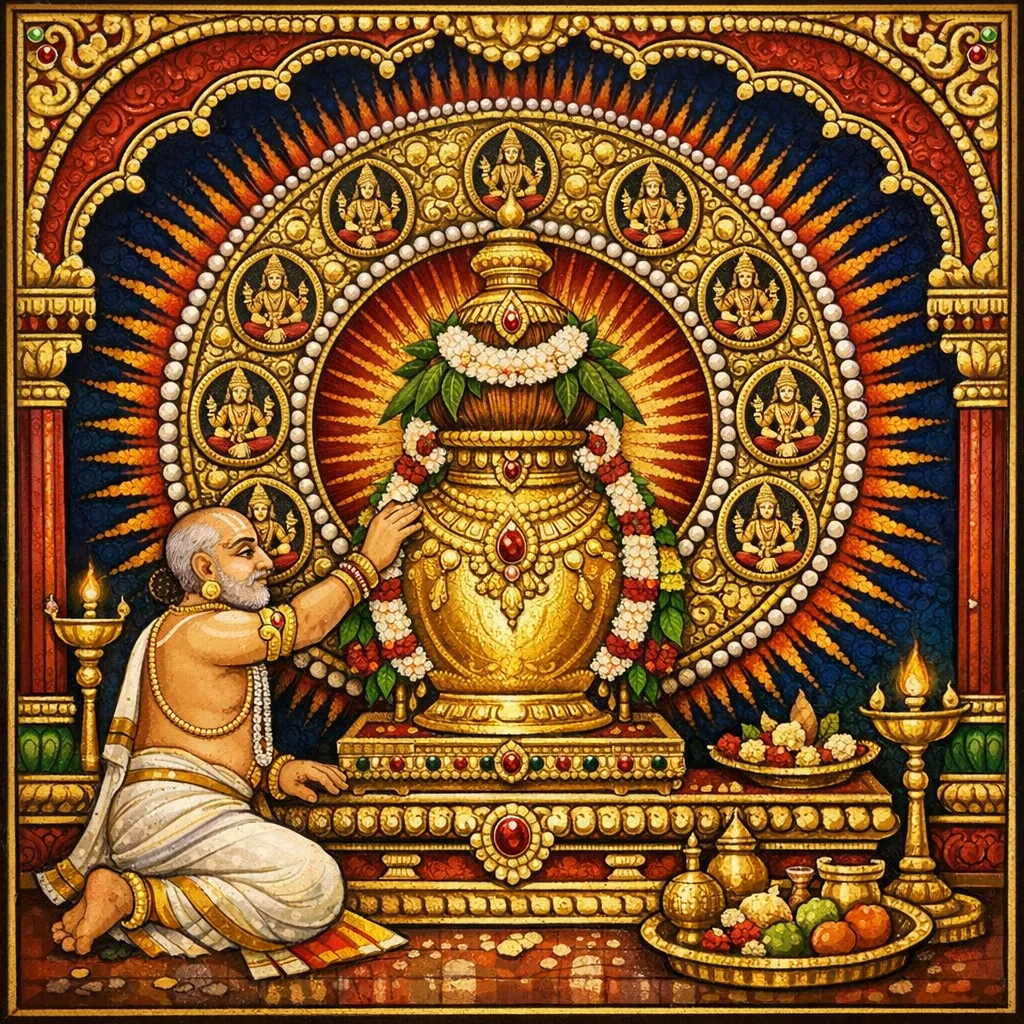
This chapter follows the purification of the Nivṛtti-kalā and turns to a technical Isāna-kalpa rite: purifying and activating the consecration water-pot (pratiṣṭhā-kalaśa). Īśvara teaches a sandhāna, a ritual “joining” of pure and impure principles through regulated phonetic measures (short/long) and through stages of sound—nāda, no-sound, and sound’s cessation—thus linking mantra-phonology with tattva-śuddhi. The cosmology is then installed in the consecration-space: the tattvas are contemplated as seated there (including puruṣa as the “twenty-fourth,” completing the full count of twenty-five), together with a prescribed akṣara series. A long catalogue of Rudra-forms and their associated worlds follows, serving as a protective and ontological grid for the pratiṣṭhā. The procedure becomes initiatory: the thread is led into the body, the binding power (pāśa) is separated and transferred into the kumbha by mudrā and breath-control, and Viṣṇu is invoked as the adhikāra-holder to authorize dīkṣā. The chapter ends with expiatory japa, weapon-mantras to cut bonds, homa counts, surrender of entitlement, and final purification through pūrṇāhuti, declaring the pratiṣṭhā “purified.”
Shlokas
Verse 1
निवृत्तिकलाशोधनं नाम चतुरशीतितमो ऽध्यायः शिवात्मनेति ख, चिह्नितपुस्तकपाठः दग्धनिःशेषपाशस्य इति ख, ङ, चिह्नितपुस्तकपाठः अथ पञ्चाशीतितमो ऽध्यायः प्रतिष्ठाकलाशोधनोक्तिः ईश्वर उवाच तत्त्वयोरथ सन्धानं कुर्याच्छुद्धविशुद्धयोः ह्रस्वदीर्घप्रयोगेण नादनादान्तसङ्गिना
“(Here ends) the chapter called ‘Purification of the Nivṛtti-kalā’ (the eighty-fourth chapter). (In marked manuscripts, variant readings occur: ‘unto Śivātman’ / ‘of him whose bonds are burnt away without remainder’.) Now begins the eighty-fifth chapter: ‘Instruction on the purification of the consecration water-pot (pratiṣṭhā-kalaśa).’ The Lord said: ‘Then one should effect the joining (sandhāna) of the two principles—the pure and the impure—by employing short and long phonetic measures, accompanied by sound (nāda), no-sound (anāda), and the limit/end of sound (nāda-anta).’”
Verse 2
ॐ हां ह्रूं हांअप्तेजो वायुराकाशं तन्मात्रेन्द्रियबुद्धयः गुणत्रयमहङ्कारश् चतुर्विंशः पुमानिति
“Om—hāṃ hrūṃ hāṃ”; then (are set forth) water, fire, wind, and ether; the tanmātras (subtle elements), the indriyas (sense-faculties), and buddhi (intellect); the three guṇas and ahaṅkāra (egoity): thus is declared the “twenty-fourth,” the Person, Puruṣa.
Verse 3
प्रतिष्ठायां निविष्ठानि तत्त्वान्येतानि भावयेत् पञ्चविंशतिसङ्ख्यानि खादियान्ताक्षराणि च
During the consecration (pratiṣṭhā), one should contemplate these principles (tattvas) as being installed there—twenty-five in number—and also the syllables beginning with “kha” and ending with “ya”.
Verse 4
पञ्चाशदधिका षष्टिर्भुवनैस्तुल्यसञ्ज्ञिताः तावन्त एव रुद्राश् च विज्ञेयास्तत्र तद्यथा
The worlds (bhuvanas) are sixty-five in number, designated by corresponding names; and exactly that many Rudras are to be understood as present there—namely, as follows.
Verse 5
अमरेशः प्रभावश् च नेमिषः पुष्करो ऽपि च तथा पादिश् च दण्डिश् च भावभूतिरथाष्टमः
Amareśa, Prabhāva, Nemiṣa, and also Puṣkara; likewise Pādi and Daṇḍin—then Bhavabhūti as the eighth authority.
Verse 6
नकुलीशो हरिश् चन्द्रः श्रीशैलो दशमः स्मृतः अन्वीशो ऽस्रातिकेशश् च महाकालो ऽथ मध्यमः
Nakulīśa, Hari, and Candra—Śrīśaila is remembered as the tenth. And there are also Anvīśa and Asrātikeśa; then Mahākāla, who stands in the middle of the enumeration.
Verse 7
केदारो भैरवश् चैव द्वितीयाष्टकमीरितं ततो गयाकुरुक्षेत्रखलानादिकनादिके
“Kedāra and Bhairava”—this is declared as the second set of eight; thereafter are mentioned Gayā, Kurukṣetra, and other holy places beginning with Khalāna and Kanādikā.
Verse 8
विमलश्चाट्टहासश् च महेन्द्रो भाम एव च वस्वापदं रुद्रकोटिरवियुक्तो महावन्तः
He is Vimalā (the Spotless One) and Āṭṭahāsa (the One of thunderous laughter); he is Mahendra and Bhāma; he is Vasvāpada (the Abode of the Vasus); he is Rudrakoṭi, Aviyukta, and Mahāvanta (the Great and Mighty One).
Verse 9
गोकर्णो भद्रकर्णश् च स्वर्णाक्षः स्थाणुरेव च अजेशश् चैव सर्वज्ञो भास्वरः सूदनान्तरः
He is Gokarṇa and Bhadrakarṇa; he is Svarṇākṣa (the Golden‑eyed) and also Sthāṇu (the Immovable One). He is Ajeśa (Lord of the Unborn), indeed omniscient; he is Bhāsvara (Radiant), and Sūdanāntara (the Slayer who brings an end to foes).
Verse 10
सुबाहुर्मत्तरूपी च विशालो जटिलस् तथा ॐ हां हूं हूं हामिति ख, चिह्नितपुस्तकपाठः अल्पीशो भ्रान्तिकेशश्चेति ङ, चिह्नितपुस्तकपाठः विमलश् चण्डहासश्चेति ङ, चिह्नितपुस्तकपाठः रौद्रो ऽथ पिङ्गलाक्षश् च कालदंष्ट्री भवेत्ततः
(He is) Subāhu (“mighty-armed”), Mattarūpī (“of an intoxicated/frenzied form”), Viśāla (“vast”), and Jaṭila (“matted-haired”). In certain marked manuscript readings, a bīja-style utterance occurs: “Oṃ hāṃ hūṃ hūṃ hām.” Also, in marked readings: Alpīśa (“lord of the small/lesser”), Bhrāntikeśa (“with dishevelled/wandering hair”), Vimala (“stainless”), and Caṇḍahāsa (“fierce laughter”). Then (he is) Raudra (“terrible”), Piṅgalākṣa (“tawny-eyed”), and thereafter Kāladaṃṣṭrī (“with time/death-like fangs”).
Verse 11
विदुरश् चैव घोरश् च प्राजापत्यो हुताशनः कामरूपी तथा कालः कर्णो ऽप्यथ भयानकः
And (he is called) Vidura, and also Ghora; (he is) Prajāpatya, and Hutāśana, the consumer of offerings. (He is) Kāmarūpī, assuming forms at will; likewise Kāla (Time/Death); also Karṇa; and then (he is) Bhayānaka, the Terrifying.
Verse 12
मतङ्गः पिङ्गलश् चैव हरो वै धातृसज्ञकः शङ्कुकर्णो विधानश् च श्रीकण्ठश् चन्द्रशेखरः
He is (called) Mataṅga; and Piṅgala; indeed Hara; known as Dhātṛ; Śaṅku-karṇa; and Vidhāna; Śrīkaṇṭha; and Candraśekhara.
Verse 13
सहैतेन च पर्यन्ताः कथ्यन्ते ऽथ पदान्यपि ं ज्योतिः ॐ पुरुष ॐ अग्ने ॐ अधूम ॐ अभस्म ॐ अनादि ॐ नाना ॐ धूधू ॐ भूः ॐ भुवः ॐ स्वः अनिधन निधनोद्भव शिव शर्व परमात्मन् महेश्वर महादेव सद्भावेश्वर महातेजः योगाधिपतये मुञ्च प्रथम सर्व सर्वेसर्वेति द्वात्रिंशत् पदानि वीजभावे त्रयो मन्त्रा वामदेवः शिवः शिखा
Along with these, the concluding portions are also stated; and now the mantra-words too are given: “ṃ jyotiḥ; oṃ puruṣa; oṃ agne; oṃ adhūma; oṃ abhasma; oṃ anādi; oṃ nānā; oṃ dhūdhū; oṃ bhūḥ; oṃ bhuvaḥ; oṃ svaḥ; anidhana; nidhanodbhava; śiva; śarva; paramātman; maheśvara; mahādeva; sadbhāveśvara; mahātejaḥ; (salutation) to the Lord of Yoga; ‘muñca’; ‘prathama’; ‘sarva’; ‘sarve-sarva’”—these are thirty-two words. In the form of bīja (seed) there are three mantras: Vāmadeva, Śiva, and Śikhā.
Verse 14
गान्धारी च सुषुम्णा च नाड्यौ द्वौ मारुतौ तथा समानोदाननामानौ रसनापायुरिन्द्रिये
Gāndhārī and Suṣumṇā are two nāḍīs (subtle channels); likewise there are two vital winds (mārutas) named Samāna and Udāna, and (these are connected with) the faculties of taste (the tongue) and excretion (the anus).
Verse 15
रसस्तु विषयो रूपशब्दस्पर्शरसा गुणाः मण्डलं वर्तुलं तच्च पुण्डरीकाङ्कितं सितं
Taste (rasa) is an object of perception; form, sound, touch, and taste are the sensory qualities. A circular figure is called a maṇḍala; it is round, marked with a lotus-emblem, and white.
Verse 16
स्वप्नावस्थाप्रतिष्ठायां कारणं गरुडध्वजं प्रतिष्ठान्तकृतं सर्वं सञ्चिन्त्य भुवनादिकं
In the consecration performed in the dream-state (visualization), one should contemplate Garuḍa-bannered Viṣṇu as the supreme causal principle; having mentally completed all the concluding acts of installation, one should also envision the worlds and the rest of the cosmic order.
Verse 17
सूत्रं देहे स्वमन्त्रेण प्रविश्यैनां वियोजयेत् ं ह्रां हां प्रतिष्ठाकलापाशाय नम इत्य् अनेनोद्भवमुद्रया रेचकेन कुम्भे समारोपयेत् ॐ हां ह्रीं प्रतिष्ठाकलापाशाय नम इत्य् अनेनार्चयित्वा सम्पूज्य स्वाहान्तेनाहुतीनां त्रयेण सन्निधाय ततः ॐ हां विष्णवे नम इति विष्णुमावाह्य सम्पूज्य सन्तर्प्य विष्णो तवाधिकारे ऽस्मिन् मुमुक्षुं दीक्षयाम्यहं
Having caused the consecration-thread (sūtra) to enter into the body by one’s own mantra, one should separate “her,” the binding/ensnaring power. With the formula “hrāṃ hāṃ, obeisance to Pratiṣṭhā-kalāpāśa,” and by means of the Udbhava-mudrā, during exhalation (recaka) one should raise that power and install it into the ritual pitcher (kumbha). Then, with the mantra “oṃ hāṃ hrīṃ, obeisance to Pratiṣṭhā-kalāpāśa,” having worshipped and fully honoured it, and having established its presence by three oblations ending in svāhā, thereafter one should invoke Viṣṇu with “oṃ hāṃ viṣṇave namaḥ,” worship and satisfy him with offerings, saying: “O Viṣṇu, within your jurisdiction here, I initiate this seeker of liberation.”
Verse 18
भाव्यं त्वयानुकूलेन विष्णुं विज्ञापयेदिति ततो वागीश्वरीं देवीं वागीशमपि पूर्ववत्
“What is to be brought about should be accomplished with your favor”—thus one should petition Viṣṇu. Thereupon, as before, one should also petition the goddess Vāgīśvarī and Vāgīśa as well.
Verse 19
आवाह्याभ्यर्च्य सन्तर्प्य शिष्यं वक्षसि ताडयेत् ॐ हां हां हं फट्प्रविशेदप्यनेनैव चैतन्यं विभजेत्ततः
Having invoked, worshipped, and satisfied (it with offerings), one should strike the disciple upon the chest; uttering “oṃ hāṃ hāṃ haṃ phaṭ,” one should then enter (him) by this very mantra, and thereafter apportion/awaken consciousness (caitanya) within him.
Verse 20
शस्त्रेण पाशसंयुक्तं ज्येष्टयाङ्कुशमुद्रया ॐ हां हं हों ह्रूं फट् स्वाहान्तेन हृदाकृष्य तेनैव पुटितात्मना
Having empowered a weapon fitted with a noose (pāśa), and employing Jyeṣṭhā’s elephant-goad (aṅkuśa) hand-gesture, one should draw the target into one’s heart with the mantra ending in “svāhā”—“oṃ hāṃ haṃ hoṃ hrūṃ phaṭ svāhā”; then, by that very mantra-power, with the self inwardly sealed/protected (puṭita-ātmā), one proceeds with the rite.
Verse 21
गृहीत्वा तं नमोन्तेन निजात्मनि नियोजयेत् ॐ हां हं हों आत्मने नमः पूर्ववत् पितृसंयोगं भावयित्वोद्भवाख्यया
Having taken that mantra (or seed-syllable), one should apply it to one’s own Self by appending the concluding homage-formula: “oṃ hāṃ haṃ hoṃ—ātmanē namaḥ” (“obeisance to the Self”). Then, as before, having contemplated union with the Pitṛs (ancestral spirits), one should perform the visualization called “Udbhava” (the contemplation of arising/origination).
Verse 22
वामया तदनेनैव देवीगर्भे विनिक्षिपेत् ॐ हां हं हां आत्मने नमः देहोत्पत्तौ हृदा ह्य् एवं शिरसा जन्मना तथा
With the left hand, by this very procedure/mantra, one should place the power/seed into the Goddess’s womb. (Recite:) “oṃ hāṃ haṃ hāṃ—ātmanē namaḥ” (“obeisance to the Self”). For the generation of the body, this is done with (the mantra placed in) the heart; likewise, for birth, with (the mantra placed in) the head.
Verse 23
ं हः फट् इति ख, ङ, चिह्नितपुस्तकद्वयपाठः ॐ हां हं हां हूं फट् इति ख, चिह्नितपुस्तकपाठः निवेदयेदिति ख, चिह्नितपुस्तकपाठः ॐ हां हं हां इति ख, ङ, चिह्नितपुस्तकपाठः भावयित्वा तु दक्षयेति ख, चिह्नितपुस्तकपाठः शिखया वाधिकाराय भोगाय कवचाणुना तत्त्वशुद्धौ हृदा ह्य् एवं गर्भाधानाय पूर्ववत्
“ṃ haḥ phaṭ”—so is the reading (in the Kha and Ṅa recensions, and in two marked manuscripts). In one marked manuscript the reading is “oṃ hāṃ haṃ hāṃ hūṃ phaṭ”. In a marked manuscript it is also read as “nivedayet” (“one should offer/present”). In the Kha and Ṅa recensions a marked manuscript reads “oṃ hāṃ haṃ hāṃ”. A marked manuscript also reads “bhāvayitvā tu dakṣaye” (“having meditated, [one should] burn/consume”). Using the śikhā (head-tuft) mantra for gaining eligibility/authority, the kavaca (armour) mantra for enjoyment/protection, and the hṛd (heart) mantra for the purification of the principles (tattva-śuddhi)—in this very manner, for the rite of garbha-dhāna (conception) too, one should proceed as previously stated.
Verse 24
शिरसा पाशशैथिल्ये निष्कृत्यैवं शतं जपेत् एवं पाशवियोगे ऽपि ततः शास्त्रजप्तया
For the loosening of the noose (bond) of the pāśa, having performed the expiatory act in this manner, one should recite it a hundred times with the head bowed (in reverence). Likewise, even for complete release from the bond, it is thereafter to be accomplished by recitation in accordance with the injunction of the śāstra.
Verse 25
छिन्द्यादस्त्रेण कर्तर्या कलावीजवता यथा ॐ ह्रीं प्रतिष्ठाकलापाशाय हः फट् विसृज्य वर्तुलीकृत्य पाशमन्त्रेण पूर्ववत्
He should cut it with the weapon-mantra (Astra), as with ritual scissors endowed with the Kalā bīja-syllable. Uttering, “Oṃ Hrīṃ—unto the consecration-Kalā noose—Haḥ Phaṭ,” he should cast it forth, shape it into a circle, and then, with the Pāśa (noose) mantra, proceed as previously prescribed.
Verse 26
घृतपूर्णे श्रवे दत्वा कलास्त्रेणैव होमयेत् अस्त्रेण जुहुयात् पञ्च पाशाङ्कुरनिवृत्तये
Having placed the offering in a ladle filled with ghee (ghṛta), one should perform the fire-offering (homa) with the Kalā-astra; then one should offer oblations five times with the Astra (weapon-mantra), for nivṛtti—the cessation of the sprouting of the bonds (pāśa-aṅkura).
Verse 27
प्रायश्चित्तनिषेधार्थं दद्यादष्टाहुतीस्ततः ॐ हः अस्त्राय ह्रूं फठृदावाह्य हृषीकेशं कृत्वा पूजतर्पणे
Then, to avert the fault that would call for expiation (prāyaścitta), one should offer eight oblations. Having invoked Hṛṣīkeśa (Viṣṇu) into the heart with the mantra “Oṃ haḥ—unto the Astra, hrūṃ, phaṭ,” one should proceed with worship and with tarpaṇa (libation-offerings).
Verse 28
पूर्वोक्तविधिना कुर्यादधिकारसमर्पणं ॐ हां रसशुल्कं गृहाण स्वाहा निःशेषदग्धपाशस्य पशोरस्य हरे त्वया
One should perform the surrender of ritual entitlement (adhikāra-samarpaṇa) according to the method stated earlier: “Oṃ hāṃ—accept the rasa-śulka (fee/oblation), svāhā. By you, O Hara, may the bonds of this sacrificial victim—completely burned without remainder—be removed.”
Verse 29
न स्थेयं बन्धकत्वेन शिवाज्ञां श्रावयेदिति ततो विसृज्य गोविन्दं विद्यात्मानं नियोज्य च
“One should not remain there in a state of bondage; rather, one should proclaim Śiva’s injunction.” Therefore, having dismissed Govinda, one should appoint the one whose very self is knowledge (vidyātmān)—that is, a learned officiant—to the task.
Verse 30
बाहुमुक्तार्धदृश्येन चन्द्रविम्बेन सन्निभं संहारमुद्रया स्वस्थं विधायोद्भवमुद्रया
With a hand-form in which the arm is partly released and only half is visible, resembling the orb of the moon, one should first steady the rite or the deity’s form by the Saṃhāra-mudrā; then one should bring about its manifestation by the Udbhava-mudrā.
Verse 31
सूत्रे संयोज्य विन्यस्य तोयविन्दुं यथा पुरा विसृज्य पितरौ वह्नेः पूजितौ कुसुमादिभिः वर्धनीकृत्येति ख, चिह्नितपुस्तकपाठः संहारमद्रयात्मस्थं इति ख, चिह्नितपुस्तकपाठः दद्यात् पूर्णां विधानेन प्रतिष्ठापि विशोधिता
Having joined it to the sacred thread and placed it as prescribed, one should set down a drop of water as done earlier. Then, having performed the visarjana (dismissal) of the Pitṛs (Fathers/ancestors) and worshipped Agni with flowers and the like, one should duly offer the complete oblation (pūrṇāhuti) according to rule; thereby even the pratiṣṭhā (consecration/installation rite) is purified.
Frequently Asked Questions
The pratiṣṭhā-kalaśa (consecration water-pot) and the ritual field around it, through tattva-śuddhi, mantra-phonology (nāda/anāda), mudrā, homa, and bond-removal (pāśa-viyoga) procedures.
Viṣṇu is invoked as the adhikāra-holder within whose jurisdiction the mumukṣu is initiated, integrating authorization (adhikāra), protection, and cosmic governance into the consecration workflow.
Cosmological categories (tattvas, bhuvanas, Rudra forms) are contemplated as installed in the consecration space, making the pratiṣṭhā a microcosmic reconstitution of the macrocosm.
Mantra-bīja sequences, mudrās (Udbhava, Saṃhāra, Jyeṣṭhā-aṅkuśa), breath-linked operations (recaka/kumbha), astra/pāśa cutting, and specified japa/homa counts for purification and bond-release.