Adhyaya 59
Chapter 59 — अधिवासनकथनं (Adhivāsana: The Rite of Inviting and Stabilizing Hari’s Presence)
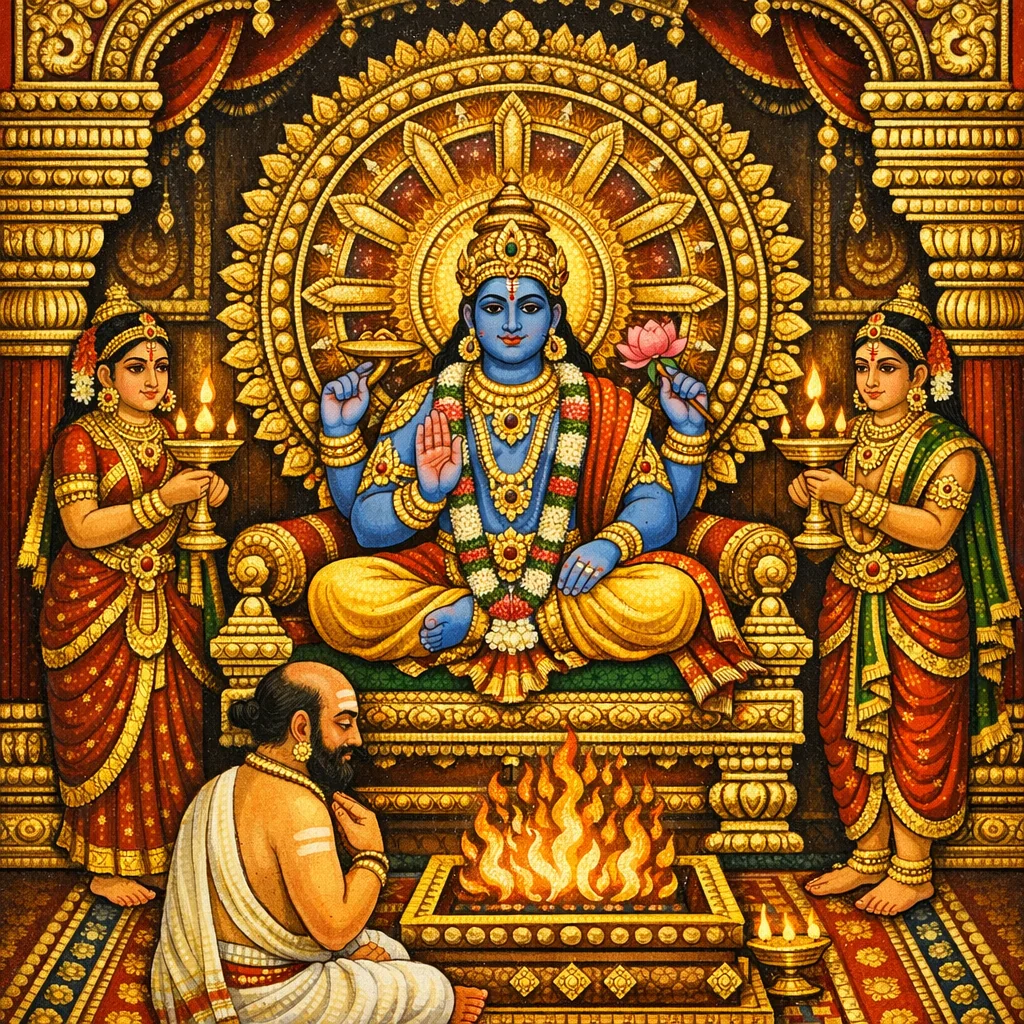
Chapter 59 defines adhivāsana as the ritual procedure that brings about and stabilizes Hari’s (Viṣṇu’s) presence for installation rites. Agni begins with inner discipline: the officiant yokes awareness to Oṁ, recenters consciousness, and performs a graded laya (re-absorption)—earth into wind, wind into space, space into mind, mind into ahaṅkāra, ahaṅkāra into mahat, and mahat into the unmanifest (avyakta), known as Vāsudeva, pure knowledge. The chapter then reverses into creation-mapping (Vyūha/cosmogenesis), listing tanmātras, senses, organs of action, and the gross body so the cosmos may be ritually “rebuilt” as a consecrated body. It teaches detailed mantra-nyāsa assigning bīja syllables to tattvas and body-loci, followed by Vaiṣṇava name-nyāsa (Keśava–Dāmodara) and ṣaḍaṅga-nyāsa. A mandala sequence (twelve-spoked cakra, solar and lunar kalās, retinue worship) culminates in installing Hari in the icon, kindling the Vaiṣṇava fire, performing homa and śānti rites, establishing sacred rivers, feeding brāhmaṇas, offering bali to the dikpatis, and keeping a night vigil with sacred recitation—thus consecrating every portion of the rite through adhivāsana.
Shlokas
Verse 1
इत्य् आदिमहापुराणे आग्नेये स्नपनादिविधानं नाम अष्टपञ्चाशो ऽध्यायः अथोनषष्टितमो ऽध्यायः अधिवासनकथनं भगवानुवाच हरेः सान्निध्यकरणमधिवासनमुच्यते सर्वज्ञं सर्वगं ध्यात्वा आत्मानं पुरुषोत्तमं
Thus, in the Ādi-Mahāpurāṇa, the Agni Purāṇa, ends the fifty-eighth chapter entitled “The Procedure for Ritual Bathing (Snāpana) and Related Rites.” Now begins the fifty-ninth chapter, “The Description of Adhivāsana.” The Blessed Lord said: “Adhivāsana is called the rite that effects the (ritual) presence of Hari. Having meditated on the Supreme Person—omniscient and all-pervading—and with one’s own self collected and purified, one should proceed toward the Supreme Puruṣottama.”
Verse 2
ओंकारेण समायोज्य चिच्छक्तिमभिमानिनीं निःसार्यात्मैकतां कृत्वा स्वस्मिन् सर्वगते विभौ
Having yoked the mind with the syllable Oṃ, and drawing inward the consciousness-power (cit-śakti) that identifies itself as an individual, one should establish the oneness of the Self—abiding in one’s own all-pervading, omnipotent Lordly Self.
Verse 3
योजयेन्मरुतां पृथ्वीं वह्निवीजेन दीपयेत् संहरेद्वायुना चाग्निं वायुमाकाशतो नयेत्
One should merge Earth into the Wind principle; by the seed-syllable of Fire one should kindle the inner fire. Then, by means of Wind one should withdraw Fire, and one should lead Wind into Ether (Space).
Verse 4
मतिशालिनीमिति ख, चिह्नितपुस्तकपाठः कृत्वा पुंसीति ङ, चिह्नितपुस्तकपाठः अधिभूतादिदेवैस्तु साध्याख्यैर् विभवैः सह तन्मात्रपात्रकान् कृत्वा संहरेत्तत् क्रमाद् बुधः
Having mentally arranged the adhibhūtas and the presiding deities together with the powers known as the Sādhyas, the wise practitioner should, step by step, effect their re-absorption—having made them into receptacles of the tanmātras, the subtle sense-elements.
Verse 5
आकाशं मनसाहत्य मनोहङ्करणे कुरु अहङ्कारञ्च महति तञ्चाप्यव्याकृते नयेत्
Having withdrawn space into the mind by the mind, place the mind into egoity (ahaṅkāra). Then merge egoity into the Great Principle (mahat), and lead even that into the Unmanifest (avyākṛta).
Verse 6
अव्याकृतं ज्ञानरूपे वासुदेवः स ईरितः स तामव्याकृतिं मायामभ्यष्ट सिसृक्षया
Vāsudeva is declared to be the Unmanifest (avyākṛta) in the form of pure consciousness/knowledge (jñāna). Desiring to create, he set in motion that unmanifest Māyā, the primordial power.
Verse 7
सङ्कर्षणं सं शब्दात्मा स्पर्शाख्यमसृजत् प्रभुः क्षोभ्य मायां स प्रद्युम्नं तेजोरूपं स चासृजत्
The Lord—as Saṅkarṣaṇa, whose essence is sound—brought forth the principle known as Touch (sparśa). Then, having stirred Māyā, he also produced Pradyumna, whose form is radiance (tejas).
Verse 8
अनिरुद्धं रसमात्रं ब्रह्माणं गन्धरूपकं अनिरुद्धः स च ब्रह्मा अप आदौ ससर्ज ह
Aniruddha is identified with the principle of taste alone (rasa); Brahmā is identified with the principle whose form is scent (gandha). That very Aniruddha—together with Brahmā—created the waters (āp) in the beginning.
Verse 9
तस्मिन् हिरण्मयञ्चाण्डं सो ऽसृजत् पञ्चभूतवत् तस्मिन् सङ्क्रामिते जीवे शक्तिरात्मोपसंहृता
Within that state, he created a golden cosmic egg (hiraṇmaya aṇḍa), constituted of the five great elements (pañca-bhūta). When the individual living being (jīva) entered into it, the creative power (śakti) was withdrawn back into the Self (Ātman).
Verse 10
प्राणो जीवेन संयुक्तो वृत्तिमानिति शब्द्यते जीवोव्याहृतिसञ्ज्ञस्तु प्राणेष्वाध्यात्मिकः स्मृतः
Prāṇa, when conjoined with the jīva, is termed “endowed with activity (vṛtti).” The jīva—designated as the inner “utterance/affirmation” (vyāhṛti)—is remembered as the indwelling spiritual principle (ādhyātmika) within the vital airs (prāṇas).
Verse 11
प्राणैर् युक्ता ततो बुद्धिः सञ्जाता चाष्टमूर्तिकी अहङ्कारस्ततो जज्ञे मनस्तस्मादजायत
Then, conjoined with the vital breaths (prāṇas), the intellect (buddhi)—of eightfold form—arose; from that arose egoity (ahaṅkāra), and from that, the mind (manas) was born.
Verse 12
अर्थाः प्रजज्ञिरे पञ्च सङ्कल्पादियुतास्ततः शब्दः स्पर्शश् च रूपञ्च रसो गन्ध इति स्मृता
Thereafter, five sense-objects (arthas) arose, accompanied by mentation (saṅkalpa) and the rest: sound (śabda), touch (sparśa), form (rūpa), taste (rasa), and smell (gandha)—so they are remembered.
Verse 13
ज्ञानशक्तियुतान्येतैर् आरब्धानीन्द्रियाणि तु र् इति ङ, चिहिनितपुस्तकपाठः मनसाहृत्य मनो ऽहङ्करणे क्षरे इति घ, चिह्नितपुस्तकपाठः वासुदेवे समाहित इति ङ, इति चिह्नितपुस्तकपाठः सङ्क्रमते जीव इति ख, चिह्नितपुस्तकपाठः चाष्टवृत्तिकीति ङ, चिह्नितपुस्तकपाठः त्वक्श्रोत्रघ्राणचक्षूंषि जिह्वाबुद्धीन्द्रियाणि तु
Endowed with the power of cognition (jñāna-śakti), these faculties are set into operation. And the jīva, drawing them back through the mind (manas), passes into the mind and then into the dissolving ego-principle (ahaṅkāra). When thus gathered and intent on Vāsudeva, the faculties become restrained. The senses are: skin (touch), ear (hearing), nose (smell), eyes (sight), tongue (taste), and buddhi (understanding) as an internal organ.
Verse 14
पादौ पायुःस् तथा पाणी वागुपस्थश् च पञ्चमः कर्मेन्द्रियाणि चैतानि पञ्चभूतान्यतः शृणु
The feet, the anus (pāyuḥ), the hands, speech (vāk), and the generative organ (upastha) as the fifth—these are the five organs of action (karmendriya). Now, therefore, hear about the five great elements (pañca-bhūta).
Verse 15
आकाशवायुतेजांसि सलिलं पृथिवी तथा स्थूलमेभिः शरीरन्तु सर्वाधारं प्रजायते
From these—space, wind, fire, water, and likewise earth—the gross body arises, serving as the support of all embodied functions.
Verse 16
एतेषां वाचका मन्त्रा न्यासायोच्यन्त उत्तमाः जीवभूतं मकारन्तु देवस्य व्यापकं न्यसेत्
For these principles, the mantras that denote them are declared excellent for ritual nyāsa (installation). One should install the syllable “ma”—of the nature of jīva—as the deity’s all-pervading presence.
Verse 17
प्राणतत्त्वं भकारन्तु जीवोपाधिगतं न्यसेत् हृदयस्थं बकारन्तु बुद्धितत्त्वं न्यसेद् बुधः
By nyāsa one should place the principle of vital-breath, prāṇa-tattva, in the syllable “bha”, as associated with the limiting adjunct of the individual soul (jīva-upādhi). The wise should place, in the heart, the syllable “ba” as the principle of intellect, buddhi-tattva.
Verse 18
फकारमपि तत्रैव अहङ्कारमयं न्यसेत् मनस्तत्त्वं पकारन्तु न्यसेत्सङ्कल्पसम्भवं
There itself one should also place (by nyāsa) the syllable “pha” as consisting of the ahaṅkāra-principle; and one should place the syllable “pa” as the mind-principle (manas-tattva), born of intention (saṅkalpa).
Verse 19
शब्दतन्मात्रतत्त्वन्तु नकारं मस्तके न्यसेत् स्पर्शात्मकं धकारन्तु वक्त्रदेशे तु विन्यसेत्
For the principle of the sound-tanmātra (śabda-tanmātra), one should place the syllable “na” upon the head; and for the principle whose nature is touch, one should place the syllable “dha” in the region of the face (mouth).
Verse 20
दकारं रूपतत्त्वन्तु हृद्देशे विनिवेशयेत् थकारं वस्तिदेशे तु रसतन्मात्रकं न्यसेत्
One should install (by nyāsa) the syllable “da,” embodying the principle of form (rūpa-tattva), in the region of the heart. And in the region of the bladder one should place the syllable “tha,” embodying the subtle essence of taste (rasa-tanmātra).
Verse 21
तकारं गन्धतन्मात्रं जङ्घयोर्विनिवेशयेत् णकारं श्रोत्रयोर् न्यस्य ढकारं विन्यसेत्त्वचि
One should install (by nyāsa) the syllable “ta,” as the subtle essence of smell (gandha-tanmātra), in the two shanks. Having placed the syllable “ṇa” in the two ears, one should install the syllable “ḍha” in the skin.
Verse 22
डकारं नेत्रयुग्मे तु रसनायां ठकारकं टकारं नासिकायान्तु ञकारं वाचि विन्यसेत्
One should place the syllable “ḍa” upon the pair of eyes; the syllable “ṭha” upon the tongue; the syllable “ṭa” upon the nose; and the syllable “ña” in the faculty of speech (mouth/voice).
Verse 23
झकारं करयोर् न्यस्य पाणितत्त्वं विचक्षणः जकारं पदयोर् न्यस्य छं पायौ चमुपस्थके
The discerning practitioner should place (by nyāsa) the syllable “jha” upon the two hands, thereby establishing the hand-principle. He should place the syllable “ja” upon the two feet, and place “cha” upon the anus and “ca” upon the generative organ.
Verse 24
विन्यसेत् पृथिवीतत्त्वं ङकारं पादयुग्मके वस्तौ घकारं गं तत्त्वं तैजसं हृदि विन्यसेत्
One should place (by nyāsa) the Earth principle—the seed syllable “ṅa”—upon the pair of feet; upon the region of the pelvis one should place “gha”; and in the heart one should install the fiery principle (tejas) together with the seed “ga”.
Verse 25
मकारन्तद्देहस्येति ङ, चिह्नितपुस्तकपाठः विनियोजयेदिति ङ, चिह्नितपुस्तकपाठः खकारं वायुतत्त्वञ्च नासिकायां निवेशयेत् ककारं विन्यसेन्नित्यं खतत्त्वं मस्तके बुधः
“‘Makāra ends (this formula): for that body’”—so reads the marked manuscript tradition; and likewise, “it should be applied (viniyojya)”—so reads the marked manuscript tradition. The wise practitioner should place the syllable ‘kha’, together with the air-principle (vāyu-tattva), in the nose; and should always place the syllable ‘ka’ and the space/ether principle (kha-tattva) upon the head.
Verse 26
हृत्पुण्डरीके विन्यस्य यकारं सूर्यदैवतं द्वासप्ततिसहस्राणि हृदयादभिनिःसृताः
Having placed (performed nyāsa of) the syllable ‘ya’—whose presiding deity is the Sun—within the lotus of the heart, seventy-two thousand (nāḍīs, subtle channels/flows) emerge forth from the heart.
Verse 27
कलाषोडशसंयुक्तं मकारं तत्र विन्यसेत् तन्मध्ये चिन्तयेन्मन्त्री विन्दुं वह्नेस्तु मण्डलं
There, one should place (perform nyāsa of) the syllable ‘ma’, conjoined with the sixteen kalās. In its very center, the mantra-practitioner should visualize the bindu—the maṇḍala of Agni (the Fire).
Verse 28
हकारं विन्यसेत्तत्र प्रणवेन सुरोत्तमः ॐ आं परमेष्ठ्यात्मने आं नमः पुरुषात्मने
There, the best of the gods should install the syllable ‘ha’ together with the praṇava (Oṃ), reciting: “Oṃ, āṃ—obeisance to the Self whose essence is Parameṣṭhin (the Supreme Lord); āṃ—obeisance to the Self whose essence is Puruṣa (the Cosmic Person).”
Verse 29
ॐ वां मनोनिवृत्त्यात्मने नाञ्च विश्वात्मने नमः ॐ वं नमः सर्वात्मने इत्य् उक्ताः पञ्च शक्तयः
“Oṃ vāṃ—salutation to the Self whose nature is the withdrawal (cessation) of the mind (manonivṛtti); and (salutation) to the Universal Self (Viśvātman). Oṃ vaṃ—salutation to the All-Self (Sarvātman).” Thus are the five Śaktis (power-mantras) declared.
Verse 30
स्थाने तु प्रथमा योज्या द्वितीया आसने मता तृतीया शयने तद्वच्चतुर्थी पानकर्मणि
In the proper place for the rite, the First is to be employed; the Second is prescribed while seated; the Third while lying down; and likewise the Fourth in the act of drinking.
Verse 31
प्रत्यर्चायां पञ्चमी स्यात्पञ्चोपनिषदः स्मृताः हूङ्कारं विन्यसेन्मध्ये ध्यात्वा मन्त्रमयं हरिं
In the subsidiary worship (pratyarcā), the Fifth is prescribed, remembered as the “five upaniṣads,” the five esoteric components. One should install the syllable hūṃ in the center, meditating on Hari as constituted of mantra.
Verse 32
यां मूर्तिं स्थापयेत्तस्मात् मूलमन्त्रं न्यसेत्ततः ॐ नमो भगवते वासुदेवाय मूलकं
Therefore, for whatever icon one installs, one should then perform nyāsa of the root-mantra. The root formula is: “Oṃ—obeisance to the Blessed Lord Vāsudeva.”
Verse 33
शिरोघ्राणललाटेषु मुखकण्ठहृदि क्रमात् भुजयोर्जङ्घयोरङ्घ्य्रोः केशवं शिरसि न्यसेत्
In due sequence—on the head, nose, and forehead; on the face, throat, and heart; on the two arms, the two shanks, and the two feet—one should perform nyāsa, placing Keśava upon the head.
Verse 34
नारायणं न्यसेद्वक्त्रे ग्रीवायां माधवं न्यसेत् अने इत्य् उक्ताः पञ्चशक्तयः इति ङ, चिह्नितपुस्तकपाठः दानकर्मणि इति ङ, चिह्नितपुस्तकपाठः अभ्यर्चायामिति ख, चिह्नितपुस्तकपाठः क्षकारमिति ख, चिह्नितपुस्तकपाठः या मूर्तिः स्थाप्यते तस्यामिति ख, चिह्नितपुस्तकपाठः गोविन्दं भुजयोर्न्यस्य विष्णुं च हृदये न्यसेत्
One should perform nyāsa by placing Nārāyaṇa upon the mouth and Mādhava upon the neck; placing Govinda upon the two arms, one should also place Viṣṇu upon the heart.
Verse 35
मधुसूदनकं पृष्ठे वामनं जठरे न्यसेत् कक्ष्यान्त्रिविक्रमं न्यस्य जङ्घायां श्रीधरं न्यसेत्
By nyāsa one should place “Madhusūdana” upon the back; one should place “Vāmana” upon the belly. Having placed “Trivikrama” at the armpits/side-flanks, one should place “Śrīdhara” upon the shanks (lower legs).
Verse 36
हृषीकेशं दक्षिणायां पद्मनाभं तु गुल्फके दामोदरं पादयोश् च हृदयादिषडङ्गकं
By nyāsa one should place Hṛṣīkeśa on the right (side/limb), Padmanābha on the ankle, and Dāmodara on the feet; and then perform the sixfold ancillary placement beginning with the Heart (hṛdaya-ādi ṣaḍ-aṅga).
Verse 37
एतत् साधारणं प्रोक्तमादिर्मूर्तेस्तु सत्तम अथवा यस्य देवस्य प्रारब्धं स्थापनं भवेत्
This has been declared as the general procedure—the preliminary rule for the installation of an image (mūrti), O best of the virtuous. Or else, it should be applied specifically to whichever deity’s installation is being undertaken.
Verse 38
तस्यैव मूलमन्त्रेण सजीवकरणं भवेत् यस्या मूर्तेस्तु यन्नाम तस्याद्यं चाक्षरं च यत्
By that very root-mantra (mūlamantra), the rite of enlivening (sajīvakaraṇa) should be performed. And for whichever deity-image (mūrti) is being installed, one should take the name belonging to that form and also its first syllable (initial letter).
Verse 39
तत् स्वैरैर् द्वादशैर् भेद्य ह्य् अङ्गानि परिकल्पयेत् हृदयादीनि देवेश मूलञ्च दशमाक्षरं
Then, having differentiated it into twelve divisions according to one’s chosen method, one should arrange the limb-mantras—beginning with the Heart and so forth, O Lord of gods—and also apply the root (mūla) as the ten-syllabled mantra.
Verse 40
यथा देवे तथा देहे तत्त्वानि विनियोजयेत् चक्राब्जमण्दले विष्णुं यजेद्गन्धादिना तथा
As the principles (tattvas) are assigned in the deity, so too in one’s own body one should place them by nyāsa. In the circular lotus-maṇḍala one should likewise worship Viṣṇu with fragrance and the other offerings.
Verse 41
पूर्ववच्चासनं ध्यायेत्सगात्रं सपरिच्छदं शुभञ्चक्रं द्वादशारं ह्य् उपरिष्टाद्विचिन्तयेत्
As stated earlier, one should meditate upon the āsana, complete with its bodily form and appurtenances; and above it one should further contemplate an auspicious cakra having twelve spokes.
Verse 42
त्रिनाभिचक्रं द्विनेमि स्वरैस्तच्च समन्वितं पृष्ठदेशे ततः प्राज्ञः प्रकृत्यादीन्निवेशयेत्
Then the adept should set (draw/visualize) a wheel with three hubs and two rims, furnished with the vowels; and thereafter, on the region of the back, the wise practitioner should install (nyāsa) Prakṛti and the other principles.
Verse 43
पूजयेदारकाग्रेषु सूर्यं द्वादशधा पुनः एदाहुतिभिस् तथा इति ग, चिह्नितपुस्तकपाठः ध्यायेत् तन्मात्रमिति ग, चिह्ह्नितपुस्तकपाठः ध्यायेत् समात्रमिति ख, चिह्नितपुस्तकपाठः पूजयेद् द्वादशाग्रेषु इति ख, चिह्नितपुस्तकपाठः पूजयेद् द्वादशारेषु इति घ, चिह्नितपुस्तकपाठः कलाषोडशसंयुक्तं सोमन्तत्र विचिन्तयेत्
One should worship the Sun in a twelvefold manner upon the twelve points/tips of the ritual arrangement, and again offer oblations (āhuti) accordingly. There one should contemplate Soma conjoined with the sixteen kalās (lunar parts/phases).
Verse 44
सबलं त्रितयं नाभौ चिन्तयेद्देशिकोत्तमः पद्मञ्च द्वादशदलं पद्ममध्ये विचिन्तयेत्
The foremost preceptor should meditate upon the “tritaya”, the threefold power together with its supporting energies, at the navel; and at its center he should contemplate a lotus of twelve petals.
Verse 45
तन्मध्ये पौरुषीं शक्तिं ध्यात्वाभ्यर्च्य च दिशिकः प्रतिमायां हरिं न्यस्य तत्र तं पूजयेत् सुरान्
Within that ritual locus/diagram, the officiant should meditate upon the Pauruṣī-Śakti (the indwelling personal Power) and worship it; then, having installed Hari (Viṣṇu) in the icon, he should venerate Him there together with the attendant gods.
Verse 46
गन्धपुष्पादिभिः सम्यक् साङ्गं सावरणं क्रमात् द्वादशाक्षरवीजैस्तु केशवादीन् समर्चयेत्
With fragrances, flowers, and the like, one should duly worship in proper sequence the Deity together with the aṅgas (auxiliary parts) and the āvaraṇa (surrounding retinue); then, using the twelve-syllabled bīja-mantras, one should fully adore Keśava and the others.
Verse 47
द्वादशारे मण्डले तु लौकपालादिकं क्रमात् प्रतिमामर्चयेत् पश्चाद्गन्धपुष्पादिभिर्द्विजः
In a twelve-spoked maṇḍala, the dvija (twice-born) should, in due order, worship the icons beginning with the Lokapālas; thereafter he should make offerings of fragrances, flowers, and the like.
Verse 48
पौरुषेण तु सूक्तेन श्रियाः सूक्तेन पिण्डिकां जननादिक्रमात् पश्चाज्जनयेद्वैष्णवानलं
Using the Pauruṣa Sūkta and the Śrī Sūkta, one should fashion the piṇḍikā (ritual pellet/ball); thereafter, following the prescribed sequence beginning with the janana (generation) rite and the rest, one should kindle the Vaiṣṇava fire.
Verse 49
हुत्वाग्निं हुतमिति कुण्डेग्निं प्रणयेद्बुधः अग्निप्रणयने मन्त्रस्त्वमग्ने ह्य् अग्निरुच्यते
Having offered into the fire with the utterance “hutam” (“it is offered”), the wise man should bring the fire into the kuṇḍa (fire-pit). For the rite of leading in the fire (agni-praṇayana), the mantra is “tvam agne …”, for there Agni is addressed as ‘Agni’ himself.
Verse 50
दक्षिणेग्निं हुतमिति कुण्डेग्निं प्रणयेद्बुधः अग्निमग्नीति पूर्वे तु कुण्डेग्निं प्रणयेद्बुधः
A learned officiant should lead (install) the kuṇḍa-fire—the fire set in the ritual pit—to the southern side, uttering “hutam iti” (“it has been offered”). But on the eastern side, the learned officiant should lead (install) the kuṇḍa-fire, uttering “agnim agnīti” (“to Agni, O Agni”).
Verse 51
उत्तरे प्रणयेदग्निमग्निमग्नी हवामहे अग्निप्रणयने मन्त्रस्त्वमग्ने ह्य् अग्निरुच्यते
To the northern side one should lead and establish the fire, reciting: “Agni—Agni—we invoke you, O Fire.” This is the mantra for the rite of bringing in and installing the sacred fire: “You, O Agni, are indeed called Agni.”
Verse 52
पलाशसमिधानान्तु अष्टोत्तरसहस्रकं कुण्डे कुण्डे होमयेच्च व्रीहीन् वेदादिकैस् तथा
Using palāśa (Butea monosperma) as the fuel-sticks, one should offer oblations numbering one thousand and eight (1008); and in each fire-pit one should also offer rice-grains, accompanied by Vedic recitations and related ritual formulas.
Verse 53
साज्यांस्तिलान् व्याहृतिभिर्मूलमन्त्रेण वै घृतं कुर्यात्ततः शान्तिहोमं मधुरत्रितयेन च
One should offer sesame seeds mixed with ghee while reciting the Vyāhṛtis, and also make a ghee-offering with the root-mantra (mūla-mantra). Thereafter one should perform a pacificatory fire-offering (śānti-homa), using the three sweet substances as well.
Verse 54
द्वादशार्णैः स्पृशेत् पादौ नाभिं हृन् मस्तकं ततः घृतं दधि पयो हुत्वा स्पृशेन्मूर्धन्यथो ततः
With the twelve-syllabled mantra, one should touch the feet, then the navel, the heart, and the head. Having offered ghee, curd, and milk into the fire, one should then touch the crown of the head thereafter.
Verse 55
ध्यात्वा पश्चात्तु देशिक इति ङ, चिह्नितपुस्तकपाठः तत्र तान् पूजयेत् सुरामिति ग, चिह्नितपुस्तकपाठः स्पृष्ट्वा शिरोनाभिपादांश् चतस्रः स्थापयेन्नदीः गङ्गा च यमुना गोदा क्रमान्नाम्ना सरस्वती
Having meditated thereafter (the marked manuscript reading adds “deśika …” and “surām …”), one should then worship them. Touching the head, the navel, and the feet, one should establish the four sacred rivers: Gaṅgā, Yamunā, Godāvarī, and, in due order by name, Sarasvatī.
Verse 56
दहेत्तु विष्णुगायत्र्या गायत्र्या श्रपयेच्चरुं होमयेच्च बलिं दद्यादुत्तरे भोजयेद्द्विजान्
He should kindle the fire (or burn the offering) with the Viṣṇu-gāyatrī; with the (standard) Gāyatrī he should cook the caru, the sacrificial porridge. He should then perform the homa, give the bali-offering, and afterwards feed the twice-born (dvija, Brāhmaṇa) guests.
Verse 57
सामाधिपानां तुष्ट्यर्थं हेमगां गुरवे ददेत् दिक्पतिभ्यो बलिं दत्त्वा रात्रौ कुर्याच्च जागरं ब्रह्मगीतादिशब्देन सर्वभागधिवासनात्
For the satisfaction of the presiding deities of the ‘samādhi’ rite, one should present a golden cow to one’s guru. Having offered bali to the Lords of the Directions, one should keep a night vigil; and by reciting the Brahma-gīta and similar sacred chants, one should perform adhivāsana, consecrating all the ritual portions and offerings.
Frequently Asked Questions
A highly specific nyāsa taxonomy: seed-syllables are installed onto precise body regions to encode tattvas (tanmātras, indriyas, mahābhūtas) and then overlaid with Vaiṣṇava nāma-nyāsa (Keśava–Dāmodara), forming a ritual ‘subtle-body architecture’ prior to icon installation and homa.
It turns metaphysics into sādhana: by dissolving the elements back to the unmanifest Vāsudeva and then reinstalling them as mantra-structured reality, the practitioner aligns inner consciousness (mukti orientation) with precise consecratory action in space and community (bhukti orientation).