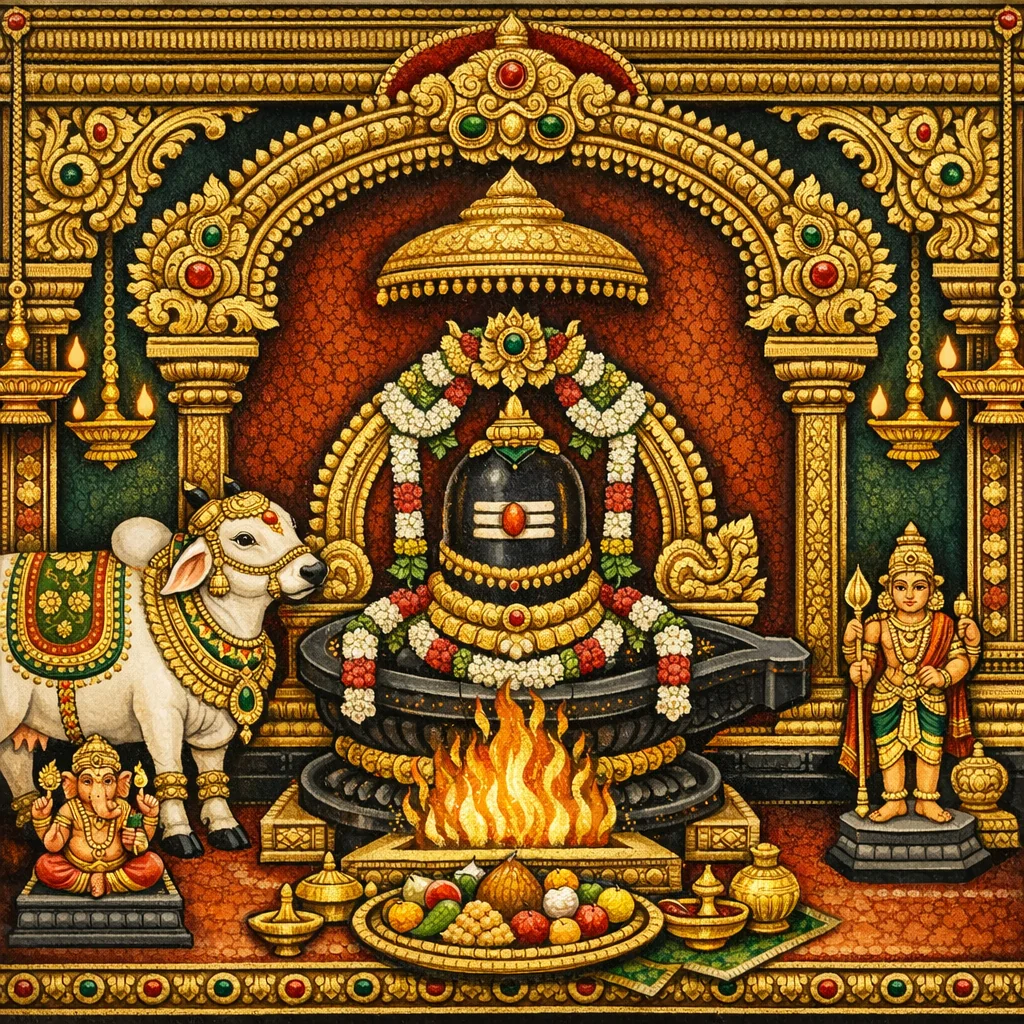
Adhyaya 77
Kapilādipūjāvidhāna — Procedure for Worship Beginning with Kapilā
Īśvara teaches a stepwise household ritual regimen that blends Vāstu-pratiṣṭhā principles with the purity disciplines of Īśāna-kalpa. It begins with worship of Kapilā, the sacred cow, using prescribed mantras and confessional prāyaścitta formulas, honoring her as cosmic Mother and remover of sin. The rite then moves to midday Śiva-upāsanā through the Aṣṭapuṣpikā observance (pedestal-form and Śiva’s limbs/aspects), and to sanctifying cooked food by reciting the Mṛtyuñjaya-mantra and sprinkling darbha-consecrated water. A cullikā-homa follows, interpreted through inner-fire symbolism (nābhi-agni, recaka, vahni-bīja, and letter-position movements), and concludes with offerings, kṣamā (seeking forgiveness), and visarjana (dismissal). The ritual map expands into household Vāstu-bali placements—doorway, mortar/pestle area, broom-space, bedchamber, and central pillar—assigning deities such as Vighnarāja, Kāma, and Skanda. Finally, the chapter codifies disciplined eating (pure vessels, silence, avoidances), prāṇa-upacāras and offerings to subsidiary vāyus, ending with post-meal rinsing and notes on manuscript variants that preserve a living ritual tradition.
Shlokas
Verse 1
इत्य् आदिमहापुराणे आग्नेये चण्डपूजाकथनं नाम षट्सप्ततितमो ऽध्यायः अथ सप्तसप्ततितमो ऽध्यायः कपिलादिपूजाविधनं ईश्वर उवाच कपिलापूजनं वक्ष्ये एभिर्मन्त्रैर् यजेच्च गां ॐ कपिले नन्दे नमः ॐ कपिले भद्रिके नमः
Thus, in the Agni Purāṇa, the seventy-sixth chapter entitled “The Account of the Worship of Caṇḍā” comes to an end. Now begins the seventy-seventh chapter, “The procedure of worship beginning with Kapilā.” The Lord said: “I shall explain the worship of Kapilā. With these mantras one should worship the cow: ‘Oṃ, obeisance to Kapilā, (named) Nandā.’ ‘Oṃ, obeisance to Kapilā, (named) Bhadrikā.’”
Verse 2
ॐ कपिले सुशीले नमः कपिले सुरभिप्रभे ॐ कपिले सुमनसे नमः ॐ भुक्तिमुक्तिप्रदे नमः
Oṃ. Salutations to Kapilā, virtuous and of good disposition; salutations to Kapilā whose radiance is fragrant and resplendent. Oṃ. Salutations to Kapilā of auspicious mind; Oṃ. Salutations to the bestower of worldly enjoyment (bhukti) and liberation (mukti).
Verse 3
सौरभेयि जगन्मातर्देवानाममृतप्रदे गृहाण वरदे ग्रासमीप्सितार्थञ्च देहि मे
O Saurabheyi, Mother of the universe, bestower of nectar upon the gods—O boon-giver, accept this mouthful of fodder, and grant me also the desired object.
Verse 4
वन्दितासि वसिष्ठेन विश्वामित्रेण धीमता कपिले हर मे पापं यन्मया दुष्कृतं कृतं
O Kapilā, you are revered by Vasiṣṭha and by the wise Viśvāmitra. Remove my sin—whatever evil deed has been done by me.
Verse 5
गावो ममाग्रतो नित्यं गावः पृष्ठत एव च गावो मे हृदये चापि गवां मध्ये वसाम्यहं
Cows are ever before me; cows are indeed behind me as well. Cows are also in my heart, and I dwell in the midst of cows.
Verse 6
दत्तं गृह्णन्तु मे ग्रासं जप्त्वा स्यां निर्मलः शिवः प्रार्च्य विद्यापुस्तकानि गुरुपादौ नमेन्नरः
“May they accept the morsel of food I have given. Having performed japa, may I become purified and auspicious. After duly worshipping the books of learning, a person should bow at the feet of the Guru.”
Verse 7
यजेत् स्नात्वा तु मध्याह्ने अष्टपुष्पिकया शिवं पीठमूर्तिशिवाङ्गानां पूजा स्यादष्टपुष्पिका
After bathing, at midday one should worship Śiva by means of the Aṣṭapuṣpikā (the eight-flower rite). The worship of the pedestal-form (pīṭha-mūrti) and of the limbs/aspects of Śiva is what is called the Aṣṭapuṣpikā.
Verse 8
मध्याह्ने भोजनागारे सुलिप्ते पाकमानयेत् ततो मृत्युञ्जयेनैव वौषडन्तेन सप्तधा
At midday, in a well-smeared (purified) dining place, one should bring in the cooked food; then, using only the Mṛtyuñjaya mantra, ending with the exclamation “vauṣaṭ,” one should perform it sevenfold.
Verse 9
जप्तैः सदर्भशङ्खस्थैः सिञ्चेत्तं वारिविन्दुभिः सर्वपाकाग्रमुद्धृत्य शिवाय विनिवेदयेत्
With water held in a conch containing sacred darbha-grass, over which mantras have been recited, one should sprinkle that offering with drops of water; then, having lifted out the foremost portion of all the cooked food, one should formally present it to Śiva.
Verse 10
अथार्धं चुल्लिकाहोमे विधानायोपकल्पयेत् विशोध्य विधिना चुल्लीं तद्वह्निं पूरकाहुतिं
Next, for the performance of the cullikā-homa, one should prepare the requisite half-portion of the arrangement and materials. Having ritually purified the cullī (the small hearth) according to rule, one should then offer the pūraka-oblation into that very fire.
Verse 11
हुत्वा नाभ्यग्निना चैकं ततो रेचकवायुना वह्निवीजं समादाय कादिस्थानगतिक्रमात्
Having offered once into the navel-fire (nābhi-agni), then by the exhalation-breath (recaka), taking up the seed-syllable of Fire (vahni-bīja), one should proceed according to the ordered sequence of movements through the letter-positions beginning with ‘ka’.
Verse 12
शिवाग्निस्त्वमिति ध्यात्वा चुल्लिकाग्नौ निवेशयेत् ॐ हां अग्नये नमो वै हां सोमाय वै नमः
Meditating with the thought, “You are the auspicious Śiva-fire,” one should place the (consecrated) offering into the hearth-fire (cullikā-agni). (Then recite:) “Oṃ hāṃ—obeisance indeed to Agni; hāṃ—obeisance indeed to Soma.”
Verse 13
सूर्याय वृहस्पतये प्रजानां पतये नमः सर्वेभ्यश् चैव देवेभ्यः सर्वविश्वेभ्य एव च
Salutation to Sūrya; salutation to Bṛhaspati; salutation to the Lord of creatures (Prajāpati). And salutation indeed to all the gods, and likewise to all the Viśvedevas.
Verse 14
ठः अन्यार्धमिति ख, चिह्नितपुस्तकपाठः अन्त्यार्धमिति ङ, चिह्नितपुस्तकपाठः निधानायोपकल्पयेदिति च, ङ, चिह्नितपुस्तकद्वयपाठः हृदि स्थानमतिक्रमेदिति ग, चिह्नितपुस्तकपाठः कादिस्थानमतिक्रमादिति ख, चिह्नितपुस्तकपाठः हामग्नये खिष्टिकृते पूर्वादावर्चयेदिमान् स्वाहान्तामाहुतिं दत्वा क्षमयित्वा विसर्जयेत्
For the syllable ṭha, some marked manuscripts read “the other half,” while others read “the final half”; and in two marked manuscripts there occurs the reading “one should prepare it for deposition (nidhāna).” Some manuscripts read “one should not transgress the placement in the heart,” while others read “(it is) by transgressing the place beginning with ka.” Having completed the prescribed arrangement, one should worship these (syllables/placements) beginning in the east; then, having offered to Agni an oblation ending with “svāhā,” one should ask forgiveness and formally dismiss (the rite/deity).
Verse 15
चुल्ल्या दक्षिणबाहौ च यजेद्धर्माय वै नमः वामबाहावधर्माय काञ्जिकादिकभाण्डके
On the hearth (cullī), on the right side/arm, one should worship with the mantra, “Homage indeed to Dharma.” On the left side/arm, one should worship Adharma; likewise, in vessels such as the sour-gruel pot (kāñjikā) and other containers, one should assign and worship the corresponding power.
Verse 16
रसपरिवर्तमानाय वरुणाय जलाग्नये विघ्नराजो गृहद्वारे पेषण्यां सुभगे नमः
Homage to Varuṇa, Lord of the waters, and to the “watery fire” (jalāgni) that brings about the transformation of essences (rasa). Homage to Vighnarāja at the doorway of the house; and homage to the auspicious one at the grinding-stone.
Verse 17
ॐ रौद्रिके नमो गिरिके नमश् चओलूखले यजेत् बलप्रियायायुधाय नमस्ते मुषले यजेत्
“Oṃ. Salutation to Raudrikā; salutation to Girikā.” One should make an offering (yajet) to the mortar (olūkhala). “Salutations to you, the weapon dear to strength (balapriyāyāyudha)!” One should make an offering to the pestle/club (muṣala).
Verse 18
सम्मार्जन्यां देवतोक्ते कामाय शयनीयके मध्यस्तम्भे च स्कन्दाय दत्वा वास्तुबलिं ततः
Then, at the place of sweeping/cleansing (the broom or the swept spot), one should offer what is prescribed for the deity—an offering to Kāma in the sleeping-apartment, and to Skanda at the central pillar. Having thus given the Vāstu-offering (vāstu-bali), one should proceed thereafter.
Verse 19
भुञ्जीत पात्रे सौवर्णे पद्मिन्यादिदलादिके आचार्यः साधकःपुत्र समयी मौनमास्थितः
Maintaining silence (mauna), the ācārya, the sādhaka’s son, and the samayī (initiated vow-holder) should take their meal from a golden vessel, or from a lotus-leaf and similar (pure) leaf-plates.
Verse 20
वटाश्वत्थार्कवाताविसर्जभल्लातकांस्त्यजेत् अपोशानं पुरादाय प्राणाद्यैः प्रणवान्वितैः
One should avoid the use of vaṭa (banyan), aśvattha (sacred fig), arka, vāta, visarja, and bhallātaka. Having first performed ācamana (ritual sipping of water), one should then take the medicine or food, preceded by regulated breaths (prāṇas) and accompanied by the syllable Oṁ.
Verse 21
स्वाहान्तेनाहुतीः पञ्च दत्वादीप्योदरानलं नागः कूर्मो ऽथ कृकरो देवदत्तो धनञ्जयः
Having offered five oblations (āhuti), each ending with “svāhā,” one kindles the inner digestive fire. These correspond to Nāga, Kūrma, Kṛkara, Devadatta, and Dhanañjaya—the five subsidiary vital airs.
Verse 22
एतेभ्य उपवायुभ्यः स्वाहापोषानवारिणा भक्तादिकं निवेद्याय पिवेच्छेषोदकं नरः
To these subsidiary Vāyu-deities (upavāyus) one should offer cooked food and the like, together with water sanctified by the utterance “svāhā” as the oblation-formula. Thereafter, one should drink the remaining water (śeṣodaka).
Verse 23
अमृतोपस्तरणमसि प्राणाहुतीस्ततो ददेत् प्राणाय स्वाहापानाय समानाय ततस् तथा
“You are the covering (upastaraṇa) of amṛta, the nectar.” Thereafter one should offer oblations to the vital breaths: saying “svāhā” to Prāṇa, “svāhā” to Apāna, and likewise thereafter to Samāna.
Verse 24
उदानाय च व्यानाय भुक्त्वा चुल्लकमाचरेत् जलाशये इति ङ, चिह्नितपुस्तकपाठः ॐ रौद्रकोटिगिरिके इति ख, ग, घ, ङ, चिह्नितपुस्तकचतुष्टयपाठः अमृतापिश्चानमसीति शरीरे ऽन्नादिवायवः
After eating, one should perform the minor rinsing (cullaka/ācamana), dedicating it to Udāna and Vyāna, the vital airs. In one marked manuscript reading it is stated as “jalāśaye”; in four marked manuscripts the recitation is given as “oṃ raudrakoṭigirike”. By this act, the food and other elements within the body are regarded as connected with the prāṇas and are sanctified with the formula: “You are amṛta; you are Anamasi.”
Frequently Asked Questions
A stepwise domestic-ritual blueprint: Kapilā-pūjā mantras, midday Aṣṭapuṣpikā Śiva worship, naivedya consecration with Mṛtyuñjaya, cullikā-homa with internal-agni visualization and letter-position sequencing, and Vāstu-bali placements across household loci.
It sacralizes everyday spaces (kitchen, doorway, bedchamber, pillar) and bodily processes (breath, digestion) through mantra and offering, aligning household order (bhukti: protection, purity, auspiciousness) with inner purification and Śiva-orientation (mukti: reduction of pāpa and cultivation of śuddhi).
Vighnarāja at the doorway, Kāma in the sleeping area, Skanda at the central pillar, and additional worship points associated with implements/locations such as mortar (olūkhala), pestle (muṣala), grinding-stone, broom/cleansing space, and vessels—forming a protective and ritually ordered household grid.