Adhyaya 98
Chapter 98 — गौरीप्रतिष्ठाकथनम् (Gaurī-Pratiṣṭhā: Installation and Worship of Gaurī; Īśāna-kalpa Elements)
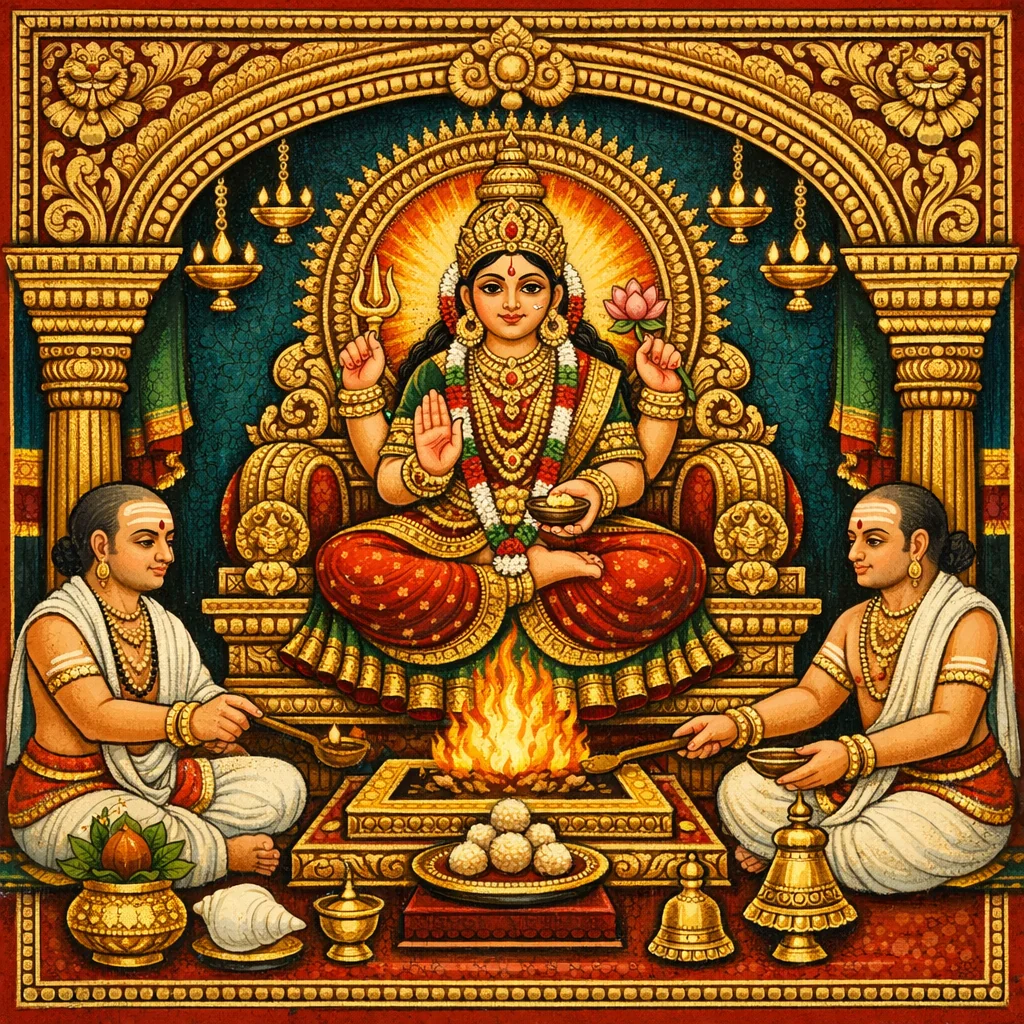
Chapter 98 begins with a brief text-critical note on variant manuscript readings, then formally opens the account of Gaurī-pratiṣṭhā (the installation and worship of Gaurī). Īśvara teaches that the rite starts with preparing the maṇḍapa and preliminary arrangements, after which the installation site is raised and set in place. The practitioner performs a systematic nyāsa of mantras—from the Mūrti-mantras through those connected with the śayyā (ritual bed)—including the Guha-mantra and the sequence from Ātmavidyā up to Śiva, culminating in Īśāna-niveśana (the invocation/installation of Īśa/Īśāna). Next, Parā-Śakti is installed by nyāsa, with homa and japa carried out as previously prescribed; the invoked powers are “united,” and a piṇḍī is formed as the embodiment of kriyā-śakti (ritual action-power). The Goddess is visualized as all-pervading within the ritual area; gems and offerings are duly placed, and she is then assigned into the icon/seat. Finally, placements are distinguished: kriyā-śakti upon the pīṭha (seat) and jñāna (knowledge-power) upon the vigraha (icon), after which Ambikā/Śivā is reverently approached (ritual touch/handling) and worshiped with complete offerings.
Shlokas
Verse 1
लिङ्गानामिति ज पिष्टकादि च तत्क्रमादिति छ , ज च मृष्टिमन्त्रेणेत्यादिः दीक्षणादिविधानत इत्य् अन्तः पाठो ग पुस्तके नास्ति शिवपूजा इति क अथाष्टनवतितमो ऽध्यायः गौरीप्रतिष्ठाकथनं ईश्वर उवाच वक्ष्ये गौरीप्रतिष्ठाञ्च पूजया सहितां शृणु मण्डपाद्यं पुरो यच्च संस्थाप्य चाधिरोपयेत्
“(Textual note:) Readings such as ‘liṅgānām…’, ‘piṣṭakādi… in that sequence’, and ‘with the cleansing (mṛṣṭi) mantra…’ occur; the internal reading ‘from the rules of initiation and related rites’ is not found in the ‘ga’ manuscript; another reading has ‘Śiva-pūjā’.” Now begins the ninety-eighth chapter, the account of the installation of the Goddess Gaurī. The Lord (Īśvara) said: “I shall explain the installation of Gaurī together with the procedure of worship—listen. Having first set up the maṇḍapa (ritual pavilion) and the preceding arrangements, one should then raise and place (the deity/installation) upon it.”
Verse 2
शय्यायान्तांश् च विन्यस्य मन्त्रान्मूर्त्यादिकान् गुह आत्मविद्याशिवान्तञ्च कुर्यादीशनिवेशनं
Having arranged (performed nyāsa of) the mantras—beginning with the Mūrti mantras and so on—up to those placed upon the bed (śayyā), and also placing the Guha-mantra and the series from Ātmavidyā up to Śiva, one should then perform the installation/invocation of Īśa, namely Īśāna-niveśana.
Verse 3
शक्तिं परां ततो न्यस्य हुत्वा जप्त्वा च पूर्ववत् सन्धाय च तथा पिण्डीं क्रियाशक्तिस्वरूपिणीं
Then, having performed nyāsa of the Supreme Power (Parā-Śakti), and having offered oblations and repeated the mantra as before, one should likewise unite the invoked forces and then form the piṇḍī, embodying kriyā-śakti—the power of ritual action.
Verse 4
सदेशव्यापिकां ध्यात्वा न्यस्तरत्नादिकां तथा एवं संस्थाप्य तां पश्चाद्देवीन्तस्यान्नियोजयेत्
Having meditated upon (the Goddess) as pervading the entire region, and likewise having duly deposited gems and other offerings (and thus visualized her so adorned), after installing her in this manner one should then invoke and assign the Goddess into that (image/seat/ritual locus).
Verse 5
परशक्तिस्वरूपान्तां स्वाणुना शक्तियोगतः ततो न्यसेत् क्रियाशक्तिं पीठे ज्ञानञ्च विग्रहे
Having (mentally) brought it to culminate in the very form of the Supreme Power (Para-Śakti), and by Śakti-yoga uniting it with one’s own subtle vital breath, one should then perform nyāsa: placing the Power of Action (kriyā-śakti) upon the pīṭha (seat) and placing Knowledge (jñāna) upon the vigraha (icon).
Verse 6
ततोपि व्यापिनीं शक्तिं समावाह्य नियोजयेत् अम्बिकां शिवनाम्नीञ्च समालभ्य प्रपूजयेत्
Thereafter, having invoked the all-pervading Śakti (vyāpinī-śakti), one should duly install/assign it within the rite. Then, having reverently approached and ritually touched Ambikā—also bearing the name Śivā—one should worship her with complete offerings.
Frequently Asked Questions
Maṇḍapa and preliminaries → mantra-nyāsa (Mūrti through śayyā, plus Guha and Ātmavidyā-to-Śiva series) → Īśāna-niveśana → Parā-Śakti nyāsa with homa and japa → union of invoked powers and piṇḍī formation → all-pervasive visualization and offering placement → assignment of the Goddess into the locus → kriyā-śakti on pīṭha and jñāna on vigraha → worship of Ambikā/Śivā.
It treats installation as both a metaphysical invocation of Śakti and a technical protocol—precise nyāsa order, differentiated placements (pīṭha vs vigraha), and coordinated homa-japa—showing ritual craftsmanship as a disciplined path aligned with dharma and spiritual realization.
The opening notes record variant readings (e.g., phrases like “liṅgānām…”, “piṣṭakādi… in sequence”, “with the mṛṣṭi mantra…”) and state that an internal reading about initiation rules is absent in one manuscript, with another variant reading “Śiva-pūjā.”