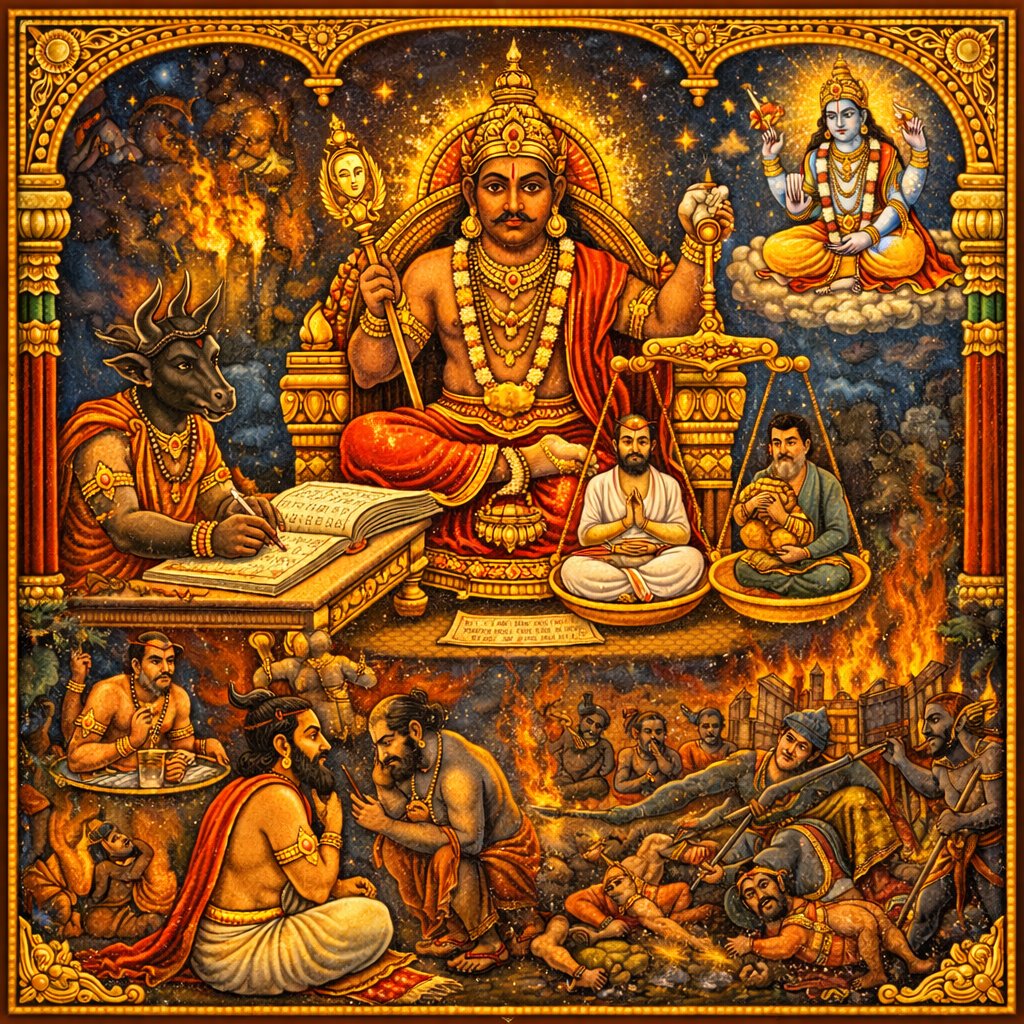
Dharma-shastra
Laws of Righteous Conduct
Exposition of dharma-shastra covering varnadharma, ashrama duties, samskaras, purification rites, and ethical codes for society.
Adhyayas in Dharma-shastra
Adhyaya 150
Chapter 150 — Manvantarāṇi (The Manvantaras) and the Purāṇic Map of Vedic Transmission
Lord Agni begins a dharma-centered cosmography by enumerating the manvantaras—successive aeons ruled by Manus—each defined by its offices: the Manu, the Indra, the deva-groups, the Saptarṣis, and the progeny that uphold earthly order. He moves from early cycles (Svāyambhuva and others) to the present markers—Śrāddhadeva/Vaivasvata Manu with the current Saptarṣis—and then to future Manus such as Sāvarṇi, stressing that a single day of Brahmā contains fourteen such administrations. Having set cosmic governance as a dharmic structure, Agni turns to the governance of knowledge: at the end of Dvāpara, Hari divides the primordial Veda, assigns priestly functions to the four Vedas, and traces their transmission through Vyāsa’s disciples (Paila, Vaiśampāyana, Jaimini, Sumantu) and later lineages and śākhās. Thus, cosmic cycles and textual lineages form one ordered continuum preserving yajña, knowledge, and Dharma.
Adhyaya 151
Duties outside the Varṇa Order (वर्णेतरधर्माः) — Agni Purana, Chapter 151
This chapter frames its teaching within a lineage: Agni declares he will expound the dharmas taught by Manu and other lawgivers—disciplines granting both enjoyment (bhukti) and liberation (mukti)—as transmitted through Varuṇa and Puṣkara to Paraśurāma. Puṣkara then introduces “varṇāśrama-etara” dharmas, universal ethical duties that stand beyond or prior to varṇa–āśrama specifications. It lists common virtues (ahiṃsā, satya, dayā, anugraha), life-sanctifying practices (tīrtha-sevana, dāna, brahmacarya, amātsarya), and pillars of religious culture (service to devas and dvijas, guru-sevā, hearing dharma, pitṛ-pūjā), while affirming civic-ethical harmony through daily devotion to the king, scriptural guidance, forbearance, and āstikya. After restating shared varṇāśrama duties (yajña, teaching, giving), it outlines varṇa-specific occupations (brāhmaṇa, kṣatriya, vaiśya, śūdra) and then details mixed-jāti classifications arising from anuloma/pratiloma unions, naming groups and prescribing livelihoods, restrictions, marriage norms, and social boundary rules. It concludes that in cases of mixture, jāti should be inferred with reference to both parents’ conduct and occupation (karma), underscoring Dharma-śāstra’s concern for social order within a broader purāṇic synthesis.
Adhyaya 152
The Livelihood of the Householder (गृहस्थवृत्तिः) — Agni Purana, Chapter 152
Spoken by Puṣkara, this chapter shifts from varṇāntara-dharma to a Dharma-shastra exposition on gṛhastha-vṛtti, the householder’s livelihood. It upholds the brāhmaṇa’s self-support through prescribed duties, allowing—only under necessity—recourse to kṣatriya, vaiśya, or even śūdra-type work, while warning against servile dependence on a śūdra or adopting a śūdra-born primary livelihood. It lists permitted occupations for the twice-born—agriculture, trade, cattle-protection, and money-lending—together with abstentions that set ethical limits on consumption and commerce. Acknowledging the moral harm inherent in farming (injury to earth, plants, and insects), it prescribes purification through yajña and deva-pūjā, integrating economic life with ritual expiation. It introduces graded penalties (measured in cows) concerning the plough, calibrating necessity, cruelty, and dharma-injury. The chapter ends with a hierarchy of livelihood modes—ṛta, amṛta, mṛta, pramṛta—permitting even mixed truth and untruth in extremis, yet rejecting base and improper livelihood as never acceptable.
Adhyaya 153
Chapter 153 — Brahmacarya-āśrama-dharma (The Dharma of the Student Stage)
This chapter shifts from household observances to brahmacarya-āśrama-dharma, portraying dharma as a life-cycle curriculum that preserves social continuity and supports spiritual ascent. It opens with norms for procreative timing (ṛtu-nights) and rites connected with conception and pregnancy, then details birth-related saṃskāras—sīmanta, jātakarma, and nāmakarma—along with varṇa-based naming conventions. It proceeds to early-life rites such as cūḍā-karman and sets upanayana timing by varṇa with age limits, followed by the student’s prescribed equipment—girdle, skins, staff, garment, and upavīta—stressing fitness and order. The teacher’s duties include training in cleanliness, conduct, fire-rites, and sandhyā worship. Practical discipline covers eating-direction symbolism, daily agnihotra-like offerings, and prohibitions on indulgent pleasures, violence, slander, and obscenity. The chapter concludes with vedāsvīkaraṇa, dakṣiṇā, and the completion bath, framing brahmacarya as a regulated knowledge-vow harmonizing śāstric study with ethical restraint.
Adhyaya 154
Chapter 154: विवाहः (Vivāha — Marriage)
The chapter shifts from brahmacarya to the gṛhastha stage, presenting marriage as a dharma-governed institution. It sets varṇa-based norms: the permitted number of wives by social class and the rule that dharma-kāryas (ritual duties) should not be performed with an asavarṇā spouse, affirming endogamy as a ritual-legal principle. It then gives transactional and protective rules—bride-price expectations in certain cases, the prohibition on giving a maiden more than once, and penalties for abduction. The text lists recognized marriage forms (Brāhma, Ārṣa, Prājāpatya, Āsura, Gāndharva, Rākṣasa, Paiśāca), distinguishing dharmic gifting from purchase, mutual choice, force, or deception. It also notes exceptional permissions for remarriage in calamities, including a levirate-like provision with the deceased husband’s younger brother. The latter portion treats vivāha-muhūrta: auspicious and inauspicious months, weekdays, tithis, nakṣatras, and planetary conditions (avoiding Viṣṇu’s “sleep,” certain months, an afflicted Moon, set benefics, and vyatīpāta), concluding with guidance on household conduct regarding conjugal approach and calendrical restraints.
Adhyaya 155
Ācāra (Right Conduct)
This chapter serves as a compact Dharma-śāstra guide to daily right conduct. Puṣkara outlines the day’s ritual and ethical rhythm: rising at brāhma-muhūrta with deva-smaraṇa, observing direction in bodily functions (by day to the north, by night to the south), and avoiding improper places for elimination. It then orders śauca through ācamana using earth, dantadhāvana, and above all snāna—declaring ritual acts done unbathed to be fruitless. A hierarchy of purifying waters is listed: ground water, drawn water, springs, lakes, tīrtha-water, and Gaṅgā as supreme. Bathing is liturgically framed by Vedic mantras (Hiraṇyavarṇāḥ, Śanno devī, Āpo hi ṣṭhā, Idam āpaḥ), underwater japa, and optional recitations (Aghamarṣaṇa, Drupadā, Yuñjate manaḥ, Pauruṣa sūkta), followed by tarpaṇa, homa, and dāna. The latter half expands into social-ethical restraints: non-harm, yielding to the burdened and pregnant, guarded gaze and speech, avoidance of inauspicious acts, public decorum, water hygiene, boundaries of sexual and social purity, reverence for Veda, deities, kings, and sages, and calendrical cautions (avoiding oil-massage on certain tithis). Manuscript variants are noted, reflecting a living transmission while preserving the core aim: purity, restraint, and welfare (yoga-kṣema) through disciplined ācāra.
Adhyaya 156
Chapter 156 — द्रव्यशुद्धिः (Dravya-śuddhi) / Purification of Substances
This chapter, following the close of the Ācāra section, teaches dravya-śuddhi—how defiled materials regain ritual fitness. Puṣkara sets out substance-wise rules, forming a dharmaśāstra taxonomy of contamination and remedy: earthenware is purified by re-firing; metals by appropriate cleansers (acidulated water for copper, alkaline solutions for bronze and iron); gems such as pearls by washing. The scope includes utensils, stone objects, water-born produce, vegetables, ropes, roots, fruits, and bamboo/reed items, showing purity as a practical discipline for household and yajña. In yajña, vessels are purified by wiping and proper handling; greasy items by hot water; domestic spaces by sweeping. Cloth is cleansed with clay and water, multiple garments by sprinkling, wood by planing, compacted items by sprinkling, and liquids by overflow. It also notes purity conventions for animals’ mouths, observances after eating, sneezing, sleep, drinking, and bathing, ācamana after entering public ways, and menstrual purity periods. Finally it prescribes clay counts for post-excretion cleansing, special rules for ascetics, and cleansers for silk, linen, and deer-hair, concluding that flowers and fruits are purified by water-sprinkling, linking outward cleanliness to ritual eligibility and dharmic order.
Adhyaya 157
Śāva-āśauca and Sūtikā-śauca: Death/Childbirth Impurity, Preta-śuddhi, and Śrāddha Procedure (Chapter 157)
This chapter systematizes dharma-śāstric rules on ritual impurity (aśauca) arising from death (śāva) and childbirth (sūtikā), beginning with the sapinda framework and graded durations by varṇa and circumstance. It then specifies exceptions by age (infant/under-three/over-three/over-six), women’s status (cūḍā performed or not; married women in relation to paternal kin), and delayed news of death (residual days, or three nights if ten nights have already passed). The text expands into preta-śuddhi and śrāddha practice: offering piṇḍas, assigning vessels, reciting gotra-nāma, defining ritual measures, and kindling three fires for Soma, Agni (Vahni), and Yama with ordered oblations. Calendrical contingencies (adhimāsa) and completion options (e.g., within twelve days) are noted, followed by annual śrāddha duties and the rationale that śrāddha benefits the departed regardless of post-mortem state. Finally it lists cases where nāśauca does not apply (certain violent/atypical deaths), prescribes immediate bathing after sex or pyre-smoke, regulates who may handle dvija corpses, and concludes with post-cremation conduct including bone-collection timing and resumption of bodily contact.
Adhyaya 158
Srāvādya-śauca (Impurity due to bodily discharge and allied causes)
This chapter systematizes aśauca (ritual impurity) for bodily discharges—including pregnancy-related bleeding and miscarriage—together with birth-impurity (sūtaka) and death-impurity (mṛtaka). It sets graded durations by varṇa, closeness of kin (sapinda, sukulya, gotrin), and life-stage (pre-teething, pre-marriage, post-cūḍā). It also integrates procedures: bathing rules, asthi-sañcayana (bone collection), udaka-kriyā (water libations), piṇḍa counts, cremation versus burial for infants, and restrictions on food, gifts, and śrāddha; when impurities overlap, the heavier overrides the lighter. Special cases include deaths by lightning or fire, epidemics, famine, war/calamity conditions, handling non-sapinda corpses, and exclusions for certain transgressive categories. Overall, purity is treated as a dharmic technology that preserves household order, regulates ritual eligibility, and aligns social duties with scriptural authority (Manu and other sages) through explicit conditional rules.
Adhyaya 159
Purification Concerning the Unsanctified (Asaṃskṛta) and Related Cases (असंस्कृतादिशौचम्)
This chapter distinguishes the post-mortem lot of the saṃskṛta (one duly consecrated by proper rites) from the asaṃskṛta (unsanctified), declaring that remembrance of Hari at the moment of death can grant svarga and even mokṣa. It then extols Gaṅgā-linked funerary efficacy: immersion of the bones (asthi-kṣepa) is said to uplift the preta, and heavenly residence is claimed to endure as long as the bones remain in Gaṅgā’s waters. Though it notes exclusions—suicides and patitas are said to lack prescribed rites—it immediately offers a compassionate remedy: even for a fallen preta, Narāyaṇa-bali is recommended as an act of grace. The teaching then turns from ritual law to existential counsel: death is impartial and does not wait for worldly attachments; only Dharma accompanies the traveler beyond death (with the wife mentioned as the sole relational exception on the Yama-path). Finally, it affirms the inevitability of karma, the cycle of manifestation and dissolution, rebirth likened to changing garments, and urges the abandonment of grief, for the embodied Self is ultimately unbound.
Adhyaya 160
Vānaprastha-āśrama (The Forest-Dweller Stage of Life)
Continuing the Dharma-śāstra sequence, Puṣkara sets forth the regulated life of the vānaprastha and forest-ascetic as a disciplined bridge between gṛhastha duties and fuller renunciation. The chapter begins with outward marks and daily observances—matted hair, maintenance of Agnihotra, sleeping on the ground, and wearing a deer-skin—showing that Vedic rites continue even in withdrawal from society. It prescribes forest residence with a controlled diet (milk, roots, nīvāra wild rice, fruits), refusal of gifts, thrice-daily bathing, and brahmacarya as restraints that purify intention and lessen dependence. Dharma is expressed through worship of the gods and honoring guests, while yatis are directed to subsist on herbs. When a householder sees children and grandchildren settled, he may take refuge in the forest. Seasonal tapas is systematized—five-fire austerity in summer, exposure to rain and sky in monsoon, and severe winter practice in damp garments—culminating in the vow of unwavering forward movement without return, symbolizing irreversible commitment to dharmic detachment.
Adhyaya 161
Yati-dharma (The Dharma of the Renunciate Ascetic)
This chapter codifies yati-dharma as a disciplined passage from social attachment to liberating knowledge. The aspirant should renounce the moment dispassion (virāga) arises, after arranging a prājāpatya iṣṭi and internalizing the sacred fires, marking a shift from outer ritual to inner tapas. The yati’s life stresses solitude, non-accumulation, minimal subsistence, careful non-harming, and speech and conduct purified by truth. Detailed alms rules define ethical dependence on society without burdening householders, and a fourfold typology (kuṭīraka → bahūdaka → haṃsa → paramahaṃsa) maps progressive interiorization. Ascetic conduct is then aligned with yoga: yama-niyama, āsana, prāṇāyāma (garbha/agarbha; pūraka-kumbhaka-recaka with mātrā measures), pratyāhāra, dhāraṇā, dhyāna, and samādhi. It culminates in mahāvākya-like non-dual affirmations identifying the Self with Brahman/Vāsudeva/Hari, presenting renunciation as ethical rigor and direct jñāna leading to moksha, including expiations (six prāṇāyāmas) and seasonal vows (cāturmāsya).
Adhyaya 162
अध्याय १६२ — धर्मशास्त्रकथनम् (Dharmaśāstra Exposition: Authorities, Pravṛtti–Nivṛtti, Upākarman, and Anadhyāya Rules)
This chapter grounds Dharma in a recognized lineage of smṛti authorities (from Manu through Parāśara, with others such as Āpastamba, Vyāsa, and Bṛhaspati), establishing an ethical and juridical canon. It defines Vedic karma as twofold—pravṛtti (engaged action driven by desire) and nivṛtti (withdrawal based on knowledge)—and extols tapas, svādhyāya, sense-restraint, ahiṃsā, and guru-sevā as disciplines culminating in ātma-jñāna, the highest means to niḥśreyasa and immortality. The chapter then turns to applied dharma, prescribing calendrical and situational rules for Vedic recitation, including the upākarman and utsarga rites, and a detailed list of anadhyāya (temporary suspension) occasions: death-impurity periods, eclipses, specific lunar days, atmospheric disturbances (thunder, meteors, earthquakes), contact with impure contexts (corpse, cremation-ground, outcaste), ominous sounds, and practical disruptions—collectively counted as thirty-seven anadhyāya instances. Thus the Agni Purāṇa links metaphysical telos (self-knowledge) with precise observance that disciplines daily life.
Adhyaya 163
Śrāddha-kalpa-kathana (Exposition of the Śrāddha Procedure)
This chapter sets out a procedural dharma-map for śrāddha, praised as a rite granting both bhukti (well-being and prosperity) and mukti (liberative merit). Puṣkara gives the sequence from inviting brāhmaṇas the previous day and receiving them in the afternoon, to the seating rules (east-facing; even numbers for deva-kārya and odd for pitṛ-kārya), extended likewise to maternal ancestors. It then details mantra-governed stages: invoking the Viśve-devas, using pavitra-equipped vessels, scattering grains, adding milk and barley/sesame, offering arghya, and shifting to apasavya orientation for pitṛ-circumambulation. A pitṛyajña-style fire offering precedes distribution of hutaśeṣa; vessels are consecrated and food sanctified by recitation and thumb-contact. The conclusion covers leftovers and water offerings, south-facing piṇḍa-dāna, svasti and akṣayya-udaka, dakṣiṇā with svadhā formulas, formal visarjana, and post-feeding observances. The chapter also distinguishes ekoddiṣṭa and sapiṇḍīkaraṇa, prescribes death-day, monthly, and annual śrāddha cycles, lists foods and gifts with their results, highlights Gayā and auspicious times, and ends by affirming the pitṛs as śrāddha-devatās who bestow longevity, wealth, learning, heaven, and liberation.
Adhyaya 164
Chapter 164: नवग्रहहोमः (Navagraha Fire-Offering)
This chapter gives a Dharma-śāstric, ritual-technical manual for Navagraha Homa, taught by Puṣkara as a remedial and augmenting rite for prosperity, pacification of afflictions, rainfall, longevity, nourishment, and even abhicāra (forceful/hostile aims). It lists the nine planetary deities (Sūrya through Ketu) and prescribes making their images in order from specific materials: copper, crystal, red sandalwood, gold, arka-wood for a paired set, silver, iron, and lead. It stresses correct diagrammatic inscription (gold writing or scented maṇḍalas), color-matched garments and flowers, perfumes, bracelets, and guggulu incense. Vedic ṛks/mantras are assigned for recitation in sequence, along with the samidh (kindling) order and oblation counts for each deity (128 or 28) using honey, ghee, and curd. Food-offerings and the protocol for feeding dvijas in planetary order are given, followed by an ordered schedule of dakṣiṇās (cow, conch, bull, gold, garment, horse, and other gifts). It concludes that planetary forces govern the rise and fall of kings and worldly conditions; therefore the grahas are supremely worthy of worship.
Adhyaya 165
Adhyaya 165 — नानाधर्माः (Various Dharmas)
Continuing the Agni–Vasiṣṭha transmission, this chapter frames dharma contemplatively: meditate on the Lord within the heart, with mind, intellect, memory, and senses made one-pointed. From this inner discipline Agni turns to applied Dharma-śāstra—śrāddha offerings and food restrictions; the special power of eclipse-junctions for gifts and ancestral rites; and the proper Vaiśvadeva procedure when fire is absent. It then sets social purity debates—especially concerning women, coercion, and impurity—beside a non-dual corrective: for one who perceives no “second” beyond the Self, conventional oppositions loosen. A sustained yoga section defines the highest yoga as cessation of mental modifications and the merging of the kṣetrajña into Paramātman/Brahman; prāṇāyāma and the Sāvitrī (Gāyatrī) are praised as supreme purifiers. The latter portion states limits of expiation and karmic consequences (degraded rebirths and long durations), concluding that yoga alone is the unsurpassed remover of sin, integrating ritual dharma with inner realization.
Adhyaya 166
Chapter 166: वर्णधर्मादिकथनं (Exposition of Varṇa-Dharma and Related Topics)
This chapter defines dharma as Veda–Smṛti based and “fivefold,” teaching that adhikāra (eligibility for practices) follows one’s varṇa, while āśrama-duties are the specific observances of each life-stage. It then classifies naimittika procedures—especially prāyaścitta (expiation)—as applicable across the four āśramas (brahmacārin, gṛhastha, vānaprastha, yati), and frames action by aims: adṛṣṭārtha (unseen fruits) such as mantra and yajña, dṛṣṭārtha (practical ends), and mixed aims in vyavahāra (legal procedure) and daṇḍa (punishment/discipline). Hermeneutically it harmonizes śruti and smṛti, explaining anuvāda as restatement for application, including guṇārtha and pari-saṅkhyārtha types, and introducing arthavāda as commendatory/explanatory discourse. The chapter catalogs saṃskāras (notably the “forty-eight”), outlines pañca-yajña and the pākayajña/haviryajña and soma-sacrifice taxonomies, and concludes with ethical qualities, daily conduct rules (speech, bathing, eating discipline), funeral/daśāha eligibility even for non-kin, mitigations for paṅkti-doṣa (dining-row contamination), and the five prāṇāhutis.
Adhyaya 167
Ayuta–Lakṣa–Koṭi Fire-offerings (अयुतलक्षकोटिहोमाः) — Graha-yajña Vidhi
Lord Agni continues teaching graha-yajña as a Dharma-śāstra ritual technology for prosperity, pacification, and victory. He defines three graded homa scales—ayuta (10,000), lakṣa (100,000), and koṭi (10,000,000)—and explains the ritual maṇḍala: the planets (navagrahas) are invoked from the agni-kuṇḍa and installed in prescribed sectors, with the Sun at the center. The chapter enlarges the ritual cosmos through lists of adhidevatās and praty-adhidevatās, prescribes materials (woods, samidh, oblation-mixtures) and counts (108 offerings, 108 kumbhas), and culminates in pūrṇāhuti, vasordhārā, dakṣiṇā, and abhiṣeka mantras invoking major deities, the navagrahas, and protective powers. It links efficacy to dāna—gold, cows, land, gems, garments, bed—and situates the rites for battle-victory, marriage, festivals, and consecrations. Advanced forms specify lakṣa- and koṭi-homa requirements (kuṇḍa measurements, priest numbers, mantra options) and a distinct abhicāra/vidveṣaṇa procedure using a triangular kuṇḍa and effigy-operations, showing the Purāṇa’s integration of practical rites with cosmic-ethical order.
Adhyaya 168
Chapter 168 — महापातकादिकथनम् (Exposition of Great Sins and Related Topics)
This chapter begins with Puṣkara’s juridico-ritual injunction: the king should punish those who refuse the prescribed prāyaścitta (expiation), and expiation must be undertaken for sins whether intentional or unintentional. It then outlines a dharmic ecology of purity through diet and contact, listing persons and situations whose food or touch causes impurity (such as great sinners, menstruating women, outcaste groups, and censured occupations) and stating when avoidance is obligatory. From these rules it turns to graded penances—kṛcchra, taptakṛcchra, prājāpatya, and cāndrāyaṇa—assigned to specific transgressions like consuming forbidden foods, leavings, or improper substances. The chapter further systematizes sin taxonomy by defining the four mahāpātakas (brahmahatyā, surāpāna, steya, gurutalpa), listing equivalent acts, and adding upapātakas and caste-degrading deeds (jātibhraṃśakara). Throughout, it integrates rājadharma (state enforcement), śauca (purity discipline), and dharma-śāstric classification, presenting social order and ritual rectification as mutually reinforcing paths of Agneya Dharma.
Adhyaya 169
Mahāpātaka-ādi-kathana (Account of the Great Sins) — concluding note incl. ‘Mārjāra-vadha’ (killing of a cat)
This chapter concludes a Dharma-śāstra unit that classifies grave transgressions (mahāpātaka) and related faults, ending with a colophon-like transition that explicitly notes mārjāra-vadha (killing of a cat). In the Agneya teaching flow, sin-taxonomy is not mere moral labeling but the necessary map for prescribing proportionate remedies. The conclusion serves as a hinge, signaling a move from identifying pāpa (wrongdoing/defilement) to the applied purification discipline of prāyaścitta. In the Agni Purāṇa’s encyclopedic method—like other practical vidyās such as Vāstu or Rāja-dharma—categories and measures are defined first, then procedures are given, integrating social order and inner purification under Dharma.
Adhyaya 170
प्रायश्चित्तानि (Expiations) — Association-Impurity, Purification Rites, and Graded Penance
This chapter (Agni Purāṇa 170) systematizes prāyaścitta as a dharma-technology for restoring purity after transgression, especially where defilement spreads through social contact and ritual participation. Puṣkara warns that sustained association with a patita (fallen person) can cause one’s fall within a year, yet clarifies that culpable “association” arises through priestly service, instruction, or sexual relation—not merely sharing conveyance, food, or a seat. It then lays out a purification protocol: adopting the same observance as the fallen person, performing water-offering rites with sapinda kin, and making a preta-like ritual gesture (overturning a water-pot), followed by a day-and-night observance and regulated social interaction. The chapter proceeds with a graded catalogue of expiations—kṛcchra, tapta-kṛcchra, cāndrāyaṇa, parāka, śāntapana—mapped to specific impurities (contact with caṇḍālas, ucchiṣṭa, corpses, menstrual impurity, improper gifts, prohibited professions, ritual lapses). It integrates repentance (anutāpa) with homa, japa, fasting, pañcagavya, bathing, and re-initiation (upanayana/saṃskāra restoration), aligning personal purification with the maintenance of varṇāśrama order and ritual eligibility.
Adhyaya 171
Chapter 171 — प्रायश्चित्तानि (Prāyaścittāni / Expiations)
This chapter begins a Dharma-śāstra manual on purification, preserving manuscript variants while moving into a systematic catalogue of prāyaścitta (expiations). Puṣkara teaches that sin is removed through mantra-japa and disciplined observances: reciting the Pauruṣa Sūkta for a month, thrice-reciting the Aghamarṣaṇa hymn, along with Vedic study, the disciplines linked with Vāyu and Yama, and the Gāyatrī-vrata. It then sets out graded austerities (kṛcchra) with exact bodily and dietary rules—tonsure, bathing, homa, and worship of Hari; standing by day and sitting by night (vīrāsana). Multiple cāndrāyaṇa models are listed (yati and śiśu forms, with counted mouthfuls/piṇḍas), followed by taptakṛcchra and śīta-kṛcchra cycles and the harsher atikṛcchra using pañcagavya-related substances. Śāntapana and its intensifications (mahā-/ati-śāntapana), parāka (a twelve-day fast), and prājāpatya sequences appear as modular “pāda” units of expiation. Finally, specialized kṛcchras based on fruits, leaves, water, roots, sesame, and brahma-kūrca are presented, concluding with the promise of prosperity, strength, heaven, and the destruction of sin through deity-worship joined to disciplined penance.
Adhyaya 172
Chapter 172 — “Expiations beginning with the Secret (Rites)” (Rahasya-ādi-prāyaścitta)
This chapter concludes a prāyaścitta (expiation) sequence, showing that the Agni Purana’s Dharma-śāstra treats atonement as a graded system. By ending with “secret” or esoteric expiations (rahasya-ādi), it teaches that purification is not only external penalty but also inward, discipline-based remedy aligned with intention (saṅkalpa) and subtle faults. Within the wider Agneya Vidyā—Lord Agni’s synthesis of worldly order and spiritual ascent—this chapter serves as a capstone to earlier methods and prepares the shift to the next chapter’s more universal cure: stotra-japa, a portable, devotion-centered practice for moral repair. The pivot underscores that Dharma is upheld through prescribed acts and inner realignment, guiding life toward both bhukti (social and personal stability) and mukti (purificatory liberation).
Adhyaya 173
Prāyaścitta — Definitions of Killing, Brahmahatyā, and Graded Expiations
Lord Agni opens a Dharma-śāstra teaching on prāyaścitta (expiation), tracing the system to Brahmā and defining “killing” as any act that ends in the separation of prāṇa (death). Guilt extends beyond the direct slayer to the instigator, group participants in a joint armed act, and indirect causation—including suicides driven by abuse or coercive circumstances—thus grounding grave sin, especially brahmahatyā (brahmin-slaying). The chapter sets principles for assessing penance by place, time, capacity, and the offense’s nature, then lists major expiations for brahmin-killing: self-sacrifice, long-term ascetic marks with alms-living, and conduct-based mitigations. It gives a graded scale by victim’s varṇa and vulnerability (aged, women, children, sick) and by specific harms (cow-killing, injuries, accidental deaths by implements). It proceeds through purity rules and food contamination, intoxicants and restricted consumption, theft with restitution and royal-penalty logic, and sexual transgressions under gurutalpa, prescribing death-penances or demanding multi-month Cāndrāyaṇas. Throughout, Agni presents prāyaścitta as juridical calibration and spiritual medicine—restoring dharma outwardly while purifying intention and conduct within.
Adhyaya 174
Chapter 174 — प्रायश्चित्तानि (Expiations)
Agni lays down a Dharma-śāstric protocol to restore ritual integrity when worship, āśrama duties, or homa is missed or disturbed. It opens with expiations for omitted pūjā—especially eight-hundredfold japa and doubled worship—and for impurity-contact affecting the deity, remedied through pañcopaniṣad mantras, homa, and feeding brāhmaṇas. Practical rules follow: for contaminated homa materials, damaged offerings, or mantra/dravya mix-ups, discard only the affected portion, sprinkle for purification, and repeat root-mantra japa. For grave mishaps such as a fallen, broken, or lost image, fasting and a hundred oblations are prescribed. The chapter then widens from procedure to soteriology: true remorse culminates in the supreme atonement, Hari-smaraṇa (remembrance of Hari). Traditional penances (Cāndrāyaṇa, Parāka, Prājāpatya), japa systems (Gāyatrī, Praṇava-stotra, Sūrya/Īśa/Śakti/Śrīśa mantras), tīrtha power, dāna including mahā-dānas, and non-dual contemplation—“I am Brahman, the Supreme Light”—are taught as sin-destroyers. Concluding verses reaffirm the Agni Purāṇa’s encyclopedic scope, placing all vidyās and śāstras in Hari as the ultimate source and purifier.