Raja-dharma
Governance & Royal Duty
The duties of kings and rulers -- statecraft, justice, taxation, diplomacy, and the dharmic foundation of governance.
Adhyayas in Raja-dharma
Adhyaya 218
Rājābhiṣeka-kathana (Account of the Royal Consecration)
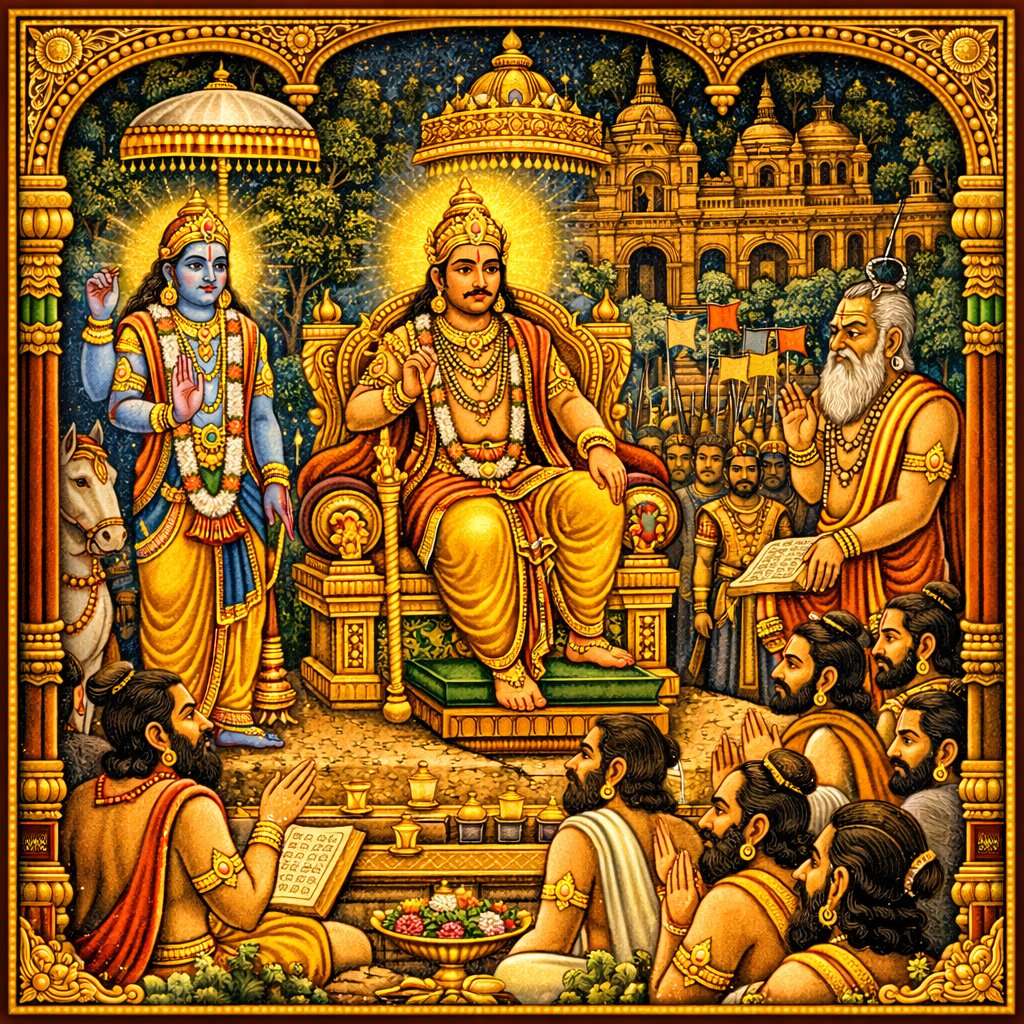
Agni resumes the teaching on rāja-dharma, prompted by Puṣkara’s question to Rāma, and conveys to Vasiṣṭha a stepwise protocol for rājābhiṣeka (royal consecration). Kingship is first defined by function—subduing enemies, protecting subjects, and using daṇḍa (punitive authority) with restraint—then by sacramental preparation: a year-long appointment of the purohita and qualified ministers, rules for the timing of succession, and expedited rites when a king dies. The chapter prescribes pre-abhiṣeka pacification (Aindrī-śānti), fasting, and homa with mantra-classes (Vaiṣṇava, Aindra, Sāvitrī, Vaiśvadeva, Saumya, Svastyayana) for welfare, longevity, and fearlessness. It details ritual apparatus (Aparājitā kalaśa, golden vessels, a hundred-holed sprinkling pot), fire-omens and ideal fire-marks, and a notable mṛd-śodhana regimen using earth from symbolically charged sites (anthill, temples, riverbanks, royal courtyard, etc.). The rite culminates in multi-varṇa ministerial sprinklings with distinct vessels, priestly recitations, protective rites for the assembly, gifts to brāhmaṇas, and public auspicious acts—mirror-gazing, binding the headband/crown, enthronement on animal hides, circumambulation, procession by horse and elephant, city-entry, donations, and formal dismissal—presenting coronation as both political investiture and a dharmic yajña.
Adhyaya 219
Abhiṣeka-mantrāḥ (Consecration Mantras)
This chapter is a rāja-dharma liturgical manual for royal consecration (abhiṣeka). Puṣkara teaches sin-destroying mantras performed by sprinkling kuśa-sanctified water from a ritual jar, declaring the rite to bestow complete success. The text then expands into an encyclopedic protection-and-victory catalogue (rakṣā, jaya-prayoga): the great deities (Brahmā–Viṣṇu–Maheśvara and the Vāsudeva-vyūha), directional guardians, ṛṣis and prajāpatis, classes of pitṛs and sacred fires, divine consorts and protective śaktis, and the full architecture of Time (kalpa, manvantara, yuga; seasons, months, tithis, muhūrtas). It proceeds through Manus, grahas, Maruts, Gandharvas and Apsarases, Dānavas/Rākṣasas, Yakṣas, Piśācas, Nāgas, divine mounts and weapons, exemplary sages and kings, Vāstu-deities and cosmic geography (lokas, dvīpas, varṣas, mountains), and finally tīrthas and sacred rivers, culminating in a closing anointing-protection formula. The narrative logic is encyclopedic: kingship is sacralized by invoking every layer of cosmic order, establishing sovereignty as a dharmic office stabilized through mantra, cosmology, and protective theology.
Adhyaya 220
Sahāya-sampattiḥ (Securing Support/Allies): Royal Appointments, Court Offices, Spies, and Personnel Ethics
After the shift from the abhiṣeka mantras, the teaching turns to sahāya-sampatti—how a consecrated king secures victory through a capable human apparatus. It lays out a rāja-dharma plan for appointing key offices: senāpati (commander), pratīhāra (chamberlain), dūta (envoy), sandhi-vigrahika (peace/war minister skilled in ṣāḍguṇya), protectors and charioteers, heads of provisioning, court-assembly members, scribes, gate officials, treasurers, physicians, elephant/horse superintendents, fort commandants, and the sthāpati (vāstu-knower). It then teaches administrative nīti: staffing the inner palace by appropriate age, guarding the armoury, assigning roles by tested character and graded capacity (uttama/madhyama/adhama), and matching duties to proven skill. A pragmatic ethic follows—associate even with the wicked when useful, but do not trust them—culminating in the doctrine that spies are the king’s eyes. Finally, it stresses counsel from many sources, psychological insight into loyalties and aversions, and people-pleasing governance: a king is truly sovereign by deeds that win public affection and prosperity grounded in popular goodwill.
Adhyaya 222
Adhyaya 222 — राजधर्माः (Rājadharmāḥ): Duties of Kings (Administrative Order, Protection, and Revenue Ethics)
This chapter sets out a graded administrative order—village headman, overseer of ten villages, of a hundred villages, and a district governor—insisting that pay match performance and that conduct be continually audited through inspection. Governance is protection-first: the king prospers only when the realm is secure, and failure to protect makes royal religiosity hypocrisy. Artha (wealth) is the working basis of dharma and kāma, yet must be obtained through śāstric taxation and the suppression of the wicked. Legal-ethical duties are detailed: fines for false testimony, custody of ownerless property as a three-year deposit, standards of proof for ownership, and guardianship of minors, daughters, widows, and vulnerable women against unlawful seizure by relatives. The king must generally compensate theft (with recourse against negligent anti-theft officials), while limiting liability for theft within a household. Revenue norms follow: customs duties that allow fair merchant profit, ferry exemptions for women and renunciants, sectoral shares (grain, forest produce, livestock, gold, goods), and a strong welfare mandate—do not tax starving śrotriyas; instead support their livelihood, for their well-being is bound to the kingdom’s health.
Adhyaya 223
Adhyaya 223 — Rājadharmāḥ (Royal Duties: Inner Palace Governance, Trivarga Protection, Courtly Conduct, and Aromatic/Hygienic Sciences)
This chapter extends Rājadharma to antahpura-cintā, the governance of the inner palace, teaching that the puruṣārthas (dharma, artha, kāma) are secured through mutual protection and proper arrangements of service. It frames the trivarga as a tree—dharma the root, artha the branches, and karmaphala the fruit—whose protection yields one’s rightful share of results. It then prescribes restraint in food, sleep, and sexual conduct, and gives behavioral signs by which affection or disaffection, modesty or corruption in palace relations may be judged, to prevent disorder and intrigue. The latter portion turns to applied “palace sciences”: an eightfold regimen of cleanliness, ācamana, purgation, levigation/impregnation, cooking, stimulation, fumigation, and perfuming, with detailed materia medica for incense (dhūpa), bathing aromatics, perfumed oils, and mouth-perfumes (mukhavāsa), including pill preparations and hygienic methods. The chapter closes with cautions to rulers about trust and night conduct, stressing security and prudence as integral to dharmic kingship.
Adhyaya 224
Rāja-dharma (राजधर्माः) — Protection of the Heir, Discipline, Counsel, and the Seven Limbs of the State
Continuing the Agneya Vidyā’s teaching on governance within rāja-dharma and nīti-śāstra, Puṣkara explains that a king safeguards the realm by first safeguarding the heir: educating the prince in dharma–artha–kāma and dhanurveda, surrounding him with trained and self-controlled influences, and preventing corrupt companionship. The chapter then moves from personal discipline to institutional discipline—appointing the vinīta (well-trained) to offices and renouncing addictions that ruin sovereignty (hunting, drink, dice), along with harsh speech, slander, and financial corruption. It warns against improper giving (wrong time/place/recipient) and urges conquest in graded order: disciplining servants, winning townsmen and countryside, then securing outer defenses (moats). Classical statecraft appears through a threefold typology of allies and the saptāṅga model of the state, with the king as the root needing maximal protection, and punishment calibrated to time and circumstance. A major nīti thread is mantra (counsel): read character through gestures, keep counsel secret, consult selectively and separately, and prevent leakage among ministers. Royal education includes ānvīkṣikī, artha-vidyā, and vārttā, grounded in jitendriyatā (sense-control). The chapter closes with welfare duties (supporting the vulnerable), cautious trust, animal-similes for royal conduct, and the culminating principle that royal prosperity arises from public affection.
Adhyaya 225
Chapter 225 — राजधर्माः (The Duties of Kings): Daiva and Pौरुष (Effort), Upāyas of Statecraft, and Daṇḍa (Punitive Authority)
This chapter redefines “daiva” (fate) as the residue of one’s own past actions, thereby placing “pauruṣa” (human initiative and effort) at the center of success in kingship. Yet it offers a realist balance: results ripen in due time when effort is supported by favorable conditions, like cultivation aided by rainfall. It then sets out the king’s working instruments in Nīti-śāstra—first the four upāyas (sāma, dāna, bheda, daṇḍa), and then seven expedients including māyā (strategic deception), upekṣā (calculated indifference), and indrajāla (illusion/stratagem). The text advises using bheda among mutually hostile factions and securing internal and external resources (alliances, ministers, royal kin, treasuries) before confronting enemies. Dāna is praised as a supreme means of influence, while daṇḍa is upheld as the pillar of cosmic and social order, demanding precise and just application. Finally, the king is mapped to cosmic forces—Sun and Moon in majesty and accessibility, Wind through intelligence networks, and Yama through restraint of faults—uniting statecraft with Dharmic cosmology.
Adhyaya 226
Chapter 226 — राजधर्माः (Rājadharma: Royal Duties and Daṇḍanīti)
This chapter serves as a daṇḍanīti manual within rājadharma, explaining how a king preserves order through measured, graded punishments grounded in standard measures. It first defines weight and coin equivalences (kṛṣṇala, triyava, suvarṇa, niṣka, dharaṇa, kārṣāpaṇa/paṇa) and applies them to scaled fines, especially the three levels of sāhasa (first/intermediate/highest). It then lists judicial penalties for false robbery claims, lying before the royal protector/judge, fabricated testimony, and misappropriation or destruction of deposits (nikṣepa). It covers commercial and labor disputes (selling another’s property, nondelivery after payment, taking wages without work, rescinding sales within ten days), marriage fraud and the remarriage of a previously given bride, and negligence by guardians/watchmen. Public order extends to planning and security (village boundary measures, ramparts), boundary violations, and theft gradations up to capital punishment for major theft and abduction. Penalties for insult and misconduct are set by social rank, including mutilations in severe cases, while Brahmin punishment emphasizes banishment over bodily harm. Corruption is targeted: guards, ministers, and judges who abuse office face confiscation and exile. Finally, the state’s response to grave crimes (arson, poisoning, adultery, assault), market fraud (adulteration, counterfeit), sanitation violations, and procedural abuses (improper summons, escape from custody) is prescribed, presenting governance as a disciplined, truth-centered instrument of dharma.
Adhyaya 227
युद्धयात्रा (Yuddhayātrā) — The War-Expedition
This chapter shifts from punishment-codification (daṇḍapraṇayana) to the king’s next duty: deciding when and how to undertake yātrā, a war-expedition. Puṣkara sets rāja-dharma–based criteria and predictive statecraft: the king should march when threatened by a stronger aggressor, especially if a rear-assailing enemy (pārṣṇigrāha) gains advantage, but only after confirming readiness—well-provisioned warriors, supported attendants, and a securely protected base. It then weaves nimitta-śāstra (omenology) into strategic timing, citing calamities befalling the enemy and cosmic signs such as earthquake-direction and comet/ketu taint. Auspicious and inauspicious bodily signs (sphuraṇa), dream-signs, and śakuna-omens guide the advance toward the enemy stronghold and the return after victory. Finally, it prescribes season-specific force composition: in the rains, emphasis on infantry and elephants; in cold seasons, spring, or early autumn, greater chariot-and-horse strength, with omens further qualified by right/left side and by gender.
Adhyaya 228
Chapter 228 — स्वप्नाध्यायः (Svapnādhāyaḥ / Chapter on Dreams)
Puṣkara teaches a structured svapna-śāstra within rāja-dharma/nīti: dreams are classed as auspicious, inauspicious, or sorrow-dispelling, and bodily/social images are read as omens. The chapter lists adverse signs—dust/ash on the head, shaving, nakedness, soiled clothes, mud-smearing; falling from heights; and portents such as eclipses, Indra’s banner falling, re-entering the womb, mounting a pyre, disease, defeat, house-collapse, and transgressive acts—then prescribes ways to restore purity and order. Remedies include bathing, honoring brāhmaṇas and teachers, sesame homa, worship of Hari–Brahmā–Śiva–Sūrya–Gaṇas, hymn-recitation, and Puruṣa-sūkta japa. After noting manuscript variants, it says certain auspicious dreams (unctuous drinking/immersion, red garlands, anointments) are especially beneficial when not narrated. A timing doctrine links dream-time to fruition: first watch ≈ one year; then six months, three months, half-month; near dawn up to ten days. One should not sleep again after a good dream; prosperity-omens include seeing king/elephant/horse/gold at the dream’s end, white garments, clear water, fruitful trees, and a spotless sky. Thus omen-lore is joined to ritual discipline and governance-minded ethics: signs are not fatalism, but prompts for dharmic correction.
Adhyaya 229
Chapter 229 — शकुनानि (Śakuna: Omens)
This chapter, following the dream section, turns to śakuna—public omens and encounter-signs relevant to rājadharma and household decisions. Puṣkara lists inauspicious sights, substances, and persons deemed ritually unfit or defiling (charcoal, mud, leather/hair, certain marginalized groups, broken vessels, skulls and bones), along with bad sound-omens (discordant instruments and harsh clamor). It then codifies directional speech-omens: “come” and “go” are auspicious or censured depending on whether the addressed person is in front or behind, and notes verbal death-portents such as “Where are you going? Stop, don’t go.” Mishaps—vehicles stumbling, weapons breaking, blows to the head, collapse of fittings—are counted as negative signs. As a dharmic remedy, worship and praise of Hari (Viṣṇu) is prescribed to destroy inauspiciousness; one should then watch for a confirming second sign and proceed by a contrary/neutralizing action. The chapter ends with auspicious omens—white objects, flowers, a full pot, cows, fire, gold/silver/jewels, foods like ghee/curd/milk, conch, sugarcane, auspicious speech, and devotional music—framing omenology as disciplined, devotional risk-management within dharma.
Adhyaya 230
Chapter 230: शकुनानि (Śakunāni) — Omens
Spoken by Puṣkara, this chapter systematizes śakuna (omens) as a predictive discipline for moments of standing still, setting out on journeys, and making inquiries, and extends it to forecasting outcomes for regions and cities. It first divides omens into dīpta (blazing/violent) and śānta (calm), teaching that dīpta tends toward sinful or adverse results while śānta leads to auspicious outcomes. Interpretation is organized by six differentiators—time, direction, place, karaṇa (astronomical factor), sound/cry, and species—with a hierarchy in which earlier factors carry greater force. The text then defines abnormal dīpta signs in direction, locality, conduct, sound, and even diet, and catalogs village, forest, nocturnal, diurnal, and dual-sphere creatures used in omen-reading. Practical rules follow for military movement (front vs rear formations), right/left positioning, encounters at departure, and the effects of cries heard within or beyond boundaries, including numerical patterns of calls. A special annual prognostic is added: the first sighting of sāraṅga as an omen may indicate the year’s result, emphasizing that statecraft relies on disciplined interpretation rather than superstition.
Adhyaya 231
Chapter 231 — शकुनानि (Śakunāni) | Omens in Governance, Travel, and War
This chapter weaves omen-lore (śakuna-śāstra) into rāja-dharma and niti, treating signs as actionable intelligence for kings, commanders, and travellers. It begins with crow-omens tied to siegecraft and the capture of cities, then extends to camp and journey indicators: left/right placement, frontal approach, and patterns of calls. Practical social cautions are interlaced—such as suspicious “crow-like” movement near a doorway implying arson or deceit—and rules are given for handling evidentiary tokens and for interpreting gains and losses of property. A wider taxonomy follows: dog-omens (barking, howling, sniffing left/right), bodily and behavioral portents (trembling, bleeding, sleep patterns), and animal signs linked to royal fate (bulls, horses, elephants—especially musth, mating, or post-calving states). Battlefield and expedition outcomes are correlated with auspicious directions, winds, planetary conditions, and disruptions like falling umbrellas. The chapter culminates in victory and defeat markers: cheerful troops and favorable planetary motion promise success, while carrion-eaters and crows overwhelming warriors foretell realm-decay—thus placing omen-reading within strategic prudence and dhārmic kingship.
Adhyaya 232
Yātrā-Maṇḍala-Cintā and Rājya-Rakṣaṇa: Auspicious Travel Rules and the Twelve-King Mandala
This chapter links royal expeditions (yātrā) to rājadharma, treating the king’s and army’s movement as a dharmic act requiring astrological judgment and scrutiny of omens. It lists times when travel should be avoided: planetary debility, adverse motion and affliction, inimical rāśis, inauspicious yogas (Vaidhṛti, Vyatīpāta), karaṇas, nakṣatra dangers (janma, gaṇḍa), and riktā tithis. Direction is systematized through paired quarter-alliances (north–east; west–south), nakṣatra-to-direction correspondences, and gnomonic shadow counts by luminary/weekday, showing jyotiḥ-śāstra integrated into policy. When signs are favorable, the king proceeds for victory remembering Hari; the teaching then turns to state protection through the saptāṅga theory of the kingdom and the mandala doctrine of inter-polity relations. It outlines the twelve-king mandala, enemy types, rear-threat dynamics (pārṣṇigrāha), strategic formations (ākranda, āsāra), and the ideal strong ruler as an impartial arbiter who can punish and grant favor. The chapter culminates in an ethic of conquest by dharma: increasing power without terrorizing non-enemies, preserving public trust, and winning allegiance through righteous victory.
Adhyaya 233
Chapter 233 — Ṣāḍguṇya (The Six Measures of Royal Policy) and Foreign Daṇḍa
This chapter shifts from internal punishment (daṇḍa) to foreign policy. Puṣkara describes coercive measures against external enemies and then defines ṣāḍguṇya, the six strategic postures of kingship. Daṇḍa is classified as open or covert, including disruptive acts—plunder, destruction of villages and crops, arson, poisoning, targeted killing, defamation, and water contamination—meant to sever an enemy’s support. It teaches upekṣā (strategic non-engagement) when conflict yields no profit or would drain resources without gain. It also presents māyopāya (deceptive stratagems): fabricated portents, manipulated omens (even meteor-like fire devices), propaganda, battle-cries, and “Indrajāla” war-illusion to demoralize foes and strengthen one’s own side. Finally, it codifies the six measures—sandhi, vigraha, yāna, āsana, dvaidhībhāva, and saṃśraya/samśaya—adding rules for choosing allies (equals or stronger) and guidance on when to hold fast, march, double-deal, or seek refuge under a superior power.
Adhyaya 234
Prātyahika-Rāja-Karma (Daily Duties of a King)
This chapter sets forth the king’s ideal daily regimen, portraying rājadharma as a disciplined union of personal purity, sacred observance, administrative scrutiny, and strategic discretion. Rising before dawn, the king checks for hidden or disguised persons amid ceremonial sounds, then first reviews revenue and expenditure, placing fiscal accountability at the head of governance. After purification and bathing, he performs sandhyā, japa, worship of Vāsudeva, fire-offerings, and ancestral libations, followed by charitable gifts to brāhmaṇas, grounding royal authority in ritual legitimacy and generosity. He then tends to health (medicine as prescribed by the physician), receives the guru’s blessing, and enters the assembly to meet brāhmaṇas, ministers, and leading representatives, deciding cases by precedent and counsel. The text stresses guarding the secrecy of counsel (mantra-rakṣā), avoiding both excessive solitude and excessive publicity, and reading subtle signs (ākāra/īṅgita) that may leak strategy. The day also includes military inspection and training (vehicles and weapons), careful food security, evening sandhyā, deliberation, deployment of spies, and guarded movement within the inner quarters—depicting kingship as continuous vigilance governed by dharma.
Adhyaya 235
Raṇadīkṣā (War-Consecration) — Agni Purāṇa Adhyāya 235
This chapter sets out a tightly ordered royal rite for launching a campaign within seven days, treating war as a dharmic act requiring ritual purity, divine alignment, and ethical rule. It begins with worship of Viṣṇu, Śiva, and Gaṇeśa, then day-by-day propitiation of the Dikpālas, Rudras, Grahas, and the Aśvins, with offerings to deities met on the road and to spirits at night. A mantra-based dream rite seeks omens of auspiciousness and danger, placing the king’s expedition under divine scrutiny. On the sixth day come the victory bath (vijaya-snāna) and abhiṣeka; on the seventh, worship of Trivikrama, nīrājana consecration of weapons and vehicles, and protective recitations as the king mounts elephant, chariot, horse, and draft animals without looking back. The latter half turns to Dhanurveda and rāja-nīti: strategic deception; classifications of vyūhas (animal/limb-based and object-based); named formations—Garuḍa, Makara, Cakra, Śyena, Ardhacandra, Vajra, Śakaṭa, Maṇḍala, Sarvatobhadra, Sūcī—and the fivefold division of the army. It warns against supply-line failure, advises the king not to fight personally, and details troop spacing, breach tactics, unit roles (shield-bearers, archers, chariots), terrain suitability by corps, morale incentives, and the theology of heroic death. Finally it codifies restraints: do not kill fugitives, noncombatants, the unarmed, or those who surrender; protect women; honor local customs after victory; distribute gains fairly; and safeguard soldiers’ families—concluding that this raṇadīkṣā ensures victory for a righteous king.
Adhyaya 236
Adhyaya 236 — श्रीस्तोत्रम् (Śrī-stotra) / Hymn to Śrī (Lakṣmī) for Royal Stability and Victory
The chapter begins with a brief transition noting variant colophons for the prior unit (Kṣā), then applies devotion to rāja-dharma: Puṣkara teaches that for the stability of rājya-lakṣmī (royal fortune) and for victory, a king should practice the hymn Indra once used to praise Śrī. Indra’s stotra proclaims Lakṣmī as the cosmic Mother and Viṣṇu’s inseparable śakti, the source of auspiciousness, prosperity, and the capacities that uphold civilization. She is lauded not only as wealth but as the embodiment of key vidyās and pillars of governance—Ānvīkṣikī (rational inquiry), Trayī (Vedic revelation), Vārtā (economy/livelihood), and Daṇḍanīti (statecraft)—explicitly binding political order to divine power. The hymn teaches moral-political causality: when Śrī withdraws, worlds decline and virtues collapse; when she casts her gracious glance, even the unqualified gain guṇa, lineage, and success. It concludes that reciting and hearing this Śrī-stotra grants both bhukti (prosperity/enjoyment) and mukti (liberation), and Puṣkara reports that Śrī’s Lord bestowed on Indra the boon of a stable kingdom and victory in battle.
Adhyaya 237
Chapter 237 — Rāma’s Teaching on Nīti (रामोक्तनीतिः)
Lord Agni presents a victory-seeking yet dharmic code of conduct, attributed to Rāma’s counsel to Lakṣmaṇa, portraying rāja-dharma as an applied science grounded in scripture and self-mastery. The king’s fourfold economic-ethical duty is defined: acquire wealth righteously, increase it, protect it, and allocate it properly to worthy recipients. Governance (naya) rests on vinaya—discipline born of śāstric certainty—identified as conquest of the senses. Royal virtues are listed (intelligence, steadiness, competence, initiative, perseverance, eloquence, generosity, and crisis-endurance), along with prosperity-bringing traits such as purity, friendliness, truth, gratitude, and equanimity. Using the metaphor of the “sense-elephant” roaming the forest of objects, the text prescribes knowledge as the goad for restraint and urges abandonment of the six inner enemies: kāma, krodha, lobha, harṣa, māna, mada. It then outlines the four classical sciences—ānvīkṣikī, trayī, vārttā, and daṇḍanīti—clarifying their domains (benefit, dharma, profit/loss, and right/wrong policy). Universal dharma is affirmed (ahiṃsā, truthful-gentle speech, purity, compassion, forgiveness), and the king is instructed to protect the weak, avoid oppression, speak pleasingly even to adversaries, honor gurus and elders, cultivate loyal friendship, give charity without pride, and act always with propriety—the mark of the great-souled.
Adhyaya 238
Chapter 238 — राजधर्माः (Rājadharmāḥ) | Duties of Kings
Voiced by Rāma, this chapter offers a compact rājadharma guide within the Agni Purana’s Nīti-śāstra. It opens with the saptāṅga theory of the state—svāmin (sovereign), amātya (ministers), rāṣṭra (territory/people), durga (fort), kośa (treasury), bala (army), and suhṛt (ally)—as mutually supporting limbs. It then lists royal and ministerial virtues: truthfulness, service to elders, gratitude, intelligence, purity, loyalty, foresight, and freedom from vices such as greed, hypocrisy, and fickleness, stressing mantra-gupti (secrecy of counsel) and skill in sandhi-vigraha (alliance and hostility). Next it describes state capacity: marks of a prosperous land, standards for founding cities, types and provisioning of forts, righteous methods of building the treasury, and disciplined organization of armed forces and punishment. It also explains choosing allies and making friends (threefold method: approach, sweet-clear speech, and honored gifts), the conduct of dependents and retainers, appointment of superintendents, revenue measures, public fears, and the king’s vigilant protection of self and realm.
Adhyaya 239
Ṣāḍguṇya — The Six Measures of Foreign Policy (with Rāja-maṇḍala Theory)
Rāma presents nīti as a disciplined science for a kingdom’s survival and expansion, grounded in accurate mapping of the rāja-maṇḍala (geopolitical circle). The king must first discern the twelvefold circle of rulers around the vijigīṣu (aspiring conqueror): the ari (enemy), the mitra (ally), their successive allies, and positional actors such as the pārṣṇigrāha (rear-threat) and ākranda (raider/disturber). The chapter defines strategic roles like the madhyama king (the contiguous intermediary between enemy and aspirant) and the udāsīna (an external neutral power, often stronger), advising differentiated engagement: favour the united, restrain the divided. Policy is organized through core measures—sandhi (treaty/alliance), vigraha (hostility/war), yāna (expedition), āsana (encampment/holding position), and related instruments—together with technical subtypes and criteria for rejecting alliances with unreliable persons. It stresses prudence: weigh immediate and future outcomes before war, recognize the roots of enmity, employ dvaidhībhāva (dual policy), and align with the stronger power when necessary. It concludes with an ethic of seeking refuge and maintaining loyal conduct under a higher, noble protector when overwhelmed, linking political realism with dharmic restraint.
Adhyaya 240
Mantra-śakti, Dūta-Carā (Envoys & Spies), Vyasana (Calamities), and the Sapta-Upāya of Nīti
This chapter opens with Rāma’s teaching that mantra-śakti (the power of strategic counsel) surpasses mere personal prowess, treating governance as an applied science of discernment. It defines knowledge as cognition, confirmation, doubt-removal, and remaining decisiveness, and formalizes “mantra” as five-limbed counsel—alliances, means, assessment of place and time, and countermeasures in adversity—whose success is marked by mental clarity, faith, operational skill, and supportive prosperity. It warns that counsel is ruined by intoxication, negligence, lust, and careless speech, then describes the ideal envoy, the three grades of envoys, and field protocol for entering hostile spaces and reading an enemy’s intent. The teaching expands into intelligence doctrine: open agents and covert spies using occupational disguises. Calamities (vyasana) are then classified as divine and human, with śānti rites and policy remedies prescribed, and the state’s core concerns are listed: revenue and expenditure, daṇḍanīti, repelling enemies, disaster response, and protection of king and realm. The chapter diagnoses failures of ministers, treasury, forts, and royal character (addictions and vices of rule), turns to camp security, and concludes with the seven upāyas—sāma, dāna, bheda, daṇḍa, upekṣā, indrajāla, and māyā—giving subtypes and ethical limits, including restraint regarding brāhmaṇas and the tactical use of illusion to demoralize foes.
Adhyaya 241
Rājanīti (Statecraft): Ṣaḍvidha-bala, Vyūha-vidhāna, and Strategic Warfare
This chapter opens the Rājanīti section, defining royal power as a disciplined union of counsel (mantra), treasury (kośa), and the four arms of the army. Rāma teaches that war should begin with divine worship and with clear knowledge of the sixfold force: standing troops, levies, allies, defectors/hostile elements, and forest or tribal contingents, weighed by importance and vulnerability. It then sets out operational doctrine—how commanders move through dangerous terrain, safeguard the king, household, and treasury, and arrange layered flanks (horse–chariot–elephant–forest troops). Major battle formations are listed (makara, śyena, sūcī, vīravaktrā, śakaṭa, vajra, sarvatobhadra), along with guidance on when open battle or covert/deceptive warfare is proper, stressing timing, terrain, fatigue, supply strain, and psychological weakness. Finally, it codifies unit measures, the anatomy of formations (uras, kakṣā, pakṣa, madhya, pṛṣṭha, pratigraha), and a taxonomy of daṇḍa/maṇḍala/bhoga arrays, presenting war-craft as a dharmic science aimed at victory with order, protection, and strategic clarity.
Adhyaya 242
Chapter 242 — पुरुषलक्षणं (Purusha-Lakshana): Marks of a Man (Physiognomy)
After finishing the earlier section on battle-array formations (vyuha), the teaching turns from outward strategy to the inner, embodied signs by which a king may judge persons. Agni presents this as a received shastra: the physiognomic science once taught by Samudra to Garga, applied to men and women with auspicious and inauspicious indicators. The chapter lists typologies and ideals of proportion—balanced symmetry, “fourfold evenness,” and the nyagrodha-parimandala standard where arm-span equals height—along with detailed marks: lineations on regions of the torso, lotus-like features, paired bodily correspondences, and measurements in angulas and kishkus. Ethical virtues (daya, kshanti, shaucha, generosity, valor) are woven into bodily assessment, implying that rajadharma requires discernment of character as well as form. Ominous signs (dryness, prominent veins, foul odor) are noted, while auspicious traits include sweet speech and an elephant-like gait, framing physiognomy as a practical tool within niti-shastra for governance, selection, and counsel.
Adhyaya 243
Chapter 243 — Strī-lakṣaṇa (Characteristics of a Woman)
After concluding the discussion of puruṣa-lakṣaṇa, the text begins a new unit on strī-lakṣaṇa, framed as a nīti-śāstric and lakṣaṇa-śāstric guide for judging auspiciousness (śubhatva) in a prospective woman. Speaking as Samudra, it lists bodily and behavioral signs—graceful limbs, a measured elegant gait, well-set feet and breasts, and auspicious anatomical marks such as a clockwise-turning navel. It also warns against inauspicious traits—coarseness, disproportion, quarrelsomeness, greed, harsh speech, and even certain name-associations—showing social harmony as a dharmic criterion. Crucially, it subordinates outward beauty to conduct: even without ideal marks, noble guṇa and ācāra can make one “auspicious,” establishing an ethical hierarchy of true merit. The closing mention of a specific hand-mark serves as an apotropaic sign, linking physiognomy with longevity beliefs within the rāja-dharma social order.
Adhyaya 244
Chapter 244 — चामरादिलक्षणम् / आयुधलक्षणादि (Characteristics of the Fly-whisk and Related Royal Emblems; Weapon Characteristics)
Lord Agni shifts from social observation to royal protocol, first laying down auspicious standards for the king’s emblems—the fly-whisk (chāmara) and parasol—as signs of legitimate sovereignty and refined court order. The chapter then turns technical in a Dhanurveda vein: counts of staffs and joints, measurements for throne and seat, and detailed rules for bow-making (materials, proportions, defects to avoid, stringing, and shaping horn-tips). Ritual emphasis culminates in worship of bow and arrows during royal processions and consecrations, teaching that martial implements must be sanctified, not merely employed. A mythic origin follows: Brahmā’s sacrifice is blocked by an iron demon, Viṣṇu appears with the sword Nandaka, and the slain bodies become iron—grounding metallurgy and weapon authority in divine history. Finally, standards for testing swords (length grades, a “sweet” ring, ideal blade form) and discipline codes (purity rules, taboos on reflections and price-talk at night) unite ethics, omenology, and statecraft into a single governance-ready manual.
Adhyaya 245
Chapter 245 — रत्नपरीक्षा (Examination of Gems)
Lord Agni sets forth a royal curriculum of Ratna-parīkṣā (gem examination) for kings, treating adornment as a sign of sovereignty and a regulated material culture. The chapter catalogs major gems and substances—diamond, emerald, ruby, pearl, sapphires, cat’s-eye, moonstone, sunstone, crystal, and many named stones and organic/mineral items—useful for courtly appraisal and procurement. It then states the key tests: inner radiance, clarity, and well-formed shape, especially for gems set in gold. Diamonds are emphasized with strict bans on wearing flawed stones (dull, impure, fractured, gritty, or merely “repairable”) and an ideal portrait: hexagonal, rainbow-like, sun-bright, pure, and “unpierceable,” with emerald-like speckling and parrot-wing sheen cited as visual standards. Pearls receive a parallel taxonomy by origin (oyster, conch, tusk, fish, cloud), and their virtues—roundness, luster, clarity, and size—are linked to aesthetics, omens, and royal legitimacy.
Adhyaya 246
Chapter 246 — वास्तुलक्षणम् (Characteristics of Building-sites / Vāstu)
Lord Agni turns from royal arms and wealth to Vāstu-śāstra, the governance of dwelling-space. He first teaches varṇa-appropriate soil colours (white/red/yellow/black) and sensory tests by fragrance and taste as a diagnostic method for selecting land. He then prescribes the ritual sequence—worship with specified grasses, honoring brāhmaṇas, and commencing the excavation rite. The technical heart is the 64-square vāstu-maṇḍala: Brahmā occupies the central four squares, while deities and forces are assigned by directions and corners, including both protective powers and afflictions such as disease and wasting. Consecratory mantra-forms (Nandā, Vāsiṣṭhī, Bhārgavī, Kaśyapī) establish the house as a living sacred field under the lordship of land/city/house. Practical dharma extends to landscape and horticulture—auspicious tree placement by direction, seasonal dwelling guidance, and agronomic remedies (irrigation mixtures, drought care, fruit-drop cures, and species-specific treatments). Thus architecture, ritual, and ecology merge into one dharmic technology of habitation.
Adhyaya 247
Chapter 247 — पुष्पादिपूजाफलं (Fruits of Worship with Flowers and Other Offerings)
Lord Agni teaches a concise devotional-ritual practice: worship with flowers as a practical means to gain success (siddhi) in all undertakings through Viṣṇu. The chapter lists flowers and leaves approved for arcana—mālatī, mallikā, yūthī, pāṭalā, karavīra, aśoka, kunda, tamāla leaf, bilva and śamī leaves, bhṛṅgarāja, tulasī (in season), vāsaka, ketakī, lotus and red water-lily—while naming items to avoid (arka, unmattaka/dhattūra, kaṅkāñcī). It then links devotion with dāna-śāstra: gifting measured quantities of ghee yields immense merit, kingship, and heavenly attainments. In the Agni Purana’s characteristic synthesis, correct selection of dravyas and disciplined giving become a governance-friendly spirituality, where prosperity, legitimacy, and religious merit reinforce one another under Vaiṣṇava worship.